Business value measurements refer to the systematic methods and criteria used in project, program, and portfolio management to assess the worth of an investment’s outputs and outcomes in terms meaningful to the organization. It is not a single metric but a family of quantitative and qualitative approaches that connect what a project delivers to what the business actually gains, marrying financial rigor with strategic and operational insight.
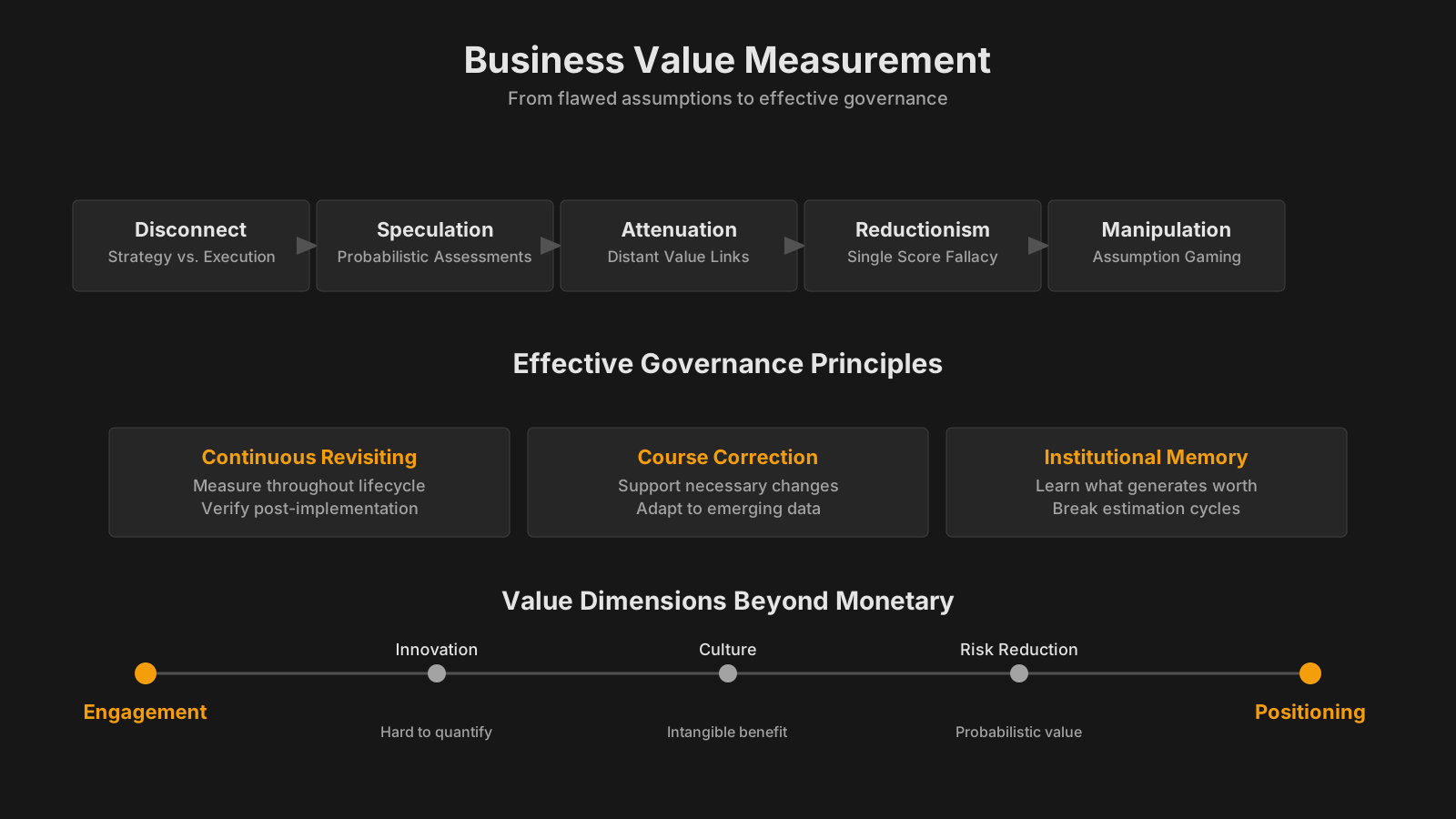
Business Value Measurements: Key Topics Summary
| Key Concept | Summary |
|---|---|
| Business Value Measurement | A structured blend of quantitative and qualitative techniques that trace project deliverables to the tangible and intangible gains an organization actually captures. |
| Value Discipline | This comprehensive practice converts project outcomes into business-aligned value statements, enabling governance and prioritization based on expected and realized benefits. |
| Governance Placement | This framing intentionally shifts value measurement beyond traditional accounting into the core governance architecture of project-centric enterprises. |
| Measurement Scope | Applied measurements cover both hard-dollar ROI and qualitative dimensions such as brand equity enhancement, compliance risk mitigation, and workforce capability advancement. |
| Financial Metrics | Net present value and related discounted cash flow metrics allow sponsors to evaluate wealth creation by comparing initial outlays against the present value of projected returns. |
| Early Indicators | Leading metrics including Net Promoter Score trends and market share movements provide early signals before definitive data from live user pilots validates the investment. |
| Scoring Models | Weighted scoring models embed strategic fit into portfolio decisions by requiring deliberate discussion of investments in intangible, future-oriented capabilities. |
| PMBOK Integration | Business value measurement threads through Initiating, Planning, Executing, and Monitoring & Controlling process groups, linking business case development to ongoing value forecasting. |
What Are Business Value Measurements?
The term encompasses the entire discipline of translating project results into business-relevant value statements so that decision-makers can prioritize, evaluate, and govern work based on expected and realized benefits. At its core, business value measurements in project management answer a simple but powerful question: is this initiative worth doing, and did it deliver what we thought it would? This definition deliberately pulls the concept away from narrow financial accounting and places it directly inside the governance fabric of project-driven organizations. In practice, these measurements span everything from hard-dollar return on investment to softer dimensions like brand equity, regulatory compliance risk reduction, and employee capability growth.
The foundation of any value measurement system is the recognition that organizations do not sponsor projects to produce deliverables; they sponsor them to trigger a chain of outcomes that eventually improve something the business cares about. A deliverable is a new CRM system. The outcome is a shorter sales cycle. The business value is the increased revenue and reduced cost of sale, though often proxies like Net Promoter Score shifts or market share movement serve as early indicators. Good measurement frameworks distinguish these layers so that teams are not rewarded simply for on-time feature deployment but for the actual behavioral or financial changes that follow.
Most mature project environments now view business value through multiple lenses simultaneously. Financial value remains central and includes metrics like Net Present Value, Internal Rate of Return, Payback Period, and Return on Invested Capital. Customer value captures satisfaction, retention, and acquisition cost improvements. Operational value focuses on process efficiency, cycle time reduction, and quality gains. Strategic value aligns the initiative with long-term goals such as entering a new market or reacting to a competitive threat. Each lens may require its own measurement scale, and one of the enduring challenges of the field is aggregating these disparate signals into a coherent go/no-go or continue/terminate decision.
When a project sponsor reviews a business case, what they are really looking at is a forecast of business value measurements grounded in assumptions about cost, time, risk, and market behavior. After delivery, those measurements become the yardstick for benefits realization tracking. The measurements themselves are not static; they evolve as a project moves from the idea stage through execution and into operations. Early estimates are often rough-order-of-magnitude judgements that get replaced by market-validated data once pilots or minimum viable products are in the hands of real users. This dynamic nature means that business value measurements are less like a single reading on a dashboard and more like a continual conversation among stakeholders about what “good” looks like as conditions change.
Dimensions of Business Value
Breaking business value into distinct dimensions helps prevent the common mistake of reducing everything to a single financial number. Financial value remains the language of the boardroom, and metrics like NPV let a sponsor compare an upfront investment against a stream of future cash flows discounted to today’s dollars — essentially asking whether the project generates more wealth than simply putting the money into a safe alternative investment. Internal Rate of Return distills that into a percentage return on the capital employed, which makes it easy to rank competing initiatives. Payback period, while cruder, appeals to risk-averse organizations that want to know how long their cash is exposed before the project breaks even.
Strategic value, on the other hand, is rarely captured by a discounted cash flow model. A regulatory compliance project may produce zero incremental revenue yet keep the company in business; its value is measured in risk avoidance and licence-to-operate continuity. Similarly, a brand repositioning effort might show up years later in pricing power and customer loyalty, well beyond the patience of a quarterly earnings cycle. Practitioners often use weighted scoring models to integrate strategic alignment into portfolio selection, forcing an explicit conversation about how much a leadership team is willing to invest in intangible future options.
Customer value introduces a different temporal signature. A new user onboarding flow that reduces time-to-first-value from three days to three hours can be measured in reduced support tickets and earlier revenue recognition, but also in sentiment scores and referral rates. The challenge here is that customer behavior changes slowly and can be masked by external factors like seasonality or competitor moves. Sophisticated programs layer leading indicators — such as trial-to-paid conversion rates — on top of lagging financial results to create an early warning system that confirms or refutes the original value hypothesis.
The Human Element in Value Measurement
Any measurement system is only as good as the honesty of the people feeding it. It is not rare to see business cases engineered to reach a predetermined threshold, with optimistic revenue projections and understated costs sandbagged until approval is secured. The discipline of business value measurements thus becomes partly a cultural effort: creating an environment where value assumptions are made explicit as testable hypotheses rather than fixed promises, and where deviations from plan trigger learning rather than blame. This shift is particularly visible in organizations that have adopted iterative delivery and evidence-based management, where early, incomplete value data is valued more highly than a perfectly polished but fact-free upfront projection.
Core Takeaways on Business Value
- Definition and core purpose
- Business value measurement converts project outputs into outcome-based value statements that equip decision-makers to prioritize investments, evaluate portfolio performance, and govern work through a common lens of expected versus realized benefits.
- Beyond narrow financial accounting
- This discipline encompasses not only hard dollar returns but also intangible drivers such as brand equity, reduced regulatory compliance risk, and growth in employee capabilities.
- Deliverables versus outcomes
- Organizations fund projects not for their deliverables but to set off a chain of outcomes that advance a business priority, so value measurement frameworks must incentivize behavioral or financial change rather than simply on-time feature delivery.
- Financial metrics and aggregation
- Financial value stays primary through metrics such as Net Present Value, Internal Rate of Return, Payback Period, and Return on Invested Capital, yet synthesizing these disparate indicators into a single, coherent investment decision continues to challenge portfolio governance.
Business Value Measurements Across the Portfolio, Program, and Project Layers
In a mature management system, value measurements operate at three distinct altitudes, each with its own cadence and decision context. At the portfolio level, the primary concern is selection and balancing: which mix of investments maximizes total strategic return given resource constraints? Portfolio business value measurement relies heavily on comparative metrics that allow apples-to-oranges comparisons — normalized ROI, strategic alignment scores, risk-adjusted value, and occasionally more advanced techniques like real options analysis. The goal is not pinpoint accuracy but robust relative ranking, so that the organization’s scarce capital and talent flow to the initiatives most likely to move the needle.
Descending to the program layer, the emphasis shifts from selection to orchestration and benefits realization. Here, business value measurements become the glue that holds multiple related projects together. A program manager is less interested in whether a single component project is on budget than in whether the combined outcomes of all components are tracking toward the promised step-change in capability. Common practice includes maintaining a benefits dependency map that traces how each project’s outputs contribute to intermediate business changes and finally to end benefits, then attaching quantifiable value targets to those end benefits. When a program governance board reviews status, it is not looking at percent-complete against a task plan; it is interrogating whether the latest benefit forecast still justifies continuation, given any emerging dis-benefits or external shifts.
At the individual project level, business value measurements appear most tangibly in the business case and in the acceptance criteria that define what “done” means from a value perspective. For a predictive project, the initial business case sets the value baseline, and the benefits management plan outlines how post-project measurements will be collected. Many organizations make the mistake of treating the business case as a one-time entry ticket. Effective project managers, however, treat it as a living artifact, revisiting key value ratios at phase gates to confirm that the original logic still holds. If a project was approved on the basis of a 20% IRR but market data now suggests 12%, the sponsor should have the opportunity to redirect or kill the initiative before more good money chases a deteriorating return.
Governance and Decision Gates
Governance bodies use value measurements to enforce discipline across the entire lifecycle. At each stage gate, the project team must demonstrate not only that deliverables are on track but that the business value forecast remains credible. A common framework is the “kill point” review, where the default decision is termination unless the team can show fresh evidence that the hypothesized benefits are still attainable. This flips the typical psychology: instead of projects drifting forward on historical momentum, the burden of proof shifts to value advocates. It is a practice borrowed from venture capital portfolio management, adapted to internal corporate projects.
In terms of PMBOK’s Process Groups, business value measurements thread through Initiating (business case development and project charter), Planning (benefits management plan, value-linked scope definition), Executing (delivering the outputs that enable benefits), and Monitoring and Controlling (tracking benefit metrics and forecasting value at completion). The PMBOK Guide’s evolution from the sixth to the seventh edition elevated value delivery from a single knowledge area to a foundational principle, explicitly advising project managers to maintain focus on value rather than merely conforming to a plan. This represents a meaningful cultural shift in the profession.
Business Value Measurements in Agile and Hybrid Environments
Agile frameworks approach business value measurement with a different rhythm and set of artifacts. Instead of a single upfront forecast locked in a business case, value is surfaced continuously through backlog prioritization and frequent stakeholder feedback. Agile business value measurement often relies on relative estimation of business value points assigned by the product owner or a value board. Each backlog item is given a value score that reflects its expected contribution to customer satisfaction, revenue growth, or risk reduction, separate from its implementation effort. The product owner then sequences work to maximize value delivery per sprint or iteration, a concept captured in the popular “cost of delay divided by duration” prioritization heuristic.
Measuring realized value in Agile settings is equally iterative. Teams track usage analytics, customer satisfaction surveys, A/B test results, and business outcome metrics sprint-over-sprint, allowing rapid reprioritization when hypotheses are disproven. A feature may have been estimated with high business value points at the start of a quarter, but if early telemetry shows negligible user adoption, the remaining planned enhancements are dropped in favor of other work. This dynamic adjustment is both the strength and the Achilles’ heel of Agile value measurement: it avoids large-scale sunk-cost fallacies but can also create an incentive to chase short-term, easily measurable metrics at the expense of longer-term, harder-to-quantify strategic bets.
Hybrid environments create tension between the governance cadence of traditional stage-gate processes and the rapid feedback loops of Agile delivery. One practical resolution is the two-tier measurement model: strategic value hypotheses are validated at periodic governance reviews using financial and market data, while tactical value indicators (such as feature adoption rates or task completion times) are tracked during each sprint review. The two cycles inform each other — a failing tactical indicator might trigger an early strategic review without waiting for the next scheduled gate. This integration of measurement cadences is where many large organizations struggle, yet it is essential for scaling Agile without losing the discipline of enterprise-level portfolio management.
Key Takeaways on Agile Value Metrics
- Continuous value discovery
- Agile replaces the one-time business case with continuous value discovery, using frequent stakeholder feedback and backlog reprioritization to ensure the highest-value features are delivered at each iteration.
- Value points and prioritization heuristics
- Product owners assign business value scores to backlog items independently of development effort, then sequence work using heuristics such as weighted shortest job first, which divides cost of delay by duration, to maximize delivered value per iteration.
- Two-tier governance model
- To reconcile stage-gate governance with Agile speed, hybrid environments validate strategic value hypotheses at periodic governance reviews while tracking tactical indicators like adoption rates and usage patterns during sprint reviews.
Frameworks and Standards: PMBOK, PRINCE2, and BVOP Perspectives
Within the PMBOK Guide, business value measurements live primarily in the domains of integration management, business case development, and benefits management. The seventh edition’s Value Delivery System places projects within a larger value chain that includes portfolios, programs, operations, and strategic planning, making value measurement an enterprise-wide concern rather than the project manager’s afterthought. PMBOK value delivery principles now explicitly call for stakeholder collaboration to define and refine value throughout the project, and for tailoring processes based on the value context. This represents a maturation beyond the process-centric view of earlier editions.
PRINCE2 handles the concept through its Business Case theme, which mandates continued business justification. The business case is not approved once and forgotten; it is updated and verified at every project board review. PRINCE2’s emphasis on a clear separation between outputs, outcomes, and benefits aligns naturally with the layered view of business value measurements. The Senior User role carries primary accountability for specifying and realizing benefits, ensuring that the voice of the customer and end user is embedded in value decisions. In practice, this often means that the business case includes a detailed benefits measurement plan specifying who will measure what, when, and with which data sources, along with tolerances for acceptable deviation.
The BVOP methodology extends business value measurements into areas that traditional frameworks sometimes treat as peripheral. It explicitly includes non-financial program benefits such as employee engagement improvements and future risk reduction, recognizing that capability built today may serve unforeseen future needs. BVOP also tracks Business Value Points as a dynamic indicator during monitoring and controlling, where a consistent decline may trigger a review for possible project closure. Additionally, program realization sets in BVOP allow different component projects to choose their own delivery methodologies, so the value measurement approach must accommodate mixed predictive and Agile workstreams under a single benefits umbrella. This flexibility mirrors the reality of many large organizations where no single methodology covers the entire portfolio.
Common Challenges, Pitfalls, and Misconceptions
The most persistent challenge in business value measurement is quantifying intangible benefits. A training program that improves leadership capability clearly has value, but attaching a precise dollar figure to it often requires heroic assumptions that strain credibility. Organizations sometimes respond by excluding soft benefits entirely, which biases the portfolio toward easily measurable cost-cutting initiatives and away from innovation and culture-building work. Challenges of measuring business value frequently arise when measurement systems become so rigid that they incentivize the wrong behavior — teams optimize for the metric rather than for genuine stakeholder value, a phenomenon well-known in the world of key performance indicators.
Another common pitfall is confusing project outputs with business outcomes. Delivering a fully functional reporting dashboard is an output; enabling faster executive decision-making that reduces inventory holding costs is an outcome. Many project closure reports proudly declare success because scope was delivered on time and on budget, while the promised value remains unverified six months later. This output-outcome gap is one of the reasons benefits realization management has become its own discipline, separate from project execution. Organizations that close projects without funding the measurement period that follows inevitably lose the thread that connects investment to impact.
Optimism bias and strategic misrepresentation add a behavioral layer to the problem. The business case for a large strategic project is rarely a coldly rational document; it is a sales tool aimed at achieving funding approval. Even when no deliberate manipulation occurs, cognitive biases push teams toward overestimating revenue uplifts and underestimating integration complexity. Countermeasures include independent assurance reviews, reference-class forecasting that compares proposed projects with historical results from similar initiatives, and a formal requirement to track and report on the variance between forecast and actual value at every major review. These disciplines shift the conversation from “how good can this project be?” to “how much should we reasonably expect it to be worth?”
Misconceptions also surround the use of earned value management. EVM provides cost and schedule variance data that serves as an early warning system for execution health, but it says nothing about whether the resulting deliverables will generate business value. A project can have a perfect cost performance index and still be a complete commercial failure if market assumptions were wrong. Confusing EVM metrics with business value measurements is a dangerous category error that leads to celebrating on-time delivery of a white elephant. The two measurement families are complementary but operate on different planes — one on project production efficiency, the other on post-project economic and strategic worth.
Key Takeaways on Measurement Pitfalls
- Intangible benefits resist precise valuation
- Attempting to quantify intangible benefits such as leadership development forces reliance on assumptions that erode credibility, leading many organizations to sidestep measurement and disregard these gains entirely.
- Excluding soft benefits distorts portfolios
- Omitting intangible gains from evaluations biases investment portfolios toward simple cost-cutting projects while starving the innovation and culture-building initiatives that sustain long-term competitiveness.
- Rigid metrics drive metric gaming
- Overly rigid measurement frameworks incent teams to chase the indicator itself rather than the underlying stakeholder value, producing distorted results that mask real deterioration.
- Outputs are mistaken for outcomes
- Delivering a reporting dashboard is merely an output; the real outcome is enabling faster decisions that reduce inventory costs, yet project closure reports frequently declare success based narrowly on scope, schedule, and budget fulfillment.
- Business cases hide cognitive bias
- Strategic business cases function as funding sales tools that systematically overestimate revenue potential and underestimate integration complexity, making independent assurance reviews and reference-class forecasting essential countermeasures.
Relationships with Other Project Management Concepts
Business value measurements sit at the intersection of several core project management disciplines. They are the logical companion to benefits management, which provides the governance framework for defining, tracking, and sustaining benefits after the project closes. The business case acts as the initial repository of value hypotheses, while the project charter authorizes the expenditure of resources in pursuit of those hypotheses. As the project moves through its lifecycle, the scope statement and work breakdown structure should be traceable back to specific value drivers so that any proposed scope change can be evaluated against its impact on expected benefits. Business value vs earned value is a distinction that every project manager must internalize: the former measures why we do the project, the latter measures how efficiently we are executing it.
Risk management also intertwines with value measurement. Every value estimate is a probability distribution, not a point forecast. Robust business cases include sensitivity analysis and risk-adjusted value calculations that show how the investment case holds up under different scenarios. The concept of value at risk, borrowed from financial portfolio management, is increasingly used to describe the potential downside of a project’s benefit stream. Program managers must aggregate risk-adjusted value across interdependent projects, recognizing that a critical component project slipping can erode the value of an entire program even if the remaining components execute flawlessly.
In portfolio management, business value measurements are the primary input to prioritization and capacity allocation. When resources are finite, value scores relative to cost and risk determine which projects get funded and which sit in the parking lot. This is where normalized value metrics like the benefit-cost ratio or the strategic contribution index become indispensable. The portfolio management team must also watch for correlation among value streams — several projects might each promise increased sales in the same customer segment, and summing their individual forecasts would double-count the same revenue pool. Sophisticated portfolio offices use dependency and overlap analysis to produce an enterprise value picture that is more than a simple addition of project-level promises.
Evolution and Current Thinking
The way organizations measure business value has evolved from a narrow financial accounting exercise into a multidimensional, continuous practice. The balanced scorecard movement of the 1990s first gave serious intellectual backing to the idea that financial results are lagging indicators, and that customer, internal process, and learning perspectives must be tracked together to predict long-term value. Today’s emphasis on OKRs — objectives and key results — further democratizes value measurement, pushing it out of the PMO and into cross-functional teams who define their own value targets linked to strategic themes. Evolution of business value measurement now sees increasing adoption of outcome-based funding models, where investment allocations are released in tranches conditional on demonstrated value milestones rather than on completion of prescribed deliverables.
Another visible shift is the integration of value stream mapping into project and portfolio decisions. Originating in lean manufacturing, value stream thinking forces an end-to-end view of how customer value flows through an organization’s processes, highlighting delays and waste that traditional project metrics ignore. This has led to the rise of value stream management platforms that tie feature delivery to business impact analytics, giving teams a real-time display of whether what they shipped actually moved the needle. The underlying philosophy is that value measurements should be as close to the work as possible, not locked away in a quarterly CFO review deck.
Debate continues about the right balance between precision and pragmatism. Some argue that the quest for ever more accurate value forecasts is a fool’s errand in complex environments, and that organizations should instead embrace option-based thinking: fund small experiments, measure cheaply, and scale only when value signals are strong. Others maintain that without rigorous, auditable value baselines, project selection becomes a political beauty contest. Both views contain truth, and the art of modern project management lies in blending structured value governance with adaptive feedback that allows for genuine learning and mid-course correction.
What is becoming non-negotiable is the expectation that project professionals can speak the language of business value fluently. Whether working inside a traditional stage-gate regime or a fast-moving Agile team, the ability to articulate what “better” looks like in terms stakeholders genuinely care about — and to quantify progress toward that better state — is moving from a specialized finance skill to a core competency for anyone who leads projects. As organizations continue to treat every project dollar as a scarce investment, the quality of business value measurements will increasingly determine whose initiatives get funded, who gets promoted, and which strategic ambitions ever leave the planning room.
Key Insights on Value Evolution
- From accounting to multidimensional practice
- Business value measurement has evolved from a narrow financial accounting exercise into a continuous discipline that integrates customer, process, and learning perspectives with financial results.
- Balanced scorecard as catalyst
- The balanced scorecard movement of the 1990s established that financial results are lagging indicators, and it demonstrated that multiple perspectives must be monitored together to forecast long-term value creation.
- OKRs push value measurement down
- Objectives and key results decentralize value measurement by shifting target definition from the PMO to cross-functional teams aligned with strategic themes.
- Outcome-based funding gains ground
- Outcome-based funding models release investment in increments, only after verified value milestones are achieved, not upon completion of prescribed deliverables.
- Value stream thinking exposes waste
- Derived from lean manufacturing, value stream management platforms connect feature delivery to real-time business impact analytics, revealing delays and flow inefficiencies that conventional project metrics miss.