Avoidance of threats is a deliberate risk response strategy in project management that eliminates a risk by removing its source, altering the project plan, or declining to proceed with the activity that gives rise to it. Unlike mitigation or transfer, avoidance does not aim to reduce the probability or impact of a risk event — it ensures that the risk cannot materialize at all. Within the Project Management Body of Knowledge (PMBOK Guide), avoidance is classified as one of the four primary strategies for negative risks, or threats, and it is applied when the risk exposure exceeds the organization’s appetite or tolerance, or when alternative approaches present a more favorable outcome. The term itself derives from general risk management literature, where hazard removal is the most decisive form of control, and it carries a specific connotation in the project environment: avoidance is not about indecision or passivity, but about proactive choice to redirect effort away from conditions that could jeopardize objectives. This strategy often surfaces at the planning stage, but it may also be invoked during execution when emergent risks threaten viability. In practice, the decision to avoid a threat carries real trade-offs — schedule shifts, scope reductions, increased cost, or even project cancellation — which is why seasoned practitioners treat it as a high-caliber tool rather than a routine default.
Key Topics in Threat Avoidance Summary
| Key Concept | Summary |
|---|---|
| Threat Avoidance | In PMBOK, avoidance is a primary negative risk strategy, chosen when the threat exposure exceeds organizational tolerance or alternative actions promise a more favorable outcome. |
| Proactive Choice | Avoidance is an intentional decision to redirect project effort away from conditions that jeopardize objectives, not a passive or indecisive reaction. |
| Trade Offs | Opting for avoidance may trigger schedule shifts, scope reductions, higher costs, or project cancellation, so practitioners weigh it as a high-stakes instrument rather than a default measure. |
| Actions | Concrete actions include modifying the technical approach, extending the schedule to bypass seasonal hazards, engaging a proven vendor, or excluding a high-risk deliverable from scope. |
| Frameworks | PMBOK classifies avoidance as an eliminate strategy; PRINCE2 treats it as the response selected when the cost of alternative responses outweighs the anticipated benefit. |
| Agile Practices | In Agile contexts, avoidance manifests as backlog pruning, spike-driven investigations that abandon risky directions, and reprioritization of features to circumvent uncertain dependencies. |
| Risk Threshold | When schedule slippage exceeds the defined risk threshold, the team must decide whether to remove the module, substitute a commercial off-the-shelf component, or defer the work to a later phase. |
| Cross-Industry | Fail-safe design principles and abandonment of unsound architectural decisions demonstrate that avoidance is the rational response when potential loss is existential. |
What Is Avoidance of Threats in Project Management?
The definition of threat avoidance centers on the complete removal of risk exposure from the project. Avoidance of threats in project management entails actions such as altering the technical approach, extending the timeline to bypass a seasonal hazard, selecting a proven vendor instead of an unproven one, or explicitly excluding a high-risk deliverable from the scope statement. The underlying logic is binary: if a risk cannot be tolerated or adequately controlled, the only acceptable course is to ensure it never enters the realm of possibility. This distinguishes avoidance from more graduated responses like mitigation, which lowers probability or impact but accepts some residual risk. Frameworks like PMBOK describe avoidance as an "eliminate" strategy, while PRINCE2 refers to "avoid" as one of the responses to a threat in its risk management procedure, emphasizing that it must be chosen when the cost of other responses outweighs the benefit. In Agile environments, the concept translates into backlog pruning, spike-driven investigations that result in abandoning a risky technical direction, or re-prioritizing features to bypass dependencies that carry unacceptable uncertainty.
The way a team actually decides to avoid a threat reveals the practical weight of the term. A project manager might, during quantitative risk analysis, discover that a particular module integration carries a 40% chance of causing a three-week delay with severe cost overrun. If the organization’s risk threshold for schedule slippage is two weeks, the analysis triggers a frank discussion: can the module be removed entirely, replaced with a commercial off-the-shelf component, or postponed to a later phase? Avoiding the threat is not a theoretical exercise; it becomes a negotiation with stakeholders about what the project will no longer attempt to accomplish. This is why threat avoidance often appears in the risk register as a “change request” rather than a simple plan update — it reshapes the project’s boundaries.
Origins and Cross-Industry Foundations
Risk avoidance as a concept did not originate in project management alone. Its intellectual roots reach into safety-critical industries where failure is catastrophic. In aviation, design engineers avoid known failure modes by excluding components that cannot be made redundantly reliable. In pharmaceutical manufacturing, a process step might be entirely eliminated if contamination risks cannot be validated out, a decision formalized through quality risk management guidelines like ICH Q9. Military planning has long recognized that the best way to survive an ambush is not to enter the kill zone — a form of avoidance through route selection. Software engineering adopted similar logic with the principle of “fail-safe” design and, in extreme cases, complete abandonment of an architectural choice when security reviews reveal unresolvable vulnerabilities. These cross-industry parallels established a cognitive model that project management later codified: when the potential loss is existential, avoidance is the most rational response, even if it means sacrificing a desirable but dangerous objective. This lineage gives avoidance its authoritative weight and explains why, in project governance, it is seldom challenged solely on grounds of lost opportunity without a rigorous analysis of what the organization stands to preserve.
Key Components and Characteristics of Threat Avoidance
Every instance of threat avoidance in a project setting can be broken down into a few essential components. The first is risk identification and quantification — without a clear understanding of the risk’s drivers, probability, and impact, avoidance cannot be justified. The second is alternative generation: the project team must develop a credible option that eliminates the exposure, whether that means a different technology, a new procurement route, or descoping a feature. The third component is impact assessment, which examines what new risks or constraints the chosen alternative introduces. Removing a hazardous excavation from the construction plan might avoid a safety risk but could force a longer, costlier elevated structure; that trade-off must be explicit. The fourth component is formal approval, because avoidance decisions frequently change the project charter, scope baseline, or critical path and therefore require sponsor engagement. Finally, documentation in the risk register closes the loop, recording the avoided risk alongside the rationale, so that future audits and lessons learned exercises capture why a particular path was abandoned. When any of these components is missing, avoidance becomes a gut-feel retreat rather than a managed risk response, which often leads to later accusations of over-caution or scope creep by other means.
Core Insights on Threat Avoidance
- Binary elimination strategy
- Avoidance eliminates a threat entirely rather than only reducing its probability or impact, setting it apart from graduated responses like mitigation that tolerate residual risk.
- Framework terminology for avoidance
- PMBOK classifies avoidance as an "eliminate" strategy while PRINCE2 uses "avoid"; both frameworks recommend its selection when the cost of alternative responses exceeds their benefits.
- Agile avoidance tactics
- In Agile environments, threat avoidance manifests as backlog pruning, spike-driven investigations that discard risky technical directions, and feature reprioritization to bypass uncertain dependencies.
- Quantitative risk analysis trigger
- When quantitative analysis reveals a threat such as a 40% chance of a three-week delay that exceeds a two-week threshold, the project manager responds by removing, replacing, or postponing the risky element.
- Cross-industry existential risk logic
- Industries as diverse as pharmaceutical manufacturing and software engineering share a common logic: when potential loss is existential, complete avoidance is the rational choice, even if it means sacrificing a desirable objective.
Frameworks and Standards Governing Threat Avoidance
Different project management methodologies treat avoidance with varying degrees of granularity, but they converge on its status as a legitimate, formal risk response. Avoidance of threats PMBOK positioning is unequivocal: it appears within the Plan Risk Responses process of the Risk Management Knowledge Area, and its execution often feeds directly into Integrated Change Control. PMBOK notes that avoidance may involve changes to the project management plan, such as modifying the schedule, scope, or approach, and that it is most suitable for high-priority risks with severe consequences. The framework does not prescribe how to avoid; it simply demands that the chosen strategy be documented, approved, and revisited during risk reassessments. In the risk register, an avoided threat should carry a residual probability of zero — though experienced project managers always verify that zero is genuine, not aspirational.
PRINCE2 and the Avoid Response
PRINCE2’s risk management procedure includes “avoid” as a key response category for threats, alongside reduce, fallback, transfer, share, and accept. The PRINCE2 approach is notable for its emphasis on the risk budget and the continuous assessment of whether the cost of avoidance exceeds the risk’s expected monetary value. A project board in a PRINCE2 environment might reject a proposed avoidance if the alternative’s cost is disproportionate, pushing the team back toward reduction or transfer. The method also ties avoidance to the Business Case — if a threat’s avoidance fundamentally weakens the justification for the project, the board might instead choose to stop the entire initiative, which PRINCE2 treats as a legitimate risk response in its own right. This connectivity between risk response and business viability reflects a mature recognition that avoiding one threat can create a strategic risk, and that such decisions belong at the governance level, not just within the project management team.
Agile and Adaptive Approaches to Avoidance
Agile frameworks rarely use the term “avoidance” explicitly, but the behavior is embedded in their iterative cadence. When a sprint planning session identifies a story fraught with unknown integration risks, a Scrum team might spike it — a time-boxed investigation — and, upon learning enough, decide that the feature carries an unacceptable level of uncertainty. The product owner then removes it from the backlog, effectively avoiding the threat. Avoidance of threats in agile projects often manifests as the disciplined act of not building something, which contrasts sharply with the predictive habit of locking scope early. Kanban teams might avoid threats by limiting work in progress on a particular class of service, preventing the accumulation of technical debt that creates downstream quality risks. Hybrid environments that blend predictive and adaptive practices see avoidance in the form of scope guardrails: a risk-adjusted backlog where items above a certain expected loss threshold are never selected for commitment. The agile advantage is speed — because the learning loop is short, the cost of avoiding a threat is often just the cost of the spike, rather than the cost of re-planning a fully baselined project.
The Practical Application of Avoidance in Real Projects
Avoidance enters the project lifecycle most naturally during planning, after risks have been identified and analyzed, but well before execution commits resources to a hazardous path. Practical application of threat avoidance typically starts with a workshop where the project manager, key team members, and a sponsor review the top-tier threats from the risk register. A typical scenario involves a software development project that originally planned to use a new, cutting-edge database technology. The risk analysis reveals a high probability of data corruption under load, with an impact that could force a complete rewrite. The avoidance response is straightforward: replace the database with a mature alternative, even if that means sacrificing some performance goals. That decision will be documented in the risk register, the technical specification will be updated, and the schedule might shift due to retooling. The project continues, but without the existential threat.
Another common scenario arises in construction or event management, where weather-sensitive activities are simply removed from the critical path by rescheduling them into a season with stable conditions, or by moving the work indoors. The project does not mitigate weather risk with contingency buffer; it avoids it by altering the physical parameters of the work. This demands early design decisions, and sometimes it pushes the project start date or increases venue costs, but the net exposure to a show-stopping storm drops to zero. Practitioners observe that avoidance decisions are often less controversial when they are framed in terms of survival rather than optimization. When a team says “this could kill the project,” stakeholder resistance to the associated trade-offs tends to soften. That dynamic is worth understanding: avoidance is a persuasive tool when justification is rooted in existential project risk rather than mere inconvenience.
Avoidance in Practice: Core Insights
- Planning-stage risk intervention
- The planning stage is where avoidance is most effective: it interrupts a trajectory after risk identification and assessment, preventing irreversible allocation of resources to a dangerous path.
- Replacing risky technology choices
- A software team eliminates data corruption risks by replacing an unproven, bleeding-edge database with a mature, battle-tested solution, consciously trading some performance gains for assured stability.
- Eliminating weather-based uncertainty
- By rescheduling outdoor work to predictable weather windows or moving operations indoors, project teams fully eliminate storm exposure, absorbing additional costs in exchange for guaranteed schedule certainty.
Common Challenges, Pitfalls, and Misconceptions
One of the most persistent misconceptions is that risk avoidance is synonymous with risk aversion or a lack of courage. Avoidance of threats misconception confusion often stems from the broader cultural use of “avoidance” as a pejorative, implying procrastination or fear-based decision-making. In professional project management, however, avoidance is a calculated, documented strategy that flows from analysis, not emotion. A project manager who chooses to avoid a threat is not “afraid” of the risk; they have determined that the expected cost of absorbing it exceeds the value of the opportunity. This confusion can lead to organizational friction, particularly in entrepreneurial cultures that valorize risk-taking. The resulting pressure to “just manage it” can push teams into mitigation when avoidance is the superior technical choice, leading to late-stage failures that were entirely foreseeable.
Another challenge lies in the incomplete removal of the threat. A project might switch from an unproven supplier to a well-known one, believing the supply risk is avoided, only to discover that the new supplier depends on the same raw material source in a politically unstable region. The threat was relocated, not eliminated. This points to the need for rigorous verification: when the risk register shows a zero probability after avoidance, someone must test that assumption. A common pitfall is that avoidance decisions create undocumented secondary risks. By avoiding a high-risk integration, the project might inadvertently introduce a performance bottleneck that later requires expensive rework. Unless those secondary risks are explicitly identified and analyzed, the avoidance can appear to have failed, when in fact it succeeded against the original threat but lacked proper follow-through.
The political dimension also deserves mention. Avoidance that removes a stakeholder’s pet feature, a favored vendor, or a personally championed technology can invite resistance that masquerades as technical objection. Experienced program managers learn to navigate this by separating the risk discussion from the feature discussion, insisting on a probabilistic analysis before the emotional case is heard. When that fails, governance boards sometimes choose to accept the risk despite the project team’s recommendation, which is their prerogative but shifts accountability accordingly. Avoidance is seldom just a technical decision; it is a negotiation with human interests that complicates the clean theoretical model.
Relationship to Other Risk Responses and Concepts
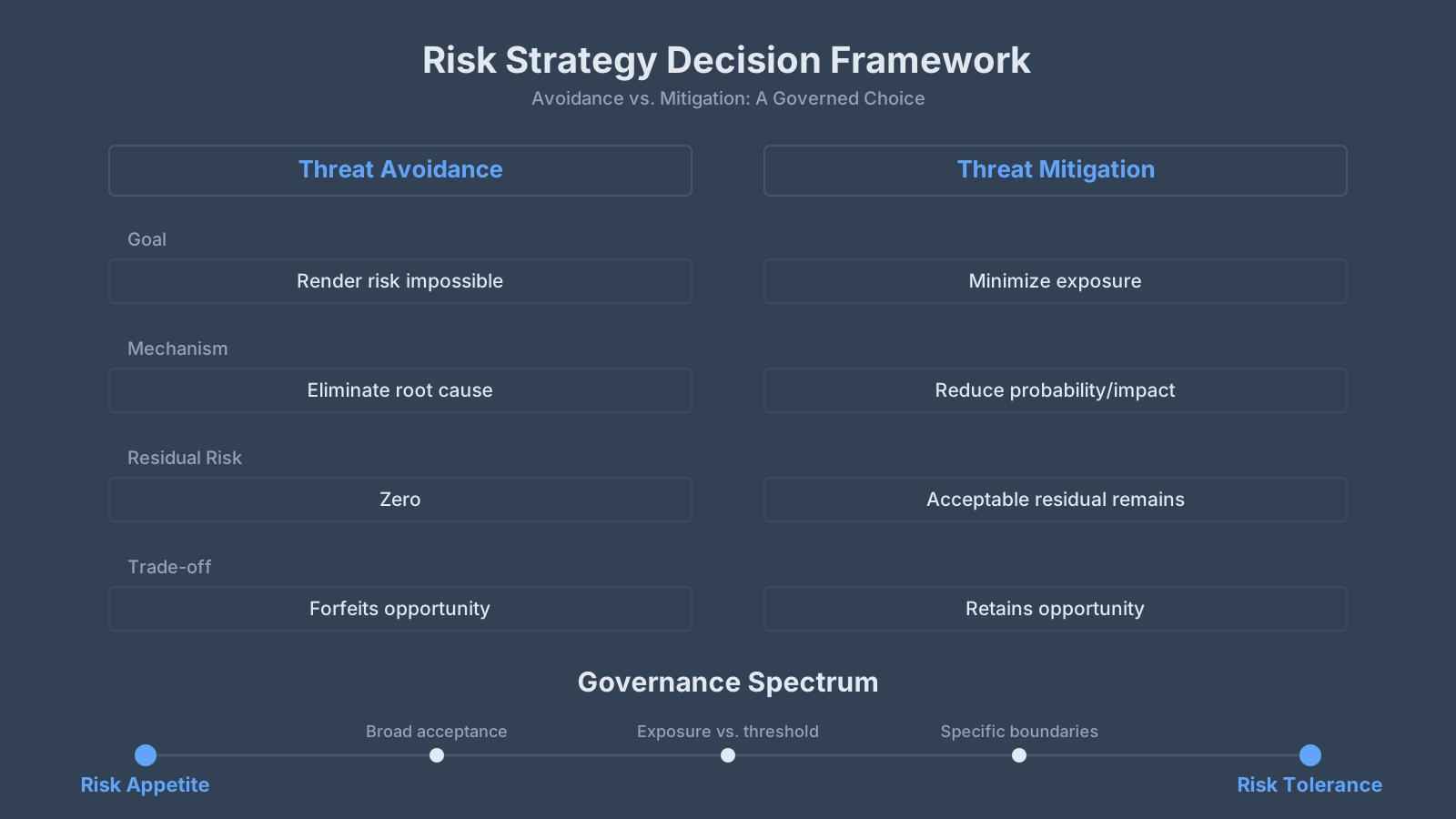
Avoidance stands in clear contrast to mitigation, transfer, and acceptance. Avoidance of threats vs mitigation is a distinction that even seasoned professionals sometimes blur: mitigation reduces probability or impact, leaving residual risk; avoidance removes the risk entirely by eliminating its cause. Transfer shifts the financial consequence to a third party, often through insurance or contractual indemnities, but does not remove the risk from the project’s purview — a transferred risk still disrupts the project, even if someone else pays. Acceptance means acknowledging the risk and choosing to deal with it if it occurs, which is only appropriate when the exposure is within organizational thresholds. Avoidance is the most aggressive of these strategies and the one most likely to change the project’s shape. In the risk hierarchy of controls, which originated in occupational safety, elimination sits at the top as the most effective control, and this maps directly onto project risk thinking: avoidance is the project equivalent of elimination, while mitigation equates to engineering or administrative controls, and transfer resembles insurance.
The relationship with contingency planning is also worth clarifying. A project that has avoided a threat does not need a contingency plan for that threat — there is nothing to fall back on because the risk no longer exists. However, a common error is to lapse into thinking that avoidance means no planning is needed at all. The avoidance itself may create new risks that require their own responses, including contingency plans. Thus the risk register does not shrink but evolves. Avoidance also interacts with opportunity management. In portfolio management, the decision to avoid a threat in one project may involve reallocating resources to another initiative that carries a higher risk profile. The net effect on the portfolio’s risk balance must be evaluated, connecting threat avoidance upstream to strategic risk appetite. This is where program and portfolio managers add value, ensuring that individual project-level avoidance does not inadvertently starve the portfolio of the very innovation the organization seeks.
Core Insights on Avoidance and Alternatives
- Avoidance eliminates, mitigation reduces
- Mitigation lowers the probability or impact of a threat but always leaves residual risk, while avoidance removes the risk entirely by addressing its fundamental cause.
- Transfer shifts cost, not risk
- Transferring risk through insurance or indemnities shifts the financial burden but does not prevent the risk from disrupting the project; acceptance is only valid when the exposure stays within the organization's tolerance thresholds.
- Avoidance needs portfolio oversight
- Avoiding a threat in one project may free resources for higher-risk, higher-reward initiatives, so program and portfolio managers must verify that this decision does not inadvertently suppress innovation critical to strategic objectives.
Evolution and Current Thinking in Risk Avoidance Practice
The understanding of threat avoidance has matured from a binary “do or don’t” toward a more nuanced view that integrates decision analysis and behavioral economics. Evolution of threat avoidance in project management now acknowledges that human cognitive biases — particularly loss aversion and the sunk cost fallacy — make avoidance difficult to execute in practice. A team that has already invested months in a design is cognitively committed to making it work, and the suggestion to avoid the risk by starting over faces irrational resistance. Current best practices address this by requiring independent risk reviewers at major phase gates, people who are not emotionally attached to the sunk cost. The growing adoption of quantitative risk modeling, including Monte Carlo simulations that express risk in terms of schedule and cost overrun likelihood, has made the case for avoidance more compelling to sponsors who respond to numbers rather than qualitative descriptions.
Another evolution concerns the timing of avoidance. Traditional PMBOK-structured thinking places risk response planning after risk analysis, which implicitly occurs during the planning process group. But in fast-moving environments, waiting until a formal planning phase may be too late. Progressive organizations now embed risk avoidance triggers in their continuous monitoring practices, allowing teams to declare a threat as “to be avoided” at any point in the lifecycle. This aligns with the PRINCE2 principle of continuing business justification and with the Agile emphasis on inspect and adapt. The BVOP methodology’s treatment of risk management reinforces this trend by requiring separate product risk management with quantified loss size units and dynamic filtering, making it possible to track when a product-level risk reaches an avoidance threshold based on predefined criteria rather than ad hoc judgment. BVOP’s use of categorized root-cause analysis for defects also supports avoidance by ensuring that systemic causes — not just symptoms — are excised from future increments. This granular, quantified approach shifts avoidance from an art to a repeatable discipline, provided the organization invests in the measurement infrastructure.
Debate persists around whether avoidance should ever be applied to risks below a certain threshold. Some portfolio managers argue that avoidance is overkill for low-severity risks and that it drains resources better spent exploiting opportunities. Others counter that any risk, regardless of magnitude, should be avoided if it can be done at negligible cost. The consensus in large-scale programs is that avoidance is a strategic tool, not a tactical one, and that its application should be reserved for risks that genuinely threaten the project’s critical success factors. The growing influence of sustainability and social responsibility considerations also expands the avoidance conversation: a project may now avoid a threat not because of financial impact, but because it poses an unacceptable reputational or environmental risk that the organization is unwilling to bear even at a low probability. This ethical dimension is likely to grow, making threat avoidance an increasingly important capability in the project management repertoire.