Critical thinking in project management refers to the disciplined, evidence-based reasoning that project professionals use to interpret information, evaluate assumptions, and make sound judgments under uncertainty. It is not a single process or tool, but a foundational cognitive skill that crosses every knowledge area, process group, and delivery approach. In portfolio, program, and project contexts, critical thinking shapes how managers assess risks, interrogate estimates, challenge stakeholder claims, and decide among competing priorities. The term appears less often as a formal technique in standards than as an enabling competence, yet its influence on forecasting, scope definition, quality review, and benefit realization is difficult to overstate.
A useful way to understand critical thinking in this field is to contrast it with merely collecting data or following procedures. Many project failures are not caused by missing information, but by weak interpretation of the information that exists. A project manager might possess a detailed risk register, a robust schedule, and weekly status reports, yet still fail to notice that optimism bias is inflating progress or that a key stakeholder’s silence indicates hidden resistance. Critical thinking is the mental discipline that turns raw project data into meaningful insight, and it operates continuously rather than at a single lifecycle stage.
Critical Thinking: Key Topics Summary
| Key Concept | Summary |
|---|---|
| Role | Critical thinking enables managers to evaluate risk exposure, scrutinize cost and schedule estimates, test stakeholder assertions, and set priorities among competing demands across portfolio, program, and project environments. |
| Enabling Competence | Although critical thinking is rarely codified as a formal technique in project management standards, it functions as an enabling competence with measurable influence on forecast reliability, scope definition, quality review, and benefit realization. |
| Definition | In project management literature, critical thinking is defined as the intellectually disciplined practice of actively conceptualizing, applying, analyzing, synthesizing, and evaluating information gathered through observation, experience, reflection, reasoning, or communication. |
| Questioning Mindset | Unlike routine operational thinking, critical thinking requires managers to interrogate the source and reliability of information, test the logical chain from evidence to conclusions, and remain willing to revise their judgment when new evidence emerges. |
| Practical Example | This mindset becomes visible when a project team rigorously tests whether a deliverable satisfies acceptance criteria, or when a sponsor reassesses the validity of a business case following a material market shift. |
| Origins | Critical thinking traces its intellectual foundations to Socratic questioning and to John Dewey's educational philosophy, which linked reflective thought directly to practical problem solving. |
| Alternative Names | Project management describes this skill under several related terms, including analytical thinking, reflective judgment, and evidence-based decision making, but has not converged on a single formal framework. |
| Impact | Critical thinking enables professionals to distinguish product risk from process risk, quantify potential losses in measurable units, and recognize when a sustained decline in Business Value Points indicates that stopping an initiative may be more prudent than additional investment. |
What Is Critical Thinking in Project Management?
In the project management literature, critical thinking in project management is defined as the intellectually disciplined process of actively and skillfully conceptualizing, applying, analyzing, synthesizing, and evaluating information gathered from observation, experience, reflection, reasoning, or communication. This definition, adapted from broader educational research, fits project work because it captures the iterative nature of deciding under uncertainty. Unlike routine operational thinking, critical thinking in projects requires the manager to question the origin and quality of information, examine the logic connecting evidence to conclusions, and remain open to revising a judgment when new facts emerge.
Core Meaning and Context
At its core, critical thinking is about the quality of reasoning. In a project setting, this quality shows up when a team debates whether a deliverable truly meets acceptance criteria, or when a sponsor challenges whether a business case still holds after a market shift. The reasoning includes identifying assumptions, distinguishing facts from interpretations, recognizing logical fallacies, and weighing evidence from multiple sources. A project manager applying critical thinking does not accept a status report at face value. Instead, they ask whether the metrics reflect reality, whether the variances are explained, and whether the corrective actions address the root cause or only the symptom.
Critical thinking also has a reflective dimension. It involves monitoring one's own thought process, recognizing personal biases, and acknowledging gaps in knowledge. That self-regulation separates critical thinking from raw intelligence or domain expertise. A highly experienced technical lead can be brilliant in a narrow specialty and still reason poorly about a commercial trade-off because of overconfidence. The project manager’s critical thinking role often involves creating conditions where such overconfidence is examined without turning technical debate into personal conflict.
Origins and Cross-Industry Context
Critical thinking has roots in Socratic questioning and later in the educational philosophy of John Dewey, who connected reflective thought to problem solving. In management contexts, the concept gained prominence through systems thinking and decision analysis, particularly in high-stakes sectors. Aviation investigations, medical differential diagnosis, and military after-action reviews all depend on structured critical questioning to prevent catastrophic error. Software engineering imported many of these habits through postmortems and root cause analysis. Project management borrows from these disciplines without adopting a single formal critical thinking framework, which is why the skill appears under different names such as analytical thinking, reflective judgment, or evidence-based decision making.
Key Takeaways on Critical Thinking
- Defined as disciplined mental process
- In project management, critical thinking is the intellectually disciplined process of converting information gathered from observation, experience, reflection, reasoning, and communication into reliable judgments through conceptualization, analysis, synthesis, and evaluation.
- Requires questioning and revision
- Unlike routine operational thinking, critical thinking requires project managers to interrogate the source and reliability of information, test the logic that links evidence to conclusions, and update their judgments whenever new evidence warrants revision.
- Focuses on reasoning quality
- The core of this skill lies in surfacing hidden assumptions, separating facts from interpretations, detecting logical fallacies, and weighing evidence from multiple sources to determine whether reported metrics and corrective actions genuinely resolve underlying problems.
- Rooted in philosophy and education
- Project critical thinking has deep roots in Socratic questioning and John Dewey's model of reflective problem solving, and it is practiced today through related disciplines such as analytical thinking, reflective judgment, and evidence-based decision making.
Key Components of Critical Thinking
The key components of critical thinking commonly referenced in management education include interpretation, analysis, evaluation, inference, explanation, and self-regulation. In project management, interpretation means making sense of requirements, metrics, and stakeholder messages. Analysis involves breaking a complex issue into parts, such as isolating schedule variance caused by resource availability from variance caused by scope growth. Evaluation concerns judging the credibility of sources and the strength of arguments, including whether an estimate is grounded in historical data or wishful thinking. Inference is the ability to draw reasonable conclusions from incomplete evidence, which is central because project decisions rarely wait for perfect information.
Interpretation and Clarification in Critical Thinking
Interpretation in projects often begins with requirement elicitation. Stakeholders frequently state needs in ambiguous language, and a critical thinker clarifies meaning before committing resources. This may involve distinguishing a stated wish from an underlying business need. For example, a request for a dashboard may actually reflect a desire for faster access to operational data, which could be met by a simpler integration. Without interpretation, teams deliver exactly what was requested and still fail on value. Clarification also matters when reading status reports, where green indicators may hide weak definitions of done or unverified completion claims.
Analysis and Inference in Critical Thinking
Analysis is the component that connects evidence to project decisions. When a project is trending late, analysis separates correlation from causation. A critical thinker examines whether the delay stems from low productivity, unrealistic estimates, dependency bottlenecks, or some combination. Inference then supports a provisional judgment. Because evidence in projects is often partial, the project manager infers likely outcomes and tests those inferences as more data arrives. This is especially visible in earned value management, where variances and performance indices must be interpreted jointly rather than read as isolated numbers. A schedule performance index below 1.0 can mean different things depending on the phase, the type of work, and the quality of progress reporting.
Evaluation and Self-Regulation in Critical Thinking
Evaluation is the discipline of assessing arguments and sources. A confident supplier claim, a persuasive stakeholder demand, or an internal team estimate all require evaluation. The project manager asks whether the source has relevant expertise, whether the claim is internally consistent, and whether alternative explanations exist. Self-regulation closes the loop. It requires the project manager to examine their own assumptions and emotional reactions. A manager who invested heavily in a particular solution may resist evidence that the solution is failing. Critical thinking includes noticing that resistance and deliberately separating personal attachment from evidence. This is not a soft virtue; it is a practical safeguard against escalation of commitment, a well-documented decision trap in capital projects.
Critical Thinking in PMBOK and Predictive Delivery
Within the PMBOK framework, critical thinking in PMBOK is not located in a single process or knowledge area, but it underpins the analytical and interpersonal skills expected of effective project managers. The PMBOK Guide treats project management as the application of knowledge, skills, tools, and techniques to project activities, and many of those techniques require reasoned judgment. For instance, quantitative risk analysis, earned value interpretation, and stakeholder engagement planning all depend on the ability to question data, compare alternatives, and assess probable outcomes. The sixth edition lists interpersonal and team skills such as decision making, problem solving, and emotional intelligence, each of which relies on critical thought. The seventh edition shifts toward principles and performance domains, where critical thinking appears as part of the broader power skills needed to navigate complexity and tailor methods to context.
Process Groups and Knowledge Areas
Critical thinking cuts across all five process groups. During initiating, it supports the assessment of the business case and the development of a realistic project charter. During planning, it drives the challenge of assumptions embedded in scope baselines, cost estimates, and risk appetites. During executing, it informs the interpretation of team performance and the quality of deliverables. During monitoring and controlling, critical thinking is most visible because variance analysis, trend analysis, and change evaluation all require separating signal from noise. During closing, it supports honest lessons learned rather than ritual post-project reviews. In terms of knowledge areas, the closest ties are to risk, quality, scope, and stakeholder management, but no knowledge area is entirely exempt. Critical thinking even affects procurement, where the evaluation of bids requires more than comparing prices.
Risk and Quality Applications of Critical Thinking
Risk management is one of the richest domains for critical thinking. The PMBOK risk processes ask practitioners to identify risks, perform qualitative and quantitative analysis, and plan responses. Each step depends on reasoning about probability, impact, and causal chains. A risk register can become a bureaucratic artifact if teams simply populate it with generic threats and assign arbitrary scores. Critical thinking pushes teams to examine whether risks are truly independent, whether responses could create secondary risks, and whether risk owners have the authority and capability to act. Quality management similarly requires critical evaluation of inspection results, defect trends, and root causes. A critical thinker does not assume that fixing a single defect resolves a systemic quality problem; they look for patterns across processes and releases.
Business Value-Oriented Project Management Perspective
In Business Value-Oriented Project Management, critical thinking is applied to the interpretation of monitoring signals and the detection of process damage. Process damage refers to invisible organizational harm that accumulates when work is overburdened, excessively reworked, or rejected despite being acceptable. A team that only tracks schedule and budget may miss these deeper inefficiencies. Critical thinking helps project professionals separate product risk from process risk, evaluate loss size in quantified units, and question whether a persistent decline in Business Value Points signals the need for closure rather than further investment. This perspective reinforces the idea that critical thinking is not an abstract mental exercise but a mechanism for protecting value.
Core Insights on PMBOK Critical Thinking
- Embedded across all PMBOK processes
- Rather than being confined to a single PMBOK process or knowledge area, critical thinking underpins the analytical and interpersonal abilities that effective project managers rely on, including decision making, problem solving, and emotional intelligence.
- Most visible in monitoring and controlling
- Monitoring and controlling makes critical thinking most visible because variance analysis, trend analysis, and change evaluation demand that project managers distinguish meaningful deviations from normal performance fluctuations before taking corrective action.
- Closest ties to risk, quality, scope, stakeholders
- Its strongest ties appear in risk, quality, scope, and stakeholder management, where critical thinking prompts teams to test whether identified risks are genuinely independent, examine how planned responses may introduce secondary risks, and verify that assigned risk owners possess both the authority and the capability to act.
Critical Thinking in PRINCE2, Agile, and Hybrid Environments
Although PRINCE2 does not define critical thinking as a named technique, critical thinking in PRINCE2 and Agile environments is embedded in their control and adaptation mechanisms. PRINCE2 expects project managers to continue business justification, learn from experience, and manage by exception. These principles cannot operate without reasoned assessment of evidence. A project manager using PRINCE2 must critically evaluate whether a stage plan remains viable, whether a deviation exceeds tolerance, and whether an exception plan addresses the actual cause of the deviation. The emphasis on roles and responsibilities does not replace judgment; it structures where critical questions should be asked and who has the authority to act on the answers.
PRINCE2 Themes and Controls
PRINCE2 themes such as quality, risk, and progress rely on critical evaluation. The quality review technique, for instance, is not merely a checklist exercise. Reviewers are expected to identify defects, assess their severity, and distinguish between deviations that require corrective action and those that can be accepted. This demands analytical reasoning and a willingness to challenge product descriptions. The continued business justification theme is particularly dependent on critical thinking because it requires the project board to periodically reassess whether the project remains desirable, viable, and achievable. A favorable original business case is not enough; the reasoning must be revisited when circumstances change. In practice, this prevents projects from continuing simply because they have momentum, budget remaining, or political sponsorship.
Critical Thinking in Agile and Empirical Process Control
Agile frameworks make critical thinking more explicit through empiricism. Scrum, for example, relies on transparency, inspection, and adaptation. The sprint review and retrospective are structured opportunities for the team to critically examine both the product and the process. Backlog refinement requires the product owner and team to question assumptions about value, dependencies, and technical feasibility. In Kanban, the interpretation of lead time, throughput, and work in progress limits requires analytical reasoning about flow. Agile does not eliminate critical thinking by relying on feedback loops. It creates tighter feedback loops so that poor reasoning is exposed sooner. A team that treats velocity as a productivity target rather than a planning heuristic is failing to apply critical thinking, even if they follow all Scrum events.
Critical Thinking in Hybrid Environments
Hybrid delivery adds complexity because the project manager must critically assess which practices fit the context. A team may combine a predictive work breakdown structure with iterative delivery for high-uncertainty components. The reasoning required to make that tailoring decision is inherently critical. What is the actual source of uncertainty? Is it the requirements, the technology, the stakeholder environment, or the supply chain? Which controls reduce that uncertainty without adding wasteful overhead? In hybrid governance, critical thinking also helps reconcile stage gate decisions with iterative feedback. A gate review that rejects a product increment because it does not match an outdated plan reflects a failure of evaluation, not a failure of the delivery team. The project manager must question whether the gate criteria are still relevant and whether the information presented is being interpreted correctly.
Purpose and Importance of Critical Thinking
The purpose and importance of critical thinking in project management are most evident in its role as a defense against the predictable failures of intuition. Projects operate in conditions of incomplete information, changing constraints, and conflicting stakeholder interests. Intuition is fast and useful, but it is also vulnerable to anchoring, confirmation bias, and overconfidence. Critical thinking slows the reasoning process at key decision points so that these biases can be identified and managed. This does not mean every decision must be analyzed slowly. It means the project manager must know which decisions carry enough risk, cost, or irreversibility to warrant deeper examination. Critical thinking provides the criterion for making that judgment, which is itself a form of metacognition.
Managing Uncertainty and Bias Through Critical Thinking
Uncertainty is not an occasional condition in project management; it is the default environment. Estimates contain error, risks interact, and stakeholder priorities shift. Critical thinking helps the project manager distinguish aleatory uncertainty, which is inherent variability, from epistemic uncertainty, which arises from lack of knowledge. The distinction matters because the responses differ. Aleatory uncertainty may require contingency buffers or robust design. Epistemic uncertainty can be reduced through research, prototyping, expert elicitation, or staged investment. A project manager who cannot make this distinction may apply the wrong tool to the wrong problem. Bias management follows a similar line. Confirmation bias leads teams to seek evidence that supports their preferred solution. Critical thinking imposes the discipline of seeking disconfirming evidence, which is one of the most effective ways to improve judgment in project decisions.
Improving Decision Quality with Critical Thinking
Project decisions range from routine to strategic. Critical thinking improves decision quality by making the reasoning behind a choice visible. When a project manager presents a recommendation to a sponsor, a well-reasoned argument includes the objective, the alternatives considered, the criteria used, the trade-offs accepted, and the key uncertainties. This structure reduces the chance that a decision will be made solely on authority, precedent, or political convenience. It also makes the decision easier to review later, which supports learning from experience. Decision quality in project work is not just about the outcome. A good decision can lead to a bad outcome due to chance, and a bad decision can occasionally succeed. Critical thinking focuses on improving the quality of the reasoning at the time the decision is made, which is the only part a project manager can control.
Critical Thinking Against Groupthink and Artificial Consensus
Groupthink is a recurring failure mode in project teams and steering committees. It occurs when the desire for harmony or conformity overrides realistic appraisal of alternatives. Critical thinking acts as a counterforce by legitimizing dissent, questioning premature consensus, and encouraging the use of structured debate techniques. In project governance, this may involve assigning a devil’s advocate role during major gate reviews or separating the discussion of options from the final evaluation. The goal is not conflict for its own sake, but the surfacing of hidden assumptions and minority viewpoints that might otherwise be suppressed. A team that reaches consensus too quickly may have avoided hard questions rather than resolved them. Critical thinking gives a name and a method to that discomfort.
Essential Insights on Bias and Uncertainty
- Guard Against Intuition Traps
- Deliberate critical thinking interrupts fast, intuitive responses at pivotal decision points, helping project managers detect and correct cognitive biases such as anchoring, confirmation bias, and overconfidence before they distort judgment.
- Calibrate Decision Depth
- As a metacognitive skill, critical thinking helps project managers evaluate the risk, cost, and irreversibility of each decision so they can apply the right level of scrutiny and avoid both overanalysis and hasty action.
- Differentiate Uncertainty Types
- Critical thinking separates aleatory uncertainty, the variability inherent in a system or process, from epistemic uncertainty, which arises from gaps in knowledge, so project managers can match their response to the source of the uncertainty.
- Discipline Improves Judgment
- Critical thinking strengthens project judgment by compelling managers to actively search for disconfirming evidence and to articulate the objective, alternatives, evaluation criteria, trade-offs, and remaining uncertainties whenever they present a recommendation.
Common Challenges and Misconceptions
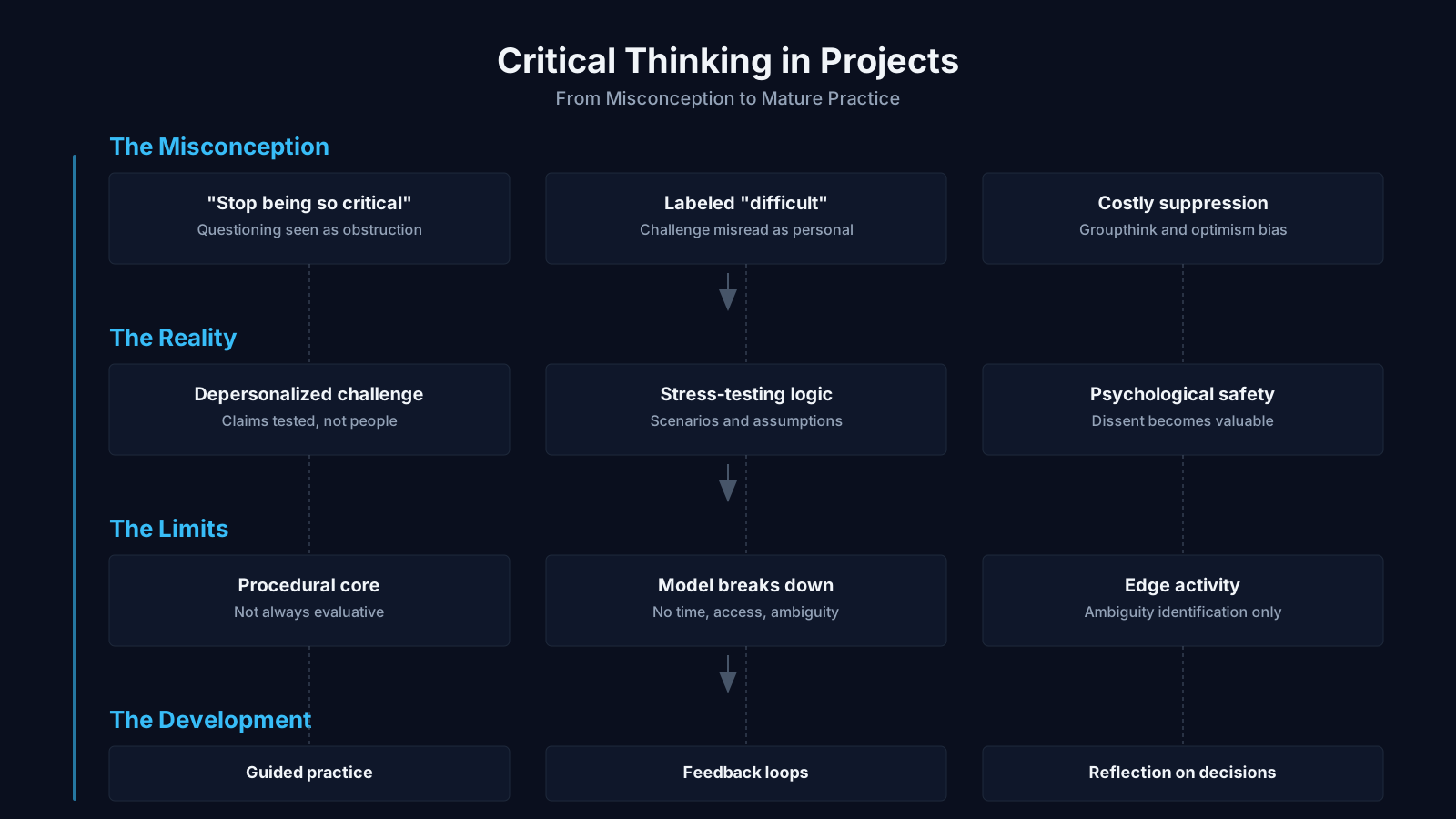
One of the common misconceptions about critical thinking is that it means being negative, skeptical, or slow to act. In reality, critical thinking is not oppositional. It is the practice of evaluating reasons and evidence before accepting a claim, which can just as easily lead to confident action when the evidence is strong. Another misconception is that critical thinking is a fixed trait that some people have and others lack. Research in education and cognitive psychology suggests that it is a learnable skill, although it requires deliberate practice and a supportive environment. Project managers sometimes confuse critical thinking with intelligence, but intelligent people can reason poorly when they are under pressure, overconfident, or emotionally attached to an outcome.
Analysis Paralysis and Decision Latency
A common challenge is overusing critical thinking to avoid committing to a decision. Teams facing high stakes may demand ever more data, endless scenario analysis, or yet another risk workshop. This is analysis paralysis. Critical thinking should sharpen judgment, not replace it with infinite deliberation. The project manager must recognize when marginal analysis no longer improves the decision and when the cost of delay exceeds the value of additional information. Setting decision criteria in advance and explicitly stating what would change the decision can prevent analysis from becoming an end in itself. A mature critical thinker understands that provisional decisions are often testable and reversible, which reduces the perceived need for certainty.
Confusion Between Critical Thinking and Technical Expertise
Another misconception in project environments is that technical experts automatically bring critical thinking to management decisions. Domain expertise is valuable, but it can also introduce narrow framing. An engineer may reason rigorously about structural integrity and still fail to assess commercial viability. A financial controller may identify cost variances with precision and still miss the operational causes behind them. Critical thinking is not a substitute for technical knowledge, and technical knowledge is not a substitute for critical thinking. In high-performing project teams, both are combined. The project manager often acts as the integrator, asking questions that connect specialized insights into a coherent project picture.
Organizational and Cultural Barriers
Organizational culture can either support or suppress critical thinking. In highly hierarchical environments, junior team members may hesitate to question senior decisions, even when they possess relevant evidence. If dissenting views are labeled as disloyalty or lack of commitment, critical thinking will retreat into private conversations and lose its influence. Some project cultures reward confidence and speed over reflection, which discourages the slower process of reasoning through ambiguity. Critical thinking also requires psychological safety, which is the shared belief that a team will not punish or humiliate someone for speaking up. Without that safety, the structures for critical review may exist on paper, but they will not produce honest dialogue. This is a practical limitation that frameworks alone cannot solve.
Critical Thinking vs Related Project Management Concepts
In project management discussions, critical thinking vs problem solving and decision making is a recurring distinction. Problem solving is the process of identifying a gap between current and desired states and then implementing a solution. Decision making is the process of selecting among alternatives. Critical thinking is the reasoning discipline that supports both but is not identical to either. A team can solve a problem using a standard template without critically examining whether the problem has been defined correctly. A manager can make a decision quickly using a weighted scoring model while feeding flawed assumptions into the model. Critical thinking operates upstream of these processes by questioning the problem frame, the quality of the alternatives, and the validity of the evaluation criteria.
Decision Making and Risk Management
Decision making in projects often relies on tools such as decision trees, Monte Carlo simulation, multi-criteria analysis, and expected monetary value. These tools produce numbers, but critical thinking determines whether those numbers are meaningful. Decision trees, for example, require probabilities and payoffs that are often estimated under uncertainty. A critical thinker examines the sensitivity of the decision to those estimates and asks whether the model captures the real trade-offs. Risk management is similarly dependent. A risk heat map can create a false sense of precision when probability and impact scores are subjective. Critical thinking encourages the use of ranges, scenario testing, and qualitative reasoning alongside quantitative models. It tempers the authority of the tool without dismissing the tool’s value.
Strategic and Systems Thinking
Critical thinking is also often confused with strategic thinking and systems thinking. Strategic thinking focuses on the long-term direction and competitive positioning of the organization. It asks whether the project should exist and how it contributes to higher-level goals. Systems thinking focuses on interconnections, feedback loops, and emergent behavior in complex systems. Critical thinking supports both by providing the evaluative engine. Strategic thinking without critical thinking can become visionary but ungrounded. Systems thinking without critical thinking can produce elaborate models that do not reflect reality. In portfolio management, the three skills combine when executives evaluate whether a program’s benefits logic is sound, whether dependencies are understood, and whether the portfolio remains balanced under changing conditions. Critical thinking is the discipline that tests the assumptions embedded in strategic and systemic views.
Key Insights on Critical Thinking
- Critical thinking operates upstream
- Critical thinking interrogates how the problem is framed, whether the alternatives are genuinely distinct and well formed, and whether the evaluation criteria are valid before any structured problem solving or decision making begins.
- Decision models need scrutiny
- A critical thinker tests how sensitive decisions are to underlying estimates and asks whether tools such as risk heat maps surface genuine trade-offs or simply produce an illusion of precision.
- Portfolio management combines all three
- Executives integrate critical thinking, problem solving, and decision making to evaluate whether the logic of expected benefits holds, to trace dependencies across initiatives, and to keep portfolios balanced as conditions change.
Evolution and Current Thinking in Critical Thinking
The evolution of critical thinking in project management reflects a broader shift from procedural compliance to adaptive judgment. Early project management standards emphasized tools, techniques, and step-by-step processes. As projects became more complex and knowledge work grew, practitioners recognized that following a process correctly does not guarantee a good outcome. The seventh edition of the PMBOK Guide, with its principle-based approach, reflects this shift by giving more weight to tailoring, context, and the judgment of the project team. PMI’s Talent Triangle has similarly elevated power skills, including critical thinking, alongside technical project management and business acumen. This evolution signals that critical thinking is no longer seen as a desirable personal trait, but as a core professional capability.
From Soft Skill to Power Skill
The term soft skill has been criticized for suggesting that skills like critical thinking are less important than technical skills. PMI now uses the term power skills to describe competencies such as communication, leadership, problem solving, and critical thinking. This change is not merely semantic. It reflects the reality that technical tools are increasingly accessible and automatable, while the ability to reason through ambiguous, politically charged, and high-stakes project situations remains scarce. Critical thinking is a power skill because it multiplies the effectiveness of every other skill. A project manager who is technically competent but critically weak may execute a flawed plan efficiently. A project manager with strong critical thinking can identify when the plan itself needs to be revised.
Artificial Intelligence and Data Interpretation
The rise of artificial intelligence and advanced project analytics has not diminished the need for critical thinking. It has increased it. Project management software can now generate forecasts, risk indicators, and schedule analytics at scale. These outputs are only as good as the assumptions behind them, and they can be misleading when interpreted literally. A machine learning model trained on historical project data may replicate historical biases, such as underestimating durations in certain types of work. Critical thinking enables the project manager to ask whether the data is representative, whether the model is appropriate, and whether the recommendation fits the current context. In this sense, critical thinking is a guardrail around automation. It ensures that predictive outputs inform human judgment rather than replace it.
Debates and Limitations
There is no single accepted method for teaching or measuring critical thinking in project management. Some practitioners argue that it develops best through case-based learning and guided reflection. Others emphasize structured techniques such as premortems, red team reviews, and assumption analysis. There is also debate about whether critical thinking can be reliably assessed through certifications or interviews. Behavioral evidence is often more revealing than declared competence. A candidate may say they value critical thinking, but their behavior in a simulation or a past project narrative may show otherwise. The limitation is that critical thinking is context-dependent. A person may reason well in familiar technical domains and poorly in novel commercial or political domains. Development therefore requires exposure, feedback, and reflection across varied project situations. No framework, including PMBOK or PRINCE2, claims to install critical thinking automatically. The standards create conditions where it can operate, but the human work remains.