In project management, biases are systematic patterns of deviation from norm or rationality in judgment, leading individuals and teams to interpret information and make decisions in ways that are predictably skewed rather than purely objective. These mental shortcuts, often unconscious, shape how project professionals estimate costs, evaluate risks, select vendors, and interact with stakeholders. Far from being random errors, biases produce consistent distortions that can accumulate across a project lifecycle, affecting everything from initial charter approval to final benefit realization. Recognizing that biases exist in every human judgment is not an admission of incompetence; it is an acknowledgment of the consistent psychological wiring that behavioral economics has mapped out over decades of research.
Key Biases at a Glance
| Definition | Biases are cognitive predispositions that systematically distort decision-making, causing judgments in project management to deviate from rationality in predictable patterns. |
|---|---|
| Origins | Pioneering research by Kahneman and Tversky revealed that biases arise from mental heuristics, efficient cognitive shortcuts that routinely fail under the uncertainty and complexity inherent to projects. |
| Accumulation | Biases introduce consistent errors that compound across the project lifecycle, skewing critical decisions from initial charter approval through ultimate benefit realization. |
| Project Context | Long feedback loops between early estimates and eventual outcomes obscure the direct link between flawed judgment and deviations in project performance. |
| Cross-Field Impact | From fatal diagnostic errors in medicine to catastrophic market misjudgments in finance and critical oversights in aviation, cognitive biases demonstrate devastating consequences that transcend project management. |
| Decision Ecosystem | Addressing bias demands analysis of the entire decision-making environment, the project team, steering committee, PMO, and organizational culture, each factor either amplifying or neutralizing distorted reasoning. |
| Planning Fallacy | The planning fallacy survives because planners fixate on the detailed steps of their own plan while disregarding the empirical distribution of outcomes from comparable past projects. |
| Anchoring Bias | Anchoring bias occurs when an initial numerical value or deadline, even an arbitrary one, exerts disproportionate influence over every subsequent judgment and forecast. |
What Are Biases in Project Management?
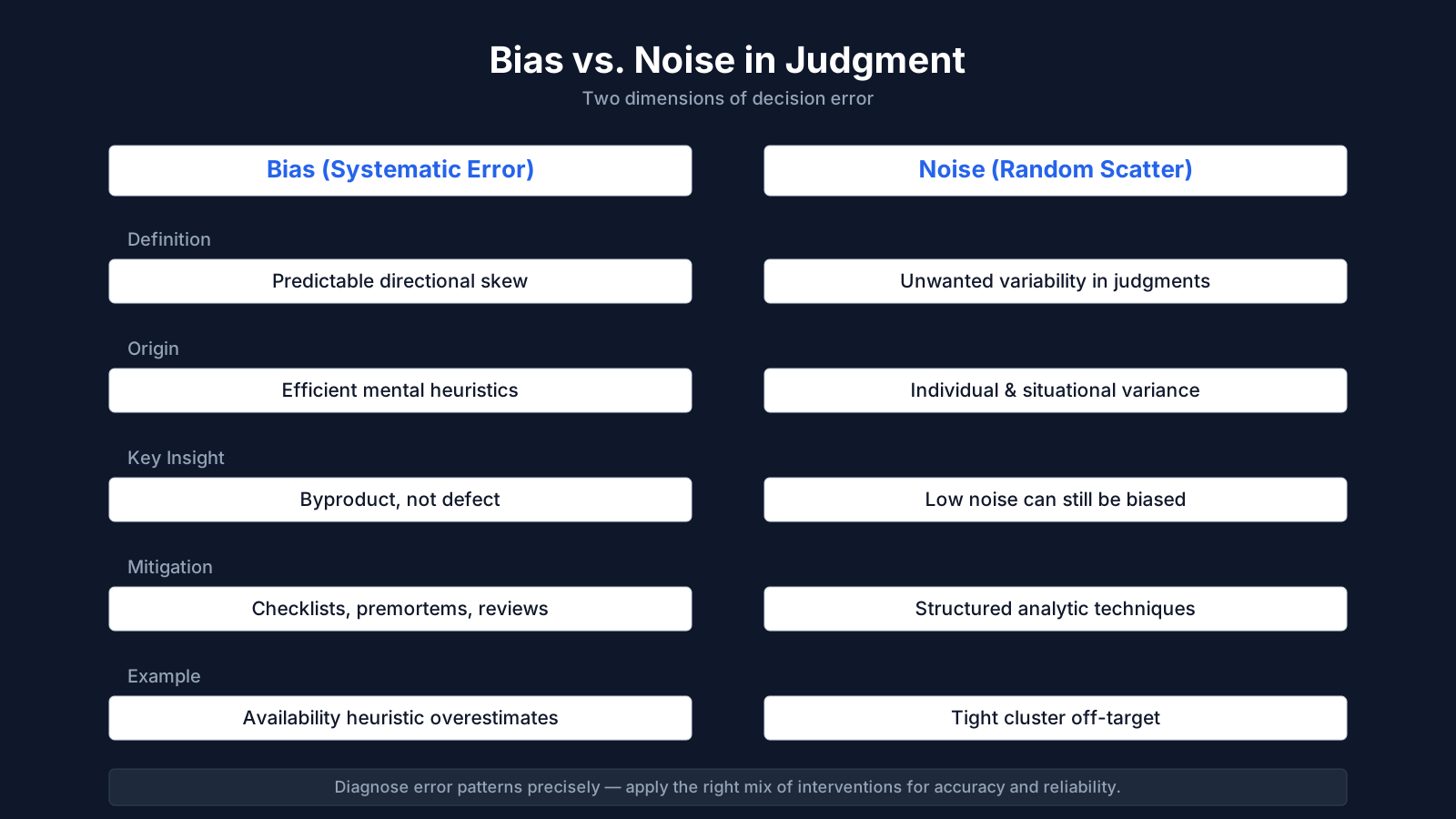
The definition of biases in project management encompasses a wide range of cognitive tendencies that cause a person’s view of the world to systematically diverge from objective reality, particularly when there is uncertainty, complexity, or emotional investment. Unlike simple mistakes, which are idiosyncratic and unpredictable, biases are directional—they lean the mind toward a certain type of error, time and again. A project manager facing a tight deadline may consistently underestimate the work remaining not because of bad data, but because of an ingrained tendency to believe things will go according to plan. Psychologists Daniel Kahneman and Amos Tversky, whose work founded the field, demonstrated that these biases arise from mental heuristics that usually serve us well but misfire under specific conditions. In project environments, where forecasts, trade-offs, and stakeholder negotiations happen under pressure, the conditions for bias are ripe.
Project work is particularly vulnerable to bias because the human mind struggles with probabilistic thinking and long-term feedback loops. When a project manager makes an estimate, the outcome may not be known for months, and by then the context has shifted, obscuring the link between the flawed judgment and the resulting variance. The consequences of bias show up as blown budgets, missed deadlines, scope creep, and unresolved stakeholder conflicts—but their root cause often goes unrecognized. In a very practical sense, bias acts as an invisible hand pushing project performance away from what analysis would suggest is reasonable. It is not about ignorance or lack of skill; even highly experienced professionals exhibit the same biases unless they actively deploy countermeasures.
Key Insights on Project Biases
- Systematic divergence from reality
- In project management, cognitive biases systematically skew perceptions away from objective reality, especially under uncertainty, complexity, or emotional investment.
- Directional, not random mistakes
- Unlike random errors, biases are directional and consistently push thinking toward the same class of misjudgment; for example, a deadline-driven manager may habitually underestimate the remaining effort.
- Heuristics that misfire
- Kahneman and Tversky demonstrated that biases arise from mental shortcuts that typically work well but break down under specific conditions.
- Projects magnify bias vulnerability
- Project environments are particularly susceptible to bias because the human mind contends with probabilistic reasoning and extended feedback cycles, where outcomes surface months later and often conceal the impact of flawed judgments.
- Costly silent consequences
- Biases silently fuel budget overruns, schedule delays, scope creep, and unresolved stakeholder conflicts, affecting even seasoned professionals when active countermeasures are absent.
The Origin and Cross-Industry Context of Bias
The origin of cognitive biases in decision-making traces back to the heuristics-and-biases research program of the 1970s, which revealed predictable irrationalities in human judgment. Outside project management, the concept of bias has profoundly influenced fields such as medicine (where diagnostic errors from anchoring and availability bias can be lethal), finance (where overconfidence and loss aversion drive market bubbles and crashes), and aviation (where confirmation bias has contributed to accidents when pilots disregarded contradictory instrument readings). In each of these domains, the recognition that experts are not immune to bias has led to systemic interventions: checklists, decision support systems, and structured review processes. Project management borrows heavily from these lessons, adapting them to the unique rhythm of temporary, cross-functional endeavors.
What makes project work distinct is that biases do not just affect individual decisions; they propagate through the planning and governance structure. A senior sponsor’s optimism bias can seed an unrealistic business case, which then becomes the baseline against which all future performance is measured, creating cascading distortions. Understanding bias therefore requires looking not just at the project manager’s mind, but at the entire decision ecosystem: the team, the steering committee, the PMO, and the organizational culture that either amplifies or dampens biased thinking.
Types of Biases Affecting Project Outcomes
The types of biases in project management can be grouped into several overlapping families, each with distinct implications for how work is planned, executed, and evaluated. Some biases primarily attack the front end of a project, distorting estimates and risk assessments. Others emerge during execution, causing teams to stick with failing approaches or to misinterpret stakeholder signals. A third set affects the human side—how we evaluate people, build trust, and resolve conflict. All of them share the trait that they operate below the level of conscious awareness unless deliberately surfaced.
Cognitive Biases in Planning and Estimation
Optimism bias, also known as the planning fallacy, is the tendency to underestimate time, costs, and risks while overestimating benefits. Project managers routinely see this when initial schedules reflect a best-case scenario, with every task magically completing on time and no allowance for the messy realities of integration, rework, or illness. The planning fallacy is not mere sloppiness; it persists because people naturally focus on the specific steps of their own plan and fail to consider the distribution of outcomes from similar past projects. Even when historical data is available, the mind discounts it in favor of the vivid, concrete narrative of the current plan.
Anchoring bias occurs when an initial piece of information—a number, a budget figure, a suggested deadline—exerts disproportionate influence on subsequent judgments. A sponsor casually mentions that “this should cost around half a million,” and from that point forward, every estimate clusters around that figure, even if the actual scope demands twice as much. The initial anchor acts like a magnetic north, pulling all adjustments toward it. Anchoring is especially dangerous in procurement and negotiation, where a vendor’s first price quote shapes the entire range of what feels reasonable. Another pervasive bias in planning is the representativeness heuristic, where a project manager assumes that because a past project in the same industry took six months, the current one will too, ignoring significant differences in complexity, team capability, or technology.
Biases in Risk Assessment and Decision-Making
Availability heuristic leads people to overestimate the likelihood of risks that are recent, vivid, or emotionally charged. A team that just experienced a major data breach may over-weight cybersecurity risks for the next project while ignoring more probable but mundane threats like supplier insolvency. Conversely, risks that have never materialized in the team’s memory are treated as remote possibilities, even when actuarial data suggests otherwise. Availability bias explains why qualitative risk registers are often filled with dramatic, low-probability events and missing the dull, high-frequency problems that quietly erode project margins.
Overconfidence bias manifests when project professionals believe their own judgment is more accurate than it actually is. This is not arrogance; it is a pervasive cognitive feature where the subjective confidence in one’s estimates is consistently higher than the objective probability of being correct. Overconfidence leads to insufficient contingency reserves, aggressive schedule commitments, and a dismissive attitude toward independent reviews. It is especially pronounced in experts, who have a deep but narrow knowledge base that can actually increase confidence without improving calibration. In portfolio management, overconfidence can cause decision-makers to greenlight projects based on overly precise ROI projections that pretend to know the future with unwarranted certainty.
Biases in Stakeholder Engagement and Team Dynamics
Confirmation bias is the tendency to search for, interpret, and recall information in a way that confirms preexisting beliefs. A project manager convinced that a particular vendor is unreliable will notice every delayed shipment and ignore the instances where the vendor delivered ahead of schedule. This bias fuels stakeholder misunderstandings, as each side accumulates evidence that supports its own narrative, making conflict resolution harder. In requirements gathering, confirmation bias leads analysts to ask questions that confirm their initial assumptions about what the client needs, rather than genuinely exploring alternative possibilities.
The halo effect causes a positive impression in one area to influence judgment in unrelated areas. If a team member is technically brilliant, the project manager might also assume they are good at communication, time management, or leadership, when in fact those skills may be lacking. Similarly, a project that is highly visible and well-branded inside the organization may be perceived as low-risk simply because it enjoys executive attention, not because the underlying risk profile is favorable. The opposite, the horn effect, can unfairly penalize individuals or projects associated with a single negative event. Both biases distort project staffing decisions, performance evaluations, and the allocation of management attention.
Core Insights on Bias Families
- Planning fallacy distorts schedules
- The planning fallacy drives project managers to systematically underestimate time, costs and risks while overstating benefits, producing best-case timelines that leave no room for integration, rework or unexpected illness.
- Anchoring skews all estimates
- A casually mentioned budget figure or deadline from a sponsor becomes a cognitive anchor that heavily distorts all later estimates, tethering the entire planning process to a number that ignores the project’s real scope.
- Representativeness ignores project differences
- Project managers often treat a new initiative as a replica of a past project from the same industry, overlooking meaningful differences in complexity, team capability and the technology stack.
- Availability overweights vivid risks
- Availability bias inflates the perceived probability of emotionally charged events like a recent data breach, while the much higher likelihood of mundane risks such as supplier insolvency is consistently downplayed.
- Risk registers favor dramatic events
- Shaped by the availability heuristic, qualitative risk registers become crowded with memorable but low-probability disasters and neglect the unglamorous, high-frequency problems that quietly erode project margins.
Biases and the PMBOK Framework
Biases in PMBOK knowledge areas are not explicitly named as a distinct process input or tool, but their influence permeates every Process Group and Knowledge Area described in the Project Management Body of Knowledge. In Project Integration Management, confirmation bias can cause a project manager to downplay negative performance reports that challenge the viability of the project, leading to delayed corrective action. During Develop Project Charter, anchoring on the initial business case numbers can constrain the project’s perceived boundaries before any serious analysis begins.
Within Project Scope Management, the planning fallacy directly undermines the accuracy of the work breakdown structure and activity duration estimates. WBS decomposition is supposed to reduce uncertainty, but if the estimator is biased, even detailed task breakdowns will carry the same systematic underestimation into smaller line items. The PMBOK acknowledges this indirectly by emphasizing expert judgment and analogous estimating, but without an explicit bias mitigation step, these techniques can actually reinforce prejudice if the experts share the same blind spots. In Project Risk Management, the Identify Risks process is highly susceptible to availability bias; the Perform Qualitative Risk Analysis process can be skewed by overconfidence in probability assessments, and Plan Risk Responses may suffer from the illusion of control—believing that mitigation actions will be more effective than they typically are.
Project Cost Management’s Determine Budget process often sees optimism bias baked into the cost baseline. The PMBOK’s emphasis on reserve analysis is a partial antidote, but the calculation of contingency reserves is only as unbiased as the underlying assumptions. Project Schedule Management similarly relies on critical path methods that assume deterministic task durations, leaving teams to manually pad estimates rather than addressing the root cognitive causes. Even Project Stakeholder Management and Project Communications Management are touched by bias: the salience of vocal stakeholders can distort the stakeholder engagement matrix, and the frequency of communication may be driven by what feels comfortable rather than what information the receiver actually needs.
Biases in PRINCE2 and Agile Environments
How biases manifest in PRINCE2 and Agile frameworks differs in surface expression but the underlying cognitive patterns remain consistent. PRINCE2’s principle of continued business justification is designed to counteract sunk cost bias—the irrational tendency to continue investing in a failing project because of the resources already committed. By requiring a formal review of the business case at each stage boundary, PRINCE2 forces a deliberate re-evaluation that can pierce through the emotional attachment to a struggling initiative. However, the same governance can introduce new biases if the project board becomes anchored on the original approval figures or falls prey to groupthink, where dissent is suppressed in favor of harmony.
Agile methodologies, with their empirical inspect-and-adapt cycles, offer some inherent resistance to certain biases. Short iterations and frequent feedback make it harder for optimistic forecasts to persist unchallenged, because reality intrudes every two weeks in the form of a sprint review. The retrospective ceremony provides a structured space to surface confirmation bias and availability heuristics that may have influenced the team’s recent decisions. But Agile teams are not immune. Planning poker attempts to mitigate anchoring by having estimators reveal their cards simultaneously, yet social pressures, the halo effect surrounding a dominant team member, or the bandwagon bias—where people converge on an estimate they think others will agree with—can still distort relative sizing. Velocity, if not calculated over a long enough horizon, can itself become an anchor that constrains future commitment discussions, creating a self-fulfilling prophecy.
Hybrid environments, which blend predictive and adaptive elements, face a compounded bias risk. The upfront planning phase may lock in optimistic assumptions that the subsequent Agile delivery cadence cannot fully correct, especially if the governance structure treats the initial plan as a performance baseline rather than a learning hypothesis. This tension illustrates that bias is not a methodology problem per se; it is a human cognition problem that any framework must actively address through process design and culture.
Core Insights on Framework Biases
- Sunk cost countermeasure
- PRINCE2 embeds the continued business justification principle to systematically assess ongoing viability at each stage boundary, ensuring past spending never justifies further investment in a failing project.
- Governance introduces new biases
- While designed to provide oversight, project boards in PRINCE2 risk anchoring on initial approval estimates and succumbing to groupthink, which silences critical dissent and distorts decision-making.
- Agile empirical resistance
- Agile’s short iterations and recurring sprint reviews compel continuous verification against delivered value, disrupting the persistence of overly optimistic forecasts that would otherwise remain unchallenged.
- Retrospective bias detection
- Retrospectives offer a deliberate pause for the team to uncover cognitive shortcuts like confirmation bias and availability heuristics, turning past decision patterns into actionable learning.
- Estimation and anchoring risks
- While planning poker’s simultaneous card reveal guards against anchoring, estimates remain vulnerable to bandwagon influence, the halo effect around strong individuals, and velocity miscalculations that entrench optimistic biases.
The BVOP Perspective on Managing Bias
BVOP’s approach to bias mitigation is embedded in its emphasis on value delivery and waste reduction rather than being labeled as a standalone bias management technique. The methodology treats persistent misjudgments that lead to rejected work or overwork as forms of waste, which connects directly to the consequences of optimism and overconfidence biases. Because BVOP mandates that risk management use quantified “loss size” units and dynamic filtering, it compels a degree of analytical rigor that makes anchoring on arbitrary high-level guesses harder to sustain. The predefined root-cause categories used in defect analysis also provide a counterbalance against confirmation bias, ensuring that teams categorize problems based on evidence rather than instinctive—but possibly skewed—attributions.
Additionally, the BVOP concept of “process damage” as an invisible form of organizational harm aligns with the subtle costs of biased decision-making that do not appear on a balance sheet. A project selection board influenced by the halo effect may consistently favor pet projects, causing demoralization, talent drain, and opportunity costs that build up slowly but erode the portfolio’s health. By tracking Business Value Points over time and signaling when a persistent decline might justify closure, BVOP introduces a data-driven circuit breaker that can counteract the sunk cost bias and overoptimism that keep failing projects alive long past their point of usefulness.
Common Challenges and Misconceptions About Biases
A widespread misconception about project management biases is that awareness alone is enough to neutralize them. Behavioral science consistently demonstrates that knowing about a bias does not prevent its influence; the mental processes involved are fast and automatic, while corrective reasoning is slow and effortful. Project managers who believe they are immune because they have read about biases often exhibit a bias blind spot—the tendency to recognize bias in others but not in oneself. This meta-bias is particularly dangerous because it shuts down the very openness required for effective debiasing techniques.
Another challenge is that organizational incentives frequently reward biased behavior. An executive who consistently delivers projects “under budget and ahead of schedule” may simply be padding estimates (a rational response to an environment that punishes overruns). If the culture celebrates heroic recovery while ignoring the baseline distortion that made the recovery necessary, bias becomes institutionally embedded. Efforts to introduce independent estimators, reference class forecasting, or devil’s advocate reviews often face resistance because they can feel like intrusive challenges to professional judgment rather than necessary quality controls.
There is also a persistent belief that data and algorithms will solve the bias problem. While quantitative models can reduce some forms of inconsistency, they are themselves designed by biased humans, trained on biased historical data, and interpreted through biased lenses. A Monte Carlo simulation that produces a range of possible completion dates is only as good as the distribution inputs, and those inputs can still be anchored on optimistic assumptions. The tool does not eliminate bias; it merely changes the layer at which it operates. The challenge is not to find a silver bullet but to build a culture of critical thinking where assumptions are regularly and explicitly tested.
Core Takeaways on Bias Misconceptions
- Awareness alone does not suffice
- Awareness of a bias does not neutralize its influence because biased mental processes operate swiftly and automatically, making corrective reasoning comparatively slow and effortful.
- Bias blind spot is dangerous
- Individuals who have studied biases often recognize them in others yet overlook them in their own reasoning, shutting down the receptiveness that effective debiasing depends on.
- Incentives can reward biased behavior
- Organizational incentive structures that celebrate under-budget and ahead-of-schedule outcomes inadvertently encourage estimate padding, turning cognitive bias into a rational adaptive response.
- Debiasing tools encounter organizational resistance
- Techniques such as independent estimation, reference class forecasting, and devil's advocate reviews are often misperceived as threats to professional judgment rather than essential quality assurance mechanisms.
- Build culture of critical thinking
- Since no single method eradicates bias entirely, organizations need to embed a culture of continuous assumption testing into their decision-making processes.
Relationships to Other Project Management Concepts
The relationship between biases and risk management is arguably the most consequential intersection in the project management discipline. Risk attitude—the organization’s appetite, tolerance, and threshold—is itself a product of cognitive and emotional biases. A risk-seeking posture on one project and risk-averse on another often reflects framing effects, where the same objective situation is perceived differently depending on whether it is presented as a potential gain or a potential loss. Decision tree analysis and expected monetary value calculations attempt to impose rationality, but the probabilities and impact values entered into these tools are still subject to availability bias and overconfidence.
Biases also connect tightly with stakeholder engagement and communication management. The salience model of stakeholder classification, which prioritizes based on power, legitimacy, and urgency, can be influenced by the availability heuristic if a stakeholder is highly visible but not necessarily most impactful. Emotional intelligence and political acumen are often touted as antidotes, but without bias awareness, a project manager’s “gut feel” about a stakeholder can simply be the halo effect or affinity bias, favoring people who share similar backgrounds. Earned value management, with its precise formulas for SPI and CPI, can create an illusion of objectivity that masks confirmation bias: a project manager may search for reasons to believe the unfavorable SPI is a data anomaly rather than a true signal.
The Evolution of Understanding Bias in Projects
The evolution of bias awareness in project management has moved from near-complete neglect to a growing but still insufficient integration into standards and practices. Early project management literature treated estimation errors as purely technical problems to be solved with better tools and more detailed decomposition. The human element was acknowledged only in the soft skills domain, separate from the hard numbers of planning. The publication of Kahneman’s “Thinking, Fast and Slow” and the popularization of behavioral economics pushed cognitive bias into business conversations, but the translation into project management methods has been slow.
Current thinking distinguishes between two layers of intervention: individual debiasing and environmental design. Individual debiasing includes training, checklists, and cognitive forcing strategies that prompt reflective reasoning. Environmental design changes the decision-making context—introducing anonymous estimation processes, separating the roles of estimator and approver, or requiring reference class forecasting as a mandatory gate criterion. There is healthy debate about which layer yields better results. Some practitioners argue that individual debiasing is futile because the cognitive load is too high, and only changes to process and incentives work. Others contend that without individual awareness, even well-designed processes can be gamed or ignored.
Research from the project management field itself remains relatively sparse compared to medicine or aerospace. The PMI’s Pulse of the Profession reports have touched on the impact of optimism bias on project performance, and some academic work has applied the planning fallacy to large infrastructure projects, particularly the pioneering work of Bent Flyvbjerg on megaproject cost overruns. The growing interest in behavioral project management suggests the field is maturing, but there is still a gap between what the science knows and what the profession does on a Monday morning.
Summary of Bias Evolution Insights
- From neglect to partial integration
- Bias awareness in project management has shifted from near-total omission to a growing yet still fragmented presence in professional standards and routine practice, remaining far from systematic adoption.
- Early technical framing of errors
- Initial project management literature framed estimation errors as purely technical shortcomings that improved tools and finer decomposition could eliminate, confining human cognitive factors to the separate domain of soft skills.
- Behavioral economics influence on projects
- Kahneman's research brought cognitive bias into mainstream business discourse, but its translation into project management methods progressed slowly; PMI Pulse reports and Flyvbjerg's megaproject studies proved pivotal in sparking practical engagement.
- Two intervention layers identified
- Current thinking distinguishes individual debiasing tools like training and checklists from environmental design approaches such as anonymous estimation, role separation, and mandatory reference class forecasting.
- Science practice gap persists
- Despite a maturing behavioral project management field, a substantial gap persists between research-based insights into bias and the methods professionals apply on a Monday morning, with some experts arguing that only process and incentive redesigns achieve lasting impact.
Approaches That Reduce the Impact of Bias
Practical approaches to reduce bias in project environments focus on introducing structured friction into decision-making processes, making it harder for automatic, intuitive judgments to go unchallenged. Reference class forecasting replaces the typical inside-view planning approach—where the team looks only at the specific project at hand—with an outside view that asks: what actually happened in a comparable set of past projects? This technique, while not perfect, has been shown to dramatically improve the accuracy of cost and schedule estimates for capital projects. It counters both optimism bias and the planning fallacy by anchoring predictions on empirical distributions rather than subjective confidence.
Independent cost and schedule validation, performed by individuals not emotionally invested in the project’s approval, provides another layer of defense. When an estimator knows their work will be reviewed by a dispassionate party, the incentive to maintain intellectual honesty increases, though it does not eliminate subconscious bias. Premortems—a facilitated session where the team imagines that the project has failed and works backward to identify what led to the disaster—harness the availability heuristic constructively, making potential problems more vivid and therefore more likely to be included in risk registers. The premortem technique is particularly effective in surfacing risks that the team’s collective optimism might otherwise suppress.
In Agile contexts, relative estimation using story points and velocity data provides a moving, empirical reference that makes persistent optimism harder to sustain, though only if the team resists redefining the scale to fit convenient narratives. Regardless of methodology, the most effective bias mitigation is rarely a single tool; it is an organizational habit of seeking out disconfirming evidence and protecting the people who voice inconvenient truths. When project managers, sponsors, and PMO leaders accept that their own minds are the most significant source of risk, the conversation shifts from blaming individuals for poor forecasts to designing systems that expect and correct for human cognitive limits.