A change control system is a formal, documented set of procedures, tools, and approval authorities that governs how modifications to project baselines, deliverables, and documentation are proposed, evaluated, approved, or rejected. It provides the structured conduit through which all change requests must flow, ensuring that no alteration to scope, schedule, cost, quality, or any other predetermined baseline occurs without deliberate scrutiny and authorized consent. In essence, it is the project’s immune mechanism against uncontrolled evolution.
Change Control System: At-a-Glance Summary
| Concept | Summary |
|---|---|
| Definition | A change control system is a formal framework of procedures, digital tools, and governance hierarchies that governs how modifications to project baselines, deliverables, and documentation are submitted, assessed, authorized, or denied. |
| Scope | It spans structured request intake forms, real-time tracking dashboards, automated notifications, and integrated workflows, enabling deliberate change management instead of ad hoc reaction. |
| Origins | Rooted in mid-20th century manufacturing quality movements, aerospace, and automotive engineering, the discipline emerged after undocumented substitutions caused cascading production delays and budget overruns. |
| Components | Essential elements include a standardized change request template, a rigorous impact analysis methodology, a tiered approval authority matrix, a traceable change log, and defined stakeholder communication protocols. |
| Audit Trail | In mature implementations, each change request is linked to associated configuration items, creating an unbroken audit trail from initial registration through final disposition. |
| Impact Analysis | Impact analysis evaluates how a proposed change propagates across the work breakdown structure, critical path schedule, cost performance baseline, quality metrics, and risk register. |
| Approval Levels | Minor, low-impact adjustments are often delegated to the project manager, while major scope expansions exceeding predefined thresholds or reshaping the business case require steering committee endorsement. |
What Is a Change Control System?
The change control system definition in project management refers to the integrated collection of processes, forms, tracking mechanisms, and decision-making bodies that allow a project to manage change intentionally rather than reactively. It encompasses everything from the paper form a team member fills out to request a deviation, to the software dashboard where the change control board logs its verdict, to the automated notification that updates impacted stakeholders about a newly approved modification. Many practitioners first encounter the term through the PMBOK Guide, where the change control system is a key element of the Perform Integrated Change Control process and a component of the overall project management information system.
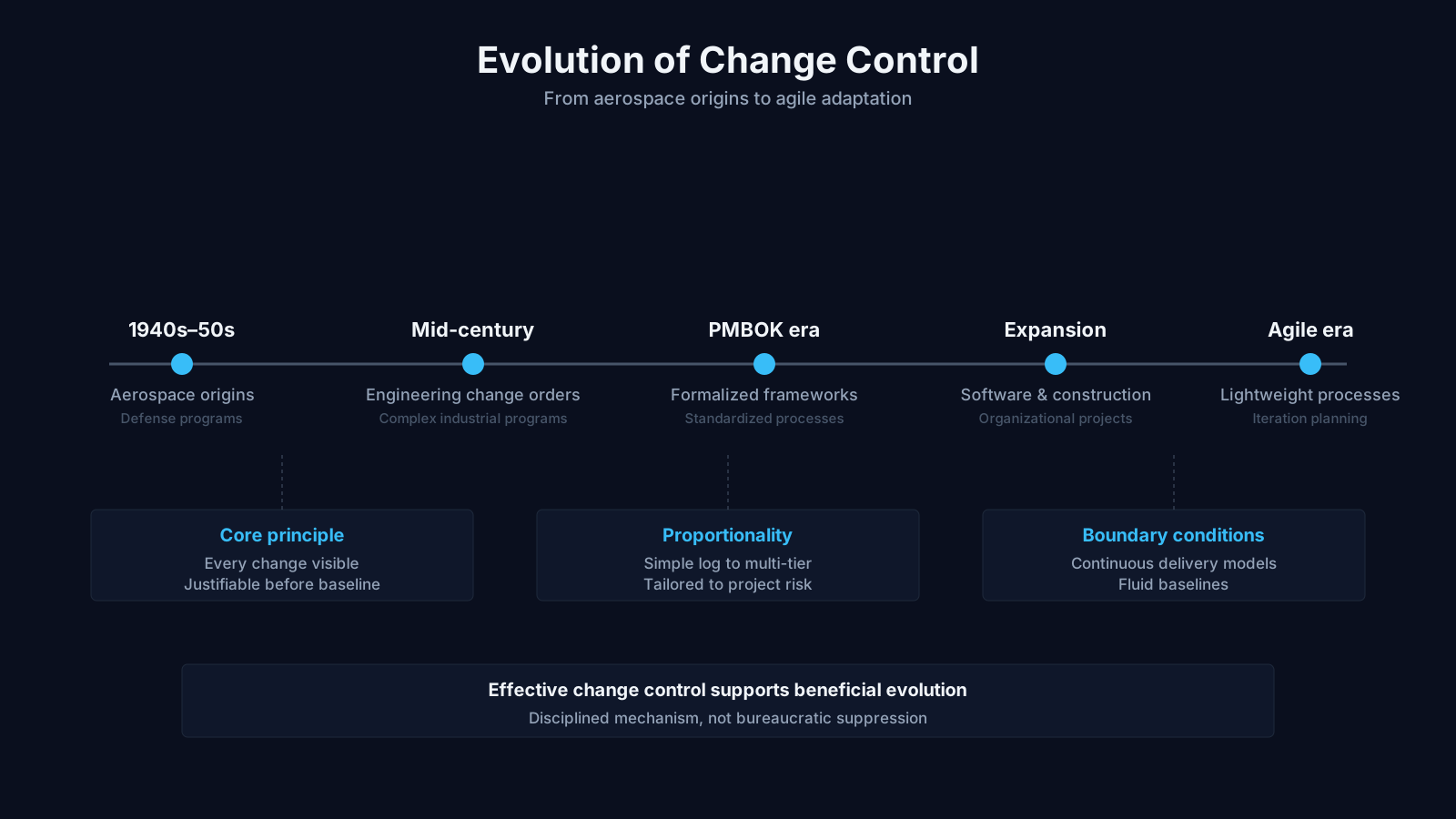
Its lineage in management thinking is less about a single inventor and more about the gradual recognition that projects, left to their own devices, tend to accumulate “just this one small change” until the original business case becomes unrecognizable. Manufacturing quality movements, particularly the formalized change notice procedures that emerged in aerospace and automotive engineering during the mid‑twentieth century, heavily influenced early project change control. Engineers on complex defense programs learned that a seemingly trivial substitution of a fastener could cascade into catastrophic delays if not traced and approved across all dependent systems. That discipline migrated into project management as large construction and IT initiatives adopted the same rigor. Today, the change control system is a staple in any environment where baseline integrity must be preserved, whether the project follows a predictive waterfall model or a hybrid delivery approach.
Core Insights on Change Control Systems
- Integrated change management framework
- A change control system combines processes, documentation, tracking tools, and governance bodies to ensure the project evaluates and adopts changes methodically rather than reacting ad hoc.
- Roots in manufacturing and engineering
- The discipline arose from mid-twentieth-century aerospace and automotive quality control, where engineers learned that even minor undocumented substitutions could cascade into costly delays across interdependent systems.
- Essential for baseline integrity
- Modern change control systems, embedded within frameworks like the PMBOK Guide’s Perform Integrated Change Control process, safeguard the project baseline and stop small, cumulative modifications from steadily eroding the business case.
Key Components of a Change Control System
The key components of a change control system typically include a standardized change request template, an impact analysis process, a predefined approval hierarchy, a change log, and mechanisms for communicating decisions. While the specifics vary by organization, these elements collectively form a closed‑loop system that prevents changes from occurring in the shadows.
Change Requests and Documentation
Every potential modification enters the system as a change request. This document captures the nature of the proposed change, its justification, the affected baselines, the estimated resource implications, and a risk assessment. The discipline of completing a change request is itself a filtering mechanism: the effort required to articulate a change often discourages frivolous submissions. In mature systems, the change request is linked to the configuration item it intends to alter, establishing a clear audit trail from register entry to eventual outcome. Many project management information tools enforce mandatory fields, ensuring that incomplete requests never reach the review stage.
Impact analysis is inseparable from the request. Once a change is logged, the project manager or a designated analyst examines how the alteration would ripple through the work breakdown structure, the schedule network, the cost baseline, quality metrics, and the risk register. This analysis usually produces a recommended course of action and often a revised estimate of the project’s key performance indicators if the change is accepted. Without this step, the decision-makers would be voting in the dark.
Change Control Board and Approval Authority
The change control board, or CCB, is the formal body that reviews and adjudicates change requests. Its composition is deliberately cross‑functional, often including the project sponsor, key customer representatives, technical leads, and functional managers. The board’s authority is not unlimited; it is typically bounded by a charter that specifies which categories of change it can approve directly and which require escalation to higher governance bodies. Small, low‑impact changes may be delegated to the project manager alone, while major scope expansions that exceed a cost threshold or alter the project’s business case must go to a steering committee.
The CCB does not merely rubber‑stamp the project manager’s recommendation. Its members challenge assumptions, verify alignment with strategic objectives, and consider opportunity cost—will approving this change consume resources better deployed elsewhere? Approved changes are documented in the change log and communicated to all affected stakeholders, while rejected changes are also recorded with the rationale for denial, creating a valuable reference if a similar request resurfaces later.
Tracking, Communication, and the Change Log
A central change log maintains a running record of every request, its status, and the final resolution. This artifact serves multiple purposes: it demonstrates governance to auditors, informs lessons learned at project closure, and prevents the same defeated idea from cycling back under a slightly different name. Integrated with project scheduling and budgeting tools, the log also feeds real‑time updates to the baselines when changes are approved, so that earned value calculations and performance forecasts always reflect the authorized version of the plan.
Communication channels are a built‑in component, not an afterthought. Stakeholders whose work depends on the changed deliverable need immediate notification. In large programs, this distribution is automated: the moment a change status flips to “approved,” the system triggers alerts to affected engineers, procurement specialists, and test teams, along with instructions for retrieving updated specifications. The absence of a reliable notification mechanism is one of the most common causes of rework, because a team that never learned about a changed interface will inevitably build to the old requirement.
The Change Control System in Project Management Frameworks
Within the PMBOK change control framework, the change control system is formally embedded in the Perform Integrated Change Control process, which sits in the Monitoring and Controlling Process Group and belongs to the Project Integration Management Knowledge Area. Here it is treated as a subsystem of the broader project management plan, and its procedure descriptions answer the fundamental questions: who can raise a change, what evidence must accompany it, how impact is assessed, who decides, and how the decision is recorded and disseminated. The sixth edition of the Guide distinguishes between the change control system and the configuration management system, although the two work closely together, a point expanded upon later.
PRINCE2 addresses change through its Issue and Change Control procedure, which occupies a prominent position within the Progress theme. Unlike PMBOK’s language, PRINCE2 refers to “issues” as the umbrella term for any question, concern, request for change, or off‑specification. The PRINCE2 change control procedure follows a logical sequence: capture the issue, assess its severity and priority, examine options, decide on a course of action, and implement. The Project Board retains authority over changes that exceed the agreed tolerance limits, while the Project Manager handles lower‑impact requests. The emphasis on stage boundaries means that many change decisions are timed to coincide with the end of a management stage, allowing the Project Board to re‑baseline the project with full awareness of cumulative drift.
Agile and Lean frameworks approach change with a fundamentally different philosophy, yet they still rely on a light‑touch change control system, albeit one that is often invisible to the casual observer. In Scrum, the Product Backlog functions as the single change intake channel. Every new requirement, enhancement, or corrective adjustment becomes a Product Backlog item, and the Product Owner acts as the filter and prioritizer, a role analogous to a CCB of one. The Sprint itself is protected from external change—this is the time‑boxing shield—but between sprints any stakeholder can propose modifications. In Kanban, work‑in‑progress limits and explicit policies serve as a continuous change throttling mechanism, ensuring that alterations do not overwhelm the team’s capacity. Some practitioners refer to this as a fluid change control system in Agile, because the mechanism is more about structured reprioritization than formal approval paperwork. For regulated industries, Agile teams often hybridize the approach, maintaining a lightweight change log and touch‑point approvals while still delivering increments every few weeks.
Key Takeaways Across Frameworks
- PMBOK formalized change integration
- PMBOK embeds the change control system within the Perform Integrated Change Control process, specifying who may raise changes, the evidence required, impact analysis responsibilities, decision authorities, and formal mechanisms for recording and distributing decisions.
- PRINCE2 issue-based stage decisions
- PRINCE2 manages change requests as issues, guiding them through capture, assessment, option evaluation, decision, and implementation, while the Project Board retains authority for changes exceeding tolerances at stage boundaries.
- Agile's lightweight continuous filtering
- In Agile and Lean environments, change undergoes continuous lightweight filtering: the Product Owner treats every new requirement or adjustment as a Product Backlog item, while Kanban teams use work-in-progress limits and explicit policies to regulate change intake and maintain steady delivery.
Purpose and Business Value of a Change Control System
Understanding the purpose of a change control system requires moving beyond the image of bureaucratic gatekeeping and recognizing its role as a stabilizer of expectations. Every project operates under a contract of trust: the sponsor trust that the team will deliver what was promised for the agreed investment, and the team trusts that the sponsor will not shift the goalposts mid‑execution without acknowledging the cost. The change control system makes that acknowledgment explicit. It transforms a soft, informal conversation—“Can we just add this one screen?”—into a documented trade‑off that forces the organization to face the consequences of its own requests.
The business value emerges most sharply when the project balances competing constraints. Without a functioning change control system, the default tendency is for scope to inflate while schedule and budget remain artificially fixed. The resulting crunch degrades quality and burns out the team. With the system in place, every scope expansion surfaces a corresponding adjustment to budget, schedule, or feature set, and the decision‑makers own that trilemma. Over the lifecycle of a program, this discipline can be the difference between a portfolio that delivers what it promised and one that hemorrhages resources into a fog of perpetual scope creep. A lesser‑recognized benefit is the protection the system offers the project manager themselves, by ensuring that a single sponsor demand, no matter how senior the individual, cannot unilaterally rewrite the baseline without due process.
Change Control System vs. Configuration Management System
Distinguishing between a change control system and configuration management system is a classic source of confusion, even for experienced practitioners. The two are tightly coupled yet conceptually distinct. The configuration management system is the broader framework that identifies, documents, controls, and audits the functional and physical characteristics of the project’s products. It maintains a configuration management database that holds the current approved version of every specification, drawing, source code module, and test script. Change control, by contrast, is the procedure that governs how those configuration items get modified. In other words, configuration management tells you what the product is at any moment, while change control tells you what happens when someone tries to change it and who gets to say yes.
The practical relevance of the distinction becomes apparent during audits. An auditor examining configuration management will verify that the as‑built product matches the latest baselined documentation. An auditor examining change control will trace a single alteration from the moment a request was submitted, through the impact analysis, CCB deliberation, and the update of the configuration item, to confirm that only authorized changes entered the baseline. A project can have a pristine configuration management repository and still suffer uncontrolled change if the change control procedure is weak; conversely, a rigorous change control system means little if the configuration items are poorly identified and versioned, and if the change control procedure is weak. They are interdependent guardians of baseline integrity.
Key Insights on Control Systems
- Configuration management defines the product
- Configuration management establishes the authoritative framework for identifying, documenting, controlling, and auditing every functional and physical attribute of project deliverables, relying on a database of baselined versions to maintain integrity.
- Change control governs product modifications
- Change control defines the formal process for modifying configuration items, specifying the approval authority required before any baseline alteration can proceed.
- Audits examine both perspectives differently
- Configuration management audits confirm that the as-built product aligns with baselined documentation, whereas change control audits trace each alteration request through impact analysis and the Change Control Board's deliberation.
- Both systems must work together
- Even a meticulously maintained configuration management repository cannot prevent uncontrolled change if change control processes are weak; conversely, no amount of rigor in change control can compensate for poorly identified and inconsistently versioned configuration items.
Practical Implementation and Real-World Challenges
The most prevalent change control system challenges surface when the process that was designed to protect the project instead becomes a bottleneck that deters necessary adaptation. In large, cross‑functional initiatives, it is not unusual to see a change request take two weeks to navigate three levels of approval while the team waits idle. That delay can cost more in lost productivity than the change itself would have cost to implement. Organizations frequently over‑specify thresholds, forcing even trivial corrections—a typo in a user interface label, for instance—through a full CCB review, which breeds cynicism and encourages teams to bypass the system entirely and make covert changes.
From a Business Value‑Oriented Project Management (BVOPM) viewpoint, overly rigid change control overhead is explicitly categorized as waste. Specifically, it maps to the waste of overwork and perfectionism: team members invest disproportionate effort in producing flawless change justifications and navigating committees, while the product owner or customer waits for an answer. BVOPM warns of process damage, an invisible organizational harm that accumulates when the control system punishes rather than enables necessary adaptation. When the change log becomes a monument to rejected acceptable work, the project loses agility not because the methodology prohibits change, but because the bureaucracy has made the cost of asking too high.
Another recurring challenge is the ghost approval. A project manager presents a change at the CCB, the board members nod in silent assent, and no formal record of the decision is captured. Months later, when the altered deliverable surfaces, the same stakeholders profess shock that such a change was ever made. Without a traceable, dated, and attributed decision log, the organization has no institutional memory of its own choices. The fix is not sophisticated software; it is a disciplined habit of recording every CCB verdict, whether oral or written, into the change log before the meeting adjourns.
Evolution and Modern Perspectives
Emerging modern change control practices emphasize velocity and value over ritual, without sacrificing the core principle of intentional modification. One visible shift is the tiered authority model, where change requests are pre‑classified into categories that route automatically to the appropriate decision‑maker. A security patch that fixes a critical vulnerability might follow a fast‑track procedure that requires only the security officer’s sign‑off, while a scope addition that touches the business case still travels to the steering committee. The tier model acknowledges that not all change carries equal organizational risk.
Another evolution is the integration of change control with real‑time project analytics. Rather than a periodic board meeting reviewing a stack of paper, modern project management information systems surface a dashboard that shows every pending change, its predicted impact on the schedule and cost performance indices, and the cumulative effect of approved changes on the estimate at completion. This live data allows the CCB to make decisions with full awareness of the project’s current trajectory, not the baseline it left behind months ago. In large programs, predictive models even flag combinations of seemingly minor changes that, in aggregate, produce nonlinear effects on the critical path, allowing the board to pre‑emptively throttle accumulation.
There is also a growing recognition that the change control system must coexist with psychological safety. When team members fear that raising a change request will brand them as troublemakers or extend their personal deadlines, they will hide rework and deviations. Forward‑leaning organizations decouple the act of raising a change from performance judgment, treating it as a normal, expected flow of information rather than a confession of failure. This shift aligns with Lean thinking, where surfacing problems quickly is valued more than maintaining the appearance of plan adherence.
Modern Change Control Core Insights
- Velocity over ritual
- Modern change control accelerates delivery by eliminating bureaucratic delays while ensuring every adjustment remains intentional, justified, and aligned with strategic value.
- Tiered authority model
- Change requests are classified by risk and automatically routed to the right decision-maker, granting immediate security officer approval for critical patches while steering committee oversight is preserved for scope expansions.
- Real-time project analytics
- Instead of relying on periodic board meetings, modern platforms provide live dashboards that surface all pending changes, their projected impacts on schedule and cost, and the cumulative effect of approved changes on the estimate at completion.
- Predictive aggregate flagging
- Predictive models in large programs detect combinations of seemingly minor changes that jointly create nonlinear disruptions to the critical path, allowing the governance board to limit accumulation before problems materialize.
- No-blame change culture
- High-performing organizations treat change requests as expected, proactive communication rather than evidence of failure, decoupling submission from performance evaluation to encourage transparent and rapid adaptation.
Common Misconceptions about Change Control Systems
One of the enduring change control system misconceptions is that its primary function is to prevent changes. In reality, a well‑designed system enables change to occur in a controlled and predictable fashion. It does not reject alterations out of hand; it rejects unauthorized alterations. The aim is never to freeze the product specification but to ensure that every modification is conscious, evaluated, and funded. When leaders frame the system as a shield against “requirement creep,” they inadvertently signal to the team that change is the enemy, which is a dangerous message in any complex endeavor where discovery is inevitable.
Another misconception confuses the system’s outputs with the project manager’s authority. A change control system does not empower the project manager to approve far‑reaching changes; it empowers the governed structure to decide. Many newly appointed project managers believe they have veto power over any change they dislike. In truth, their role is to facilitate the process—to ensure the impact analysis is sound, that the CCB has the information it needs, and that the decision, whatever it is, is implemented faithfully. Misunderstanding this role can lead to tension when a sponsor‑initiated change sails through the board despite the project manager’s private objections.
Finally, there is a persistent belief that adopting Agile eliminates the need for any change control system. What actually happens is that the system’s form changes profoundly. The product backlog, sprint reviews, and definition of ready become the new control points. The underlying principle—only work that has been consciously prioritized enters the team’s immediate plans—remains intact. Organizations that mistake the absence of paperwork for the absence of control often discover, to their chagrin, that their “Agile” project has become a chaotic stream of stakeholder whims, one in which the team builds whatever was most recently shouted into the corridor. The discipline simply shifts from gate reviews to continuous grooming and explicit economic trade‑off discussions.