The Cynefin Framework is a sense-making model used in project, program, and portfolio management to diagnose the nature of a problem, decision, or operating context by examining the relationship between cause and effect. It separates situations into five domains: clear, complicated, complex, chaotic, and disorder. Developed by Dave Snowden in the late 1990s, it helps project leaders avoid applying one standard management approach to every challenge and instead match their response to the actual level of unpredictability present.
Cynefin Framework: Summary of Key Topics
| Key Concept | Summary |
|---|---|
| Cynefin Framework | A decision-support model for diagnosing problems, decisions, and operating environments by analyzing how cause and effect relate, enabling leaders to match their response to the specific context. |
| Origins | Developed by Dave Snowden at IBM Global Services in the late 1990s to help project leaders align their management approach with the actual level of unpredictability they face. |
| Interdisciplinary Basis | Draws on complexity science, cognitive psychology, knowledge management, and anthropology to give organizations a practical framework for decision making under varying degrees of uncertainty. |
| High-Stakes Adoption | Applied by emergency response teams, military planners, healthcare systems, and public policy groups to distinguish situations that demand immediate stabilization from those that permit deliberate analysis. |
| Project Management Use | Projects routinely face uncertainty comparable to high-stakes environments, making traditional linear planning insufficient for complex conditions and requiring context-sensitive judgment. |
| Simple Domain | Routine status reporting, standardized invoice processing, and straightforward access requests follow clear cause and effect relationships governed by established policies. |
| Complicated Domain | Selecting an enterprise software platform, designing a structural component, and planning a data center migration require expert analysis to identify the correct solution among multiple valid options. |
| Complex Domain | Organizational change, new product development, cross-functional process redesign, and large-scale agile transformations unfold through unpredictable cause and effect relationships that require adaptive, iterative responses rather than fixed plans. |
What Is the Cynefin Framework? Definition and Core Meaning
In project management, the Cynefin Framework definition centers on context-sensitive decision making. It is not a project delivery methodology, a maturity model, or a risk register replacement. It is a diagnostic lens that asks a fundamental question before any planning begins: how much can be known about the cause and effect relationships in this situation.
When the Cynefin Framework is explained to project teams, the emphasis usually falls on the difference between ordered and unordered systems. Ordered systems have predictable or analyzable cause and effect. Unordered systems do not operate under such linear logic. That distinction matters because it changes whether a team should plan, analyze, experiment, or act immediately.
The framework does not prescribe a single response for all unknowns. It compels the project manager and the sponsor to distinguish between uncertainty that can be reduced through analysis and uncertainty that must be resolved through interaction and feedback. This is a subtle but important shift. Many failed projects are not the result of poor execution but of an initial misclassification of the context.
Cynefin Framework: Key Insights
- Diagnostic lens, not methodology
- Cynefin is best understood as a diagnostic lens that clarifies how knowable cause-and-effect relationships are in a given situation, rather than as a delivery methodology, maturity model, or substitute for a risk register.
- Ordered versus unordered systems
- In ordered systems, cause and effect are either predictable or can be reliably analyzed; in unordered systems, causality follows nonlinear patterns and can only be understood through experimentation and feedback.
- Misclassification drives project failure
- Project failure often results from an initial misclassification of the operating context rather than from weak execution, which makes accurate context assessment a critical early step.
Origins and Cross-Discipline Context of the Cynefin Framework
The origin of the Cynefin Framework is generally traced to Dave Snowden, who developed it while working at IBM Global Services in the late 1990s. Snowden drew on complexity science, cognitive psychology, knowledge management, and anthropology to create a practical way for organizations to make decisions under different levels of uncertainty. The word Cynefin is Welsh and loosely translates to habitat or place of multiple belongings, with no exact English equivalent.
The framework gained traction outside project management before it became common in business settings. Emergency response teams, military planners, healthcare systems, and public policy groups have used it to distinguish between situations that require immediate stabilization and those that permit careful analysis. In those fields, misreading a situation can have immediate severe consequences, which is why the model emphasizes rapid orientation before action.
Project management imported the Cynefin Framework because projects routinely confront uncertainty that resembles conditions found in those high-stakes environments. A software release with unpredictable user behavior, a construction project with unknown ground conditions, and a regulatory change with shifting interpretations all contain elements of complexity that traditional linear planning struggles to address.
Key Components of the Cynefin Framework: The Five Domains
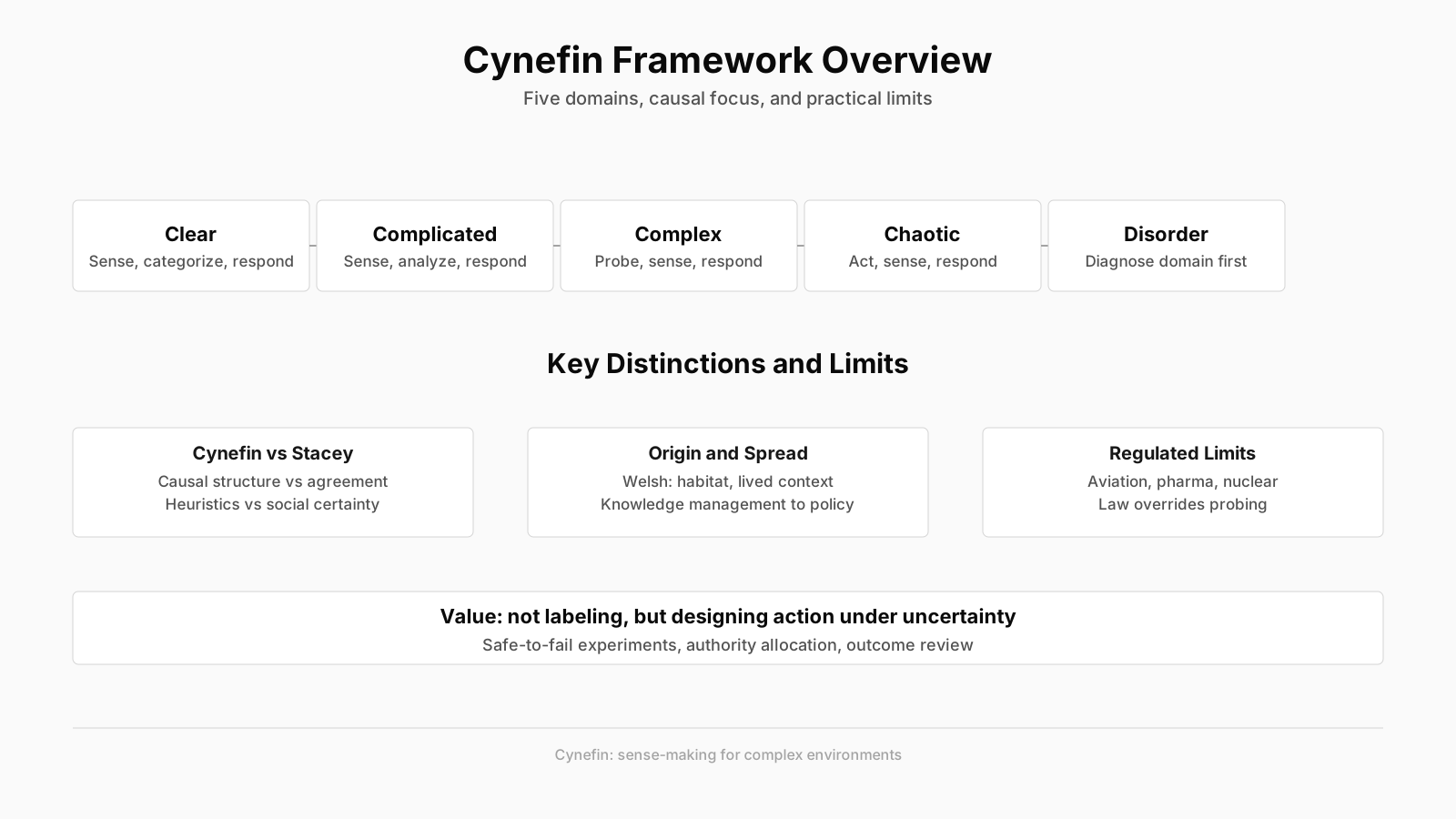
The five domains of the Cynefin Framework are clear, complicated, complex, chaotic, and disorder. Each domain represents a distinct type of relationship between cause and effect, and each carries a different decision-making heuristic. The domains are not value judgments. A clear domain is not superior to a complex domain, and a chaotic domain is not automatically a failure. They are simply different operating conditions.
Clear Domain
The clear domain is defined by obvious cause and effect relationships that are visible to everyone involved. The appropriate response pattern is sense, categorize, and respond. The project manager recognizes the situation, applies a known best practice, and moves on. Examples include routine status reporting, standardized invoice processing, or simple access requests that follow an established policy.
Constraints in the clear domain are rigid and fixed. The rules are known and stable. This makes the clear domain efficient, but it also creates a hidden risk. When people become too comfortable, they stop noticing small changes in the environment. A clear process can drift toward failure because the underlying assumptions slowly erode while everyone continues to follow the old rules.
Complicated Domain
The complicated domain contains cause and effect relationships that exist but are not self-evident. They require analysis, expertise, or investigation. The appropriate response pattern is sense, analyze, and respond. Project examples include selecting an enterprise software platform, designing a structural component, or planning a large data center migration. Multiple valid answers may exist, and they are often described as good practice rather than best practice.
A complicated problem behaves like a mechanical watch. An expert can disassemble it, identify the worn part, and prescribe a repair. A complex system behaves more like traffic or a market, where the whole emerges from interactions that cannot be reduced to one component. This distinction is one of the most important in the Cynefin Framework, and it is also one of the most frequently missed.
Complex Domain
The complex domain is characterized by cause and effect relationships that can only be understood in retrospect. Nothing about the system allows reliable prediction before the work begins. The appropriate response pattern is probe, sense, and respond. Project teams run small, safe to fail experiments, observe what emerges, and then amplify the patterns that produce beneficial outcomes.
Complex work appears frequently in organizational change, new product development under shifting market conditions, cross-functional process redesign, and large-scale agile transformations. In these environments, imposing a detailed upfront plan creates false confidence. The plan looks credible, but the system will still behave in unexpected ways because the interactions among people, technology, and constraints generate emergent results.
Chaotic Domain
The chaotic domain is defined by an absence of stable cause and effect relationships, often because the situation is changing too rapidly or the system has broken down. The appropriate response pattern is act, sense, and respond. The immediate priority is not analysis. It is stabilization. Project examples include a critical production outage, a major security incident, or a sudden regulatory action that shuts down a workstream overnight.
In a burning building, you do not form an analysis committee. You evacuate first and assess later. That is act, sense, and respond in its most direct form. Once the immediate crisis is contained, the project leader can begin to see patterns and move the problem into another domain where more deliberate decision making is possible.
Disorder
Disorder sits at the center of the framework. It is the condition in which it is unclear which of the other four domains applies. People in disorder tend to interpret the situation through their own professional bias. A risk manager sees a risk problem, an engineer sees a technical problem, and a finance leader sees a budgeting problem. None of them has enough evidence to confirm the actual nature of the situation.
The practical guidance for disorder is to avoid acting from habit. The team should gather more information and break the situation into smaller components that can be assigned more confidently to one of the four domains. Disorder is common at the start of a project, especially when sponsors and stakeholders have conflicting assumptions about what the project is trying to solve.
The domains are not static. A problem can move from chaotic to complex, from complex to complicated, or even from clear back into chaos. The boundary between clear and chaotic is particularly dangerous. Overconfidence in a clear process can cause a sudden fall into crisis when the system hits a hidden constraint or an external shock.
Core Insights on Domain Types
- Five distinct domains
- The Cynefin Framework consists of five distinct domains: Clear, Complicated, Complex, Chaotic, and Disorder. Each domain reflects a different relationship between cause and effect and therefore requires a matching decision-making heuristic.
- Clear domain response pattern
- In the Clear domain, cause and effect are obvious to everyone involved, so the appropriate response is to sense, categorize, and act by applying established best practices such as routine status reporting or standardized invoice processing.
- Clear domain drift risk
- Processes in the Clear domain are vulnerable to gradual failure because their underlying assumptions erode over time, while teams continue to follow outdated rules without noticing that the context has shifted.
- Complex domain emergent behavior
- Complex work, frequently found in organizational change and large-scale agile transformations, generates emergent outcomes through the interactions among people, technology, and constraints, which means even a credible plan cannot prevent unexpected system behavior.
The Cynefin Framework in PMBOK and PRINCE2
The Cynefin Framework in PMBOK is not presented as a named process or tool, but its logic aligns closely with the Seventh Edition's emphasis on tailoring, uncertainty, and development approach selection. PMBOK 7 encourages project teams to assess the nature of the work before choosing a predictive, iterative, incremental, agile, or hybrid life cycle. Cynefin provides one way to make that assessment explicit and defensible.
Within the PMBOK knowledge areas and process groups from earlier editions, the framework most directly informs project scope management, risk management, and stakeholder engagement. A clear domain initiative may support well-defined baselines and detailed risk registers. A complex domain initiative may require rolling wave planning and the use of empirical data rather than purely deterministic estimates.
PRINCE2 also does not mandate the Cynefin Framework, but its principle of tailoring to the project environment creates a natural home for it. During the starting up a project and initiating a project processes, the project board and project manager can use Cynefin to decide how much upfront planning is rational and how frequently the project level controls should be reviewed. The risk theme and the plans theme benefit from separating complicated analysis work from emergent complex conditions.
The Cynefin Framework in Agile, Hybrid, and Predictive Project Environments
The Cynefin Framework in Agile project management explains why iterative and incremental approaches work well in complex domains but are not automatically the right answer everywhere. Predictive environments align naturally with clear and complicated work, where requirements are stable and cause and effect can be identified before execution. Agile environments align with complex work, where teams need frequent feedback to discover what works.
Hybrid approaches emerge when a project spans multiple domains. A regulatory compliance module may be clear, a data migration may be complicated, and a user experience redesign may be complex. Rather than forcing one method across the entire initiative, the project manager can tailor the delivery approach by domain. This is a practical application of the Cynefin Framework that avoids methodology debates based on preference alone.
Agile practitioners often observe that Scrum and Kanban were built for complex adaptive work. Cynefin reinforces why detailed upfront requirements fail in that context. The cause and effect relationships emerge through doing, not through analysis. However, not all agile work is complex. A team delivering well-known features with established acceptance criteria may actually be operating in the clear or complicated domain, and in those cases additional iteration can become waste rather than value.
Key Takeaways on Domain-Based Delivery
- Domain dictates delivery method
- The Cynefin Framework separates work that is well served by predictive planning in clear and complicated domains from complex work, where only iterative feedback cycles can reveal emerging requirements and reduce uncertainty.
- Agile aligns with complexity
- Scrum and Kanban are purpose-built for complex adaptive challenges, where attempting to lock in detailed requirements upfront tends to produce brittle plans and costly rework.
- Hybrid mixes across domains
- Because most projects span clear, complicated, and complex domains at the same time, delivery leaders can match each workstream to its own method, applying strict controls to a compliance module while treating a user experience redesign as an adaptive experiment.
- Iteration can become waste
- When teams deliver well-known features against fixed acceptance criteria in clear or complicated domains, repeated iteration adds coordination cost and delays instead of value, so those workstreams are better served by batch or linear delivery.
Purpose and Importance of the Cynefin Framework in Project Decision Making
The importance of the Cynefin Framework lies in its ability to improve decision quality under uncertainty. Project leaders often apply the same planning toolkit to every situation because it feels consistent and defensible. Cynefin interrupts that habit. It forces an explicit question: do we understand the cause and effect here, or are we guessing?
In the clear domain, over-analysis wastes time and slows delivery. In the complex domain, premature detailed planning creates a false sense of control. Cynefin helps project managers align the cost of planning and control with the level of uncertainty actually present. This is not a justification for skipping planning. It is a way to ensure planning is proportionate.
The framework also supports stakeholder communication. When an executive demands a deterministic schedule for complex work, the project manager can use the Cynefin vocabulary to explain why range estimates and empirical validation are more credible. This shifts the conversation from personal preference to the nature of the system being managed. It gives project leaders a structured way to challenge
In portfolio management, executives can use Cynefin to balance the mix of ordered and unordered initiatives. Too many complex projects without sufficient experimentation capacity can overload governance structures. Too many clear projects can create a false sense of control and leave the portfolio exposed to disruption. The framework helps portfolio managers understand when a project should be funded as a predictable investment and when it should be funded as a sequence of learning experiments.
Business Value-Oriented Project Management applies a related logic when it treats process damage as a real organizational cost. If a team classifies a complex product as complicated, the resulting overplanning and rigid control can create avoidable waste and rejected acceptable work. In that context, the Cynefin Framework becomes a lightweight diagnostic for preventing value-destroying misalignment between method and reality.
Common Challenges, Pitfalls, and Misconceptions
Common misconceptions about the Cynefin Framework begin with the belief that complex and complicated mean the same thing. They do not. Complicated work may be difficult, but it can be understood through expertise and analysis. Complex work cannot be reliably predicted in advance. Failing to distinguish the two is one of the most frequent errors in project decision making.
Another misconception is that the framework tells a project team which methodology to use. It narrows the range of effective responses, but it does not remove professional judgment. A complex domain suggests that experimentation and feedback are appropriate, but it does not tell the team whether Scrum, a Kanban-based flow model, or a custom hybrid approach will work best in that specific organization.
Organizational culture can also distort the framework. A planning-heavy organization may treat complex work as complicated and demand a detailed schedule. An agile enthusiast may treat clear work as complex and introduce unnecessary iteration. Both failures produce waste. The framework is most reliable when the team has the discipline to question its own initial classification.
The Cynefin Framework should not be applied to every project decision. When a problem is fully defined and supported by extensive historical data, a standard operating procedure or a simple decision matrix is faster and less expensive. Sensemaking can become overhead if it is forced into routine work. The framework is a tool for uncertainty, not a substitute for operational discipline.
Key Cynefin Misconceptions and Pitfalls
- Complex versus complicated confusion
- Complicated work yields to expert analysis and established patterns, whereas complex work involves emergent behavior that cannot be reliably forecast before action.
- Framework does not prescribe methods
- The Cynefin Framework narrows the viable response space but still requires professional judgment to select a concrete method, because context-specific constraints always shape implementation.
- Complex domain suggests experimentation
- In the complex domain, experimentation and feedback loops are appropriate, yet the framework does not recommend a specific delivery approach such as Scrum, Kanban, or a hybrid.
- Misapplying framework to work type
- A planning-heavy organization often imposes detailed schedules on complex work, while a change-oriented practitioner may introduce unnecessary iteration into work that is already clear and predictable.
- Simple solutions for defined problems
- When a problem is fully defined and historical data supports a known pattern, a standard operating procedure or decision matrix delivers faster, lower-cost results than open-ended exploration.
Cynefin Framework vs Stacey Matrix and Other Complexity Models
The Cynefin Framework vs Stacey Matrix comparison is common because both tools address project complexity and decision making. The Stacey Matrix plots certainty and agreement on two axes and identifies zones such as simple, complicated, complex, and chaotic. Cynefin is not a two-axis model. It is a domain-based sensemaking framework with response heuristics, constraints, and boundary dynamics that the Stacey Matrix does not explicitly address.
The Stacey Matrix is often used to justify the selection of agile methods when requirements and technology are uncertain. Cynefin goes further by describing how to act in each domain, not just where the project sits. It adds a temporal dimension: a project may move between domains as more is learned. The Stacey Matrix is generally seen as a positioning tool, while Cynefin is a dynamic sensemaking tool.
Cynefin also differs from root cause analysis. Root cause analysis assumes a discoverable cause, which makes it suitable for complicated problems. In complex domains, root cause analysis often produces a plausible but misleading narrative because causes are multiple, interacting, and emergent. A single linear story may satisfy stakeholders without improving the system.
Evolution and Current Thinking on the Cynefin Framework
The evolution of the Cynefin Framework has moved from its early knowledge management focus toward broader decision support in organizations. Earlier versions used the label simple for the clear domain. Later practice often uses clear or obvious because the word simple can imply that the work is risk free, which is not true. Even clear work has failure modes caused by complacency and stale assumptions.
Current thinking places more attention on constraints and movement between domains than on static classification. Practitioners now discuss enabling constraints, governing constraints, and rigid constraints as part of the framework. This shift makes Cynefin more useful for designing project controls, not just for choosing a delivery method.
Debate exists about the framework's boundaries and reliability. Some practitioners argue that the edges between domains are too fuzzy for rigorous use. Others note that Cynefin works best as a conversational tool rather than a scoring instrument. There is also discussion about whether organizations tend to overclassify situations and spend too much time debating the domain instead of taking action. These debates have not diminished the framework's popularity, but they have made its application more careful.
In project management, Cynefin has become part of the broader conversation about adaptive governance, program resilience, and decision making under uncertainty. It is not a certifiable method, and it does not replace earned value management, risk registers, or stage gates. Instead, it provides a sense-making layer that helps those tools operate in the right context.
Core Insights on Cynefin's Evolution
- Broader decision support evolution
- Cynefin has matured from a knowledge management framework into a comprehensive decision-support model that helps organizations navigate complexity rather than merely categorize information.
- Clear replaces simple label
- Practitioners increasingly favor clear or obvious over simple because simple misleadingly suggests that work carries no risk and can be handled without careful judgment.
- Focus on constraints and movement
- Contemporary practice emphasizes constraints and transitions between domains instead of static classification, which makes Cynefin more actionable for designing project controls and monitoring dynamic conditions.
- Sense-making layer, not replacement
- Rather than replacing earned value management, risk registers, or stage gates, Cynefin adds a sense-making layer that ensures these tools are applied in the context where they are most effective.
The Cynefin Framework in Program and Portfolio Management
The Cynefin Framework in program management enables program managers to design governance that matches the uncertainty of each component project. A program may contain a clear domain infrastructure project, a complicated domain systems integration, and a complex domain organizational change initiative. Applying identical controls to all three creates friction and may hide early signals of value or failure.
Program managers can use the framework to decide where stage gates are appropriate and where continuous review is more effective. Complex workstreams may need frequent validation through safe to fail experiments. Ordered workstreams may need conventional milestone tracking and variance analysis. The program manager becomes an integrator who translates between different epistemic conditions rather than enforcing uniformity.
At the portfolio level, Cynefin supports balance and strategic optionality. A portfolio heavily weighted toward complex initiatives may require more slack, more capability building, and a higher tolerance for emergent outcomes. A portfolio weighted toward clear and complicated initiatives may optimize for efficiency and predictable benefits, but it may also become vulnerable to disruption. Portfolio leaders use this insight to avoid treating all investments as if they carry the same level of knowability.
Benefits management also shifts by domain. In clear and complicated projects, benefits may be modeled with detailed financial projections. In complex programs, benefits are often emergent and change as the system responds to interventions. The program manager should use periodic validation and benefit mapping rather than fixating on a single forecast produced at the beginning of the initiative.