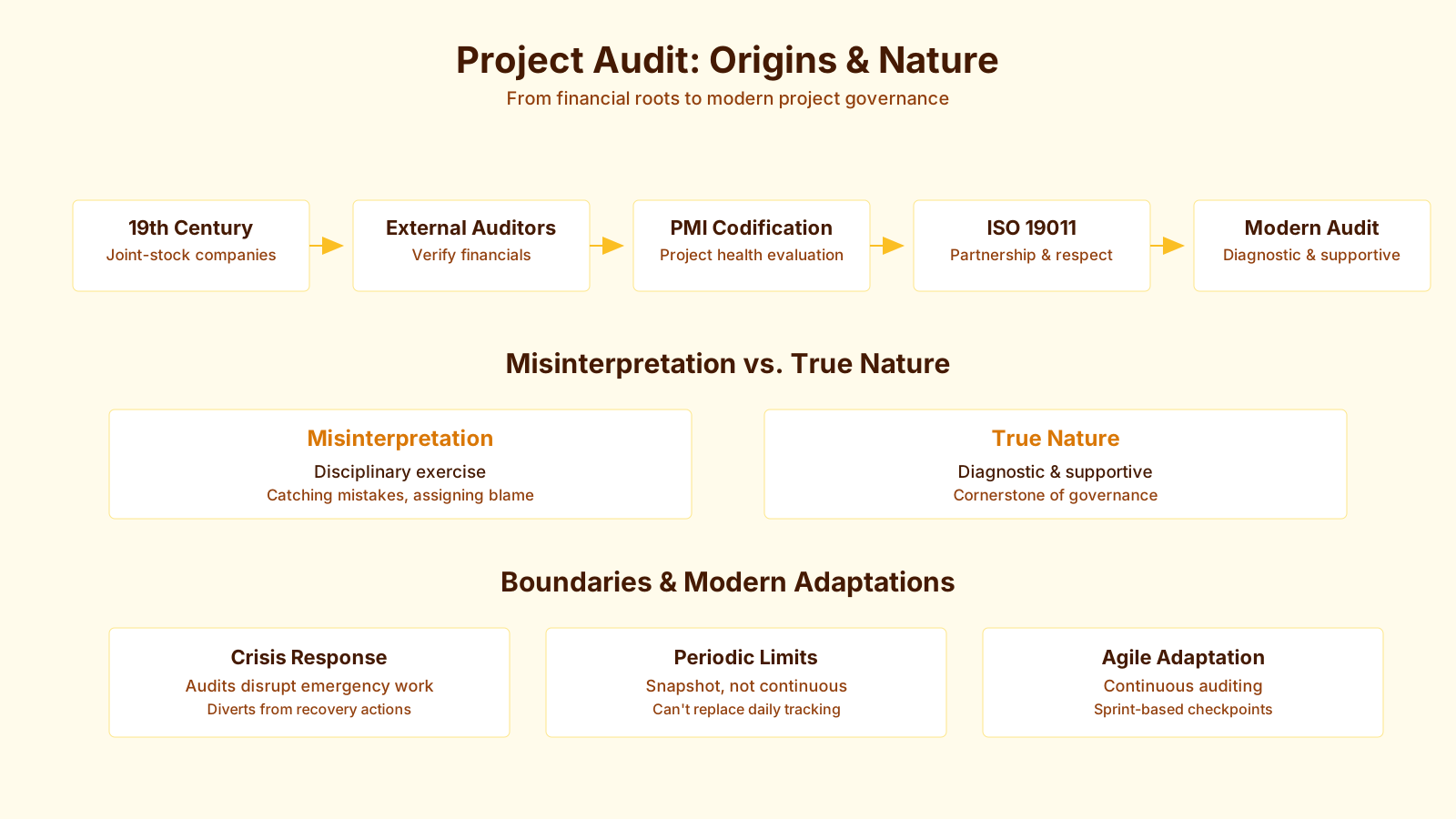
An audit in project management refers to a structured, independent examination of a project’s processes, deliverables, documentation, and compliance with established standards, policies, and contractual requirements. Unlike ongoing monitoring or routine status reviews, an audit is typically a formal, periodic assessment that evaluates whether the project is being managed correctly and whether its outputs meet quality and governance expectations. The concept originates from financial accounting but has been adapted across industries, including construction, software development, and manufacturing, to verify that what is being built matches what was planned and that the methods used are sound. In the project context, audits are not merely about catching mistakes; they are a learning and assurance mechanism that can uncover systemic weaknesses before they cause irreparable damage.
Audits at a Glance: Summary Table
| Key Concept | Summary |
|---|---|
| Audit Purpose | A systematic, periodic examination that appraises both the project's managerial processes and its deliverables against established quality benchmarks and governance frameworks. |
| Distinction from Testing | While testing and quality control validate product conformance to specifications, audits provide a holistic assessment of management effectiveness, governance robustness, and process adherence, offering a broader health check of the project. |
| Audit Scope & Depth | Audit scope can vary from a targeted compliance snapshot of an isolated process to an exhaustive evaluation encompassing project execution, governance structures, and stakeholder engagement maturity. |
| Historical Evolution | The lineage of project audits extends to ancient financial oversight practices, and they gained systematic traction during the Industrial Revolution as industries formalized controls to safeguard safety, product quality, and fiscal integrity. |
| Quality Management Integration | The ascendancy of quality management systems in the 20th century, exemplified by ISO 9001, institutionalized audits as indispensable instruments for certifying an organization's adherence to its documented processes and continuous improvement commitments. |
| Adoption in High-Stakes Sectors | High-consequence sectors like aviation and healthcare pioneered audit adoption early, given the catastrophic potential of failures; this rigor has since permeated pharmaceuticals, IT systems, and manufacturing, where systemic lapses can incur severe operational and human costs. |
| Alignment with Methodologies | PRINCE2 integrates audit discipline implicitly through its core principles of continued business justification, capturing lessons learned, and clearly defined roles and responsibilities, delivering governance rigor without explicitly labeling these as audit activities, in contrast to PMBOK's more overt emphasis on the term. |
What Is an Audit in Project Management?
The project audit definition goes beyond simple inspection or review by emphasizing independence, objectivity, and a systematic methodology. An audit evaluates evidence against defined criteria—such as the project management plan, quality management plan, risk register, or organizational process assets—and reports findings without bias. It asks not just “are we doing the project right?” but also “are we doing the right project?” This distinction separates audits from mere testing or quality control activities, which tend to focus on product specifications rather than the broader health of the initiative. A project audit can be internal, conducted by members of the organization who are not directly involved in the project, or external, performed by third-party auditors with no prior stake in the outcome. The depth and scope vary widely, from a brief compliance check focusing on a single process to a comprehensive audit examining every aspect of project execution, governance, and stakeholder alignment.
The formal nature of an audit means that it follows a predefined set of steps: planning, evidence collection, analysis, reporting, and follow-up. Auditors do not simply walk around and form opinions; they use checklists, interviews, document reviews, and data sampling to corroborate their observations. This rigor is what gives audits their credibility and why they are often a requirement in regulated industries or in organizations with mature project management offices. Despite their reputation for being confrontational, effective audits are designed to be collaborative, with the auditee given opportunities to clarify or dispute findings before finalization. At its core, an audit is a health check that reveals whether the project’s vital signs align with the organization’s appetite for risk and its definition of success.
Key Insights on Project Audits
- Independent and objective evaluation
- An audit systematically appraises project evidence against benchmarks such as the project management plan, quality management plan, and risk register to produce unbiased, actionable findings that strengthen stakeholder confidence.
- Broader than quality control
- While quality control verifies product conformity to specifications, a project audit evaluates the overall management approach and governance, determining whether the project is executed effectively and aligned with strategic goals.
- Internal or external auditors
- Audits are performed either internally by members independent of the project or externally by third parties with no vested interest, and their scope can span from a narrow compliance review of a single process to a full-scale assessment of the entire project's health.
- Structured, collaborative health check
- Following a structured methodology of planning, evidence gathering, analysis, reporting, and follow-up, audits incorporate a collaborative exchange that enables auditees to clarify findings, providing a comprehensive health check of the project's alignment with organizational risk appetite and success benchmarks.
Origins and Cross-Industry Context
Although project management audits are now a distinct discipline, the history of audits stretches back centuries to the practice of financial accountability in ancient civilizations, where officials would verify records of grain storage or tax collection. The modern audit movement gained momentum during the industrial revolution, as factory owners and regulators needed reliable ways to ensure safety, quality, and financial integrity. In the twentieth century, the rise of quality management systems—particularly ISO 9001—codified the audit as a mandatory tool for certifying that organizations followed documented processes. Industries like aviation and medicine adopted audit methodologies early because the consequences of failure were catastrophic; a maintenance audit on an aircraft engine or a clinical audit in a hospital literally saves lives.
The cross-industry influence on project audits is unmistakable. Financial audits introduced sampling techniques and the concept of materiality—focusing on errors that could significantly alter decisions. Quality audits from manufacturing emphasized process conformance and the identification of root causes rather than blame. Safety audits from heavy industry added the principle that near-misses and latent conditions are as important to investigate as actual accidents. When these ideas migrated into project management, they shaped how audits are conducted today: they are risk-based, evidence-driven, and preventive by design. It is not uncommon for a project manager in a pharmaceutical company to encounter an auditor who applies the same rigor as one would in a Good Manufacturing Practice inspection, or for an IT project to be audited using methods borrowed from financial controls and Sarbanes-Oxley compliance. This heritage explains why so many audit terms—like “finding,” “nonconformity,” and “corrective action”—sound familiar across business functions.
Key Components and Types of Project Audits
To fully grasp the range of types of project audits, it helps to break them down by focus area, timing, and origin. A quality audit, which is perhaps the most widely referenced in the PMBOK Guide, assesses whether project activities comply with the quality policies, processes, and procedures defined in the quality management plan. It often reviews deliverables against acceptance criteria and inspects whether quality assurance activities are being performed as intended. A risk audit, on the other hand, zeroes in on the effectiveness of risk responses; it checks whether risks have been correctly identified, whether response strategies are working, and whether residual and secondary risks are being monitored. Procurement audits examine the contracting process from solicitation through closure, verifying that the buyer-seller relationship adhered to terms and identifying lessons learned for future contracts.
Beyond these broad categories, practitioners often distinguish between compliance audits and performance audits. Compliance audits answer the question, “Are we following the rules?”—rules that could be internal, such as a project management methodology, or external, like government regulations. Performance audits look deeper, at whether the project is achieving its objectives efficiently and economically. There is also a temporal dimension: a concurrent audit happens while the project is underway, allowing real-time correction, while a post-project audit occurs after closure and serves primarily as a knowledge-capture tool. Some organizations use milestone-based audits, triggering an audit at the end of each phase or at significant decision gates. The chosen type depends on what the organization is trying to protect or improve—budget control, schedule adherence, scope stability, or stakeholder trust—and on how much disruption the project team can absorb.
Quality Audits
A quality audit is not the same as testing the product. It is a review of the processes used to create the product. The auditor looks at whether design reviews were held, whether test plans were followed, whether nonconforming items were tracked to closure. One of the subtle but powerful benefits of a quality audit is that it frequently identifies process improvements that the project team could not see because they were too close to the day-to-day work. The PMBOK Guide’s Manage Quality process explicitly lists quality audits as a tool and technique, and notes that they may confirm the implementation of approved change requests, corrective actions, and defect repairs. In practice, a quality audit might sample a handful of completed user stories in an Agile context to verify that the definition of done was consistently applied and that technical debt was not accumulating unnoticed.
Risk Audits
A risk audit examines the risk management process itself, not the risks. It checks whether the risk register is being actively maintained, whether risk owners are engaged, and whether contingency plans still make sense given shifts in the project environment. It is not uncommon for risk audits to reveal that high-probability risks have been consistently underestimated because of optimism bias, or that low-impact risks have consumed disproportionate management attention. The PMBOK Guide ties risk audits to the Monitor Risks process, emphasizing that they evaluate the overall effectiveness of risk responses and the risk management plan. An experienced auditor might point out that even though all identified risks have response plans, the project lacks a process for capturing emerging risks that do not fit the original categories—a gap that can be catastrophic in a fast-moving market.
Procurement Audits
Procurement audits focus on the legal and administrative aspects of contracts within a project. They trace the entire procurement lifecycle: make-or-buy decisions, vendor selection criteria, contract negotiation, performance reporting, payment schedules, and formal acceptance. Any deviation from the procurement management plan or the signed contract becomes a finding. These audits are particularly critical when public funds are involved or when the project depends on a handful of critical suppliers. Beyond compliance, a procurement audit often unearths valuable insights about supplier relationship management that can inform future sourcing strategies. A finding that a certain vendor consistently delivered late because of unrealistic lead times in the request for proposal can change how the organization writes its next RFP, benefiting the entire portfolio.
Key Insights on Audit Types
- Audits classified by focus area
- Each audit type addresses a specific project dimension: quality audits verify conformance to the quality management plan; risk audits assess whether risk responses are suitable and effective; procurement audits examine contract performance; and compliance audits confirm conformance with laws, regulations, and organizational policies.
- Timing shapes audit purpose
- Concurrent audits conducted during project execution provide real-time feedback that enables timely adjustments and keeps outcomes on track, whereas post-project audits distill lessons learned and institutional knowledge to strengthen future project delivery.
- The PMBOK Guide includes quality audits
- In the PMBOK Guide framework, quality audits are a defined tool of the Manage Quality process, providing structured assessments that validate compliance with organizational policies and verify that approved change requests, corrective actions, and defect repairs have been effectively executed.
Audits in Project Management Frameworks
The PMBOK audit processes are embedded across several Knowledge Areas, not as a standalone process group, which sometimes causes confusion for new project managers. In the PMBOK Guide, the Manage Quality process (under Project Quality Management) uses quality audits to determine whether project activities comply with organizational and project policies. The Monitor Risks process (under Project Risk Management) employs risk audits to examine the effectiveness of risk responses. The Control Procurements process (under Project Procurement Management) leverages procurement audits to review the contracting process from plan through closure. These audits are presented as tools and techniques, meaning they are methods that a project manager and team can apply rather than mandatory stages. The Guide makes clear that audits can be performed by internal or external auditors and should be scheduled at intervals that reflect the project’s complexity and risk exposure.
PRINCE2, the structured method developed by the UK government, does not use the term “audit” as prominently as PMBOK does, but its principles of continued business justification, learn from experience, and defined roles and responsibilities embed an audit-like discipline throughout. PRINCE2 projects have a Project Assurance role responsible for monitoring compliance and ensuring the project remains viable. Health checks and quality reviews, particularly during the Managing Product Delivery and Closing a Project processes, function as audits in all but name. In some PRINCE2 implementations, a formal independent audit may be commissioned at stage boundaries, and the method’s emphasis on lessons reports and end-project reports reflects an auditing mindset. The management products—such as the Quality Register and Configuration Item Records—provide the documentary evidence an auditor would seek.
Agile and hybrid environments present a more nuanced picture. Classic Agile frameworks like Scrum do not include formal audits; instead, they rely on inspect-and-adapt cycles, such as sprint reviews and retrospectives, which serve a similar purpose in a far less structured manner. However, in scaled Agile environments, especially those operating in regulated industries, an audit function may be integrated at the program level. Some organizations perform “Agile audits” that check whether the principles of the chosen framework are being honored—whether the team is truly self-organizing, whether work in progress limits are respected, whether the organization is removing impediments fast enough. The Lean governance concept of “go see” (genchi genbutsu) aligns with audit philosophy: leaders and auditors going to where work happens and observing reality rather than relying on reports. Hybrid projects, which blend predictive and adaptive practices, often schedule audits at the same cadence as traditional phases while keeping the audit scope light and iterative, reflecting the flexibility of the delivery approach.
The BVOP Perspective on Audits
From a Business Value-Oriented Project Management standpoint, audits are not merely compliance rituals but diagnostic tools that detect process damage and value erosion that accumulate quietly in projects. BVOPM emphasizes that invisible organizational harm—what it terms “process damage”—can remain undetected without the kind of systematic scrutiny that an audit provides. An auditor, in this view, is looking for signs of overwork, perfectionism that adds no business value, and rejected work that was actually acceptable, all of which are categories of waste that BVOPM explicitly targets. By linking audit findings to Business Value Points, a BVOPM-minded organization can go beyond pass-fail judgments and quantify whether the project’s underlying processes are actually contributing to or subtracting from value realization. A persistent decline in those points, if uncovered during an audit, might trigger not just corrective actions but a serious discussion about closure.
BVOPM’s focus on cross-functional teams and transparent issue tracking also shapes how audits are conducted. Because the methodology insists that brief planning documents be readable by everyone, including new joiners, an auditor can more easily trace whether what the team planned aligns with what they executed. The methodology’s hiring-and-training-based dependency analysis means that an auditor evaluating human resource risks might look beyond the usual skills matrix to see whether onboarding and knowledge transfer have been factored into the schedule. In this sense, a BVOP-aware audit expands the traditional checklist to include softer, but equally consequential, factors that determine whether a project can sustain its value delivery over time.
Core Insights on BVOP Audits
- Audits as diagnostic tools
- BVOPM positions audits as diagnostic instruments that reveal the silent accumulation of process damage and value erosion, rather than treating them as routine compliance exercises.
- Targeted waste categories
- Auditors actively detect patterns of overwork, perfectionism that lacks business value, and unwarranted rejection of acceptable work, each representing a specific waste category that BVOPM explicitly targets for elimination.
- Quantified value measurement
- By tying audit results to Business Value Points, organizations transcend simplistic pass-fail evaluations and assess whether underlying processes are truly advancing or eroding value realization.
Practical Application of Audits in Projects
The project audit process in practice rarely follows the neat, linear sequence found in textbooks. An audit might be triggered by a governance board concerned about a project that is consistently amber on its dashboard, or by a contractual clause that requires a third-party assurance review before payment of a milestone. The project manager is typically notified weeks in advance, asked to prepare documentation packs, and expected to make team members available for interviews. The auditors arrive with a detailed checklist—often based on the project management plan and any relevant organizational standards—and begin tracing how work is actually performed. They might spot that the change log shows eighteen unapproved changes that bypassed the formal integrated change control process, not out of malice but because the process itself was so cumbersome that the team developed a workaround. That kind of finding is exactly what makes a capable auditor worth their fee: they see the system, not just the symptoms.
During the evidence collection phase, the auditor uses techniques like stratified sampling of deliverables, review of meeting minutes to detect decision latency, and examination of the issue log to identify patterns. A common scenario involves a software project where the code review process is documented as thorough, but the auditor discovers that pull requests are merged with only superficial comments ninety percent of the time. The finding is not that the team is incompetent; it is that the definition of “review” is too loose and the project lacks a measurement for review effectiveness. Once the audit report is issued, the project manager and sponsor must respond with a corrective action plan that addresses each finding, assigns an owner, and sets a target date. Follow-up audits, or at least a formal closure of findings, ensure that the issues are not swept aside once the immediate pressure is off. In mature organizations, the audit report is also fed into the lessons learned repository, so that future projects do not repeat the same procedural missteps.
Common Challenges, Pitfalls, and Misconceptions
A surprisingly persistent misconception is that an audit is the same as a witch hunt. This fear causes project teams to hide problems, which defeats the very purpose of the audit. Audit challenges often begin with human dynamics: the auditee feels judged, the auditor struggles to remain objective in the face of defensiveness, and the sponsor wants a clean report to protect reputations. A related pitfall is scope creep of the audit itself. What begins as a focused quality audit can balloon into a fishing expedition that examines every decision ever made, paralyzing the project for weeks. Experienced auditors guard against this by having a clearly defined audit charter and a time-boxed schedule, but not every organization enforces that discipline.
Another difficulty is the so-called “checklist mentality,” where the auditor mechanically ticks boxes without exercising professional judgment. A project might show all the right signatures on all the right forms, yet still be fundamentally broken because the culture punishes honest reporting. A good auditor knows when to probe deeper, but an inexperienced one can produce a report that gives a false sense of security. There is also the problem of audit fatigue: when projects are subjected to overlapping audits from different governance bodies—internal PMO, external client, regulatory agency—the team spends more time preparing for audits than delivering value. Smart organizations coordinate audit schedules and share findings across compliance functions to minimize this burden. Finally, a common mistake is treating an audit as a one-time event rather than embedding its lessons into process improvements that outlast the project.
Key Takeaways on Audit Pitfalls
- Audit as a witch hunt
- Treating audits as adversarial witch hunts provokes teams into concealing deficiencies, directly thwarting the audit's core purpose of surfacing and addressing organizational vulnerabilities.
- Uncontrolled scope and emotions
- Without a tightly defined scope, audits devolve into fishing expeditions when auditors, auditees, and sponsors react defensively or protect reputations; a precise charter and strict time-boxed schedule are therefore essential.
- Checklist mentality provides false reassurance
- Mechanically ticking boxes without exercising professional judgment produces superficially reassuring reports that overlook fundamental flaws, especially in organizational cultures that penalize candid disclosure.
- Audit fatigue and a one-off mindset
- Duplicative audit demands from multiple governance bodies drain team capacity and diminish value delivery, while treating each review as an isolated event prevents organizations from converting findings into lasting process improvements.
Relationships to Other Project Management Concepts
Understanding audit vs inspection is crucial because the two are frequently conflated. An inspection is a point-in-time check of a specific deliverable or work product against precise specifications; it asks, “Does this component meet the drawing?” An audit asks a larger question: “Does the system that produced this component reliably create conforming outputs, and if not, why not?” Audits are therefore upstream of inspections, identifying the process weaknesses that inspections can only detect after the fact. This distinction matters because replacing inspections with audits can shift a project from merely catching defects to preventing them.
Audits also intersect deeply with quality assurance and quality control. Quality assurance is about building processes that prevent defects, while quality control is about measuring outputs and rejecting nonconforming ones. Audits serve as a bridge between the two: they evaluate whether quality assurance activities are effectively preventing defects, and they often scrutinize quality control records to see if trends are being analyzed. Another closely related concept is the governance review, which is a broader evaluation of project alignment with strategic objectives. A governance review might use audit findings as input but will also consider market changes, stakeholder satisfaction, and business case viability. The relationship between audits and lessons learned is also symbiotic: a well-run audit feeds directly into the organizational knowledge base, while past lessons often form the criteria against which new audits are conducted.
Evolution and Current Thinking
Modern audit practices in project management have moved away from the rigid, adversarial model toward a more collaborative, risk-based approach. The old view that auditors must be detached and impersonal is giving way to the recognition that true objectivity does not require coldness. Some organizations now experiment with “mini-audits” or “sprint audits” that last only a day or two, focusing on a narrow slice of the project in response to an emerging risk indicator. The influence of Agile has introduced the idea that audit findings should be added to the backlog and prioritized alongside feature work, rather than being handed down as non-negotiable directives from a separate authority. This trend, while not yet mainstream, shows promise in reducing the friction between auditors and teams.
There is also a growing debate about the role of technology in project audits. Data analytics tools can now scan project management information systems to flag anomalies automatically—for example, an unusual pattern of schedule baseline resets or a spike in cost variances immediately after a certain milestone. Some argue that continuous, automated surveillance makes traditional periodic audits obsolete, while others counter that algorithms lack the contextual understanding to interpret the human factors behind the numbers. The concept of “integrated assurance” is gaining traction, wherein financial, quality, risk, and security audits are combined into a single, unified assessment, informed by a shared data model. Whether these trends will fundamentally reshape the audit or simply supplement it remains an open question, but what is certain is that the need for independent, evidence-based assurance of project health will not disappear, no matter how the tools evolve.
Key Insights on Audit Evolution
- Collaborative risk-based audits
- Project audits have moved from rigid, adversarial inspections to collaborative reviews anchored in risk assessment and constructive problem-solving.
- Objectivity without detachment
- Today's audit profession affirms that true objectivity is enhanced by trust and open communication, not compromised by working closely with the project team.
- Mini and sprint audits
- Forward-thinking organizations use focused mini audits, often lasting just one or two days, to investigate a narrow project slice as soon as an early risk indicator emerges.
- Agile-aligned audit findings
- Agile-inspired practices now treat audit observations as backlog items that teams prioritize and address within their regular workflow, replacing prescriptive top-down directives.
- Integrated assurance approach
- Integrated assurance unifies financial, quality, risk, and security audits into a single coherent assessment built on a shared data model, eliminating redundancy and delivering holistic governance insights.