The adaptive development approach is a product delivery methodology in which detailed requirements are not fully known at the outset but are discovered and refined through repeated short cycles of work and continuous stakeholder collaboration. Within the Project Management Institute’s lexicon, this approach is characterized by high levels of uncertainty and volatility in requirements, with scope being elaborated and approved incrementally as the project progresses. Rather than attempting to nail down every specification before work begins, teams using an adaptive approach expect change and treat it as a natural part of the development process, not an exception to be controlled. This mindset places a premium on rapid feedback, frequent inspection of working deliverables, and the ability to pivot quickly when new information emerges.
At a Glance: The Adaptive Development Approach
| Key Concept | Summary |
|---|---|
| Definition | Adaptive development is a change-driven delivery approach in which requirements evolve iteratively through short work cycles and continuous stakeholder collaboration, rather than being fully predefined. |
| Origins | The term originates from Jim Highsmith's Adaptive Software Development (late 1990s), which drew on complex adaptive systems theory to promote self-organizing teams and emergent, responsive project behavior. |
| Iterative Delivery | Each time-boxed iteration, typically lasting one to four weeks, produces a tangible, testable product increment that stakeholders can directly evaluate and provide feedback on. |
| Feedback Loops | Frequent delivery of working increments establishes tight feedback loops, enabling continuous inspection and rapid pivoting as new information and stakeholder insights surface. |
| Empirical Control | Grounded in transparency, inspection, and adaptation, the process uses observable evidence from working software to refine the backlog, rather than relying on a detailed upfront plan. |
| Team Structure | Cross-functional, self-organizing teams possess all necessary skills to produce completed increments independently, while management focuses on removing impediments and maintaining enabling constraints. |
| Scope Flexibility | Adaptive projects typically fix time and cost while allowing scope to flex, inverting the traditional predictive model where scope is fixed and schedule and budget are variable. |
| PMBOK Recognition | The Sixth Edition identifies it as a change-driven (Agile) life cycle, and the Seventh Edition recognizes it as one of four fundamental development approaches: predictive, iterative, incremental, and agile. |
| Frameworks | Notable frameworks include Scrum, Kanban, and Extreme Programming (XP). PRINCE2 Agile supports adaptive delivery by integrating agile techniques into its governance framework. |
| Iteration Scope | Individual iteration scope is fixed and committed once the iteration begins, but the overall project scope remains flexible and evolves through insights gained from each delivered increment. |
What Is an Adaptive Development Approach?
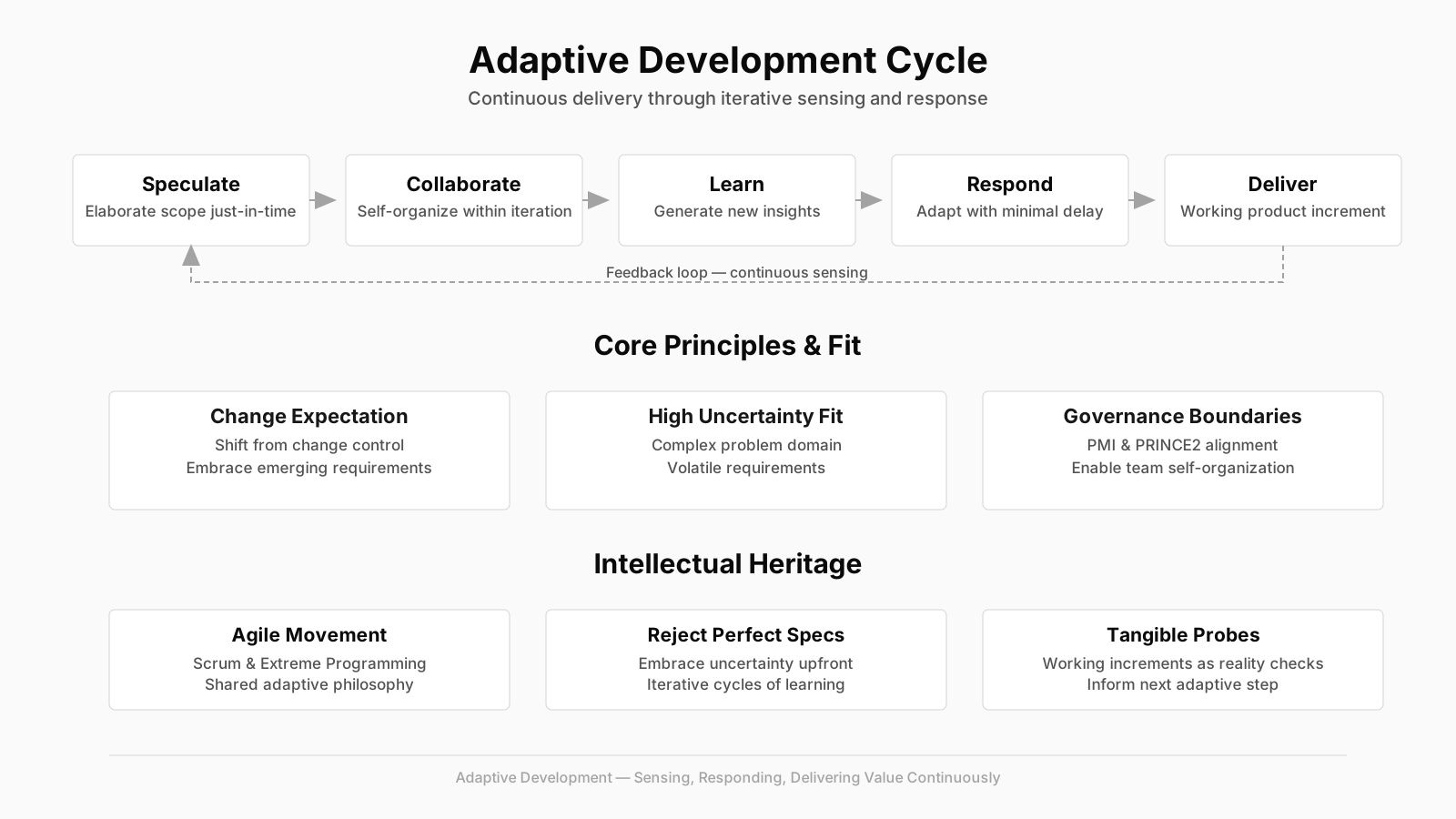
Defined in the PMBOK Guide Sixth Edition as a change-driven life cycle also known as Agile, the adaptive development approach definition encompasses methods where iterations are very rapid and each cycle produces a usable increment of the product. The PMBOK Seventh Edition broadens this into one of four primary development approaches: predictive, iterative, incremental, and adaptive, noting that adaptive approaches are appropriate when requirements are subject to a high degree of uncertainty and change. In plain terms, the team commits to a time-boxed period of work, typically one to four weeks, and at the end of that period they deliver something tangible that stakeholders can actually interact with. The scope of that specific iteration is fixed and approved before the work starts, but the overall project scope remains flexible and evolves based on what is learned from each delivery.
PRINCE2 does not explicitly label anything as an adaptive development approach in its core manual, but its tailoring guidance, particularly in PRINCE2 Agile, fully accommodates adaptive delivery by overlaying Agile techniques onto the governance framework. The key insight is that adaptive development is not a methodology in itself; it is a broad category that includes specific frameworks like Scrum, Kanban, Extreme Programming, and others. The term’s origin in management literature can be traced back to Jim Highsmith’s work on Adaptive Software Development in the late 1990s, which drew from complex adaptive systems theory to propose that software projects should mimic the self-organizing, emergent behavior seen in natural systems. What stuck from that early thinking was the rejection of linear, deterministic planning in favor of a process that senses changes and responds with minimal delay.
The intellectual basis from complex adaptive systems is worth digging into briefly because it explains why the approach works the way it does. In a complex system, small changes can produce large, unpredictable effects, and the environment itself is constantly shifting. A project that builds something new, especially software, behaves much like this. Trying to predict every requirement months in advance is a fool’s errand when users don’t know what they want until they see something working. The adaptive approach accepts that uncertainty and bakes in the ability to learn and adjust. Over time, the phrase “adaptive development” has become a standard term in PMI circles, appearing in the Agile Practice Guide and the PMBOK standards as a formal descriptor, while in the broader industry it often gets lumped under the Agile umbrella.
Core Insights on Adaptive Development
- Change-driven rapid iterations
- Aligned with Agile as described in the PMBOK Guide, adaptive development uses rapid, change-driven cycles that deliver a functional product increment at the end of each iteration.
- Time-boxed delivery cycles
- Teams commit to fixed timeboxes, typically one to four weeks, producing a tangible outcome at the end of each iteration while retaining the flexibility to adjust overall project scope.
- Broad category, not methodology
- Adaptive development is an umbrella term that encompasses specific frameworks such as Scrum, Kanban, and Extreme Programming, rather than a single standalone methodology.
- Rooted in complexity theory
- Originating from Jim Highsmith's Adaptive Software Development, the approach applies complex adaptive systems theory to move beyond linear planning and enable rapid responsiveness to change.
Key Characteristics and Components of Adaptive Development
Several features distinguish an adaptive development approach from more traditional ways of building products. The key characteristics of adaptive development include iterative and incremental delivery, short feedback loops, empirical process control, and a culture that not only tolerates but actively encourages change. The iterative nature means that the team repeatedly cycles through planning, execution, and review, learning something each time. The incrementality ensures that each cycle adds a piece of working, tested functionality that can be released if needed. This is a crucial distinction: iterative means refining through repetition, while incremental means building piece by piece. Adaptive approaches almost always combine both, which is why the PMBOK often refers to them as both iterative and incremental.
Short feedback loops are the heartbeat of adaptive work. When an iteration lasts only two weeks, stakeholders see progress quickly and can correct misunderstandings before the team goes too far down a wrong path. Empirical process control, a concept borrowed from lean manufacturing and Scrum, relies on transparency, inspection, and adaptation. Instead of following a detailed plan, the team observes what actually happens, measures real progress against working software, and adjusts the backlog accordingly. The backlog itself is a living artifact — a prioritized list of desired features that the product owner continuously grooms based on new insights, shifting business priorities, and user feedback.
Cross-functional teams are another central component. Because adaptive approaches demand the ability to deliver a done increment every iteration, the team must include all the skills needed to take a feature from concept to completion without handoffs to external groups. This reduces waiting time and prevents the loss of context that occurs when work passes between silos. Self-organization is expected, not as a lofty ideal but as a practical necessity: the people closest to the work are best positioned to figure out how to get it done. Management’s role shifts from directing tasks to removing impediments and setting clear boundaries within which the team can operate autonomously.
One more defining characteristic is the use of fixed time and cost but variable scope. In a predictive project, scope is fixed and time and cost are estimated based on that scope. In an adaptive project, the date and the team size are generally fixed, and the scope flexes. This inversion is often the hardest thing for traditional organizations to swallow, because it feels like giving up control. In practice, it is a far more honest approach: it acknowledges that in complex work, you cannot know everything in advance, so you commit to delivering the highest-value items within the constraints you have.
Adaptive Development in Project Management Frameworks
Project management frameworks have incorporated adaptive concepts in different ways. Adaptive development in PMBOK appears most prominently in the transition from the Sixth Edition’s appendix on Agile to the Seventh Edition’s entire paradigm shift toward principles and development approaches. The Sixth Edition process-based view still recognized adaptive life cycles within the development life cycle discussion, noting that iterative and incremental approaches are appropriate when scope cannot be fully defined. The Seventh Edition abandons process groups as the central organizing structure and instead speaks of development approaches as one dimension of tailoring, placing adaptive on par with predictive, iterative, incremental, and hybrid. This signals a formal acceptance that no single approach is universally correct.
In the PMBOK’s planning processes, when an adaptive approach is selected, the emphasis moves from upfront detailed planning to rolling-wave planning. The project charter still exists, but it is lighter, acknowledging that the precise product scope will emerge. The work breakdown structure is typically replaced by a product backlog, and the schedule is managed through cadence and iteration planning rather than a fully elaborated Gantt chart. Quality management becomes continuous, built into the team’s definition of done, with automated testing and frequent reviews. Risk management remains essential, but risks are often surfaced during daily standups and retrospective meetings, rather than through a single risk register updated periodically.
PRINCE2 takes a different route. Adaptive delivery within PRINCE2 is enabled by the PRINCE2 Agile guidance, which maps the principles, themes, and processes of PRINCE2 onto common Agile practices. PRINCE2’s management stages still provide control points for governance, but the technical delivery stages may be run iteratively using an adaptive approach. The concept of tolerances is particularly useful here: a project board sets time, cost, quality, risk, and benefit tolerances, and the project manager can operate flexibly within those boundaries. If a forecast suggests a tolerance will be exceeded, the board decides whether to adjust or stop the project. This provides a governance safety net that works with, not against, the adaptive mindset.
The Agile Manifesto and its twelve principles form the philosophical backbone of most adaptive approaches, even if the manifesto itself is not a formal framework. The principles that value responding to change over following a plan, delivering working software frequently, and welcoming changing requirements even late in development align perfectly with the adaptive approach as described in PMI’s standards. In fact, the PMI’s Agile Practice Guide explicitly bridges the manifesto and the PMBOK, making it clear that adaptive development is a legitimate, mature choice for projects in uncertain environments. The conversation has shifted from whether to use adaptive methods to when and how to tailor them appropriately.
Key Insights on Adaptive Development
- PMBOK formalizes adaptive approaches
- The Seventh Edition placed adaptive development on par with predictive, iterative, incremental, and hybrid methods, marking a deliberate shift from process groups to guiding principles and affirming that no single delivery model fits every project context.
- Rolling-wave planning replaces upfront detail
- Adaptive planning uses rolling-wave design, a prioritized product backlog in place of a traditional work breakdown structure, cadence-driven iteration scheduling, continuous quality practices, and early risk surfacing through daily standups and retrospectives.
- PRINCE2 Agile governs through tolerances
- PRINCE2 Agile retains management stages as governance checkpoints while delivering technical work iteratively; the project board sets tolerances for time, cost, quality, risk, and benefits, empowering managers to adapt within clearly defined boundaries.
Types of Adaptive Development Approaches
Although adaptive development approach types are numerous and sometimes overlap, a few prominent methods dominate practice. Scrum is by far the most widely adopted. It organizes work into sprints of a fixed length, usually two weeks, with defined roles: a product owner who manages the backlog, a Scrum master who facilitates the process, and a self-organizing development team. Daily standups, sprint reviews, and retrospectives provide the rhythm of inspection and adaptation. Scrum prescribes nothing about technical practices, which makes it broad enough to be applied in many contexts, but also means it must be supplemented with technical disciplines from other methods.
Kanban offers a less prescriptive alternative. It does not mandate iterations but instead visualizes workflow on a board, limits work in progress, and aims to optimize flow. Work items are pulled as capacity allows, and cycle time and throughput are measured to continuously improve. Kanban suits environments where incoming work is unpredictable, such as maintenance or support teams, but it can also be combined with Scrum in what is sometimes called Scrumban, where a continuous flow is punctuated by periodic planning and review cadences. Extreme Programming (XP) takes a more radical stance on technical excellence, emphasizing practices like test-driven development, pair programming, continuous integration, and shared code ownership. XP’s intense focus on code quality and its ability to embrace changing requirements make it a highly refined adaptive approach, though its full adoption demands a mature team and supportive culture.
Lean Development, inspired by Toyota’s production system, focuses on eliminating waste, amplifying learning, deciding as late as possible, and delivering as fast as possible. It views any activity that does not directly add customer value as waste, including excessive documentation, waiting, and partially done work. Lean principles underpin many adaptive methods, and the concept of minimizing work in progress is common across Kanban, Scrum, and XP. The Scaled Agile Framework (SAFe) attempts to bring adaptive principles to large enterprises by adding layers of coordination, though its complexity sometimes dilutes the very adaptability it promotes. Practitioners often observe that the more layers of governance you add, the more you drift back toward predictive control.
Choosing among these types comes down to context. A small co-located team building a web application may thrive with pure Scrum and XP. A distributed operations team handling unpredictable incidents might find Kanban a more natural fit. Large organizations with multiple interdependent teams often need something like LeSS (Large Scale Scrum) or Scrum of Scrums. The existence of so many options is itself a testament to the adaptive philosophy: no single prescription fits all, and the approach itself must adapt to the environment.
When to Use an Adaptive Approach
Determining when to use adaptive development involves honestly assessing the project’s uncertainty profile, the culture of the organization, and the nature of the deliverable. Projects with high requirements volatility, where the customer cannot clearly articulate what they want until they see it, are prime candidates. If the work involves a creative or innovative effort where the solution is unknown, an adaptive approach allows learning to shape the outcome. Similarly, when time-to-market pressure demands early delivery of a minimum viable product, the ability to release incrementally becomes a competitive advantage, not just a convenience.
Stakeholder availability is another critical factor. Adaptive methods require frequent, engaged feedback from customers or their proxies. If the business side cannot commit a product owner or subject matter experts to collaborate continuously, the approach will sputter. The physical or virtual co-location of the team also matters; while remote Agile works, it demands deliberate communication practices. Projects that are inherently risky from a technical standpoint benefit from the rapid prototyping and early testing that adaptive methods encourage, because failures occur early and cheaply. A common mistake is to choose an adaptive approach solely because it is trendy, without considering whether the organization’s contracting, budgeting, and governance practices can support it. Many agile transformations fail because the surrounding enterprise processes remain rigidly predictive.
Conversely, there are clear situations where an adaptive approach is a poor fit. Projects with well-understood, stable requirements, such as constructing a building or deploying a known regulatory change, are often better served by a predictive method where design and planning precede execution. When physical assets are involved, the cost of change increases steeply as the project progresses, making early detailed design economically rational. Likewise, in highly regulated industries where rigorous documentation and traceability are mandated, the lightweight documentation typical of adaptive teams may need to be supplemented significantly. The point is not that adaptive methods cannot work under regulation — they can and do — but the overhead required to satisfy compliance may erode some of the speed benefits.
Key Insights on Adaptive Fit
- Ideal for volatile and creative projects
- Adaptive development excels when requirements shift rapidly and the solution path is unclear, allowing early minimum viable products to seize competitive advantage in creative or technically uncertain settings.
- Demands engaged stakeholders and agile enterprise support
- Success depends on continuous stakeholder collaboration and empowered product ownership; the transformation will likely stall unless budgeting, contracting, and governance practices fully align with agile principles.
- Poor fit for stable, regulated, or physical projects
- Projects with well-defined requirements, high cost of physical change, or stringent regulatory oversight typically benefit from predictive methods, though adaptive approaches can work in regulated contexts if the organization accepts the extra compliance burden.
Practical Application and Real-World Scenarios
Bringing adaptive development into practice looks different depending on the domain, but certain patterns recur. A software startup building a new product might begin with a product vision and a handful of high-level epics. The team holds a release planning session to establish a rough roadmap, then dives into the first sprint. During sprint planning, they pull the top items from the backlog, break them into tasks, and commit to a sprint goal. Every day, the standup surfaces blockers. Mid-sprint, a stakeholder demo may elicit feedback that causes the product owner to reprioritize the backlog. At the sprint review, the team demonstrates working software, and the retrospective uncovers process improvements for the next sprint. This rhythm, repeated relentlessly, produces a stream of valuable increments and allows the product vision to sharpen over time.
In a non-software context, adaptive approaches are appearing in marketing campaigns, organizational change initiatives, and even hardware development with rapid prototyping. A marketing team might run two-week iterations where each sprint delivers a tested campaign element — a landing page, a set of ads, a social media strategy — and data from live A/B tests feeds directly into the next sprint’s priorities. The same empirical cycle applies: think, build, test, learn, adjust. The adaptive mindset shifts the definition of success from “followed the plan” to “delivered value and learned quickly.” This is a profound cultural shift, and organizations that get it find that their capacity to respond to market shifts improves dramatically.
Roles in an adaptive project are less about hierarchy and more about accountability. The product owner is accountable for maximizing the value produced by the team, making tough prioritization decisions based on return on investment, risk, and strategic alignment. The development team is accountable for quality and for delivering a done increment each iteration. A project manager, if present at all, often serves as a servant leader, clearing obstacles, facilitating communication with external groups, and ensuring the team has what it needs. This contrasts starkly with the command-and-control project manager role in predictive environments, and many experienced PMs struggle with the transition. Those who succeed learn to measure progress by working software and team health rather than by percent-complete of a plan.
Within the Business Value-Oriented Project Management methodology, adaptive principles are deeply embedded. BVOPM treats scope change not as a failure but as valuable user feedback, using a five-level scope scale from “Definite” to “Unlikely” to categorize expectations realistically. Its emphasis on cross-functional teams and waste reduction — where overwork, perfectionism, and rejecting acceptable work are explicitly tagged as waste categories — aligns with the adaptive commitment to delivering the highest value with the least overhead. The methodology’s relational effort points for estimation and its recognition of process damage as invisible organizational harm further reinforce the need for frequent inspection and adaptation, hallmarks of any adaptive development approach.
Common Pitfalls, Challenges, and Misconceptions
Despite its widespread acclaim, common misconceptions about adaptive development persist and cause real damage in practice. The most dangerous is the belief that adaptive means no planning at all. In reality, adaptive projects involve constant planning at multiple levels: daily, per iteration, per release, and at the product roadmap level. The difference is that plans are treated as hypotheses, not contracts. A team that skips planning altogether will flounder, delivering random features with no coherence. Another myth is that adaptive approaches eliminate documentation. They do not eliminate it; they ask what documentation is truly necessary and what is merely ritual. A user story and acceptance tests can serve as living documentation, but regulatory or handover needs may require more traditional artifacts. The key is to document what is needed, when it is needed, and no more.
Fragile Agile is a term practitioners use for organizations that adopt the rituals of adaptive methods without the underlying mindset. Standups turn into status reports for management, retrospectives produce no real changes, and product backlogs become wish lists managed by a committee. In these settings, the adaptive approach deteriorates into micro-management with a new vocabulary. Another common pitfall is the failure to establish a genuinely cross-functional and empowered team. If team members are matrixed across multiple projects, or if architects and testers are separate teams with their own backlogs, the ability to deliver a done increment within an iteration is severely crippled. Handoffs and delays creep back in, and the benefits of short feedback loops evaporate.
Technical debt is a subtle trap. The pressure to deliver something every sprint can lead teams to cut corners on design and code quality, accumulating workarounds and quick fixes that slow future development. Adaptive development demands a rigorous commitment to sustainable pace and continuous refactoring; otherwise, velocity decays over time. On the cultural front, executives who demand fixed-scope, fixed-date commitments while simultaneously wanting an adaptive approach create a fundamental contradiction. True adaptivity requires trading off scope to protect schedule and quality, and if that trade cannot be made, the approach is being undermined from the top. Education and transparent communication about the nature of the work are the only real antidotes.
Core Pitfalls in Adaptive Work
- Adaptive still requires planning
- Teams must plan at the daily, iteration, release, and roadmap levels while treating each plan as a hypothesis to be tested and adapted rather than a fixed contract.
- Documentation is curated, not eliminated
- Adaptive methods strip away ritualistic documentation yet preserve what is essential, such as user stories, acceptance tests, and regulatory artifacts, to maintain clarity without overload.
- Fragile Agile adopts rituals without mindset
- Organizations that perform standups and retrospectives without embracing adaptive values merely produce status reports, unchanged processes, and micromanagement repackaged in contemporary language.
- Constraints can undermine adaptive delivery
- Accumulated technical debt from sprint pressure erodes velocity over time, while executive demands for fixed scope and deadlines directly contradict the dynamic trade-offs that adaptive delivery requires.
Relationship to Other Development Approaches
Understanding adaptive vs predictive development clarifies the trade-offs inherent in each choice. Predictive, or waterfall, methods assume that requirements can be largely defined upfront, and subsequent phases of design, build, and test follow a linear sequence. Change is managed through formal control procedures that evaluate impact before approval. Adaptive methods, by contrast, assume that upfront requirements will be inaccurate and that iterative delivery with built-in change absorption will produce a better product. Neither is inherently superior; the choice depends on the degree of uncertainty and the cost of change in the specific domain. A bridge cannot be iteratively delivered in small usable increments; a new mobile app can.
The distinction between adaptive, iterative, and incremental approaches is often blurred but worth dissecting. An iterative approach focuses on refining a product through successive approximations, like sculpting a statue by repeatedly shaping and evaluating. An incremental approach builds the product piece by piece, delivering a partially functional version with each increment. Adaptive approaches combine both: they refine what they have built (iterative) while adding new pieces (incremental) in each cycle. Pure iterative development, without incrementality, rarely makes sense in a business context because you would keep working on the same feature set without expanding it. Pure incremental delivery without iteration can work if requirements are clear and stable, but then you are in predictive territory.
Hybrid approaches have emerged as a pragmatic middle ground, mixing adaptive and predictive practices within a single project. A common hybrid pattern is to use a predictive approach for the high-level planning and governance of a project while allowing technical teams to work adaptively within that framework. For example, a large infrastructure project might manage procurement and regulatory compliance predictively, while the software components are built using Scrum. The PMBOK Seventh Edition explicitly endorses tailoring and hybrid models, recognizing that few real-world projects fit neatly into a single category. The art lies in designing the interfaces between predictive and adaptive parts so they do not conflict.
Evolution and Current Thinking
Looking at the evolution of adaptive development reveals a long arc from specialized software practice to mainstream management philosophy. The roots go back to the 1950s and 1960s with iterative and incremental development being used on early space and defense projects, but the modern wave gained momentum in the 1990s with Rapid Application Development, the Dynamic Systems Development Method, and Jim Highsmith’s Adaptive Software Development. The Agile Manifesto of 2001 coalesced these ideas into a shared set of values. In the decade that followed, Agile expanded from small teams to large enterprises, spawning scaling frameworks and a vast consulting industry. The PMI, once a bastion of predictive thinking, gradually absorbed these concepts, culminating in the 2017 release of the Agile Practice Guide and the radical reimagining of the PMBOK in 2021.
Current thinking moves beyond dogmatic adherence to any single framework toward context-driven selection. The concept of “Agile suitability filters” — tools that help organizations assess whether a project, team, and culture are ready for adaptive methods — reflects a more mature, nuanced understanding. The focus has shifted from process mechanics to organizational agility: building structures, policies, and incentive systems that enable frequent inspection and rapid adaptation. There is healthy debate about whether scaling frameworks like SAFe dilute agility by reintroducing layers of formal planning and coordination. Some argue that scaled agility is an oxymoron, while others see it as a necessary compromise in large, complex environments. Both camps agree that leadership mindset, more than any framework detail, determines success.
The integration of adaptive principles with design thinking and lean startup methods has created a front-to-back innovation pipeline. Teams use design thinking to discover customer problems, lean startup to validate business hypotheses, and adaptive delivery to build the solution iteratively. This convergence is pushing project managers to become product thinkers, blending facilitation skills with strategic acumen. The days of the project manager as a pure administrator of work are numbered. Adaptive development, in its many forms, continues to reshape not just how projects are run but what it means to manage a project in the first place.
Core Insights on Adaptive Development
- From niche practice to mainstream management
- Adaptive development originated with iterative methods on 1950s space and defense projects, gained formal recognition through the Agile Manifesto, and ultimately reshaped the Project Management Institute's guidance and the PMBOK Guide.
- Context-driven framework selection
- Modern practice emphasizes agile suitability filters and organizational agility over rigid framework adherence, recognizing that a leadership mindset geared toward learning and adaptation matters more than any particular scaling approach.
- Project managers become product thinkers
- The convergence of adaptive delivery with design thinking and lean startup principles creates a continuous innovation flow that compels project managers to blend expert facilitation with sharp strategic product acumen.