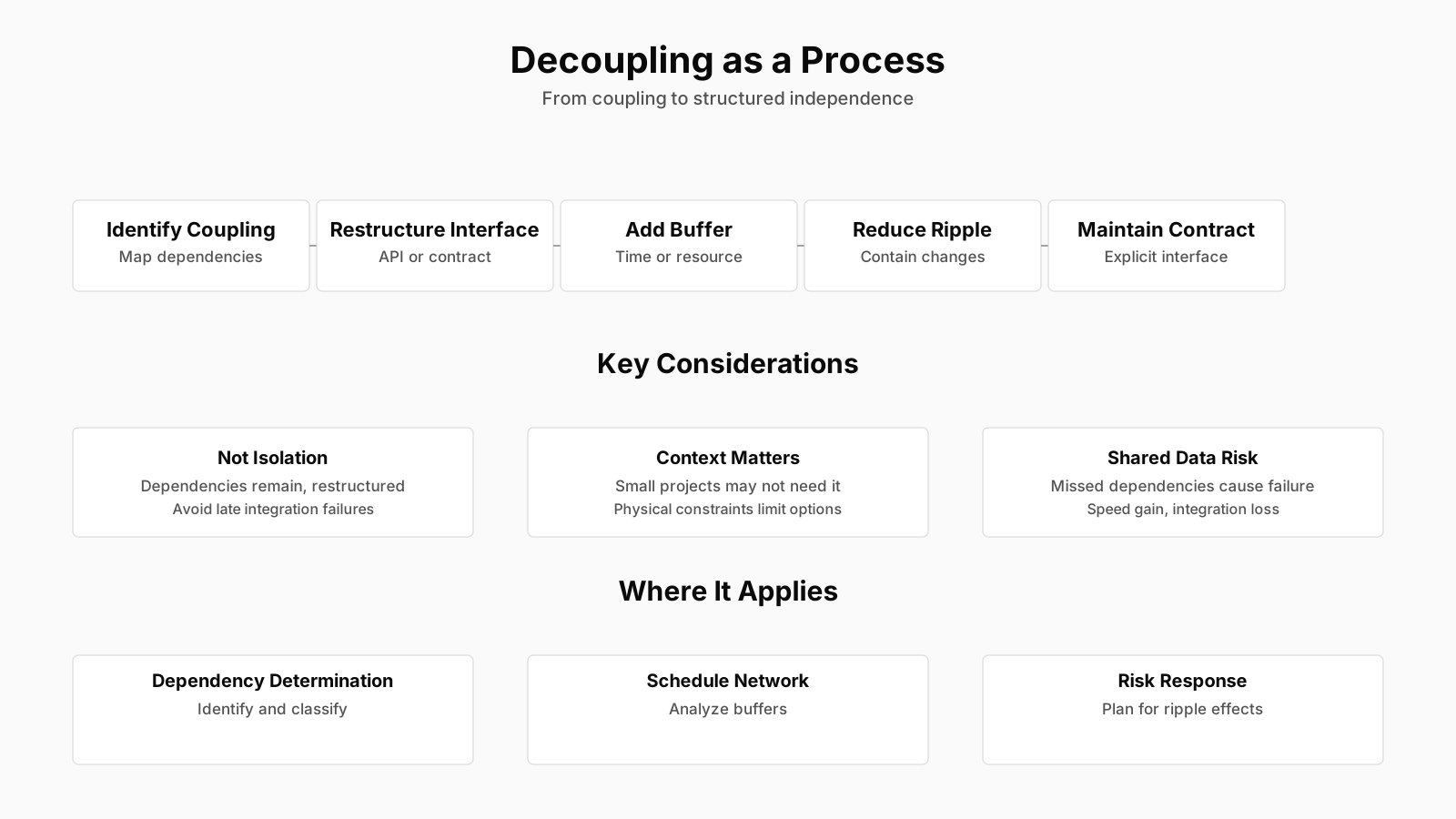
Decoupling in project management refers to the deliberate separation of activities, components, systems, or decisions so that a change, delay, or failure in one area does not automatically cascade into others. It is a strategy for reducing tight dependencies and creating independent work streams that can progress without constant synchronization. The concept appears in scheduling, risk management, organizational design, and software architecture, often under related labels such as loose coupling, modularity, or dependency breaking. Decoupling does not mean removing all relationships between project elements. It means restructuring those relationships so that they are managed through clear interfaces, buffers, or contracts rather than through direct and fragile interdependence.
Key Topics in Decoupling at a Glance
| Key Concept | Summary |
|---|---|
| Decoupling | Decoupling is the intentional isolation of project activities, components, systems, or decisions to contain change and failure, preventing localized issues from cascading across dependent work. |
| Scheduling | Decoupled scheduling embeds time buffers at critical integration points and uses rigorous dependency mapping to ensure that task-level delays do not propagate automatically across the project timeline. |
| Risk Management | Maintaining dedicated risk reserves for interface failures and clearly defined escalation paths isolates potential disruptions before they can affect multiple work streams. |
| Organizational Design | Program managers can reduce cross-team dependencies by establishing independent funding envelopes and formal shared service agreements, allowing each work stream to proceed with greater autonomy. |
| Software Architecture | Modular design, microservices, and well-governed API contracts apply decoupling directly, isolating service failures and preventing a single fault from compromising the entire system. |
| PMBOK Alignment | The PMBOK Guide supports decoupling principles through its guidance on dependency identification, schedule network analysis, and risk response planning, all of which aim to limit the spread of uncertainty. |
| Origins | Decoupling originates in systems theory and engineering, where managing complex interdependencies has long been a foundational practice for building resilience in large-scale systems. |
| Governance | Governance decoupling separates business case approval from technical planning, ensuring that delays or issues in one decision body do not block progress in the other. |
What Is Decoupling in Project Management?
A useful way to understand decoupling in project management definition is to see it as a dependency management technique rather than a standalone process. In nearly every project, some tasks cannot begin until others finish, some components cannot be tested until their dependencies are stable, and some decisions cannot be finalized until upstream information arrives. Decoupling changes that pattern. It introduces a boundary, a standard, a buffer, or an alternative path that lets one part of the project move even when another part is not ready. A project manager might decouple a design phase from a development phase by freezing a portion of the requirements early. Or a program manager might decouple two work streams by creating separate funding envelopes and shared service agreements.
The term is not defined as a formal process in most major project management frameworks, but the underlying idea is embedded throughout them. The PMBOK Guide addresses decoupling indirectly through dependency determination, schedule network analysis, and risk response planning. PRINCE2 touches on it through product-based planning, management stages, and work package boundaries. Agile approaches apply it explicitly through modular architecture, independent product backlog items, and autonomous teams. Because decoupling appears in so many contexts, it is often easier to describe by its effects than by a single locked definition. It reduces the probability that one unstable element destabilizes the entire project.
Decoupling Definition and Core Meaning
The core meaning of decoupling is the reduction of coupling, where coupling is the degree to which one project element depends on another. Tightly coupled tasks must coordinate constantly. Loosely coupled tasks coordinate at defined checkpoints. Decoupled tasks coordinate only through stable agreements, such as a fixed interface, a published schedule, or a shared data format. In project work, this might mean replacing a sequential handoff between design and engineering with an agreed specification that lets engineering start before the full design is complete. It might also mean separating the approval of a business case from the technical planning of a solution so that a delay in one governance body does not freeze the other.
Practitioners often observe that decoupling is not simply an organizational chart exercise. Real decoupling requires a shared understanding of where integration will happen. If two teams are told to work independently but their outputs must eventually fit together, the decoupling effort will fail unless they agree on the shape of that fit. This is why interface definitions, acceptance criteria, and integration points are central to the concept. Decoupling is not about isolation. It is about controlled separation with planned convergence.
Origins and Cross-Industry Context
Decoupling has roots in systems theory and engineering, where designers have long dealt with the problem of complex interdependencies. In software engineering, modular design and service-oriented architecture are direct attempts to decouple components so that one failing service does not bring down an entire system. In manufacturing, product platforms and standardized parts let different teams develop subsystems in parallel. In civil engineering, expansion joints allow sections of a bridge to move independently under thermal stress. These cross-industry examples share a common logic: reduce unnecessary interdependence while maintaining purposeful connections.
The concept entered broader management thinking through systems dynamics and organizational theory. Large organizations often suffer from tight coupling between departments, where a small change in one area triggers unpredictable effects in another. Project management borrowed this awareness to explain why some schedules collapse under minor delays. A tightly coupled schedule can look efficient on paper because it minimizes slack, but it becomes fragile when reality shifts. Decoupling introduces deliberate slack or interface stability to make the schedule more robust. In software delivery, the rise of microservices and API contracts has made decoupling a widely recognized practice, but the underlying project management concern is much older.
Core Insights on Decoupling
- Dependency management technique
- Decoupling operates as a dependency management strategy rather than a standalone formal process, using boundaries, standards, buffers, or alternative paths to allow one project component to progress while a dependent component remains unfinished.
- Embedded across major frameworks
- Although most frameworks do not define decoupling explicitly, it surfaces indirectly in PMBOK through dependency determination and risk response planning, in PRINCE2 through product-based planning and work package boundaries, and in Agile through modular architecture and autonomous team structures.
- Practical decoupling examples
- Project managers apply decoupling by freezing portions of requirements early to separate design from development, or by replacing sequential handoffs with an agreed specification that enables engineering to begin before the overall design is complete.
Key Components of Decoupling
Understanding the key components of decoupling helps distinguish real decoupling from superficial autonomy. The first component is dependency visibility. A project team cannot decouple what it cannot see. Before separating work streams, the team must map the actual dependencies that exist between tasks, components, teams, and decisions. Some dependencies are hard, meaning they cannot be removed without changing the nature of the work. Others are soft or discretionary, meaning they exist because of habit, organizational preference, or a particular sequencing choice. Decoupling usually targets soft dependencies while designing safeguards around hard ones.
The second component is a stable interface or contract. Two decoupled parties still need a shared agreement about how their outputs will interact. In a software project, this could be an API specification. In a construction project, it could be a set of dimension standards or a structural load specification. In a business project, it could be a service-level agreement between the process design team and the technology implementation team. Without a stable interface, decoupling creates parallel work that later fails at integration. The interface is the point where autonomy ends and coordination begins.
The third component is a buffer or slack mechanism. Even with clear interfaces, variation happens. A decoupled schedule might include time buffers at integration points, a risk reserve for interface failures, or a decision escalation path when two teams interpret a contract differently. Buffers absorb the shocks that would otherwise require constant real-time coordination. The fourth component is a feedback loop. Decoupled work streams must still report on progress, surface interface issues, and confirm that their assumptions remain valid. Feedback loops prevent silent drift, which is one of the most common causes of late-stage integration failure.
Types of Decoupling in Projects
Decoupling can apply to different project dimensions. Schedule decoupling separates activities that would traditionally be sequenced by creating overlapping phases, staged handoffs, or time buffers. Architectural decoupling separates system components so that they can be built and changed independently. Organizational decoupling separates teams or departments so that their internal decisions do not require constant cross-approval. Decision decoupling separates governance decisions from execution decisions, allowing a project board to consider strategy while delivery teams resolve tactical issues.
Each type has different trade-offs. Schedule decoupling can compress a timeline but may increase rework if early work is based on unstable assumptions. Architectural decoupling can increase flexibility but often raises integration testing costs. Organizational decoupling can improve speed but may reduce shared context. Decision decoupling can make governance more efficient but may create a gap between strategic intent and operational reality. Mature project teams choose the type and degree of decoupling based on the specific risk they are trying to manage, not on a generic preference for autonomy.
Decoupling in PMBOK and PRINCE2
Within the PMBOK framework, decoupling in PMBOK appears most clearly in project schedule management and project risk management, though the term itself is not used as a named process. The PMBOK Guide describes dependency determination as part of sequencing activities. Project managers classify dependencies as mandatory, discretionary, external, or internal. Decoupling often involves converting a mandatory dependency into a discretionary one, or replacing a discretionary dependency with a more flexible arrangement such as a lead, a lag, or a conditional start. In risk management, decoupling is a mitigation strategy. If a project faces a high-risk dependency on a single supplier, the project team can reduce the impact by qualifying a second supplier or by building a partial internal capability.
The seventh edition of the PMBOK Guide shifts toward principles and performance domains rather than process groups. Its emphasis on systems thinking, stakeholder engagement, and value delivery aligns well with decoupling. Systems thinking reminds project managers that removing one dependency often creates another elsewhere. Stakeholder engagement recognizes that decoupled teams still need to share expectations and understand the overall project purpose. Delivery principles such as focusing on value and enabling rapid feedback loops imply that decoupling should be used strategically, not mechanically. The PMBOK framework, in both its sixth and seventh editions, treats decoupling as part of a broader set of tailoring decisions rather than as a standalone technique.
Decoupling in the PMBOK Knowledge Areas
Schedule management uses decoupling to reduce the fragility of critical paths. A schedule with many finish-to-start dependencies may be efficient when everything goes as planned, but it leaves little room for recovery. By inserting buffers, allowing parallel work where feasible, and redefining task boundaries, a project manager can decouple portions of the schedule that do not truly need to wait on each other. This is related to, but distinct from, fast-tracking. Fast-tracking overlaps activities that were originally sequential, while decoupling changes the underlying dependency structure so that overlap becomes less risky.
Procurement management uses decoupling when a project separates its supply chain into modular packages. Instead of purchasing one integrated system from a single vendor, the project might buy standard components from multiple vendors and manage their interfaces internally. This can reduce supplier lock-in and allow parallel vendor work. Quality management uses decoupling when it defines acceptance criteria for intermediate deliverables so that testing can begin before final integration. Resource management uses decoupling when it creates cross-functional teams that can make local decisions without waiting for functional department approval.
The PRINCE2 Perspective
PRINCE2 does not define decoupling as a distinct concept, but its product-based planning approach contains a strong decoupling logic. PRINCE2 requires the project team to identify products and their dependencies through product breakdown structures and product flow diagrams. Once products are defined, work packages can be assigned to different teams. A well-structured work package should contain enough information for a team to proceed without continuous direction from the project manager. This is a form of organizational decoupling. The work package description defines what is expected, and the team determines how to deliver it within tolerances.
Management stages in PRINCE2 also provide a governance-level form of decoupling. A stage boundary lets the project board review progress and make decisions about the next stage without micromanaging daily work. The delivery teams work within the current stage plan until the boundary is reached. This separation between governance cadence and delivery cadence is a practical example of decision decoupling. PRINCE2 also uses tolerances to prevent small deviations from triggering continuous escalation. A team can proceed within agreed tolerances for time, cost, scope, and risk, which allows the project board to focus on exceptions rather than routine variation.
Key Takeaways on PMBOK Decoupling
- Decoupling as flexible scheduling
- PMBOK treats decoupling primarily as a scheduling and risk management technique, allowing teams to convert mandatory dependencies into discretionary ones and to apply leads, lags, or conditional starts where they create planning flexibility.
- Reducing supplier dependency risk
- Teams can reduce single-supplier risk by qualifying a second source or building partial internal capability, which preserves delivery options when the primary vendor underperforms.
- Alignment with PMBOK 7 principles
- The seventh edition's principles and performance domains, especially systems thinking and stakeholder engagement, support decoupling because they encourage adaptive execution while keeping the team focused on the overall project purpose.
- Tailoring and schedule buffers
- In tailoring, decoupling becomes a deliberate choice to create recovery options: schedule buffers, parallel workstreams, and multi-vendor sourcing of standard components provide flexibility that strict finish-to-start dependencies would not allow.
Decoupling in Agile and Hybrid Environments
Agile delivery methods make decoupling in Agile a foundational concern, especially in scaled and technical environments. Agile teams aim to deliver working increments frequently. To do that, they need product backlog items that can be developed and tested independently or with minimal coordination. Product owners often split large features into smaller stories that have clear acceptance criteria and limited cross-team dependencies. In software architecture, microservices, feature toggles, and API contracts are technical decoupling mechanisms. They allow different teams to deploy changes without waiting for a single integrated release. This is not merely a technical preference. It is directly tied to the Agile emphasis on small batches, fast feedback, and sustainable pace.
Agile frameworks such as Scrum do not mandate a specific architectural style, but empirical practice shows that tightly coupled codebases slow down value delivery. When every change requires regression testing across the entire system, teams lose the ability to ship frequently. Decoupling the system into independently deployable components restores that ability. In scaling frameworks, such as SAFe or LeSS, dependency boards and program boards are used to visualize cross-team dependencies. The goal is not to eliminate all coordination but to reduce the number of dependencies that require synchronous planning. Teams may coordinate through integration events, shared services, or platform teams rather than through continuous direct interaction.
Agile Decoupling Patterns
Feature toggles are a common Agile decoupling pattern. A team can merge incomplete code behind a toggle, allowing the code to be integrated without exposing the unfinished feature to users. This decouples code integration from feature release. Another pattern is the use of contracts between teams. When two teams must work together, they define an interface contract early and then develop against that contract. One team can build a test double or a stub to simulate the other team's component. This allows both teams to proceed in parallel. In product management, decoupling may also occur between discovery and delivery. A product team might explore user needs independently while a delivery team continues working on already validated backlog items.
Hybrid environments often combine predictive governance with Agile delivery. In such settings, decoupling helps manage the tension between fixed milestones and iterative work. A program may decouple the release plan from the detailed sprint plan. Senior stakeholders approve the release scope at a high level, while delivery teams decide what they can commit to each sprint. Another hybrid pattern is decoupling design authority from delivery speed. A central architecture function may define standards and interface requirements, while teams retain autonomy over implementation details. This allows the organization to preserve enterprise-level consistency without resorting to command-and-control oversight.
Purpose and Importance of Decoupling
The importance of decoupling in project management lies in its ability to reduce fragility and increase the number of work items that can move forward simultaneously. Projects are often delayed not because individual tasks take longer than expected, but because small delays propagate through tightly linked sequences. A two-day delay in one activity becomes a two-week delay in a dependent phase because of coordination loss, resource rescheduling, and timing mismatches. Decoupling reduces this propagation by creating independence where possible. It also allows different teams to work at different speeds, which is especially valuable in programs that combine fast digital workstreams with slower regulatory or construction workstreams.
Decoupling also improves risk management. When a project depends on a single critical path with tightly coupled activities, any single point of failure can threaten the entire delivery. By separating high-risk components from low-risk components, the project team can isolate uncertainty. A proof-of-concept can proceed in parallel with stable production work. A new supplier can be tested on a non-critical component before being trusted with a core deliverable. This containment logic is familiar in engineering, but it applies equally to business projects. A pilot market launch can be decoupled from a full-scale rollout so that the organization learns from the pilot without betting the entire program on it.
From a BVOP perspective, decoupling requires monitoring for process damage, which is defined as invisible organizational harm that accumulates when separated work streams drift apart. A team may look productive because it is delivering independently, but if its output no longer fits the overall value chain, the organization has created waste. BVOP also emphasizes that waste includes overwork, perfectionism, and rejected acceptable work. Decoupling can reduce some forms of waste by minimizing waiting and rework, but it can also create new waste when interfaces are unclear or when teams duplicate effort because they do not understand each other's work. The value of decoupling is therefore conditional. It must be tied to a clear integration and feedback mechanism.
Core Insights on Decoupling
- Reducing delay propagation
- Decoupling isolates variations within individual tasks so that minor delays remain contained instead of compounding across dependent activities and derailing the overall schedule.
- Enabling parallel workstreams
- Separating high-risk and low-risk components lets teams advance at different cadences, which unlocks simultaneous progress and keeps uncertainty confined to the workstreams where it originates.
- Balancing waste outcomes
- Although decoupling reduces waiting and rework, it can introduce new inefficiencies through ambiguous interfaces or duplicated effort, so handoffs and boundaries require active monitoring to preserve the intended process gains.
Decoupling vs Loose Coupling and Related Concepts
A common point of confusion is the difference between decoupling vs loose coupling. Loose coupling describes a state in which elements have minimal dependence on each other. Decoupling describes the action or process of reducing that dependence. In practice, the two terms are often used interchangeably, but they carry different emphases. A project team might say that two workstreams are loosely coupled because they only interact through a monthly status review. The act of setting up that arrangement is decoupling. Loose coupling can also be an architectural property, while decoupling is more often a deliberate management intervention. Understanding this distinction helps teams decide when they are describing an outcome versus a technique.
Modularity is another related concept. Modularity means dividing a system or product into discrete components with defined interfaces. Decoupling is one of the main purposes of modularity. A modular design makes it possible to change one component without redesigning the entire system. In project terms, a modular work breakdown structure can decouple work packages so that different contractors or teams can take ownership of specific components. Dependency inversion is a software engineering concept that also appears in project management discussions. It suggests that high-level policies should not depend on low-level details. In a project, that might mean defining the business outcome before specifying the technical solution, so that a change in technology does not force a change in the business case.
Related Scheduling and Dependency Concepts
Decoupling is often confused with fast-tracking and crashing, but they are not the same. Fast-tracking overlaps sequential activities to shorten the schedule, accepting the risk that rework may occur. Crashing adds resources to reduce activity durations. Decoupling changes the dependency structure so that activities no longer need to wait for each other in the same way. It can enable fast-tracking by reducing the risks that usually make overlap dangerous. If two activities share a stable interface and clear acceptance criteria, overlapping them is less likely to produce costly rework. If they remain tightly coupled, fast-tracking may accelerate schedule collapse.
Integration management is the counterbalance to decoupling. The more a project decouples its parts, the more important integration becomes. This may seem contradictory, but it is a core principle. Decoupling does not remove the need for integration. It moves integration to defined points and makes it more manageable. A project with heavily decoupled workstreams still needs a strong integration plan, integration testing, and clear accountability for final assembly. Without that, independence becomes fragmentation.
Common Challenges and Misconceptions
One of the most persistent decoupling misconceptions is that decoupling means removing all dependencies. Every project has irreducible dependencies. Some tasks depend on physical completion, regulatory approval, or a single expert's judgment. Decoupling cannot make those disappear. What it can do is reduce unnecessary dependencies and create structures that absorb the impact of unavoidable ones. Teams that treat decoupling as a goal in itself often create more coordination overhead than they remove. They split work into artificially isolated packages, then discover that the packages cannot be integrated without extensive rework.
Another misconception is that decoupled teams do not need to communicate. In reality, decoupling changes the type and frequency of communication rather than eliminating it. Two teams working against a shared interface still need to discuss assumptions, exceptions, and changes to the interface. If they stop communicating entirely, they may build to different interpretations of the contract and fail at integration. The point of decoupling is to reduce the need for continuous coordination, not to eliminate collaboration. Regular integration events, joint reviews, and transparent reporting remain necessary.
A common practical challenge is hidden coupling. Teams may believe they are independent because their work packages are assigned separately, but they may share resources, data models, or approval chains that create invisible dependencies. For example, two teams might both rely on the same part-time technical architect. On paper their tasks are decoupled, but in reality every decision waits for that single resource. Hidden coupling often emerges late in the project when integration testing begins. This is why dependency mapping should be revisited regularly rather than treated as a one-time planning exercise.
Decoupling can also undermine systemic coherence. When every team optimizes locally, the whole project may suffer from duplicated effort, inconsistent user experience, or conflicting business rules. A decoupled program with weak governance can produce many completed components that do not fit together into a valuable outcome. For this reason, experienced program managers often advocate decoupling delivery while centralizing a small number of strategic decisions. The delivery autonomy is real, but it operates within a framework that preserves the integrity of the whole.
Key Insights on Decoupling Pitfalls
- Decoupling does not remove all dependencies
- Some tasks remain anchored to physical completion, regulatory approval, or expert judgment, so decoupling is most effective when it strips away avoidable dependencies and builds in capacity to absorb the impact of unavoidable ones.
- Decoupling as a goal causes overhead
- When decoupling becomes the goal rather than a delivery strategy, teams create artificially isolated work packages that often cannot be integrated without extensive rework.
- Communication remains essential
- Even with a shared interface, teams need to align on assumptions, exceptions, and changes or they risk building to incompatible interpretations that surface only during integration.
- Invisible dependencies persist
- Work packages that appear independent can still share resources, data models, or approval chains, and local optimization often leads to duplicated effort and conflicting business rules.
Evolution and Current Thinking
The evolution of decoupling in project management reflects a broader shift from predictive control toward adaptive coordination. Early project management methods often treated dependencies as fixed constraints to be planned around. The dominant approach was to create a detailed network diagram and manage the critical path. Decoupling existed mainly as a schedule optimization technique. Over time, especially with the growth of software delivery and digital transformation, decoupling became a design philosophy. Teams now think about dependency reduction during product architecture, organizational design, and contract structuring, not just during schedule development.
Current thinking emphasizes the difference between technical decoupling and organizational decoupling. A system can have a modular architecture but still be built by teams that are tightly coupled through slow approval processes. Conversely, teams can be highly autonomous but forced to work with a monolithic system that creates hidden dependencies. The most effective decoupling strategies align technical and organizational boundaries. This idea, often discussed in the context of team topologies and value stream mapping, holds that the system architecture should support the way teams are organized. When these two dimensions are misaligned, decoupling efforts tend to fail or create new bottlenecks.
Another shift is the recognition that decoupling is not a one-time structural decision. It is a continuous practice. Dependencies change as the project evolves, team members change, stakeholders revise their expectations, and external conditions shift. A dependency that was safely decoupled in the planning phase may become tightly coupled again if the interface changes without a formal update. Regular dependency reviews, integration testing, and architectural governance are therefore part of mature decoupling practice. The goal is not a perfect static design but the ability to detect and manage new coupling as it emerges.
There is also healthy debate about how much decoupling is appropriate. Some organizations pursue microservices and autonomous teams with great enthusiasm, only to find that the operational overhead of managing dozens of interfaces outweighs the benefits. Others avoid decoupling because they fear losing control, and they end up with slow, fragile project structures. The most credible view is that decoupling should be proportional to the cost of coordination and the risk of propagation. A small project with a stable scope may not need much decoupling. A large program with high uncertainty and multiple workstreams probably does. Context determines the right level.