In project management, a deliverable is defined as any unique and verifiable product, result, or capability required to complete a process, phase, or project. The term anchors how teams plan, execute, track, and close work because a deliverable gives objective shape to otherwise abstract effort. Unlike daily operational output, a deliverable is tied to a specific project objective and cannot be considered complete until it meets stated acceptance criteria and is formally accepted by the relevant stakeholder.
This definition may sound straightforward, but it carries more weight than many project teams initially assume. A deliverable may be a physical asset such as a building or a machine, a digital artifact such as a software module or a database, a document such as a risk register or a project charter, or even a capability such as a trained operations team. The common thread is that someone can inspect it, evaluate it against requirements, and say yes or no to accepting it.
Across methodologies the language shifts, but the underlying concept remains stable. PMBOK uses the term deliverable directly. PRINCE2 prefers product and divides products into specialist and management categories. Agile frameworks speak of increments, potentially releasable software, and working product. In all of these, the deliverable is the point where project effort becomes a transferable result.
Deliverables at a Glance: Key Topics Summary
| Key Concept | Summary |
|---|---|
| Formal Definition | The Project Management Institute defines a deliverable as a unique and verifiable product, result, or service capability required to complete a process, phase, or project. |
| Strategic Purpose | Deliverables convert abstract effort into objective, verifiable outcomes, providing the foundation for planning, execution, tracking, and formal project closure. |
| Project Alignment | Unlike routine operational output, a project deliverable is bound to a specific objective and is complete only after it satisfies defined acceptance criteria and receives formal stakeholder acceptance. |
| Common Types | Deliverables may include physical assets, digital artifacts, formal documents, or operational capabilities such as a fully trained operations team. |
| Intangible Deliverables | Intangible outcomes such as organizational restructuring, redesigned processes, or measurable improvements in customer satisfaction count as deliverables when they can be demonstrated, measured, and verified. |
| Execution Pitfall | A frequent pitfall is mistaking activity for output. Teams report strong progress while the actual deliverable remains far from formal acceptance. |
| Contractual Origin | The term originates in procurement and contract law, where a supplier is contractually obligated to transfer a specified item or service to a buyer under a statement of work or purchase agreement. |
| Scope Ambiguity Risk | When components are not clearly defined, a deliverable becomes a moving target with conflicting stakeholder interpretations. This ambiguity often surfaces late in the project, when corrective changes are most expensive. |
What Is a Deliverable in Project Management?
The deliverable definition in project management centers on two qualities: uniqueness and verifiability. A unique deliverable is produced for a specific project or phase rather than as part of routine operations. A verifiable deliverable can be inspected, tested, or otherwise assessed against predefined criteria. The Project Management Institute defines a deliverable as any unique and verifiable product, result, or capability to perform a service that must be produced to complete a process, phase, or project.
That definition deliberately covers more than physical products. It includes results such as organizational restructuring, process redesign, or improved customer satisfaction, provided those results can be demonstrated and verified. For example, a merger integration project might produce a consolidated accounting process as a deliverable, even though the process itself is not a physical object. The important test is whether a knowledgeable stakeholder can confirm that the output matches what was requested.
PRINCE2 handles the same concept through the term product. A specialist product is something the end user will ultimately receive or use, while a management product exists to support project governance. Management products include the project brief, business case, plans, and reports. This distinction matters because it forces project teams to recognize that governance artifacts are also deliverables, not incidental paperwork.
A deliverable is not the work spent producing it. The hours of coding, testing, and design do not constitute a deliverable. The working software build does. This is not a trivial distinction in project control. Schedule progress should be judged by the condition of the deliverable, not by the volume of effort expended. Teams that confuse activity with output often report strong progress while the actual deliverable remains weeks away from acceptance.
Key Insights on Project Deliverables
- PMI deliverable definition
- Under the Project Management Institute definition, a deliverable is any unique and verifiable product, result, or capability to perform a service that must be produced to complete a process, phase, or project.
- Uniqueness requirement
- Uniqueness means the deliverable is created for a specific project or phase rather than produced through routine operational activities.
- Verifiability requirement
- Verifiability requires the deliverable to be inspectable or testable against predefined criteria so a knowledgeable stakeholder can confirm the output matches the agreed requirements.
- Specialist and management products
- Specialist products are delivered to end users, and management products support project governance, but both count as formal deliverables rather than incidental paperwork.
Origins and Cross-Industry Context of Deliverables
The origin of deliverables in project management is closely tied to procurement and contract law. In a contractual relationship, a deliverable is the item or service a supplier is obligated to transfer to a buyer under the terms of a statement of work or purchase agreement. That commercial meaning shaped how project managers came to define project outputs, because a project is frequently governed by the same logic of request, production, verification, and acceptance.
Outside project management the concept appears in many fields without changing its core idea. Manufacturing uses specifications and finished goods. Aerospace and defense projects have long relied on formal deliverable checklists for contractor payments. Software engineering adopted the term to describe compiled components, release candidates, and documentation. In each case the deliverable is the thing that moves from one party or phase to another under controlled conditions.
The cross-industry usage gives the concept credibility because it has survived very different technical environments. A construction firm may deliver a bridge, a research team may deliver a final study, and a marketing agency may deliver a campaign asset library. The underlying contract model remains consistent even when the deliverable is intangible. This consistency is one reason the term translates so easily into project management standards.
Key Components and Characteristics of Deliverables
The key components of deliverables are the specification, acceptance criteria, quality standards, ownership, and handoff conditions. Each component exists to remove ambiguity about what finished means. Without these components, a deliverable becomes a moving target that stakeholders can interpret differently, and that ambiguity typically surfaces late in the project when changes are most expensive.
The specification describes what the deliverable must include or be able to do. Acceptance criteria define the measurable conditions a stakeholder will use to sign off. Quality standards set the performance, reliability, security, or documentation thresholds. Ownership assigns a person or role accountable for producing the deliverable. Handoff conditions identify who receives it, how it will be transferred, and what training or support must accompany the transfer.
Verifiability is the characteristic that separates a deliverable from a vague promise. A deliverable must be inspectable. A design document can be reviewed. A software module can be tested. A constructed floor can be measured. If no one can verify that the requirement was met, the item is not a mature deliverable; it is an aspiration.
A deliverable also has a lifecycle of its own. It is conceived during planning, developed during execution, inspected during quality control, accepted during scope validation, and transferred during closing. This lifecycle mirrors the larger project lifecycle but operates at the level of individual outputs. Managing that nested lifecycle is a core responsibility of the project manager and the team leads.
Key Insights on Deliverable Components
- Five core components
- These five elements work together to create an unambiguous definition of a finished deliverable, leaving no room for misinterpretation.
- Ambiguity prevention
- By locking down these definitions early, the team prevents deliverables from shifting over time, because ambiguous requirements tend to surface only in later stages when corrective changes carry the highest cost.
- Component definitions
- The specification outlines required features, acceptance criteria define measurable conditions for sign-off, quality standards set performance thresholds, ownership identifies the accountable party, and handoff conditions specify how the deliverable will be transferred and supported.
- Nested lifecycle
- Each deliverable progresses through planning, execution, quality control, scope validation, and closure, with the project manager and team leads accountable for managing that entire progression.
Types of Deliverables in Project Management
The types of deliverables in project management are commonly divided into internal and external, interim and final, tangible and intangible, and product versus management deliverables. These categories are not mutually exclusive, but they help project teams sort different outputs and assign appropriate controls.
Internal and External Deliverables
External deliverables are the ones seen and accepted by customers, sponsors, or regulators. Examples include a constructed warehouse, a released mobile application, a compliance report, or a trained operational team. Internal deliverables are used by the project team or parent organization to manage the work. A work breakdown structure, risk register, quality plan, and status report are internal deliverables even though they may never be seen by the client.
Interim and Final Deliverables
Interim deliverables support progress toward a final result. A draft architecture, a prototype, a beta build, or an environmental impact study can all be interim deliverables. Final deliverables represent the agreed project result. The final deliverable of a software project might be a production-ready system and its deployment documentation. Interim deliverables are sometimes forgotten because they are not part of the original scope statement, yet their absence can stall later work.
Tangible, Intangible, and Management Deliverables
Tangible deliverables have physical presence, such as equipment, buildings, or printed materials. Intangible deliverables include services, capabilities, intellectual property, or organizational changes. A help desk transition project may deliver an operational support model, which is intangible but still verifiable through performance metrics and service level agreements. Product deliverables are those the customer uses, while management deliverables support the governance and control of the project itself.
Deliverables in PMBOK and PRINCE2
Deliverables in PMBOK are embedded in scope management, quality management, and closure processes. The project charter, project management plan, and work breakdown structure all define or describe deliverables before the team begins execution. Each work package in the WBS is linked to one or more deliverables, and the WBS dictionary records the acceptance criteria and quality requirements for those deliverables.
In the PMBOK flow, Define Scope produces the detailed scope statement and identifies deliverables. Create WBS decomposes the work into deliverable-oriented packages. Validate Scope is the process where the customer or sponsor formally accepts completed deliverables. Control Quality verifies that the deliverables meet the defined quality standards before they reach the validation step. This sequence prevents a team from presenting an unverified output as finished.
PRINCE2 uses product-based planning to manage deliverables. The project product description defines the overall project deliverable and its acceptance criteria. A product breakdown structure decomposes the final product into smaller components, and product descriptions specify quality requirements for each one. A product flow diagram shows the sequence in which products must be created and integrated.
PRINCE2's management products and specialist products receive different treatment. Management products are governed by the framework's processes and templates. Specialist products are governed by whatever technical or business standards apply to the industry. This split prevents project administration from being treated as informal effort and assigns formal ownership to items such as the business case, plans, logs, and reports.
Essential Insights on Deliverable Frameworks
- PMBOK scope and quality integration
- PMBOK integrates deliverables throughout scope management, quality management, and project closure, positioning them as persistent control points rather than isolated outputs.
- WBS links work to deliverables
- Every work package in the work breakdown structure links to one or more deliverables, while the WBS dictionary formalizes acceptance criteria and quality requirements to guide execution and validation.
- Verification before customer acceptance
- Control Quality first confirms that deliverables meet defined standards, after which Validate Scope enables formal customer or sponsor acceptance, ensuring that only verified outputs are presented as complete.
- PRINCE2 product breakdown structure
- PRINCE2 uses a product breakdown structure to decompose the final product into manageable components, each governed by a product description that defines its quality criteria and acceptance method.
- Management products given formal ownership
- PRINCE2 separates management products such as the business case, plans, logs, and reports from specialist products, giving project governance artifacts formal ownership and accountability rather than leaving them as incidental work.
Deliverables in Agile and Hybrid Environments
Deliverables in agile project management are typically expressed as increments of working product rather than fully documented end items. Agile teams still produce deliverables, but they define them through user stories, acceptance tests, and a Definition of Done rather than a fixed specification written months in advance. The emphasis shifts from one final big-bang handover to frequent, small, potentially releasable increments.
In Scrum, the primary deliverable at the end of each sprint is a product increment that meets the team's Definition of Done. That increment may or may not be released, but it must be usable and aligned with the product goal. The sprint review is the formal opportunity for stakeholders to inspect the deliverable and adapt the product backlog. This frequent inspection reduces the risk of building the wrong deliverable across long periods of isolation.
Kanban teams treat completed work items as deliverables flowing through the board. The definition of done is embedded in workflow policies and exit criteria. Hybrid environments often combine a predictive WBS with agile delivery cycles. A project may have a formal scope baseline, but the actual software deliverable is built in sprints and accepted incrementally. In these situations the project manager must maintain traceability between the WBS deliverables and the agile product backlog items.
A common agile misconception is that documentation is not a deliverable. The Agile Manifesto values working software over comprehensive documentation, but it does not say documentation has no value. Many agile projects deliver architecture overviews, security reviews, operational runbooks, and user guides. The difference is that documentation is produced when it supports the working product, not as an end in itself.
BVOP Perspective on Deliverables
The BVOP deliverables perspective treats employee-created tools and open-source software as formal products rather than informal side outputs. In traditional project governance, a tool built by a team member to speed up testing or deployment might exist outside the official scope. BVOP considers such artifacts as deliverables with quality and acceptance obligations when they create business value.
This perspective also emphasizes cross-functional teams as a core success factor for producing integrated deliverables. When a deliverable moves across functional boundaries, handoff delays and quality gaps tend to increase. Cross-functional ownership keeps the deliverable attached to a single accountable group while still allowing specialized input. BVOP does not present this approach as superior, but it recognizes that the boundaries around what counts as a deliverable affect how teams govern real work.
Key Takeaways on BVOP Deliverables
- Tools as formal deliverables
- BVOP elevates employee-created tools and open-source software to formal product status, applying the same quality and acceptance obligations whenever these tools generate measurable business value.
- Beyond traditional project scope
- Traditional project governance often leaves team-built tools outside the official scope, whereas BVOP explicitly brings these artifacts into formal deliverable management and accountability.
- Cross-functional teams as a success factor
- BVOP identifies cross-functional teams as a core success factor because they integrate the specialized knowledge needed to produce deliverables that span multiple disciplines.
- Reducing handoff delays and gaps
- Each handoff across functional boundaries increases the likelihood of delays and quality gaps, so BVOP favors consolidating ownership to maintain continuity and reduce friction.
- Single accountable group ownership
- Cross-functional ownership preserves a single point of accountability for the deliverable while enabling specialized input from multiple functional areas.
Purpose and Importance of Deliverables in Project Management
The importance of deliverables in project management is that they convert project promises into inspectable results. A project charter may state a vision, but the deliverables define what will actually change hands. They give stakeholders a basis for confidence, give team members a concrete target, and give the project manager a way to measure progress that does not rely on subjective self-reporting.
Deliverables also anchor contractual and financial arrangements. Many projects are funded by milestone payments tied to accepted deliverables. If the deliverable cannot be verified, payment may be delayed and trust erodes. In regulated environments, deliverables such as validation reports, safety cases, and audit documentation become the formal evidence that the organization met its obligations. A missing deliverable can carry legal or compliance consequences even if the physical result functions correctly.
At the portfolio level, deliverables link individual projects to organizational strategy. A program may coordinate multiple related deliverables that together produce a capability. Without clear deliverable definitions, program managers cannot assess component readiness or identify where integration is failing. In short, deliverables are not just outputs. They are the control points around which project governance operates.
Deliverables vs Milestones, Tasks, and Outcomes
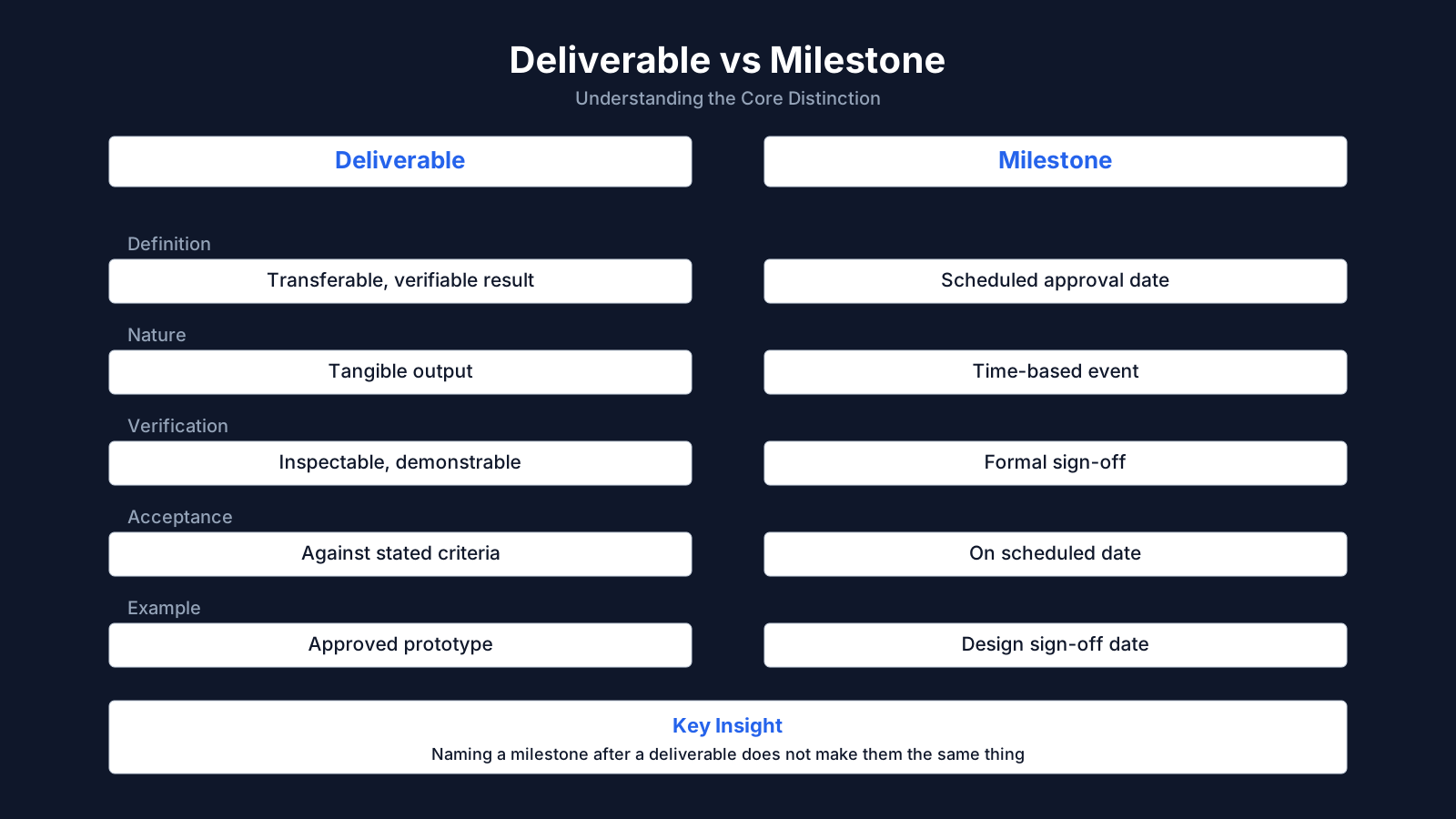
The comparison of deliverables vs milestones often confuses new project managers. A milestone is an event or point in time, not a thing. A milestone may mark the completion of a deliverable, but it can also mark a decision, a phase gate, or an external event. The deliverable is the object being reviewed. Saying "the software design is complete" is a milestone statement. The software design document itself is the deliverable.
Tasks and activities are the work performed to produce a deliverable. Coding, testing, meeting, and reviewing are tasks. The tested code module is the deliverable. This distinction matters because project schedules track tasks, while scope validation tracks deliverables. A team can complete all scheduled tasks and still fail to produce an acceptable deliverable if the work was misdirected or if the acceptance criteria were misunderstood.
Outputs, outcomes, and benefits form another related set. The deliverable is the project output. The outcome is the change that occurs when the deliverable is used. A new enterprise resource planning system is the deliverable. Shorter monthly closing cycles are the outcome. Reduced overtime cost is a benefit. PMI has sharpened this distinction in recent standards because organizations often invest in outputs that never generate the intended outcomes.
Understanding these boundaries prevents the common mistake of celebrating delivery without confirming usefulness. A project can be delivered on time and within budget, with every deliverable accepted, yet fail to produce business value. That does not mean the project manager failed, but it shows that the deliverable is not the final purpose of the project. It is the mechanism through which value is expected to emerge.
Core Insights: Deliverables, Milestones, and Tasks
- Milestones mark points in time
- A milestone is a specific point in time rather than a tangible output, and it can mark deliverable completion, a key decision, a phase gate, or an external occurrence.
- Tasks are schedule activities
- Project schedules track activities such as coding, testing, meeting, and reviewing, not the deliverables themselves.
- Deliverables validate project scope
- Scope validation focuses on deliverables, whereas project schedules focus on tasks, so these two tracking mechanisms serve distinct purposes in project management.
- Task completion is not enough
- A team can complete every scheduled task and still fail to produce an acceptable deliverable if the work drifts off course or the acceptance criteria are misunderstood.
- Delivery does not ensure value
- A project can finish on time and within budget with every deliverable accepted and still fail to generate meaningful business value, a distinction PMI now explicitly emphasizes.
Practical Application of Deliverables Across the Project Lifecycle
Deliverables across the project lifecycle change in character and purpose as the project progresses. During initiation, the project charter and preliminary scope statement are themselves deliverables because they authorize and frame the work. These deliverable documents may seem administrative, but they create the formal basis for resource allocation and stakeholder commitment.
During planning, the project team produces the scope baseline, WBS, schedule, risk register, and quality management plan. Each is a management deliverable with its own owner and review process. The team also defines the final deliverables in enough detail to establish acceptance criteria. This planning work is not done for its own sake; it is the production of governance deliverables that will guide execution.
Execution is where the specialist deliverables are built. Engineering teams produce drawings and prototypes. Software teams produce working increments. Marketing teams produce campaign assets. The project manager's focus shifts to removing obstacles, tracking progress against the deliverables, and ensuring that quality control occurs before the customer sees the output. In predictive projects, execution also produces formal performance reports and change requests.
Monitoring and controlling links deliverable verification to corrective action. Quality control checks the deliverable against specifications. Validate Scope obtains formal acceptance. If a deliverable fails inspection, a change request or defect repair action follows. The deliverable then becomes a feedback loop, not just an output. Closing formalizes the final acceptance and transfers ownership of the deliverable and its supporting documentation to operations or the customer.
Common Challenges, Pitfalls, and Misconceptions About Deliverables
One of the most common misconceptions about deliverables is that a project has one final deliverable. In reality, even a modest project produces dozens of deliverables, many of which are internal and never seen by the customer. When project teams fail to identify these internal deliverables, governance gaps appear. Risk registers are not reviewed, design decisions are not recorded, and handoffs become informal conversations instead of controlled transfers.
Vague acceptance criteria are a frequent source of conflict. A deliverable described as "user-friendly" or "high-quality" cannot be verified objectively. The project team may believe the work is done while the customer remains unsatisfied. This is why acceptance criteria should be developed before or alongside the work, not after the deliverable is presented. Retroactive agreement on what finished means is usually a negotiation, not a validation.
Deliverable creep is another common problem. Stakeholders may expand a deliverable's scope by adding features, reports, or revisions that were not part of the original agreement. Because the changes seem small, they often bypass formal change control. Over time the deliverable grows beyond what was planned, consuming schedule and budget without a matching increase in value. A disciplined project manager treats these additions as change requests, even when they arrive as friendly suggestions.
Intangible deliverables create their own set of measurement challenges. A project may promise improved customer trust, enhanced collaboration, or a stronger safety culture. These outcomes can be valid deliverables, but only if the team defines observable indicators. Without indicators, the deliverable becomes unfalsifiable and therefore impossible to verify. Practitioners often observe that intangible deliverables require more rigorous upfront definition than physical ones, not less.
Another misconception is that documentation is always a deliverable. Some project cultures produce excessive status reports, meeting minutes, and slide decks that nobody reads. These artifacts consume effort but do not aid governance. A deliverable should serve a purpose. If a document does not inform a decision, record a decision, or transfer knowledge, it may be waste rather than a deliverable.
Core Insights on Deliverable Misconceptions
- Multiple deliverables, not one final output
- Most projects generate numerous internal deliverables that customers never see, and neglecting to identify them weakens governance across risk review, decision documentation, and handoff control.
- Vague criteria enable scope creep
- Subjective terms such as "user-friendly" or "high-quality" prevent objective acceptance testing, which allows stakeholders to introduce unplanned features that consume schedule and budget without adding measurable value.
- Treat additions as formal changes
- Disciplined project managers route informal feature suggestions through formal change control, because intangible outcomes like improved trust or safety culture cannot serve as verifiable deliverables.
Evolution and Current Thinking on Deliverables
Current thinking on deliverables has shifted from a documentation-heavy mindset toward outcomes and value. Older project management practice often treated the deliverable as the finish line. Modern standards, including PMBOK 7, place more emphasis on whether the deliverable enables the intended outcome and benefit. This does not mean deliverables are less important. It means they are now evaluated in a larger chain of value creation.
Agile and lean influences have changed how frequently deliverables are inspected and accepted. Instead of one final acceptance at the end, teams validate small increments continuously. This reduces the risk that a large contractual deliverable will be rejected after months of work. The tradeoff is that continuous acceptance requires more stakeholder involvement and more mature quality practices. Some organizations struggle with that requirement, especially in regulated industries where formal acceptance points are fixed by governance bodies.
The product mindset has also influenced deliverable management. Rather than treating a software release as the end of a project, many organizations now treat the product as an ongoing responsibility. The deliverable is not abandoned after handoff. It evolves through releases, service updates, and integration with other systems. This has blurred the boundary between project deliverables and operational assets, which in turn changes how contracts, warranties, and support arrangements are written.
Debate continues about whether a deliverable-centric approach is still best. Some argue that focusing on deliverables encourages teams to optimize for the output rather than the outcome. Others respond that without clear deliverables, accountability disappears and projects become unbounded. The practical resolution in most mature organizations is to define deliverables rigorously while also tracing each deliverable to a measurable outcome. That dual focus preserves control without losing sight of value.
Technology has also expanded what a deliverable can be. A machine learning model, an application programming interface, a data pipeline, or a reusable component library can all serve as deliverables. These digital artifacts often require specialized verification methods, versioning, and security review. The core definition of a deliverable has not changed, but the technical nature and governance requirements of modern deliverables have become more complex.