In project management, customer requests are formal or informal expressions of a customer’s need, preference, expectation, or desired change that may require action from the project team. They enter the project environment through conversations, documents, support tickets, review sessions, testing feedback, or direct stakeholder communication. Customer requests are not automatically requirements, nor are they automatically approved changes. They are raw inputs that must be assessed, prioritized, translated into actionable specifications, and formally controlled before they influence scope, schedule, budget, or quality.
Customer Requests: Key Topics at a Glance
| Concept | Summary |
|---|---|
| Definition | A customer request is any formal or informal articulation of a need, preference, expectation, or requested change that warrants evaluation or action by the project team. |
| Sources | Requests arrive through multiple channels, including stakeholder conversations, project documentation, support tickets, review sessions, testing feedback, and direct communications. |
| Nature | Requests range from precise, actionable demands to broad statements that require further interpretation and clarification before they can be addressed. |
| Requirements | A request is promoted to a requirement only after analysis verifies strategic alignment, feasibility within project constraints, and approval through formal governance. |
| Analysis | Because most requests capture only part of the underlying need, teams must elicit missing details through targeted clarification, direct observation, or structured elicitation techniques. |
| Authority | Project teams must confirm that the requester holds the authority to influence scope, understands the relevant business context, and represents a broader stakeholder or user group. |
| Implied Needs | The stated request often differs from the underlying business outcome. For example, a search feature request may reflect a deeper need to reduce time spent locating records. |
| Service Context | In service management, customer requests typically involve routine, low-risk needs such as access provisioning or password resets, and they follow predefined approval and fulfillment workflows. |
What Are Customer Requests in Project Management?
A customer requests in project management definition centers on the gap between what a customer states and what a project ultimately delivers. A customer request is any communication from a customer, end user, sponsor, or product owner that articulates a desired capability, correction, improvement, or change to a planned or delivered result. The request may be highly specific, such as a demand for a particular report format, or extremely vague, such as a statement that a system feels too slow or a process seems confusing.
Within formal project management, customer requests are treated as unvalidated inputs. They carry intention but not yet commitment. A request becomes a requirement only after analysis confirms that it aligns with project objectives, is feasible within constraints, and has been approved through appropriate governance. This distinction is critical because many projects fail when teams treat every customer comment as an immediate work order. The formal project environment exists precisely to filter and structure such inputs.
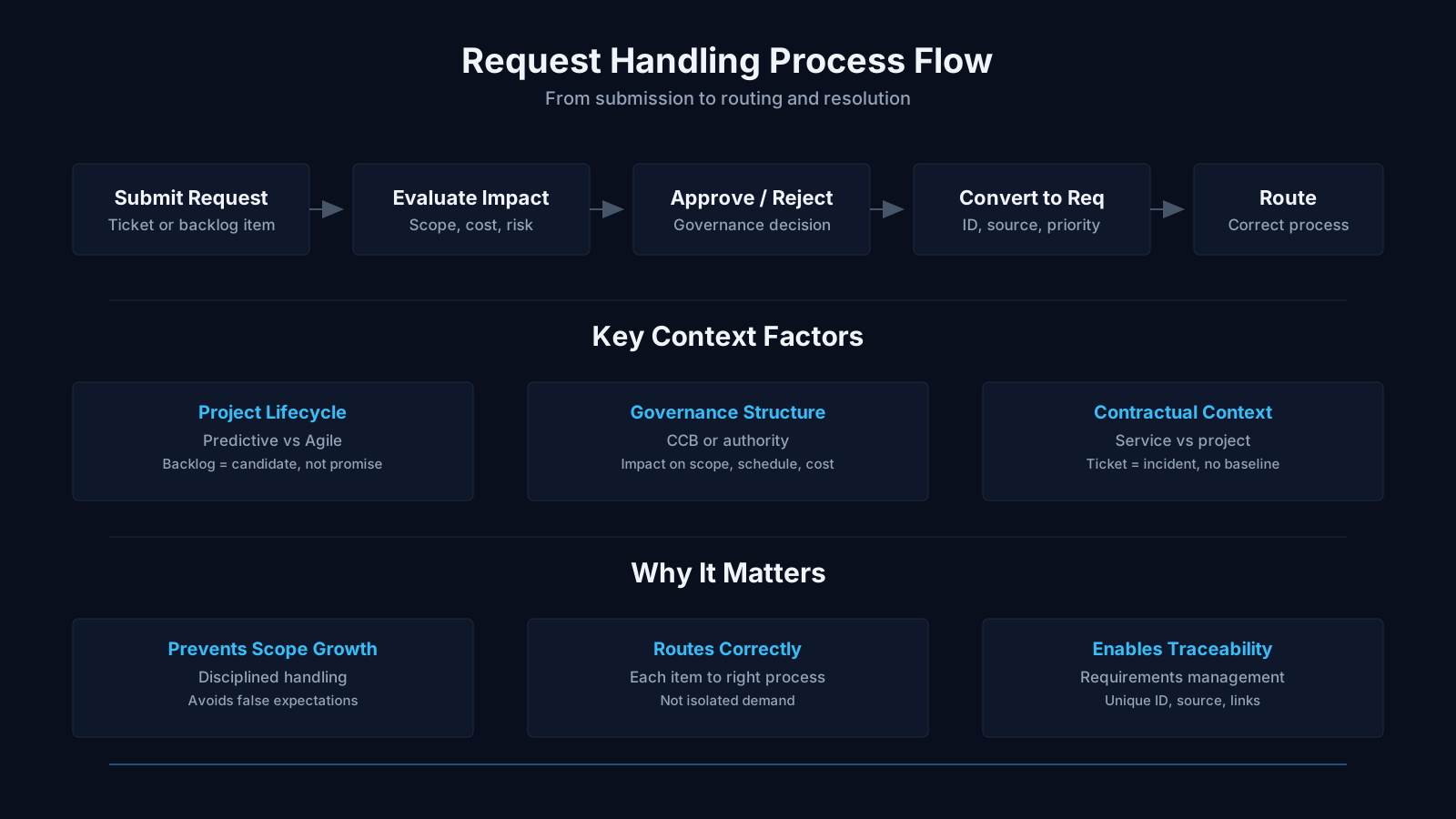
Customer requests appear in predictive, iterative, and hybrid environments, although the handling mechanisms differ. In predictive projects, requests often arrive through change control channels. In Agile environments, requests populate backlogs and are refined continuously. Regardless of the framework, the underlying principle remains the same. A customer request is a signal of perceived value or dissatisfaction, and the project team must interpret that signal before acting.
Core Takeaways on Customer Requests
- Definition and Core Concept
- A customer request is any communication from a customer, end user, sponsor, or product owner that articulates a desired capability, correction, improvement, or change to a planned or delivered result.
- Unvalidated Project Inputs
- In formal project management, customer requests function as unvalidated inputs that express intent but do not yet represent a commitment from the project team.
- Pathway to Requirements
- A customer request becomes a requirement only after analysis verifies alignment with project objectives, feasibility within resource and schedule constraints, and approval through the appropriate governance process.
- Risk of Improper Handling
- Project failure often occurs when teams treat every customer comment as an immediate work order, because the formal project environment exists specifically to filter, validate, and structure such inputs.
Key Components of Customer Requests
The key components of customer requests include the source, the stated need, the implied outcome, the priority, the urgency, and the conditions of satisfaction. A well-formed customer request may contain all of these elements explicitly. In practice, most requests contain only a partial picture, and the missing components must be uncovered through clarification, observation, or structured elicitation.
Source and Origin
The source matters because it affects the legitimacy, context, and weight of the request. A request from a paying client sponsor differs from one made by an indirect user or a member of the customer’s procurement team. Project teams must identify whether the person making the request has authority to influence scope, understand the business context, or represent a broader user group. Misinterpreting a casual observation from a non-decision-maker as a formal customer request can distort priorities.
Stated Need and Implied Outcome
Customers rarely describe a solution perfectly. They describe a problem, a frustration, or a desired state. The stated need may be "add a search feature" while the implied outcome is "reduce the time users spend locating records." Effective request analysis separates the expressed solution from the underlying outcome. This prevents teams from building precisely what was asked for while missing what was actually needed.
Priority and Urgency
Priority reflects business importance, while urgency reflects time sensitivity. A request may be highly urgent but strategically unimportant, or strategically valuable but not time-critical. Teams that collapse these two dimensions into a single label often misallocate resources. Customer requests need a clear view of both dimensions so that trade-offs remain visible to stakeholders.
Conditions of Satisfaction
Every request carries implicit or explicit acceptance criteria. A customer may request faster reporting, but what does faster mean in measurable terms? Without conditions of satisfaction, the request cannot be verified as complete. Experienced project managers push for observable, testable outcomes before approving work on a request.
Customer Requests vs Requirements and Change Requests
A common area of confusion is the difference between customer requests, requirements, and change requests. The customer requests vs requirements distinction is straightforward but often ignored under schedule pressure. A requirement is a formally documented condition or capability that a deliverable must satisfy. A customer request is an input that may or may not evolve into a requirement. Requirements have been analyzed, validated, accepted, and placed under configuration control. Requests have not yet passed through that process.
Change requests, on the other hand, are formal proposals to modify an approved baseline, document, deliverable, or plan. A customer request can trigger a change request, but the two are not synonymous. The change request includes analysis of impact, alternatives, risk, and recommendation. It is a governance artifact, whereas a customer request is often an informal message. In practical terms, a customer may say "we need this field added to the form." That statement is a customer request. Once the team evaluates the impact on database structure, validation rules, reporting, and testing, the resulting document submitted for approval is the change request.
This distinction is more than academic. It protects the project from uncontrolled scope expansion and gives stakeholders a transparent path from idea to decision. It also clarifies accountability. The customer is responsible for articulating the request, but the project team is responsible for transforming it into a viable, evaluated proposal.
Core Distinctions in Change Management
- Formal requirement definition
- A requirement represents a formally documented condition or capability that has undergone analysis, validation, and acceptance, and is subsequently maintained under configuration control.
- Customer request as input
- A customer request enters the process as an unprocessed input that may later be refined into a formal requirement, yet teams frequently blur this distinction when deadlines create pressure.
- Change request proposal scope
- A change request serves as a formal proposal to alter an approved baseline, document, deliverable, or plan, and it typically includes an impact analysis, alternative options, risk assessment, and a clear recommendation.
- Practical request example
- For instance, when a customer asks to add a new field to a form, the team assesses implications for database structure, validation rules, reporting outputs, and testing, then documents the findings as the change request.
- Protection against scope creep
- This structured process guards the project against uncontrolled scope expansion while providing stakeholders with a transparent route from initial idea to formal decision.
Origins and Cross-Industry Context
The concept of customer requests has deep roots beyond project management. In service management frameworks such as ITIL, customer requests are handled through request fulfillment processes that distinguish standard service requests from incidents and changes. A customer requests in service management context covers routine, often low-risk needs such as access provisioning, equipment installation, or password resets, where predefined approval paths and service level targets apply. This service management perspective influenced project management by reinforcing the need for classification, routing, and measurement of customer inputs.
In manufacturing, customer requests often appear as order changes, customization specifications, or engineering change notices. In software engineering, defect reports and enhancement suggestions function as customer requests. In healthcare and aviation, requests may carry safety, regulatory, or compliance implications that demand rigorous documentation and traceability. These industries demonstrate that treating customer requests as uncontrolled verbal commitments is dangerous. The project environment inherits this discipline and applies it to scope, quality, and risk management.
Cross-industry usage also shaped vocabulary. Terms such as request for change, service request, enhancement request, and customer voice all describe related but distinct concepts. Project teams benefit from understanding these origins because they reveal why certain practices, such as separation of duties between request capture and request approval, exist in mature organizations.
Customer Requests in PMBOK and PRINCE2
Within the PMBOK framework, customer requests PMBOK guidance appears primarily in the areas of stakeholder engagement, requirements collection, scope management, and integrated change control. Customer requests are a source of stakeholder needs and expectations. They inform the Collect Requirements process, but they do not replace requirements documentation. The project team must evaluate requests against the project charter, benefits management plan, and organizational strategy before incorporating them into the scope baseline.
In the PMBOK sixth edition structure, customer requests commonly trigger change requests that flow through the Perform Integrated Change Control process. The project manager reviews the request, assesses impact across all knowledge areas, and presents the change request to the change control board or designated authority. In the seventh edition, customer requests are understood as information that supports tailoring decisions, value delivery, and stakeholder engagement. The emphasis shifts from process compliance toward continuous alignment with value and outcome.
PRINCE2 Perspective
PRINCE2 addresses customer expectations through the quality theme and the change theme. Customer quality expectations are captured early and converted into measurable acceptance criteria and product descriptions. When a customer raises a new request during the project, PRINCE2 treats it as an issue if it may affect baselines or planned products. The project board or change authority evaluates the request for impact on benefits, risk, cost, and timescale. This prevents ad hoc acceptance and keeps the project’s business case intact.
Both PMBOK and PRINCE2 emphasize that customer requests must be compared with formal baseline commitments. A request is not rejected simply because it arrives late. It is evaluated against its actual value and impact. The frameworks differ in terminology and governance structures, but they share the same core logic: customer requests need disciplined translation into approved project work.
Key Takeaways on Request Governance
- PMBOK formal request evaluation
- In PMBOK, customer requests enter the Collect Requirements process and are then processed through Perform Integrated Change Control, where they are evaluated against the project charter, the benefits management plan, and organizational strategy before any scope baseline changes receive approval.
- PRINCE2 issues for requests
- PRINCE2 classifies new customer requests as issues when they could affect baselines or planned products, which triggers formal issue management and governance procedures to determine whether the request should be accepted.
- Shared disciplined translation logic
- Both frameworks ultimately rely on the same core discipline: customer quality expectations must be converted into measurable acceptance criteria, and requests must be translated through a controlled governance process into approved project work, regardless of differences in terminology and governance structures.
Customer Requests in Agile and Hybrid Environments
In Agile environments, customer requests in Agile practice are treated as a continuous stream of feedback rather than as interruptions. The product owner maintains a backlog of user stories, epics, and technical items. Customer requests enter this backlog and are refined during backlog refinement sessions. They may be expressed as user stories, acceptance criteria, bug reports, or feature ideas. The product owner decides their order based on value, risk, dependencies, and stakeholder feedback.
Agile does not eliminate control over customer requests. It redistributes control. The product owner acts as the filter and prioritizer, while the team provides feasibility input. A request does not become a commitment until it is pulled into an iteration or increment plan. This allows Agile teams to respond quickly without abandoning traceability. Scrum, Kanban, and DevOps practices all support this flow, although they use different artifacts and cadences.
Hybrid Frameworks
Hybrid projects often struggle with customer requests because they combine predictive governance with iterative delivery. A request may be evaluated through a change control board while also being logged in a backlog. The key is clarity about which decisions belong to which body. Some hybrid approaches allow small, low-impact customer requests to be handled directly by the product owner, while larger requests go through formal change control. This preserves both responsiveness and governance.
BVOP methodology offers a useful perspective here. It treats scope change as user feedback rather than as project failure, and it defines a five-level scope scale from definite to unlikely. Under this view, customer requests are not inherently negative signals. They are information about how well the project is meeting evolving user expectations. The challenge is to classify and respond to them without destabilizing delivery.
Purpose and Importance of Customer Requests
The importance of customer requests lies in their role as an early indicator of value perception and stakeholder satisfaction. A well-managed flow of customer requests helps the project team detect misalignment before it hardens into failed acceptance or low adoption. Requests reveal what customers find missing, confusing, or valuable in the actual product or service being delivered.
Ignoring customer requests creates several risks. The project may complete on time and budget but deliver a result that no longer reflects the customer’s operational reality. Late requests may accumulate and become a source of conflict during acceptance. Alternatively, accepting every request without evaluation leads to scope creep, team burnout, and schedule erosion. The value of customer requests is not in their volume but in the quality of the decisions they provoke.
Customer requests also serve an organizational learning function. Patterns in requests can reveal weaknesses in requirements elicitation, user training, product design, or communication. Teams that treat requests as part of a feedback loop build stronger products and more resilient stakeholder relationships over time.
Core Takeaways on Customer Requests
- Early indicator of misalignment
- Customer requests expose what users find missing, confusing, or valuable, enabling teams to correct misalignment before it turns into rejected deliverables or weak adoption.
- Balanced evaluation of requests
- Dismissing requests risks delivering a product that ignores operational realities, while accepting every request without scrutiny leads to scope creep, team burnout, and schedule delays.
- Quality over request volume
- The true value of customer requests lies in the decisions they drive, because recurring patterns in those requests often reveal deeper weaknesses in requirements gathering, training, design, or communication.
Managing Customer Requests Across the Project Lifecycle
The customer requests management process changes shape as the project moves from initiation to closing. Early in the project, requests often inform requirements discovery and charter refinement. During execution, they require change control and impact analysis. Near the end, they often relate to defects, acceptance criteria, or transition concerns.
Initiation and Planning
During initiation, customer requests help clarify the business need and identify high-level expectations. They may influence the project charter, stakeholder register, and initial risk assessment. In planning, requests inform requirements documentation, scope baseline, and quality metrics. The project manager must distinguish between requests that clarify existing requirements and requests that expand the project’s intended outcome.
Execution and Control
Most customer requests arrive after delivery begins. A common scenario is a customer reviewing an early prototype or pilot release and asking for adjustments. The project team logs the request, evaluates its connection to the approved scope, and determines whether it represents a gap, a change, or a misunderstanding. If it is a gap, the team corrects the deliverable. If it is a change, the team prepares a change request with schedule, cost, and risk impact.
What this really means in practice is that a customer might say during a demonstration, "This screen should also show the approval status." The team does not immediately alter the build. It checks the requirements baseline. If the approval status was already specified, this is a defect in the deliverable and the team fixes it. If it was never specified, this is new scope and the team initiates the appropriate change path. That moment of classification determines whether the project absorbs work or requests additional resources.
Closing
During closing, customer requests frequently surface as punch list items, training issues, or transition support needs. They must be resolved or formally deferred before handover. A robust closing process ensures that unresolved requests are documented, approved by the appropriate authority, and either included in the final acceptance or transferred to operations with clear ownership.
Common Challenges and Misconceptions
Several common challenges with customer requests affect projects regardless of methodology. One is the belief that all customer requests must be accepted because the customer is always right. This misconception confuses customer satisfaction with unquestioning compliance. Satisfied customers value transparent evaluation more than automatic agreement, especially when the evaluation reveals that a request would undermine the schedule, budget, or technical integrity of the project.
Another challenge is treating every request as a requirement too quickly. Teams under delivery pressure may skip analysis and move straight into development. This leads to rework when the request was actually misunderstood or when the customer did not realize the full implications. A request for a simple data export, for example, can spiral into a complex integration task if the team does not clarify formats, security restrictions, and volume expectations.
Prioritization is also a recurring problem. Customers often describe every request as high priority. Without a transparent prioritization mechanism, project teams become reactive and lose control of their own delivery plan. Equally damaging is the opposite failure, where teams become so protective of the baseline that they dismiss legitimate customer feedback as noise. Mature project management requires a middle path that acknowledges the value of requests while protecting the integrity of project commitments.
When Customer Requests Should Not Be Applied
There are situations where a customer request should not proceed. If it violates regulatory requirements, security policies, or safety standards, it must be rejected regardless of customer insistence. If it would materially alter the approved business case without compensating benefit, the governance body may defer it to a subsequent phase or separate initiative. Requests that arise outside the authorized stakeholder group or that contradict the project’s strategic objectives also warrant careful scrutiny. Exercising this judgment is part of professional project management and does not indicate a lack of customer focus.
Key Insights on Request Handling
- "Customer always right" fallacy
- Customers are more satisfied when requests are evaluated transparently than when they are automatically accepted, especially if fulfilling the request would compromise the schedule, budget, or technical integrity.
- Skipping analysis causes rework
- Teams that skip structured analysis under delivery pressure often create rework because the request was misunderstood or the customer had not considered its full implications.
- Simple requests can escalate
- What appears to be a simple data export can escalate into a complex integration effort when formats, security restrictions, and data volume expectations are not clarified before development begins.
- Overprotecting the baseline
- Teams that guard the baseline too rigidly risk treating legitimate customer feedback as noise, which can erode trust and weaken project outcomes.
- Scrutinize unauthorized requests
- Requests that originate outside the authorized stakeholder group or conflict with the project's strategic objectives require careful scrutiny and may be better deferred to a later phase or a separate initiative.
Evolution and Current Thinking
The evolution of customer requests in project management reflects broader changes in how projects deliver value. Early project management approaches often viewed customer requests as disturbances to the plan, something to be minimized through rigorous upfront specification. Contemporary thinking recognizes that customer needs are rarely static and that early feedback can prevent expensive late-stage failure.
Agile practices accelerated this shift by normalizing continuous customer involvement and iterative delivery. Customer requests became less about formal change orders and more about ongoing conversation. At the same time, predictive environments retained formal change control because some industries require traceability, regulatory compliance, and baseline stability. Current best practice is not a single universal method but a tailored approach based on project complexity, regulatory context, and customer maturity.
Another shift concerns the use of data. Teams increasingly analyze customer requests for patterns, using insights from request history to improve requirements elicitation, product design, and stakeholder communication. This moves the conversation from individual request management to systemic learning. A request is no longer just an item to approve or reject. It is a signal about the quality of understanding between the project team and the customer.
The focus has also shifted from documentation volume to decision quality. A short, well-analyzed change request is more valuable than a lengthy repository of unprocessed customer wishes. Customer requests matter because they test whether the project is still delivering what the customer actually values. That test remains relevant regardless of the framework or toolset in use.