In project management, a backlog is a prioritized and dynamically managed list of work items that a team intends to deliver, most commonly associated with Agile frameworks but also found in hybrid and traditional predictive environments. At its simplest, it is the single authoritative record of everything known to be needed for a product, a release, or a sprint, yet it is far more than a static inventory. The backlog embodies the evolving understanding of scope, value, and constraints, serving as the pivot point around which planning, estimation, and daily execution revolve. It is both a planning artifact and a communication tool, constantly shaped by stakeholder feedback, market shifts, and technical discovery. Unlike a binding contractual specification, a healthy backlog reflects what has been learned so far while remaining open to what will be learned tomorrow.
Backlog Summary: Key Topics
| Key Concept | Summary |
|---|---|
| Backlog | A backlog is a living, prioritized inventory of work a team intends to deliver. While central to Agile delivery, it is also adopted in hybrid and traditional environments to manage scope and expectations dynamically. |
| Product Backlog | In the canonical Scrum definition, the Product Backlog is an emergent, ordered list of everything needed to improve the product. The Product Owner bears sole accountability for its content, availability, and priority ordering. |
| Core Purpose | Backlogs decouple the identification of potential work from the commitment to execute it. They serve as a buffer of candidate ideas, pulling the most valuable items into active development only when capacity and strategic alignment intersect. |
| Useful Incompleteness | Backlogs are deliberately maintained in a state of useful incompleteness. They capture only the most valuable work known at that moment, embracing the reality that emerging insights will continuously reshape priorities. |
| Historical Origins | The term originates from 17th-century domestic fireplaces, where a “back log” was a large log placed behind the main fire to sustain a slow, steady burn, providing a reliable reserve of heat, much as a well-managed backlog sustains a team’s workflow. |
| Modern Evolution | Ken Schwaber and Jeff Sutherland codified the Product Backlog as a foundational Scrum artifact. The concept later expanded into broader project management and scaled frameworks like SAFe, where portfolio and program backlogs align enterprise strategy with delivery. |
| Item Attributes | Each backlog item typically includes a succinct user story, explicit acceptance criteria that define completion, a clear value proposition or business rationale, and notes on dependencies or technical constraints. |
| Refinement | Backlog refinement, previously referred to as grooming, is a continuous collaborative practice where the team and Product Owner decompose large items, elaborate near-term work, reprioritize based on new insights, and discard items that no longer serve the product vision. |
What Is a Backlog?
A backlog in project management is best understood as an ordered list of capabilities, features, fixes, or technical work that represents the delivery team’s emerging plan. In its purest Agile form, found in the Scrum Guide, the product backlog is described as an emergent, ordered list of what is needed to improve the product, with the Product Owner held accountable for its content, availability, and ordering. This definition immediately dispels two common misunderstandings: that the backlog is merely a to-do list, and that it is a frozen scope document. Instead, it is a living artifact that evolves sprint by sprint as more is learned about user needs and technical feasibility.
The backlog is not confined to software. Construction projects using lean principles might maintain a backlog of pending design decisions. Marketing teams running Agile ceremonies often keep a backlog of campaign tasks. In every domain, the artifact carries the same DNA: it separates the act of discovering work from the act of committing to it, providing a buffer of ideas that can be pulled into execution when capacity exists and value is clearest. This separation is what allows teams to respond to change without the overhead of formal change control for every new insight.
What distinguishes a project management backlog from any generic list is the discipline of continuous refinement. Items at the top are smaller, clearer, and ready to be implemented; items further down can be vague, large, or provisional. The backlog is never “finished.” It is deliberately kept in a state of useful incompleteness, representing the most valuable work known at that moment while acknowledging that tomorrow’s priorities may look different. That incompleteness is not a weakness but a deliberate design choice that prevents premature investment in low-value detail.
Essential Insights on Backlogs
- An ordered emerging plan
- A backlog is an ordered list of capabilities, features, fixes, and technical enablers that constitutes the team's emergent plan, continuously refined to reflect the most valuable next steps.
- Living artifact, not a to-do list
- Far from a static checklist or a fixed-scope contract, the backlog is a continuously evolving repository that changes each sprint as teams uncover deeper user needs and technical realities.
- Separates discovery from commitment
- By maintaining a deliberate separation between discovery and commitment, the backlog lets teams pull items into delivery only when value is validated and capacity is available, intentionally remaining incomplete to avoid over-investment in low-priority details.
Origins and Cross-Industry Context
The origin of the term backlog traces back to 17th-century domestic life, where a “back log” was a large log placed at the back of a fireplace to keep a fire burning slowly and steadily over long periods. By the early 20th century, the word had migrated into manufacturing and logistics, signifying an accumulation of unfulfilled orders or work waiting to be processed. Factories spoke of their order backlog, and service industries still use the phrase to describe the queue of client requests that have been accepted but not yet completed. This lineage carries a subtle truth: a backlog is not inherently negative, but rather a reservoir of demand waiting to be converted into output.
The software and product development community adopted the term in the 1990s, particularly through the emergence of Scrum. Ken Schwaber and Jeff Sutherland formalized the Product Backlog as a core artifact, borrowing the language of queued work but infusing it with intentional prioritization and constant grooming. The shift was profound: instead of a passive pile of unaddressed tickets, the backlog became an active management instrument, deliberately sequenced to maximise value. From there, the concept spread into broader project management practices, especially as Agile principles were adapted in non-IT settings and as scaling frameworks like SAFe introduced portfolio and program backlogs. Today it is equally at home in a startup standup as it is in an enterprise PMO overseeing hybrid lifecycles.
Key Components and Characteristics of a Backlog
The DEEP characteristics of a product backlog—Detailed appropriately, Emergent, Estimated, and Prioritized—capture the essence of good backlog health. “Detailed appropriately” means that high-priority items contain sufficient clarity for the team to pull them into a sprint, while lower-priority items can remain coarse-grained, expressed as epics or brief outcome statements. “Emergent” acknowledges that the backlog changes continuously as new information surfaces; it is never a finalised specification. “Estimated” signals that team members have attached a relative size or effort indication to items, usually through story points or ideal days, to support forecasting without pretending to pin down exact hours. “Prioritized” (or more accurately, ordered) reflects that the sequence of items is driven by value, risk, dependencies, and cost of delay.
Beyond the DEEP mnemonic, each backlog item typically carries several attributes: a short description often written from a user’s perspective, acceptance criteria that define what “done” looks like, a value statement or business reason, and any dependencies or technical notes. In software, the user story format—“as a [user], I want [capability], so that [benefit]”—is prevalent, but other work like defects, technical debt reductions, and research spikes also earn a place. The backlog itself is managed through a process called refinement (formerly “grooming”), where the team and the Product Owner collaboratively split large items, add detail to upcoming ones, reorder based on new insights, and remove items that no longer serve the product vision. Refinement is not a one-time activity; it is a continuous, timeboxed practice that keeps the backlog actionable without drifting into premature specification.
The plain-language reality behind DEEP is this: you want the top few items to be crisp enough that a developer or team member could start work on them tomorrow with minimal questions, while the items further down can be little more than reminders of conversations yet to be had. The effort estimate on a story does not commit the team to a date; it is simply a tool for rough sizing and trade-off conversations. And “prioritized” almost always means a negotiation, because value is subjective, and what the sales team considers critical may be entirely different from what reduces technical risk. The backlog is the arena where those tensions become visible and manageable.
Key Insights on Backlog Fundamentals
- DEEP criteria define quality
- A well-maintained product backlog follows the DEEP principle: items are Detailed appropriately for upcoming sprints, Estimated to enable forecasting, Emergent to reflect evolving requirements, and Prioritized to deliver the highest business value.
- Items carry essential attributes
- Each backlog entry should include a user-centric description, explicit acceptance criteria, a defined business value, and relevant technical or dependency annotations. Common types range from user stories and defects to technical debt items and research spikes, all serving to guide the team toward incremental value delivery.
- Refinement keeps backlog actionable
- Consistent, timeboxed refinement sessions allow the team and Product Owner to decompose large items, elaborate on upcoming work, adjust priorities as new information emerges, and discard entries that no longer support the product strategy, keeping the backlog lean and planning-ready.
Types of Backlogs in Project Management
Different types of backlogs in project management serve distinct planning horizons and decision-making needs. The most familiar is the product backlog, which contains everything that could eventually be done for a particular product or service across its entire lifecycle. It is managed by a Product Owner and is the source from which sprint or iteration backlogs are drawn. A sprint backlog, in turn, is the subset of product backlog items that a team commits to completing within a single timebox, together with the tasks required to turn them into a done increment. During the sprint, the team owns the sprint backlog and updates it daily, revealing progress without changing the scope of the commitment unless negotiated with the Product Owner.
At a higher level, program and portfolio backlogs aggregate work across multiple teams or value streams. SAFe, for instance, defines a Portfolio Backlog that holds epics of strategic importance, which then flow into a Program Backlog for a particular Agile Release Train. These scaled backlogs introduce governance thresholds, such as the Lean business case and epic approval gates, to ensure that large investments receive progressive validation before consuming team capacity. Beyond Agile, traditional predictive projects sometimes maintain a “change backlog” or “issues register” that functions similarly: requested changes are logged, assessed, and prioritised, then incorporated through formal change control only when approved. While not called a backlog explicitly in many PMBOK-aligned environments, the logic is the same—capture, order, and defer commitment until the right moment.
Backlog in Project Management Frameworks
The backlog in the PMBOK framework is most thoroughly explored in the Agile Practice Guide, co-published by PMI and the Agile Alliance, where it is recognised as a central artifact for adaptive lifecycles. The guide explains that the backlog provides the product scope and is progressively elaborated as work moves forward. In the Seventh Edition of the PMBOK Guide, the focus shifts from process groups to principles, yet the concept of a living scope definition that responds to feedback aligns directly with the principle of “embrace adaptability and resiliency.” Many project managers blending predictive and adaptive approaches will maintain a high-level requirements document for contractual purposes while keeping a granular backlog as the team’s operational scope tool.
Within PRINCE2 Agile, the product backlog is similarly positioned as the engine of iterative delivery. The framework distinguishes between the project product description (the overall vision) and the backlog that breaks it down into manageable increments. PRINCE2 Agile emphasizes that the backlog’s content is continuously prioritised against the project’s business case, ensuring that even in an Agile delivery rhythm the justification for the project remains intact. In Scrum, the backlog enjoys its most codified role: artifacts, accountabilities, and events are explicitly designed around its flow. The Product Owner refines and orders; the Developers pull work during Sprint Planning based on capacity and the recent past performance; the Sprint Review inspects the resulting increment and adapts the product backlog accordingly. Kanban methods can use a backlog as an upstream column, where items wait until a pull signal frees capacity, reinforcing the flow-based perspective rather than timeboxed iteration.
Key Backlog Insights Across Frameworks
- PMBOK's adaptive and hybrid scope
- Within PMBOK, the Agile Practice Guide positions the backlog as the central adaptive artifact that progressively elaborates product scope, while the Seventh Edition’s adaptability principle validates a living backlog that hybrid teams can align with contractual requirements.
- PRINCE2 Agile's business case prioritization
- PRINCE2 Agile treats the product backlog as the iterative delivery engine, decomposing the project product description into manageable increments and continuously reprioritizing its contents against the business case to maintain ongoing justification.
- Scrum's codified backlog flow
- Scrum gives the backlog its most codified role: the Product Owner refines and orders items, Developers pull work during Sprint Planning, and Sprint Review adapts the backlog, whereas Kanban treats it as an upstream column that gates pull signals.
The BVOP Perspective on Backlog Management
The BVOP approach to backlog management introduces a structured scope-thinking layer that directly influences how items are classified and prioritised. Business Value-Oriented Project Management (BVOPM) defines a five-level scope scale ranging from Definite to Unlikely, which allows teams to tag backlog entries by their probability of ever being implemented. A feature marked as “Unlikely” might never enter active refinement, while a “Definite” item becomes a near-term candidate for detailed breakdown. This scale reduces the cognitive load of maintaining an overly long backlog and injects a healthy realism into what the team signals as actionable. At the same time, BVOPM’s use of relational effort points encourages the team to compare items against one another rather than against an abstract unit, tightening the connection between backlog estimates and actual delivery cadence.
Practical Application and Use of Backlogs
In daily project work, the practical application of project backlogs begins with the Product Owner or a similar role constantly scanning for new inputs—customer interviews, stakeholder requests, analytics data, competitive moves—and deciding whether they merit a place on the list. The act of writing a new backlog item is not an endorsement of its value; it is merely the first step of logging a possibility. Refinement sessions, often held mid-sprint for an hour or two, gather the team to ask questions, sketch out acceptance criteria, and split large stories into smaller ones that can be delivered within an iteration. This collaborative discussion surfaces hidden complexities early and prevents the backlog from becoming a catalogue of half-understood wishes.
Prioritisation techniques vary widely. Some teams use simple stacking, where the most valuable item sits at the top and everything else falls in relative order behind it. Others employ formal frameworks like MoSCoW (Must have, Should have, Could have, Won’t have) or weighted shortest job first (WSJF) when cost of delay is a dominant factor. The Kano model occasionally shapes the backlog by classifying features into basic expectations, performance features, and delighters, helping the Product Owner balance competitive necessity against innovation. Regardless of the technique, the ordering is always provisional. A market shock, a regulatory change, or a technical bottleneck can reshuffle the backlog overnight, and the team’s ability to absorb that reshuffling without derailing morale is what separates mature backlog management from bureaucratic list-keeping.
Backlogs also serve as a forecasting tool. By tracking the rate at which the team completes estimated items (velocity in Scrum, throughput in Kanban), project managers and product leaders can project likely delivery dates for specific features or releases. This is not a guarantee, but a probabilistic forecast that improves as more empirical data accumulates. In hybrid settings, the backlog sits alongside a milestone schedule, with high-confidence near-term items feeding fixed-date commitments while the mid-term horizon remains flexible, allowing the project to honour business deadlines without pretending that every variable is known in advance.
Key Takeaways on Backlog Use
- Continuous input scanning
- The Product Owner routinely assesses signals from customers, stakeholders, analytics, and competitors to determine which items merit a place on the backlog, recognizing that logging an idea represents only a possibility and not a commitment to its value.
- Refinement sessions surface complexity
- Mid-sprint refinement sessions enable the team to clarify requirements, define acceptance criteria, and decompose large stories into manageable increments, thereby exposing hidden dependencies and technical risks well before development begins.
- Diverse prioritization frameworks
- Teams employ techniques such as simple ranking, MoSCoW, Weighted Shortest Job First, or the Kano model to sequence items by balancing economic value, cost of delay, and customer impact, which ensures critical necessities are met while preserving space for innovation.
- Adaptability and delivery forecasting
- Backlogs must absorb abrupt reprioritization from market shifts or regulatory changes, and tracking velocity alongside throughput allows teams to project delivery dates, aligning firm near-term commitments with a flexible medium-term outlook.
Common Challenges, Pitfalls, and Misconceptions
A surprising number of common backlog management pitfalls stem from treating the backlog as a bottomless suggestion box. When every idea, complaint, and “nice-to-have” is dumped into the list without curation, the backlog balloons in size, becomes cognitively unmanageable, and loses its signalling power. Stakeholders begin to believe that their pet feature is “in the backlog” and therefore guaranteed to be delivered one day, when in reality it may never reach a priority position. Product Owners who lack the organisational authority or courage to say no contribute to this bloat, gradually turning the backlog into a source of false expectations rather than a transparent planning tool.
Another persistent misconception is that a fully refined backlog of many sprints ahead is a sign of maturity. In practice, keeping too many items in a ready state wastes effort and creates the illusion of certainty. Teams may spend hours detailing features that will later be descoped or radically altered, only to watch that work evaporate. The discipline lies in refining just enough, just in time—typically one to three sprints ahead—so that the team never starves for work but never overinvests in speculation. The “detailed appropriately” part of DEEP is often the hardest to calibrate. Additionally, the term “backlog” itself carries an industrial-age connotation of overdue work, which can subtly pressure teams to push through items faster than quality allows. Reframing the backlog as a strategic asset rather than an arrears list is a cultural shift that many organisations still struggle with.
Relationships to Other Concepts
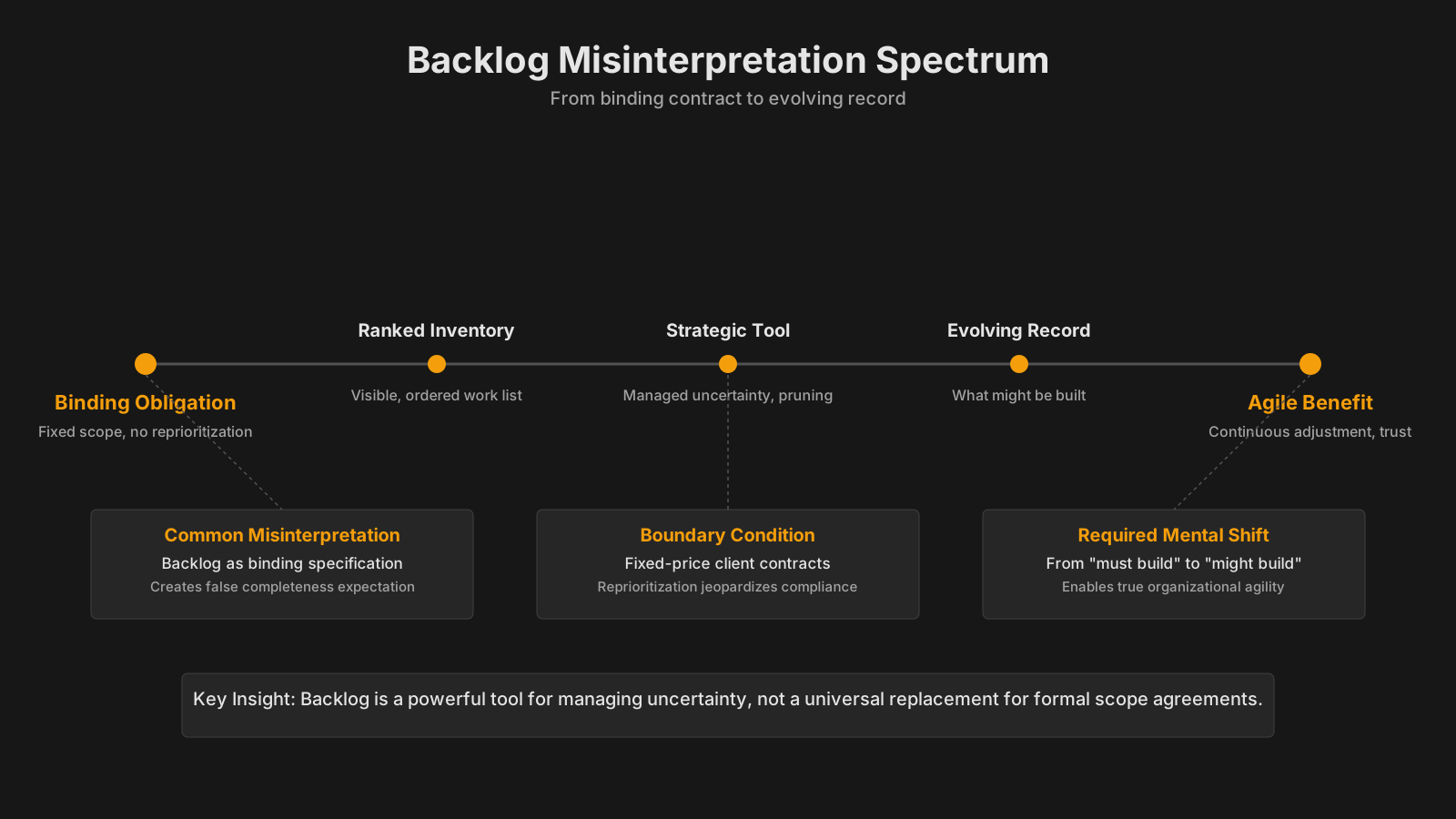
The relationship between a backlog and a work breakdown structure highlights the contrast between adaptive and predictive scoping. A WBS decomposes the entire project scope into deliverables and work packages in a hierarchical, complete-on-arrival manner, assuming that the scope is stable and can be fully defined early. A backlog, conversely, is flat and deliberately incomplete, capturing only what is currently known and allowing the decomposition to happen progressively as items move upward in priority. In hybrid models, a high-level WBS might define the contractual boundaries, while a backlog handles the detailed execution within those boundaries. The two can coexist, but confusing one for the other often leads to micromanagement of Agile teams or, on the flip side, a loss of contractual control in fixed-price environments.
Backlog items are typically expressed as user stories, but the backlog also encompasses epics (large stories that must be split into smaller ones) and themes (logical groupings of multiple stories or epics related to a common goal). The product roadmap sits above the backlog, providing the strategic narrative of which capabilities will be tackled in which timeframes, usually in months or quarters. The roadmap answers “why this sequence?” while the backlog answers “what exactly will we build next?” The sprint backlog’s relationship to the daily scrum is equally tight: the team uses the sprint backlog to inspect progress toward the sprint goal, not as a performance report for external consumption. Distinguishing these artifacts keeps each layer of planning focused on its proper audience and cadence.
Key Insights on Backlog Relationships
- Backlog vs. WBS scoping contrast
- A WBS decomposes the full project scope up front into a hierarchical, fully defined structure, while a backlog remains a flat, deliberately incomplete list that evolves as priorities shift.
- Hybrid model coexistence
- In hybrid environments, a high-level WBS defines contractual boundaries while the backlog manages detailed execution; confusing the two can lead to micromanaging Agile teams or undermining contractual control in fixed-price work.
- Backlog item hierarchy
- Beyond user stories, the backlog includes epics that must be decomposed into smaller, actionable stories, and themes that align multiple stories or epics around a unifying business goal.
- Roadmap and sprint backlog roles
- The product roadmap communicates the strategic sequence of capabilities, while the sprint backlog enables the team to inspect progress toward the sprint goal during the daily scrum; it functions as a self-management tool rather than an external performance report.
Evolution and Current Thinking
The evolution of backlog management practices has moved from a software-centric, single-team concern to a strategic capability in large-scale product organisations. Early Scrum teams often maintained a single product backlog in a spreadsheet or a physical card wall; today, dedicated tools like Jira, Azure DevOps, or linear apps provide real-time collaboration and analytics. Scaling frameworks such as SAFe, LeSS, and Nexus introduced multi-level backlogs (team, program, solution, portfolio) with explicit rules for how items flow between them and how economic decision filters are applied at each gate. This scaling brought necessary discipline but also added complexity that, if applied rigidly, can reintroduce the heavyweight governance that Agile originally sought to reduce.
A contemporary debate centres on whether the backlog should be intentionally limited in size. Some practitioners advocate for a “backlog as a fridge” metaphor—if it’s been in there too long without being pulled, throw it out. Others support the concept of a “lean backlog” where only items with clear, near-term intent survive, and everything else is archived to a separate idea repository that is reviewed periodically. Advances in artificial intelligence are beginning to influence backlog management as well: machine learning models can analyse past delivery data, customer behaviour, and market trends to suggest prioritisation adjustments or to detect stale items that have remained untouched for quarters. Whether these tools accelerate decision-making or add a layer of opaque automation remains an open question. What does remain constant is the core insight that a well-managed backlog is a conversation, not a contract, and that its value is measured not by how many items it contains but by how quickly the right work reaches users.