Ambiguity types in project management refer to the distinct categories of unclear, equivocal, or multi-interpretable conditions that can obscure a project’s scope, requirements, technology, environment, or stakeholder expectations. These types are not merely synonyms for uncertainty; they capture situations where the problem itself, the available information, or the decision pathways are subject to conflicting interpretations, often making forward movement seem like navigating through fog. Project practitioners who can identify the specific type of ambiguity at play are better equipped to select appropriate tools—from progressive elaboration and iterative delivery to assumption mapping and decision deferral—rather than applying a generic risk buffer and hoping for the best. The concept draws on broader organizational theory, including the distinction between state uncertainty, effect uncertainty, and response uncertainty, but within project management it has been refined into operational categories that help teams diagnose why clarity is lacking and what to do about it.
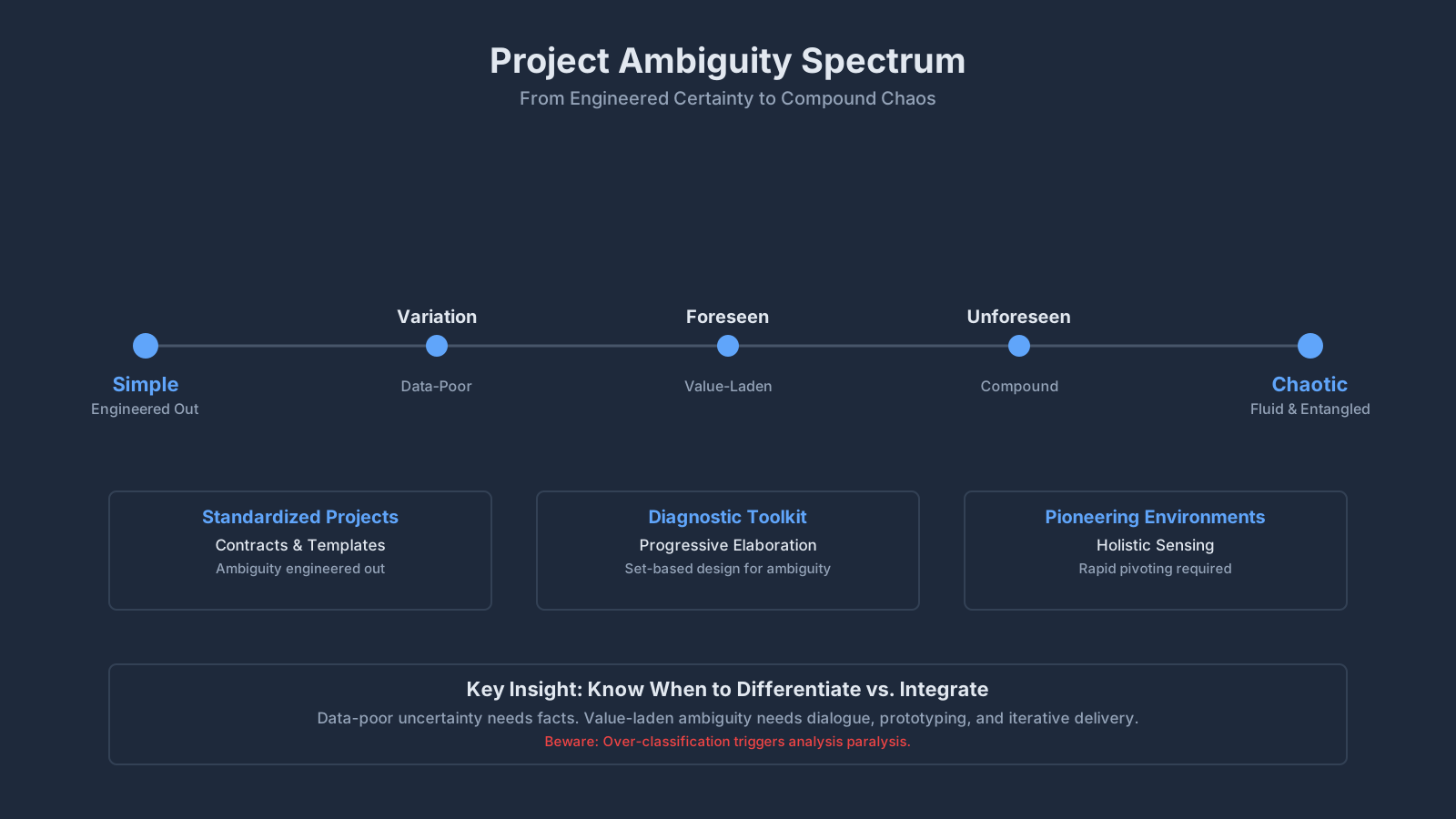
Ambiguity Types: Key Concepts Summary
| Concept | Summary |
|---|---|
| Ambiguity Types | Distinct categories of equivocal or open-ended conditions that obscure a project's scope, requirements, technology, operating environment, or stakeholder expectations, each demanding a different resolution strategy. |
| Classification | Classifying ambiguity by source and nature emerged from field practice and research, enabling practitioners to choose targeted techniques such as progressive elaboration or assumption mapping rather than defaulting to generic risk buffers. |
| Aleatory vs Epistemic | Aleatory ambiguity stems from inherent, irreducible randomness in a system, whereas epistemic ambiguity originates from knowledge gaps that investigation, modeling, or experimentation can progressively close. |
| Internal vs External | Internal ambiguity is typically resolved through facilitated workshops and tighter governance structures; external ambiguity often requires stakeholder negotiation, political navigation, or deliberate acceptance of residual exposure. |
| Environmental & Role | Environmental ambiguity reflects volatile markets, shifting regulations, or organizational dynamics that erode planning assumptions, while role ambiguity surfaces when decision rights, sponsorship, or accountability boundaries remain undefined. |
| PMBOK & PRINCE2 | PMBOK Seventh Edition addresses ambiguity implicitly through the principle of navigating complexity, while PRINCE2 embraces stage-by-stage planning to acknowledge that long-range precision is often unattainable. |
| Agile Approach | Agile environments treat ambiguity as the inherent condition of knowledge work; frameworks like Scrum and Kanban leverage short feedback loops and incremental delivery of working software to surface and resolve it continuously. |
What Are Ambiguity Types in Project Management?
The phrase “ambiguity types” is not a single, standardized term from a governing body like PMI or AXELOS, but it represents a project management ambiguity types classification that has emerged from decades of field practice and research into uncertainty management. In essence, it means breaking down the monolithic cloud of “we don’t know” into more manageable shapes. For instance, a project might suffer from requirement ambiguity, where stakeholders describe outcomes in contradictory ways, or from technical ambiguity, where the means to achieve a requirement are novel and poorly understood. There is also environmental ambiguity—shifting market conditions, regulatory signals, or organizational politics that render planning assumptions fragile—and role ambiguity, where team members or sponsors lack clear decision authority or accountability. Recognizing these as distinct types matters because each demands a different response. Brute-force analysis works for some, but for others only iterative sensing and responding, or even deliberately delaying certain decisions, will suffice.
The PMBOK Guide, Seventh Edition, approaches this indirectly through the principle of “navigate complexity,” which acknowledges that many projects exist in a space of unpredictable interactions and human behavior patterns where cause and effect are not obvious. The standard’s shift from process groups to principles reflects the reality that ambiguity cannot be fully planned away. Similarly, PRINCE2’s management-by-stages structure is a defensive mechanism against ambiguity: by planning in detail only for the next stage and keeping later stages at a summary level, the method accepts that long-range clarity is often an illusion. In Agile environments, ambiguity is not treated as a defect to be eliminated but as the natural state of knowledge work; frameworks like Scrum and Kanban use short feedback cycles, constant reprioritization, and working software as a probe to resolve ambiguity gradually. The concept of “ambiguity types” thus serves as a diagnostic lens, a way to move from the vague complaint that “things are unclear” to a precise, actionable assessment of what kind of unclearness is blocking progress.
The Difference Between Ambiguity and Uncertainty
Many project teams conflate ambiguity with uncertainty, but the distinction is critical. Uncertainty is a lack of information about the future state of a known variable: the probability of a vendor delivering on time, the temperature at which a component will fail, the final market price of a raw material. Ambiguity, on the other hand, exists when even the structure of the problem is in dispute. You might have all the data in the world about user preferences, but if different stakeholders interpret that data in mutually exclusive ways, you face ambiguity, not mere uncertainty. This difference was famously articulated in the organizational theory literature by researchers who separated uncertainty (incomplete knowledge of outcomes) from equivocality (multiple, conflicting interpretations of a situation). In project management, understanding this split helps explain why a detailed Monte Carlo analysis of schedule risks often fails to resolve stakeholder disagreements about what the deliverables should actually do. Those disagreements are ambiguous, not probabilistic, and require negotiation, prototyping, and shared understanding rather than more data.
Key Insights on Ambiguity Types
- Four common ambiguity categories
- Ambiguity types split uncertainty into concrete categories such as requirement, technical, environmental, and role ambiguity, shifting the focus from vague dissatisfaction to precise diagnosis of the specific unclearness that is stalling progress.
- Frameworks respond to ambiguity differently
- Project management standards address ambiguity through distinct mechanisms: PMBOK applies a navigate complexity principle, PRINCE2 relies on management by stages, and Agile leverages short feedback cycles, each providing a tailored response to unpredictable conditions.
- Practitioner-derived classification system
- The ambiguity types concept is not a formal standard from bodies like PMI or AXELOS; rather, it grew from decades of field practice and uncertainty management research, reflecting real-world project experience rather than theoretical mandates.
Key Components and Common Categories of Ambiguity
The key components of ambiguity types in projects can be organized around the source of the equivocality: the customer’s world, the solution space, the business context, and the human system that performs the work. One widely observed breakdown includes requirement ambiguity, technical ambiguity, environmental ambiguity, and role ambiguity. Requirement ambiguity appears when the problem to be solved is poorly defined or when multiple stakeholders express needs that conflict with each other but no one has the authority to adjudicate. The classic symptom is the stakeholder who says “I’ll know it when I see it.” Technical ambiguity surfaces when the project must use new materials, novel algorithms, or unproven integration patterns, making it impossible to predict reliably how long the work will take or whether it will succeed at all. Environmental ambiguity involves external forces—new legislation, competitor moves, economic shifts—that are not just uncertain in timing but whose very implications for the project are open to multiple interpretations. Role ambiguity occurs when team members are unsure who makes which decisions, whose approval matters, or what “done” really means for their individual contribution; it erodes accountability and creates hidden rework loops.
Other categorizations dig deeper into the nature of the ambiguity itself. For example, some practitioners distinguish between aleatory ambiguity, which arises from inherent randomness or complexity that cannot be reduced (like the unpredictable spread of a new technology in a market), and epistemic ambiguity, which stems from a lack of knowledge that could, in theory, be acquired through investigation, modeling, or experimentation. A project team facing epistemic ambiguity might invest in a technical spike or a design sprint to resolve it; introducing a margin in the budget for aleatory ambiguity may be the wiser path. Another useful lens is the distinction between internal and external ambiguity: internal ambiguity lives within the project’s own documentation, assumptions, and team dynamics, while external ambiguity connects to the ecosystem the project operates in. This split matters because internal ambiguity can often be resolved through workshops, clarification sessions, and improved governance, whereas external ambiguity may require political navigation or accepting a higher level of residual risk. Recognizing these layers prevents the mistake of trying to analyze away an ambiguity that is actually a permanent feature of the environment.
How Ambiguity Types Manifest Across Lifecycle Phases
The shape of ambiguity shifts as the project moves from initiation through delivery and closeout. During initiation and early planning, requirement ambiguity is at its peak. Stakeholders often cannot articulate precise needs because they themselves are exploring the problem space; this is when business case assumptions are most fragile and the charter may contain lofty statements that mean different things to different readers. As the team moves into design and execution, technical ambiguity takes center stage. The unknowns shift from “what do we want?” to “can we actually build this?” Teams may discover that a chosen platform cannot scale, or that an integration behaves unpredictably under load. Environmental ambiguity, though always present, becomes acutely visible during monitoring and controlling, when external changes force rebaselining or when a sponsor interprets a market signal differently than the project manager. Late in the lifecycle, role ambiguity can resurge during handover and closeout because the operational support team may have a different understanding of acceptance criteria than the delivery team, creating a dangerous gap in expectations.
Agile projects compress this progression through iterative delivery. Each sprint intentionally surfaces requirement and technical ambiguity early, in small, safe doses, rather than allowing it to accumulate unseen until a big-bang integration. The product backlog is not a crisp specification; it is a ranked list of ambiguous desires that get refined conversationally just-in-time. This works because ambiguity, unlike a fixed risk, cannot be stockpiled and analyzed in a separate risk register—it must be experienced to be understood. Conversely, highly predictive projects rely on phased gating and change control to contain ambiguity, assuming that the team can, with enough expert analysis, drive out most epistemic ambiguity before commitments are made. Both approaches have merit, but their effectiveness depends on whether the dominant ambiguity type in the project is something that yields to upfront study or something that requires empirical discovery through building and feedback.
The Place of Ambiguity Types in Project Management Frameworks
Formal frameworks address ambiguity not as a named artifact but as a ambiguity management in PMBOK and PRINCE2 concern embedded in their processes. The PMBOK Guide’s traditional Knowledge Areas touch ambiguity in several places. Scope Management introduces progressive elaboration and rolling wave planning as tactics for dealing with unclear requirements at the frontier of the plan. Risk Management includes the concept of ambiguity risk, though it is often conflated with variability and event risk; the Identify Risks process expects teams to detect sources of ambiguity alongside discrete threats. The Monitor and Control Project Work process acts as the point where realized ambiguity—such as a regulatory interpretation that suddenly shifts—gets escalated and evaluated. The Seventh Edition’s principle-based approach, especially the “navigate complexity” principle, is the clearest acknowledgement that projects exist in a state of irreducible ambiguity that demands adaptive systems and decentralized sense-making.
PRINCE2 tackles ambiguity through its governance structure. The principle of “manage by stages” is a direct structural response to the impossibility of detailed long-range planning in an ambiguous environment. Each stage boundary provides a natural point to reassess the project’s continued viability against new interpretations of the business case. The senior user role in PRINCE2 is designed to represent the often ambiguous voice of the customer, giving it a formal channel rather than letting conflicting user demands destabilize the team. In practice, the project board’s tolerance setting also encodes a form of ambiguity absorption: the project manager operates within tolerances, and only when a stage forecast exceeds those boundaries does the board need to grapple with the ambiguity of whether to continue. BVOPM, the Business Value-Oriented Project Management methodology, introduces a specific scope classification that directly acknowledges ambiguity types. Its five-level scale—Definite, Probable, Possible, Doubtful, and Unlikely—categorizes scope items by their clarity and likelihood, treating ambiguous scope as a normal planning input rather than a failure of analysis. This allows the team to plan with appropriate margins and to treat scope changes that clarify formerly ambiguous items as useful feedback, not as scope creep. BVOPM’s product risk management also uses quantified Loss size units to express the impact of ambiguous technical risks, filtering them dynamically as information emerges—an explicit nod to the epistemic nature of many technical ambiguities.
Ambiguity Types in Agile and Hybrid Environments
Agile methods are built on the assumption that ambiguity is a permanent condition, not a temporary nuisance. The product backlog is a living, ambiguous artifact; it holds user stories that are intentionally lightweight containers of meaning. The real resolution of ambiguity happens during sprint planning, daily standups, and sprint reviews, where conversation replaces documentation. Technical ambiguity is tackled through spikes—time-boxed experiments that produce knowledge, not deliverable features. The concept, borrowed from Extreme Programming, is a direct instrument against epistemic ambiguity: instead of guessing how a new technology will behave, the team spends a few days building a thin slice to find out. Hybrid frameworks combine these adaptive tactics with the structural oversight of traditional gating. For instance, a hybrid project might use a high-level predictive plan for known, well-defined elements while operating an Agile sub-team for the ambiguous user-facing features. The key in hybrids is to route each work stream to the governance model that matches its dominant ambiguity type, rather than forcing a one-size-fits-all approach that would either strangle exploration or leave critical dependencies unmanaged.
A common observation among practitioners is that Agile’s comfort with ambiguity often clashes with the organization’s need for fixed-price contracts and deterministic milestones. This tension is, in itself, a form of role ambiguity: the team is told to embrace change but is measured against a baseline frozen months earlier. Addressing that means acknowledging the ambiguity of the commercial arrangement explicitly and designing incentive models that share the burden of emergent understanding, such as target-cost contracts with gain-share provisions. Without this, the project is caught in two contradictory definitions of success, and the team will experience exactly the kind of paralyzing ambiguity the frameworks are meant to dissolve.
Essential Insights on Ambiguity Types
- Ambiguity embedded in formal frameworks
- PMBOK and PRINCE2 manage ambiguity by weaving it into procedural mechanisms rather than designating it as a distinct project artifact.
- Scope techniques for unclear requirements
- Progressive elaboration and rolling wave planning provide structured methods within Scope Management to address requirements that remain undefined or fluid during early planning stages.
- Navigate complexity acknowledges ambiguity
- The Seventh Edition’s “navigate complexity” principle explicitly recognizes that projects inevitably confront irreducible ambiguity, demanding adaptive systems and decentralized sense-making.
- PRINCE2 senior user and tolerances
- The senior user role formalizes the inherently ambiguous customer voice, while the project board’s tolerance thresholds accommodate uncertainty until stage forecasts breach agreed limits.
- BVOPM classifies ambiguity explicitly
- BVOPM’s five-level scope classification, spanning from Definite to Unlikely, treats ambiguous scope as a standard planning input and applies Loss size units to quantify ambiguous technical risks.
Practical Application and Common Scenarios
In real project work, applying ambiguity types to project decisions begins with diagnostic conversations rather than complex modeling. A project manager noticing that sprint velocity keeps missing forecasts might pause to ask: Is this because the stories themselves are poorly understood (requirement ambiguity), or because the team is struggling with a new microservices architecture (technical ambiguity), or because the product owner keeps changing priorities based on conflicting executive signals (role ambiguity)? Each answer leads to a different intervention. If it’s requirement ambiguity, the fix might be a series of rapid prototypes and user observation sessions, not a longer requirements document. If it’s technical ambiguity, a dedicated spike or the involvement of a specialist coach could unblock the work. If it’s role ambiguity, the need is for an explicit decision-rights matrix and a facilitated session with sponsors to clarify who actually has final say on scope trade-offs. This diagnostic approach is far more efficient than the default reaction of demanding more detailed task breakdowns and pushing the team harder, which often just accelerates the production of ambiguous output.
Consider a hypothetical medium-sized enterprise implementing a new customer relationship management system. During planning, the team may face requirement ambiguity because the sales and marketing departments describe completely different workflows, each insisting their view is the “right” one. At the same time, technical ambiguity appears when the IT team realizes the chosen cloud provider’s API deprecation schedule is unclear, threatening the integration design. Environmental ambiguity exists because the company is considering an acquisition that would double the user base and change the functional scope entirely. Role ambiguity surfaces when the steering committee includes both the COO and the CFO, who have given the project manager conflicting guidance on budget flexibility. A seasoned program manager would treat each of these as a separate ambiguity stream, not a single “messy project” problem. They might use facilitated requirements workshops with decision-making protocols to resolve the marketing-sales conflict, commission an independent cloud architecture review for the technical unknowns, build a flexible contract with the vendor to accommodate the possible acquisition, and insist on a written delegation from the executive team to clarify who resolves budgetary trade-offs. This layered response is only possible because the ambiguity was decomposed into its types.
The practice of consciously mapping ambiguity types is also valuable during stage gates or sprint reviews. Instead of asking “is the plan still valid?” in a binary way, the team and governance body can assess residual ambiguity. A risk-adjusted backlog might carry items labeled with their dominant ambiguity category, helping the product owner decide that a feature with high technical ambiguity should be pulled earlier in the schedule to create time for learning. This thinking turns ambiguity from a scary unknown into a workable constraint, much like a limited budget or a fixed deadline. Project managers who develop a fluency in naming ambiguity types—and who resist the organizational pressure to pretend everything is certain until proven otherwise—consistently make more credible commitments because their plans already account for the known pockets of equivocality.
Challenges, Pitfalls, and Misconceptions
A common misconception about ambiguity in project management is that it can always be eliminated with enough analysis, expert involvement, or stakeholder alignment. This belief drives teams to produce ever-thicker specification documents, endless research phases, and rounds of approval that only deepen confusion because each expert layer adds another interpretation. When the ambiguity is aleatory—stemming from inherent unpredictability in the market or technology—no amount of study will remove it. The proper response is to build in adaptability mechanisms, such as modular architecture that allows components to be swapped, or commercial terms that reprice when scope clarifies. Treating all ambiguity as resolvable is a dangerous fallacy that leads to blown budgets and teams trapped in analysis paralysis. Another frequent pitfall is failing to distinguish ambiguity from disagreement, and thus attempting to resolve a conflict through research when what is needed is negotiation. Two stakeholders may both understand a requirement perfectly but hold opposing preferences; that is not ambiguous needs, it is a decision stalemate requiring authority, mediation, or escalation.
The human dimension of ambiguity is often underestimated. Even when a project manager correctly identifies technical ambiguity, the team may be psychologically uncomfortable admitting they do not know how to solve a problem, especially in organizations that reward certainty and punish visible struggle. This leads to overly optimistic estimates, hidden prototyping under the guise of production work, and a culture where early warnings are suppressed. Role ambiguity is similarly corrosive because it generates shadow decision-making structures: people start asking whoever seems confident rather than the person with actual accountability, creating parallel chains of command that fracture the project. Addressing these dynamics is as much a leadership challenge as a technical one. The project manager must model comfort with ambiguity, celebrating when a team surfaces an unknown early rather than framing it as a failure of planning.
There are also situations where the concept of ambiguity types itself is misapplied. Some teams use it as a label to dismiss legitimate planning efforts, claiming “it’s too ambiguous to plan,” when in fact a great deal of epistemic ambiguity could be resolved with a few days of focused research or a conversation with a subject-matter expert. Ambiguity typing is not a justification for laziness; it is a tool for directing effort where it will be most valuable. Over-categorization can also lead to artificial rigidity, where a project manager insists a topic is purely one type of ambiguity and rejects a blended intervention that might work better. In practice, many ambiguous situations are hybrids—requirement ambiguity blurring into technical ambiguity as the solution itself reveals new user needs—and the boundaries between categories are soft. The value lies in the conversation the categories provoke, not in placing them into fixed taxonomical boxes.
Core Takeaways on Ambiguity Missteps
- Ambiguity cannot always be eliminated
- Aleatory ambiguity reflects inherent unpredictability, so no amount of analysis or expert input can ever make it disappear.
- Adaptability beats exhaustive analysis
- For irreducible uncertainty, the most effective response is to build in flexibility through modular architecture or adjustable commercial terms, instead of relying on ever thicker documents.
- Resolvable ambiguity fallacy
- Treating all ambiguity as resolvable drives blown budgets and traps teams in analysis paralysis, endlessly chasing a certainty that does not exist.
- Ambiguity versus disagreement
- When unclear requirements are mistaken for conflicting preferences, teams default to costly research rather than the negotiation, authority, or escalation the situation demands.
- Social and role ambiguity traps
- Fear of repercussions leads teams to hide technical uncertainty, role ambiguity spawns shadow decision-making, and some misuse ambiguity as a pretext to avoid legitimate planning.
Relationships to Other Project Management Concepts
Understanding ambiguity types related to risk, complexity, and planning deepens their practical value. Ambiguity is closely tied to risk, but it is not a subset of traditional threat-based risk management. A project risk register typically captures discrete events with probabilities and impacts; an ambiguous requirement, however, is not an event—it is a condition that introduces a whole family of potential secondary risks. Project teams managing high ambiguity often augment their risk management with assumption logs that explicitly track the beliefs underlying estimates and schedules, treating each assumption as a source of potential equivocality that must be monitored. A key difference from standard risk is that ambiguity often demands more qualitative, sense-making responses, such as stakeholder dialogue and iterative prototyping, rather than contingent time and cost reserves alone. Complexity and ambiguity also overlap: a highly complex project with many interacting parts can generate ambiguity because the interactions produce emergent behaviors that no single person can interpret fully. But a project can be complex without being ambiguous (a massive construction project with well-established engineering codes) and ambiguous without being complex (a small, colocated team building a new product feature that customers have not yet seen).
Ambiguity also strongly influences the planning approach. The selection between predictive, iterative, incremental, and Agile lifecycles is fundamentally a response to the distribution of ambiguity types across the project. When requirement ambiguity is high and technical ambiguity is moderate, an Agile lifecycle excels because it allows requirements to emerge through interaction with working increments. When technical ambiguity is immense but requirements are stable (building a next-generation battery, for example), a hybrid lifecycle of proof-of-concept phases followed by structured delivery may be more appropriate. Rolling wave planning, a technique from the PMBOK, is a direct planning response to temporal ambiguity: near-term work is planned in detail, while far-term work remains at a high level until ambiguity recedes. This technique acknowledges that ambiguity decays with time and proximity, and it prevents teams from wasting effort on detailed plans for work that will almost certainly be reinterpreted before it begins.
The link to stakeholder management is equally potent. Most requirement ambiguity arises not from a lack of communication but from genuine differences in stakeholder mental models. Techniques like the analytic hierarchy process or multi-criteria decision analysis can sometimes expose and resolve these differences, but only if the stakeholders are willing to converge. When they are not, the ambiguity type transitions from epistemic (can be known with more effort) to something closer to a political conflict, which demands a different set of tools, including negotiation, escalation, and sometimes restructuring the project charter to make trade-offs explicit. This is where BVOPM’s emphasis on a Transparent Board of Project Issues, where all roles can raise concerns before authorization, becomes relevant: it creates a formal space to surface and negotiate divergent interpretations early, before they harden into unresolvable disputes during execution.
Evolution and Current Thinking on Ambiguity Types
The evolution of ambiguity management in modern project delivery has moved from a view of ambiguity as a negative force to be suppressed toward an acceptance that it is an inherent feature of creative and strategic endeavors. Early project management texts, influenced by defense and construction origins, emphasized complete specification and detailed planning, implying that ambiguity was a temporary embarrassment overcome by thoroughness. Over time, the rise of software engineering and product development exposed the limits of that view. The Agile Manifesto’s preference for responding to change over following a plan was, in essence, a recognition that customer-facing projects swim in requirement and environmental ambiguity that cannot be defined away. The lean startup movement brought the concept of the pivot—a structured change in direction when initial assumptions prove ambiguous—into mainstream business thinking. Today, scholars and senior practitioners talk about “ambiguity tolerance” as a core competency for project managers, distinguishing it from mere risk management. There is a growing body of thought arguing that project success in knowledge industries depends not on eliminating ambiguity but on calibrating responses to match the ambiguity type, velocity, and impact.
Debates persist, however. One school holds that ambiguity types should be formalized into a taxonomy that is assessed at every gate review, perhaps using a checklist that scores requirement, technical, environmental, and role ambiguity on a simple scale. Another argues that such formalization kills the very adaptive thinking needed to navigate ambiguity, and that project managers should instead cultivate a reflective practice, using ambiguity types as conversational hooks rather than audit criteria. Both views have merit depending on the organizational culture. In heavily regulated industries, a structured ambiguity assessment may be the only way to justify flexible planning to oversight bodies. In startups, such a checklist would likely gather dust. What is not debated is that the binary certainty-uncertainty language of traditional project management is insufficient for describing the lived experience of project teams, who daily confront situations that are fuzzy, multi-layered, and rapidly shifting. Ambiguity types, by giving managers a richer vocabulary, enable more precise diagnosis and more appropriately varied responses—whether that means pausing for a spike, engaging a neutral facilitator, or rewriting the project charter to reflect new realities.
A typical reflexive aside from a veteran program manager might note that the most dangerous ambiguity is the one nobody names because it lives in the gap between what the sponsor says publicly and what they actually intend. Every framework offers tools for documented risks and stated requirements, but the unspoken, politically charged ambiguities—a sponsor who secretly wants the project to fail to prove a point, or a supplier who is deliberately ambiguous about capacity to retain leverage—these are the ones that dismantle projects quietly from the inside. Recognizing that ambiguity can be manufactured and weaponized is the dark side of this domain, and no typology will capture it completely. Still, even in those cases, the habit of asking “what type of ambiguity is operating here, and who benefits from its persistence?” can be a surprisingly sharp analytical tool.
Key Insights on Ambiguity Evolution
- From problem to inherent feature
- The field has progressed from treating ambiguity as a transient problem solvable through exhaustive specification to embracing it as an essential, value-creating feature of creative and strategic endeavors.
- Calibrating responses to ambiguity
- Modern scholarship contends that succeeding in knowledge-intensive industries requires tailoring responses to the specific type, tempo, and consequence of ambiguity, rather than seeking to eradicate it through rigid, front-loaded planning.
- Taxonomy versus reflective conversation
- Practitioners remain divided on whether ambiguity should be codified into formal checklists or leveraged as conversation starters for reflection, yet unarticulated political ambiguities consistently prove the most destructive to project outcomes.