A checklist in project management is a structured list of items, actions, criteria, or deliverables used to verify that specific project activities have been completed, reviewed, or approved. It functions as a cognitive aid that reduces errors of omission in repetitive, complex, or high-stakes work. Within formal project management frameworks, checklists appear as quality control instruments, risk identification prompts, stage gate review tools, and team coordination artifacts. Their core purpose is not to create new knowledge but to ensure that existing knowledge is reliably applied at the right time and under pressure.
Key Topics in Checklists: A Summary
| Definition | Summary |
|---|---|
| Checklist | A checklist is a structured record of required steps, attributes, conditions, or deliverables that must be verified during project execution, review, or closure to ensure completeness and compliance. |
| Primary Purpose | Checklists function as embedded quality control gates, early risk identification prompts, stage gate review instruments, and cross-functional coordination artifacts that reduce the likelihood of overlooked requirements in complex project environments. |
| Startup Checklist | A project startup checklist compels the project manager to confirm sponsor authority, baseline approval, risk register establishment, and communication plan distribution prior to execution, ensuring governance prerequisites are met before resources are committed. |
| Historical Origins | The formal management checklist emerged from high-risk operational settings, notably aviation and aerospace during the mid-twentieth century, where reliance on human memory in complex machine interfaces produced unacceptable error rates. |
| Healthcare Application | The World Health Organization surgical safety checklist has become a globally recognized protocol that reduces preventable surgical complications by standardizing critical verification points across the perioperative pathway. |
| Construction Application | Construction punch lists function as final verification checklists that confirm completion and correction of outstanding work items before facility handover, protecting owners from latent defects and incomplete scope. |
| Checklist Item Components | Well-designed checklist items include an unambiguous condition or action statement, a binary or graduated verification status, a named owner or role, and a timestamp that establishes an audit trail for each verification. |
| Quality Criteria | Vague prompts such as "review quality" invite subjective interpretation and inconsistent outcomes, while behaviorally specific prompts such as "confirm all open defects are assigned and severity-rated" drive repeatable verification and measurable compliance. |
What Is a Checklist in Project Management?
In the context of project management, a checklist is defined as a documented inventory of steps, attributes, conditions, or deliverables that must be confirmed during the execution, review, or closure of project work. The question of what is a checklist in project management often arises because the term is used across quality, risk, procurement, and administrative functions with slightly different nuances. Unlike a simple reminder list, a project management checklist typically includes acceptance criteria, verification status, ownership, and date fields that make it auditable and actionable. It standardizes a recurring process so that critical actions are not skipped under schedule pressure, stakeholder demands, or team fatigue.
A checklist is not a plan and it does not replace professional judgment. It supports judgment by externalizing memory. In a complex project environment, even highly experienced professionals can overlook known requirements when interrupted by resource conflicts, scope adjustments, or competing priorities. A project startup checklist, for example, prompts the project manager to confirm sponsor authority, baseline approval, risk register creation, and communication plan distribution before execution begins. That simple verification sequence prevents omissions that would otherwise surface later as much larger problems.
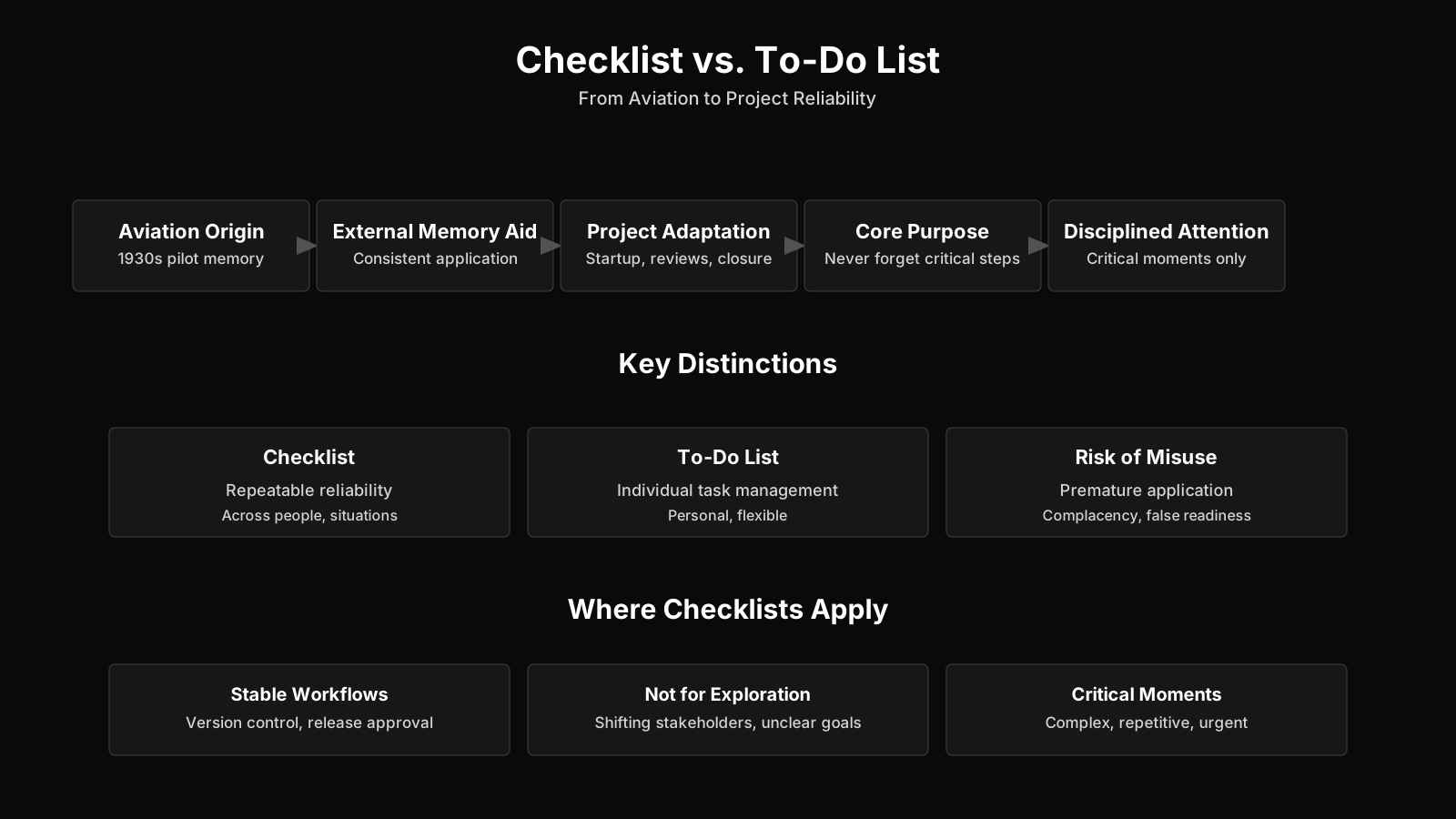
Practitioners often distinguish between a checklist and a mere to-do list. A to-do list is typically personal, unstructured, and sequenced by priority or sequence. A checklist is usually shared, formally reviewed, and built around verification rather than task assignment. The critical difference is that checklists are designed for reliability, not just productivity. They are most valuable when the same set of checks must be performed repeatedly by different people with consistent results.
Core Takeaways on Checklists
- Documented inventory of work
- A project management checklist catalogs the specific steps, attributes, conditions, and deliverables that require confirmation during project execution, review, or closure.
- More than a reminder list
- A project management checklist goes beyond a simple reminder list by incorporating acceptance criteria, verification status, ownership, and date fields, which together make it auditable and directly actionable.
- Standardizes recurring processes
- By standardizing recurring processes, a checklist ensures that critical actions are not overlooked when schedule pressure, stakeholder demands, or team fatigue create risk.
- Supports, not replaces, judgment
- A checklist does not replace a project plan or professional judgment, but it strengthens judgment by externalizing memory in complex project environments.
- Ensures consistency, prevents omissions
- A project startup checklist, for example, prompts the project manager to confirm sponsor authority, baseline approval, risk register creation, and communication plan distribution, catching omissions before they escalate into larger problems.
Origins and Cross-Industry Context of Checklists
The origin of checklists in management is generally traced to high-risk operational environments where human memory proved unreliable in complex machine interfaces. Aviation and aerospace industries developed rigorous checklist protocols during the mid-twentieth century to formalize pre-flight, in-flight, and emergency procedures. These protocols became standard practice because they reduced catastrophic errors caused by skipped steps or misremembered sequences. A similar pattern emerged in medicine, where the World Health Organization surgical safety checklist became a globally recognized tool for reducing preventable surgical complications.
Construction and manufacturing also adopted checklists long before project management formalized the concept. Construction punch lists, for instance, are essentially closing checklists that verify the completion and correction of work items before a facility or system is handed over. Manufacturing quality control has used check sheets and inspection checklists for decades to maintain consistency across production runs. Software engineering borrowed the idea through test checklists, release readiness checklists, and code review criteria.
What makes these cross-industry applications relevant to project management is their shared emphasis on standardization under uncertainty. A checklist does not eliminate uncertainty, but it ensures that known critical actions are performed even when the surrounding context is unstable. That is precisely the condition in most projects, where changing requirements, resource constraints, and schedule pressure regularly degrade human attention. Project management adopted checklists as a lightweight mechanism to counter that degradation without adding heavy process overhead.
Key Components of a Checklist
The key components of a checklist vary by application, but most effective project checklists share a common structure. Each item on the checklist typically includes a clear description of the condition or action to be checked, a binary or graduated verification status, an assigned owner or role, and a date or timestamp for when the check was performed. The item description must be specific enough that two different reviewers would interpret it the same way. Vague items like "review quality" produce inconsistent results, whereas items like "confirm all open defects are assigned and severity-rated" generate consistent verification.
Another important component is the scope boundary of the checklist. A well-designed checklist states what it covers and what it explicitly does not cover. This prevents scope creep within the checklist itself, which is a common failure mode. The checklist should also include escalation criteria, meaning instructions for what happens when an item cannot be verified or fails the check. Without escalation definitions, a checklist can become a dead end where known problems are recorded but not acted upon. Finally, revision history and review dates are component parts that keep the checklist aligned with current project context. A checklist that is not periodically reviewed drifts into irrelevance.
Checklists also have two dominant structural patterns: read-do and do-confirm. A read-do checklist directs the user to read each item and then perform the action immediately. This pattern is common in task execution, such as a server deployment checklist. A do-confirm checklist allows the user to perform a sequence of actions first and then pause to confirm that each required step was completed. Quality inspections and stage gate reviews often use do-confirm structures. Understanding these patterns helps project managers choose or design the appropriate checklist format for the situation.
Core Insights on Checklist Structure
- Common item anatomy
- Each checklist item typically combines a specific description, a binary or graduated verification status, an assigned owner or role, and a timestamp that records when the check was performed.
- Unambiguous descriptions required
- Item descriptions need enough precision that any two reviewers will arrive at the same interpretation, because vague phrasing such as "review quality" leads to inconsistent results across users.
- Explicit scope boundaries
- A well-designed checklist states both what it covers and what it excludes, which keeps the review within its intended boundaries and prevents scope creep from diluting its focus.
- Defined escalation criteria
- Effective checklists specify the next step when an item cannot be verified or fails, ensuring that identified problems trigger action instead of becoming dead ends where known issues are logged but never resolved.
Checklists in PMBOK and PRINCE2
In the PMBOK Guide, checklists in PMBOK are recognized primarily as data gathering tools within quality management and risk management processes. The PMBOK Guide includes checklists as a technique in the Identify Risks process, where they prompt the project team to consider categories of risk such as technical, external, organizational, and project management risks. They also appear in the Control Quality process, where checklists serve as structured verification aids for confirming that deliverable attributes meet specified requirements. In the Manage Quality process, checklists support consistency in quality management activities across the project.
The PMBOK framework does not treat checklists as a standalone project artifact but rather as an embedded tool within larger processes. A quality checklist, for example, derives its items from the quality management plan, quality metrics, and acceptance criteria defined in the project scope. A risk checklist draws on historical information, lessons learned, and the risk breakdown structure. This integration means that a checklist is only as good as the planning artifacts that feed it. A checklist that is disconnected from the project's actual baselines and constraints adds little value and may create a false sense of assurance. The seventh edition of the PMBOK Guide shifts toward principles and performance domains, but checklists remain relevant as a practical tool within delivery and measurement domains.
PRINCE2 does not mandate a specific checklist artifact, but its method includes several controls that function in a checklist-like manner. Stage boundaries require explicit confirmation that products for the current stage are complete and approved before the next stage can be authorized. Quality review techniques in PRINCE2 include structured checks against product descriptions and quality criteria. The lessons log and risk register similarly act as prompts for recurring verification activities. In practice, PRINCE2 practitioners often embed checklists within work packages, stage plans, and highlight reports to streamline these mandatory reviews without adding separate documentation burdens.
Purpose and Importance of Checklists
The purpose of checklists in project management is to reduce errors of omission, standardize recurring verification activities, and provide an auditable record of completed checks. Projects are temporary and often unique, but within them there are many repetitive tasks: status reporting, quality inspections, procurement reviews, stakeholder approvals, and phase transitions. A checklist ensures that these tasks are performed with consistent rigor regardless of who is executing them or how much time pressure exists at the moment.
Beyond error reduction, checklists support team coordination and knowledge transfer. When a new team member joins a project, a well-structured checklist communicates expectations quickly without requiring lengthy onboarding. A communication plan checklist, for example, identifies which stakeholders receive which reports and at what frequency. A release readiness checklist aligns developers, testers, and operations staff around the same set of completion criteria. That shared understanding reduces friction and rework.
Checklists also create a lightweight audit trail. In regulated industries or projects with strict governance requirements, a completed checklist demonstrates that required controls were executed. This evidentiary function is separate from the checklist's cognitive benefit. Even when no external audit is anticipated, the historical record of completed checklists can support lessons learned reviews and root cause analysis after an issue occurs. The importance of checklists therefore extends from immediate operational reliability to long-term organizational learning.
Core Value of Project Checklists
- Reduces omission errors
- Checklists prevent essential steps from being overlooked in repetitive project tasks, preserving rigor and consistency even when schedules tighten and attention is divided.
- Aids team coordination
- They bring developers, testers, and operations staff onto the same page by defining shared completion criteria for releases and other cross-functional activities.
- Accelerates knowledge transfer
- A well-structured checklist makes expected workflows and quality gates immediately clear to new team members, shortening onboarding cycles and reducing reliance on informal knowledge.
- Supports governance and audits
- Completed checklists serve as auditable records that required controls and verification activities were performed, which is especially valuable in regulated or governance-intensive environments.
- Enables organizational learning
- Historical checklist data supports post-incident reviews and root cause analysis by revealing where process breakdowns occurred, enabling targeted process improvements over time.
Types of Checklists in Project Management
The types of checklists in project management can be categorized by their function within the project lifecycle. Quality control checklists are used during deliverable inspection to confirm that products meet specified acceptance criteria and quality metrics. Risk identification checklists prompt teams to consider known categories of risk, such as technology dependencies, regulatory changes, resource availability, and supplier stability. Stage gate checklists support phase transition reviews by verifying that required deliverables, approvals, and performance data are complete before the next phase is authorized.
Project startup checklists focus on initiation tasks, including project charter approval, stakeholder identification, governance structure establishment, and initial resource assignment. Procurement checklists ensure that request for proposal documents, vendor evaluations, contract terms, and legal reviews are completed in the correct sequence. Communication checklists verify that stakeholder groups receive appropriate information at the right frequency, with special attention to sensitive or high-impact messages. Meeting checklists are often overlooked but highly practical, covering agenda distribution, decision log updates, action item assignment, and follow-up scheduling.
In agile environments, the Definition of Done functions as a specialized checklist that defines the conditions a product increment must satisfy before it is considered complete. A Definition of Done typically includes integration testing, documentation updates, peer review, and compliance checks. Acceptance criteria on individual user stories function as micro-checklists for verifying that a specific feature meets stakeholder expectations. Kanban systems use explicit entry and exit criteria at each workflow state, which effectively embed checklist logic into the visual board. These agile variants demonstrate that checklists can be adaptive and value-focused rather than bureaucratic.
Practical Application Across the Project Lifecycle
The checklist application in project lifecycle varies by phase, but the underlying principle remains consistent: verify known requirements before moving forward. During initiation, a project charter development checklist ensures that the business case, high-level scope, key assumptions, constraints, and sponsor approval are all in place before formal authorization. In planning, checklists support data gathering for risk identification, quality planning, procurement planning, and stakeholder engagement planning. They prompt the project manager to consider elements that might otherwise be forgotten when schedules are tight.
During execution, checklists are most visible in recurring team activities. A daily standup checklist in agile projects reminds the team to review progress against sprint goals, surface blockers, and update the task board. A change request checklist in predictive environments ensures that impact analysis, cost estimation, and approval routing are completed before a change is implemented. In construction or engineering projects, inspection checklists verify that safety protocols, material certifications, and workmanship standards are met at predefined hold points.
Monitoring and controlling phases rely on checklists to maintain governance without excessive meetings. A project health check checklist might include schedule variance thresholds, cost performance index levels, risk register currency, stakeholder satisfaction indicators, and deliverable quality trends. Completing such a checklist at regular intervals provides early warning of emerging issues. At project closure, a lessons learned checklist ensures that knowledge capture, contract closeout, financial reconciliation, and deliverable handover are not skipped in the rush to disband the team. A closing checklist also supports transition to operations or follow-on projects.
From a business value-oriented project management (BVOPM) perspective, checklists are valuable only when they protect or increase value delivery. A checklist that forces teams to re-verify already accepted work or to pursue perfection on low-value criteria creates process waste. That waste can manifest as overwork, perfectionism, and the rejection of work that was actually acceptable. The practical application of checklists therefore requires periodic questioning of each item: does this check still reduce risk or improve value, or is it maintained only because it has always been there?
Checklist Use Across Project Phases
- Phase-specific verification principle
- Checklists are tailored to the demands of each project phase while still confirming that all known requirements have been satisfied before work advances.
- Initiation and planning support
- During initiation and planning, checklists help establish the project charter, identify key risks, define quality standards, align procurement needs, and secure stakeholder engagement before execution begins.
- Agile and change management
- Daily standup checklists keep sprint goals and emerging blockers visible to the team, while change request checklists enforce impact analysis and route each request through the appropriate approval channels before implementation.
- Inspection and health checks
- Construction hold point checklists confirm that safety and workmanship standards are met before work proceeds, and project health checks monitor schedule, cost, risk, stakeholder, and quality indicators to flag emerging issues early.
- Closure and avoiding waste
- Lessons learned checklists reduce the risk of omitting knowledge capture and formal closeout actions, yet their value declines when teams re-verify work that has already been accepted or pursue checklist items that add little value to project outcomes.
Common Challenges, Pitfalls, and Misconceptions
One of the most persistent common misconceptions about checklists is that they replace professional judgment. In reality, checklists are decision support tools, not decision-making algorithms. A poorly designed checklist that tries to encode every possible condition becomes unwieldy and often produces worse outcomes than no checklist at all. The checklist should cover the critical, repeatable, and error-prone steps, while leaving room for expert discretion on novel or ambiguous situations. Overreliance on checklists can lead to what practitioners sometimes call checklist compliance theater, where boxes are ticked but the underlying conditions have not actually been verified.
Checklist bloat is a widespread challenge. Over time, items are added in response to isolated incidents, and rarely are items removed. The result is a lengthy, low-signal checklist that teams skim rather than carefully verify. This directly undermines the original purpose. A useful rule of thumb is that a checklist should fit on one page for most operational checks, or one screen for digital versions. If it exceeds that size, it probably attempts to cover too much and should be split by role or subprocess. Each item must be genuinely critical, meaning that skipping it would materially increase project risk or rework probability.
Resistance to checklists is common among experienced team members who perceive them as micromanagement or as a lack of trust. This resistance often stems from past exposure to poorly designed checklists, not from the concept itself. The most effective approach is to involve the people who will use the checklist in its creation and review. When a checklist reflects real work practices and captures tacit knowledge, it becomes a shared team asset rather than an imposed control. Another pitfall is failing to update checklists when project context changes, such as after a major scope change or a shift in regulatory requirements. Outdated checklists create a false sense of security and may direct attention away from emerging risks.
Checklists vs Related Project Management Tools
A frequent point of confusion is the difference between a checklist vs work breakdown structure, commonly abbreviated WBS. A WBS decomposes project scope into manageable deliverables and work packages, establishing a hierarchical structure for planning and control. A checklist, by contrast, is not a decomposition of scope but a verification aid for ensuring that specific activities, criteria, or conditions are met. The WBS tells you what needs to be produced; the checklist tells you what to confirm before, during, or after that production. They are complementary, not interchangeable.
Checklists are also confused with check sheets. A check sheet is a data collection tool that records the frequency or occurrence of defects, events, or observations, often using tally marks. A checklist records completion or conformance. The distinction matters because a check sheet produces data for statistical analysis, while a checklist produces a verification record. In quality management, both may appear together: an inspector uses a checklist to verify conformance criteria and a check sheet to log defect types for Pareto analysis.
Another related concept is the acceptance criteria, which defines the conditions a deliverable or user story must satisfy to be accepted by the customer. Acceptance criteria are specific to a product or feature, while a checklist is typically broader and process-oriented. A Definition of Done in agile is closer to a checklist than acceptance criteria because it applies to every increment and includes workflow conditions like testing, documentation, and review. A to-do list, as noted earlier, is a personal prioritization tool with no formal verification structure. Understanding these distinctions helps project managers select the right tool for the right purpose rather than lumping all structured lists into one category.
Key Insights on Checklist Distinctions
- WBS versus checklist purpose
- A work breakdown structure decomposes project scope into hierarchical deliverables to support planning and control, whereas a checklist functions as a verification tool for confirming that specific activities, criteria, or conditions have been satisfied.
- Production versus confirmation focus
- The WBS identifies the deliverables that must be produced, while the checklist specifies the conditions or actions to verify before, during, or after production.
- Check sheet as statistical tool
- A check sheet is a structured data collection tool that records the frequency of defects or events, typically with tally marks, to enable statistical analysis such as Pareto charting rather than one-time verification.
- Combined quality management use
- In quality management practice, inspectors use checklists to confirm whether conformance criteria are met and check sheets to log defect types by frequency, enabling Pareto analysis.
- Acceptance criteria versus Definition of Done
- Acceptance criteria specify the conditions a deliverable must satisfy to gain customer acceptance, whereas the agile Definition of Done functions as a checklist because it applies uniformly to every increment and incorporates workflow requirements such as testing, documentation, and review.
Evolution and Current Thinking on Checklists
The evolution of checklists in project management has moved from static paper forms to dynamic, integrated digital tools. Project management information systems now allow checklists to be linked to work items, versioned automatically, and updated in real time based on project data. A digital stage gate checklist, for example, can automatically pull schedule variance, unresolved high-severity defects, and open risks from the project dashboard before the gate review. This reduces manual data entry and ensures the checklist reflects current conditions rather than a snapshot from days earlier.
Current thinking also emphasizes the need for checklists to be context-sensitive and user-maintained. The idea of a single universal checklist that works for every project has largely been abandoned. Instead, best practice now treats checklists as living artifacts that are tailored to project complexity, team maturity, and organizational governance requirements. A high-risk infrastructure project may need detailed safety and regulatory checklists, while a small internal software project may need only a short Definition of Done and a release readiness checklist. The checklist should be commensurate with the risk profile.
There is ongoing debate about the optimal length and frequency of checklist use. Some practitioners argue that checklists should be reserved for high-stakes, rare, or highly repetitive tasks, while everyday project coordination should rely on trusted workflows and team communication. Others advocate embedding checklists into routine meetings and status reviews as a form of lightweight governance. The truth is situational. A checklist that is used daily and reviewed weekly may be burdensome in a stable, low-risk project but essential in a regulated clinical trial or aerospace program. The challenge for project managers is to calibrate checklist intensity to actual risk without falling into checklist fatigue or ritual compliance.