Brainstorming is a facilitated group technique used in project management to generate a large quantity of ideas, uncover risks, define requirements, or solve complex problems through free-flowing, non-judgmental conversation. It draws on the collective creativity of a cross-functional team, temporarily suspending criticism to allow unconventional thoughts to surface. Within formal project frameworks, brainstorming is treated not as casual discussion but as a structured data-gathering method that feeds into planning, risk management, and scope definition artifacts.
Brainstorming at a Glance
| Key Concept | Summary |
|---|---|
| Brainstorming | A facilitated group ideation technique that generates diverse ideas, uncovers hidden risks, clarifies requirements, and resolves complex problems through open, non-judgmental dialogue. |
| Structured Method | In formal project environments, brainstorming functions as a disciplined elicitation method, directly populating planning artifacts, risk registers, and scope baselines rather than serving as casual conversation. |
| Core Premise | Maximizing idea quantity statistically raises the odds of discovering a breakthrough solution, while deferred judgment eliminates the fear-driven self-censorship that stifles innovation. |
| Facilitation | The facilitator must cultivate psychological safety and rigorously enforce the norms that no idea is too unconventional and all criticism is suspended during the initial ideation burst. |
| Historical Origins | Pioneered in 1940s advertising by Alex Osborn, brainstorming emerged from the insight that premature criticism routinely extinguishes novel thinking in collaborative settings. |
| Technique Family | Rather than a single rigid protocol, brainstorming constitutes a versatile family of techniques that can be calibrated to an organization’s risk tolerance and cultural norms. |
| Project Adaptation | Project management adopts a disciplined facilitated variant, channeling session outputs directly into risk registers and requirements traceability matrices rather than capturing loose inspirational notes. |
| Core Rules | Classic brainstorming rests on four foundational rules whose simplicity masks the deliberate enforcement required to produce meaningful, actionable outcomes. |
What Is Brainstorming in Project Management?
A brainstorming definition in project management describes a deliberate session where participants voice ideas spontaneously, with a facilitator capturing every contribution before any evaluation takes place. Unlike informal chatter around a coffee machine, the project-based brainstorming session has clear objectives, selected participants, and a pre-defined output that ties directly to a process like risk identification, requirements collection, or lessons learned. The core premise is that the sheer volume of ideas increases the probability of finding a truly valuable solution, while the absence of early criticism prevents self-censorship. In practice, this means even half-formed thoughts are welcomed, and participants are encouraged to build on each other’s suggestions, something that would be stifled in a normal status meeting.
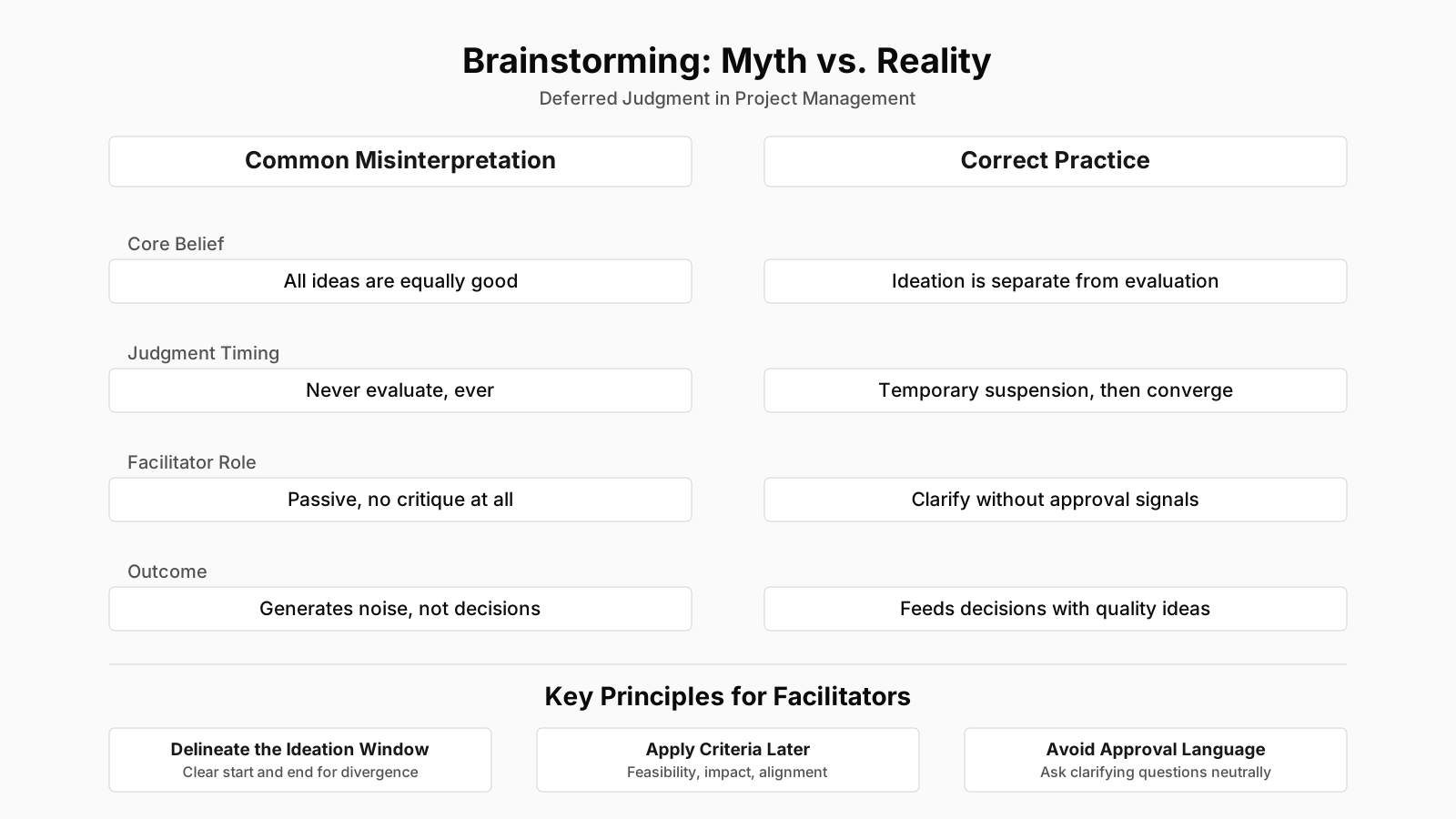
The technique rests on a set of operating rules originally formalized outside project management but subsequently woven into standard facilitation practices. Judgment is deferred until a later filtering stage, so a project manager or scrum master running a brainstorming session will often start by stating explicitly that no idea is too wild and no rebuttals are allowed during the initial ideation window. This is harder than it sounds. Teams accustomed to critical debate may initially struggle to hold back reactions, which is why the facilitator role is crucial to maintain the psychological safety required for genuine creativity.
When done well, brainstorming surfaces risks nobody had previously documented, unexpressed stakeholder needs, and innovative approaches to technical challenges. When done poorly, it becomes a ritual where the loudest voices dominate and the same familiar ideas are recycled. That tension explains why project management bodies of knowledge treat brainstorming as a valid but context-dependent tool rather than a universal solution for every decision point.
Core Takeaways on Project Brainstorming
- A structured session with a clear purpose
- Project brainstorming is a deliberate activity that aligns selected participants around defined objectives, producing outputs that directly inform risk identification, requirements collection, and the documentation of lessons learned.
- Volume of ideas drives valuable solutions
- Generating a large quantity of ideas raises the probability of discovering genuine breakthroughs, while the absence of early criticism removes the self-censorship that often stifles contribution.
- Judgment deferred to a later stage
- Facilitators intentionally postpone evaluation until a designated filtering phase, embracing half-formed concepts so participants can build freely on each other's suggestions without rebuttal during the initial creative window.
- Facilitator protects psychological safety
- A skilled facilitator enforces strict ground rules to neutralize critical reactions, particularly within debate-oriented teams, establishing a psychologically safe container where authentic creativity can surface.
- An effective but context-dependent tool
- Strong sessions uncover undocumented risks, unexpressed stakeholder needs, and innovative technical approaches, whereas weak execution merely amplifies dominant voices repackaging familiar concepts, demanding selective application rather than routine use.
Origins and Cross-Industry Context
Brainstorming originated in the advertising industry in the 1940s, when Alex Osborn, a partner at an agency, grew frustrated with how meetings killed novel thinking through premature criticism. He codified the four now-classic rules: defer judgment, strive for quantity, welcome wild ideas, and combine and improve suggestions. From advertising the method travelled to product design, military planning, and eventually software engineering, each field adapting it to its own constraints. In project management it arrived as a natural fit for the complex, multi-stakeholder environments where no single person holds all the relevant information.
Other disciplines also shaped the variants that project teams use today. Manufacturing quality circles employed structured brainstorming to surface defect root causes. Software development embraced it for user story workshops and sprint retrospectives. Medicine used it for differential diagnosis discussions, though with tighter guardrails. This cross-pollination reinforced the idea that brainstorming is not a single rigid format but a family of techniques that can be tuned to the risk tolerance and cultural norms of the organization.
It would be a mistake, however, to assume that all lessons from other industries transfer cleanly into project work. A marketing brainstorm may prioritize provocative, high-emotion ideas that would be entirely inappropriate for a nuclear plant’s risk identification workshop. The project management adaptation tends toward a more sober, facilitated variant where outputs are mapped to a risk register or a requirements traceability matrix rather than left as loose inspirational notes.
Key Components and Types of Brainstorming
A classic brainstorming session in project management follows four core rules that, despite their simplicity, require deliberate enforcement. Deferred judgment means nobody evaluates or criticizes any idea during the generation phase — not with words, tone, or body language. Quantity over quality pushes the group to list as many items as possible, because the 30th idea is often closer to a breakthrough than the first two. Freewheeling encourages imaginative leaps, even if they seem absurd on the surface. And combination and improvement ask participants to piggyback on earlier contributions, morphing them into something sharper.
Beyond the Osborn classic, project managers draw on several differentiated forms. Reverse brainstorming inverts the problem, asking the team to identify everything that could cause failure, which is then flipped into preventive actions — a technique especially useful in risk workshops. Nominal group technique introduces a period of silent individual idea writing before public sharing, reducing the anchoring effect of the first speaker. Brainwriting, where participants write ideas on cards that circulate for others to build upon, eliminates production blocking and equalizes participation across introverts and extroverts. Electronic brainstorming tools, now common in distributed teams, allow parallel, anonymous input that can generate more ideas with less social anxiety.
The choice among these types is not arbitrary. A project team with a dominant sponsor might need brainwriting or nominal group technique simply to prevent the hierarchy from crushing honest contributions. A rapid-response agile team under time pressure might use a tight five-minute electronic brainstorm integrated into their retrospective board. The type selection itself becomes a facilitation decision that shapes the quality of the output as much as the topic being explored.
Core Insights on Brainstorming
- Four classic brainstorming rules
- The foundational rules of deferred judgment, prioritizing quantity over quality, and building through combination and improvement must be deliberately enforced to sustain a productive idea generation phase.
- Reverse brainstorming approach
- Reverse brainstorming inverts the problem by first cataloguing every conceivable cause of failure and then converting those insights into preventive actions, making it particularly effective in risk assessment workshops.
- Nominal group technique benefits
- By having participants silently record their ideas before any public discussion, the nominal group technique minimizes the anchoring bias of early speakers and safeguards genuine, unfiltered contributions.
- Brainwriting and participation equity
- Brainwriting involves passing written ideas among participants for iterative building, which removes production blocking and ensures equitable contribution opportunities for both introverts and extroverts.
- Electronic brainstorming advantages
- Electronic brainstorming leverages parallel, anonymous input via digital platforms to boost idea volume and reduce social anxiety, making it ideal for distributed teams and time-sensitive agile retrospectives.
Brainstorming in PMBOK, PRINCE2, and Agile Frameworks
Brainstorming is listed as a data-gathering technique in multiple PMBOK processes, including Collect Requirements, Identify Risks, and Plan Quality Management. The PMBOK Guide — both in its sixth and seventh editions — presents it as a method to elicit ideas from stakeholders and subject matter experts, noting that a facilitator is typically needed to keep the session productive. It is not described as the sole technique for any process but rather as one tool among several, to be selected based on project characteristics and the nature of the information being sought.
Brainstorming in the PMBOK Process Groups
During the Collect Requirements process, brainstorming helps uncover stakeholder needs that remain hidden in formal interviews because people often do not articulate tacit expectations until another person’s comment triggers a connection. In the Identify Risks process, a cross-functional brainstorming workshop allows a project team to surface threats and opportunities that would escape a purely checklist-based approach. The technique also appears in Plan Risk Responses and in the retrospective activities that inform lessons learned during project closing. The PMBOK framework expects the raw output to be refined later — ideas are clustered, categorized, and validated against project constraints, a step that turns unfiltered creativity into actionable project documents.
Brainstorming in PRINCE2
PRINCE2 does not mandate brainstorming by name, but its emphasis on facilitated workshops for product-based planning and risk management makes the technique a default component of many PRINCE2 projects. A project manager running a PRINCE2 risk workshop will typically deploy brainstorming to populate the initial risk register, after which the ideas are assessed using probability and impact grids in line with the methodology’s management of risk theme. The structured separation of ideation and evaluation aligns well with PRINCE2’s principle of managing by stages, where early-stage thinking should not be prematurely constrained by later-stage feasibility filters.
Brainstorming in Agile and Scrum
Agile teams use brainstorming constantly, though rarely under that formal label. Sprint planning sessions often open with a quick brainstorm to decompose a feature into potential tasks. Backlog refinement workshops are essentially structured brainstorms where the product owner, developers, and testers collectively surface hidden dependencies and edge cases. Retrospectives rely on brainstorming formats like “start, stop, continue” to capture team sentiment without blame. In Scrum, the scrum master acts as the facilitator, enforcing the no-interruption rule and ensuring that the discussion does not slide into solutioning before the problem space is fully explored. The fast iteration cycles of agile mean that brainstorming outputs are expected to be immediately actionable rather than stored in a repository for later review, which changes the pacing and the tolerance for half-baked ideas.
The Role of Brainstorming in Predictive, Agile, and Hybrid Environments
In predictive project management, brainstorming is heavily used during planning and risk workshops, where the upfront clarity of scope demands a comprehensive initial pass at requirements and risks. A waterfall project might hold a multi-day facilitated session early in the life cycle, bringing together architects, business analysts, operations staff, and client representatives to map out everything that could affect the baseline. The outputs are then scrubbed, prioritized, and fed into the scope statement, WBS, risk register, and quality management plan. Because changes are more expensive later, the goal is to think broadly now and eliminate surprises.
In agile environments, brainstorming is distributed across the life cycle rather than concentrated at the start. A product owner might trigger a brainstorm when a story is too ambiguous, developers might swarm on a spike story with a whiteboard session, and the team might use silent brainstorming during a retrospective to gather honest feedback. The informality can mask just how frequently the technique is used; story point estimation poker itself is a form of structured anonymous brainstorming to reduce anchoring bias. Hybrid projects combine both patterns, using a high-level upfront brainstorm to define the roadmap and then iterative, smaller brainstorms to flesh out details just-in-time.
The environment also influences the facilitation style. A co-located predictive project team in a regulated industry may follow a strict timed agenda with a dedicated scribe, while a distributed agile team might use a digital whiteboard with post-it columns and a silent brainwriting warm-up. Neither approach is inherently superior; the risk lies in choosing a format mismatched to the team’s culture or the sensitivity of the topic. Brainstorming about an embarrassing technical debt problem, for example, might need anonymity even in a trusting team, pushing the facilitator toward an electronic tool regardless of the overarching methodology.
Key Insights by Environment
- Predictive projects brainstorm upfront
- In predictive environments, intensive brainstorming sessions are scheduled early in the lifecycle to identify and document all critical requirements and risks, thereby preventing costly rework once execution begins.
- Agile distributes brainstorming continuously
- Agile environments embed brainstorming into daily rituals such as backlog refinement, spike investigations, retrospective discussions, and estimation sessions, making its continuous application so natural that its prevalence often goes unnoticed.
- Hybrid blends both approaches
- Hybrid environments integrate an initial broad brainstorming effort for the overall roadmap with targeted, real-time sessions to resolve immediate challenges, while selecting facilitation tools based on team co-location, trust dynamics, and the sensitivity of the subject.
Practical Application Across the Project Lifecycle
Brainstorming During Project Initiation
In the early stages, brainstorming often takes the shape of a chartering workshop where the project sponsor, key stakeholders, and core team identify high-level risks, assumptions, constraints, and success criteria. A facilitator might pose open-ended questions like “What would cause this project to be cancelled?” or “What does the business absolutely need to see six months from now?” The raw lists that emerge become the foundation for the project charter’s assumptions log and preliminary risk list. Without this session, hidden expectations tend to surface later as expensive change requests or political conflicts.
Brainstorming for Risk Identification
Risk brainstorming in project management is one of the most established uses, often conducted as a structured session with categories based on a risk breakdown structure. Participants are encouraged to think beyond technical failures and consider regulatory, organizational, environmental, and stakeholder-related sources of uncertainty. A common facilitator technique is to start with a silent sticky-note period to capture individual concerns, then group and discuss them publicly. The output directly populates the risk register and informs the qualitative risk analysis. Project managers note that brainstorming produces a wider range of low-probability, high-impact risks than checklist reviews, simply because it pushes people to imagine worst-case scenarios they might otherwise suppress as too unlikely to mention.
Brainstorming During Execution and Monitoring
Once execution begins, problem-solving brainstorms address emerging issues that fall outside planned response strategies. A sudden supplier failure, a regulatory change, or a technical integration dead-end might trigger a rapid-fire session in a war room. These sessions are narrower, time-boxed, and focused on generating immediate options rather than speculative ideas. The deferred-judgment rule remains, but the follow-up evaluation is compressed, often moving to decision-making within the same meeting. Teams that practice brainstorming regularly during planning tend to be faster and more effective in these crisis-mode applications because the rules and facilitation patterns are already internalized.
Brainstorming in Closing and Lessons Learned
Post-project retrospectives are essentially structured brainstorms designed to capture what worked, what didn’t, and what should be done differently next time. Here the challenge is not idea generation quantity but emotional safety, because participants may be uncomfortable admitting mistakes even in a closed setting. Facilitators often use brainwriting or anonymous electronic polling to surface the most sensitive lessons, then gradually open the discussion as trust builds. The insights are consolidated into the final lessons learned register and feed organizational process assets, making brainstorming at this stage a bridge between one project’s end and the next one’s improved start.
Common Challenges, Pitfalls, and Misconceptions of Brainstorming
A common misconception about brainstorming is that unstructured group discussions always yield better ideas than individuals working alone. Decades of research in social psychology have shown that nominal groups — where people think independently before pooling ideas — often outperform traditional interactive brainstorming in both quantity and quality. This does not render brainstorming useless, but it exposes the danger of assuming that simply gathering people in a room will automatically unlock superior creativity. The production blocking effect, where one person speaking prevents others from thinking clearly, is a well-documented limitation that many project facilitators fail to account for.
Social loafing also creeps in when participants believe their individual contribution will not be noticed. In a large brainstorming session, a couple of people may carry the entire conversation while others mentally check out, confident that their silence will be invisible. This is particularly common in hierarchical organizations where junior team members have learned that keeping quiet is safer than floating an idea that might be judged later. Even with a good facilitator, the illusion of group productivity — the feeling that more was accomplished than actually was — can lead a project team to accept a shallow risk register as complete simply because the whiteboard looks full.
Another common mistake is conflating brainstorming with decision-making. The output of a brainstorm is a raw list, not a chosen course of action. Project teams sometimes drift from ideation into premature convergence, selecting a solution before the full range of options has been explored. That tendency becomes especially dangerous when the sponsor is present and inadvertently signals approval of an early idea, effectively shutting down further creativity. Facilitators must explicitly separate the divergent thinking phase from the convergent evaluation phase, often by scheduling them as distinct meetings or at least with a deliberate break in between.
Brainstorming is also a poor technique when the problem is well-understood and the solution space is narrow. Using it to decide between two well-defined technical alternatives wastes time and can generate irrelevant noise. It is similarly inappropriate in contexts where confidentiality is paramount or where the participants lack enough domain knowledge to contribute meaningfully. Recognizing when not to brainstorm is as important as knowing how to run one.
Core Takeaways on Brainstorming Pitfalls
- Nominal groups outperform interactive sessions
- Structuring idea generation so that participants first work alone reduces conformity and cognitive interference, leading to a greater quantity and diversity of high-quality ideas compared to open group discussion.
- Production blocking and social loafing
- When only one person can speak at a time, others' trains of thought are interrupted, and in larger or status-driven groups, individuals often reduce effort because they assume their input will not be recognized.
- Premature convergence and false productivity
- Teams often mistake a full whiteboard for substantive progress, settling on an early solution prematurely, especially when a sponsor's endorsement is misinterpreted as a signal to halt divergent thinking.
Relationships to Other Project Management Concepts
Brainstorming complements other facilitation tools such as affinity diagrams and the nominal group technique, often serving as the chaotic front end that feeds into orderly analysis. After a brainstorming session produces dozens of raw ideas, the team might use an affinity diagram to cluster them into natural groups, creating the structure needed for a work breakdown structure or a risk category scheme. The Delphi technique, by contrast, is an anonymous, iterative polling method aimed at expert consensus; it handles the same information-gathering purpose but in a dramatically different way that avoids group dynamics entirely. Brainstorming is social and spontaneous, Delphi is solitary and controlled, and project managers should select between them based on whether the goal is divergent exploration or convergent expert judgment.
The concept also ties closely to requirements elicitation and scope management. Brainstorming in a requirements workshop generates user stories, features, and constraints that later move through prioritization methods like MoSCoW or pairwise comparison. In earned value management, the technique itself is invisible, but the scope baseline it helped shape is what later gets measured. Project managers who treat brainstorming as a one-off icebreaker miss the traceability chain that connects a hastily scribbled idea on a flip chart to a numbered requirement in the traceability matrix.
Brainstorming relates to team development as well. Tuckman’s forming-storming-norming-performing model suggests that teams in the storming phase may struggle with brainstorming because trust is not yet sufficient for uncensored sharing. A facilitator may choose a more structured variant or wait until norming before unleashing a full free-for-all session. The technique also overlaps with risk management processes beyond identification; the brainstorming output can be filtered through probability-impact matrices, SWOT analysis, and assumption analysis, creating a layered analytical workflow.
Evolution and Current Thinking in Brainstorming
Modern thinking on brainstorming emphasizes hybrid approaches that combine individual ideation with group sharing, moving away from the pure Osborn-style verbal free-for-all that dominated earlier decades. The recognition that production blocking and evaluation apprehension are real and measurable has led to a quiet revolution in facilitation practice. Brainwriting, silent sticky-note rounds, and electronic parallel submission are no longer seen as second-choice alternatives but as often superior default methods, particularly for sensitive topics or diverse teams. The pure interactive brainstorm may now be reserved for situations where the energy and rapid combinatorial spark of spoken conversation genuinely adds value that cannot be replicated in writing.
Debates persist around the value of wild ideas and the role of constraints. Some practitioners argue that completely unconstrained brainstorming generates noise that wastes analysis time, while others point to well-known cases where a seemingly absurd suggestion triggered a later practical solution. The contemporary view tends to accept a middle path: sessions should be designed with a specifically framed question and perhaps a time limit to keep the mind from wandering too far from relevance, but within that frame no idea should be filtered prematurely. The framing itself is now considered a critical design choice that largely determines session quality.
The rise of distributed teams has also reshaped brainstorming. Asynchronous brainstorming over shared documents or digital whiteboards allows participants to contribute over hours or days, reducing time pressure and letting ideas emerge from deeper reflection. Some teams report that asynchronous brainstorms yield more thoughtful risk identifications than live workshops because people can research and consider before typing. The downside is the loss of energy and spontaneous cross-fertilization, which facilitators attempt to recover by combining an asynchronous idea-gathering period with a short live synthesis meeting. The evolution is ongoing, and the best practice is increasingly not a single format but a toolkit of methods that a seasoned project manager selects with the same diagnostic care they would apply to a schedule compression technique or a stakeholder engagement strategy.
Core Takeaways on Modern Brainstorming
- Hybrid approaches now dominate
- Effective brainstorming now typically alternates between solo idea generation and structured group sharing, sidestepping the free-form verbal exchanges that often stifle contributions from quieter voices.
- Silent methods often superior
- Techniques such as brainwriting, silent sticky-note rounds, and electronic parallel submission have become default choices because they minimize production blocking and evaluation anxiety, making them especially effective for sensitive topics or cognitively diverse teams.
- Balanced view on constraints
- Using a carefully framed question with a clear time boundary keeps sessions focused yet open, while combining asynchronous idea submission with a live synthesis meeting can re-energize the group and surface the most promising concepts.