Budget Build Up is a systematic, bottom-up approach to constructing a project’s cost baseline by aggregating detailed estimates from the lowest levels of the work breakdown structure. It serves as the foundational methodology for creating a definitive budget in both predictive and hybrid project environments. The term is used widely in cost management practice, aligning closely with the PMBOK Guide’s bottom-up estimating technique and PRINCE2’s emphasis on detailed cost breakdowns. Rather than relying on high-level benchmarks or analogous data, Budget Build Up forces a granular examination of every activity, resource, and work package, assembling a financial picture that reflects the full scope of project delivery.
Budget Build Up: Key Summary
| Key Concept | Summary |
|---|---|
| Budget Build Up | This method aggregates cost estimates for every defined activity, resource, and work package, constructing a complete financial projection that minimizes gaps and enhances budget accuracy. |
| Bottom-Up Budgeting | Also referred to as detailed budget assembly, the term emphasizes building a comprehensive cost framework from foundational elements, rather than applying top-down approximations. |
| Construction Example | In construction, budget build-up quantifies material takeoffs, labor hours, and equipment rates per unit, then consolidates them across the project site to form a reliable cost baseline that reflects local conditions. |
| Manufacturing Application | Manufacturers apply the concept through bill-of-materials costing, pricing each component, fastener, and subassembly to reveal cost drivers and inform sourcing decisions before the final product price is finalized. |
| Aerospace and Defense | Government aerospace and defense contracts formalized the work breakdown structure (WBS) by requiring cost proposals built from discrete work elements, later evolving into a baseline control tool for earned value management. |
| Military Life-Cycle | Military life-cycle analysis decomposes weapon systems into their smallest maintainable units, each assigned failure and cost data, to forecast total ownership costs across decades of operation and support. |
| Software Engineering | Agile software teams adapt the principle by estimating user stories in story points and converting these relative effort measures into cost forecasts, using sprint velocity to enhance predictive fidelity. |
| Cost Inputs | Work packages are priced by detailing labor categories, material quantities, equipment hours, and subcontracted services; quantities come from technical specs, and unit costs are sourced from competitive quotes or historical benchmarks. |
What Is Budget Build Up in Project Management?
The phrase Budget Build Up refers to the granular, bottom-up process of aggregating cost estimates from the lowest level of the work breakdown structure into a total project cost baseline. It is not a single formula or software function but a disciplined estimation practice that starts with the smallest identifiable units of work. In a typical construction project, for example, the budget build-up begins with material quantities, labor hours, equipment costs per cubic meter of excavation, and then sums these figures across the entire site. In software development, the build-up might involve developer hours by feature, infrastructure cloud costs, and license fees, all rolled up to a release-level budget. The defining characteristic is the direction of aggregation: from detail upward, hence bottom-up.
The concept rests on a straightforward premise: the most accurate cost projection comes from understanding every piece of work required. By engaging the people who will actually perform the tasks, a Budget Build Up captures tacit knowledge that top-down approaches often miss. This technique is sometimes called detailed budget assembly or bottom-up budgeting, though the term "Budget Build Up" highlights the construction aspect—building a complete financial structure rather than just estimating numbers. In practice, it is a key component of cost management planning and is tightly linked to the creation of the cost baseline, against which project performance is measured using earned value management.
Many project managers consider Budget Build Up synonymous with definitive estimating, particularly when it moves past the rough order of magnitude phase. The PMBOK Guide classifies bottom-up estimating as a tool and technique of the Estimate Costs and Determine Budget processes. What the guide does not always capture is the iterative, sometimes messy reality of how these estimates are assembled in workshops, spreadsheets, and planning sessions, where assumptions are challenged and scope gaps become painfully visible. Budget Build Up is as much a scope validation exercise as a financial one; it forces the team to answer, “What exactly are we building, and what will it take?”
Key Insights on Budget Build Up
- Bottom-up cost aggregation process
- As a disciplined estimation practice, Budget Build Up aggregates granular cost data from the smallest work packages of the work breakdown structure into a fully integrated project cost baseline.
- Captures hands-on task knowledge
- Engaging the people who will perform the work enables this method to capture detailed task-level knowledge and practical nuances that top-down estimates inherently overlook.
- Also called bottom-up budgeting
- Often referred to as bottom-up budgeting or detailed budget assembly, the name Budget Build Up reflects its focus on constructing an entire financial architecture rather than simply compiling isolated cost figures.
- Linked to cost baselines
- As a core element of cost management planning, Budget Build Up directly feeds the cost baseline, which serves as the benchmark for measuring project performance through earned value management techniques.
Origins and Cross-Industry Context
Budget Build Up does not originate from a single industry but from the universal management challenge of resource allocation under uncertainty. Manufacturing, construction, and defense sectors have used bottom-up cost assembly for decades, long before formal project management frameworks codified the practice. In manufacturing, the concept appears in detailed bill-of-materials costing, where every component, fastener, and subassembly is priced before the final product cost is known. In aerospace and defense, large-scale government contracts mandated detailed cost proposals built from nano-level work breakdown elements, which later influenced the PMBOK’s emphasis on the WBS as a controlling baselines tool. The military’s life-cycle cost analysis, for instance, required breaking down a weapon system into its smallest maintainable units, each with its own failure and cost profile, a practice that naturally evolved into the budget build-up logic used today in complex projects.
Construction has arguably the longest history with this technique. Quantity surveyors and estimators have been building up costs from take-offs and unit rates since the nineteenth century, long before the term "project management" existed. In oil and gas, the sheer capital intensity forced a rigorous approach: every well, pipeline joint, and compressor station would be estimated from its components. The methodology simply migrated into broader project management as the discipline absorbed practices from these engineering-heavy fields. Software engineering, on the other hand, was a relative latecomer, adopting the approach with Agile movements that advocated story-point-based effort estimation that could then be converted to cost, a nuanced variant of bottom-up thinking, though not always strictly financial at the work-item level.
Key Components of Budget Build Up
The Work Breakdown Structure as the Foundation
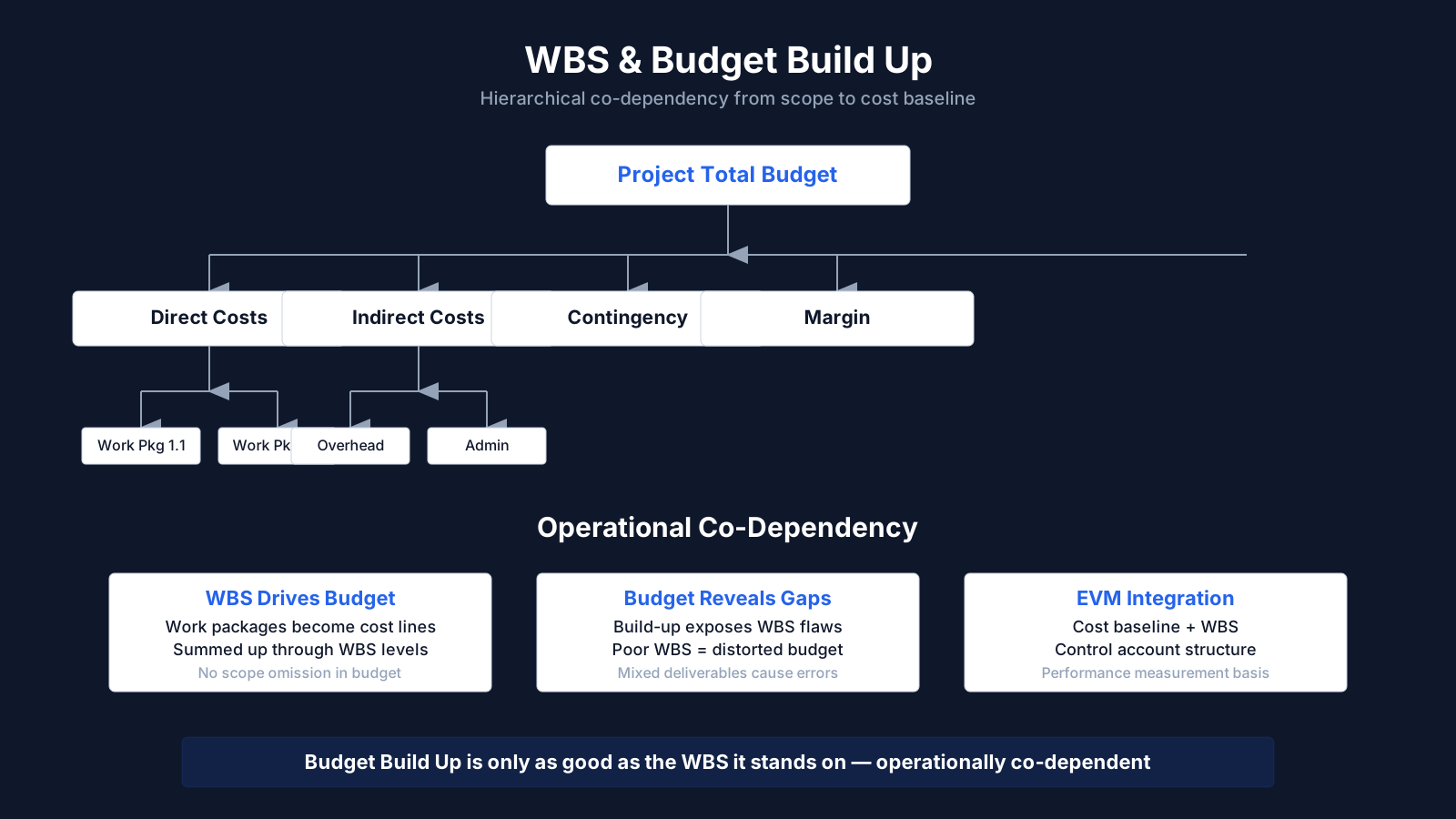
No Budget Build Up can exist without a work breakdown structure, whether formally documented or tacitly agreed upon. The key components of Budget Build Up include the work breakdown structure (WBS), activity cost estimates, resource rates, and indirect cost allocations. The WBS decomposes the project scope into deliverables and work packages, providing the skeleton onto which costs are attached. In a bottom-up build, the WBS must be sufficiently detailed to allow work packages to be discrete, measurable, and assignable to a single responsible party. If the WBS contains ambiguous or overlapping nodes, the resulting budget will inherit that confusion. Practitioners often find that the budgeting exercise reveals WBS flaws, sending teams back to refine the decomposition before numbers can be trusted.
Activity Cost Estimates and Resource Requirements
Each work package is then estimated individually, considering labor, materials, equipment, services, and any other direct resources needed. Labor estimates involve determining the skill levels, hourly or daily rates, and the effort required in person-hours or person-days. These figures often come from the people doing the work, which is why this approach is sometimes called participatory estimating. Material quantities are derived from specifications, engineering drawings, or requirements documents, and priced using vendor quotes, published catalogs, or historical procurement data. The accuracy of this step relies heavily on the quality of the technical documentation and the team’s experience.
Equipment costs are built up from usage rates and durations. For rented machinery, the rate is straightforward; for owned assets, organizations may apply internal chargeback mechanisms. Software development adds complexity here because resource costing may include capitalizing development labor, licensing cloud environments, or purchasing third-party APIs. The estimator must also consider sub-contractor quotes, which themselves are often the result of another party’s bottom-up build. This layering of estimates creates a chain of trust that only holds if every link has been prepared with equal rigor.
Direct, Indirect, and Contingency Costs
Direct costs are those directly attributable to a work package, like the concrete for a foundation. Indirect costs, also called overheads or shared costs, are not traceable to a single work package but necessary for project execution. These might include project management office expenses, site security, quality assurance, or general administrative support. In a Budget Build Up, indirects are often calculated as a percentage uplift on direct costs or derived from a separate bottom-up analysis of the enabling functions. This is one area where method matters: a flat overhead percentage can distort the real cost picture, especially if some work packages require disproportionately more indirect support than others.
Contingency is then added, usually at the project level, to address identified risks and estimating uncertainty. The amount is often based on a risk analysis rather than an arbitrary number. Some organizations keep contingency outside the cost baseline as a management reserve, while others embed it within the budget. In either case, a thorough Budget Build Up separates variance due to estimation errors from variance caused by risk events, an insight critical for earned value reporting later. Neglecting this separation is a frequent source of governance confusion.
Core Insights on Budget Build Up
- WBS is the foundation
- The work breakdown structure decomposes project scope into discrete, measurable work packages, each assigned to a single accountable owner, and any ambiguity or overlap among WBS elements directly undermines the accuracy of the resulting budget.
- Work package cost estimation
- Each work package is estimated independently for labor, materials, equipment, and services; labor estimates require a clear specification of skill levels, hourly or daily rates, and effort measured in person-hours or person-days.
- Context-specific costing methods
- Material costs are based on vendor quotes, published catalogs, or historical procurement data, while software projects introduce further complexity through capitalized development labor, cloud environment licensing, and third-party API subscriptions.
Budget Build Up in Project Management Frameworks
PMBOK and Bottom-Up Estimating
The PMBOK Guide positions bottom-up estimating as a key technique in the Estimate Costs process, part of the Planning Process Group. Budget Build Up aligns closely with PMBOK's bottom-up estimating technique and the PRINCE2 concept of producing detailed cost breakdowns. In Determine Budget, these aggregated estimates become the cost baseline. The standard emphasizes that bottom-up estimates are more accurate when the detailed data exists, but also more time-consuming. The project manager is expected to weigh the cost of estimating against the risk of inaccurate figures. The process of building up a budget in a PMBOK-aligned project also feeds into the resource management plan, as activity-level labor and material estimates influence procurement schedules and staff acquisition timelines.
PRINCE2 and Detailed Cost Breakdown
PRINCE2 does not use the exact term "Budget Build Up," but its principle of management by stages and its focus on product-based planning lead to a similar outcome. A PRINCE2 project creates detailed stage plans with cost breakdowns, and the overall project budget is assembled from these stage budgets. The Project Plan aggregates the stage-level figures, often built bottoms-up for the next immediate stage and top-down for later stages. This hybrid approach acknowledges the impracticality of fully detailed builds for distant future phases, a realism that many pure predictive methodologies gloss over.
Agile and Hybrid Approaches to Budget Build Up
In Agile environments, the concept of a detailed upfront Budget Build Up seems antithetical to iterative planning. However, at the release or increment level, many Agile teams do perform a form of bottom-up cost accumulation. They use story points to estimate effort for a set of features, convert points to cost using a team’s velocity-derived cost-per-point, and add infrastructure and other fixed costs. This is a variant of bottom-up costing, though it relies on relative sizing rather than absolute hour estimates. In hybrid projects, it is common to see a high-level budget set by analogy for governance purposes, while the execution teams build up detailed week-by-week or iteration budgets from the bottom, then reconcile the two. The Budget Build Up thus becomes a rolling-wave activity, progressively elaborated as scope clarity improves.
BVOP Perspective on Budget Build Up
Business Value-Oriented Project Management introduces a cautionary note on traditional Budget Build Up practices. BVOPM identifies that traditional budget build-up can suffer from WBS inaccuracy, and advocates using relational effort points instead. The methodology warns that a detailed WBS, no matter how meticulously crafted, can create a false sense of precision if the underlying scope is unstable or poorly defined. BVOPM suggests that early budget builds should acknowledge a range of scope confidence using a five-level scale—from Definite to Unlikely—to prevent treating every work package as equally certain. Scope changes are then viewed as user feedback rather than planning failures, which changes the psychological relationship with the budget. Instead of rigidly clinging to a bottom-up number built on shifting sand, teams can maintain a flexible cost envelope that adapts as scope clarifies. BVOPM also integrates the concept of process damage, recognizing that forcing an organization to commit to extremely detailed Build Ups too early can waste effort and erode morale if priorities later shift dramatically.
BVOP Budgeting Core Takeaways
- Relational effort points alternative
- Traditional budget build-up that depends on detailed work breakdown structures often introduces inaccuracy; BVOPM recommends relational effort points as a more adaptive and realistic alternative.
- False precision warning
- A meticulously crafted work breakdown structure can project a false sense of precision when the underlying scope is unstable or poorly defined.
- Scope confidence scale
- Early budget builds should reflect scope confidence using a five-level scale from Definite to Unlikely, so that not every work package is treated as equally certain and unfounded commitments are avoided.
- Flexible envelope and process damage
- Scope changes are treated as valuable user feedback rather than planning failures, enabling a flexible cost envelope while protecting the process and team morale from the damage that premature detailed estimates can cause.
Practical Application and Use of Budget Build Up
In real-world project delivery, Budget Build Up is most commonly deployed during the planning phase, after the project charter has been approved but before major commitments are made. In practice, budget build-up is used during the planning phase to develop a definitive cost baseline that can be submitted for funding approval. The project manager and the control account managers, often with input from functional leads, gather in estimation workshops. These sessions can be intense, sometimes lasting days, as they pore over WBS dictionaries, requirement documents, and vendor proposals. Spreadsheets become the primary tool, with formulas linking work package estimates to summary costs. Even in organizations with sophisticated enterprise project management software, the core thinking happens in a collaborative, manual review of every line item.
A mid-sized engineering project might involve a Budget Build Up with hundreds of line items: excavation by cubic meter, concrete by cubic meter for each foundation type, structural steel by ton, procurement of long-lead items, commissioning labor, training costs, and a dozen indirect cost categories. Each line demands a reasonable justification, often documented in a basis of estimate (BOE) file. The BOE captures assumptions, source data, and calculation logic, providing an audit trail that protects the estimator later if costs are challenged. This documentation is a vital but frequently skimped aspect; without it, the Budget Build Up becomes a house of cards.
In Agile or hybrid contexts, the build-up may be less monumental but still present. A product owner and the development team might build up the budget for the next quarter by summing the cost of the team’s time (calculated from loaded salaries), cloud hosting expenses, and any external consultants. The dynamic is less formal but no less bottom-up—it simply uses team capacity and velocity as the underlying detail instead of a fully decomposed WBS. The key is that someone, at some level, is still adding up the smallest knowable cost units to form a total, even if that total is only for the next few sprints rather than the entire project lifecycle.
One often overlooked benefit of the Budget Build Up is its role in aligning stakeholder expectations. When sponsors see a detailed build, even if they don’t examine every cell in the spreadsheet, they perceive a level of rigor that top-down summary figures cannot provide. The transparency of the method serves as a communication and trust-building artifact, particularly in capital-intensive industries where funding gates demand demonstrable analytic rigor.
Common Challenges, Pitfalls, and Misconceptions
Despite its logic, Budget Build Up is fraught with practical difficulties. A common pitfall in budget build-up is the omission of indirect costs or the assumption of perfect resource availability. Indirect costs like supervision, facilities, quality control, and security can easily be forgotten when the team is deeply focused on direct work activities. Because these costs do not map cleanly to a single work package, estimators may neglect them entirely, only to discover during execution that overheads are eating into the contingency. Similarly, assuming that resources will be available exactly when needed, at standard rates, without premium or overtime, is an optimistic fallacy. Real projects experience resource bottlenecks, forcing premium pay or substitution with less experienced staff, both of which blow up the carefully assembled budget.
Another pervasive misconception is that Budget Build Up guarantees accuracy. Because the process is so detailed, stakeholders sometimes mistake precision for correctness. An estimate can be precise to the dollar and still be wildly wrong if a critical scope element was missed or a technical assumption was flawed. The technique reduces estimation error but does not eliminate it; the difference between precision and accuracy must be communicated relentlessly. Moreover, a bottom-up build is only as reliable as the lowest-level estimates. If those contain systematic optimism or are based on vendor quotes that will later be renegotiated, the entire structure is compromised. In complex projects, the aggregation of many small uncertainties can produce large total variances—a phenomenon known as the central limit effect in cost risk analysis.
The time and cost of performing a full Budget Build Up can also be a barrier. For very large programs, the effort itself can consume weeks of highly paid specialist time, a cost that must be justified by the improved expenditure control it enables. When a project faces aggressive deadlines, the temptation is to shortcut the build-up, using rough-order-of-magnitude figures at the work package level. That approach produces a bottom-up total that is little better than a top-down guess, yet dressed in the disguise of analytic rigor. Practitioners call this “garbage in, garbage out” at the detail level.
Finally, human biases infiltrate every estimation workshop. Senior engineers may underestimate tasks they are familiar with, ignoring the complications that junior staff will encounter. Conversely, estimators who fear budget cuts may pad figures, leading to a baseline that is politically stable but financially inefficient. The Budget Build Up process is not immune to organizational politics; it merely exposes it at a very granular level, which can make those tensions more visible and, sometimes, more contentious.
Core Budget Build Up Pitfalls
- Indirect costs frequently omitted
- Indirect costs including supervision, facility overheads, quality assurance, and security are routinely underestimated when planning emphasizes direct activities, leading to contingency funds being consumed by these uncovered obligations.
- Assumption of perfect resource availability
- The expectation that resources will be available precisely on schedule and at standard rates, without premium or overtime, is a flawed assumption that exposes the budget to inevitable real-world disruptions.
- Resource bottlenecks inflate budgets
- Resource bottlenecks in actual projects compel either premium-rate labor or the use of less experienced substitutes, both of which drive costs well above the meticulously crafted budget.
- Precision does not equal accuracy
- A cost estimate can be mathematically precise yet fundamentally inaccurate when it omits a key scope component or relies on a faulty technical premise; therefore, the distinction between precision and accuracy must be underscored at every project review.
- Central limit effect on variances
- Within complex projects, the compounding of numerous individual uncertainties generates significant overall variance, a phenomenon captured by the central limit effect in cost risk analysis that often yields budget overruns linear planning overlooks.
Relationship to Other Cost Management Concepts
Budget Build Up does not exist in isolation; it is one of several cost estimation techniques. The most obvious contrast is with top-down estimating, where the total project cost is derived from analogous projects or parametric models, and then apportioned downward to lower levels. Budget build up is distinct from top-down estimating, which relies on historical data and expert judgment rather than granular work package analysis. Analogous estimating uses the actual costs of previous, similar projects as a basis, scaled for size and complexity. Parametric estimating applies statistical relationships between historical data and other variables, such as cost per square foot. While both top-down methods are faster and often sufficient in early project phases, they lack the specificity and scope-driven confidence of a full Budget Build Up. In mature cost management systems, the two approaches are reconciled: a top-down budget may serve as a funding limit, while the bottom-up build provides the detailed cost control baseline, and any gap must be resolved through value engineering or scope negotiation.
The Budget Build Up is also intimately connected to the cost baseline, the time-phased budget against which earned value performance is measured. The aggregation process must ensure that costs are not only totaled correctly but also distributed over time. Activity-level resource requirements feed into the schedule, and the resulting time-phased budget becomes the basis for Planned Value. A build-up that ignores phasing—say, by simply providing a lump sum for all concrete work—will be useless for earned value management, which requires distinct time periods to calculate schedule variance. The integration of the Budget Build Up with the schedule is therefore non-negotiable for any project that uses EVM principles.
Management reserves and contingency reserves are also related. During the build-up, explicit contingency amounts are usually added after the base costs are aggregated, often calculated by a risk analysis. Management reserves for unidentified risks are controlled by senior management, outside the baseline. Confusing these two during the build-up can lead to a project manager spending reserves that were intended for unforeseeable events, or conversely, hiding contingency inside work package estimates, making it impossible to track risk exposure transparently.
The term “Budget Build Up” can sometimes be confused with “budgeting by components” or “component-based budgeting,” but those terms are more frequently used in financial planning for organizational budgets, not project cost baselines. In project management, the phrase retains its specific meaning: a bottom-up aggregation of WBS-level estimates into a total project cost, distinct from the organization’s fiscal budget cycle.
Evolution and Current Thinking on Budget Build Up
The practice of building up project budgets has evolved from paper-based quantity sheets to integrated digital models. Modern approaches integrate budget build-up with rolling-wave planning to balance detail and flexibility, acknowledging that early detail for distant phases is speculative at best. In building information modeling (BIM) environments, for instance, a 5D cost model automatically aggregates quantities from a 3D design, linking design objects to cost databases so that the budget build-up updates as the design changes. This digital thread reduces manual re-estimation but does not eliminate the need for human judgment about rates, productivity factors, and risk.
There is an ongoing tension between the desire for upfront certainty and the Agile recognition that scope emerges. Some organizations now practice “budgeting as hypothesis,” where the build-up is treated as a cost model to be tested and refined, not a fixed contract. This thinking is especially prevalent in software and product development projects, where a detailed bottom-up build for a year-long effort might be continuously revised every quarter based on validated learning and pivot decisions. The budget becomes a living artifact, still built bottom-up, but with a shorter shelf life for its assumptions.
Another evolution is the integration of probabilistic analysis into the build-up process. Instead of producing single-point estimates at the work package level, teams are increasingly asked to provide three-point estimates (optimistic, most likely, pessimistic) which are then aggregated using Monte Carlo simulation. This approach yields a range of possible total project costs with confidence intervals, transforming the Budget Build Up from a single number into a risk-informed decision tool. It does add complexity to the process, but advocates argue that the effort is well-spent for projects with high uncertainty or severe cost overrun consequences.
Critics of exhaustive Budget Build Up point to the phenomenon of “detail illusion,” where the sheer volume of numbers convinces decision-makers that the estimate is robust, when in fact it is just voluminous. Debates continue in the project management community about the optimal level of detail: too coarse, and the estimate is unreliable; too fine, and the cost of estimating outweighs the value of precision, and the build becomes unmaintainable. The sweet spot varies by industry, project phase, and organizational risk appetite, and there is no universally accepted rule. This is why many standards now advocate for progressive elaboration—starting with a top-down figure and progressively replacing it with bottom-up detail as knowledge grows, which is essentially a hybrid of the two philosophies.
The current best practice is not to abandon Budget Build Up but to apply it intelligently: use it for what is near, use parametric or analogous data for what is far, and recognize that any budget is a forecast subject to revision. The technique remains fundamental because it connects the cost dimension intimately with the scope dimension, and without that connection, project control becomes a financial illusion, not management.
Core Insights on Budget Build-Up
- From paper sheets to digital models
- Budget build-up has shifted from isolated paper quantity sheets to integrated digital models where design objects are dynamically linked to live cost databases, enabling real-time cost feedback and reducing manual reconciliation errors.
- Rolling-wave planning integration
- Forward-thinking practices now embed budget build-up within rolling-wave planning cycles, directing detailed estimating effort toward near-term, well-understood scopes while keeping distant phases at a higher-level allowance to avoid speculative precision.
- Budgeting as a hypothesis
- Leading organizations treat the budget build-up as an evolving cost hypothesis, subjecting it to regular stress tests and iterative refinement based on empirical project data rather than freezing it as a contractual target.
- Three-point estimates with simulation
- Project teams increasingly provide three-point estimates covering optimistic, most likely, and pessimistic scenarios, which are then aggregated through Monte Carlo simulation to produce probabilistic cost ranges with explicit confidence intervals that inform risk-reserve decisions.
- Detail illusion and optimal granularity
- Experienced practitioners warn that a dense line-item structure can manufacture a spurious impression of accuracy, fueling continuing debate over the granularity threshold where the value of additional detail actually justifies the cost of maintaining it.