Decision making is the process by which a project manager, team, sponsor, or governance body selects a course of action from two or more alternatives to move the project toward its objectives. In project management, the term refers not only to the moment of choice but also to the surrounding activities of identifying options, assessing uncertainty, weighing trade-offs, and assigning accountability for the outcome.
Project decisions occur at every level, from portfolio selection to a daily stand-up adjustment. Because projects are temporary, unique, and constrained, decision making in this context differs from routine operational management. The stakes are often high, information is incomplete, and the full consequences may not be known until later in the life cycle.
Key Topics in Decision Making
| Key Concept | Summary |
|---|---|
| Decision Making | In project management, decision making involves selecting a course of action among competing alternatives while navigating uncertainty, resource constraints, and schedule pressure, with full awareness that outcomes cannot be guaranteed. |
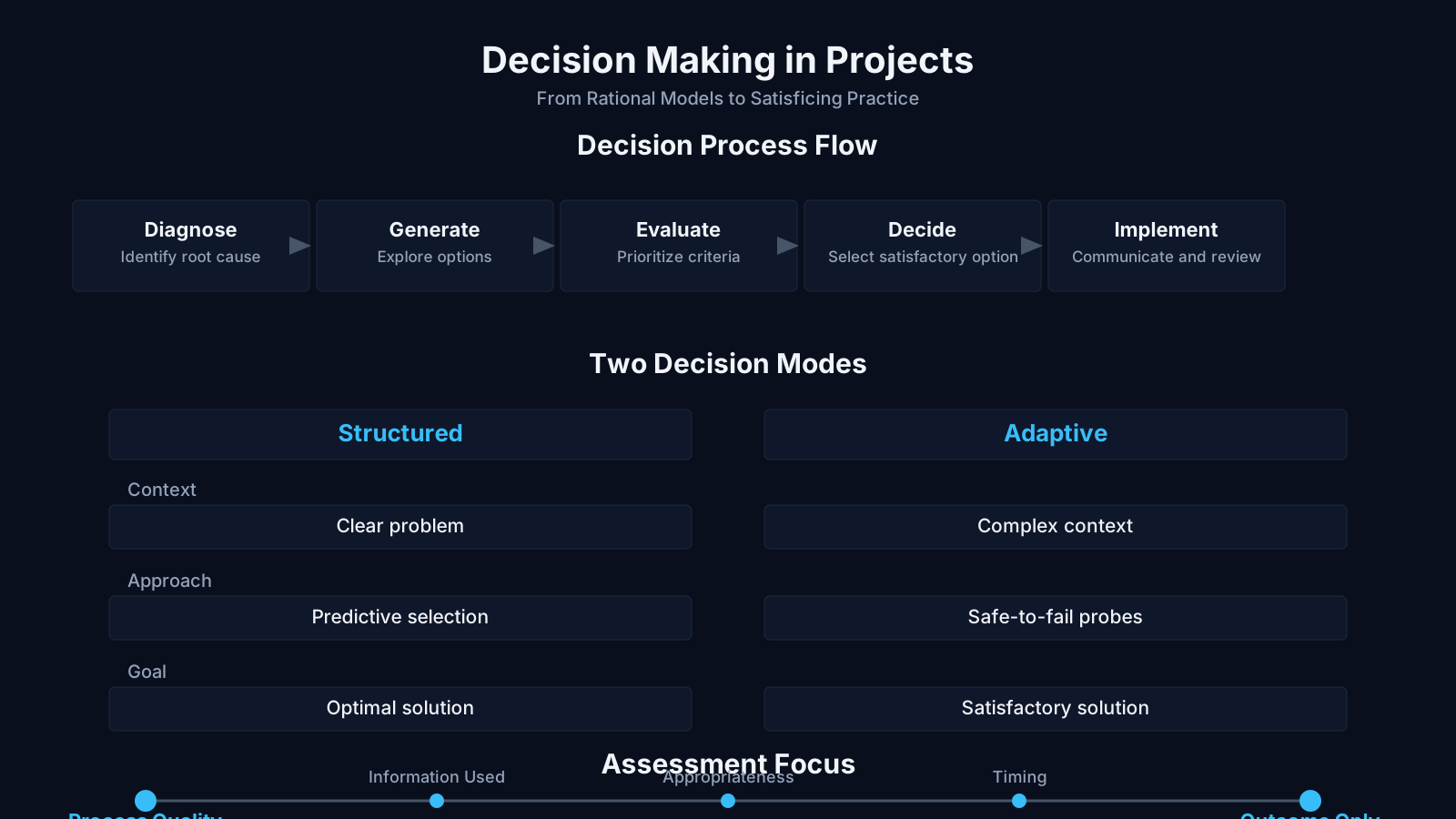
| Decision Process | The decision process encompasses identifying viable options, evaluating uncertainty, weighing trade-offs, and assigning clear accountability, extending well beyond the final moment of choice. |
| Project Trade-offs | Even with a complete diagnosis of schedule slippage, project teams must often choose among adding budget, cutting scope, or accepting a later delivery date, each carrying distinct consequences. |
| Bounded Rationality | For instance, a project manager may need to evaluate vendor bids using incomplete cost data and an afternoon deadline, illustrating how real decisions are made within cognitive and informational limits. |
| Satisficing | Rather than pursuing an optimal supplier, the manager selects the first bid that meets minimum acceptable thresholds for reliability, price, and schedule alignment. |
| Decision Quality | Strong problem-solving capabilities do not guarantee sound decisions when selection criteria are ambiguous or when decision rights are assigned to the wrong role. |
| Theory Origins | Modern decision theory integrates operations research, economics, psychology, and management science, while subsequent research revealed that people operate under bounded rationality, limited attention, and latent biases. |
| Challenge Culture | Aviation crew resource management introduced structured protocols that allow junior crew members to question a captain's decisions without fear. High-stakes decisions across industries benefit from similar structure, open communication, and a culture that actively invites challenge. |
What Is Decision Making in Project Management?
When project professionals look for a what is decision making in project management explanation, they usually want more than a dictionary answer. The term is defined in practice as choosing between competing alternatives under conditions of uncertainty, resource constraint, and time pressure while accepting that the outcome may not be fully predictable.
Decision making is often treated as part of problem solving, but the two are not identical. Problem solving includes recognizing a gap, diagnosing root causes, and generating options. Decision making is the selection act that follows analysis. A project team may fully understand why a schedule is slipping and still face a difficult decision about whether to add cost, reduce scope, or accept a later delivery date.
The authority to decide varies by role. A sponsor may make major funding decisions, a project manager may make trade-off decisions within tolerances, and a self-organizing team may make technical implementation decisions. In all cases, effective decision making requires clarity about who has the right to choose, what criteria apply, and how the decision will be communicated.
A practical way to understand bounded rationality is to imagine a project manager evaluating vendor bids with incomplete cost data and a deadline the same afternoon. Instead of seeking the perfect supplier, the manager selects the bid that meets minimum acceptable criteria for reliability, price, and schedule fit. This is satisficing, not optimizing, and it reflects the reality of most project decision making.
Decision Making Definition and Scope
A decision making definition in project management must account for authority, timing, risk, and reversibility. The scope of a decision includes the people affected, the resources committed, and the potential consequences if the choice proves wrong. Some decisions are reversible with little cost, while others create path dependencies that are difficult or expensive to undo.
Project decisions are rarely made in a vacuum. They interact with governance structures, stakeholder expectations, organizational culture, and contractual obligations. For that reason, many organizations document decisions in a decision log that captures the choice, rationale, decision maker, date, and any dissenting views.
Decision Making vs Problem Solving
Problem solving is the broader process of identifying a gap between the current state and a desired state, analyzing causes, and generating alternatives. Decision making is the narrower act of committing to one of those alternatives. The distinction matters because a team can have excellent problem-solving skills but still make poor decisions if the selection criteria are unclear or if the wrong person holds the decision right.
Key Insights on Project Decisions
- Practical definition of decision making
- Project decision making involves committing to a course of action among competing alternatives when uncertainty, resource constraints, and time pressure make fully predictable outcomes impossible.
- Decision making versus problem solving
- Problem solving identifies gaps, root causes, and possible responses, but a distinct decision is still required to choose among responses, such as adding cost, reducing scope, or accepting a later delivery date.
- Decision rights by role
- Sponsors hold authority over funding decisions, project managers make trade-offs within agreed tolerances, and self-organizing teams own technical choices, making explicit decision rights essential to avoid delays and conflict.
- Bounded rationality in practice
- Because project managers rarely have complete information or unlimited time, they tend to choose the first option that satisfies minimum acceptable criteria instead of pursuing an optimal solution.
- Decision scope and consequences
- A decision's scope encompasses the people affected, the resources committed, and the consequences of a poor choice, which is why unclear criteria or the wrong decision holder can undermine even the strongest problem-solving effort.
Origins and Cross-Industry Context of Decision Making
Modern decision making theory draws on operations research, economics, psychology, and management science. Early management models assumed decision makers could access all relevant information and choose the optimal option. Later research challenged that assumption by showing that people and organizations operate with bounded rationality, limited attention, and hidden biases.
Outside project management, decision making has been studied intensely in aviation, medicine, military operations, and software engineering. Aviation crew resource management developed structured protocols to ensure junior crew members can question a captain's decision without fear. Medicine uses diagnostic decision trees and second opinions to reduce individual error. These disciplines share a common lesson: high-stakes decisions benefit from structure, communication, and a healthy challenge culture.
Project management adopted many of these ideas through risk management, stage gates, and team-based planning. The cross-industry experience matters because projects combine technical complexity with human judgment. A decision that looks rational on a spreadsheet can fail in practice if the people executing it do not understand or support it.
Origins in Management and Behavioral Science
The behavioral school of management introduced the idea that human decision makers seldom optimize. Instead, they use heuristics, simplify complex problems, and stop when a satisfactory option appears. This insight changed how organizations design decision processes. It encouraged checks and balances, structured criteria, and greater attention to cognitive bias.
Cross-Industry Influences on Project Decision Making
Military and emergency response organizations contributed the concept of decision making under extreme time pressure. Their models emphasize rehearsed decision rules, clear roles, and rapid feedback loops. Software engineering added iterative decision making, where a choice can be revisited as new information emerges. Project management blends these influences by matching the decision method to the level of uncertainty and consequence.
Key Components and Types of Decision Making
Understanding the key components of decision making begins with separating the decision from the information that supports it. The main components include the decision right, the alternatives, the evaluation criteria, the available information, the risk tolerance of the organization, and the time available to decide.
Decision rights are often the most underappreciated component. A project manager may have deep insight into a problem but no authority to approve a budget increase. In contrast, a sponsor may have authority but limited day-to-day context. Confusion about decision rights causes delays, rework, and stakeholder frustration.
Project decisions fall into several types. Strategic decisions set direction, such as whether to initiate a project or approve a major scope change. Tactical decisions guide execution, such as selecting a vendor or sequencing work packages. Operational decisions handle immediate issues, such as reassigning a team member after an unplanned absence.
Decisions can also be classified as programmed or nonprogrammed. Programmed decisions follow known rules, such as approving a change request that falls within predefined thresholds. Nonprogrammed decisions require novel judgment, such as responding to a sudden regulatory change or a critical supplier failure.
Decision methods vary by involvement. Autocratic decision making assigns the choice to a single person and is useful in emergencies or when speed is critical. Consultative decision making gathers input from others while keeping authority with the decision maker. Consensus decision making seeks broad agreement and is appropriate for decisions that require strong ownership, though it is slower. Delegation shifts the decision to a designated person or team.
Types of Project Decisions
In addition to strategic, tactical, and operational categories, project decisions can be grouped by their subject matter. Scope decisions determine what work is in or out of the project. Resource decisions allocate people, equipment, and budget. Risk decisions select among avoidance, transfer, mitigation, or acceptance. Contract decisions shape procurement relationships and supplier accountability.
Each type interacts with the others. A risk decision may alter the schedule, which then creates a new resource decision. This interconnectedness means that isolated decision making often produces unintended consequences. Experienced project managers evaluate the ripple effects of a decision before committing to it.
Core Takeaways on Decision Making
- Six Core Decision Components
- A robust decision integrates clearly assigned decision rights, well-defined alternatives, explicit evaluation criteria, reliable information, a realistic understanding of risk tolerance, and sufficient time.
- Decision Rights and Authority
- Because authority and relevant context often reside with different people, unclear decision rights generate delays, rework, and frustration among stakeholders.
- Three Decision Levels
- Strategic decisions set long-term direction, tactical decisions coordinate execution, and operational decisions resolve immediate issues.
- Programmed versus Nonprogrammed
- Programmed decisions follow established rules and predefined thresholds, while nonprogrammed decisions require novel judgment when responding to unfamiliar or exceptional events.
Decision Making in PMBOK, PRINCE2, and Agile Frameworks
Framework guidance for decision making in PMBOK is distributed across multiple processes rather than isolated in a single knowledge area. In predictive environments, decisions are often tied to baselines, change control, gate reviews, and risk response planning.
In the PMBOK framework, decision making appears as a tool and technique in processes such as Collect Requirements, Plan Risk Responses, and Monitor and Control Project Work. Techniques include multi-criteria decision analysis, voting, and autocratic decision making. The choice of technique depends on the importance of the decision, the number of stakeholders, and the need for speed or buy-in.
PRINCE2 gives decision making a governance-heavy structure. The project board decides whether to authorize initiation and each subsequent stage. The project manager has authority to make decisions within delegated tolerances for time, cost, scope, risk, quality, and benefits. If a tolerance is forecast to be exceeded, the decision escalates to the board as an exception. This management by exception approach prevents unnecessary escalation while protecting governance thresholds.
Agile environments push decision making closer to the work. Product owners make value and priority decisions. Development teams make technical design and implementation decisions. Scrum Masters and other facilitators guard the process rather than command the outcome. The principle of last responsible moment encourages teams to delay irreversible decisions until they have better information, while still ensuring the decision is made in time to avoid rework.
Decision Making in the PMBOK Framework
Within the PMBOK framework, multi-criteria decision analysis helps teams evaluate alternatives against weighted factors such as cost, risk, schedule impact, and strategic alignment. Voting techniques, including Roman voting and Fist of Five, surface team preferences quickly. These methods do not replace judgment; they structure judgment so that trade-offs become visible and defensible.
Decision Making in PRINCE2
The PRINCE2 emphasis on management products means that decisions are usually linked to a documented business case, plan, or exception report. The continued business justification principle requires the project board to stop or redirect a project when the justification disappears. Decisions are therefore framed as governance choices, not purely technical or personal preferences.
Decision Making in Agile and Hybrid Environments
Agile teams use frequent feedback to make decisions in smaller increments. Sprint reviews, retrospectives, and daily stand-ups become decision forums for adjusting the product backlog, improving team process, and removing blockers. Hybrid environments combine predictive governance for high-level commitments with Agile autonomy for delivery details. The resulting decision model must clarify which decisions remain with leadership and which belong to the team.
The BVOP Perspective on Decision Making
BVOP decision making links choices directly to business value and treats some decision patterns as sources of organizational waste. The methodology emphasizes a transparent board of project issues where cross-functional roles can raise concerns before major commitments are made.
BVOPM also introduces the concept of process damage as the invisible harm that accumulates when decisions are repeatedly made without adequate consultation or when accepted work is rejected later. Business Value Points serve as a monitoring input for decisions about continuation, adjustment, or closure. A persistent decline in value points can signal that the project should be questioned rather than automatically extended.
A practical way to imagine process damage is to think of each unclear handoff as a small crack in the project's foundation. One poor decision may be survivable, but repeated misalignment gradually undermines trust and creates hidden rework that no single status report captures.
Key Insights on Value-Linked Decisions
- Value-linked decision making
- BVOP ties every decision directly to business value and identifies specific decision-making patterns as systemic sources of organizational waste.
- Transparent issue board
- A shared, visible issue board enables cross-functional roles to surface concerns before the organization commits to significant scope or resource decisions.
- Process damage accumulation
- Process damage is the invisible erosion of trust and efficiency that accumulates when decisions are made without adequate consultation or when work that was previously accepted is later rejected.
- Business Value Points input
- Business Value Points serve as a monitoring signal for deciding whether to continue, adjust, or terminate a project, ensuring that value evidence rather than sunk cost drives the next step.
- Persistent decline signals
- A persistent decline in value points should prompt teams to challenge the project instead of defaulting to another extension, because continuous misalignment erodes stakeholder trust and generates hidden rework.
Practical Application of Decision Making Across the Project Lifecycle
The practical application of decision making changes shape at each stage of a project. At initiation, decisions focus on business case viability, feasibility, and project charter approval. Gatekeepers use techniques such as multi-criteria analysis, expert judgment, and stakeholder consultation to decide whether the project should receive funding.
During planning, the project manager and team make decisions about scope baseline, schedule network, cost estimates, risk responses, and resource allocation. These decisions are often iterative. For example, a schedule decision may change after a risk response decision reveals new dependencies. Planning decisions are typically documented in management plans so that later execution choices have an auditable reference.
Execution includes a high volume of daily decisions: assigning work, resolving blockers, responding to defects, accepting delivered work, and managing stakeholder expectations. Many of these decisions are small but cumulatively shape project performance. Teams using Agile methods often handle execution decisions in daily stand-ups or sprint reviews, with clear rules for who can decide what.
Monitoring and controlling decisions involve comparing actual performance against baselines. Variance analysis may trigger decisions to take corrective action, preventive action, or defect repair. Integrated change control decisions determine whether a requested change is approved, deferred, or rejected. These decisions require discipline because approving too many small changes can erode scope and schedule integrity.
At closing, decisions involve formal acceptance, handover of deliverables, release of resources, and archives. The decision to close may also involve evaluating whether benefits are likely to be realized and whether outstanding risks have been accepted by the appropriate owner.
Initiation and Planning Decisions
Initiation decisions often have the highest strategic impact and the least project-level information. A sponsor approves a charter based on estimates and assumptions that will evolve. Planning decisions then translate strategy into baselines. The project manager typically facilitates these decisions but may not own all of them, especially when they affect contractual commitments or enterprise priorities.
Execution, Monitoring, and Closing Decisions
Execution decisions tend to be frequent and fast. The project manager or team lead must balance consistency with flexibility. Monitoring decisions are often threshold-based, but human interpretation still matters. Closing decisions may appear routine, yet they influence knowledge transfer, benefit realization, and stakeholder satisfaction long after the project team disbands.
Common Challenges, Pitfalls, and Misconceptions in Decision Making
Project teams encounter recurring decision making pitfalls and misconceptions that can undermine even well-structured governance. One common misconception is that more data always produces better decisions. In reality, additional data can create analysis paralysis, especially when the cost of delay exceeds the value of the information.
Cognitive biases are a persistent challenge in project decision making. Confirmation bias leads a sponsor to favor information that supports a preferred project. Anchoring leads a team to overvalue the first estimate they hear. Escalation of commitment, sometimes called sunk cost thinking, keeps failing projects alive because stakeholders do not want to lose what has already been spent.
Group dynamics create additional pitfalls. Groupthink suppresses dissent in the interest of harmony. The highest-paid person's opinion can override evidence. False consensus may lead a project manager to assume agreement when team members are simply staying quiet. In some organizations, decision making is treated as a competitive win-lose event, which discourages collaboration and honest risk disclosure.
There are also valid limitations to structured decision making. Not every small decision requires a formal analysis or committee. Applying a heavyweight governance process to trivial choices slows the team and signals mistrust. The challenge is to match the decision method to the decision's risk, reversibility, and stakeholder impact.
When Decision Making Should Be Simplified
Low-risk decisions benefit from speed and clear ownership. A team deciding where to store project documentation does not need a steering committee. The governance principle is proportionality. High-impact decisions deserve structured analysis and broader input, while routine choices should remain close to the work.
A common surprise for new project managers is that delaying a decision does not necessarily reduce risk. On some projects, not deciding is itself a decision that consumes time, leaves the team blocked, and increases uncertainty elsewhere.
Core Insights on Decision Pitfalls
- More data can cause paralysis
- Excess information frequently triggers analysis paralysis, particularly when the delay caused by gathering more data outweighs the marginal benefit of the additional insight.
- Cognitive biases distort choices
- Confirmation bias, escalation of commitment, and false consensus systematically skew project decisions by reinforcing the status quo, protecting prior investments, or assuming agreement that does not exist.
- Sunk cost thinking persists
- Escalation of commitment sustains failing projects because stakeholders resist writing off resources already invested, even when future returns are unlikely.
- Win-lose culture blocks honesty
- A competitive, win-lose framing of decision making suppresses collaboration and discourages team members from surfacing risks or dissenting views.
- Over-governance harms routine choices
- Applying heavy governance to routine decisions slows momentum and signals a lack of trust, while high-impact choices warrant deeper analysis, broader input, and more deliberate scrutiny.
Relationship Between Decision Making and Other Project Management Concepts
Decision making and risk management are closely related because every project decision is made under uncertainty. Risk management supplies the probability and impact information that shapes risk response decisions. A risk owner may decide to avoid, transfer, mitigate, or accept a risk based on the expected consequences and the organization's risk appetite.
Decision making is also central to change control. The Perform Integrated Change Control process evaluates how a requested change affects scope, schedule, cost, quality, resources, and risk. The decision to approve or reject a change often depends on whether the change improves value or only adds gold plating.
Stakeholder engagement is another close relationship. Decisions that exclude affected stakeholders may be technically sound but politically weak. RACI charts, decision logs, and steering committee terms of reference help clarify who makes which decisions. Without that clarity, stakeholder conflict often masquerades as a disagreement about facts when it is actually a disagreement about authority.
Decision making should not be confused with delegation. Delegation transfers the authority to act, but the delegator remains accountable for the outcome. In a project context, a sponsor may delegate day-to-day trade-off decisions to the project manager while retaining accountability for the business case. Similarly, escalation is not the same as abdication; escalation moves a decision to a higher authority when thresholds are breached.
Decision Making and Governance
Governance sets the rules for decision making by defining roles, thresholds, escalation paths, and approval requirements. A well-designed governance model does not remove human judgment. It makes the judgment visible, consistent, and subject to review. A poorly designed model concentrates too much authority in one place or creates so many approval layers that decisions become slow and demotivating.
Evolution and Current Thinking in Project Decision Making
Current thinking in project decision making reflects a shift away from purely rational, top-down models toward adaptive, behaviorally informed, and participatory approaches. Projects increasingly operate in complex environments where cause and effect are unclear, so practitioners use frequent feedback, small experiments, and decision reversibility as risk management tools.
Agile and Lean influences have popularized the last responsible moment principle, which postpones decisions until the cost of delay becomes significant. This is not procrastination; it is a deliberate strategy to reduce uncertainty before committing. In some contexts, teams use set-based design to keep multiple options open until constraints force convergence.
There is also growing attention to decision quality rather than decision speed alone. A fast decision that must be reversed days later can cost more than a slower decision made once. Organizations now focus on decision records, clear criteria, and psychological safety so that people can challenge poor assumptions without fear.
Debate continues about how much decision authority should be centralized in a project manager or distributed to teams. Predictive projects often favor centralized control for scope and cost decisions, while Agile favors decentralized technical decisions. The current consensus is that no single approach fits every project. The method should be tailored to complexity, organizational culture, regulatory constraints, and the consequences of being wrong.
The relationship between data and intuition also remains contested. Some organizations push for automated decision support and quantitative models. Others argue that experienced judgment is essential when data is incomplete or ambiguous. In practice, mature project environments treat data as an input to judgment, not a replacement for it.
Key Insights on Adaptive Decision Making
- Adaptive, behaviorally informed decision models
- Project decision making now favors adaptive models that blend behavioral insights with broad participation, replacing purely rational, top-down approaches.
- Reversibility as a risk tool
- In complex environments where cause and effect are unclear, teams mitigate risk through frequent feedback loops, small experiments, and deliberately reversible decisions.
- Last responsible moment principle
- Agile and Lean thinking advocate postponing decisions until the cost of delay becomes material, a deliberate strategy for reducing uncertainty rather than a form of procrastination.
- Psychological safety and decision records
- Decision records, explicit criteria, and psychological safety enable team members to challenge flawed assumptions openly and without fear.
- Authority tailored to project type
- Decision authority ranges from centralized control in predictive projects to decentralized technical choices in Agile, shaped by complexity, culture, regulatory constraints, and the cost of being wrong.