A daily standup is defined as a short, recurring coordination meeting held by a project team every working day, usually limited to fifteen minutes, in which team members align on progress, surface obstacles, and adjust their immediate plan. In project management, the term is used almost interchangeably with the Scrum event called the Daily Scrum, although standup-style meetings also appear in Kanban, hybrid, and traditional delivery contexts. The standing posture implied by the name is a deliberate design choice intended to keep the session brief and focused.
A daily standup in project management is not primarily a reporting ceremony. It is a synchronization mechanism. When used correctly, it replaces lengthy status updates with a quick inspection of whether the team is moving toward its current goal and what, if anything, is blocking that movement.
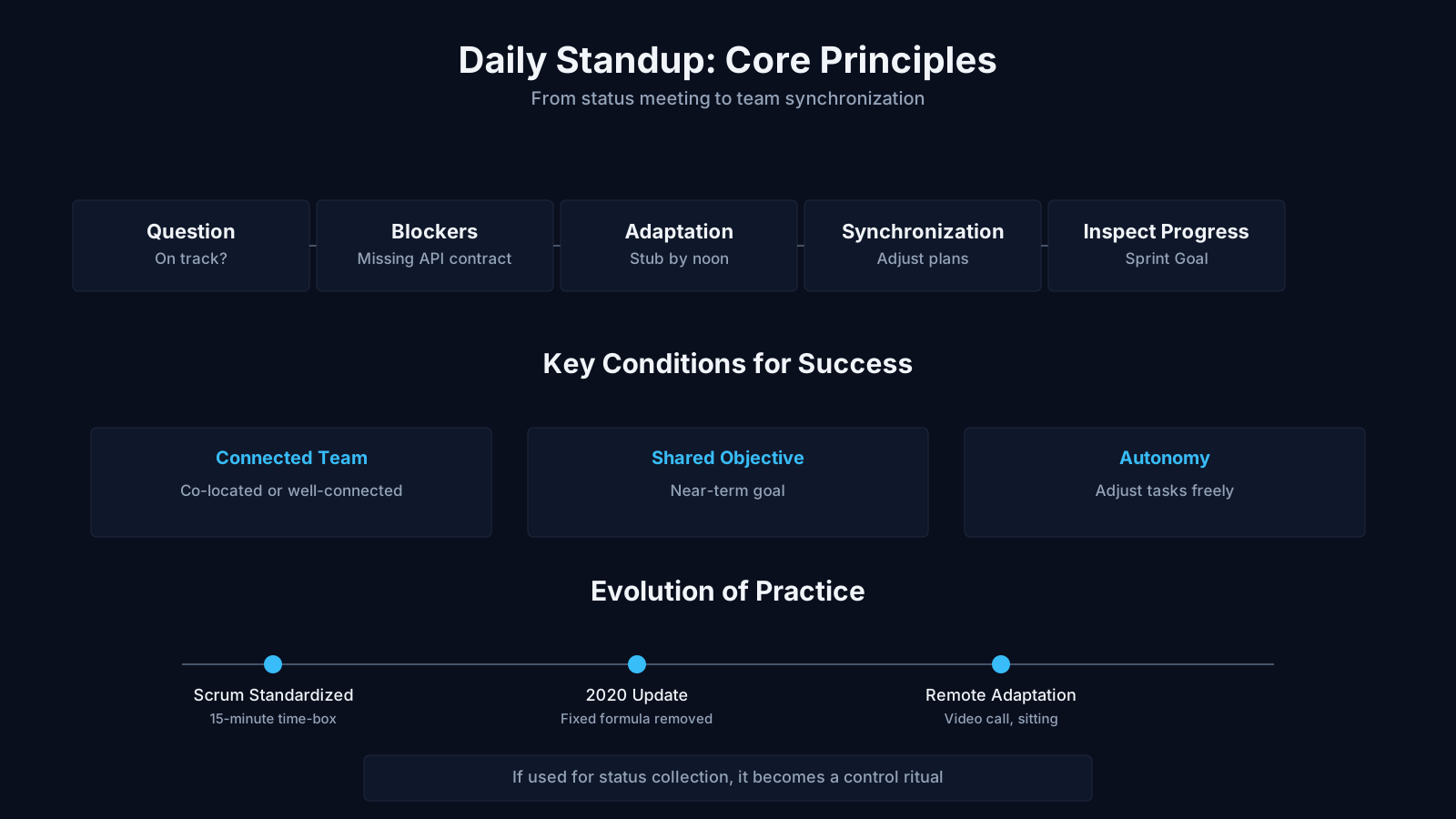
Daily Standup: Key Topics Summary
| Concept | Summary |
|---|---|
| Definition | A daily standup is a brief, recurring coordination meeting held every working day, typically capped at fifteen minutes, where team members synchronize progress and surface impediments before they escalate. |
| Time-boxed Sync | This time-boxed synchronization occurs at a consistent time and location each working day, enabling the team to inspect completed work and align on the next twenty-four hours of priorities. |
| Core Features | Its defining characteristics include a strict time limit, participants standing to encourage brevity, attendance by the full team, and emphasis on coordination rather than detailed troubleshooting. |
| Board Walkthrough | Many teams review the work board from right to left, prioritizing items nearest completion or currently blocked over a person-by-person status report. |
| Agile Origins | The practice evolved within Agile software development, particularly Extreme Programming and Scrum, during the late 1990s and early 2000s as a lightweight alignment ritual. |
| Cross-Industry Use | Short standing briefings have long been used by military units, hospital staff, construction crews, and maintenance teams to transfer critical information safely between shifts. |
| Healthcare Huddles | In healthcare, daily safety huddles convene nurses, physicians, and administrators to review patient risk, staffing gaps, and equipment readiness before clinical operations begin. |
| Coordination Pattern | As a general coordination pattern for teams managing interdependent work and shifting conditions, the daily cadence helps surface delays early; skipping even one day can allow minor issues to compound. |
What Is a Daily Standup?
A widely used daily standup definition in project management describes the practice as a time-boxed team sync meeting that happens every working day, typically at the same time and place, so team members can inspect progress and plan the next twenty-four hours of work. The exact structure varies, but the defining features remain consistent: short duration, standing participants, whole-team attendance, and a focus on coordination rather than problem solving.
The daily standup is a team-level event, not an executive briefing. Its primary output is an adjusted plan for the day, not a formal record. Participants are expected to leave the meeting with a shared understanding of what has changed since the previous day and where the team should concentrate its attention. Some teams also use the standup to confirm that impediments are being handled by the right person outside the meeting.
In the Scrum framework, the daily standup is formalized as the Daily Scrum. The Scrum Guide describes it as a fifteen-minute event for the developers of the Scrum team. Its purpose is to inspect progress toward the Sprint Goal and adapt the Sprint Backlog as necessary. The Product Owner and Scrum Master may attend, but the event belongs to the developers. This distinction matters because it shifts accountability from management oversight to team self-management.
Core Purpose of the Daily Standup
The core purpose is to reduce the gap between what a team planned and what is actually happening. Without a frequent synchronization point, a developer can remain blocked for days before anyone notices. A tester may discover a dependency that requires rework. A designer may be waiting on a decision that nobody realized was pending. The daily standup makes these gaps visible early enough for the team to respond without cascading delay.
The standup also supports self-organization. When team members hear what their colleagues are working on, they can identify overlaps, offer help, or renegotiate task ownership. This is different from a manager assigning work. The meeting creates a regular moment for peer-level negotiation.
Common Variations of the Daily Standup
Not all daily standups look alike. The classic variation uses three questions: what did I complete since the last standup, what will I work on until the next standup, and what impediments are in my way. This format was widely taught in early Scrum training. Many teams still find it useful because it gives each participant a predictable structure.
Another common variation is the board walk. Instead of going person by person, the team walks the work board from right to left, focusing on items that are closest to completion or currently blocked. This shifts attention from individual activity to work item flow. Teams using Kanban often prefer this style because it aligns with their focus on flow efficiency and work item aging.
Key Insights on Daily Standups
- Time-boxed daily sync
- A daily standup is a brief, recurring meeting held at a consistent time and place each working day to inspect progress and align the team on the next twenty-four hours of work.
- Defining features of standups
- Its defining characteristics include a strictly limited duration, standing participants, full team attendance, and a deliberate emphasis on coordination rather than in-depth problem solving.
- Planning output, not a record
- The primary output is a revised daily plan that gives every participant a shared understanding of emerging changes and the areas that require focused attention.
- Purpose: close the planning gap
- The core purpose is to narrow the gap between planned work and actual progress, enabling blockers to surface quickly so team members can offer support or renegotiate task ownership.
Origins and Cross-Industry Context of the Daily Standup
The origins of the daily standup in modern project management are most commonly traced to Agile software development methods, particularly Extreme Programming and Scrum, which gained prominence in the late 1990s and early 2000s. However, the underlying idea of a brief standing coordination meeting is older. Military units, hospital shift teams, construction crews, and maintenance teams have long used short standing briefings to pass information safely between shifts or trades.
The physical act of standing is not accidental. Standing discourages long monologues and signals that the meeting is temporary. In many industrial settings, a standing huddle at the start of a shift serves the same purpose: align the crew, review risks, and confirm the plan. The Agile standup borrowed this practical ritual and adapted it to knowledge work.
In healthcare, daily safety huddles bring nurses, physicians, and administrators together to review patient risk, staffing, and equipment issues. In aviation, crew briefings before a flight share similar characteristics. These settings demonstrate that the daily standup is not unique to software projects. It is a general coordination pattern that works wherever teams face interdependent tasks, changing conditions, and the need for quick error correction.
Within software engineering, the daily standup became a defining practice of Agile teams. It spread alongside Scrum and Extreme Programming as organizations sought faster feedback and fewer status meetings. By the early 2000s, the daily standup had become one of the most recognized Agile ceremonies, even among teams that did not adopt Scrum in full.
Key Components of a Daily Standup
The key components of a daily standup include a fixed time-box, a predictable cadence, a defined team membership, and a structured focus on progress and obstacles. Each component exists to prevent the meeting from drifting into a general discussion or turning into a status parade. Removing any of these components tends to weaken the practice.
A daily standup works because it is predictable. The team knows when it happens, where it happens, and how long it will take. This predictability reduces scheduling overhead and makes attendance a habit. Teams often hold the standup at the same time every morning, but the exact time matters less than consistency.
Time-Box and Cadence
The fifteen-minute time-box is not a target duration. It is a maximum. Many teams finish in eight to ten minutes. The time-box forces participants to share only information relevant to the whole team. If a topic requires deeper discussion, the team records it and follows up after the standup with only the people involved.
The daily cadence is equally important. A standup that happens twice a week is not a daily standup. The daily rhythm is what enables quick detection of blockers and rapid plan adjustment. In long-running projects, skipping days can create a false sense that work is progressing smoothly until a larger problem emerges.
Participants and Roles in a Daily Standup
The participants are normally the people doing the work. In Scrum, this means the developers. The Product Owner may attend to hear progress and answer questions, but they are not the meeting leader. The Scrum Master may facilitate or observe, but the team owns the event. In non-Scrum settings, the project manager may attend as a participant rather than a chair.
Having the right people in the room is more important than having many people. If managers, external stakeholders, or other departments dominate the conversation, the standup loses its peer-coordination quality. Some teams restrict attendance to core team members and invite others only when there is a specific reason.
Focus Areas and Typical Questions in a Daily Standup
The traditional three-question format focuses on completed work, planned work, and impediments. This structure is simple and easy to learn. However, newer guidance from the Scrum community has moved away from mandating these questions. The 2020 Scrum Guide removed the three questions entirely and left the structure to the developers, provided the event still inspects progress toward the Sprint Goal.
Many teams still use the three questions because they work. The risk is that they become a mechanical recitation. When participants list activities without connecting them to a goal, the standup turns into a reporting exercise. Effective teams tie each update back to the current sprint or iteration goal.
Walking the Board as a Daily Standup Technique
Walking the board starts from the right side, where completed work sits, and moves left toward work in progress. The team examines blocked cards first because they represent the greatest risk to flow. Then the team looks at work nearing completion, because small investments there can unblock delivery. Finally, the team glances at upcoming work to confirm that someone is ready to pick it up.
This technique works well for Kanban teams and for Scrum teams that maintain a physical board. It depersonalizes the update. Instead of asking what each person did, the team asks what is happening to the work. That subtle shift can reduce defensiveness and keep attention on delivery rather than individual productivity.
Core Takeaways on Standup Structure
- Fixed time-box and consistent schedule
- A strict time-box and a consistent daily schedule lower coordination costs, reinforce attendance as a routine, and keep the conversation focused on team-level progress rather than allowing it to slide into unstructured status reporting.
- Structured focus on progress and blockers
- Participants share only updates that affect the whole team, and any deeper discussion is logged for a smaller follow-up with the relevant people afterward. The Product Owner may attend as an observer but does not facilitate, preserving the developers' ownership of the daily inspection.
- Daily rhythm for rapid blocker detection
- A daily cadence helps the team surface blockers early and adjust the plan before small issues compound; skipping days risks masking real delays behind optimistic assumptions. The 2020 Scrum Guide intentionally leaves the event's structure to the developers, requiring only that it inspects progress toward the Sprint Goal.
Daily Standup in Project Management Frameworks
The daily standup in project management frameworks plays different roles depending on whether the environment is Agile, predictive, or hybrid. In Scrum, it is a formal event with explicit rules and a defined purpose. In Kanban, a similar meeting is often called a daily sync or standup, but it focuses on flow and work item aging rather than a sprint goal. In PMBOK-based predictive projects, a daily standup is not a required process, but it can function as an informal coordination practice within the executing process group.
The practice has become common across all three delivery modes because coordination delay is expensive everywhere. Even in traditional projects with detailed schedules, a brief daily check-in can reveal that a deliverable is slipping before a milestone is at risk. The key difference is formality. Agile frameworks treat the standup as a core event, while predictive frameworks treat it as a useful meeting technique.
Daily Standup in Agile and Scrum
In Scrum, the daily standup is one of five events, alongside Sprint Planning, Sprint Review, Sprint Retrospective, and the Sprint itself. The Daily Scrum is designed to inspect progress toward the Sprint Goal. It creates focus, improves communication, and helps the team identify impediments. The event is time-boxed to fifteen minutes and held every working day of the sprint.
Scrum does not require a specific agenda. The developers choose the format that works for them. This flexibility is intentional. A fixed script may not suit a team working on complex infrastructure tasks, while the three-question format may suit a team with clearly separated responsibilities. The only firm requirement is that the team leaves with a clear plan for the next day.
Daily Standup in PMBOK and Predictive Environments
The PMBOK Guide does not define the daily standup as a named process. In the Sixth Edition process-based structure, the standup can support Direct and Manage Project Work during project execution and Monitor and Control Project Work during monitoring activities. In the Seventh Edition, the practice aligns with the Team performance domain and the Stakeholder performance domain, where shared understanding and frequent communication are emphasized.
Predictive projects often use daily standups selectively. A construction project manager might hold a short morning huddle with crew leads, but the full project team does not meet daily. In software projects using a predictive lifecycle, a daily standup can still work as a lightweight control. The project manager may attend, but the discussion remains focused on today’s work and any issues that need escalation.
Daily Standup in PRINCE2 and Hybrid Delivery
PRINCE2 itself does not prescribe a daily standup. The method relies on management stages, work packages, checkpoint reports, and highlight reports for control. However, PRINCE2 Agile explicitly recognizes daily standups as a useful team-level practice when the delivery approach is Agile. In a hybrid project, the standup sits below the project board and does not replace the formal reporting cadence.
A common pattern in hybrid environments is to run daily standups inside a work package while retaining weekly or monthly stage controls. The team uses the standup for day-to-day coordination. The project manager uses checkpoint reports and stage assessments for governance. This separation preserves both speed and control, provided the two layers do not duplicate information.
Daily Standup and Business Value-Oriented Project Management
From a Business Value-Oriented Project Management perspective, the daily standup aligns with the methodology’s emphasis on cross-functional teams as a core success factor. It also creates a regular opportunity to notice early signs of waste. Overwork, perfectionism, and rejected acceptable work can become visible in a standup before they show up in formal metrics.
BVOPM treats waste identification as an organizational analysis issue rather than a simple meeting topic. The daily standup is not the place to solve deep process damage. But it can surface symptoms. A team member repeatedly reporting excessive hours or rework may be revealing a pattern that deserves broader attention.
Purpose and Importance of the Daily Standup
The purpose and importance of a daily standup lies in its ability to compress coordination into a predictable routine and make deviations visible before they become delays. Without daily synchronization, a team can lose days to blocked tasks, misunderstood handoffs, or duplicated work. The standup shortens the feedback loop between plan and reality.
In practice, this means a developer who is blocked on an API can mention it on Tuesday morning instead of waiting for a weekly status meeting on Friday. Another developer may have solved the same issue the previous week. The standup connects that knowledge in minutes. That is the real value: it creates a recurring moment for the team to notice and resolve friction.
The daily standup also builds accountability. When people state their plan publicly each morning, they are more likely to complete it. This is not about pressure from management. It is about visible commitment among peers. Teams that take the standup seriously often develop a stronger sense of shared ownership for the sprint or iteration goal.
There is also a social dimension. A short daily check-in reinforces that the team is a unit, not a collection of individuals. Remote teams especially benefit from a predictable daily touchpoint. It can reduce isolation and ensure that people working on separate tasks still understand how their work fits into the larger effort.
Still, the daily standup is not a cure-all. It does not replace planning, review, or retrospective conversations. Its value depends on the team having a clear goal and visible work. Without those foundations, the standup can become a hollow ritual that consumes time without producing alignment.
Core Benefits of the Daily Standup
- Early visibility into blockers
- Daily standups surface deviations and blocked tasks early, allowing the team to resolve issues before they escalate into delays that would otherwise consume multiple development days.
- Accelerated feedback loop
- The daily cadence shortens the gap between planning and execution, so a developer can raise an API integration issue on Tuesday morning instead of letting it wait until a weekly status meeting on Friday.
- Public commitment boosts completion
- Publicly stating plans each morning creates a sense of accountability that makes team members more likely to follow through and complete the work they have committed to.
- Strengthened shared ownership
- A well-run standup reinforces collective ownership, reduces isolation, and clarifies how individual tasks contribute to the shared sprint goal.
Daily Standup vs Status Meeting
The distinction between a daily standup vs a status meeting is essential for understanding the practice. A traditional status meeting is often led by a manager or project leader who asks each team member to report progress against a plan. A daily standup is owned by the team and oriented toward peer-to-peer coordination and adjusting the immediate work plan.
Status meetings tend to flow upward. Information moves from team members to the person in charge. Decisions may then flow downward. The daily standup, by contrast, flows sideways. The team shares information with itself. The project manager or Scrum Master may listen, but the primary audience is the rest of the team.
Duration also differs. Status meetings can stretch to thirty or sixty minutes because they often include detailed explanations, justifications, and problem solving. The daily standup should not become that. Its fifteen-minute limit forces a different kind of conversation. If a topic needs more time, the right people take it offline.
Another difference is frequency and scope. A status meeting may occur weekly or monthly and review past progress. A daily standup happens every working day and focuses on the immediate horizon. The shorter horizon makes it possible to adjust plans before commitments harden.
A common source of frustration is when a well-intentioned daily standup slowly becomes a status meeting. This happens when a manager asks each person for a report, when team members speak to the manager instead of to each other, or when the meeting becomes a forum for defending incomplete work. Recognizing that shift early is critical to preserving the value of the practice.
Common Challenges, Pitfalls, and Misconceptions
The most frequent common daily standup challenges involve drift into status reporting, overrunning the time-box, and misunderstanding the meeting’s purpose. These problems often develop gradually. A team starts with good intentions, then a manager begins asking questions, a discussion runs long, and before anyone notices the standup has become a burden.
Another misconception is that the daily standup must solve problems. It does not. The standup identifies issues and assigns them to the right people for follow-up. Trying to solve a technical problem during the standup excludes people who do not need to be involved and consumes the team’s limited coordination time.
The Status Report Trap
The status report trap is the most common anti-pattern. Team members face the project manager and recite what they did yesterday. Nobody listens to each other. The manager records the information and moves on. This format does not create alignment, nor does it encourage peer support. It simply duplicates what could have been written in an email.
One early warning sign is when participants say their update and then visibly disconnect. Another is when questions flow only from the manager to the team. If the team is not talking to itself, the standup has lost its purpose. Teams can avoid this by walking the board, rotating facilitators, or focusing on work items instead of individual reports.
Overrunning the Time Box
Overrunning the fifteen-minute limit is another common problem. A single technical discussion can easily consume ten minutes while other team members wait. This is not necessarily a sign of bad intent. Developers often want to help resolve a problem immediately. But the standup is not the place for that depth.
The standard remedy is to use a parking lot or follow-up list. The team captures the topic, then only the relevant people stay after the standup to address it. This keeps the main meeting short and respects everyone’s time. It also forces the team to recognize the difference between coordination and problem solving.
Remote and Distributed Standups
Remote teams face additional challenges. Time zones, video conferencing fatigue, and asynchronous communication complicate the simple act of getting everyone in a room at the same time. Some teams replace the synchronous standup with a chat-based check-in. Others keep a short video call but struggle with connection issues, background noise, and people multitasking.
Remote standups require more deliberate facilitation. The facilitator may need to call on people, watch for disengagement, and keep the meeting moving. Teams using asynchronous standups should ensure that someone reviews the updates and follows up on blockers. An asynchronous check-in that nobody reads is worse than no standup at all.
The daily standup is not always the right tool. It adds little value when team members work independently on non-overlapping tasks. It can be counterproductive for teams with highly variable schedules or widely separated time zones. In those cases, asynchronous updates or less frequent synchronization may be more appropriate.
Key Standup Pitfall Insights
- Status report trap
- The most common anti-pattern emerges when team members report completed tasks directly to the project manager, causing the rest of the team to visibly disengage.
- Time-box overruns
- Standups frequently exceed their time limit when managers interject with questions or when side discussions emerge, turning the meeting into a recurring source of frustration.
- In-meeting problem solving
- Attempting to resolve technical issues during the standup sidelines team members who are not involved and drains the limited time needed for coordination.
- Distributed team complications
- Time zone gaps, video call fatigue, and asynchronous messaging combine to make synchronous participation difficult for distributed teams.
Relationships Between Daily Standup and Other Project Management Practices
The relationship between the daily standup and visual management is particularly strong in Agile environments. The meeting assumes that the work is visible, usually on a physical board or digital tool, so the team can inspect flow rather than rely on memory. This transforms the standup from an abstract update into a data-informed conversation about blocked items, aging work, and current priorities.
A visible board lets the team see the whole state of work in seconds. The standup then becomes an interpretation of that board. Instead of asking what people are doing, the team can ask why a card has not moved, what is blocking it, or who needs help. The board provides an objective reference that reduces ambiguity and disagreement.
The daily standup also connects to the sprint backlog. In Scrum, the sprint backlog is the team’s plan for the sprint. The standup is the daily inspection of that plan. The team may add, remove, or adjust backlog items based on what it learns. This keeps the sprint backlog current and reflects the empirical nature of Agile planning.
Impediment management is another close relationship. A standup frequently surfaces impediments. The team needs a way to track those impediments until they are resolved. Some teams use an impediment log. Others assign an owner and review the item the next day. The standup provides the trigger, but it does not replace the resolution process.
The sprint retrospective also links to the standup. If the same issue appears in many consecutive standups, the team may need to examine it more deeply. The retrospective is the right forum for that analysis. The standup identifies the symptom, while the retrospective addresses the underlying cause.
In traditional project management, the daily standup can complement risk and issue logs, milestone schedules, and communication plans. A new risk mentioned in a standup can be escalated to the risk register. A schedule delay can be assessed against the project baseline. The standup acts as an early warning sensor rather than a formal control.
Evolution and Current Thinking on the Daily Standup
The evolution of the daily standup reflects a broader shift in Agile practice away from scripted ceremonies and toward outcomes. Early descriptions of the daily standup often prescribed three questions. The 2020 Scrum Guide removed that prescription and left the structure to the team, while still requiring the event to inspect progress toward the Sprint Goal and produce an actionable plan for the next day.
This change recognized that the three-question format can become mechanical. Teams were answering the questions without connecting their work to a shared goal. By removing the script, the Scrum Guide encouraged teams to design a standup that works for their context. Some teams now start by reviewing the Sprint Goal, then walk the board. Others focus only on blockers and risks.
Current best practice emphasizes relevance over ritual. The standup should answer one question: are we on track to meet our current goal, and if not, what will we do today to change that? The format can vary as long as the team leaves with a clear plan. This definitional shift keeps the standup useful instead of ceremonial.
Remote work has also changed thinking about the daily standup. Many distributed teams now use asynchronous updates through collaboration tools. Some experts argue that asynchronous standups can replace synchronous meetings for teams in far-apart time zones. Others point out that asynchronous updates lose the immediate back-and-forth that makes a live standup valuable. The current consensus is contextual: choose the format that preserves the core purpose of fast, visible coordination.
There is also growing recognition that daily meetings are not universally beneficial. A team that already communicates continuously may not need a standup. A highly mature team may find the meeting redundant. The best daily standup is often the one that remains useful enough that the team would choose to keep it even if nobody required it.
Practitioners sometimes observe that the value of a daily standup is not in the meeting itself but in the discipline it creates. The standup forces a team to make the work visible, define what done means, and confront impediments daily. Those habits matter more than the specific format. This is why the practice has endured despite many variations and occasional criticism.
Key Takeaways on Standup Evolution
- From scripted ceremony to outcomes
- The daily standup has matured from a checklist-driven ritual into a working session that drives alignment, removes blockers, and advances measurable sprint outcomes.
- Scrum Guide 2020 flexibility
- The 2020 Scrum Guide dropped the three prescribed questions and delegated the standup format to the team, while still requiring a daily inspection of progress toward the Sprint Goal.
- Routine questions missed shared goals
- When teams mechanically recited the standard three questions, individual updates often lacked a clear connection to the sprint objective, weakening the event's value as a coordination mechanism.
- Core standup purpose
- The standup ultimately confirms whether the team is on track to meet its current goal and, when it is not, determines the concrete actions the team will take that day to correct course.
- Contextual format decision
- For distributed teams, the choice between synchronous and asynchronous standups remains contested, but the guiding principle is to select the format that best sustains rapid, transparent coordination.