Benefits realization in PMO is a systematic governance framework used by Project Management Offices to guarantee that the strategic value, measurable improvements, and intended outcomes defined in business cases are actually delivered and maintained. It establishes processes, roles, and metrics that track benefits from project approval through to post-implementation, shifting accountability from mere deliverable completion to sustained value creation.
The Structured Process of Ensuring Projects Deliver Intended Business Value
Benefits realization in PMO refers to the structured set of governance practices, roles, and processes a Project Management Office employs to ensure that the strategic value, measurable improvements, and intended outcomes promised in business cases are actually delivered and sustained long after project completion. It shifts the conversation from simply tracking deliverables and milestones to answering a harder question: did we get what we paid for, and is it still working? This concept pulls the PMO out of a purely administrative support function and positions it as a steward of organizational value, accountable not for projects themselves but for the net change those projects are supposed to create.
The idea sounds straightforward, yet it sits at the intersection of portfolio management, performance measurement, change management, and executive sponsorship. Many organizations have a PMO that monitors schedule variance and budget burn, but few PMOs systematically verify whether the new CRM system actually increased sales conversion rates six months after go-live, or whether the restructuring program reduced operating costs without destroying employee morale. That gap, between delivering an output and harvesting an outcome, is exactly where benefits realization management within a PMO lives.
PMOs shifting from benefit counting to enterprise-wide benefits facilitation.
Benefits Realization in PMO: Key Topics Overview
Key Concept
Summary
Benefits Realization
The PMO deploys structured governance, defined roles, and disciplined processes to ensure that strategic value and intended outcomes articulated in business cases are fully realized and sustained over the investment lifecycle.
Value Focus
This orientation shifts the dialogue from monitoring deliverables and milestones to rigorously assessing whether the expected value was captured and whether that value endures over time.
Stewardship Role
This concept reframes the PMO as a custodian of organizational value, holding it accountable for the net business impact generated by investments rather than merely their completion.
Integration Points
Effective benefits management converges at the critical intersection of portfolio prioritization, performance measurement, organizational change management, and active executive sponsorship.
Common Gap
While most organizations track schedule and budget compliance, very few systematically verify whether a delivered capability actually yielded the targeted business outcomes after go-live.
Outcome Harvest
The critical divide between deploying a deliverable and realizing a measurable outcome defines the operational space where benefits realization management adds distinct value.
Key Distinctions & Clarifications
Benefits Realization vs. Project Success Measurement
Project success measurement traditionally focuses on the triple constraint of time, cost, and scope, asking whether the project delivered its agreed outputs within approved parameters. Benefits realization, in contrast, extends beyond the project lifecycle to verify that those outputs actually generated the measurable improvements and strategic value outlined in the business case, which often requires revisiting the assumption log to confirm that original premises still hold. A project can be rated highly successful by traditional metrics if a new software platform is deployed on schedule and under budget, yet still fail if the anticipated increase in customer retention never materializes.
Benefits realization in the PMO context reframes success not as the moment of handover but as the sustained achievement of outcome targets, often months or years later. This distinction forces the PMO to support benefit mapping and tracking during the operational phase, collaborating with business owners who are accountable for harvesting the value. The key difference is temporal and dimensional: project success measurement is transactional and closure oriented, while benefits realization is longitudinal and value oriented.
A distinguishing example highlights the gap clearly: a PMO might celebrate the on time launch of a self service portal, yet benefits realization practices would require the PMO to track whether call center volume actually decreased by the projected 30% within six months, and to flag if user adoption is lagging, triggering corrective action. Without this disciplined separation, organizations risk declaring victory on projects that deliver assets but no tangible advantage.
Origins in Public Sector Programme Management
The structured practice of benefits realization emerged in the United Kingdom during the 1990s, driven by public sector demands for greater accountability in large scale government programmes. The Office of Government Commerce, later succeeded by Axelos, embedded benefits management into its Managing Successful Programmes framework, initially released in 1999. The core problem was that massive IT and transformation programmes routinely exceeded budgets and timelines while producing outputs that failed to improve public services in any demonstrable way.
MSP introduced the concept of a benefits profile, a defined measurement approach, and a benefits realization plan that survived beyond individual projects, shifting the focus from activity completion to value delivery. What began as programme level governance soon influenced PMO thinking, as project management offices recognized that without connecting their oversight to lasting outcomes, they remained administrative bodies rather than strategic enablers. By the early 2000s, thought leaders began advocating for the PMO as the owner of benefits tracking frameworks, linking portfolio selection to a benefit dependency map.
Over time, the meaning has evolved from simply counting realized benefits against forecasts to a more nuanced role: the PMO now often facilitates benefits identification during business case development, coordinates cross project benefit interactions, and maintains an enterprise benefits register. This origin story explains why benefits realization in a PMO still carries the language of programme management and why its most mature implementations are found in government and regulated industries where proving public value and return on investment is not optional.
Boundary Conditions When the PMO Cannot Own Outcomes
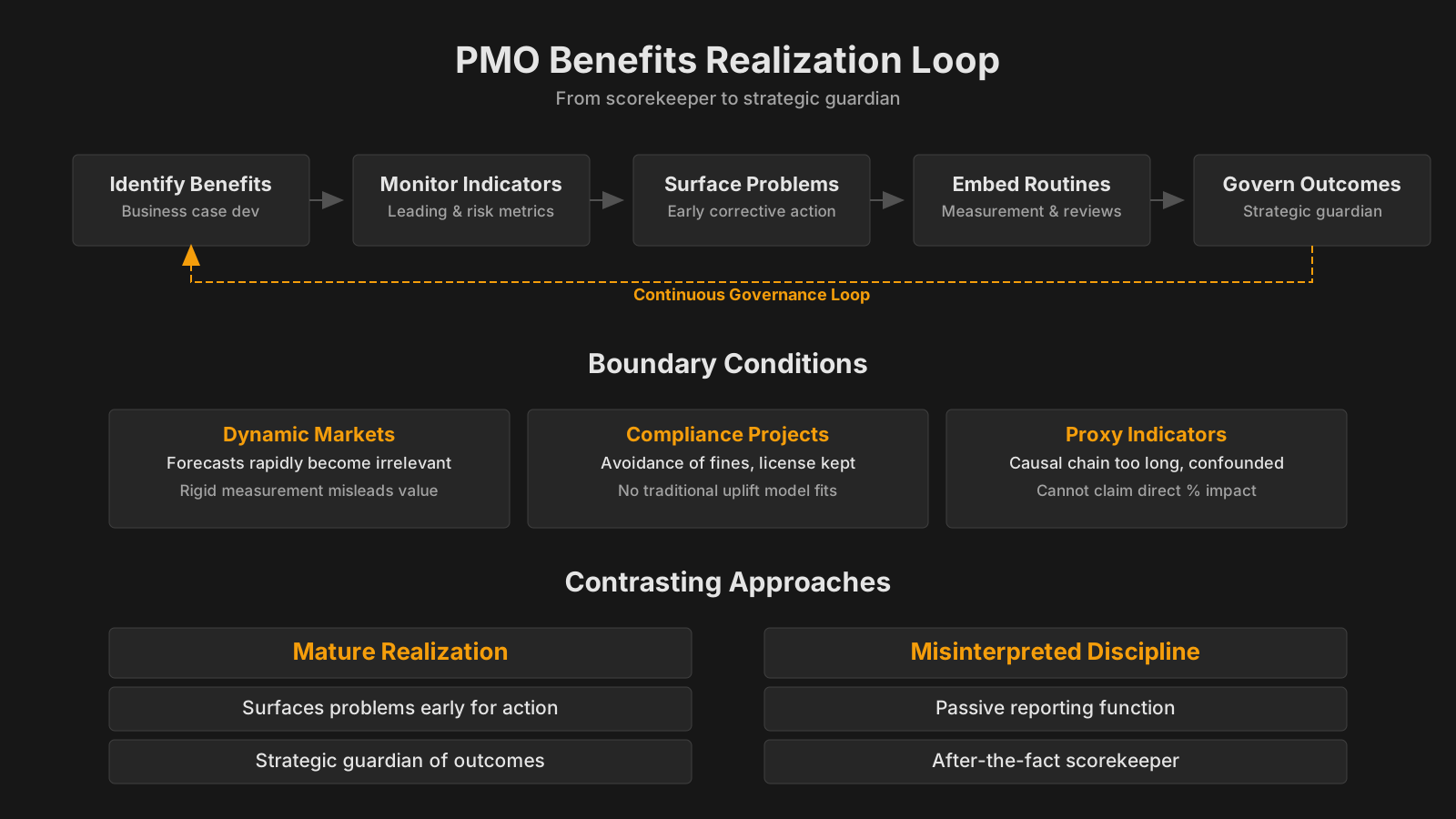
Benefits realization practices assume a clear link between a project’s outputs and observable business performance, yet several boundary conditions limit when the model can be effectively applied. The most significant boundary is operational control: a PMO can define metrics, collect data, and escalate concerns, but it cannot force a business unit to adopt a new process or change long established habits. If the operational sponsor disengages after project closure, the PMO’s benefits tracking often becomes a paper exercise, as the actual value depends on decisions made in functional areas far removed from the project team.
Another boundary emerges when benefits are intangible or highly diffuse, such as improved brand perception or increased employee satisfaction. While proxy indicators can be established, the causal chain is too long and confounded by external variables for a PMO to credibly claim a specific percentage improvement came directly from the project. In highly dynamic environments, where market conditions shift abruptly, pre project benefit forecasts rapidly become irrelevant, and the rigid measurement regimes some PMOs impose can lead to misleading conclusions about project value.
Regulatory or compliance projects present a further boundary: the benefit is often the avoidance of a fine or the maintenance of a license to operate, which while valuable, does not fit a traditional uplift based benefits model. In these situations, the PMO must accept a limited role, focusing on confirming that the compliance output was delivered and the risk exposure was reduced, without forcing a monetized benefit calculation that would distort reality. Recognizing these boundaries helps prevent the overreach that discredits a PMO’s benefits function.
The Misinterpretation of Benefits Realization as a Post-Project Audit
A persistent bias of benefits realization in a PMO is equating it with a post-project review or a retrospective audit conducted months after delivery. In this view, the PMO waits until the project is closed, then checks financial ledgers and performance dashboards to see if predicted benefits appeared. The fact is that disciplined benefits realization is a forward looking, lifecycle governance activity that starts during portfolio intake and continues through the entire post transition period.
It begins with ensuring that the business case includes measurable benefit targets with clear accountability, not vague aspirations. During project execution, the PMO monitors leading indicators and benefit risks, such as user adoption rates during pilot phases, to forecast whether the ultimate outcomes remain achievable. After go live, the focus shifts to embedding measurement routines and facilitating benefit reviews where sponsors and operational owners discuss trajectory adjustments.
Treating it as a simple audit misses the proactive stewardship element entirely. The audit mentality also encourages a blame oriented culture: if benefits are not realized, the project is deemed a failure. A mature benefits realization approach, by contrast, recognizes that the PMO’s role is to surface problems early enough for corrective action, whether that means retraining users, redesigning a business process, or even decommissioning an asset that will never yield the expected return.
Misinterpreting the discipline as a passive reporting function strips it of its power to influence decisions and protect organizational value. Correctly understood, it is a continuous governance loop that turns the PMO into a strategic guardian of investment outcomes, not an after the fact scorekeeper.
Extrinsic motivation is the drive to perform project tasks, meet objectives, or comply with process requirements because of external rewards, incentives, recognition, or consequences rather than inherent satisfaction in...
The ADKAR Model is a goal-oriented change management framework that defines the five sequential conditions an individual must meet to successfully adopt and sustain a change. Unlike organizational change models that...
Individual project risk is an uncertain event or condition that, if it occurs, has a positive or negative effect on one or more project objectives. In project management, each such risk is assessed as either a threat...
Historical information is the recorded data, documents, and knowledge from past projects, programs, or operational work that project managers use to guide decisions on current and future initiatives. It encompasses...
Forming Storming Norming Performing Adjourning is a five-stage model of team development that describes the predictable behavioral and relationship phases a project team passes through from initial assembly to eventual...
Fixed Price with Economic Price Adjustment (FP-EPA) is a procurement contract type in which the seller receives a predetermined fixed price for the agreed scope, but that amount can be adjusted during the contract term...
Deliverables are unique and verifiable products, results, or capabilities required to complete a process, phase, or project. They give objective shape to effort and anchor how teams plan, execute, track, and close work....
Knowledge transfer is the structured process of moving project knowledge, skills, context, and lessons from one individual, team, or system to another so that the receiving party can use that knowledge effectively. In...
The Closing Process Group is the set of project management processes used to formally complete a project, phase, or contractual relationship. It represents the final stage of the five PMBOK process groups and ensures...
Cost Plus Incentive Fee, abbreviated CPIF, is a cost-reimbursable contract type in project procurement management in which the buyer reimburses the seller for allowable costs incurred and pays an incentive fee that...
Funding requirements are the scheduled amount and timing of financial resources needed to execute a project according to its approved plan. In project management, they reconcile the cost baseline with organizational...
Cost Performance Index, abbreviated as CPI, is an earned value management metric that measures the cost efficiency of project work by comparing the value of work completed to the actual costs spent. A CPI of 1.0...
A check sheet is a structured, tabular form used in project quality management to record and categorize data as it is collected. It enables project teams to track defects, frequencies, and process variations in real...
The Benefit-Cost Ratio (BCR) is a financial metric used in project portfolio management to evaluate the economic viability of an initiative. It quantifies the relationship between the total expected benefits and the...
The adaptive development approach is a product delivery methodology where requirements are not fully known at the start, but emerge through iterative development cycles and ongoing stakeholder input. It manages high...
Feature completion rates measure the proportion of planned features that a project team has fully delivered and had accepted by a defined point in a release, iteration, or project phase. The metric is widely used in...
The Cynefin Framework is a sense-making model that helps project, program, and portfolio managers categorize problems and decisions based on the relationship between cause and effect. It defines five domains: clear,...
Leading indicators in project management are predictive measures that signal likely future performance, risks, or outcomes before they appear in final project reports. Project managers use them to identify early...
A change control system is a formal set of documented procedures, tools, and approval authorities that governs how modifications to project baselines, deliverables, and documentation are proposed, evaluated, approved,...
A conflict model is a structured framework in project management for understanding how disagreements arise, escalate, and resolve within project teams and stakeholder groups. It categorizes conflict sources, recognizes...
The Development Approach and Life Cycle Performance Domain is a project management performance domain that encompasses the activities and functions associated with selecting a development approach, structuring project...
Key Performance Indicators, or KPIs, are a limited set of quantifiable measures that indicate how well a project, program, or portfolio is performing against its most critical objectives. In project management, KPIs...
A contingency reserve is the amount of time or money allocated within the project baseline to respond to identified risks that may or may not occur. It is tied directly to the risk register and enacted through planned...
A cumulative flow diagram is a visual project management tool that displays the number of work items in each state of a defined workflow over a continuous time period. It represents workflow status as a stacked area...
Correlation versus causation is the project management discipline of distinguishing an observed statistical association between two variables from a proven causal relationship. It allows project managers to evaluate...
Assumption and Constraint Analysis is the systematic process of identifying, documenting, and validating the presumptions and limitations that underpin a project plan. It ensures uncertainty is explicitly acknowledged...
Funding limitations are constraints on the amount, timing, or availability of financial resources committed to a project, program, or portfolio. In project management, they determine which work can be authorized, when...
An information radiator is a highly visible display of project information placed in a shared physical or digital space. It continuously broadcasts status, progress, risks, and decisions, allowing team members and...
A fail safe is a designed condition, mechanism, or plan state in project management that allows a project to contain a failure before it cascades into uncontrolled schedule, cost, or scope damage. The term originates in...
Interpersonal skills are the behavioral competencies project managers and team members use to communicate, influence, negotiate, resolve conflict, and build working relationships with stakeholders throughout the project...
A Basic Ordering Agreement (BOA) is a written instrument that establishes general terms and conditions between a buyer and seller for future orders of supplies or services. It serves as a non-binding framework in...
A firm fixed price (FFP) contract is a procurement agreement in which the buyer pays a predetermined, unadjustable amount for a defined scope of work, regardless of the seller's actual costs. In project management, an...
A Big Visible Chart is a large, prominently displayed physical or digital board that communicates critical project metrics, status, and progress in a transparent, immediately accessible way. It serves as an information...
Good Practices in project management are methods, techniques, processes, and behavioral norms that have gained broad acceptance among practitioners because they increase the likelihood of achieving project objectives....
Estimate at Completion (EAC) is a project management forecast of the total expected cost of a project once all remaining work is finished. It combines actual costs incurred to date with revised projections of remaining...
In project management, a buyer in agreements and contracts is the party that formally acquires goods, services, or results from an external seller. This role sits at the center of procurement, defining requirements,...
Decoupling is a project management strategy that deliberately separates activities, components, systems, or decisions so a change, delay, or failure in one area does not automatically cascade into others. It reduces...
Cost-benefit analysis (CBA) is a structured evaluation method in project management that compares the total expected costs of an initiative with its total anticipated benefits to determine whether the investment is...
Communication models are conceptual frameworks that describe how information is transmitted from a sender to a receiver and where meaning can be clarified, lost, or distorted among project stakeholders. In project...
An external dependency is a relationship between a project activity and an input, deliverable, decision, or resource that lies outside the project team’s direct control. It represents a prerequisite supplied by another...
In project management, an agreement is a mutually accepted understanding between two or more parties that defines commitments, deliverables, and the framework for executing work. Agreements span a spectrum from legally...
Earned Value Management (EVM) is a project management technique that integrates scope, schedule, and cost to measure project performance and progress in a single monetary baseline. It compares the value of work actually...
Decision making is the process by which a project manager, team, sponsor, or governance body selects a course of action from two or more alternatives to move the project toward its objectives. In project management, it...
Explicit knowledge is codified, documented project information that can be shared, retrieved, and reused without relying on personal memory or face-to-face contact. It includes project charters, work breakdown...
A combined burn chart is a project progress visualization that plots completed work, remaining work, and total scope on a single time-series graph. It combines the downward focus of a burndown chart with the upward...