Benchmarking, in the sphere of project, program, and portfolio management, is defined as the structured process of comparing an organization's project practices, processes, or performance metrics against those of recognized leaders, competitors, or established industry standards. The objective is to identify performance gaps, uncover improvement opportunities, and establish realistic targets that can elevate the maturity and outcomes of future or ongoing work. While the term is used across many disciplines, within project management it specifically refers to a deliberate, analytical effort to learn from external or internal reference points and then adapt those insights to the unique constraints of a project environment.
Benchmarking: Key Topics at a Glance
| Key Concept | Summary |
|---|---|
| Definition | Benchmarking is the structured discipline of measuring project practices, processes, and performance metrics against industry best-in-class performers or recognized standards to identify actionable gaps. |
| Objective | Its primary purpose is to reveal performance gaps, surface actionable improvement opportunities, and set evidence-based targets that elevate project outcomes and organizational maturity. |
| Project Context | Within project management, benchmarking functions as a deliberate analytical discipline that extracts lessons from external or internal exemplars and translates those insights to fit the unique constraints of a project environment. |
| Metrics | Relevant metrics typically include cost performance index, schedule variance, stakeholder satisfaction scores, and defect density, each compared against comparable project data to quantify performance differentials. |
| Beyond Comparison | Beyond numerical comparison, effective benchmarking interrogates the underlying practices, methods, and governance policies that enable reference organizations to achieve superior results. |
| Practical Example | For instance, a project manager in construction might benchmark the average volume of change orders per project phase across similar firms to establish realistic thresholds and strengthen the change control framework. |
| Origins | Formal benchmarking emerged in the late 1970s when Xerox conducted a systematic comparison of its manufacturing operations and product quality against Japanese competitors, catalyzing the practice. |
| Key Components | Every benchmarking initiative follows a core cycle: defining the focus area, selecting appropriate partners, gathering reliable data, analyzing performance gaps, and integrating findings into actionable improvements. |
What Is Benchmarking in Project Management?
Benchmarking in project management is a data gathering and analysis technique that forms part of quality management and performance improvement processes. It involves selecting specific dimensions of project work, such as cost variance, schedule adherence, stakeholder satisfaction, or defect rates, and measuring them against comparable data from other projects. The benchmarking definition in project management extends beyond simple metric comparison—it encompasses understanding the underlying practices, methods, and policies that produce superior results in the reference organizations. The outcome is not a copy-paste template but a calibrated target informed by what has been proven achievable elsewhere. In practice, a project manager might benchmark the average number of change requests per phase in similar industry projects to set a realistic threshold for their own change control process, adjusting for differences in complexity and environment. This form of external validation grounds performance targets in reality rather than optimism or guesswork.
Many practitioners are surprised to learn that benchmarking is not merely an exercise in competitive intelligence; it is equally concerned with learning from internal sources. Internal benchmarking compares performance across different business units, programs, or even past phases of the same project. The analysis can be qualitative—studying how a high-performing team manages risk escalation—or quantitative, such as tracking the median time to resolve issues. The common thread is a structured methodology that emphasizes data integrity, contextual adaptation, and a willingness to challenge entrenched assumptions about what is “good enough.”
Core Insights on Benchmarking
- Structured quality management technique
- Benchmarking is a rigorous data collection and analysis methodology that evaluates key project metrics, including cost variance, schedule adherence, stakeholder satisfaction, and defect rates, by comparing them with performance data from similar initiatives.
- External validation creates realistic targets
- By examining the practices, methods, and policies that drive top-performing organizations, benchmarking anchors performance targets in empirical evidence, replacing wishful thinking, guesswork, and one-size-fits-all templates with actionable benchmarks.
- Internal benchmarking drives improvement
- Internal benchmarking compares performance across business units, programs, or historical project phases through qualitative and quantitative analysis, forcing teams to reexamine comfort zones and raise the bar for what constitutes acceptable performance.
Origins and Cross-Industry Context
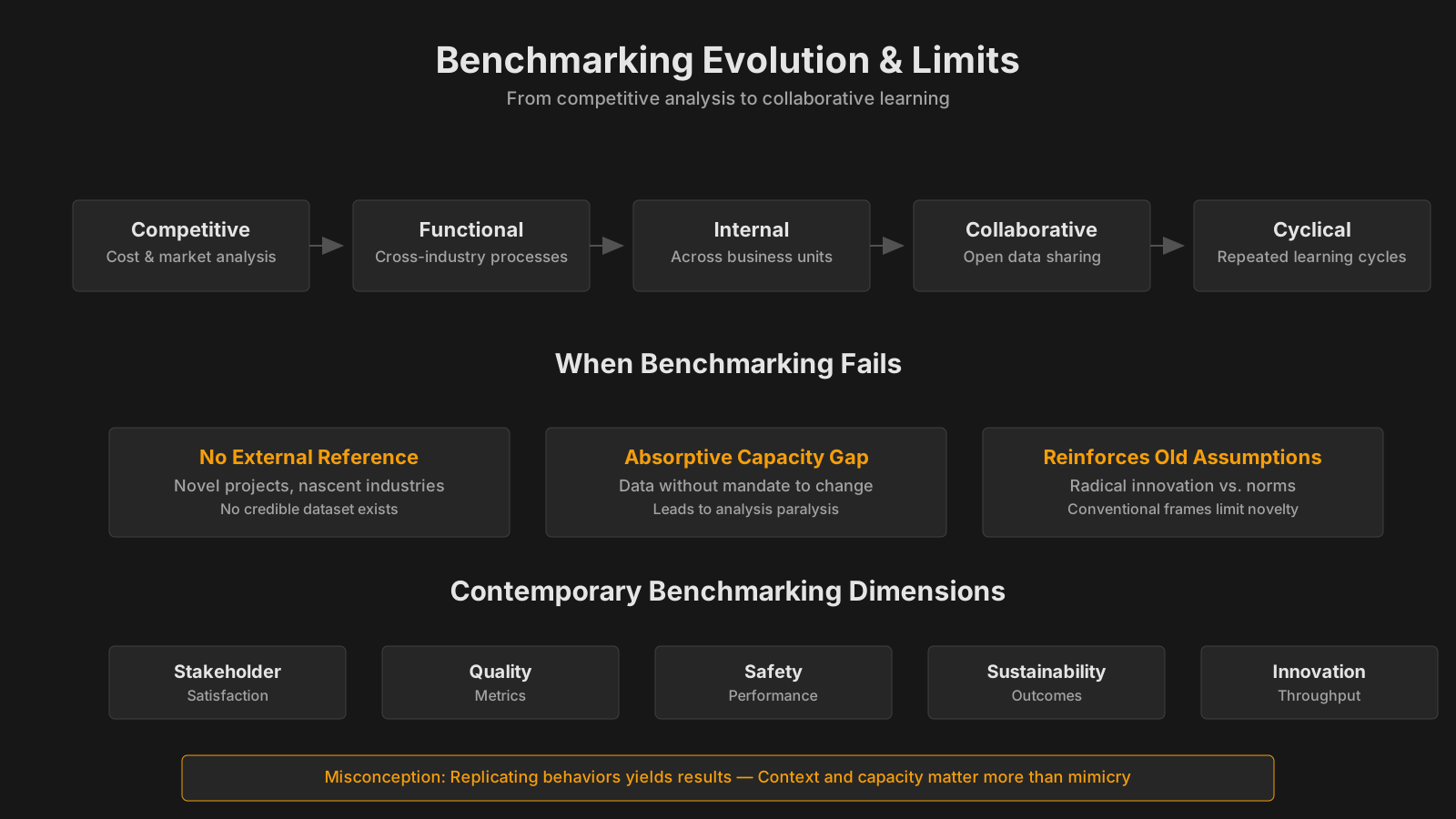
Benchmarking as a formal management practice traces its roots to the late 1970s, when Xerox Corporation, facing intense competitive pressure from Japanese manufacturers, undertook a systematic comparison of its operations, costs, and product quality against those of its rivals. The initiative, known as competitive benchmarking, helped Xerox dramatically reduce manufacturing costs and regain market share. From manufacturing, the concept migrated into other sectors—construction, aerospace, healthcare, and software engineering—each adapting the core idea to its own performance drivers. In aviation, safety benchmarking across airlines became a standard for reducing incident rates. In medicine, hospital mortality and readmission rates are benchmarked to drive quality improvement. These cross-industry applications lent credibility to benchmarking and generated a body of research on what makes the practice effective.
When benchmarking entered project management, it absorbed lessons from these predecessors. Early adopters in large engineering and IT projects used benchmarking to justify budgets and schedules by referencing analogous projects. Over time, the Project Management Institute (PMI) codified benchmarking as a recognized technique, embedding it within the quality knowledge area. The construction industry’s use of normalized cost-per-square-meter data to forecast project budgets is a direct inheritance from manufacturing’s unit-cost comparisons. However, project environments present a distinct challenge: unlike ongoing operations, projects are temporary and unique, which means that directly porting benchmarks from one context to another requires careful normalization for scope, risk profile, and stakeholder expectations.
Key Components and Types of Benchmarking
At its core, any benchmarking effort in project management unfolds through several logical components: selection of what to benchmark, identification of benchmarking partners, data collection, gap analysis, and implementation of findings. Key components of benchmarking also include defining the metrics with operational precision so that apples-to-apples comparisons are possible. For example, if a program office decides to benchmark “project delivery speed,” it must specify whether this means duration from charter to handover, from first commit to go-live, or some other boundary. Without this rigor, data become interesting anecdotes at best and misleading at worst.
Benchmarking is commonly categorized into several types. Performance benchmarking compares quantitative metrics—cost performance index (CPI), schedule variance, test coverage percentages—against those of other entities. Process benchmarking goes deeper, examining the methods and workflows that generate those numbers; a project might benchmark its risk identification process against a firm known for early risk detection, not just the count of risks logged. Internal benchmarking compares within the same organization, often across divisions or historical projects, and is generally easier to access but less likely to expose breakthrough practices. External competitive benchmarking looks at direct competitors and is notoriously difficult because sensitive data are guarded. Functional benchmarking compares similar functions across different industries, such as a pharmaceutical R&D project’s stage-gate process compared with aerospace’s phase-gate reviews, which can spark truly innovative adaptations. Generic benchmarking focuses on processes that transcend industry, like stakeholder communication or resource loading. Finally, strategic benchmarking examines high-level directions, such as portfolio mix or innovation yield, and is usually reserved for program and portfolio management levels.
A frequent misconception is that benchmarking is a one-time effort. In reality, the most valuable applications are iterative. As the organization matures, benchmarks are refreshed, and the target shifts from matching the average performer to approaching the top quartile. Recalibration reflects the principle that standards of excellence are not static; what was best-in-class three years ago may be merely table stakes today.
Benchmarking Components and Types
- Logical benchmarking components
- Benchmarking unfolds through a disciplined sequence that begins with defining the subject and selecting comparison partners, then gathering reliable data, analyzing performance gaps, and translating insights into actionable improvements.
- Precision in defining metrics
- Operationally precise definitions are essential for metrics to support valid comparisons; for example, “project delivery speed” must be clearly specified as the elapsed time from project initiation to final handover, removing any ambiguity before measurement begins.
- Performance versus process benchmarking
- Performance benchmarking evaluates quantitative outcomes such as cost performance index and schedule variance, revealing what results are achieved, whereas process benchmarking dissects the underlying methods and workflows to understand how those results are generated.
- Internal and functional benchmarking
- Internal benchmarking draws on data from within the organization, comparing divisions or past projects to drive consistent improvement with ready access to information, whereas functional benchmarking reaches across industries to adapt best practices from analogous functions, often fueling breakthrough innovations.
- Generic and strategic benchmarking
- Generic benchmarking targets universally applicable processes, like stakeholder communication, that operate across sectors, while strategic benchmarking assesses an organization’s high-level direction including portfolio mix and resource allocation, typically guiding decisions at the program and portfolio management levels.
Place in Project Management Frameworks
Within the PMBOK Guide, benchmarking is explicitly positioned as a data-gathering technique in the Plan Quality Management process. It is used to set quality standards and metrics by studying comparable projects, industry norms, and published standards. Benchmarking in PMBOK appears again in Control Quality as a means to evaluate whether deliverables meet the planned metrics, and in a broader sense, it supports the Monitor and Control Project Work process when performance is assessed against organizational or industry baselines. PMBOK’s emphasis is on using benchmarking to inform the project management plan’s quality components, and the technique is considered adaptable to predictive, Agile, and hybrid life cycles. The guide cautions that benchmarks must be relevant to the project’s context; a high-tech startup’s defect tolerance cannot be directly compared to that of a mature defense contractor without adjustment.
PRINCE2 does not prescribe benchmarking as a named technique in its core text, but its principles of continued business justification and learn from experience naturally accommodate it. The quality theme in PRINCE2 encourages the use of quality tolerances and product descriptions that can be informed by external comparisons. A PRINCE2 project might benchmark its quality criteria against those used in similar projects within the same program, leveraging the project board’s experience. In Agile environments, benchmarking becomes a delicate tool. Agile practitioners often value team-specific context and sustainable pace, and they may resist external benchmarks that promote velocity chasing. However, many Agile organizations do benchmark cycle time, lead time, and defect escape rates across teams, provided the comparison is used for systemic improvement rather than individual performance appraisal. In hybrid models, benchmarking is frequently applied at the governance level: a program steering committee might compare the value realization of different component projects against industry norms to decide on continued funding.
Practical Application and Use in Project Work
Benchmarking activities typically occur at distinct points in the project lifecycle, though their influence can be ongoing. During initiation, a project sponsor or PMO might analyze benchmarks of similar completed projects to shape the business case, setting the expected return on investment and preliminary budget envelope. A project manager planning a large infrastructure deployment may access industry consortium databases to benchmark anticipated material waste rates, using those figures to fine-tune procurement and logistics plans. Benchmarking in practice is most visible during quality planning, where it directly informs the quality management plan’s metrics, control limits, and inspection criteria. For instance, a software development project manager might benchmark the industry median for critical defects per thousand lines of code and then define the project’s acceptance threshold as the upper quartile of that benchmark, communicating to the team that the goal is not just “few defects” but a level that positions the product competitively.
During monitoring and controlling, benchmarking enables objective performance assessment. If the project’s cost variance repeatedly falls outside the range observed in similar historical projects, it signals a need to investigate whether estimating assumptions were flawed or whether a systemic issue is at play. Portfolio managers use benchmark data to identify underperforming components. A portfolio of transformation initiatives might compare each project’s schedule performance index against a published benchmark for that type of change; consistent underperformance may trigger a health check or reprioritization. In programs, benchmarking supports benefits management by providing a reality check on claimed benefits—if every similar program in the industry realized a 10 percent efficiency gain and this program promises 30 percent, the discrepancy demands hard evidence.
The actual practitioners of benchmarking vary. In large organizations, a centralized Project Management Office (PMO) often maintains a repository of internal benchmarks and coordinates external data collection. Project managers themselves, especially in organizations with a mature continuous improvement culture, may lead focused benchmarking studies for a specific challenge, such as reducing stakeholder escalations. Quality assurance teams and process analysts frequently drive process benchmarking efforts that span multiple projects. External consultants may be brought in to provide proprietary databases or facilitate competitive benchmarking where internal staff would face access barriers.
Key Takeaways on Benchmarking Practice
- Lifecycle-driven benchmarking moments
- Benchmarking is triggered at specific lifecycle milestones but exerts continuous influence over decision-making during initiation, planning, and monitoring.
- Initiation shapes business cases
- During initiation, sponsors and PMOs validate ROI assumptions and establish credible budget ranges using data from comparable completed projects.
- Quality planning sets concrete targets
- In quality planning, benchmarking converts industry performance quartiles into concrete control limits and inspection criteria, such as setting a software project's defect threshold to match top-quartile outcomes.
- Monitoring reveals performance gaps
- During monitoring, cost and schedule variances compared against historical benchmarks reveal biased estimating assumptions and underlying systemic issues that warrant immediate investigation.
- Programs validate benefit claims
- Benefits management applies benchmarking to stress-test benefit forecasts, demanding substantiation when projected outcomes significantly outperform the historical results of comparable industry initiatives.
Common Challenges, Pitfalls, and Misconceptions
One pervasive misconception is equating benchmarking with simple copying. Common benchmarking pitfalls begin when organizations collect impressive-sounding metrics without understanding the processes and environmental factors that produced them. A project manager might discover that a celebrated firm delivers projects 20 percent faster and simply mandate that the team match that speed, ignoring that the benchmarked firm uses a modular design platform and has a dedicated change approval board that meets daily. Without process insight, the pursuit becomes a dangerous race to meet numbers that are mismatched to the local reality.
Data quality is the Achilles’ heel of any benchmarking study. Benchmark data are frequently self-reported, and the definitions used by different organizations can vary wildly. One company may classify a project as “late” only after exceeding a 10 percent buffer, while another uses the original baseline with zero tolerance. The illusion of precision from neatly tabulated figures often seduces decision-makers into false confidence. Another challenge is the selection of appropriate benchmarks. Comparing a first-of-its-kind innovation project to repetitive operational projects yields nonsense; the benchmarking effort must control for project type, complexity, team maturity, and risk profile. Moreover, some organizations suffer from benchmarking myopia—they focus exclusively on external comparisons and overlook the rich data available from their own completed projects, which often provides more contextually relevant insights because it shares the same culture, systems, and constraints.
Benchmarking also carries a subtle behavioral risk. When performance metrics are tied to rewards or sanctions, teams may game the numbers—reporting inflated schedule progress or reclassifying defects—just as they might for any other target. It is critical to communicate that benchmarking exists to learn, not to punish. And there are times when benchmarking should be deliberately avoided. In projects pushing the boundary of innovation, seeking external comparators may anchor thinking to existing paradigms and stifle breakthrough creativity. Similarly, when reliable benchmarks do not exist—common in nascent fields—fabricating benchmarks from thin air introduces more risk than they mitigate.
Relationships to Other Project Management Concepts
Benchmarking does not exist in isolation; it interconnects with several foundational elements of project management. Benchmarking and quality management are closely linked because benchmarks provide the factual basis for setting quality metrics, control limits, and improvement targets. In the Plan-Do-Check-Act cycle that underpins many quality approaches, benchmarking often supplies the external reference during the “Plan” phase by establishing what “good” looks like. In Six Sigma initiatives within projects, benchmarking may define the initial sigma level to be improved upon. Lessons learned processes are the internal twin of benchmarking: while benchmarking looks outward or across units for current best practices, lessons learned capture internal historical experience that can be used to set future benchmarks.
The concept is often confused with a baseline, but they are distinct. A baseline is the approved, fixed reference point for project performance against which actuals are compared; it is internal and specific to that project. A benchmark is typically external or cross-sectional and represents a standard of excellence or an industry norm. Gap analysis follows benchmarking: once the benchmark identifies a performance differential, gap analysis decomposes the root causes and required actions to close the gap. Key performance indicators (KPIs) are the vehicle through which benchmarks are often expressed. A KPI such as “cost of rework as a percentage of total project cost” can be benchmarked, and then the same KPI is tracked internally. Maturity models like OPM3 or CMMI embed benchmarking concepts by allowing an organization to assess its capabilities against a defined maturity scale derived from industry data.
Benchmarking also interacts with risk management. When external benchmarks are used to set aggressive targets, the project’s risk register should reflect the uncertainties of achieving those targets given the organization’s current capability. In program management, benchmarking the benefits realization of similar programs helps refine the business case and provides an evidence base for gate reviews. Thus, benchmarking acts as a connective tissue between planning, quality, risk, and governance.
Core Insights on Benchmarking Relationships
- Quality management connections
- Benchmarking provides the empirical foundation for quality metrics, control limits, and improvement targets, while also supplying the external reference for the Plan phase of PDCA and for establishing initial sigma levels in Six Sigma.
- Lessons learned as internal twin
- Lessons learned capture an organization’s own historical experience, functioning as the internal counterpart to benchmarking’s outward search for current best practices across units.
- Benchmark versus baseline distinction
- A baseline is the approved, project-specific yardstick for measuring actual performance, while a benchmark represents an external standard of excellence or an industry-wide norm.
- Gap analysis builds on benchmarks
- Once benchmarking reveals a performance gap, gap analysis systematically isolates root causes and specifies the corrective actions needed to close it.
- Maturity models and program management
- Maturity models like OPM3 and CMMI incorporate benchmarking by evaluating capabilities against industry-standard scales, and program management leverages benchmarks of benefits realization to sharpen business cases and inform gate reviews.
Evolution and Current Thinking
The practice of benchmarking in project management has evolved substantially from its manufacturing origins. Early adopters depended on manual surveys, trade conferences, and published reports. The rise of project management software and centralized databases in the 1990s enabled the creation of industry-wide repositories where anonymous project data could be pooled and analyzed. Today, modern benchmarking approaches leverage big data analytics, machine learning, and real-time dashboards to provide instant comparative feedback. Organizations can now benchmark a project’s sprint velocity against a dynamically updated cohort of similar teams filtered by industry, technology stack, and team size, receiving recommendations that adjust as the dataset grows.
This evolution has sparked debates among practitioners. One school argues that benchmarking has become too metric-centric, reducing complex human endeavors to sterile numbers that obscure the messy, context-dependent reality of project work. Critics point out that a fixation on benchmarks can drive conformity, leading project managers to design for the metric rather than for genuine stakeholder value. Another perspective, particularly strong in the Agile community, holds that team idiosyncrasy should be respected, and that internal trend analysis—a team improving against its own past performance—is often more meaningful than external comparisons. The counterargument accepts that external benchmarks, when used lightly and without punitive weight, can challenge complacency and reveal possibilities a team never imagined.
Current best practice emphasizes blended approaches: combine internal trend data with carefully chosen external references, always adjusting for context. Leading PMOs now curate “contextualized benchmarks” where they tag projects not only by industry and budget but by complexity drivers—regulatory environment, stakeholder fragmentation, technology novelty—to create more meaningful comparison groups. The trend is moving away from static, annual benchmarking studies toward continuous benchmarking embedded in project information systems. As artificial intelligence capabilities grow, predictive benchmarking is emerging, where algorithms forecast likely performance ranges based on project attributes even before execution begins, helping sponsors set more realistic expectations. Despite all technological progress, the core principle remains unchanged: benchmarking is fundamentally about structured learning, not mere measuring, and its value is realized only when insights translate into changed behaviors and improved outcomes.