The basis of estimates is the supporting documentation that captures the reasoning, assumptions, data sources, calculations, and confidence levels behind project cost, resource, and duration estimates. It serves as the evidentiary backbone that transforms a raw number into a credible, auditable forecast. Without a proper basis of estimates, a project budget or schedule is little more than a collection of guesses that cannot withstand scrutiny from sponsors, regulators, or historical review. In professional project management, the basis of estimates is considered a core artifact that links the estimate itself to the ground truth of how it was derived.
Across industries, the concept of documenting the foundation of a numerical forecast is not unique to project management. Civil engineering projects have long required detailed quantity takeoffs and unit cost references. Defence acquisition programs use elaborate cost estimating relationships and parametric models, demanding strict configuration control of the underlying data. Manufacturing environments capture routing sheets and time study data to justify standard costs. In software engineering, estimation rationale often includes reference class forecasting and analogies to completed stories or features. While the terminology differs, the underlying principle remains constant: an estimate without a clear explanation of its genesis is inherently unreliable. The project management profession adopted and formalised this expectation, weaving the basis of estimates into its most widely recognised standards.
Basis of Estimates: Summary of Key Topics
| Key Concept | Summary |
|---|---|
| Basis of Estimates | The documented foundation of every project estimate, detailing the reasoning, assumptions, data origins, calculation methods, and quantified confidence levels that support the final figure. |
| Importance | Without it, budgets and schedules collapse under scrutiny because sponsors, auditors, and future analysts have no traceable rationale to validate the numbers. |
| Defence Programs | Defence acquisition estimates rely on rigorous cost estimating relationships and parametric models, with every data element under strict configuration control to ensure auditability over decades. |
| Core Contents | The core documentation specifies the project scope, the chosen estimation methodology, referenced historical baselines, productivity assumptions, and an explicit statement of the estimating range tied to a confidence level, such as P50 or P90. |
| Management Plans | While organisations often embed the basis within broader cost or schedule management plans, its essence remains the line-item or work-package-level justification that allows anyone to reconstruct how each number was derived. |
| PRINCE2 Approach | PRINCE2 embeds this rationale in the Plan narrative and Product Description, directly linking assumptions to effort estimates and cost projections so that reviewers can follow the logic from product scope to resource forecast. |
| Agile Practice | Agile teams maintain an analogous basis through documented story point calibration, historical velocity data, and explicit reasoning behind capacity selections for each sprint, creating a defensible trail from relative sizing to release forecasts. |
| Worked Example | A bridge construction estimate might hinge on assumptions such as a defined alignment, standard HS20-44 design loading, and the clear exclusion of wetland mitigation costs, all of which critically affect the final figure. |
Definition and Core Meaning of Basis of Estimates
A basis of estimates definition in project management encompasses far more than a simple record of calculations. It is a structured compilation of all the elements that influenced the estimator’s judgement at the time the estimate was prepared. This includes the scope description that was assumed, the methods used to derive the quantity or effort figures, any referenced historical data or analogous projects, the specific assumptions about resource productivity or availability, and a clear statement of the estimating range and confidence level. Some organisations also embed the basis of estimates within a larger cost or schedule management plan, but at its core, it is the detailed rationale pinned to each line item or work package.
The concept appears in the PMBOK Guide as a distinct output from the Estimate Costs, Estimate Activity Resources, and Estimate Activity Durations processes. In PRINCE2, the equivalent reasoning lives inside the Plan narrative and the Product Description, where assumptions are linked to estimated effort and cost. Agile practitioners, while often eschewing heavyweight documentation, still maintain a form of basis of estimates through story point calibration records, team velocity data, and the rationale behind sprint capacity choices. The common thread is an insistence that the estimate’s logic remain transparent, testable, and revisable when new information emerges.
In practical terms, the basis of estimates functions as a contract of understanding between the estimating team and the decision-makers who will use the numbers. It answers the question “why this number?” with enough specificity that someone not involved in the original estimating session can replay the logic and arrive at a similar range. That replayability is what separates a formal estimate from an intuition-based guess, and it is a hallmark of mature project management practice.
Key Insights on Estimate Basis
- Structured compilation beyond raw calculations
- The estimate basis forms a comprehensive record of every factor that shapes the estimator's judgment, rather than merely listing arithmetic results.
- Essential components of estimate rationale
- For each line item, it documents the assumed scope, derivation methods, historical benchmarks, productivity assumptions, and an estimating range with its associated confidence level.
- Framework presence across methodologies
- The concept appears in PMBOK as an output of cost and activity estimating processes, in PRINCE2 within plan narratives, and in Agile through story point calibration and velocity tracking records.
- Transparent, testable, revisable logic
- Across all frameworks, the unifying principle is that estimate reasoning must be transparent, testable, and open to revision whenever new information emerges.
- Contract between estimators and decision-makers
- It serves as a shared understanding that explains why a specific number was selected, allowing any reviewer to replay the logic and arrive at a comparable range.
Key Components of the Basis of Estimates
Understanding the key components of a basis of estimates helps both estimators and reviewers ensure nothing critical is omitted. The first component is the scope definition, which describes precisely what is included and, just as importantly, what is excluded. An estimate for constructing a bridge, for instance, might assume a specific alignment, standard design loads, and exclusion of environmental mitigation costs. If those boundaries are not documented, a later change can appear to be a cost overrun when in reality the scope was never included to begin with.
Another essential element is the estimating methodology used. This could be analoguous estimating, parametric modelling, bottom-up estimating, or three-point estimating with a PERT distribution. The basis of estimates must name the method and explain why it was selected for that particular work package. For a parametric estimate, the underlying parameters such as dollars per square foot or hours per function point are documented along with their sources. If expert judgement was heavily relied upon, the basis should identify the experts, their qualifications, and the logic chain they followed.
Assumptions and constraints form the conditional skeleton of any estimate. A resource estimate might assume a particular skill mix is available locally; a schedule estimate might assume no weather delays during a critical outdoor phase. Listing these assumptions explicitly prevents future disagreements and allows project managers to monitor for assumption breakage. Alongside assumptions, the basis of estimates should record any known risks that were explicitly excluded from the point estimate but could influence the range. The inclusion of an uncertainty range and a stated confidence level, such as “plus or minus 15% at a 50% confidence,” completes the quantitative picture and prepares the organisation for reserve analysis and contingency planning.
The Basis of Estimates in PMBOK and PRINCE2 Frameworks
Within the basis of estimates in PMBOK structure, the artifact appears most prominently as an output of the planning processes in the Cost Management and Resource Management Knowledge Areas. The Plan Cost Management process produces the cost management plan, which may specify the format and precision level for the basis of estimates, but the actual documentation emerges from Estimate Costs. Similarly, Estimate Activity Resources produces resource requirements along with the basis explaining how the quantities and types were determined. The same pattern holds for Estimate Activity Durations. These outputs feed into the development of the project budget and schedule baseline, and the basis of estimates becomes part of the project documents that are updated and referenced throughout execution and change control.
PMBOK’s emphasis on progressive elaboration means that the basis of estimates is refined as the project moves from concept to detailed planning. Early rough order of magnitude estimates might have a very thin basis relying on high-level analogies and broad market benchmarks. By the time the definitive estimate is prepared, the basis should be rich with bottom-up detail, vendor quotes, and engineered quantity takeoffs. This graduated depth aligns with the concept of the estimating life cycle, where increasing certainty demands increasingly rigorous documentation.
PRINCE2 approaches the basis of estimates more implicitly through its Plans theme. Every Plan, from project plan down to team plan, must describe the estimating basis. The Product-Based Planning technique produces Product Descriptions that include the quality criteria and effort required, and the estimation assumptions are captured in the plan text. While PRINCE2 does not use the exact phrase “basis of estimates,” the expectation that plans are supported by documented reasoning is equally strong. The Management Products of the plan and the associated configuration records serve the same governance function, ensuring that estimates can be traced back to their original premises and challenged during stage assessments.
Agile and Hybrid Environments
Agile frameworks do not typically produce a standalone basis of estimates document, but the foundational logic appears in team artifacts. Story point sizing relies on relative estimation, and the team’s shared understanding of what a story point represents serves as the basis. Historical velocity and cumulative flow data give that basis a quantitative anchor. For larger initiatives, a hybrid team might maintain a lightweight estimation backlog that links feature-level t-shirt sizes to the assumptions about team composition, technical debt, and integration complexity. The discipline of documenting these rationales, even in a wiki or an electronic tool, prevents the common situation where a new team member questions an estimate and nobody can recall the original reasoning.
Core Insights on Estimate Basis
- PMBOK output in planning
- Within the PMBOK framework, the basis of estimates serves as a critical output from the Estimate Costs and Estimate Activity Resources processes, documenting the methodologies, assumptions, and data sources used to derive cost and resource estimates.
- Feeds budget and baseline
- By documenting estimation assumptions and benchmarks, the basis of estimates directly informs the project budget and schedule baselines, and serves as an essential reference during execution to assess change requests and maintain alignment with the original planning intent.
- Progressive elaboration of estimates
- Under PMBOK's progressive elaboration, the basis of estimates matures from rough order of magnitude approximations built on analogies and market benchmarks to definitive estimates supported by detailed bottom-up analysis, vendor quotations, and calibrated quantity takeoffs.
- Product descriptions capture assumptions
- Product-Based Planning integrates estimation assumptions directly into Product Descriptions, which specify quality criteria and effort expectations, ensuring that all planning documents reflect a consistent and traceable rationale for resource and cost decisions.
- Documentation prevents lost rationale
- Maintaining a recorded rationale for each estimate in a shared repository, whether a wiki or an electronic tool, safeguards institutional memory and enables teams to revisit the original logic when assumptions are challenged or conditions change, avoiding costly re-estimation cycles.
Practical Application in Project Planning
The practical application of basis of estimates begins at the very first conceptual estimate and continues through project closure. During the initiation phase, a business case may require a high-level cost estimate. Even at this stage, recording the broad assumptions such as the scope boundaries, market conditions, and comparable project references allows the sponsor to understand the estimate’s fragility. As the project enters detailed planning, estimators build the basis of estimates incrementally, often using templates that map to each work package in the work breakdown structure.
In capital projects, the basis of estimates often takes the form of a detailed spreadsheet or database that links every cost line to quantity takeoffs, unit prices, and productivity rates. For an IT project, it might include function point counts, complexity adjustment factors, and effort distribution models across design, build, and test phases. Resource estimates are tied to role profiles, assumed utilisation rates, and geographical cost differentials. The underlying principle is that any number presented in the budget or schedule should be traceable back to a specific work package and the estimating logic applied to it.
Once execution begins, the basis of estimates transforms into a management tool. When a change request arises, the project manager consults the original basis to determine whether the scope, assumption, or constraint boundary has been crossed. This provides an objective criterion for accepting or rejecting scope creep. Earned value management systems often rely on the basis to explain cost and schedule variances; a negative cost variance might be traced to an overly optimistic productivity assumption documented in the basis, pointing to a need for revised estimating for future work.
Common Challenges and Misconceptions
One of the common pitfalls of basis of estimates is treating it as a static document that is filed away after approval. Estimates are inherently contingent, and the assumptions they rely on can become invalid as the project unfolds. A basis that is not updated to reflect revised market conditions, resource availability, or scope elaboration turns into a historical curiosity rather than a living reference. Practitioners often observe that the moment an estimate is baselined, the accompanying basis of estimates gets forgotten, only to be unearthed during a post-mortem when it is too late to influence outcomes.
Another frequent misunderstanding is confusing the basis of estimates with the estimate itself. The estimate is the output number; the basis is the supporting argument. Presenting only the number without the supporting documentation is a common cause of stakeholder mistrust, particularly in environments where past projects have suffered from chronic cost overruns. There is also a tendency to underplay uncertainty by omitting range statements or using a single-point estimate without context. A mature basis of estimates explicitly states the confidence level and the factors that could widen or narrow the range, encouraging a candid conversation about contingency and management reserve.
Resource constraints during the planning phase often lead to a compressed basis of estimates that relies too heavily on expert judgement without independent validation. While expert judgement is legitimate, its reliability plummets when the experts are not named, their track record is unknown, and their logic is undocumented. The illusion of precision from software tools that generate detailed budgets at the push of a button can also mask a thin basis, leading the team to believe the estimate is robust when it is merely computationally elaborate but foundationally weak.
Key Insights on Estimate Pitfalls
- Living document, not static
- A basis of estimates must be actively refreshed to reflect shifting market conditions, resource availability, or scope changes; otherwise it devolves from a practical reference into a static historical record.
- Numbers alone breed mistrust
- Delivering an estimate figure without the underlying rationale erodes stakeholder confidence, particularly in organizations where chronic cost overruns are a recurring reality.
- Uncertainty must be explicit
- A mature basis of estimates explicitly states confidence levels and the key variables that could widen or narrow the range, enabling candid discussions about appropriate contingency and management reserves.
- Expert judgement needs validation
- Expert judgement becomes dangerously unreliable when contributors are unnamed, their track records are unverified, and the logic behind their estimates is never documented.
- Software precision is deceptive
- Intricate budgets generated by software tools can mask a thin foundation, creating a convincing but false impression of rigor when the estimate is computationally elaborate yet fundamentally unsupported.
BVOP Perspective on Basis of Estimates
The Business Value-Oriented Project Management methodology introduces relational effort points in basis of estimates as a distinct departure from absolute time-based estimating. Instead of predicting hours or days, BVOP teams assign relational effort points that express how much effort one activity requires compared to another, using a consistent scale anchored to a reference activity. The basis of estimates in a BVOP setting therefore documents the reference calibration and the logic behind each relationship, treating the estimate as a function of comparative complexity rather than a forecast of clock time.
BVOP also integrates a five-level scope scale that ranges from Definite to Unlikely, directly influencing how effort points translate into planning horizons. An activity rated as Definite receives a confident estimate and forms part of the committed plan. Activities classified as Probable, Possible, or Unlikely are either placed in a buffer or treated as options, and this classification becomes a prominent line in the basis of estimates. What makes BVOP distinctive is its philosophical stance: when scope changes, it is interpreted as user feedback rather than estimate failure. The original basis of estimates then serves not as an indictment of poor forecasting but as a record of what was known at the time, supporting an adaptive planning rhythm that realigns effort points and scope classifications as learning accumulates.
Relationships with Other Project Management Concepts
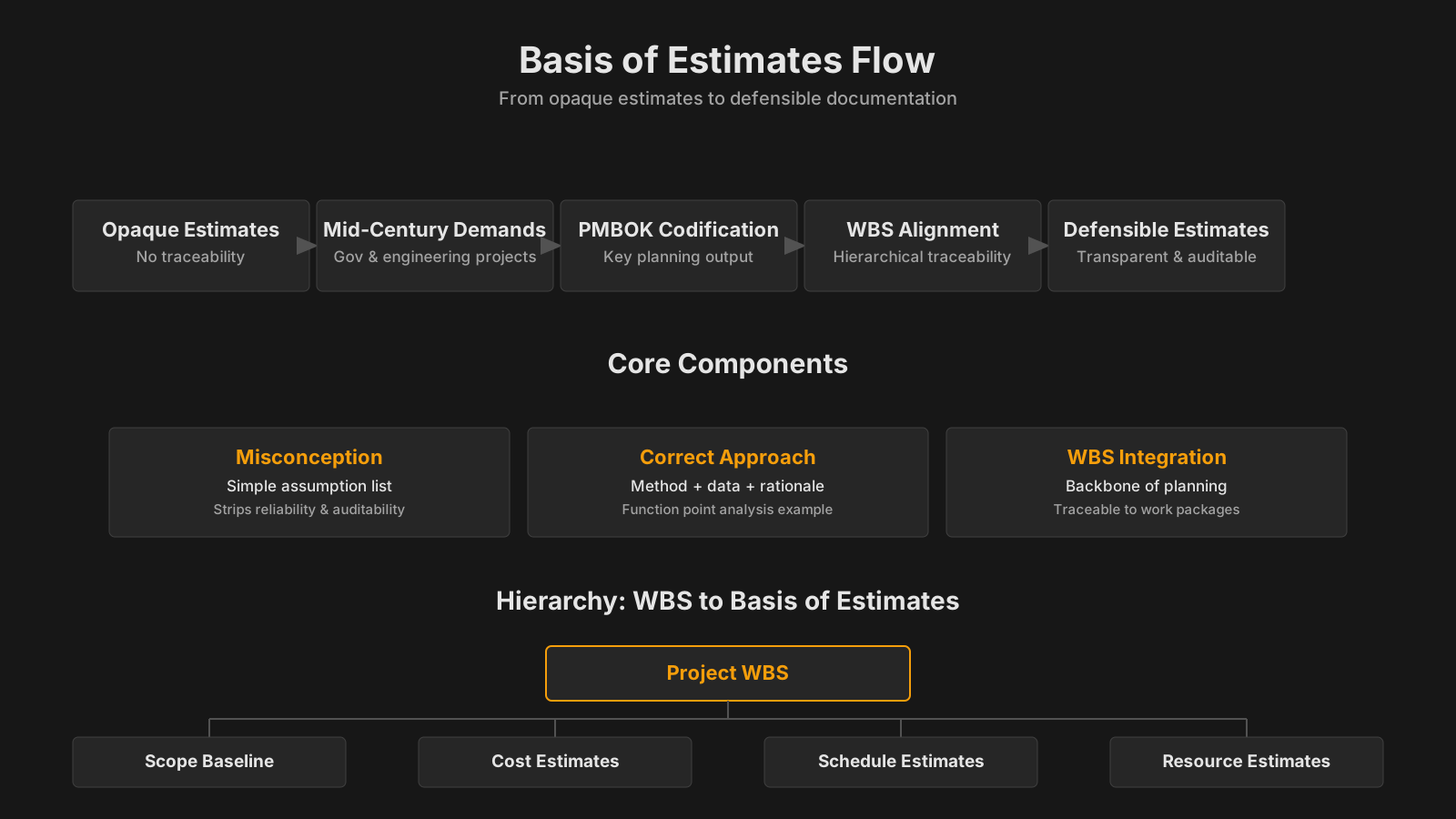
The basis of estimates and work breakdown structure are tightly coupled. Each control account or work package in the WBS should have a corresponding entry in the basis of estimates that details how its planned cost or duration was derived. Without this alignment, the estimate floats free from the scope definition, and any gap or overlap in the WBS leads directly to estimating errors. The link to the risk register is equally important; risks that are explicitly excluded from the point estimate are noted in the basis, and their potential impact is captured in the contingency reserve analysis. This ensures that the risk response strategy and the estimating baseline are consistent.
The basis of estimates also connects to the assumptions log, but the two artifacts serve different purposes. The assumptions log is a catalog of all project assumptions, often at a higher level, while the basis of estimates embeds the assumptions that specifically affect the numbers. For example, the assumption that key resources will be available on demand appears in both, but the basis of estimates quantifies the consequence if that assumption proves false, perhaps by providing an alternative estimate under a constrained resource scenario. Confusing the two artifacts can lead to gaps in traceability, as not all log entries carry quantitative implications that are explicitly modelled.
Earned value management systems use the basis of estimates to dissect variances. A schedule performance index below 1.0 might be explained by an incorrect duration estimate for a repeating activity; the basis reveals whether the original productivity rate was overly optimistic. Similarly, during integrated change control, the basis of estimates provides the analytical foundation for assessing the secondary effects of a change, such as the ripple through procurement lead times or resource reallocation. A well-constructed basis of estimates thus functions as the informational hub that links scope, cost, schedule, risk, and quality planning.
Key Insights on Estimate Integration
- WBS alignment ensures estimating accuracy
- Each control account and work package in the WBS is anchored by a corresponding basis of estimates entry that documents the derivation of its cost and duration; this explicit linkage eliminates ambiguity about scope boundaries and prevents estimation errors that stem from gaps or overlaps.
- Risk register drives contingency analysis
- Risks deliberately excluded from the deterministic point estimate are documented within the basis of estimates, and their quantified potential impacts feed directly into contingency reserve analysis to determine the appropriate size and allocation of the reserve.
- Basis serves as informational hub
- Unlike an assumptions log, which merely lists assumptions without evaluating their effects, the basis of estimates quantifies consequences and establishes traceable connections across scope, cost, schedule, risk, and quality planning, while also providing the analytical foundation for assessing change requests.
Evolution and Current Thinking
Modern approaches to basis of estimates are increasingly influenced by probabilistic modelling and the demand for greater transparency in the face of uncertainty. Instead of a single deterministic basis, advanced organisations maintain a range-driven basis that links each estimating input to a probability distribution. Monte Carlo simulation then uses this basis to generate a full cost or schedule risk profile, replacing the static plus-or-minus percentage with a cumulative distribution curve that executives can use to set contingency at specific confidence levels. This evolution forces the basis of estimates to become more data-rich, capturing not just the most likely value but also the low and high estimates and the shapes of the uncertainty.
There is also a growing recognition that the basis of estimates should not be purely backward-looking. In complex programs, estimators are beginning to embed trigger conditions in the basis, stating that if a particular assumption crosses a predefined threshold, the estimate must be revisited. This turns the basis into an early warning mechanism. The influence of Agile and lean thinking has pushed many traditional environments to limit the granularity of the basis to what is immediately useful, abandoning overly detailed work package estimates for future phases in favour of rolling wave approaches that produce a lighter but still defensible basis until closer to execution.
Some practitioners are exploring the use of artificial intelligence to generate initial cost models from historical project data, but the basis of estimates still requires human interpretation to capture contextual factors that no algorithm can infer. The danger of automating the basis is that it can obscure the assumptions embedded in the training data, creating a black-box estimate that fails audit. The current consensus is that the basis of estimates, whether supported by AI or prepared manually, must remain a transparent, human-readable artifact that fosters accountability rather than numerical mystique. As project environments become more volatile, the ability to articulate the estimate’s foundations clearly and honestly will only grow in importance.