Leadership styles in project management are defined as the recurring patterns through which a project manager influences a team, makes decisions, communicates expectations, and handles conflict and performance. A style is not simply a personality trait; it is a visible set of behaviors that stakeholders experience during planning, execution, and delivery. Because project managers frequently lack direct line authority over team members, their leadership style often carries more weight than their formal position. The term covers both a manager's default tendencies and the deliberate shifts made to fit a particular project environment, phase, or team maturity level.
Leadership Styles: Key Topics Summary
| Key Concept | Summary |
|---|---|
| Leadership Styles | Leadership styles encompass the recurring methods a project manager uses to set direction, make decisions, communicate expectations, resolve conflict, and manage team performance. |
| Informal Authority | Because project managers often lack formal line authority over team members, their leadership style typically exerts more influence than their positional power. |
| Adaptive Approach | This concept includes both a manager's default behavioral tendencies and the deliberate adaptations made to fit a specific project environment, phase, or team maturity level. |
| Team Commitment | A widely accepted definition describes leadership style as the approach a project leader uses to provide direction, motivate people, and secure genuine commitment. |
| Project Context | This is especially relevant because project work is temporary and cross-functional, requiring managers to coordinate specialists and vendors who sit outside the traditional reporting hierarchy. |
| Team Impact | Leadership style influences whether the team waits for detailed instructions or collaborates around a shared vision, and it directly shapes risk escalation speed, issue resolution, and team morale. |
| Style Spectrum | A manager who makes unilateral decisions and demands immediate compliance follows a directive pattern, while one who invites the team to evaluate options before selecting a path follows a participative pattern. |
| Key Models | Paul Hersey and Ken Blanchard developed situational leadership, and Daniel Goleman popularized six emotional leadership styles, demonstrating that no single style is universally effective or ineffective. |
What Is Leadership Style in Project Management?
A widely used leadership style definition in project management describes it as the method a project leader uses to provide direction, motivate people, and gain commitment. This definition matters because project work is temporary and cross-functional; a project manager may coordinate procurement specialists, software developers, subject matter experts, and vendors who do not report to them in a traditional hierarchy. The style shapes whether the team waits for detailed instructions or collaborates around a shared vision, and it directly affects risk escalation speed, issue resolution, and overall morale. In PMI terms, leadership is one of the key interpersonal and team skills required for effective project management, but the selection of a style is always context dependent.
A non-specialist way to think about this is to compare a project manager to a conductor who sometimes steps into the orchestra. How the leader signals timing, invites input, and handles mistakes is not just personality; it is the leadership style in action. A project manager who consistently makes unilateral decisions and demands immediate compliance is showing a directive pattern, while one who asks the team to weigh options before selecting a path is showing a participative pattern.
Essential Insights Into Project Leadership Style
- Working Definition of Style
- A leadership style encompasses the specific behaviors and communication patterns a project leader applies to set direction, build motivation, and secure commitment from the team.
- Why the Definition Matters
- Because project work is temporary and cross-functional, project leaders routinely coordinate specialists, developers, and vendors who sit outside the traditional reporting hierarchy, making influence and clarity essential.
- Effect on Team Behavior
- The leadership style determines whether team members wait for detailed direction or collaborate toward a shared vision, and it directly influences how risks are escalated, how issues are resolved, and how morale is sustained.
- Context Drives the Choice
- PMI recognizes leadership as a required interpersonal and team skill, but the effective application of any style depends on situational factors such as project phase, team maturity, and stakeholder expectations.
- Conductor Analogy and Patterns
- Like a conductor who steps into the orchestra, a project leader signals timing, solicits input, and responds to errors in ways that consistently reveal a directive, participative, or delegative pattern.
Origins and Cross-Industry Context
The origins of leadership styles in management literature trace back to social psychology and organizational behavior, not to project management originally. Kurt Lewin and colleagues introduced the classic autocratic, democratic, and laissez-faire typology in the 1930s. Later, James MacGregor Burns and Bernard Bass distinguished transformational from transactional leadership. Paul Hersey and Ken Blanchard developed situational leadership, and Daniel Goleman popularized six emotional leadership styles in his work on leadership effectiveness. These models crossed into project management because the discipline borrowed heavily from general management while adapting the concepts to temporary, constrained environments.
Military command and aviation crew resource management offer two contrasting uses. Military environments often rely on directive leadership during combat but use participative briefings during planning. Healthcare incident command uses a structured directive style during emergencies. These cross-industry applications reinforce that leadership styles are not universally good or bad; they produce different results under different levels of urgency, team expertise, and risk. Project management then translates these patterns into choices about how meetings are run, how estimates are challenged, and how stakeholders are influenced.
Key Components and Characteristics of Leadership Styles
The key components of leadership styles include decision-making authority, communication cadence, motivation methods, feedback style, and the balance between task orientation and people orientation. A directive style concentrates decisions at the project manager level, while a participative style distributes analysis and choice across the team. Communication cadence varies from frequent, prescriptive updates to open, consultative dialogue. Motivation methods range from reward-based and corrective exchanges to appeals to purpose and mastery. Feedback may be formal and corrective or coaching-oriented. These components operate together; changing one element usually changes the style's character.
Another component is adaptability. In real projects, the same manager rarely applies a pure style. The style is often a pattern within a range, shaped by the project's complexity, regulatory constraints, team distribution, and stakeholder expectations. A common practitioner observation is that style is less about what the manager prefers and more about what the situation can tolerate without creating resistance.
Core Takeaways on Leadership Style Components
- Five Core Style Components
- A project manager's leadership style emerges from five interacting components: decision-making authority, communication cadence, motivational approach, feedback style, and the balance between task execution and people development.
- Directive Versus Participative Decisions
- Directive leaders retain decision rights with the project manager, whereas participative leaders distribute analysis and choice across the team to build ownership and commitment.
- Communication and Feedback Patterns
- Communication spans a spectrum from frequent prescriptive updates to open consultative dialogue, while feedback ranges from formal corrective input to coaching-oriented guidance that develops team capability.
- Motivation Through Rewards or Purpose
- Motivational approaches range from reward-based and corrective exchanges to appeals to deeper purpose and mastery, shaping how team members engage with their work over time.
- Situational Fit Beats Personal Preference
- Because these components interact and managers rarely apply a pure style, the most effective style depends on project complexity, regulatory constraints, team distribution, and the amount of resistance the situation can absorb.
Major Leadership Styles in Project Management
There are multiple types of leadership styles in project management, each reflecting different assumptions about human motivation and control. These types are often grouped along a continuum from directive to empowering. No style is inherently superior; the value of each depends on the phase of work, the maturity of the team, and the nature of the constraints.
Directive and Laissez-Faire Styles
Directive or autocratic leadership centralizes decision-making and provides clear, immediate instructions. It is often used in crisis recovery, regulatory compliance, or when teams are inexperienced. The benefit is speed and clarity, but overuse suppresses initiative and leads to disengagement. Laissez-faire leadership gives the team broad autonomy and minimal intervention. The benefit is high ownership among mature experts, but it can look like abdication if the project lacks clear boundaries or if a team leader is not actually steering. In project settings, laissez-faire works only when the team has strong self-governance and an established framework such as agile retrospectives and defined acceptance criteria.
Democratic and Participative Styles
Democratic leadership invites team members into decision-making, often through facilitation, voting, or consensus-building. In project management this appears in planning workshops, risk identification sessions, and change control discussions. A participative style increases commitment and surfaces diverse technical knowledge, but it slows decisions. When a project is under severe time pressure, the project manager may need to narrow participation to a small group or switch temporarily to a directive mode. The skill lies in framing the decision space so that the team's participation is real rather than ceremonial.
Transformational and Transactional Styles
Transformational leadership motivates through vision, intellectual stimulation, individual consideration, and idealized influence. Project managers who use this style connect a deliverable to a larger business outcome or customer benefit. Transactional leadership operates through exchanges, rewards, and corrective action against agreed standards. In project work a transactional approach shows up in earned value reviews, milestone incentives, and escalation thresholds. Both have a place. A transformation-focused leader may inspire energy, while a transaction-focused leader may ensure deviations are caught early. Most effective project managers blend the two, using vision to maintain direction and transactional controls to protect baselines.
Servant, Coaching, and Affiliative Styles
Servant leadership flips the hierarchy by focusing first on the growth, well-being, and effectiveness of the team. It is common in agile environments, where the Scrum Master removes impediments rather than assigning tasks. Coaching leadership develops people through questions and feedback, supporting long-term capability even though it requires time. Affiliative leadership prioritizes relationships and team harmony. It is useful after conflict, during high-stress periods, and when trust has been damaged. Each of these people-centered styles can increase psychological safety, but they must be balanced with the project's need for decisions and accountability.
Situational and Hybrid Styles
Situational leadership argues that no single style fits all team members or tasks. The project manager adjusts direction and support based on the individual's competence and commitment for a given assignment. Hybrid approaches go further by mixing elements from several styles. A project manager might be visionary in front of the steering committee, democratic in requirements workshops, directive in a critical-path recovery, and coaching in one-on-one performance conversations. This is not inconsistency if the shifts are reasoned and communicated; it becomes a problem when the team perceives unpredictability or manipulation.
Leadership Styles in PMBOK and PRINCE2 Frameworks
Within PMI's PMBOK Guide, leadership styles in PMBOK are not treated as a separate formal process but as interpersonal and team skills used mainly in Develop Team and Manage Team. The sixth edition lists several styles, including servant, transactional, transformational, charismatic, interactional, and laissez-faire. The seventh edition shifts toward principles, one of which is to demonstrate leadership behaviors. This principle emphasizes adapting leadership to context, modeling desired conduct, and creating a team environment where people can perform. PMBOK's guidance remains deliberately non-prescriptive; it recognizes that a style that works in a stable, predictive program may fail in a high-uncertainty agile product team.
In practice, this means project managers should be ready to read team dynamics and governance expectations rather than rely on a single certified model. A PMO may require formal decision logs and change boards, but the project manager still decides whether to draft the log in a participative workshop or to assign it directly.
PRINCE2 Perspective
PRINCE2 does not prescribe specific leadership styles. Its focus is on defined roles, accountabilities, and management by exception. The project manager has authority to make day-to-day decisions within stage tolerances, and the project board steps in only when those tolerances are threatened. This structure implicitly supports a delegated and bounded style: the project manager leads within agreed limits. PRINCE2's principles and themes create the control environment, but the human side of leading the team, managing conflict, and maintaining momentum is left to the project manager's professional judgment.
Key Takeaways on PMBOK and PRINCE2 Leadership
- Leadership as applied skill
- PMBOK positions leadership as an applied interpersonal and team skill rather than a standalone process, with its most direct application occurring within the Develop Team and Manage Team processes.
- Styles listed in edition six
- The sixth edition explicitly identifies six leadership styles available to project managers, namely servant, transactional, transformational, charismatic, interactional, and laissez-faire, each suited to different team and situational demands.
- Seventh edition principle shift
- The seventh edition shifts to a principle based approach in which project managers are expected to demonstrate leadership behaviors, adapt their style to context, model desired conduct, and cultivate a high performing team environment.
- PRINCE2 leaves people side open
- PRINCE2 provides a structured control environment with defined roles, accountabilities, and management by exception that enables delegated leadership within agreed tolerances, while deliberately leaving people leadership, conflict management, and momentum building to the project manager's professional judgment.
Leadership Styles in Agile, Hybrid, and Predictive Environments
In Agile environments, servant leadership in Agile is the dominant reference point for team-level leadership. The Scrum Master, in particular, is expected to protect the team from external interference, remove blockers, facilitate ceremonies, and coach the team toward self-management. This is not a passive role; it is an active choice to influence without command. Product owners use a different leadership expression, often authoritative around vision and value prioritization but collaborative in backlog refinement. Kanban and Lean approaches further emphasize leadership as enabling flow, reducing work in progress, and improving the system rather than controlling individuals.
Agile Environments
In agile teams, leadership style is often measured by how well it increases autonomy and shortens feedback loops. A servant leader asks what the team needs instead of dictating how work should be done. This suits knowledge work where the team holds more technical detail than the project manager. However, servant leadership does not mean avoiding decisions. In a release planning session, the leader may still have to set constraints, reject scope changes, or enforce a definition of done.
Hybrid and Predictive Environments
Predictive projects typically require the project manager to exercise more formal control over baselines, change requests, and contractual commitments. In these environments a directive or transactional style often appears during governance reviews, while a participative style supports requirements definition and feasibility analysis. Hybrid environments combine both worlds. A project manager might lead a high-level waterfall plan while allowing an agile subteam to self-organize its sprints. The leadership challenge is to avoid sending mixed signals: the team needs clarity about which decisions are open for collaboration and which are fixed by governance.
BVOP and Value-Oriented Leadership Styles
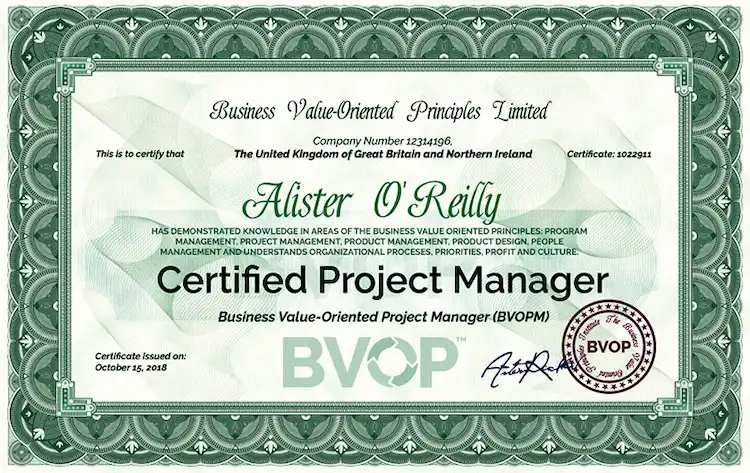
Business Value-Oriented Project Management frames leadership around protecting value delivery rather than enforcing process compliance. In a BVOP context, BVOP leadership style tends toward facilitation and cross-functional collaboration. Leaders are expected to keep teams focused on business value points, to treat employee-created tools and open-source software as legitimate formal products, and to reduce waste such as overwork, perfectionism, and rejected acceptable work. The style resembles servant leadership but with more explicit attention to value metrics and organizational damage. This is not presented as the only valid approach, but it reflects the broader shift toward outcome-driven leadership.
Key Takeaways on Value-Oriented Leadership
- Value Delivery Over Compliance
- Business Value-Oriented Project Management redefines leadership as the discipline of safeguarding value delivery rather than simply enforcing process compliance.
- Facilitation and Collaboration
- Within a BVOP environment, leadership shifts toward facilitation and cross-functional collaboration instead of top-down command and control.
- Focus on Business Value Points
- Leaders are expected to keep teams oriented toward business value points, recognize employee-created tools and open-source software as legitimate product assets, and actively reduce waste such as overwork, perfectionism, and rework caused by rejecting acceptable output.
- Servant Leadership Plus Metrics
- This approach resembles servant leadership while placing greater explicit emphasis on value metrics and organizational harm, reflecting a broader shift toward outcome-driven leadership rather than a single prescriptive model.
Practical Application Across the Project Lifecycle
Practical application of leadership styles across the project lifecycle requires reading the dominant risk in each phase. During initiation, an authoritative or visionary style is common because the project manager must articulate the business case, align sponsors, and set a clear destination. Planning often benefits from democratic and coaching styles, as subject matter experts need to challenge estimating assumptions and surface risks. However, if the schedule is externally fixed, the project manager may shift to a directive style around constraints while remaining participative about how the work is sequenced.
Execution, Monitoring, and Closing
Execution calls for a mix of servant and coaching styles, especially in knowledge work where developers, analysts, and designers need problem-solving space. Monitoring and controlling often reintroduce transactional elements, as variances against baselines require fact-based corrective actions. A project manager who avoids hard performance conversations in the name of being people-focused may allow slippage to become systemic. Closing tends to favor participative and affiliative styles for lessons learned, recognition, and knowledge transfer. The same project manager may look very different in a steering committee meeting during execution than in a retrospective at the end.
For example, a project manager who favors a democratic style might still hold a short directive meeting when a critical vendor misses a regulatory deadline. The shift is not betrayal; it is a response to the fact that time pressure and contractual risk have changed the decision environment.
Common Challenges, Pitfalls, and Misconceptions
Common leadership style misconceptions create recurring problems in project environments. One is that there is a single best style for all projects. Another is that a person's leadership style is fixed by personality. A third is that directive leadership is always authoritarian, while servant leadership is always soft. In reality, the effectiveness of a style depends on team maturity, project criticality, cultural norms, and organizational governance. Misapplied styles often show up as democratic approaches used during urgent production incidents, or pacesetting used with a junior team that needs guidance rather than a model of high individual output.
Another pitfall is pseudo-democracy, where the project manager asks for input but has already made the decision. This reduces trust faster than simply making a directive call. Inconsistency also causes confusion. If a manager shifts from coaching to directive without explaining a change in constraints, the team may interpret the behavior as arbitrary. Laissez-faire styles should not be applied in safety-critical or highly regulated contexts. Likewise, a purely democratic style is rarely appropriate when a risk requires immediate containment.
Key Takeaways on Leadership Misconceptions
- No Single Best Style
- Leadership effectiveness is context dependent: team maturity, project criticality, cultural norms, and organizational governance all shape which style works, so no single style can claim universal superiority.
- Misapplied Styles Cause Failures
- Democratic decision making during urgent production incidents stalls critical response, while pacesetting overwhelms junior teams that require structured guidance; both are clear cases of misapplied leadership styles.
- Pseudo-Democracy Undermines Trust
- Soliciting input after a decision has already been finalized, or switching leadership styles without explaining the changed constraints, signals to teams that leadership is either deceptive or arbitrary, which erodes trust.
Relationship to Other Project Management Concepts
The relationship between leadership styles vs management is a foundational comparison in project work. Management is primarily concerned with planning, organizing, controlling, and coordinating resources within defined constraints. Leadership is concerned with influencing people to act, aligning them around purpose, and creating conditions for performance. A project manager can execute a work breakdown structure, track earned value, and maintain a risk register while still providing weak leadership. Conversely, a leader with strong vision but weak management discipline may inspire a team into chaos. The most effective project professionals combine both, shifting emphasis as the project moves through periods of ambiguity and periods of execution.
Leadership style also connects to emotional intelligence, power types, team development models, and stakeholder engagement. A project manager with high emotional intelligence can read when an affiliative style is needed to repair trust or when a coaching style is needed to develop a struggling team member. It differs from communication style, which concerns message delivery, and from decision-making models, which concern the logic used to choose among options. Leadership style is the broader behavioral pattern that wraps together communication, influence, and accountability.
Evolution and Current Thinking on Leadership Styles
Current thinking on leadership styles in project management has moved away from rigid taxonomies toward contingency, adaptability, and context sensing. The older view treated styles as stable categories; contemporary practice treats them as a repertoire. Distributed and remote teams have made command-and-control less viable because managers cannot observe work directly. Psychological safety, inclusive leadership, and coaching have gained prominence, especially in software and product delivery. There is also healthy debate about whether servant leadership is sufficient in high-stakes, safety-critical programs where clear authority structures are necessary. Evidence suggests that leadership effectiveness is highly context dependent, and the project manager's ability to shift is more important than adherence to any single label.
The evolution is not complete. Some organizations still expect project managers to be directive by default, while others treat servant leadership as a universal ideal. Practitioners often observe that the most credible leaders are those who can explain why a particular style is being used at a given moment. That transparency matters more than the label attached to the style.
Core Insights on Evolving Leadership Styles
- From categories to repertoire
- Contemporary leadership thinking has moved beyond rigid style classifications toward a flexible repertoire that project managers selectively deploy as project conditions shift.
- Contingency and context sensing
- Leadership effectiveness is highly context dependent, which makes situational awareness and adaptive judgment more valuable than adherence to any single style label.
- Remote work undercuts command-and-control
- The shift to distributed and remote teams has eroded the viability of directive, command-and-control leadership because managers no longer have direct visibility into how work is performed.
- Rise of coaching and inclusion
- Psychological safety, inclusive leadership, and coaching oriented approaches have become central, especially in software and product delivery environments where collaboration drives performance.
- Debate over servant leadership
- Open debate continues about whether servant leadership alone provides enough clarity in high-stakes, safety-critical programs that require unambiguous authority structures, and the direction of this evolution remains contested.