An Agile Center of Excellence, often abbreviated as Agile CoE or ACE, is a permanent organizational structure designed to define, promote, and sustain agile practices and mindsets across an enterprise. It acts as an internal custodian of agile knowledge, tools, standards, and coaching, ensuring that agile initiatives maintain consistency while remaining adaptive to context. Unlike a temporary steering committee or a single transformation program, the Agile Center of Excellence is intended to endure beyond the initial adoption wave, embedding continuous improvement into the organization's DNA.
Agile Center of Excellence: Core Topics Overview
| Key Concept | Summary |
|---|---|
| Definition & Role | The Agile Center of Excellence is a permanent organizational function that curates and advances agile methods, mindsets, and the supporting assets of standards, toolkits, and coaching to ensure coherent adoption enterprise-wide. |
| Primary Mandate | As a dedicated hub, the ACE integrates governance frameworks, expert coaching, and practical enablement to scale agile ways of working uniformly across teams, programs, and portfolios. |
| Leadership Approach | The ACE practices servant leadership, building capability and autonomy across the organization by influencing and empowering practitioners rather than issuing directives. |
| Bridging Strategy & Execution | The ACE connects strategic ambitions with delivery realities by equipping portfolio managers with systemic insights while embedding coaches to elevate team-level technical and collaborative practices. |
| Conceptual Foundations | Rooted in 1990s management consulting and knowledge management, the CoE model draws on quality circles, communities of practice, and internal consulting traditions to institutionalize continuous improvement. |
| Evolution from PMO | The Agile Center of Excellence arose when traditional PMOs, designed for predictive environments, proved ill-suited to iterative and empirical agile rhythms; ACEs fill that gap with adaptive governance and agile-native support. |
| Foundational Charter | A precise charter detailing purpose, decision rights, and expected value is the critical foundation that keeps the ACE focused and prevents it from devolving into irrelevance or empire-building. |
| Coaching Structure | An integrated coaching bench consisting of enterprise, team-level, and technical coaches delivers hands-on mentoring to teams while surfacing systemic impediments to senior leadership for resolution. |
| Living Playbooks | Lean, evolving playbooks document shared definitions, proven practices, and common anti-patterns as a baseline that invites ongoing challenge and refinement, never hardened into rigid mandates. |
| Measurement Framework | The ACE employs a lightweight measurement system focused on flow metrics, team engagement, quality, and value delivery, aggregating data safely to foster improvement without triggering blame or metric manipulation. |
What Is an Agile Center of Excellence?
The Agile Center of Excellence definition encompasses more than a training unit or a group of coaches. It is a centralized locus of expertise that combines governance, guidance, and enablement functions to scale agile ways of working across multiple teams, programs, and portfolios. In project management contexts, an ACE provides the scaffolding for agile delivery by curating methodologies, advising on tailoring, and measuring the health of agile adoption. Many organizations establish an ACE after an initial pilot proves successful but inconsistent replication threatens broader rollout. The center then becomes the engine that converts isolated successes into a sustainable, organization-wide capability.
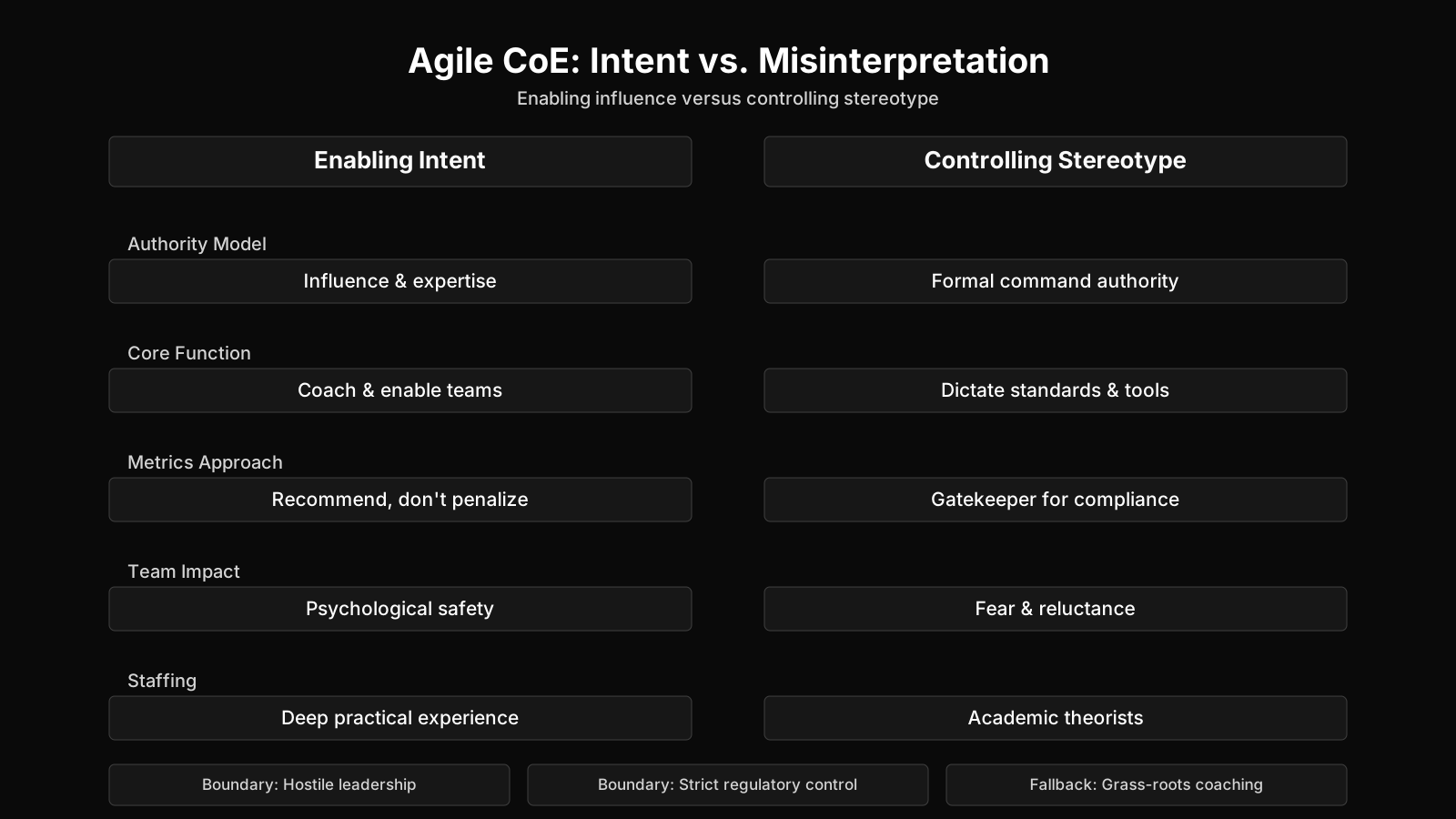
An ACE does not replace the role of the project manager or scrum master, nor does it dictate every decision from a command-and-control position. Instead, it operates as a servant-leader function, equipping practitioners with the knowledge, artifacts, and confidence to make sound choices within their projects. This distinction is crucial because the word "center" sometimes implies top-down control, but maturity models now stress that an agile CoE should lead through influence and empowerment. The balance between standardization and autonomy is a hallmark of what the center is really about: enabling agility, not enforcing rigid procedures.
Within larger portfolios, the ACE serves as a bridge between strategic aspirations and execution realities. Portfolio managers rely on the center to evaluate whether agile methods are being applied appropriately, to recommend course corrections, and to surface systemic impediments. At the same time, team-level practitioners access the ACE for coaching, facilitation of retrospectives, and help with technical practices like test-driven development or continuous delivery. This dual-altitude view, from enterprise strategy to code commit, makes the Agile Center of Excellence a uniquely versatile entity in modern project management.
Essential Insights on Agile CoE
- Centralized locus of expertise
- An Agile Center of Excellence goes beyond training or coaching to fuse governance, guidance, and enablement, scaling agile discipline from individual teams up through programs and the enterprise portfolio.
- Scaffolding for agile delivery
- It curates and tailors agile frameworks, monitors adoption health, and removes systemic obstacles to convert scattered pilot wins into a durable organizational capability.
- Established after pilot success
- Organizations form an Agile Center of Excellence once initial pilots prove their value, yet inconsistent replication risks derailing a wider agile transformation.
- Servant-leader, not controller
- The ACE does not supplant project managers or scrum masters; it empowers teams through influence-based coaching and shared accountability instead of directive control.
- Bridge from strategy to execution
- Portfolio managers rely on the ACE to evaluate agile methods and surface systemic impediments, while delivery teams access it for coaching, retrospectives, and targeted technical practices.
Origins and Evolution of the Center of Excellence Concept
The Center of Excellence concept history traces back to fields far beyond software delivery. The term itself gained traction in management consulting and knowledge management during the 1990s, when organizations began formalizing the capture and dissemination of expert knowledge. In disciplines such as quality management, Six Sigma, and customer relationship management, centers of excellence were established to house deep expertise that could be called upon by any part of the business. The idea was simple but powerful: rather than let rare knowledge remain locked in individual heads or departments, an institutionally sanctioned team would gather, validate, and redistribute it for the benefit of the whole enterprise.
In project management, the concept migrated through the Project Management Office trend. Early PMOs focused on compliance, reporting, and process adherence. When agile frameworks like Scrum and later the Scaled Agile Framework emerged, organizations discovered that a traditional PMO often struggled to support iterative, empirical approaches. The Agile Center of Excellence arose as a response: a specialized entity that understood both the principles of agile and the realities of organizational change. It borrowed the structural legitimacy of a CoE but oriented it toward continuous learning, servant leadership, and value delivery metrics rather than waterfall gate-checking.
Today the agile CoE sits at the intersection of several historical streams: quality circles from manufacturing, communities of practice from knowledge management, and internal consulting from professional services. Each stream contributed an expectation: quality circles brought the idea of voluntary improvement groups; communities of practice highlighted the power of informal networks; internal consulting introduced the discipline of diagnosing and solving problems without owning the implementation. A mature ACE blends all three, while adding a forward-looking research function that scans for emerging practices and tools.
Key Components of an Agile Center of Excellence
Understanding the key components of an Agile Center of Excellence reveals why some centers thrive while others become cost centers that agile teams learn to avoid. The first component is a clear charter that articulates the ACE's purpose, authority boundaries, and value proposition to the organization. Without this, the center drifts into either irrelevance or overreach. A well-drawn charter will specify that the ACE provides advisory services, not command decisions, and that it is accountable for improving the overall agility of the enterprise as measured by business outcomes.
A second component is the presence of multi-skilled coaches and mentors. These individuals do not simply hold certifications; they bring real-world experience in different domains, such as product management, engineering, and organizational design. An effective ACE employs a mix of enterprise coaches, team coaches, and technical coaches who can pair with teams on the ground while also advising senior leadership. This layered coaching model ensures that tactical help is available without losing sight of systemic impediments that only leadership can resolve.
Standards and playbooks form another distinctive component. While agile values working software over comprehensive documentation, large organizations still need a common language and reference points. An ACE curates minimal, living playbooks that capture agreed-upon definitions, recommended practices, and anti-patterns. Crucially, these playbooks are not mandates but baselines, explicitly open to challenge and revision through empirical evidence. They often cover areas like definition of done, acceptable iteration length ranges, release cadence, and risk-tiered governance thresholds. The playbooks are treated as the current best guess, not eternal truth.
Metrics and health assessments round out the core components. The ACE defines a light-touch measurement framework that tracks flow metrics, team engagement, quality signals, and business value delivery without incentivizing gaming. Teams own their local measures, but the ACE aggregates data safely to spot patterns, such as a systematic decline in throughput following an organizational change. This measurement duty demands high integrity and transparency; if teams sense that metrics will be used punitively, they will withhold data or optimize for the wrong indicators.
Key Insights on ACE Building Blocks
- Clear charter defines boundaries
- A well-defined charter explicitly delineates the advisory scope, authority boundaries, and accountability for driving enterprise agility, with success gauged by tangible business outcomes.
- Layered coaching expertise matters
- High-impact ACEs integrate enterprise, team, and technical coaches whose combined expertise spans product management, engineering, and organizational design, enabling practical and context-sensitive guidance.
- Living playbooks serve as baselines
- The ACE maintains lean, living playbooks that codify essential practices like definitions of done, iteration cadences, and risk-tiered governance, treating these references as challengeable baselines open to refinement rather than fixed mandates.
- Trustworthy measurement framework
- A lightweight measurement system monitors flow, team health, quality, and value delivery, aggregating data safely to build trust and discourage gaming while nurturing a culture of continuous improvement.
Roles and Responsibilities of an Agile CoE
Delving into the Agile CoE responsibilities clarifies who does what in a center that might otherwise be described in vague terms. The most visible role is the coach, often the public face of the ACE. Coaches embed with teams for a defined period, facilitate events, teach agile principles, and then gradually step back as the team builds self-sufficiency. Their loyalty is to the team’s growth, not to a hidden management agenda, and this trust is the currency that makes subsequent responsibilities possible.
Alongside coaching sits the training and enablement function. The center designs and delivers everything from introductory workshops for new hires to advanced masterclasses for seasoned practitioners. Rather than off-the-shelf curriculum, effective ACEs build context-sensitive learning paths that reflect the organization's actual tech stack, regulatory environment, and market dynamics. They also certify internal trainers to scale learning beyond what the core center staff can handle alone.
Governance facilitation is a less celebrated but equally critical responsibility. The ACE does not own governance; it helps the existing governance bodies adapt their rituals to complement rather than crush agile delivery. This might involve redesigning investment approval processes to support incremental funding, or teaching portfolio review boards how to use relative estimation instead of fictional precision. In doing so, the center becomes a trusted advisor to executive committees, translating between the language of contracts and the language of iterative discovery.
Another responsibility often overlooked is tooling and infrastructure advocacy. The center evaluates, recommends, and sometimes manages the suite of tools that support backlog management, continuous integration, and value stream mapping. It avoids becoming an IT operations group, but it ensures that the tooling ecosystem does not fragment into incompatible islands. The ACE also maintains a knowledge repository where teams share lessons learned, templates, and success stories, effectively curating the organization's memory of what works.
The Agile Center of Excellence in PMBOK and Other Frameworks
The Agile Center of Excellence in PMBOK is not an explicit construct, but its functions map clearly to several domains within the standard. PMBOK’s seventh edition, with its shift toward principles and performance domains, accommodates the ACE under the Team domain, the Development Approach and Life Cycle domain, and the Planning domain. The center’s work in fostering empowered teams directly supports the principle of stewardship and the creation of a collaborative project team environment. Where PMBOK describes tailoring and process adaptation, the Agile CoE provides the organizational capability to perform that tailoring thoughtfully and consistently.
In a predictive or hybrid environment, the ACE assumes the role of an integration hub between traditional phase-gate controls and agile delivery cadences. It might maintain a decision matrix that guides project managers on when to use rolling-wave planning versus firm baselines, or how to map earned value management data onto agile progress metrics. The center helps project managers, who may be new to iterative delivery, navigate the cognitive shift from monitoring adherence to monitoring outcomes.
PRINCE2, with its principles of continued business justification and learn from experience, finds a natural ally in the Agile Center of Excellence. The center houses the lessons learned repository that PRINCE2 emphasizes, but it goes further by actively mining patterns from those lessons and converting them into preventive actions or updated guidance. In PRINCE2 terms, the ACE can serve as a support function to the project board, providing specialist advice on the viability of using agile within a given project’s tolerance envelope. It does not replace the project manager’s day-to-day control, but it supplies the expert judgment that the board needs to make informed stage boundary decisions.
From a Business Value-Oriented Project Management perspective, the ACE’s remit naturally includes fostering cross-functional team structures and eliminating process waste, both of which BVOPM identifies as essential success factors. BVOPM’s concept of process damage, the invisible harm caused by overwork, perfectionism, or rejected acceptable work, aligns with the center’s responsibility to establish sustainable pace and continuous improvement rituals that surface such harm before it calcifies. When a center tracks business value points across programs, it echoes BVOPM’s approach of monitoring persistent declines as early warning signals for possible project or program closure, though the ACE typically presents those signals as recommendations rather than decisions.
Agile CoE Framework Alignment Insights
- PMBOK performance domain alignment
- The ACE directly aligns with PMBOK's Team, Development Approach and Life Cycle, and Planning performance domains, providing a structured basis for context-aware process tailoring across all projects.
- Hybrid environment integration hub
- When operating in predictive or hybrid environments, the ACE seamlessly connects traditional phase-gate controls with agile delivery cadences and maintains decision matrices that help project managers select the optimal approach for each initiative.
- PRINCE2 lessons and board support
- The ACE serves as the central repository for lessons learned, translates recurring patterns into proactive preventive actions, and provides the project board with specialist guidance on the viability of agile delivery methods while respecting established tolerance boundaries.
- Business value and waste reduction
- The ACE cultivates cross-functional team structures, systematically eliminates process waste, and monitors business value indicators as early warning signals that can prompt timely project or program reassessment.
Practical Application and Use in Real Projects
In practice, an Agile Center of Excellence implementation often begins with a small core of experienced agile practitioners who are given a charter and initial sponsorship. Their first act is rarely to publish a playbook. Instead, they embed with a few teams, understand the real pain points, and demonstrate value quickly. This builds the credibility needed to later introduce standards, metrics, and governance adjustments without being perceived as an ivory tower. One common pattern is for the ACE to run a pilot with a struggling initiative, turning it around visibly, and then use that success as a case study to open doors across the organization.
As the center matures, it starts to offer services that scale beyond hands-on coaching. It may run open office hours where anyone can bring a problem, host cross-team retrospectives to uncover systemic impediments, or facilitate big-room planning events for entire value streams. The center’s physical or virtual space becomes a neutral ground where conflicts between business and technology, or between different tribes, can be mediated using agile principles rather than escalation. This impartiality is delicate and must be guarded; the moment the ACE is seen as an extension of a particular executive’s agenda, its effectiveness plummets.
On the project lifecycle, the center’s involvement is typically heaviest during initiation and early iterations. Coaches help formulate the initial backlog, craft a plausible release plan, and set up the team’s working agreements. As the team stabilizes, the center dials back its direct presence but maintains a light-touch sensing mechanism, such as periodic health checks, to detect regression or burnout. When new members join or when the project enters a particularly challenging phase, the center may temporarily re-engage. For programs, the ACE supports the program manager in aligning multiple teams’ cadences, resolving dependencies, and ensuring that the aggregate value stream is optimized rather than individually optimized silos.
The center also serves as a career lattice for agile professionals. Coaches and scrum masters can rotate through the ACE to develop deeper skills and then return to delivery teams, spreading patterns organically. This rotation prevents the ACE from becoming an insulated priesthood and keeps its guidance grounded in current, messy reality rather than textbook theory. Many organizations have found that embedding this career path is the single most durable contribution of the ACE, because it creates a distributed network of change agents who no longer depend solely on the center for guidance.
Common Challenges, Pitfalls, and Misconceptions
The Agile Center of Excellence challenges that surface in practice are remarkably consistent across industries. The most pervasive is the confusion between a center of excellence and a center of enforcement. When the ACE is staffed by people who believe their job is to ensure compliance to a predefined framework, teams quickly learn to give surface-level obedience while protecting their real working methods. The very agility the center is meant to foster gets driven underground. This pattern is often an artifact of rewarding the ACE for visible artifacts, such as how many teams are "doing Scrum," rather than for measurable improvements in cycle time, quality, or customer satisfaction.
A related pitfall is the assumption that the ACE owns the transformation. An agile transformation is a leadership-led, organization-wide change effort. The ACE can be a critical instrument in that effort, but it cannot shoulder accountability for outcomes that executives abdicate. When sponsors treat the ACE as a bolt-on fix, allocating underpowered resources and expecting overnight cultural change, the center gets scapegoated for larger systemic failures. A seasoned practitioner knows that the ACE is an amplifier, not a creator, of organizational intent.
Misconceptions about the center’s role in metrics often lead to distrust. Teams fear that the ACE is a surveillance arm of management, gathering data to compare team performance or justify headcount reductions. The center must proactively communicate its data principles, perhaps by making all aggregated data visible to everyone and never reporting individual team velocity to any audience that controls team composition. Even a single breach of this principle can destroy the psychological safety that the ACE relies upon. Another misconception is that the center should eliminate the need for external consultants. In reality, the ACE often works alongside external advisors to bring in fresh perspectives and then internalize the learning, avoiding the build-it-and-they-leave syndrome where external knowledge walks out the door with the consulting contract.
Finally, there is the persistent myth that an ACE is only a transitional structure that dissolves once the organization "becomes agile." Organisational entropy ensures that without a steady gentle force, practices degrade, shortcuts become norms, and new hires dilute the cultural norms. The center’s mission evolves from transformation to sustainment and continuous improvement, but its existence remains valuable as a custodian of excellence. The alternative, hoping that a mature market of internal self-organized communities will maintain standards indefinitely, rarely survives the first major business crisis or leadership change unassisted.
Core Takeaways on ACE Pitfalls
- Enforcement versus enablement trap
- When an ACE emphasizes enforcing a rigid framework rather than enabling improvement, teams respond with superficial compliance, concealing their actual working methods and forcing genuine agility underground.
- ACE amplifies, does not own
- Agile transformation is a leadership-led effort; the ACE amplifies organizational intent but does not own outcomes, so when executives abdicate responsibility, the center is often scapegoated for systemic shortcomings.
- Psychological safety around metrics
- Teams distrust the ACE if they suspect it operates as a surveillance function; to build trust, the center must openly publish its data principles, keep aggregated metrics transparent, and never share individual team velocity with anyone who controls team composition.
- Sustainment role endures
- The ACE is more than a transitional structure; organizational entropy erodes practices without steady reinforcement, making the center valuable far beyond the initial transformation as a custodian of sustained excellence.
Relationship to Other Organizational Entities
Clarifying the Agile Center of Excellence vs PMO distinction is one of the most frequent practical needs. A traditional PMO focuses on portfolio governance, project reporting, resource allocation, and methodology compliance. An Agile CoE, by contrast, prioritizes coaching, enablement, and community-building. The two can coexist, and often do, with the PMO handling financial and resource governance while the ACE handles ways of working and continuous improvement. In some organizations, the ACE and PMO report to the same executive, creating a potent combination where governance adapts to the methods rather than resisting them. But conflating the two into a single entity without thoughtful design usually results in a hybrid that struggles to gain the trust of either the executives or the agile teams.
Communities of practice, sometimes called guilds, are another neighbor. These are voluntary networks of practitioners who share a craft, such as testers, product owners, or scrum masters. The ACE typically catalyses and supports communities of practice by providing meeting space, facilitation, and a link to organisational strategy. However, the communities remain peer-led, while the ACE holds a formal mandate. The relationship can be symbiotic: the ACE brings resources and executive connection; the communities bring grassroots passion and practical insight. When the ACE tries to direct communities too tightly, the volunteer energy evaporates. Conversely, communities without an ACE often fizzle when the initial enthusiasts burn out or move on.
Lean-Agile transformation offices, often seen in large-scale SAFe adoptions, are a specialization of the ACE concept. In such setups, the center not only coaches teams but also manages the lean portfolio management function, facilitates agile release train launches, and synchronizes program increments. Despite the different name, the underlying principle is the same: a dedicated group of change agents, coaches, and process stewards who sustain the transformation’s momentum. The differences are largely about scope and the frameworks adopted, rather than fundamental purpose.
Current Thinking and Future Trends
Contemporary research and practitioner observation suggest that the future of Agile Centers of Excellence lies in their ability to morph into adaptive enablement functions that blur the line between coach and internal consultant. Rather than prescribing a single agile recipe, the modern ACE curates a menu of practices from Scrum, Kanban, Lean Startup, and beyond, helping teams select and evolve their own methodologies. This shift from "one way" to "informed choice" reflects a maturing understanding that excellence is not a state but a process of relentless experimentation.
A growing school of thought argues that the ACE should explicitly measure its own value and sunset itself if it becomes parasitic. This forces centers to operate with the same business rigor they ask of others. Some advocates propose that after an initial ramp-up period, the ACE’s budget should be partially allocated by internal customers based on the services they actually consume, creating a pull-based economic model. If no team willingly pays for the coaching or playbook maintenance, the center shuts down, preventing the drift into bureaucratic self-preservation.
Remote and hybrid working patterns have changed the ACE’s operational fabric. Coaching that once relied on physical co-location and osmotic communication now requires deliberate virtual facilitation techniques. Centers are experimenting with asynchronous coaching, recorded workshops, and community chat platforms as supplements to live interaction. The risk, noted by practitioners, is that coaching becomes transactional instead of relational. Top-performing ACEs are therefore investing in high-bandwidth online environments that preserve the nuance of team dynamics even when people are not physically together.
Finally, the integration of business agility beyond software development is expanding the ACE’s remit to include marketing, legal, and human resources functions. These departments seek their own agile transformations, and the center becomes a cross-functional enterprise agility hub. The terminology may evolve, with some organizations dropping the word Agile altogether in favor of "Business Agility Center of Excellence" or "Ways of Working CoE," but the core mission of embedding learning, adaptation, and value focus across the entire organization remains constant. In this sense, the Agile Center of Excellence is becoming less a project management fixture and more a permanent organ of the learning organization.
Key Insights on Future ACE Trends
- Adaptive enablement over prescribed methods
- Modern ACEs curate a portfolio of practices from multiple agile frameworks, empowering teams to select and adapt their own methodologies rather than adhering to a single prescriptive model.
- Self-funded accountability with sunset clauses
- ACEs must quantify their contributions and allow internal customers to fund only the services they consume, creating a mechanism where the center naturally dissolves if it ceases to deliver measurable value.
- Enterprise-wide remit and virtual coaching
- The ACE is expanding into marketing, legal, and HR as an enterprise-wide agility hub, and hybrid work demands deliberate virtual facilitation that preserves relational coaching rather than letting it become transactional.