Cost of Quality is defined as the total cost incurred over the life of a project or product to prevent nonconformance to requirements, appraise the product or service for conformance, and respond to failures that occur. In project management, the term encompasses both the cost of achieving quality and the cost of poor quality. It is a foundational concept in project quality management because it reframes quality as a set of measurable trade-offs rather than an abstract desire for excellence.
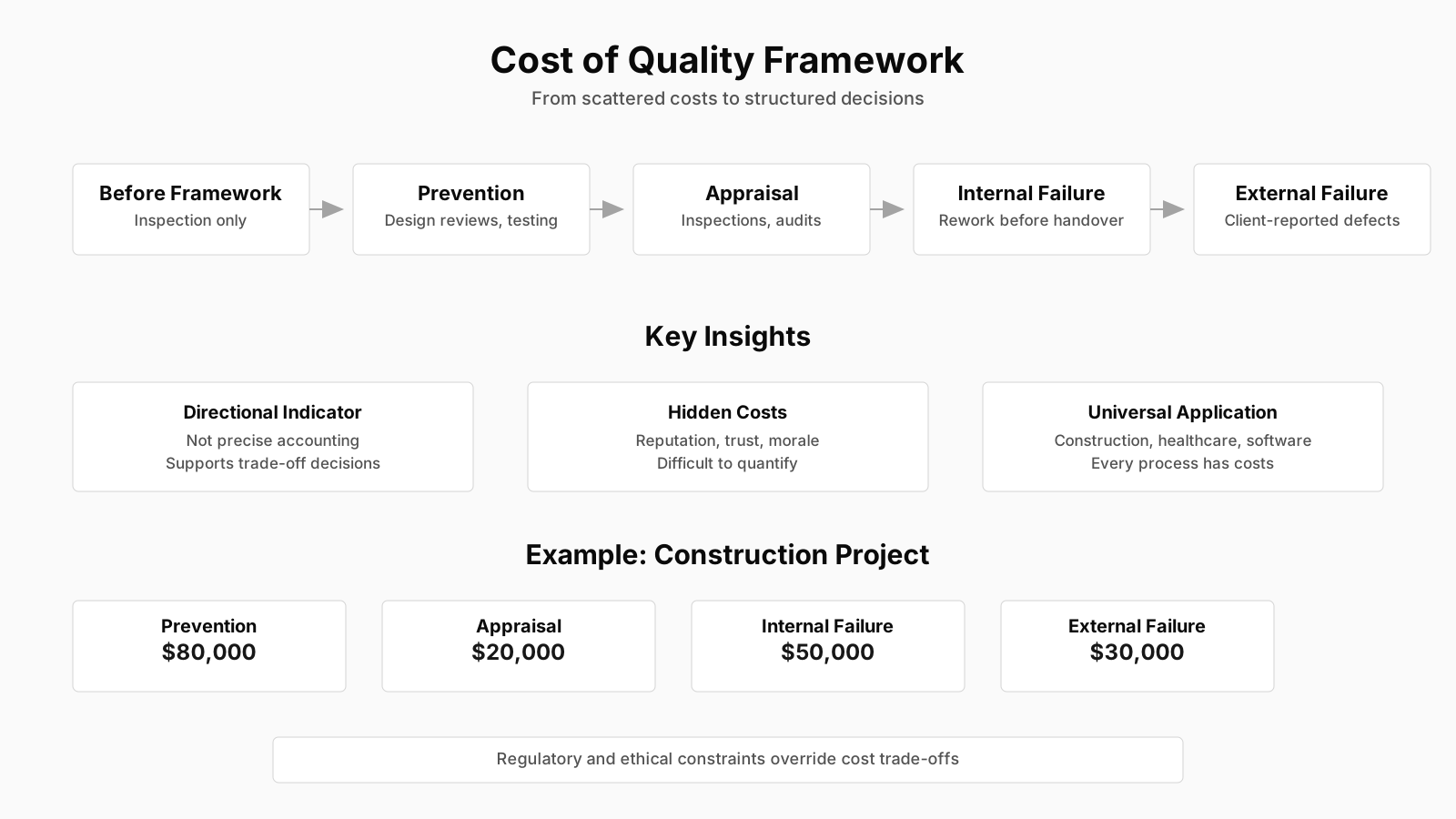
Cost of Quality: Key Topics at a Glance
| Key Concept | Summary |
|---|---|
| Definition | Cost of Quality represents the total investment required across the project life cycle to prevent nonconformance, verify conformance, and address failures when they occur. |
| Proactive Investment | Directing more resources toward prevention and appraisal increases early Cost of Quality but typically prevents significantly larger expenses after defects reach the customer. |
| External Failure Costs | External failure costs emerge after delivery and often carry the largest hidden financial impact, including reputational harm, warranty claims, and lost future revenue. |
| Internal Failure Costs | Internal failure costs include rework, scrap, retesting, repair, schedule delays, and idle time caused by correcting defects before they reach the customer. |
| Prevention Activities | Effective prevention includes requirements clarification, design reviews, quality planning, process documentation, training, supplier qualification, and the use of structured checklists. |
| Balanced Measurement | Proactive and reactive cost categories are equally important, yet many organizations track only reactive costs because they appear directly on invoices and financial statements. |
| Point of Diminishing Returns | Additional prevention effort eventually yields only marginal benefit, particularly when uncertainty is high and product direction is still emerging or unstable. |
What Is Cost of Quality?
The cost of quality definition in project management refers to all resources expended to ensure that deliverables meet requirements, plus the resources consumed when they do not. This means the concept extends far beyond the cost of a quality department or inspection team. It includes prevention activities such as training and process design, appraisal activities such as audits and testing, and failure costs ranging from rework to warranty claims.
Cost of Quality is often misunderstood as the price paid to add quality to a deliverable. In practice, quality is not an optional layer added at the end. It is embedded in planning, design, execution, and control. A project that spends heavily on prevention and appraisal may carry a higher upfront Cost of Quality, but a project that skips those activities often pays a much larger total cost after defects reach the customer. That trade-off sits at the heart of the concept.
What this really means on a day-to-day project is that a decision to skip peer reviews or shorten testing is not free. It simply shifts cost from one category to another. For example, a software project that reduces test coverage to meet a deadline often incurs higher internal rework and external support costs later. Cost of Quality provides the vocabulary and the analytical frame to make that shift visible.
Cost of Conformance and Cost of Nonconformance
Within the broader definition, Cost of Quality is commonly split into the cost of conformance and the cost of nonconformance. Conformance costs are the proactive investments made to prevent defects or verify that deliverables meet requirements. Nonconformance costs are reactive, arising after something has already gone wrong. Both categories matter equally in a complete analysis, though organizations tend to track only the reactive portion because it appears on invoices and timesheets more directly.
Key Takeaways on Cost of Quality
- Full scope of quality costs
- The cost of quality spans prevention, appraisal, and failure costs, extending well beyond the quality department or inspection team to include every activity that influences product or service integrity.
- Quality is embedded, not added
- Quality is intentionally woven into planning, design, execution, and control, rather than treated as an optional layer applied after project completion.
- Skipping quality inflates later costs
- Cutting back on test coverage, peer reviews, or similar quality activities may lower upfront spending, but it usually drives up rework and support costs once defects escape to the customer.
Key Components of Cost of Quality
The key components of Cost of Quality are traditionally grouped into four categories: prevention costs, appraisal costs, internal failure costs, and external failure costs. These four categories form the backbone of most project quality cost models. They move from proactive to reactive, and from internal to external, helping teams see where their quality budget actually goes.
Each component behaves differently. Prevention and appraisal costs are controlled by the project team and can be planned in advance. Internal failure costs happen inside the project or organization before the deliverable reaches the customer. External failure costs occur after delivery and often carry the greatest hidden expense, including reputational damage and lost future work. A complete Cost of Quality analysis includes all four components rather than isolating one or two.
Prevention Costs
Prevention costs are the resources spent to keep defects from happening in the first place. In a project setting, prevention includes requirements clarification, design reviews, quality planning, process documentation, training, supplier qualification, and the development of standards or checklists. These activities often feel indirect and administrative, so they are easy targets for budget cuts when a project is under pressure.
Prevention is the most leverage-rich category. A defect prevented at the requirements stage costs far less than the same defect discovered during user acceptance testing or after release. Project managers who understand Cost of Quality see prevention not as overhead but as a deliberate risk reduction strategy. Still, prevention has limits. There is a point beyond which additional prevention effort produces little marginal benefit, especially when uncertainty is high and the product direction is still emerging.
Appraisal Costs
Appraisal costs are incurred to evaluate whether deliverables meet requirements. They include inspections, walkthroughs, audits, testing, laboratory analysis, and product verification activities. Appraisal does not add functionality to the deliverable, but it detects defects before they escape to the customer. In predictive projects, appraisal often appears as stage-gate reviews or formal acceptance testing. In Agile projects, it appears as automated test suites, code reviews, and definition-of-done checks.
Appraisal costs tend to rise when prevention has been weak. If requirements are ambiguous or skills are uneven, teams compensate with more testing and inspection. That can be rational, but it is often a symptom rather than a solution. A mature project team balances appraisal with prevention so that verification remains a safety net rather than the primary quality strategy.
Internal Failure Costs
Internal failure costs occur when a defect is found before the deliverable is transferred to the customer. These include rework, scrap, re-testing, repair, schedule slippage caused by rework, and the idle time that results when downstream work stops because an upstream defect must be corrected. Internal failure costs are visible inside the project and can be substantial, but they are still less damaging than external failures.
A common trap is treating internal rework as normal project friction. Teams absorb the extra effort without tracing it back to a quality decision that could have been made differently. Cost of Quality analysis exposes that hidden rework as a real cost, allowing the project sponsor to compare it against the prevention or appraisal investment that might have avoided it.
External Failure Costs
External failure costs arise after the deliverable has reached the customer. They include warranty claims, product recalls, help desk support, field repairs, liability costs, and the administrative burden of managing customer complaints. In service projects, external failure may appear as customer rejection, contract penalties, or the need to re-perform work at a client site.
External failure costs are usually the most expensive category, not only because they include direct remediation but also because they carry intangible losses such as damaged reputation, reduced customer confidence, and lower employee morale. Those intangibles are hard to quantify precisely, but they are real. Projects that ignore external failure risk often underprice quality, treating quality investment as an optional buffer rather than a core part of project economics.
Origins and Cross-Industry Context
The Cost of Quality origins lie primarily in manufacturing and industrial quality management. The framework emerged as quality professionals such as Joseph Juran, Armand Feigenbaum, and Philip Crosby worked to make quality costs visible to executives. Their core insight was that poor quality consumes resources that could otherwise be used for productive output, and that those costs can be measured, analyzed, and managed.
Outside project management, Cost of Quality has strong roots in aviation, medicine, automotive engineering, and software engineering. Aviation uses the concept to justify rigorous safety inspections and maintenance programs because failure costs include catastrophic outcomes. Healthcare applies similar logic to patient safety, where prevention and appraisal costs are weighed against the enormous cost of medical errors. Software engineering adapted the manufacturing model to include test automation, defect tracking, and technical debt. In each field, the language differs, but the structure of prevention, appraisal, and failure remains remarkably stable.
The cross-industry use of Cost of Quality gives project managers a shared vocabulary with operational leaders. When a project manager explains quality trade-offs to a sponsor or steering committee, the manufacturing or healthcare executive often recognizes the concept immediately. That recognition helps elevate quality discussions from technical detail to business-level decision making.
Key Insights on Quality Cost Origins
- Manufacturing roots of quality costing
- Cost of Quality originated in manufacturing and industrial quality management, where it gave production teams a structured method to quantify rework, scrap, inspection, and warranty expenses that had previously been buried in overhead accounts.
- Pioneering quality management thinkers
- Joseph Juran, Armand Feigenbaum, and Philip Crosby transformed quality from an abstract ideal into a measurable business concern, showing executives that poor quality consumes identifiable, manageable resources rather than representing an inevitable cost of doing business.
- Aviation's safety-driven quality approach
- Aviation uses Cost of Quality to justify rigorous safety inspections and maintenance programs because the potential failure costs extend beyond financial loss to include catastrophic safety outcomes and long-term reputational damage.
- Healthcare and software adaptations
- Healthcare applies the framework to patient safety by weighing prevention and appraisal investments against the severe financial and human costs of medical errors, while software engineering adapts it to prioritize test automation, defect tracking, and technical debt reduction.
- Shared vocabulary for business decisions
- Cross-industry adoption gives project managers a shared vocabulary with operational leaders, allowing quality discussions to shift from isolated technical defects to strategic business trade-offs and resource allocation.
Cost of Quality in PMBOK and PRINCE2
Cost of Quality PMBOK guidance appears most directly within Project Quality Management. In the PMBOK framework, Cost of Quality is used during Plan Quality Management as a tool for estimating the financial impact of quality choices. It supports the development of the quality management plan and helps the project manager decide how much to invest in prevention and appraisal versus accepting a certain level of failure risk.
PMBOK also connects Cost of Quality to control quality and manage quality processes. During Manage Quality, the team may audit processes and identify where internal failure costs are rising. During Control Quality, inspections and testing generate appraisal costs. The data from those processes feeds back into future estimates and helps refine the quality approach. PMBOK does not prescribe a fixed ratio among the four categories, but it does encourage project managers to understand the financial consequences of quality decisions.
A layered explanation may help here. Think of Cost of Quality in PMBOK like a budget category that runs alongside scope, schedule, and cost baselines. Just as a project manages schedule variance by comparing planned and actual dates, it manages quality cost by comparing planned prevention and appraisal spending against actual rework and failure expense. The comparison is not always precise, but it guides judgment and sponsor communication.
PRINCE2 Quality Theme
PRINCE2 does not use the phrase Cost of Quality as a defined term, but its quality theme covers the same ground through quality planning, quality control, and quality assurance. The PRINCE2 quality management approach defines how the project will verify that products meet their quality criteria. Quality tolerance, quality registers, and product descriptions all generate the data needed to assess whether the project is investing enough in prevention and appraisal.
Within PRINCE2, the project board is ultimately accountable for accepting quality risk. A PRINCE2 project manager who estimates the cost of quality can present clearer options to the board. For example, the board may choose to fund more quality reviews in exchange for reducing the probability of expensive rework during the final product handover. That is a Cost of Quality decision even when PRINCE2 does not label it that way.
Cost of Quality in Agile and Hybrid Environments
Cost of Quality in Agile environments shifts the emphasis from end-stage inspection to built-in quality and continuous feedback. Agile teams reduce external failure costs by delivering small increments and validating them early with customers. They reduce internal failure costs through practices such as test-driven development, continuous integration, pair programming, and automated regression testing. Appraisal is not absent, but it is embedded in the team’s daily work rather than isolated in a separate quality phase.
In Agile, the cost of delay is often considered alongside Cost of Quality. A product team may accept a slightly higher defect rate in exchange for getting a feature to market quickly, but that decision has a quality cost that must be monitored. If the defect rate climbs too high, the team absorbs growing rework costs and erodes customer trust. Agile frameworks therefore treat quality as a non-negotiable constraint within the definition of done, even while scope and schedule remain flexible.
What happens in hybrid environments is that predictive controls and Agile delivery practices coexist. A hybrid project may maintain a formal quality management plan and stage gate approvals while using Agile techniques for incremental delivery. In that setting, Cost of Quality analysis helps bridge the gap. It allows a project manager to estimate the cost of replacing late-stage testing with automated tests or just-in-time requirements validation.
Agile Quality Practices and Total Cost
Agile practices often increase prevention and appraisal costs in the short term. Automated test development, frequent refactoring, and continuous integration all require sustained effort. The payoff comes in the form of fewer internal and external failures. Teams that treat these practices as optional often find that their velocity drops as technical debt accumulates and bugs resurface in later sprints. Cost of Quality thinking explains why that velocity drop is not an external mystery but a predictable consequence of deferred prevention.
Key Insights on Agile Quality Costs
- Built-in quality and embedded appraisal
- Agile shifts quality costs from final inspection to built-in quality practices by embedding appraisal in daily team activities, so defects are caught continuously rather than at a separate testing phase.
- Increments cut external failure costs
- Frequent customer validation of small increments reduces external failure costs by surfacing mismatches with user expectations before they escalate into costly field defects.
- Engineering practices lower internal failures
- Engineering disciplines such as test-driven development, continuous integration, pair programming, and automated regression testing lower internal failure costs by preventing defects from reaching later stages of delivery.
- Quality trade-offs demand monitoring
- When teams accept higher defect rates to accelerate delivery, rework costs and customer trust erode quickly, so quality must remain a non-negotiable element of the definition of done.
- Hybrid merges governance with agility
- Hybrid environments preserve formal quality plans and stage gate approvals while leveraging Agile delivery, which allows managers to quantify savings from automated testing and just-in-time validation.
Purpose and Importance of Cost of Quality
The importance of Cost of Quality lies in its ability to turn quality from a vague aspiration into a defensible economic decision. Without a clear view of quality costs, project sponsors may see prevention and appraisal as discretionary spending. With a Cost of Quality model, those same sponsors can compare a modest investment in design reviews against the much larger cost of rework, recalls, or customer dissatisfaction.
Cost of Quality also supports project risk management. Quality failures are a significant source of project risk, and the cost categories provide a way to quantify that risk in financial terms. A project manager can use historical failure cost data to justify contingency reserves or to argue for a more rigorous change control process. The concept links the quality management plan to the project budget in a way that feels concrete to decision makers.
In real project work, the importance of Cost of Quality shows up most clearly at decision gates and steering committee reviews. A sponsor may ask why the project needs more time for testing or more money for training. The project manager who can present prevention, appraisal, and failure cost data gives the sponsor a sound reason rather than a defensive explanation. That is the difference between quality being seen as a project overhead and quality being seen as a portfolio-level investment.
Decision Making and Budgeting
Budgeting for quality is often an afterthought in project planning. Teams estimate scope, schedule, and cost, but they rarely allocate quality cost categories explicitly. Cost of Quality encourages a more deliberate approach. The project manager can estimate expected prevention and appraisal costs, then compare them against the estimated internal and external failure costs under different scenarios. That comparison supports trade-offs such as investing in more automated testing to reduce rework later.
Cost of Quality vs Cost of Poor Quality
Cost of Quality vs Cost of Poor Quality is a distinction that frequently causes confusion. Cost of Quality includes both the cost of conformance and the cost of nonconformance. Cost of poor quality is narrower. It refers only to the failure costs, both internal and external, that result from not meeting requirements. Put another way, Cost of Quality is the complete umbrella, while Cost of Poor Quality is the portion of that umbrella representing rework, scrap, warranties, and dissatisfaction.
Some organizations use the two terms interchangeably in everyday conversation. That shorthand is inaccurate and can distort decision making. If a manager says the project needs to reduce its Cost of Quality, they often mean it needs to reduce failure costs. Reducing total Cost of Quality indiscriminately could mean cutting prevention and appraisal, which might actually increase the overall Cost of Quality later. Precision in language matters here.
The relationship between the two terms is dynamic. When prevention and appraisal investments are effective, the cost of poor quality declines. When prevention and appraisal are underfunded, the cost of poor quality rises, often disproportionately. A project that understands this relationship can deliberately choose a quality investment level that minimizes total cost rather than simply minimizing any single category.
Key Distinctions in Quality Costs
- COQ includes conformance and nonconformance
- Cost of Quality is the overarching category that encompasses both the cost of conformance and the cost of nonconformance.
- COPQ covers only failure costs
- Cost of Poor Quality is the narrower subset limited to internal and external failure costs that result from unmet requirements, including rework, scrap, warranty claims, and customer dissatisfaction.
- Interchangeable usage distorts decision making
- Treating the two terms as interchangeable is misleading because indiscriminate reductions in total Cost of Quality can lower prevention and appraisal spending, which frequently raises overall costs over time.
- Strategic investment minimizes total cost
- A project that understands this relationship can intentionally choose the quality investment level that minimizes total cost rather than merely minimizing any single cost category.
Common Challenges, Pitfalls, and Misconceptions
The most persistent Cost of Quality misconceptions revolve around the idea that higher quality always costs more. The phrase “quality is free” is often repeated without its underlying logic. It does not mean quality costs nothing. It means that the reduction in failure costs can more than offset the cost of prevention and appraisal. When teams cut quality activities to save money, they often discover that total Cost of Quality rises, not falls.
Another challenge is measurement. External failure costs, especially reputational damage and lost future sales, are difficult to quantify. Many organizations therefore exclude them from formal quality cost reports. That creates a distorted picture in which prevention looks expensive and failure looks manageable. The result is chronic underinvestment in quality and a pattern of recurring defects that no one connects to the original budget decision.
There is also a behavioral pitfall. Teams under deadline pressure tend to defer quality activities because the benefits appear later while the cost appears now. That is a natural human bias, but Cost of Quality analysis exists precisely to counteract it. It makes the later cost explicit so that near-term decisions do not silently mortgage the project’s outcome.
A related misconception is that Cost of Quality belongs only to manufacturing or regulated industries. In knowledge work and service projects, quality failures are less visible than a defective part, but they are no less expensive. Poor requirements, incorrect data migrations, and confusing user interfaces all generate rework and customer support burdens. The cost categories apply just as well to those projects as they do to an assembly line.
BVOP Perspective on Cost of Quality
Cost of Quality in BVOP is addressed through a structured product risk management approach rather than through generic quality slogans. BVOPM uses separate product risk management with quantified Loss size units and dynamic filtering to make failure consequences explicit. Defect analysis in BVOPM relies on predefined root-cause categories, which creates a consistent framework for understanding why quality costs occur and which interventions might reduce them.
This perspective aligns naturally with Cost of Quality because it ties failure events to measurable loss. In a BVOPM-influenced project, the decision to invest in prevention or appraisal is not based on a vague sense that quality is important. It is based on the size and likelihood of potential losses. While BVOPM is not a replacement for established quality models, its emphasis on explicit loss quantification adds useful discipline to the Cost of Quality discussion.
Core Insights on Loss-Based Quality
- Risk-based quality approach
- BVOP replaces generic quality slogans with a structured product risk management approach that quantifies failure consequences as measurable loss units.
- Root-cause defect framework
- BVOPM applies a predefined set of root-cause categories to defect analysis, creating a consistent framework for tracing quality costs back to their sources and identifying interventions that can reduce them.
- Loss-based investment decisions
- In BVOPM projects, investment decisions for prevention and appraisal activities are driven by the estimated size and likelihood of potential losses, replacing vague assumptions about quality with measurable risk criteria.
Relationships to Other Project Management Concepts
Cost of Quality and risk management overlap significantly, but they are not the same. Risk management addresses uncertainty across all project dimensions, including schedule, cost, scope, and quality. Cost of Quality focuses specifically on the financial consequences of quality-related uncertainty and nonconformance. A project can use qualitative risk registers and quantitative risk models to support Cost of Quality estimates, but the two tools answer different questions.
Cost of Quality also connects to earned value management, benefit-cost analysis, and requirements traceability. In earned value management, rework and quality failures appear as negative variances or unfavorable performance indices. Benefit-cost analysis uses quality costs to determine whether a proposed quality improvement is worth pursuing. Requirements traceability helps pinpoint which requirement failures are driving internal and external failure costs, making prevention more targeted.
There is also a relationship to the project baseline. Quality activities consume schedule and budget, so a change in Cost of Quality strategy may require a change request. For example, if the project decides to add an independent verification phase after a design failure, that addition affects the schedule baseline. Good project integration management ensures that quality decisions are reflected in the overall project plan rather than treated as isolated technical choices.
Distinguishing Cost of Quality from Similar Concepts
Cost of Quality is sometimes confused with cost management, but cost management is concerned with all project costs, not only those tied to quality. It is also confused with value engineering, which seeks to optimize the function-to-cost ratio of deliverables. Value engineering can reduce quality cost by simplifying a design, but its primary purpose is value optimization, not defect prevention. Understanding these boundaries helps teams apply the right tool at the right time.
Evolution and Current Thinking
The Cost of Quality current thinking reflects a shift from reactive inspection toward proactive design quality and data-driven decision making. Modern approaches integrate Cost of Quality into business case analysis, project governance, and product management. Rather than calculating quality costs only at the end of a project, teams now track prevention, appraisal, and failure signals continuously through dashboards, defect systems, and delivery metrics.
Lean thinking and Six Sigma have also influenced how Cost of Quality is applied. Lean practitioners treat quality failures as waste and seek to eliminate their root causes. Six Sigma provides statistical methods to measure defect rates and their financial impact. In combination, these methods allow project teams to link process capability directly to Cost of Quality outcomes. The result is less reliance on subjective judgment and more use of data to decide where quality investment will pay back.
The current debate centers on measurement completeness. Some practitioners argue that external failure costs can never be fully captured, so Cost of Quality should be used as a directional indicator rather than a precise accounting tool. Others push for more rigorous models that estimate reputation and customer lifetime value. Most experienced project managers land somewhere in the middle: they use Cost of Quality to structure the conversation and support trade-off decisions, while acknowledging that some costs will remain uncertain. That honest, context-dependent view is the most practical way to apply the concept in real project, program, and portfolio environments.
Core Takeaways on CoQ Evolution
- Proactive quality focus
- Modern Cost of Quality practices have evolved from end-of-project inspection to embedding quality into design and using data-driven decisions across the entire project lifecycle.
- Continuous quality signal tracking
- Teams now monitor prevention, appraisal, and failure indicators continuously via dashboards, defect tracking systems, and delivery metrics rather than waiting until project completion to calculate quality costs.
- Lean and Six Sigma integration
- Lean methods treat quality failures as waste to be eliminated, while Six Sigma supplies statistical tools for measuring defect rates and their financial impact, enabling teams to connect process capability directly to Cost of Quality results.
- Pragmatic directional use
- Since external failure costs are inherently difficult to quantify completely, seasoned practitioners treat Cost of Quality as a directional guide for framing discussions and informing trade-off decisions, accepting its inherent uncertainty.