An assumption log is a project document that systematically catalogs all assumptions and constraints that influence a project’s planning, execution, and control. The assumption log in project management serves as a living repository where each premise that the team and stakeholders have accepted as true without immediate proof is recorded, tracked, and revisited throughout the project lifecycle. Unlike risk registers that center on uncertain events that could impact objectives, an assumption log gives explicit visibility into the foundational beliefs that underpin scope, schedule, cost estimates, and resource plans. When an assumption turns out to be false, it often triggers a risk event, scope adjustment, or baseline revision, which is exactly why this artifact demands continuous attention rather than a one-time entry.
Assumption Log: Key Topics Summary
| Concept | Summary |
|---|---|
| Definition | An assumption log is a structured project document that records presumed conditions or facts used for decision making and estimating, even though their validity remains unverified. |
| Purpose | It functions as a dynamic repository, compelling the team to regularly reassess each premise across the project lifecycle, converting initial assumptions into validated knowledge or identified risks. |
| Risk Register | Unlike a risk register, which catalogs uncertain future events, the assumption log makes transparent the foundational convictions that inform scope, schedule, cost, and resource planning. |
| False Assumptions | Invalidated assumptions often precipitate risk events, scope changes, or baseline revisions, making continuous monitoring essential to preserve plan integrity. |
| Constraints | Constraints such as regulatory deadlines or fixed budgets are also recorded; labeling each entry as assumption or constraint clarifies which elements can be validated and which must be accommodated. |
| Hidden Dependencies | Capturing assumptions alongside constraints reveals hidden interdependencies, preventing plans from being constructed on unacknowledged or fragile premises that can fracture team alignment. |
| Structure | Each log entry typically includes a unique identifier, a clear statement, the affected domain, a validation method, an accountable owner, the date logged, and a current status to track progression from assumed to confirmed. |
| PMBOK Usage | Per the PMBOK Guide, the assumption log is initiated during the Develop Project Charter process and progressively elaborated throughout scope, schedule, and risk planning to maintain alignment with evolving project knowledge. |
What Is an Assumption Log?
A precise definition of an assumption log characterizes it as a component of the project documents that lists factors considered to be true, real, or certain for the purposes of decision-making and estimating, even though their validity has not been verified. The log frequently also includes constraints, which are limiting factors the project must operate within, such as regulatory deadlines, fixed budgets, or mandated technology standards. While constraints are not assumptions in themselves, they often give rise to assumptions about how the project will navigate those limitations, so practitioners commonly manage them alongside each other in the same artifact.
The core purpose of making assumptions explicit is straightforward: undocumented assumptions silently shape every estimate, schedule commitment, and resource allocation. If team members hold different, unspoken assumptions about a vendor’s lead time or a stakeholder’s availability, the resulting plans will be built on invisible fault lines. By writing them down, the project creates a shared reference point that can be challenged, validated, or monitored. This process shrinks the blind spots that exist in the earliest, most uncertain phases of a project and converts gut feelings into verifiable statements.
A useful way to think about the assumption log is as a shared notebook of the conditions the team is betting on for success. In a highway construction project, an assumption might be that the ground composition allows for standard piling methods without unexpected rock layers. If soil testing later proves that wrong, the cost and schedule baselines become invalid. By documenting that assumption early and assigning someone to confirm it through geotechnical surveys, the project replaces blind optimism with a planned validation step. The log, in that sense, is not just a tracking tool; it is a forcing function for deliberate inquiry.
Assumptions versus Constraints
It is worth separating the two concepts clearly because they are often mishandled together. An assumption is a belief about a future condition or event that is taken as given for planning purposes, even though evidence may not yet exist. A constraint is a restriction that is already known and generally fixed, such as a completion date mandated by regulation or a maximum budget set by the funding body. The confusion arises because constraints can spawn assumptions: a fixed deadline might lead the team to assume that certain approvals will be fast-tracked. Recording both in the same log helps trace those dependencies, but each entry should explicitly label whether it is an assumption or a constraint to avoid mixing up what can be validated versus what must simply be accommodated.
Assumption Logs: Core Insights
- Definition and shared contents
- An assumption log is a project document that records unverified factors treated as true for decision making and estimation, and it routinely tracks constraints that define the project's operational boundaries.
- Purpose of explicit assumptions
- Documenting assumptions prevents unspoken beliefs from quietly undermining estimates, schedules, and resource allocations, closing critical blind spots during the earliest and most uncertain phases.
- Notebook of success conditions
- The log functions as a shared notebook of the conditions the project is relying on, with each entry explicitly labeled as an assumption to be validated or a constraint that must be accommodated.
Key Components and Structure of an Assumption Log
The key components of an assumption log include a set of standard fields that make each recorded premise actionable and auditable. While no universal format is mandated by any major methodology, a well-structured assumption log typically captures a unique identifier, a concise statement of the assumption, the category or domain it affects, the planned validation method, the person responsible for tracking its validity, the date it was logged, and its current status. Some organizations also include a field that rates the impact if the assumption proves false, which helps prioritize which assumptions need the most urgent validation.
A typical entry might record that the project assumes a specific third-party API will deliver sub-second response times under peak load. The category could be “Technical – Performance,” the validation method might be a load test conducted in the first sprint after integration, and the owner would be the lead developer. The status could transition from “Open” to “Validated” once the test results confirm the performance envelope. Additional fields sometimes capture the date of validation, any constraints related to the assumption, and a cross-reference to associated risks in the risk register. This level of detail prevents assumptions from becoming vague intentions and instead turns them into concrete, manageable items.
Organizations that manage large programs often extend their assumption logs with custom metadata, such as the assumption’s source, the stakeholder who stated it, or its linkage to specific work packages in the work breakdown structure. The structure must be simple enough that team members will actually use it, yet rich enough to drive meaningful follow-up. When the log becomes cluttered with dozens of trivial entries like “The team will have access to coffee,” it loses credibility. Disciplined teams prune entries regularly and focus on assumptions that materially alter project parameters if they prove wrong.
Assumption Log in PMBOK and Other Frameworks
Within the PMBOK Guide, the assumption log is recognized as a project document that is initially created during the Develop Project Charter process and later iteratively elaborated in planning processes such as Plan Scope Management, Plan Schedule Management, and Identify Risks. The PMBOK sixth edition lists the assumption log as an output of the Develop Project Charter and Plan Risk Management processes, and it is consistently updated during project monitoring and controlling. The seventh edition, with its shift to principles and performance domains, still references assumption logs within the broader category of logs and registers, emphasizing their role in maintaining transparency and supporting adaptive decision-making.
Practitioners following PMBOK typically feed assumptions into quantitative risk analysis. An assumption that a key resource will not leave the project, for example, can be tested through sensitivity analysis by modeling what happens to the schedule if attrition occurs. The log therefore becomes a natural feeder into both qualitative and quantitative risk processes. It also interfaces with the scope baseline, because many assumptions are embedded directly in the scope statement and the WBS dictionary. The project management plan itself often includes a section on assumptions and constraints that summarizes the most critical entries from the log for high-level visibility.
PRINCE2 Approach
In PRINCE2, the concept of a separate assumption log is not explicitly prescribed. Instead, assumptions are typically documented within the Project Brief, the Business Case, or captured during the quality and risk management activities. The project’s Risk Register often holds assumptions that could become risks if they are invalidated. During the Initiating a Project process, the Project Board reviews the main assumptions to confirm whether the project remains viable. While some PRINCE2 practitioners choose to maintain a dedicated assumptions document, the methodology’s integrated approach means that assumptions rarely sit in isolation; they are woven into the justification and governance documentation.
Assumption Log in Agile Environments
Agile and Scrum frameworks rarely maintain a formal, standalone assumption log. The heavy cadence of inspection and adaptation reduces the need for a static artifact, because assumptions are surfaced and challenged continuously during backlog refinement, sprint planning, and daily standups. Teams often record assumptions as clarifications on product backlog items, as part of the definition of ready, or as impediments that need resolution. It is not unusual to see a lightweight assumptions list kept on a team wiki or in a collaboration tool, but the expectation is that any assumption that endures for more than a sprint must be validated quickly or discarded. This approach trades formal documentation rigor for frequent, just-in-time verification.
Assumption Log Practices Across Frameworks
- PMBOK assumption log lifecycle
- Under PMBOK, the assumption log is first created during the Develop Project Charter process and subsequently refined in planning activities like Plan Scope Management and Identify Risks, ensuring assumptions are formally tracked from project initiation through detailed planning.
- PRINCE2 integrated assumptions
- PRINCE2 integrates assumptions directly into the Project Brief and Business Case, embedding them within the governance and business justification artifacts rather than treating them as a separate log, so they remain tightly coupled with the project's rationale and strategic alignment.
- Agile continuous assumption validation
- Agile teams surface and test assumptions continuously through ceremonies like backlog refinement, sprint planning, and daily standups, ensuring that any assumption that does not withstand frequent scrutiny is promptly validated or discarded, minimizing risk and enabling fast learning.
Purpose and Importance of Maintaining an Assumption Log
The primary purpose of an assumption log is to move hidden expectations into the open so that project decisions rest on a transparent and shared foundation. Without such a log, different team members and stakeholders operate from different mental models of reality. An architect might assume a round-the-clock construction permit while the project manager schedules work based on daytime-only access, leading to a two-week schedule variance that no one catches until it is too late. Documenting assumptions forces those conversations early and provides a clear audit trail that explains why certain estimates or choices were made.
A well-maintained assumption log also becomes a powerful risk management tool. Every assumption carries an inherent risk of being wrong, and when an assumption fails, it often converts directly into a risk or an issue. If a software project assumes that the client’s legacy database schema is well-normalized, and that assumption proves false during data migration, the resulting rework could threaten the release date. By tracking that assumption explicitly, the team can plan a validation spike early in the project, thereby converting a potential crisis into a manageable task. The log essentially builds a map of the project’s vulnerabilities that sits underneath the risk register.
Beyond risk, the assumption log supports transparent governance and stakeholder confidence. Project sponsors and steering committees often review the highest-impact assumptions to assess whether the project is still on solid ground. When assumptions are validated and closed, stakeholders gain evidence that the planning foundations are being tested rather than blindly trusted. This visibility is especially valuable in high-uncertainty environments such as research and development projects, where the line between reasonable hypothesis and wishful thinking can be thin.
Common Challenges and Pitfalls When Managing an Assumption Log
One of the most common pitfalls of assumption log management is treating the log as a static artifact that is populated once at the start of the project and then forgotten. Assumptions that are never revisited lose their protective value entirely. In practice, a project may log fifty assumptions during the charter phase, but if no one is assigned to check them, the log becomes a graveyard of forgotten bets. Six months later, an invalid assumption derails the schedule, and the log sits there as a testament to good intentions that were never acted upon.
Another frequent issue is vagueness. An assumption that states “The client will provide timely feedback” is nearly useless because it lacks measurable criteria. What does “timely” mean, two days or two weeks, and under what conditions? Without specifics, the assumption cannot be validated, and no accountability can be assigned. Effective assumption logs use plain but precise language that leaves little room for interpretation, such as “The client will review and approve each deliverable within five business days of submission.” That statement can be tracked, and if it fails, the impact on the schedule can be quantified.
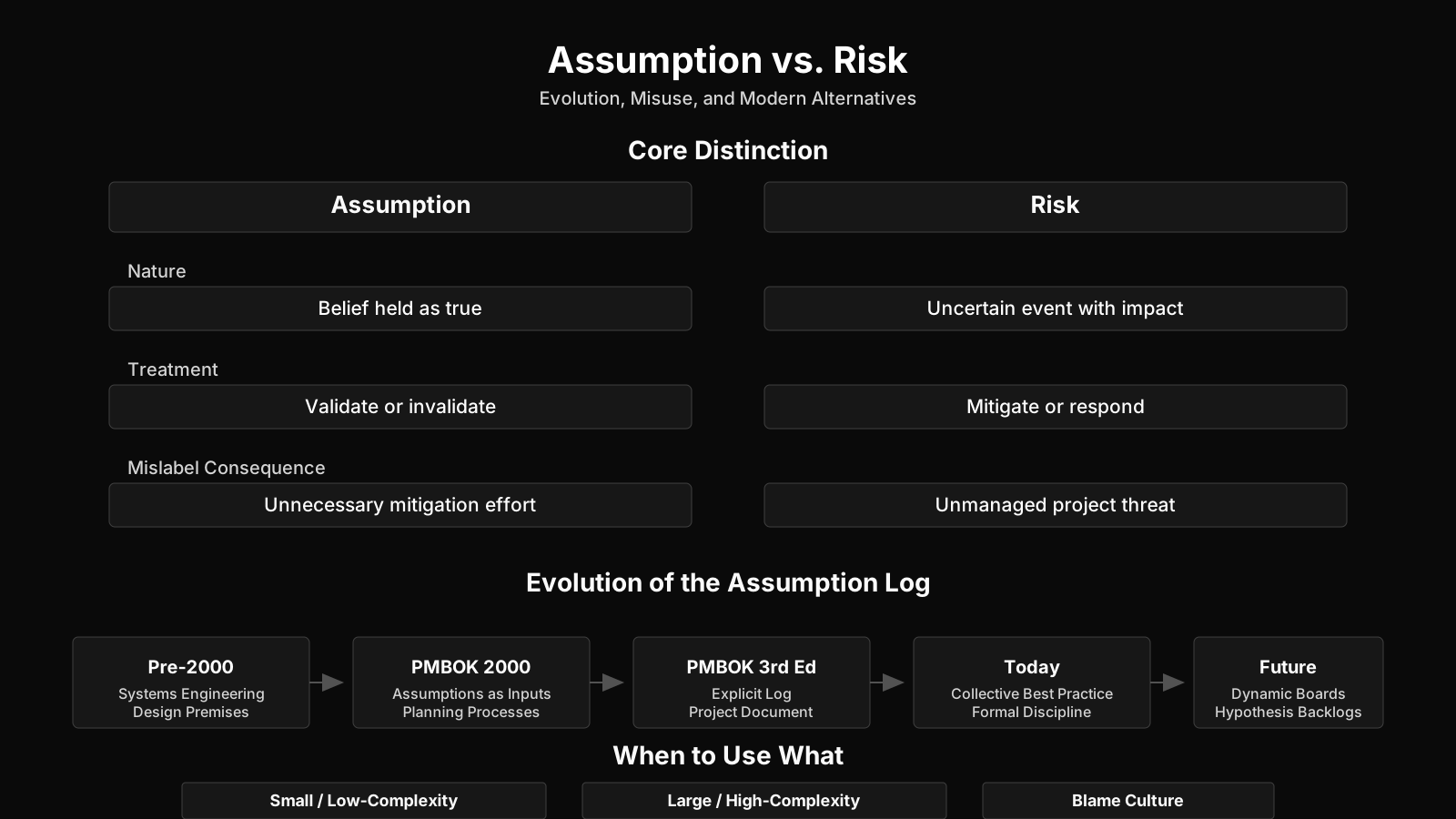
A deeper misconception is that assumption logs are only needed on large, predictive projects. In reality, even small, agile initiatives benefit from explicitly recording the few high-stakes assumptions that could break the sprint or release. The formality may be reduced to a sticky note or a shared document, but the discipline of surfacing and testing these premises prevents teams from living in a comfortable bubble until reality intrudes. Another trap is confusing assumptions with risks from the start, which muddles the validation process because assumptions need confirmation, whereas risks need response strategies. While an assumption can become a risk later, keeping them conceptually distinct during logging preserves clarity.
Key Takeaways on Assumption Log Pitfalls
- Static log trap
- The most prevalent mistake is populating the assumption log once at the project's start and never revisiting it, transforming it from a live safeguard into an inert reference that fails to protect the project as conditions shift.
- Assumption graveyard outcome
- When nobody is accountable for monitoring assumptions, the log becomes a graveyard of forgotten bets, and a false assumption documented early on can still derail the schedule months later.
- Vague assumptions lack criteria
- An assumption such as "The client will provide timely feedback" is virtually useless because it contains no measurable criteria that would enable anyone to confirm whether it holds true.
- Precision beats vagueness
- Well-maintained logs rely on plain but precise language and concrete, measurable criteria; for example, requiring the client to review and approve each deliverable within five business days of submission.
- Assumptions confused with risks
- Confusing assumptions with risks distorts the validation process because assumptions must be confirmed while risks require response plans; even small agile initiatives benefit when high-stakes assumptions are explicitly surfaced.
Relationship Between Assumption Log, Risk Register, and Other Project Artifacts
A frequent source of confusion is the assumption log versus risk register distinction, but the two artifacts serve complementary purposes. A risk register records uncertain future events that, if they occur, would have a positive or negative effect on objectives. An assumption log records statements that are currently treated as true for planning purposes. When an assumption is invalidated, it often generates a new risk entry or turns into a current issue. A common process flow is that the assumption log feeds the risk identification step; during periodic reviews, any assumption that shows signs of weakening gets escalated into the risk register with an appropriate probability and impact rating.
The assumption log also ties closely to the scope baseline, the WBS, and the schedule. Many work packages include embedded assumptions about resource availability, technical feasibility, or external dependencies. If the assumption log is not synchronized with these baselines, the team may be executing against a plan that no longer reflects reality. Project managers often use the assumption log as a cross-check when reviewing change requests, because a change often reveals that an earlier assumption has failed. The issue log and change log similarly interact with assumptions; an assumption that is proven false may directly become an issue to be resolved or a change request to be approved.
Program and portfolio managers extend this relationship further. At the program level, assumptions about shared resources, market conditions, or technology roadmaps are tracked in a program-level log that feeds into component projects. If the program assumption that a new regulation will not take effect until the following year is overturned, several projects must update their own assumption logs and risk registers simultaneously. This web of dependencies is why mature organizations treat the assumption log as a cross-cutting artifact that must be aligned with governance, financial, and strategic planning documents.
Evolution of the Assumption Log and Current Best Practices
Current best practices for assumption log management focus on embedding validation triggers directly into the project schedule and making the log accessible to everyone involved in the work. The old habit of a project manager privately maintaining a spreadsheet and reviewing it once a month has given way to collaborative logs that are visible in shared platforms, where any team member can flag an assumption that looks shaky. This social accountability increases the odds that assumptions are challenged early, often from people closest to the work who see inconsistencies before they show up in formal status reports.
Over the past two decades, the assumption log has evolved from an informal note buried in the project scope statement to a standalone project document recognized by the PMBOK and many organizations’ project management information systems. In the early 2000s, many practitioners recorded assumptions in the project charter and never revisited them. Today, robust project management plans include scheduled assumption reassessments at each phase gate or major milestone. Some industries, such as pharmaceutical development and infrastructure, have made assumption tracking part of their governance checkpoints, where funding gates are not opened until a set of critical assumptions have been validated with evidence.
Digital tools have made it easier to link assumptions to risks and automated reminders, but the core discipline remains a human one. The most sophisticated tracking system is worthless if the project culture penalizes people for identifying flawed assumptions. Enlightened project leaders treat the assumption log as a learning tool rather than a blame mechanism. They also recognize that not every assumption needs the same level of scrutiny, applying a tiered approach where low-impact assumptions are simply logged and archived, while high-impact ones receive dedicated validation tasks, scheduled reassessments, and executive attention.
Another shift in thinking is the integration of assumption tracking with agile ways of working. Hybrid teams often maintain a lightweight assumptions backlog that is reviewed during iteration planning and retrospectives. The assumption that a third-party API will remain stable for the next three months, for instance, might be revisited every two weeks in the sprint review. This rhythm reduces the likelihood of an invalid assumption festering unnoticed, and it aligns naturally with the iterative delivery model. Regardless of the methodology, the modern assumption log is no longer a dusty document but an active instrument of project control, closely tied to risk management, validation planning, and transparent communication with stakeholders.
Core Takeaways on Assumption Logs
- Collaborative logs replace private spreadsheets
- Teams now track assumptions in shared platforms rather than isolated documents, enabling those closest to the work to flag questionable assumptions early and prevent them from hardening into plans.
- Validation embedded into project governance
- Leading organizations schedule formal assumption reviews at phase gates and key milestones; in regulated industries, critical assumptions often require evidence-based substantiation before subsequent funding is approved.
- Tiered scrutiny with human discipline
- A system that assigns rigorous validation and executive attention to high-impact assumptions while archiving low-impact ones only works when the project culture actively encourages surfacing flawed assumptions without fear of penalty.