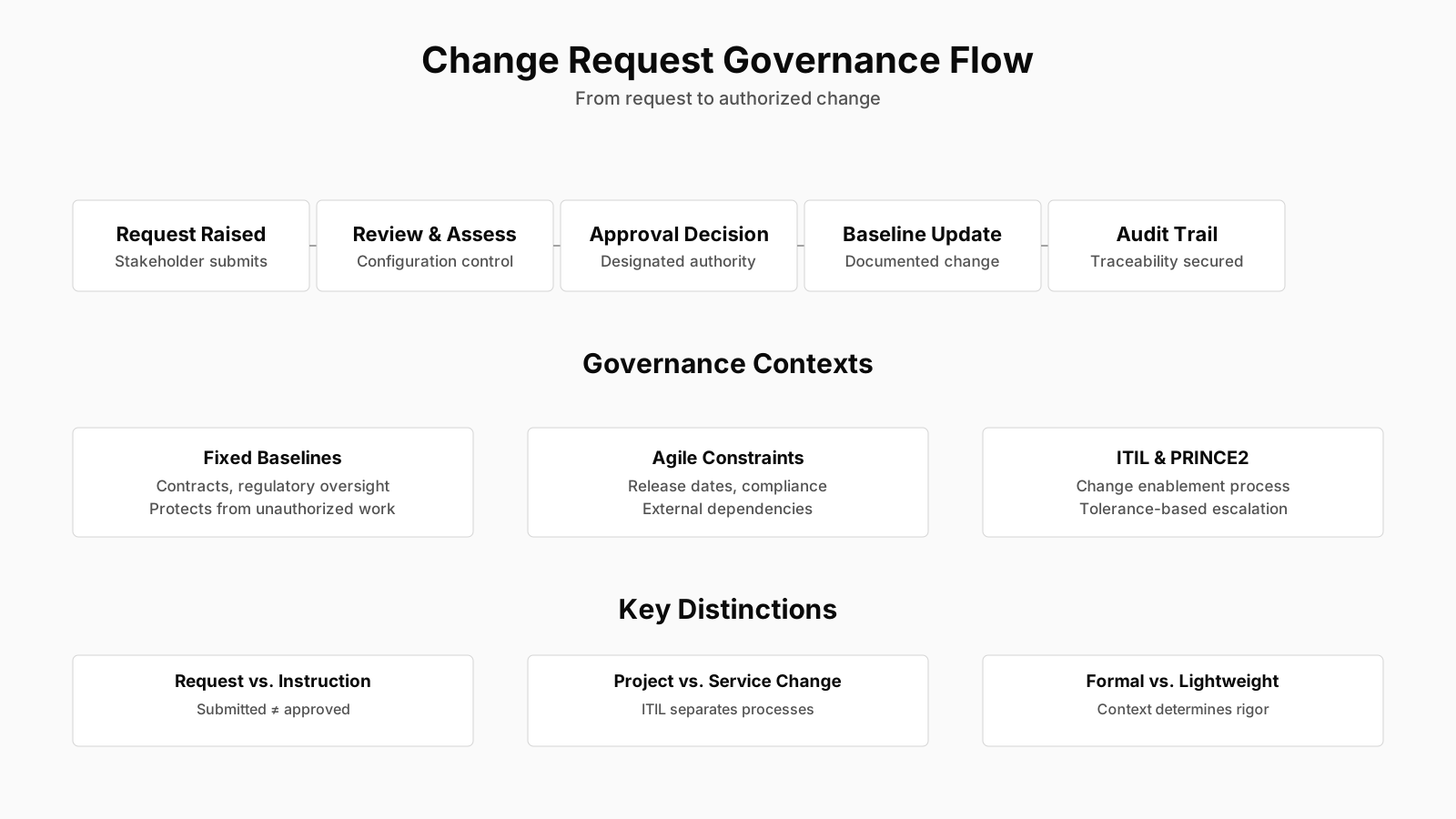
Change requests in project management are formal proposals to modify any approved plan, baseline, deliverable, or project document. The request itself does not authorize a change; rather, it initiates a structured process of review, impact assessment, and decision making. Change requests are one of the primary mechanisms by which a project remains aligned with valid stakeholder needs while still protecting the integrity of its approved scope, schedule, cost, and quality commitments.
Formal project environments rely on change requests to distinguish deliberate adjustments from unmanaged drift. In predictive and hybrid frameworks, the term carries defined governance weight. In Agile settings, the language often shifts to backlog refinement and reprioritization, but the underlying control question persists for changes that affect fixed constraints. This article explains the definition, framework placement, components, types, related concepts, challenges, and evolution of change requests in project, program, and portfolio management.
Change Requests: Key Topics Summary
| Key Concept | Summary |
|---|---|
| Core Purpose | Change requests serve as a controlled mechanism to reconcile evolving stakeholder requirements with approved baselines while protecting scope, schedule, cost, and quality commitments. |
| Agile Adaptation | Agile teams absorb change through backlog refinement and reprioritization, but still require disciplined evaluation when proposed changes affect fixed constraints such as contractual terms or release dates. |
| Article Coverage | The article examines the definition, framework positioning, core components, types, related concepts, challenges, and evolution of change requests across project, program, and portfolio management. |
| Terminology Variations | PRINCE2 labels the equivalent control a request for change, whereas Agile frameworks typically capture product changes as prioritized backlog items rather than standalone change documents. |
| Common Triggers | Change requests often originate from new regulatory requirements, invalidated assumptions, identified defects, supplier constraints, or stakeholder requests for additional capability. |
| Required Components | A complete change request documents the change description, business rationale, affected elements, impact analysis, alternatives considered, priority, urgency, and requester identification. |
| Quality Attributes | High-quality requests identify the precise screen, workflow step, or data field affected, avoiding vague language such as improve the user interface. |
| Governance and Approvals | Project managers can approve minor changes within predefined tolerances, while changes that alter baselines or major benefits require formal board approval from sponsors, business owners, technical leads, and other stakeholders. |
What Is a Change Request?
A change request is defined as a documented proposal to alter one or more controlled elements of a project. In the PMBOK framework, the change request definition includes modifications to project documents, deliverables, baselines, or any formally controlled component. PRINCE2 refers to a similar concept as a request for change, while Agile environments often express product changes through backlog items rather than standalone change documents.
Formality separates a change request from an informal suggestion. A stakeholder may mention an idea in a meeting, but the idea does not become a change request until it is captured, documented, and routed through a defined review path. This formality matters because projects are authorized against a baseline. The baseline serves as the official reference for measuring performance and variance. Deliberate deviation from that reference requires a conscious approval decision, not just a conversation.
In practical terms, a change request often begins when someone sees a disconnect between what the project is doing and what it should be doing under current conditions. The disconnect could be a new regulatory requirement, a missed assumption, a defect, a supplier constraint, or a stakeholder desire for additional capability. Converting that disconnect into a change request forces the project team to articulate what would change, why it matters, and what the impact would be.
Change Request Essentials at a Glance
- Formal documented proposal
- A change request is a formal, documented proposal to modify controlled project elements, including deliverables, baselines, documents, and other configuration items subject to change control.
- Varying methodology terminology
- PMBOK uses the term change request, PRINCE2 labels it a request for change, and Agile environments typically express product changes through prioritized backlog items.
- Formality versus informal suggestion
- An idea raised in a meeting remains informal until it is captured, documented, and routed through a defined review and approval path.
- Triggered by project gaps
- Change requests frequently stem from project gaps such as new regulations, defects, supplier constraints, missed assumptions, or stakeholder demands for additional capability.
Key Components of a Change Request
The key components of a change request vary by organization, but a usable request generally includes a change description, rationale, affected items, impact assessment, alternatives, priority, urgency, and requester identification. Some change logs also record the date of submission, the target decision date, and the relationship to existing risks or issues. These details allow reviewers to evaluate the request without repeated follow-up.
A strong change description specifies what will change and what will not change. Vague language such as improve the user interface is less useful than a precise statement about the screen, workflow, or data field affected. The rationale should connect the change to business value, compliance, risk reduction, or operational necessity. Without a credible rationale, decision makers cannot compare the request against competing priorities.
Impact assessment is often the most demanding component. It examines effects on scope, schedule, cost, quality, resources, procurement, communication, risk, and benefits. Experienced practitioners know that a change that looks small in one area can ripple into other areas once dependencies are traced. For example, adding a data field to a report may also affect data entry, validation, testing, training, and downstream integrations.
Alternatives matter because the first proposed change is rarely the only option. A change request that includes a short comparison of alternatives gives the change control board a better decision frame. It also prevents the team from rushing into an expensive solution when a less disruptive option could achieve the same result.
Change Requests in PMBOK and Predictive Environments
Within the PMBOK framework, change requests in PMBOK are closely tied to the Perform Integrated Change Control process in Integration Management. This process belongs to the Monitoring and Controlling Process Group, although change requests can originate from many Executing and Monitoring processes. Variance analysis, quality control, risk monitoring, stakeholder engagement, and procurement activities can all surface the need for a change.
Perform Integrated Change Control exists to ensure that all change requests are reviewed through a single, consistent process. The process evaluates impact, decides on approval, manages updates to baselines and project documents, and communicates the result. This integrated approach prevents fragmented decision making, where one manager approves a schedule change while another manager rejects the related budget change without understanding the connection.
Predictive environments often use a Change Control Board to make decisions on significant changes. The project manager typically has authority to approve smaller changes within predefined tolerances, but changes that affect baselines or major benefits may require board approval. The board usually includes representatives from the sponsor, business owners, technical leads, and other functions with a stake in the outcome.
Baselines and Change Requests
Baseline integrity is central to predictive change control. The scope baseline, schedule baseline, and cost baseline represent the agreed plan. When an approved change modifies one of these baselines, the new baseline becomes the reference for future performance reporting. This is not an admission of failure. Real projects operate in shifting conditions, and an outdated baseline is more misleading than a formally revised one.
Core Insights on Change Requests
- Integrated change control process
- In PMBOK, the Perform Integrated Change Control process functions as the formal review mechanism for all change requests, operating within the Monitoring and Controlling Process Group to enforce a single, consistent evaluation pathway before any change is approved.
- Multiple sources of change
- Change requests can originate from variance analysis, quality control, risk monitoring, stakeholder engagement, and procurement activities whenever those activities reveal a variance or new information that requires a formal response.
- Prevents fragmented decision making
- Because schedule, cost, and scope implications are evaluated together under integrated change control, the project avoids situations where one manager approves a change while another rejects a related change without recognizing their interdependence.
- Change Control Board authority
- In predictive environments, the Change Control Board normally brings together the sponsor, business owners, and technical leads to evaluate and authorize changes that alter baselines or significantly affect expected benefits.
- Project manager approval limits
- Project managers retain authority to approve minor changes that fall within clearly defined tolerances, whereas changes exceeding those limits require formal escalation to the Change Control Board.
Change Requests in PRINCE2
The PRINCE2 change request is part of the Change Theme and is formally recorded as a request for change. PRINCE2 divides issues into three categories: requests for change, off-specifications, and problems or concerns. A request for change asks for a deliberate modification to an approved baseline, while an off-specification identifies that a deliverable does not meet its specification or that something planned is missing.
PRINCE2 requires a Change Control Approach document early in the project. This document defines how issues and changes will be captured, assessed, decided, and communicated. It also defines the change authority, which may be the project board or a delegated person. The change authority can approve changes within a specified budget and impact threshold, but changes beyond that threshold escalate to the project board.
The issue register records all issues, including requests for change. Each request is assessed for impact on time, cost, quality, scope, risk, and benefits. PRINCE2 keeps the business case at the center of change decisions. A change that seems productively useful may still be rejected if it weakens the business case or diverts the project from its original justification.
Change Requests in Agile and Hybrid Environments
Agile change requests operate differently from their predictive counterparts. In Scrum, product changes usually enter the product backlog as new or modified product backlog items. The product owner orders the backlog based on value, risk, dependencies, and feedback. This continuous reprioritization is normal and expected, not treated as an exceptional control event.
That said, Agile does not eliminate the need for formal change control on fixed constraints. Changes to release commitments, regulatory scope, budget envelopes, team composition, architectural standards, or contractual obligations still require a record and an explicit decision. In regulated industries, Agile teams often maintain a lightweight change log to demonstrate traceability without falling back into heavyweight documentation.
Hybrid projects use a tiered approach. Product-level scope changes may flow through backlog refinement, while changes affecting stage gates, funding, or external commitments follow a formal change request process. The principle is reasonably simple: the formality of the change process should match the formality and impact of the thing being changed.
Agile Change Control Core Takeaways
- Backlog prioritization handles agile changes
- Changed requirements in Scrum and other Agile frameworks become new or modified backlog items that the product owner continuously reorders using value, risk, dependency, and feedback signals, keeping the team focused on the highest-priority outcome.
- Fixed constraints still demand formal control
- Changes that affect release commitments, regulatory scope, budget envelopes, team composition, architectural standards, or contractual obligations still require explicit documentation and a clear decision record; backlog reprioritization alone does not absorb these fixed constraints.
- Lightweight logs ensure regulated traceability
- Regulated organizations use lightweight change logs to preserve an auditable trail that links each change to its approval and rationale, demonstrating traceability without imposing heavyweight documentation practices.
- Hybrid projects tier their change processes
- Hybrid projects route product-level scope changes through backlog refinement while formal change requests govern stage gates, funding, and external commitments, aligning control formality with the impact and risk of each change.
Purpose and Importance of Change Requests
The purpose of change requests is to create a transparent, repeatable, and auditable path for modifying the project's agreed direction. A change request makes the proposed alteration explicit and subjects it to a conscious decision. Without that mechanism, changes can enter the project through side conversations, assumptions, or good intentions, and the project baseline loses its meaning.
Change requests support governance by preserving the decision history. If a project later runs over budget, the change log shows which scope increases were approved, by whom, and on what basis. This evidence is especially important in public sector, construction, and regulated work, where external auditors may review decisions years after delivery. It also protects the project manager from the perception of unilateral decision making.
Another important function is exposing the true cost of change. When a stakeholder asks for an additional feature, the request process forces a conversation about schedule, budget, risk, and displaced work. This reduces the illusion that change is free. A common experience is that the act of filling in a change request causes stakeholders to withdraw low-value items because the impact becomes visible for the first time.
Change requests also support organizational learning. A repository of past changes reveals patterns in requirements maturity, vendor performance, stakeholder behavior, and estimation accuracy. Over time, these patterns can improve planning and risk management on future projects.
Types of Change Requests
The primary types of change requests recognized in the PMBOK framework are corrective action, preventive action, defect repair, and updates. Corrective action realigns work with the plan after performance has deviated. Preventive action addresses future risk before it becomes an issue. Defect repair fixes a nonconforming deliverable or component. Updates modify plans, documents, or templates without necessarily changing the product.
These categories are useful because they clarify intent. A corrective action implies that something is already off track. A preventive action implies that the project is still on track but vulnerable. A defect repair implies that the product failed to meet a specification. An update implies that knowledge about the project has changed and the documentation must follow. Reviewers may treat these differently. A defect repair required for safety compliance may need faster approval than a documentation update.
Change requests can also be classified by domain: scope, schedule, cost, quality, risk, resource, procurement, or stakeholder. Most changes cross domains. A scope addition will likely influence schedule and cost. That is why integrated impact analysis matters. Treating a change as a single-domain event usually produces an incomplete decision.
Key Takeaways on Change Request Types
- Four primary PMBOK categories
- The PMBOK framework defines four primary change request types: corrective action, preventive action, defect repair, and updates, each serving a distinct control function.
- Distinct purpose of each type
- Corrective action brings work back into alignment with the approved plan, preventive action reduces the probability or impact of future risks, defect repair resolves nonconforming deliverables, and updates modify plans or documents without altering the product scope.
- Category reveals urgency and intent
- The assigned category signals both urgency and intent, so a safety-related defect repair typically requires expedited approval while a routine documentation update can follow the standard review path.
- Domain classification matters
- Change requests may affect multiple domains including scope, schedule, cost, quality, risk, resource, procurement, or stakeholder domains, and treating them as single-domain events often produces incomplete impact assessments and poor decisions.
The Change Control Board and Decision Roles
Decision authority in change control is rarely held by one person alone. The change control board roles typically include a chair, project manager, business sponsor, technical representative, and affected functional leads. The board reviews requests that exceed the project manager's delegated authority or that affect baselines, benefits, or significant risk exposure. The project manager remains responsible for coordinating the process and implementing approved changes.
The requester can be any stakeholder, including a customer, sponsor, team member, supplier, or regulator. The requester's role is to describe the change and its rationale, not to decide the outcome. In mature organizations, the person who raises a change does not need to be the person who benefits from it. A team member might raise a change request because a design constraint creates downstream risk, even if no external stakeholder requested it.
Delegated authority is a common practice. The sponsor may authorize the project manager to approve changes up to a specific cost or schedule impact. Beyond that threshold, the change goes to the board. This tiered approach avoids clogging governance bodies with minor requests while preserving oversight for significant decisions. The thresholds are usually documented in the change control approach or project management plan.
Some organizations appoint a change manager or change coordinator to handle intake, documentation, and communication. This role is not the same as a change manager in organizational change management. In project change control, the coordinator keeps the log current, routes requests, follows up on impact assessments, and communicates decisions.
Change Request Lifecycle and Evaluation
The change request lifecycle typically includes submission, screening, impact analysis, decision, documentation, implementation, and closure. Each stage has a distinct purpose. Submission captures the request in a controlled log. Screening confirms that the request is complete and that the project has authority to consider it. Impact analysis examines consequences across baselines and performance domains.
A request may be returned to the requester if critical information is missing. This is not necessarily rejection. It is a quality check on the decision input. A decision based on incomplete impact analysis can produce an approved change that is technically fine but strategically damaging. Skilled project managers learn to identify the few pieces of information that will actually change the decision, rather than demanding exhaustive detail for every request.
Impact analysis is the stage where most errors occur. The obvious effect is usually easy to estimate. The hidden effects are harder: downstream rework, regression testing, training, documentation updates, vendor contract amendments, and stakeholder communication. In complex systems, a change request may also alter assumptions in other work packages. These ripple effects are why many organizations require cross-functional review before the change control board meets.
After the decision, the approved change updates the appropriate plans, baselines, and registers. Rejected changes remain in the log with a reason, because a rejected request may reappear later under different conditions. Implementation follows the normal project execution processes. Closure occurs when the change is verified and its effects are no longer active. The change remains part of the project record indefinitely.
Key Insights on Change Lifecycle
- Seven-stage lifecycle framework
- The change request lifecycle moves through submission, screening, impact analysis, decision, documentation, implementation, and closure, with each stage acting as a distinct control point that maintains traceability and discipline.
- Screening verifies completeness and authority
- Screening acts as an entry gate that verifies the request is complete and the project has legitimate authority to consider it, returning incomplete or unauthorized requests before formal analysis begins.
- Incomplete analysis risks strategic damage
- A decision based on incomplete impact analysis can approve a change that is technically viable but strategically damaging, so experienced managers direct attention to the limited facts that would actually alter the outcome.
- Cross-functional review reveals hidden effects
- Cross-functional review surfaces downstream consequences that are otherwise difficult to anticipate, such as rework, regression testing, training, documentation updates, vendor contract amendments, and stakeholder communication, before the change control board meets.
Configuration Management and Change Requests
Configuration management and change requests are related but distinct disciplines. Configuration management identifies controlled items, records their versions, and verifies that the actual product matches its documented state. Change requests are the proposed modifications to those controlled items. Once a change is approved, configuration management ensures that the revised version becomes the new controlled baseline.
Configuration identification answers the question of what is under control. In a software project, controlled items might include requirements, design documents, source code, build scripts, test plans, and release notes. In construction, controlled items might include drawings, specifications, permits, and material approvals. A change request that touches one of these items triggers a configuration change, not a simple file edit.
Configuration status accounting tracks current and historical versions. It also records the linkage between a change request and the resulting version update. This traceability is crucial in safety-critical and regulated industries. If a product failure occurs later, investigators need to know which change introduced the altered specification or code. Without configuration management, change requests become isolated documents with no clear connection to the product's actual state.
Integrating Change Requests with Risk and Issue Management
Change request and risk management are linked because many changes originate from risk responses. When a risk is identified and a response is selected, the response may involve modifying the plan, adding contingency, changing a supplier, or altering scope. In formal environments, that modification becomes a change request. The risk register and change log should cross-reference each other so that future reviewers can see why a change was made and what risk it addressed.
Issues also feed change requests. An issue is a current problem. When the project cannot resolve the issue within the existing plan, the project manager may raise a change request to adjust the approach. This flow is normal. It is not a sign of poor planning. It simply reflects that the project has moved from managing uncertainty to managing a known deviation.
The integration point is important because it preserves the rationale for the change. A change request that simply says add two weeks to the schedule tells part of the story. If the change log links to a specific risk and issue, the full story becomes visible: a supplier delay created an issue, a risk response called for a schedule buffer, and the buffer became an approved baseline change. That linkage is valuable for audits, lessons learned, and future risk planning.
Core Takeaways on Linking Change, Risk, and Issues
- Changes Arise from Risk Responses
- A selected risk response often becomes the source of a change request when it demands adjustments to the project plan, contingency reserves, supplier arrangements, or scope boundaries.
- Cross-Reference Risk Register and Change Log
- Cross-referencing the risk register and change log creates an auditable trail that shows both the rationale for a change and the specific risk it was intended to mitigate.
- Issues Also Trigger Change Requests
- When an issue exceeds the limits of the current plan, a change request formalizes the shift from proactive uncertainty management to corrective action on a known deviation.
- Complete Story Through Linkages
- A schedule extension of two weeks has limited meaning on its own; only when the request is linked to the originating risk and issue does the full chain of events become visible, such as a supplier delay that justified the added buffer.
- Value for Audits and Future Planning
- This integrated record strengthens audits, lessons-learned reviews, and future risk planning by preserving the original reasoning behind every baseline adjustment.
Change Requests vs Related Concepts
A change request versus issue distinction confuses many project teams. An issue is a current problem that has already occurred. A risk is a future uncertain event. A change request is a proposed modification. The overlap occurs because an issue or risk often triggers a change request. For example, a supplier failure is an issue, but the decision to switch suppliers may be documented as a change request.
Scope creep is uncontrolled expansion of scope without formal approval. It is often the result of small, informal additions that accumulate over time. A change request, by contrast, makes the addition visible and subjects it to governance. Gold plating is similarly unapproved: the team adds features or quality beyond requirements without a change request. Both scope creep and gold plating undermine baseline integrity even when the intent is positive.
A workaround is a temporary action to keep work moving despite an issue. It does not necessarily change the baseline. A change request may formalize a permanent fix after the workaround. A risk response may also generate a change request if the selected response modifies the plan, budget, or schedule. A baseline update is the administrative result of an approved change, but the update is not a separate change request. These distinctions help route the work to the correct process and prevent double-counting or confusion in project records.
In contract-heavy industries, a change order is the formal contractual amendment that follows an approved change request. The change request proposes the change, and the change order authorizes the corresponding cost and schedule adjustment under the contract. Confusing the two is common, but the distinction matters because a change request may be approved internally yet still require a negotiated change order before the contractor is authorized to proceed.
Project change control is also not the same as organizational change management. Project change requests govern modifications to project baselines and deliverables. Organizational change management focuses on preparing people to adopt new processes, systems, or behaviors. The two can coexist, but they are different disciplines.
Common Challenges and Misconceptions
Among the most damaging change request pitfalls is verbal approval without documentation. A stakeholder says yes in a corridor, the team acts, and later the decision is forgotten or disputed. The absence of a written record makes it impossible to reconstruct who approved what and why. In audited environments, this gap can be as serious as making an unauthorized change.
Change fatigue is another real challenge. When requests arrive frequently and decisions lag, teams may stop believing in the plan. That cynicism can lead to bypassing the process entirely. The solution is not necessarily stricter control. It is usually a better calibrated process: small changes decided quickly, major changes given proper review, and decisions communicated promptly.
Approval bottlenecks create a different problem. If the change control board meets only monthly or requires excessive documentation for minor changes, the process becomes an obstacle rather than a safeguard. Some organizations respond by delegating more authority to the project manager and using tiered thresholds. Others simplify the intake form and rely on impact classification to separate routine changes from exceptional ones.
A persistent misconception is that a change request indicates poor planning or project failure. That view is unhelpful. Projects exist in complex environments, and new information often justifies change. A project with no change requests may simply be ignoring signals. Another misconception is that Agile projects do not need change requests. Product backlog items can absorb many product-level changes, but fixed constraints, compliance obligations, and release commitments still demand a controlled record.
Key Takeaways on Approval Pitfalls
- Verbal approvals invite disputes
- Because verbal approvals leave no auditable trail, they cannot be reconstructed when questions arise, and auditors often treat the absence of written evidence as equivalent to an unauthorized change.
- Heavy processes become obstacles
- When change control boards meet infrequently or demand excessive documentation for minor changes, teams lose confidence in the approval process and the controls intended to protect the project begin to obstruct delivery.
- Tiered authority speeds decisions
- Organizations improve responsiveness by delegating greater authority to the project manager, classifying changes by impact to separate routine adjustments from exceptional ones, and directing product-level changes through the product backlog while maintaining formal records for fixed constraints and compliance obligations.
Change Requests and Business Value-Oriented Project Management
Business Value-Oriented Project Management treats scope change as user feedback and applies value-driven criteria to change decisions. In this context, a BVOP change request evaluation considers process damage, which is invisible organizational harm caused by overwork, perfectionism, or rejected acceptable work. The organization also tracks Business Value Points, so a change that does not protect or improve delivered business value may lose priority even if it appears low-cost and technically simple.
Limitations of the Change Request Process
Change requests are not universally appropriate. Change request limitations appear when the overhead of documentation exceeds the risk of acting. In small, short-duration projects with one or two stakeholders, a full change control board may be unnecessary. The project manager and sponsor can agree on adjustments directly, provided the decision is recorded in a simple log or meeting note.
In innovation projects where uncertainty is high, applying predictive-style change control to every idea can kill agility and discourage experimentation. The process may also create a false sense of control if requests are logged but impact analysis is superficial. A well-documented change request with no real analysis is not governance; it is paperwork. Organizations should calibrate the process to the project's complexity, regulatory exposure, and risk tolerance.
Another limitation is that change requests usually focus on formal baselines and controlled documents. They may not capture cultural resistance, team overload, or loss of trust. A change can be approved on paper and still fail in practice if the people affected have not been engaged. This is why change request approval does not replace the interpersonal and organizational work needed to implement the change effectively.
Key Limitations and Calibration Takeaways
- Documentation overhead versus risk
- Change requests are not appropriate in every setting; in short, low-complexity projects with only one or two stakeholders, the overhead of formal change control outweighs the risk of acting directly, so a simple log or meeting note is sufficient and a full change control board adds no value.
- Innovation projects lose agility
- Applying predictive-style change control to every idea in high-uncertainty innovation projects erodes agility and discourages the experimentation those projects depend on.
- False control undermines governance
- A change request that is well documented but lacks substantive impact analysis creates a false sense of control and functions as paperwork rather than governance, which makes it essential to calibrate the process to project complexity, regulatory exposure, and risk tolerance.
- Approval does not ensure implementation
- Because change requests focus on formal baselines and controlled documents, approval alone does not replace the interpersonal and organizational effort needed to implement the change effectively.
Evolution and Current Thinking
The evolution of change requests reflects a broader shift from bureaucratic protection of the baseline toward decision agility and value-based governance. Early change control practices often treated every change as a threat. Modern thinking distinguishes between high-impact changes that require formal review and low-impact adjustments that can be delegated to teams or product owners. Tiered change authority is now common, with different paths for routine, moderate, and significant changes.
Value management has become more prominent in change decisions. Instead of only asking whether a change is feasible, organizations ask whether it preserves or enhances the business case. This shift encourages decision makers to consider benefits, strategic fit, and opportunity cost, not just technical impact. A change that is easy to implement may still be rejected if it consumes attention without improving the project's value contribution.
Automation has changed the mechanics of change request management. Workflow tools can capture requests, route them to reviewers, apply impact checklists, and maintain audit trails. Machine learning and analytics are emerging to identify patterns in change frequency, approval rates, and implementation outcomes. These tools can help project managers forecast change-related risk, but they do not replace the judgment required for a sound decision.
The debate between formal change control and continuous backlog refinement remains active. Some practitioners argue that heavy change boards suppress innovation and slow delivery. Others point out that without formal records, organizations lose the ability to learn from rejected changes and to defend decisions in audits. In mature environments, the answer is usually contextual. Formal change requests belong where baselines, contracts, and compliance demand them. Lightweight backlog mechanisms belong where product scope is intentionally adaptive and the cost of a wrong decision is low.