Change management in project management refers to the structured approach for evaluating, approving, and controlling modifications to project baselines, requirements, deliverables, and other formally defined aspects of a project. It is a governance mechanism that ensures any alteration to the agreed-upon scope, schedule, cost, or quality undergoes systematic review before being incorporated. Without such a mechanism, projects risk uncontrolled expansion, resource drain, and misalignment with business objectives. The discipline draws heavily from integrated change control, configuration management, and stakeholder communication practices, and it appears explicitly in every major project management framework.
Change Management: Key Topics at a Glance
| Key Concept | Summary |
|---|---|
| Definition & Purpose | Change management encompasses the structured processes, governance tools, and team behaviors that govern how project teams evaluate and implement modifications to approved baselines, ensuring controlled evolution of scope, schedule, and deliverables. |
| Agile Change Mechanism | In Agile environments, the Product Owner’s ongoing authority to reprioritize backlog items based on empirical sprint feedback creates an organic, continuous change management system, embedding adaptability into each iteration rather than relying on sequential phase-gate approvals. |
| Impact Assessment | Even a seemingly minor scope expansion can cascade across schedule, cost, risk, and quality parameters, potentially extending the timeline by weeks, straining testing capacity, and eroding overall deliverable quality, demanding rigorous ripple-effect analysis. |
| Evaluation Criteria | Each change request is assessed against strategic alignment with the business case, urgency, regulatory mandates, resource availability, and cumulative effect on established performance baselines, ensuring only value-added or necessary modifications proceed. |
| Tracking & Pattern Analysis | Maintaining a structured change log not only prevents duplicate requests and creates a defensible audit trail for governance, but also surfaces systemic patterns over time, revealing weaknesses in initial requirements elicitation or persistent stakeholder over-optimism. |
| Configuration Management & Traceability | A robust configuration management system links each approved change to version-controlled baselines of documents and deliverables, establishing end-to-end traceability from the original request through verification and final acceptance. |
| PMBOK Guidance (Sixth vs. Seventh) | PMBOK Sixth Edition delineates change management as a standalone process with distinct inputs and outputs, whereas the Seventh Edition integrates it fluidly into complexity and risk domains, still demanding formal oversight but with greater contextual agility. |
| Authority Thresholds | Predefined authority thresholds empower the project manager to approve routine changes within tolerances, while deviations beyond those limits automatically escalate to the Project Board or sponsor, preserving control without creating decision bottlenecks. |
Definition and Core Meaning
At its most technical, the change management definition in project management is the collection of processes, tools, and behaviors that guide how a project team handles requests to alter anything under formal configuration control. In the PMBOK Guide, this function is encapsulated within the Perform Integrated Change Control process, which exists in the Monitoring and Controlling Process Group. It is not a standalone knowledge area but rather a cross-cutting activity that touches scope, schedule, cost, quality, resources, risk, and procurement. The fundamental premise is that changes are inevitable, but their impact must be understood before they are accepted or rejected.
In PRINCE2, the concept lives within the Change theme, which deals with issues and change control. PRINCE2 distinguishes between requests for change (RFCs), off-specifications, and other project issues, all of which require formal handling. The methodology prescribes a clear escalation path depending on the severity of the proposed change and its implications for the project’s tolerances. Agile approaches, by contrast, do not typically use the term “change control” in the predictive sense. Instead, they embrace changing requirements through iterative delivery and backlog refinement, but that does not mean changes are uncontrolled. The Product Owner’s authority to reprioritize the backlog, combined with empirical feedback from each sprint, serves as a built-in change management system that is continuous rather than phase-gated.
What “change management” does not mean in this context, and this is a point of frequent confusion, is organizational change management, the practice of helping people adopt new processes or technologies. While that is a legitimate discipline, project change management is strictly about controlling the project’s own boundaries and specifications. The two sometimes intersect when a project’s deliverables trigger organizational changes, but their methods and objectives are distinct.
Core Insights on Change Control
- Technical definition in project management
- Change management is the structured set of processes, tools, and team behaviors that govern how a project evaluates, authorizes, and incorporates modifications to any item under formal configuration control while preserving baselines and strategic intent.
- PMBOK's integrated control process
- The PMBOK Guide anchors this function in the Perform Integrated Change Control process, a central element of the Monitoring and Controlling Process Group that examines all change requests, balances their cross-functional effects, and safeguards the project’s approved plan.
- Cross-cutting activity across all areas
- Change control is not a standalone knowledge area; it spans scope, schedule, cost, quality, resources, risk, and procurement because changes are unavoidable and their cumulative impact must be fully understood before any acceptance or rejection decision is made.
- PRINCE2's formal change categories
- PRINCE2 sorts changes into requests for change, off-specifications, and other project issues, each following a defined escalation pathway determined by the change’s severity and its implications for agreed project tolerances, which ensures consistent governance.
- Agile's continuous built-in system
- Agile approaches replace phase-gated change control with a continuous, built-in mechanism: iterative delivery and constant backlog refinement openly accommodate evolving requirements, and the Product Owner’s reprioritization authority serves as an ongoing change governance instrument, distinct from enterprise-level organizational change management.
Key Components of Change Management
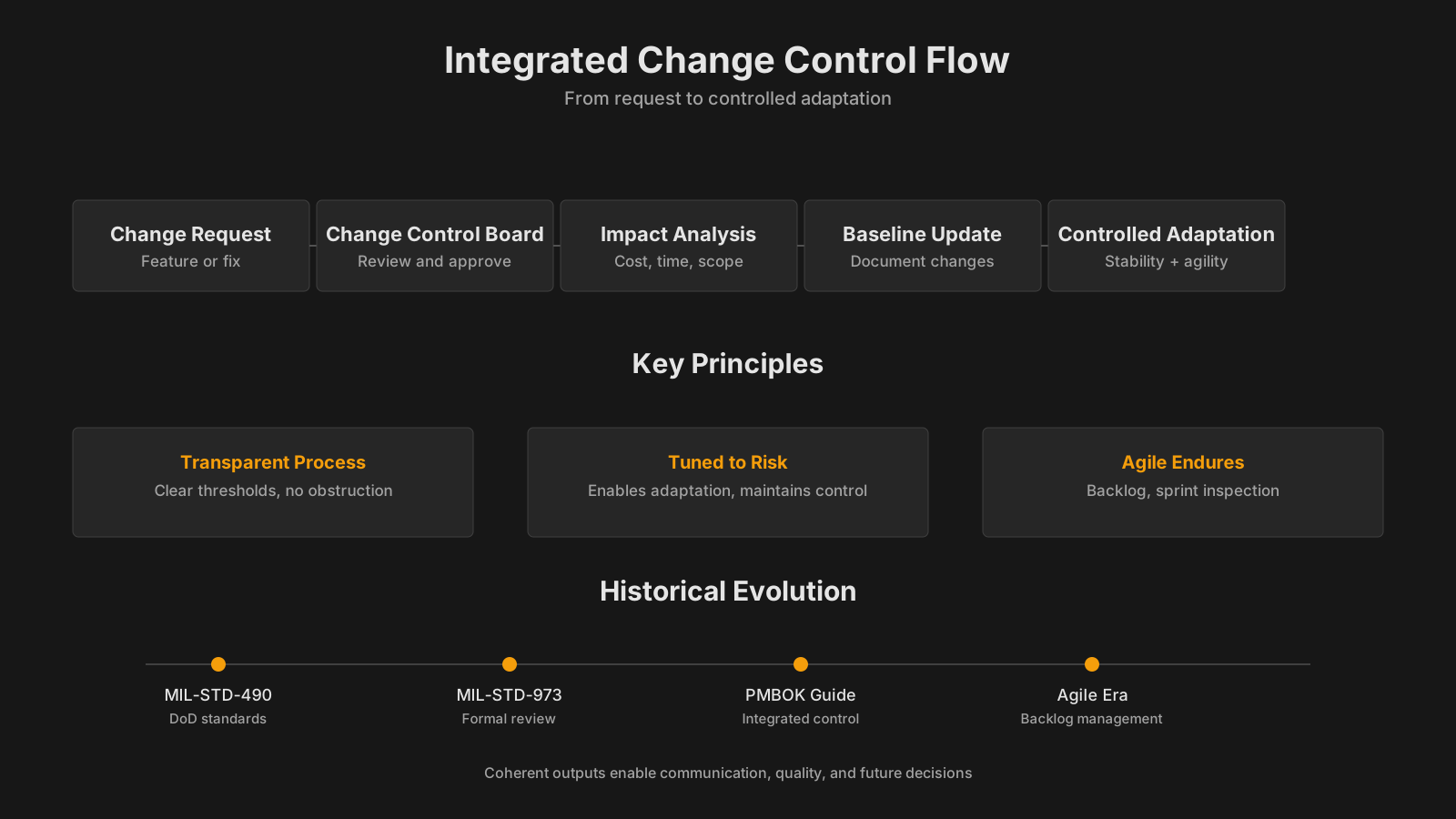
The key components of change management in projects include the change request itself, impact analysis, the change control board (CCB), decision-making criteria, and the repository that tracks change history. The change request is a formal document that describes what is being proposed, the rationale, and the expected benefits. It must be specific enough to allow for proper evaluation; vague statements like “add reporting feature” are typically rejected until clarified. Impact analysis examines the ripple effects. A single scope addition might affect the schedule by three weeks, increase costs by a defined amount, introduce new risks, and even degrade quality if testing resources are stretched.
The change control board, often called the CCB, is the authorized group that reviews and decides on changes. It is not a standing committee for micromanaging every decision but rather a filter that ensures the right people see the right changes. The project manager usually chairs or facilitates it, and members include key stakeholders such as the sponsor, technical leads, and sometimes client representatives. The board does not need to be large; on smaller projects, a single decision-maker can act as the de facto CCB. Criteria for evaluation often include alignment with the business case, urgency, regulatory compliance, resource availability, and cumulative impact on baselines. Decisions are typically “approve,” “reject,” or “defer,” and that record becomes part of the project’s historical data.
A frequently overlooked component is the change log, a simple but vital artifact that tracks every request from submission through final disposition. This log serves multiple purposes. It prevents duplicate requests, provides an audit trail for governance, and, over time, reveals patterns that might indicate a shaky requirements-gathering phase or unrealistic stakeholder expectations. Some organizations supplement this with a configuration management system that links changes to specific versioned baselines of documents and deliverables, ensuring traceability from request to implementation.
Change Management in Project Management Frameworks
Understanding change management PMBOK requires looking at Perform Integrated Change Control from the sixth and seventh editions of the Guide. In the sixth edition, it is a distinct process with clear inputs such as the project management plan, work performance reports, and change requests, and outputs including approved change requests and plan updates. The seventh edition’s principle-based structure addresses change more fluidly under the “Navigate Complexity” and “Optimize Risk Responses” domains, but the expectation of formal control remains. The PMBOK emphasizes that only approved changes get incorporated into baselines; anything else is uncontrolled variance.
PRINCE2’s treatment under the Change theme is more prescriptive about issue types. The project manager maintains an Issue Register, and each issue receives an assessment of its impact on the project product, the stage plan, or the business case. A key feature is the concept of authority levels defined by the Project Board: changes within tolerance can be approved by the project manager, while those exceeding tolerances must be escalated. This prevents routine adjustments from clogging governance channels.
In frameworks like the PMI’s Standard for Program Management, change management scales up. Program-level changes may alter component projects’ boundaries, introduce new projects, or shift benefits realization timelines. The program manager must evaluate how a change in one project affects the integrated roadmap and resource allocation across others. Portfolio management goes further, using change management as a strategic tool to rebalance the portfolio when enterprise priorities shift. Here, the concept blends with demand management and investment appraisal, but the core principle of structured evaluation before action applies throughout.
Key Insights on Change Control
- PMBOK sixth edition process
- The Sixth Edition defines Perform Integrated Change Control as a structured process that reviews change requests and work performance data, yielding approved changes, plan updates, and project document updates.
- PMBOK seventh edition approach
- The Seventh Edition addresses change adaptively through the "Navigate Complexity" and "Optimize Risk Responses" performance domains, while still requiring disciplined control for all modifications.
- Baseline control principle
- Only approved changes are incorporated into baselines; any unapproved modification represents uncontrolled variance and must be avoided.
- PRINCE2 issue register
- The PRINCE2 Change theme mandates an Issue Register through which the project manager assesses each issue’s impact on the project product, stage plan, and business case before determining the response.
- Program-level change scaling
- At the program level, change management extends to redefining component project boundaries, initiating new projects, or recalibrating benefits realization timelines, always through a structured evaluation prior to action.
The Integrated Change Control Process
In practice, the integrated change control process unfolds as a sequence of steps that begins with the identification of a need and ends with the closure of the change request after implementation and verification. The process starts when someone, be it a team member, stakeholder, or client, recognizes a deviation from the plan or an opportunity to improve the outcome. That person submits a change request, which may originate from a risk response, a testing defect, a stakeholder review, or an external mandate such as new regulation. The request is logged and assigned an identifier immediately so that it cannot slip through the cracks.
Impact Analysis and Feasibility
Once logged, the project team conducts an impact analysis. This step is where the technical and managerial expertise intersects most densely. The analyst examines how the change ripples across the project’s constraints. A seemingly innocent request to replace a payment gateway in an e-commerce project, for instance, might extend the development timeline, force retesting of the entire checkout flow, require legal review of new terms, delay the payment vendor onboarding, and invalidate the already-signed procurement contract. Those findings get documented in an impact statement that quantifies, where possible, the schedule delay in days, the cost increase in currency, the risk profile change, and the resource reallocation required.
Sometimes the impact is not purely quantitative. There are qualitative dimensions, such as the effect on team morale, the distraction from other commitments, or the subtle degradation of architectural coherence when too many patches are applied. Good project managers surface these softer factors because they directly influence long-term success even if they are not visible in a Gantt chart recalculation.
Review, Decision, and Communication
The change control board then reviews the request and impact analysis. This meeting is not a rubber stamp. The discussion often becomes a negotiation among stakeholders who hold different priorities. The sponsor may push for the change to satisfy a key client, while the technical lead warns of technical debt. The project manager facilitates the conversation, focusing on the project’s business case as the ultimate arbiter. A decision is reached and recorded, and the request is either approved, rejected, or deferred with conditions. Approved changes require updates to the project management plan, baselines, and any affected subsidiary plans. The communication that follows is just as critical: all affected parties must know what was decided, what they are now accountable for, and what the new expectations are.
Implementation of the change proceeds according to the revised plans, and verification confirms that the change has been properly executed and accepted. The change request is then closed in the log, and the project continues. This entire lifecycle—request, analyze, decide, implement, verify, close—forms the backbone of integrated change control and distinguishes it from informal, undocumented adjustments that erode project integrity over time.
Types of Changes in Projects
Project practitioners categorize changes along several dimensions, and knowing the types of project changes helps in designing appropriate control mechanisms. The most visible category is scope change, which alters the product, service, or result the project is tasked to deliver. Scope changes can be additive, such as a new module in a software implementation, or subtractive, where features are descoped to meet a deadline. Schedule changes modify the timing of deliverables or milestones without necessarily altering what is delivered. A decision to accelerate the launch to meet a market window is a schedule change that may require crashing or fast-tracking, which in turn may have cost and risk implications.
Cost changes involve adjustments to the budget baseline, often as a consequence of scope or schedule changes but sometimes independently due to vendor pricing shifts or regulatory fees. Quality changes are rarer to see in explicit change requests; more often, they emerge as tradeoffs. When a team is under pressure, the implied request to “just get it done” is, in reality, a quality change that drops testing rigor or documentation standards, and good change management surfaces that reality rather than letting it fester unstated.
Risk-related changes are peculiar. A change request might be submitted not because the project wants to alter its objectives but because a risk response plan requires modifying a work package or introducing a new contingency activity. For instance, after a supplier viability risk is identified, the project might request adding a backup supplier qualification to the procurement plan. That change, while defensive, still needs formal evaluation. Finally, compliance changes arise from external factors: a new law, an updated industry standard, or a corporate policy can force modifications mid-project, and these often carry an urgency that overrides normal cost-benefit deliberation.
Key Insights on Project Change Types
- Scope changes alter project deliverables
- Scope changes, whether additive (a new software module) or subtractive (descoping features to meet a deadline), are the most visible change type and immediately ripple into cost, schedule, and resource plans.
- Schedule changes adjust delivery timing
- Schedule changes adjust delivery dates and milestone timing without altering the work’s content; accelerating a launch often demands crashing or fast‑tracking, which can escalate costs and introduce new risks.
- Cost changes revise budget baselines
- Cost changes revise the budget baseline, frequently stemming from scope or schedule modifications but also triggered independently by supplier price increases, currency fluctuations, or new regulatory levies.
- Quality changes often remain implicit
- Quality changes seldom surface as formal requests, instead manifesting as subtle tradeoffs when deadline pressures erode testing rigor, documentation thoroughness, or performance validation.
- Risk and compliance changes force action
- Responses to emerging risks often demand adjustments to work packages or new contingency measures, whereas compliance changes triggered by new legislation or industry mandates are urgent and bypass conventional cost‑benefit evaluation.
Change Management in Predictive, Agile, and Hybrid Environments
Agile change management approach is fundamentally different in tempo and philosophy from predictive change control but achieves the same governance purpose through different means. In a predictive project, changes are seen as exceptions to a stable baseline, and the process is designed to filter and gate them heavily. In Agile, the baseline is not rigid; the backlog is a living artifact that the Product Owner can reorder at any time. Change is not an expectation. Every sprint review functions as a mini-change assessment event, where stakeholders see working increments and may suggest adjustments that become new backlog items. The team’s velocity, the definition of done, and the sprint goal serve as guardrails. A change that would exceed the sprint’s capacity or undermine the definition of done must be deferred to a future sprint.
That does not mean Agile teams have no change control. Mid-sprint scope changes are generally forbidden to protect the team’s focus, which is a form of change gate. At the release level, significant pivots may trigger a re-baselining exercise that resembles a lightweight version of integrated change control. So the distinction is not “control vs. no control” but “periodic gate review vs. continuous adaptation with constraints.” Hybrid environments, as one might expect, borrow from both worlds. They might maintain a high-level scope baseline for regulatory or contractual purposes while using iterative delivery within each phase. Change requests that affect the contractual baseline go through a formal CCB, while internal technical adjustments are managed via backlog grooming.
One nuance that often surprises new practitioners is that hybrid models require clear demarcation of what lies inside and outside the flexible boundary. Without that demarcation, a stakeholder may assume a change is agile-friendly and become frustrated when the CCB rejects it. This is where the project charter or a project governance document should explicitly define which categories of changes follow which process. It prevents the kind of role ambiguity that leads to political friction.
Common Challenges and Misconceptions
Perhaps the most pervasive change management challenges stem not from the mechanics of the process but from human behavior and organizational culture. A frequent problem is that change control is seen as an administrative burden that slows everything down. Team members bypass the formal process because they trust their own judgment, or a client pressures a developer directly, and the change gets implemented without documentation. Months later, when the test team discovers a feature no one authorized, the finger-pointing begins. The antidote is not stricter enforcement alone but a combination of leadership tone, tool simplicity, and visible demonstrations that the process protects the team, not punishes it.
Another challenge is the “death by CCB” scenario, where every minor adjustment requires a committee meeting. This leads to processing delays that genuinely harm project agility. Mature organizations define thresholds, perhaps monetary or impact-level, below which changes can be approved by the project manager alone. This balances governance with pragmatism. A related misconception is that change management means resisting change. On the contrary, a well-run process gives decision-makers the information to say “yes” with confidence, knowing the consequences have been priced in. The goal is not to block change but to make it intentional.
Misunderstanding the relationship between change and risk also causes errors. A change request that emerges from a realized risk does not always need full impact analysis afresh, because the contingency plan might already be documented and pre-approved. Treating it as a new change can duplicate effort. Conversely, failing to recognize that a change introduces new risks is a classic oversight. Every approved change should trigger a mini risk review, however informal. Finally, the belief that Agile projects need no change management at all is a myth. Agile structures change into its rhythm, but when the change involves contractual scope, compliance, or cross-team dependencies beyond the sprint, some formal control is still required.
Core Insights on Change Management Pitfalls
- Human behavior drives most failures
- While change control processes are well-defined, failure often occurs when organizational culture and individual behaviors circumvent them, undermining the formal system.
- Set approval thresholds to reduce bottlenecks
- Delegating authority based on predefined financial or impact limits empowers project managers to decide on low-risk changes, preventing the change control board from becoming a bottleneck.
- Adapt control to change context
- Self-organizing Agile teams efficiently absorb routine scope adjustments, but formal change governance remains critical to safeguard contractual obligations, regulatory compliance, and inter-team alignment.
Relationship to Other Project Management Processes
Change management does not exist in isolation, and distinguishing change management vs configuration management is a common point of clarification. Configuration management focuses on identifying, documenting, and controlling the functional and physical characteristics of deliverables and their supporting documentation. It ensures that everyone knows which version is current and what has been approved. Change management deals with the decision to alter those characteristics. In practice, the two are symbiotic: change requests trigger configuration updates, and configuration status provides the baseline against which changes are evaluated.
The link to risk management is equally strong. A change request often arises as a risk response or, conversely, the change itself introduces secondary risks. Many experienced project managers embed a risk assessment directly into the change request form so that this connection is not forgotten. Scope management and schedule management are obviously affected because every approved change updates the scope baseline, which in turn cascades to the work breakdown structure, activity list, and schedule network. The integrated change control process ensures that when one piece moves, the others move with it, rather than drifting apart over time.
Cost management ties in through the budget baseline and earned value management. When a change increases the planned work, the budget at completion and performance measurement baseline must be re-established, and this has to happen in a controlled way because it resets the yardstick against which future performance is measured. Stakeholder engagement is yet another overlapping area. The change log is essentially a specialized stakeholder communication tool, signaling who raised which request, what was decided, and the rationale. Ignoring the stakeholder sentiment in change decisions can lead to disengagement or political sabotage, even when the technical decision was correct.
Evolution and Current Thinking
Over the past two decades, modern change management practices have shifted from a purely policing function toward a decision-support role. The early era of project management treated change control as a fortress wall, protecting the triple constraints from external disturbance. While that mindset still has value in high-regulation environments, the general trend acknowledges that projects exist in a dynamic context. Change is not the enemy; undetected and unevaluated change is. The focus now is on speed of decision-making, transparency, and integrating change management with continuous value assessment.
Digital tools have accelerated this evolution. Automated workflow systems can route a change request through impact analysis, risk screening, and CCB voting without waiting for a biweekly meeting. Some platforms offer what-if scenario simulations that predict schedule and cost deltas before a human even reviews the request. This reduces the administrative friction that historically made change control feel bureaucratic. However, technology alone cannot replace the judgment required to weigh intangible factors, and that is where the role of the project manager as a facilitator of thoughtful trade-offs remains irreplaceable.
Business Value-Oriented Project Management Perspective
Some modern methodologies, including Business Value-Oriented Project Management, draw attention to the less visible damage that uncontrolled or poorly managed change can inflict on a project’s value delivery. This perspective introduces the concept of “process damage,” the gradual erosion of team productivity, morale, and architectural integrity that happens when changes are accepted without holistic thinking. Decision-makers are encouraged to track such damage not through simple cost variance but by monitoring Business Value Points, a metric where a persistent downward trend might signal that the cumulative impact of changes has compromised the project’s viability. Waste categories are explicitly recognized: overwork induced by last-minute scope injections, perfectionism applied to features that changed three times already, and rejected work that was fully acceptable until a stakeholder shifted priorities without formal evaluation. While these ideas are not yet mainstream in all frameworks, they reflect a growing consensus that change management must account for organizational health, not just baselines.
Core Takeaways on Change Management Evolution
- Policing to decision-support shift
- Change management has evolved from rigidly enforcing triple-constraint barriers into a dynamic decision-support function that champions decision velocity, operational transparency, and continuous value appraisal.
- Automation augments but does not replace
- Automated impact analysis and what-if simulations accelerate risk screening and feasibility checks, yet project managers remain indispensable for evaluating intangibles, exercising nuanced judgment, and facilitating balanced trade-off decisions.
- Process damage concept introduced
- Permitting scope changes without a holistic impact assessment steadily degrades team productivity, morale, and architectural soundness, a cumulative harm now formally recognized as process damage.
- Tracking Business Value Points
- Sustained downward trends in Business Value Points, rather than simple cost variance, reveal when accumulated changes have undermined project viability and surface hidden waste from overwork, perfectionism, and rejected deliverables.
Practical Considerations for Project Managers
For the working project manager, change management lives in the daily discipline of asking “has this been baselined?” when anyone starts working on something that wasn’t in the plan. It appears in the weekly routine of scanning the change log for stale requests that need follow-up. It shows up in difficult conversations with a sponsor who wants a change by Friday, and the project manager must explain that skipping impact analysis might save two days now but cost two months later when a hidden dependency snaps. These moments are not glamorous, but they accumulate into the difference between a project that delivers what it promised and one that ends in a tangle of unapproved work and exhausted people.
The most effective practice is to make change management visible but not heavy. A one-page change request form, a clear threshold matrix posted on the project’s collaboration hub, and a CCB that meets for fifteen minutes standing up rather than an hour around a conference table can transform the perception of the process from bureaucratic overhead to professional safeguard. Experienced project managers also learn to read the informal signals: an increase in change requests for a particular module often indicates a deeper problem with the initial requirements, and addressing the root cause is more efficient than processing each change in isolation.
Change management, at its core, is a commitment to intentionality. It says that the project team will not drift; it will choose its path with eyes open. That commitment is what sponsors, clients, and regulators ultimately trust, and no amount of planning quality can substitute for it if the control loop is missing. The discipline has matured from a simple approval checklist into a nuanced, context-sensitive governance function that spans predictive, agile, and hybrid worlds, and it continues to adapt as projects become more complex and more intertwined with organizational strategy.