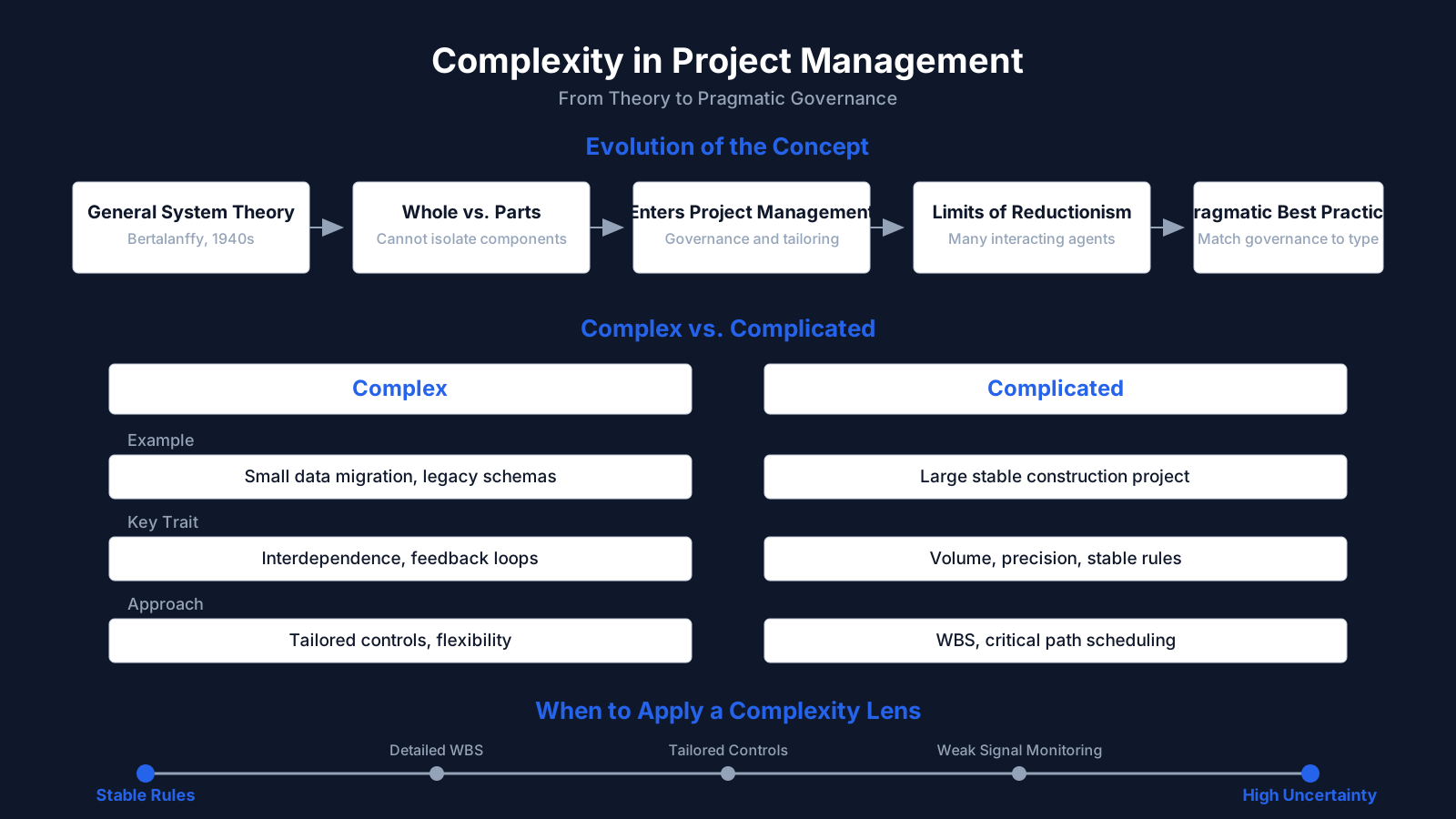
In project management, the complexity definition refers to the condition of a project, program, or portfolio characterized by many interdependent elements, unclear cause-and-effect relationships, emergent behavior, and ambiguity that together make outcomes difficult to predict and control. It is not the same as size, difficulty, or risk, although those factors can amplify it. A small technical migration can be highly complex while a large construction project with stable specifications may be merely complicated. The definition therefore centers on how much uncertainty, interdependence, and emergent behavior a team must absorb to deliver value.
Complexity Definition: Key Topics at a Glance
| Complexity Concept | Project Management Summary |
|---|---|
| Defining complexity | Project complexity arises from tightly coupled dependencies, nonlinear cause and effect relationships, emergent behaviors, and ambiguity, all of which reduce predictability and control over outcomes. |
| PRINCE2 perspective | PRINCE2 treats complexity as an environmental factor that determines the appropriate level of process, governance, and documentation, rather than as a formally defined concept. |
| Agile empirical approach | Agile frameworks respond to unpredictable cause and effect by replacing comprehensive upfront planning with empirical feedback loops, frequent inspection, and adaptation. |
| Behavior of complex systems | A complex system, such as a major airport during severe weather, consists of numerous interacting agents and reinforcing feedback loops that generate cascading delays beyond any single operator's control. |
| PMI practice guidance | PMI practice guidance emphasizes human behavior, system dynamics, and ambiguity, while directing attention to technical, organizational, and external factors that shape project outcomes. |
| Complex adaptive systems | Concepts from complex adaptive systems in biology, ecology, and economics explain emergent outcomes that cannot be understood by analyzing individual components in isolation. |
| Sector impact | Complexity thinking has influenced safety analysis in aviation, patient care coordination in medicine, and modular product architecture in software engineering. |
| Dynamic complexity in practice | A seemingly straightforward product launch can become dynamically complex when a late regulatory approval triggers supplier penalties, contractual renegotiations, and shifting marketing commitments that exceed the scope of a traditional work breakdown structure. |
What Is Complexity in Project Management?
A clear complexity in project management definition must separate the condition from related ideas such as size, difficulty, and risk. The Project Management Institute describes complexity as a characteristic of a project or program that is difficult to manage because of human behavior, system behavior, and ambiguity. PRINCE2 does not define complexity as a single formal term, but its tailoring guidance treats complexity as a factor that influences how much process, governance, and documentation a project needs. Agile frameworks generally approach complexity through the lens of unpredictable cause and effect, where work cannot be fully planned in advance and teams must use empirical feedback loops.
A useful mental model is the difference between a complicated machine and a living ecosystem. A complicated system, like a jet engine, has many parts but predictable relationships, and a trained expert can diagnose and repair it using manuals. A complex system, like an airport on a stormy afternoon, has many interacting agents, local decisions, and feedback loops that can produce delays no single person fully controls. Many projects contain both kinds of work, but treating complex work as merely complicated often leads to brittle plans and failed controls.
Complexity Definition in PMBOK and PRINCE2
Within the PMBOK framework, complexity is not confined to one knowledge area. It appears in Integration Management, Risk Management, Stakeholder Management, and Communications Management because complex projects generate more interfaces and more ambiguous information flows. PMI's practice guidance draws attention to human behavior, system behavior, and ambiguity, and it encourages practitioners to look at technical, organizational, and external factors as contributors. PRINCE2 uses complexity in its tailoring considerations, examining the number of products, the breadth of stakeholder involvement, and the stability of requirements. Neither framework treats complexity as something to eliminate, rather as something to recognize and manage through appropriate controls and feedback.
Complexity Versus Complicated and Uncertain
Complex and complicated are distinct concepts. A complicated project can be analyzed, decomposed, and understood by specialists who reduce it into known parts. A complex project resists full decomposition because interactions between parts create outcomes that no specialist can fully anticipate. Uncertainty is also different from complexity, although they often coexist. Uncertainty is a lack of information, while complexity is a property of the system itself. A team can reduce uncertainty by gathering data, but complexity may remain even after many facts are known because the relationships keep shifting.
Core Insights on Project Complexity
- Complexity distinct from size and risk
- Complexity is a distinct condition emerging from human behavior, system dynamics, and ambiguity, and it resists being folded into measures of size, difficulty, or risk because each demands a different management approach.
- Frameworks define complexity differently
- PMI formalizes complexity as a management challenge driven by behavior and ambiguity, PRINCE2 treats it as a factor that tailors governance and documentation, and Agile methods respond to it as unpredictable cause and effect that demands iterative adaptation.
- Complicated versus complex systems
- A complicated system such as a jet engine contains many components with predictable interactions that experts can analyze and repair, while a complex system such as an airport during severe weather emerges from interacting agents and feedback loops that no single person can fully predict or control.
- Oversimplification causes project failure
- Treating complex work as though it were merely complicated creates brittle plans and controls that break under real conditions, so practitioners need to examine technical, organizational, and external dimensions across product design, stakeholder behavior, and requirement stability.
Origins and Cross-Industry Context
The study of complexity has deep roots in systems thinking, cybernetics, and the natural sciences. Complex adaptive systems concepts, developed in fields such as biology, ecology, and economics, describe how large networks of interacting agents can produce emergent outcomes that cannot be reduced to the behavior of individual parts. Project management borrowed these ideas because many large initiatives behave like adaptive systems rather than mechanical processes. In aviation, medicine, and software engineering, complexity thinking has influenced safety analysis, patient care coordination, and modular product design.
The Cynefin framework, created by Dave Snowden, is widely used to categorize decision making contexts. In the clear domain, cause and effect are obvious and best practices apply. In the complicated domain, cause and effect require analysis and expert judgment. In the complex domain, cause and effect can only be understood in retrospect, so effective responses involve safe-to-fail experiments and rapid feedback. Many enterprise transformation programs, product innovation efforts, and post-merger integrations operate in the complex domain for periods of time, which is why project managers need a broader toolkit than simple variance control.
Key Components and Types of Project Complexity
Project management literature generally breaks complexity into several interacting dimensions rather than a single score. The most common types of project complexity include structural complexity, dynamic complexity, and sociopolitical complexity. Structural complexity relates to the number of elements and their interconnections, such as many work packages, interfaces, systems, or teams. Dynamic complexity appears when cause and effect are separated in time or space, so small decisions can produce delayed or disproportionate consequences. Sociopolitical complexity arises from divergent stakeholder interests, cultural differences, informal power structures, and conflicting priorities.
Ambiguity is often treated as a fourth dimension, although some models fold it into dynamic complexity. A project with ambiguous complexity has unclear requirements, unclear success criteria, or unstable assumptions. Cognitive complexity refers to the mental load placed on leaders and teams when they must make decisions with incomplete information, contradictory signals, and high stakes. These dimensions rarely exist in isolation. A technically straightforward product launch can become dynamically complex because a regulatory approval arrives late, triggering supplier penalties and shifting marketing commitments that no work breakdown structure anticipated.
Structural Complexity
Structural complexity describes the architecture of a project, including the number of deliverables, teams, systems, contracts, and interfaces. When hundreds of work packages share dependencies, a change in one area can ripple across many others. The management response to structural complexity is usually decomposition, interface mapping, modular design, and rigorous configuration control. However, decomposition has limits because it assumes that the whole is simply the sum of its parts. That assumption weakens as interactions multiply and become less predictable.
Dynamic Complexity
Dynamic complexity describes how project variables interact over time. Feedback loops, delays, nonlinearity, and path dependence are common features. A small delay in a design review can cascade through procurement and testing, creating resource conflicts that lead to further delays in ways that a linear schedule does not show. Dynamic complexity is particularly challenging in programs with many concurrent streams because local optimizations can damage overall performance. Practitioners often observe that earned value charts may look acceptable while underlying feedback loops have already locked in future problems.
Sociopolitical and Organizational Complexity
Sociopolitical complexity comes from people and their relationships, not from technology. Conflicting objectives, hidden agendas, organizational silos, and cultural differences can all create unpredictable outcomes. A project with clear technical requirements may still fail because two executives have competing priorities, and their teams interpret the same status data differently. This type of complexity often increases with the number of funding sources, geographic locations, and regulatory regimes. Managing it requires stakeholder engagement, political awareness, and careful communication rather than more detailed technical analysis.
Ambiguity and Cognitive Complexity
Ambiguity refers to the absence of a single shared interpretation. Requirements, success criteria, and even the problem statement can be interpreted in multiple ways. Cognitive complexity is the burden that ambiguity places on decision makers. When leaders face contradictory signals, time pressure, and high consequences, their ability to reason clearly declines. Teams under cognitive overload may simplify prematurely or swing between indecision and impulsive action. This is why high-complexity projects often benefit from structured decision making, visible information radiators, and psychological safety.
Key Insights on Complexity Dimensions
- Complexity spans interacting dimensions
- Project complexity cannot be reduced to a single score; it emerges from the interplay of structural, dynamic, sociopolitical, ambiguity, and cognitive dimensions that continuously influence one another.
- Structural complexity from interconnections
- Structural complexity stems from the volume of discrete elements, including work packages, interfaces, systems, and teams, as well as the density and pattern of their interconnections.
- Dynamic complexity creates cascading effects
- Dynamic complexity emerges when cause and effect are separated in time or space, allowing small decisions to trigger delayed or disproportionate consequences that conventional linear schedules cannot anticipate.
- Sociopolitical complexity involves stakeholders
- Sociopolitical complexity arises from conflicting stakeholder interests, cultural differences, informal power dynamics, and competing priorities that shape decision-making beyond formal authority.
- Ambiguity adds cognitive load
- Ambiguity introduces unclear requirements, shifting success criteria, and unstable assumptions, while cognitive complexity weighs on leaders and teams by forcing high-stakes decisions under incomplete information.
Complexity in PMBOK, PRINCE2, and Agile Frameworks
The way project management frameworks handle complexity in PMBOK has shifted over time from a focus on controlling variables to enabling adaptation. The PMBOK Guide's process groups and knowledge areas provide structure, but its practice guides explicitly acknowledge that highly complex projects require more judgment, tailored governance, and integrated change control. In predictive environments, complexity often appears in the Integration Management and Risk Management knowledge areas, where the project manager must coordinate overlapping constraints and emerging threats. PRINCE2's principle of tailoring invites practitioners to scale the method's themes, processes, and management products according to project complexity. An initiative with many products, teams, suppliers, and external dependencies needs more formal stage boundaries and exception procedures than a simple internal update.
Agile frameworks treat complexity as a reason to shorten feedback loops and defer detailed planning. Scrum and Kanban assume that requirements and technical solutions will evolve, so teams use empirical process control and regular inspection. Hybrid approaches often reserve predictive controls for well-understood components while applying iterative delivery to complex components that need learning. BVOPM applies a related perspective by treating detailed work breakdown structures as potentially unreliable under high complexity, using relational effort points and a five-level scope scale instead of pretending that every future activity can be predicted.
Predictive and Plan-Driven Environments
In plan-driven environments, complexity is often addressed through integrated change control, detailed work breakdown structures, risk registers, and stage gates. These tools provide visibility and accountability, but they can also create an illusion of control if they do not account for emergent behavior. Project managers in predictive environments may need to supplement formal controls with informal sensing mechanisms, such as regular technical reviews and stakeholder consultations. The goal is not to abandon baselines but to recognize that baselines are provisional when complexity is high.
Agile and Hybrid Environments
Agile methods use short iterations, continuous delivery, and frequent customer feedback to manage complexity without requiring complete upfront knowledge. Complexity is accepted as a natural condition of product development, not a failure of planning. Hybrid environments mix this approach with traditional controls. A typical hybrid project might use a detailed WBS for well-understood infrastructure work while using Scrum for a customer-facing application that needs rapid learning. The challenge is ensuring that the governance system does not treat both workstreams with the same reporting cadence and tolerance thresholds.
Practical Application Across the Project Lifecycle
In real project work, complexity assessment in project management tends to be informal and ongoing rather than a one-time scoring exercise. At initiation, sponsors and project managers examine the number of stakeholders, technical novelty, organizational interfaces, regulatory exposure, and schedule pressure to decide how much governance is appropriate. During planning, complexity influences how much decomposition is useful. For a structurally complicated workstream, a detailed WBS may reduce risk; for a dynamically complex one, excessive detail can create false confidence and a maintenance burden.
During execution and monitoring, complexity shows up in change requests, rework loops, unplanned dependencies, and communication failures. Teams often handle this by increasing cadence, using visual management, and shifting from variance control to trend analysis. At closing, lessons learned discussions frequently reveal that the most damaging events were not isolated risks but the interaction of several small changes that nobody saw as a connected pattern. Portfolio managers apply complexity thinking when sequencing programs, because a portfolio of interdependent initiatives can exhibit emergent behavior just as individual projects do.
Project managers, program managers, PMO analysts, and sponsors all use complexity judgments, often without labeling them. A sponsor deciding whether to approve a project charter weighs complexity against strategic importance. A program manager deciding whether to stagger releases considers how much integration risk is acceptable. A PMO designing a reporting process asks whether frequent exceptions signal a complex system that needs different governance, not just stricter compliance.
Lifecycle Applications of Complexity Thinking
- Ongoing informal assessment
- Complexity is evaluated as an ongoing management discipline, informing decisions throughout the project lifecycle rather than being reduced to a single formal score at the outset.
- Initiation governance calibration
- At project initiation, managers calibrate governance intensity against stakeholder scale, technical novelty, organizational interfaces, and schedule pressure, ensuring oversight matches the project's actual complexity profile.
- Execution adaptation strategies
- As execution unfolds, rework, change requests, and communication breakdowns reveal emergent complexity, leading teams to shorten planning cycles, introduce visual controls, and shift from static variance reporting to ongoing trend analysis.
- Cross-project pattern recognition
- Closure reviews show that significant disruptions frequently stem from the interaction of minor changes, and portfolio managers apply the same complexity perspective when sequencing interdependent programs and managing cross-project dependencies.
Common Challenges, Pitfalls, and Misconceptions
One of the most persistent common misconceptions about project complexity is that it can be eliminated by adding more detailed planning, stricter reporting, or stronger governance. In complicated environments those controls help, but in complex environments they can make things worse by slowing down learning and creating an illusion of control. Another misconception is that complexity equals size or budget. A small software migration with poor data quality and unclear ownership can be far more complex than a large construction project with stable specifications and known engineering practices.
A related pitfall is over-simplification. Executives sometimes compress a complex situation into one metric or one root cause, then demand a single action plan. This produces what experienced project managers call the fallacy of false precision, where a confident schedule or risk matrix masks deep uncertainty. Practitioners also observe that complexity is often treated as a problem to solve rather than a condition to manage. The practical consequence is that teams waste energy trying to convert complex work into predictable work instead of designing feedback loops, buffers, and optionality.
Another challenge is that indicators of emerging complexity are easy to miss in status reports. Rework rates, increasing informal communication, delayed decisions, and rising exceptions are often early signals. Governance boards trained on earned value variance may not ask about those signals. When complexity is denied or ignored, projects drift into firefighting, hero behavior, and blame cycles. These are organizational symptoms, not just technical ones. At the same time, labeling a project complex is not a license to avoid plans, metrics, or commitments. It means choosing the right kind of plan and the right type of metrics.
Relationships to Other Project Management Concepts
Understanding complexity versus risk matters because the two concepts are often confused. Risk management assumes that events or conditions can be identified, assessed, and assigned probability and impact. Complexity, by contrast, describes a systemic condition in which cause-and-effect relationships are unclear, emergent, or unstable, so probabilities may be unknowable. A risk register can list a supplier failure, but it cannot fully capture how that failure might interact with a design change, a regulatory delay, and a key person leaving. Complexity thinking therefore complements risk management rather than replacing it.
Complexity also interacts with uncertainty, ambiguity, volatility, and systems thinking. Uncertainty is a lack of knowledge; ambiguity is multiple possible interpretations; volatility is rapid change. Complexity can amplify all three. Systems thinking provides tools such as causal loop diagrams and stock-and-flow models to visualize feedback and nonlinearity. Scope management, stakeholder engagement, and change control are all affected by complexity, because high complexity tends to generate more frequent change requests and hidden dependencies. In governance, complexity calls for lighter but more frequent decision forums, while complicated work benefits from deeper expert review.
There is also a close connection between complexity and resilience. A resilient project has slack, redundancy, modularity, and rapid feedback. These features do not reduce complexity, but they help the project absorb shocks and continue functioning. Conversely, a highly optimized plan with no slack may look efficient on paper but is fragile when complex interactions emerge. Project managers who understand this are less likely to view every buffer as waste and more likely to protect optionality.
Key Insights on Complexity Interactions
- Complexity complements risk management
- Risk management operates on the assumption that events can be identified and assigned probabilities, whereas complexity describes systemic conditions in which cause and effect are not directly traceable, making the two disciplines complementary rather than competing.
- Uncertainty, ambiguity, and volatility defined
- Uncertainty denotes incomplete knowledge, ambiguity arises when multiple plausible interpretations coexist, and volatility reflects rapid and unpredictable change. Each of these conditions calls for a distinct management response.
- Systems thinking visualization tools
- Causal loop diagrams and stock-and-flow models enable project teams to surface feedback loops and nonlinear dynamics that conventional linear planning tools often overlook, making system behavior more visible before decisions are made.
- Broader impact on project practices
- High complexity tends to produce frequent change requests and latent interdependencies, prompting governance structures that rely on shorter, more frequent decision cycles and schedules with intentionally built-in slack.
Evolution and Current Thinking
The evolution of complexity thinking in project management reflects a broader shift from deterministic control models toward adaptive and probabilistic approaches. Early project management methods borrowed from industrial engineering, assuming that enough decomposition and measurement could make any project predictable. The rise of software development, enterprise change programs, and cross-border initiatives revealed the limits of that assumption. PMI's practice guidance now treats complexity as a core strategic consideration, and agile methods have normalized iterative learning. The Cynefin framework has helped leaders choose different responses: best practices for clear domains, expert analysis for complicated ones, safe-to-fail experiments for complex ones, and immediate stabilization for chaotic ones.
Current thinking remains divided about how much complexity should be formalized. Some organizations use complexity scoring models during project intake; others argue that scoring creates false confidence and that complexity is better sensed through ongoing dialogue and weak signal monitoring. There is also debate about whether complexity is an objective property of a project or a subjective perception of the people managing it. A project may be highly complex for a new team with limited context and manageable for an experienced team with established relationships. This context dependence is why mature organizations manage complexity as a dynamic condition rather than a static label.
Another emerging perspective treats complexity not as an obstacle to be reduced but as a source of innovation. Emergent outcomes can be beneficial when teams create conditions for learning, such as small experiments, diverse perspectives, and fast feedback. That said, beneficial emergence requires discipline. Without clear boundaries and escalation paths, complexity can easily slide into chaos. The current best practice is therefore pragmatic: understand the type of complexity, match governance and delivery methods to that type, and preserve enough flexibility to change the approach when the complexity profile shifts.