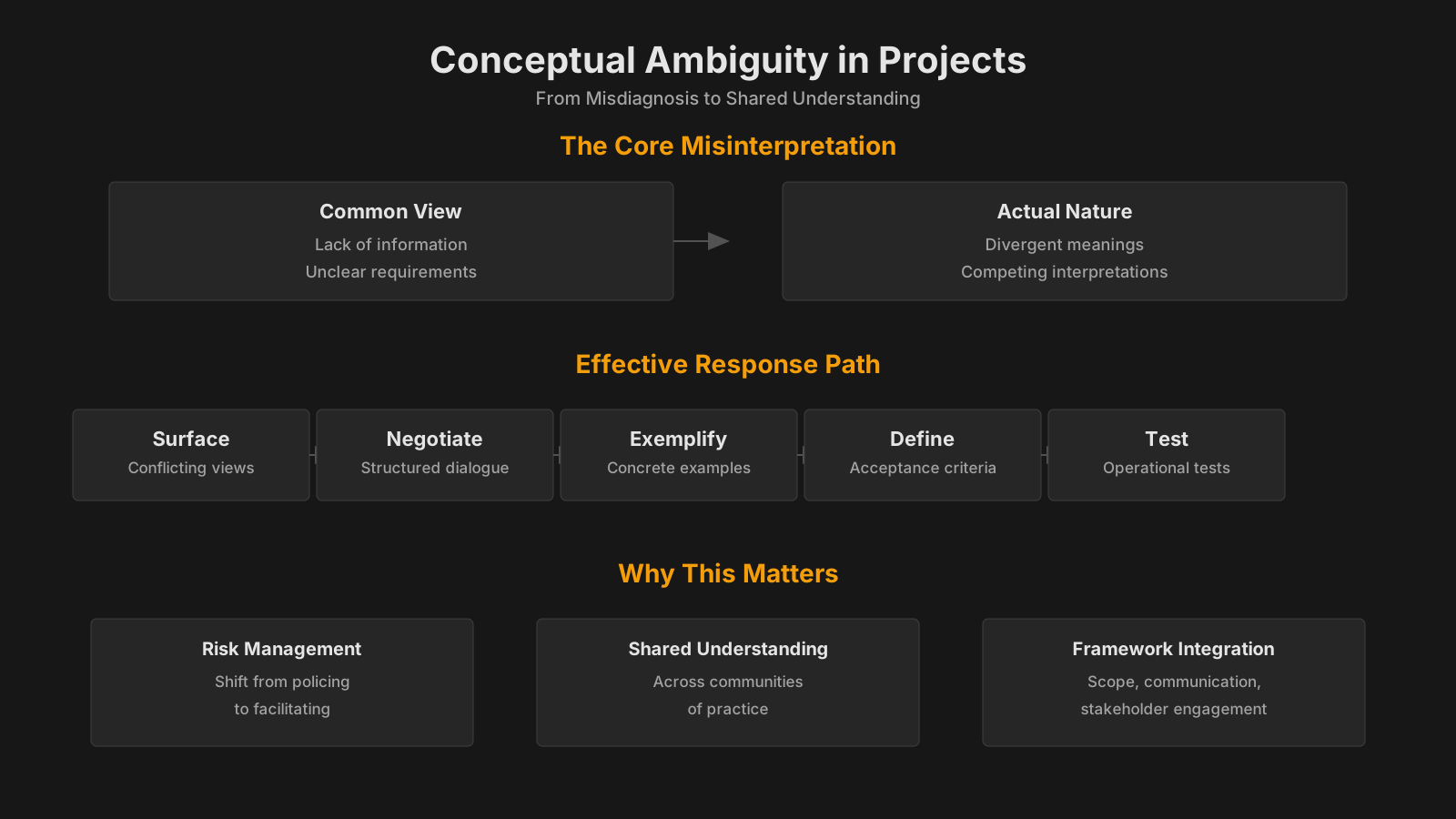
Conceptual ambiguity in project management is defined as the condition where a term, requirement, objective, or deliverable can be interpreted in multiple plausible ways by different stakeholders, leading to misaligned expectations and execution risk. It refers to uncertainty that does not stem from missing information but from the absence of a shared meaning. A project may have a fully documented scope statement, a signed charter, and detailed specifications, yet still suffer from conceptual ambiguity because the words themselves carry divergent meanings across business units, technical teams, and sponsors. Within the PMBOK framework, this condition is not treated as a standalone process but as a recurring source of risk that affects scope, communication, quality, and stakeholder engagement. Understanding conceptual ambiguity is foundational because it explains why projects with identical documents and methodologies can produce radically different outcomes depending on who interprets those documents.
Key Topics in Conceptual Ambiguity
| Concept | Summary |
|---|---|
| Conceptual Ambiguity | Conceptual ambiguity arises when a term, requirement, objective, or deliverable supports multiple plausible interpretations among stakeholders, leading to misaligned expectations, rework, and execution risk. |
| Limitations of Formal Documentation | Formal scope statements, signed charters, and detailed specifications do not eliminate conceptual ambiguity because language carries different meanings across business units, technical disciplines, and executive sponsors. |
| Semantic Divergence in Practice | The word "complete" may signal functionally operational to a developer, legally certified to a compliance officer, or ready for customer billing to a finance lead, revealing how a single term can trigger conflicting acceptance criteria. |
| Intellectual Foundations | The concept draws on philosophy, linguistics, and cognitive science, where a single word or mental category maps to multiple referents depending on context, speaker intent, and interpretive frame. |
| Adoption Across Disciplines | It migrated into systems engineering, software development, and management science because complex technical projects create recurring conditions in which language, models, and operational reality diverge. |
| Aviation Safety Precedent | Aviation uses scripted phraseology and mandatory readbacks precisely because an instruction such as "turn left" can shift meaning with aircraft orientation, controller perspective, and timing, making shared scripts a safety critical control. |
| Project Management Mitigation | Project management treats ambiguity as a systemic condition and mitigates it through iterative clarification, stakeholder validation, controlled vocabulary, and baselined definitions. |
| Role Ambiguity and Boundary Definition | Role ambiguity emerges when accountability terms such as "oversee," "support," or "coordinate" imply different levels of ownership, and it is resolved by establishing a shared boundary definition that tests whether a deliverable falls inside or outside a role. |
What Is Conceptual Ambiguity in Project Management?
A conceptual ambiguity definition centers on the gap between a shared vocabulary and a shared understanding. In project environments, practitioners often assume that using the same word means sharing the same concept. That assumption can be dangerous. For example, the word "complete" might mean functionally operational to a developer, legally certified to a compliance officer, or ready for customer billing to a finance lead. All three interpretations are reasonable within their own domains, yet none is inherently more correct than the others absent a governing definition. Conceptual ambiguity is therefore not a language problem in the ordinary sense. It is a cognitive and organizational problem rooted in how individuals frame their work, their incentives, and their professional identities.
What makes conceptual ambiguity distinct from vagueness is that vague terms provide too little information to determine meaning, while ambiguous terms provide too many possible meanings. A vague requirement might state that a system should be "fast." An ambiguous requirement might state that the system should support "standard reporting." The word "standard" can mean industry-standard, company-standard, or a technical protocol. Each interpretation is clear on its own, but they conflict when operationalized. This distinction matters because project managers often respond to vagueness by requesting more detail. That response does not resolve ambiguity. More detail can actually deepen it by adding more terms that themselves carry competing meanings.
In practice, conceptual ambiguity surfaces most often when stakeholders come from different professional communities. A sponsor discussing "value" may be thinking about quarterly revenue impact. An operations manager may think about process stability. An Agile team may think about customer satisfaction and flow efficiency. None of them is wrong. The project manager inherits the task of reconciling these interpretations without dismissing any of them as uninformed. This is not a simple translation exercise. It requires recognizing that the ambiguity is not a defect in communication that can be fixed once, but a persistent organizational condition that must be managed throughout the project lifecycle.
Essential Takeaways on Conceptual Ambiguity
- Gap between vocabulary and understanding
- Conceptual ambiguity emerges when teams share identical terminology yet operate from fundamentally different underlying concepts, leaving a gap between common vocabulary and genuine understanding.
- Same word, different meanings
- The word "complete" may mean functionally operational to a developer, legally certified to a compliance officer, or ready for customer billing to a finance lead, depending on each role's priorities.
- Beyond a language problem
- Rather than a simple language problem, conceptual ambiguity is a cognitive and organizational issue rooted in how individuals frame their work, incentives, and professional identities.
- Ambiguity distinct from vagueness
- Vagueness offers too little detail to settle on a single meaning, whereas ambiguity presents too many competing interpretations that can each seem valid.
- Risky assumption of alignment
- Project practitioners often assume that shared vocabulary implies shared understanding, but that assumption becomes hazardous without an authoritative definition to anchor the term.
Origins and Cross-Industry Context of Conceptual Ambiguity
The concept of conceptual ambiguity has deep roots in philosophy, linguistics, and cognitive science, where it has long been studied as a feature of natural language and categorization. Conceptual ambiguity explained in these fields refers to the way a single lexical item or mental category can map to multiple distinct referents depending on context. From there, the idea migrated into systems engineering, software development, and management science, largely because complex technical projects are exactly the environments where language and reality drift apart. In software engineering, for instance, the term "requirement" itself has been the subject of decades of debate over whether it denotes a capability, a constraint, a user story, or a contract clause.
Outside project management, aviation and medicine offer instructive parallels. In aviation, standardized phraseology exists precisely because ordinary language proved too ambiguous for high-stakes coordination. Pilots and air traffic controllers use scripted phrases and readbacks because a seemingly clear instruction like "turn left" can be interpreted differently depending on aircraft orientation, perspective, and timing. Medicine has similar struggles with diagnostic terminology, where a term like "stable" can mean no immediate deterioration, acceptable for discharge, or unchanged over a defined observation window. These fields demonstrate that conceptual ambiguity is not merely an annoyance. In high-consequence environments, it becomes a direct source of error, and therefore the institutions built around those fields invest heavily in controlled vocabularies.
Project management inherited the problem without always inheriting the rigor of controlled language. Unlike aviation, most projects do not operate under a single regulatory body that mandates precise phraseology. Unlike medicine, project teams rarely have the time or authority to standardize every term before work begins. Instead, project management has developed a more pragmatic response: recognize ambiguity as a systemic condition and manage it through iterative clarification, stakeholder validation, and baselined definitions. This approach acknowledges that while perfectly eliminating conceptual ambiguity is unrealistic, reducing its most damaging effects is both possible and necessary.
Key Components and Types of Conceptual Ambiguity
Understanding the key components of conceptual ambiguity requires distinguishing between the source of ambiguity, the location where it manifests, and the mechanism by which it creates harm. The source is usually a mismatch between stakeholder mental models. A mental model is the internal representation a person holds about how something works, what it includes, and what it excludes. When two stakeholders hold different mental models of a deliverable but use the same label, the ambiguity lives not in the document but in the gap between those internal representations. The location is often a scope statement, a requirement, an acceptance criterion, a metric, or even a project role title. The mechanism of harm is typically a delayed discovery: the discrepancy becomes visible only when a deliverable is demonstrated, tested, or handed over.
There are several recognizable types of conceptual ambiguity in project settings. Semantic ambiguity occurs when a word has multiple dictionary or domain-specific meanings. Referential ambiguity occurs when a term points to different objects depending on who is speaking. Structural ambiguity occurs when the grammar of a statement allows two readings, as in "modify the report and the dashboard that supports finance." Boundary ambiguity occurs when the edges of a category are unclear, such as what counts as a "critical defect" versus a "major defect." Finally, role ambiguity occurs when responsibilities are described with terms like "oversee," "support," or "coordinate" that imply different levels of accountability to different people. Each type demands a slightly different management response, though all share the common feature of being invisible at the moment of agreement.
A useful way to grasp this is to imagine a project charter that authorizes the development of a "customer portal." To the sponsor, the customer portal is a marketing-facing website that reduces call center volume. To the IT architect, it is a set of backend services exposed through an interface layer. To the legal team, it is a data-processing application subject to privacy regulations. The phrase appears once in the charter, but it carries three operational meanings. The ambiguity is not resolved by reading the charter more carefully. It can only be resolved by creating a definition that all three parties can use to test whether a given design, component, or workflow falls inside or outside the boundary of the portal. Without that test, the project team will likely build all three versions and call them one.
Semantic and Referential Ambiguity in Requirements
Semantic ambiguity in requirements is among the most common sources of rework in predictive and hybrid projects. A requirement that says "the system shall notify the user" leaves open what notification means: an in-app message, an email, a text message, or a mobile push notification. Each option has different cost, architecture, and user-experience implications. Referential ambiguity, by contrast, arises when the same term points to different entities. For instance, a requirement may say "the manager approves the request." In a large organization, there may be several roles colloquially called "manager," and the requirement may not specify whether the approver is the line manager, the budget manager, the compliance manager, or a system-defined role. These distinctions are not academic. They become visible only when the wrong person approves, or when an approval workflow is built around an assumption that one stakeholder group never validates.
Project practitioners often observe that semantic ambiguity is easier to detect in review sessions than referential ambiguity. A reviewer can ask, "What do we mean by notification?" and expose the semantic gap. Referential ambiguity stays hidden because the same word seems to refer to a single obvious entity in each stakeholder's mind. The project manager who assumes that "the manager" is universally understood inherits the conflict later. This is why many mature organizations maintain project glossaries or data dictionaries that define not just technical terms but also business terms that cross departmental lines. The glossary does not eliminate ambiguity, but it forces disagreements into the open early enough to be managed.
Boundary and Role Ambiguity in Deliverables and Teams
Boundary ambiguity in deliverables is closely related to the concept of definition of done in Agile and "acceptance criteria" in predictive delivery. A team may agree that a feature is done when it is tested, documented, and reviewed. But what counts as tested? Does it mean unit tested, integration tested, user acceptance tested, or all three? Each boundary draws a different line around the completion of work. Similarly, a quality threshold like "critical defect" may be defined for one product but not another, and the absence of a boundary definition allows different testers to classify the same bug in different categories. The result is a quality report that looks objective but contains a hidden layer of subjective judgment.
Role ambiguity works differently. It is not about what a thing is but about who owes what to whom. Terms like "own," "drive," "facilitate," and "support" appear frequently in RACI matrices and job descriptions, but their meanings vary across organizational cultures. A "driver" in one organization is expected to perform most of the work. In another, a driver simply coordinates others who perform the work. When a project manager imports a RACI template without calibrating these terms, the matrix offers the appearance of clarity while concealing deep accountability gaps. Conceptual ambiguity in roles becomes especially dangerous in cross-functional teams, where members from different departments carry different assumptions about what it means to "support" a workstream.
Core Insights on Ambiguity Types
- Three required components
- Effective analysis of conceptual ambiguity depends on distinguishing three elements: the underlying source, the point at which the ambiguity becomes visible, and the mechanism through which it creates risk.
- Semantic ambiguity from multiple meanings
- Semantic ambiguity occurs when a word or phrase carries several dictionary or domain-specific meanings, leaving more than one interpretation valid until context resolves the intended sense.
- Structural ambiguity in grammar
- Structural ambiguity arises when a sentence’s grammar permits two distinct readings, for example when a modifier can attach equally to either of two nouns.
- Boundary ambiguity in categories
- Boundary ambiguity appears when the edges of a category are not clearly defined, such as when teams must decide whether a defect counts as critical or major.
- Role ambiguity and accountability
- Role ambiguity develops when terms like “oversee” or “coordinate” suggest different levels of authority and accountability to different stakeholders, weakening clear ownership.
Conceptual Ambiguity in PMBOK and PRINCE2 Frameworks
Within the PMBOK framework, conceptual ambiguity is not named as a formal knowledge area, but it cuts across several of them. It is most visible in Project Scope Management, Project Communication Management, Project Risk Management, and Project Stakeholder Management. Conceptual ambiguity PMBOK treatment appears through tools like requirements traceability matrices, stakeholder engagement plans, and risk registers. Each tool creates a place where ambiguity can be detected and recorded. A stakeholder register that includes expectations, influence level, and communication preferences is not just an administrative artifact. It is a structured prompt for the project manager to ask whether two stakeholders have different interpretations of the same stated interest.
The PMBOK emphasis on baselines also intersects with conceptual ambiguity in a specific way. A baselined scope statement is supposed to provide a controlled reference point. Yet a baseline can only control what it explicitly defines. If the scope statement says "implement a standard CRM integration," and the word "standard" is never defined, the baseline itself is ambiguous. In that case, the change control process becomes the mechanism through which the ambiguity is eventually resolved, because the moment a stakeholder disputes whether a specific integration feature is included, the project team must interpret the original intent. Change requests often emerge not because stakeholders changed their minds, but because they discovered that their original interpretation was not shared. This is a crucial insight: many things that look like scope changes are actually the delayed surfacing of conceptual ambiguity.
PRINCE2 addresses the issue differently. The methodology relies heavily on management products, stage boundaries, and a clear separation between project direction, management, and delivery. PRINCE2 does not use the term "conceptual ambiguity" explicitly, but its principles embed responses to it. The principle of defined roles and responsibilities reduces role ambiguity by naming specific accountability at each level. The principle of focus on products encourages teams to describe outputs in terms of their purpose, composition, derivation, format, and quality criteria. A product description that forces a team to define what a deliverable is, who needs it, and what quality criteria it must meet directly attacks conceptual ambiguity at the requirement level. Even so, PRINCE2 product descriptions can still contain ambiguous terms. The methodology manages this residual risk through stage boundaries, where the project board reviews the evolving understanding of products before authorizing the next stage.
How Lifecycle Choice Shapes Ambiguity Risk
Predictive lifecycles tend to treat conceptual ambiguity as something to resolve early through detailed planning, signed requirements, and formal acceptance criteria. This approach works when the domain is stable and stakeholders can articulate their interpretations with confidence. It fails when the ambiguity is irreversible or undiscoverable until a working product exists. A sponsor may not know that "integration" means real-time data synchronization until they see a batch-fed prototype. No amount of upfront questioning will surface that gap because the sponsor does not yet have the experience to recognize their own assumption.
Agile and iterative lifecycles accept that conceptual ambiguity often cannot be resolved analytically in advance. Instead, Agile teams use working software, frequent demonstration, and user feedback to reveal where interpretations diverge. A user story that says "as a customer, I want to see my order status" may be implemented in many ways. The story becomes clearer only when the team demonstrates a working version and the product owner says, "That is not what I meant by status." The ambiguity was always there. The demonstration merely made it visible. From this perspective, Agile's incremental delivery is not just about responding to change. It is also a mechanism for discovering the hidden ambiguity that predictive projects would not find until much later.
Conceptual Ambiguity in Agile and Hybrid Environments
In Agile environments, the phrase "shared understanding" is often used as a safeguard against conceptual ambiguity. Teams use techniques like story mapping, specification by example, behavior-driven development, and three amigos sessions to align mental models before development begins. Conceptual ambiguity in Agile teams is managed less through formal documentation and more through repeated conversation around concrete examples. The assumption is not that the team will define every term perfectly, but that frequent collaboration will expose divergent interpretations quickly and cheaply. A product owner who describes "user profile completion" and a developer who builds a five-field form discover their mutual misunderstanding during sprint review, not at release.
Hybrid environments face a particular challenge. They often inherit predictive governance structures, such as stage gates and approval boards, while using Agile delivery methods at the team level. In these settings, conceptual ambiguity can be magnified because different layers of the organization use the same words within different frameworks. The term "acceptance" may mean formal sign-off at the governance layer but informal product owner approval at the team layer. The term "release" may mean a scheduled deployment to an operations team, a market launch, or a version made available to users. A hybrid project manager must actively map these terms across the predictive and Agile layers to prevent governance decisions from being based on one interpretation while delivery work proceeds on another.
One subtle danger in Agile is that ceremony and jargon can create a false sense of shared meaning. A team may routinely say "definition of done" and believe they have aligned, while individual members still define "tested" differently. A product owner may say "minimum viable product" without specifying the hypotheses the MVP is meant to validate. In these cases, the label provides social comfort but not operational precision. Experienced Scrum Masters and Agile coaches recognize this and press teams to define terms through observable behavior and concrete examples rather than through synonyms and abstractions.
Core Takeaways on Conceptual Clarity
- Shared understanding as a safeguard
- Agile teams deliberately build shared understanding before development begins, reducing conceptual ambiguity before it can create costly implementation errors.
- Example-driven alignment techniques
- Story mapping, specification by example, behavior-driven development, and three amigos sessions align mental models by grounding abstract ideas in concrete, mutually visible examples.
- Conversation beats formal documentation
- Agile manages ambiguity through repeated conversation about specific examples rather than through detailed written specifications, allowing meaning to be negotiated and refined in context.
- Early exposure of divergent interpretations
- Frequent collaboration surfaces mismatched assumptions quickly and at low cost, ensuring that misunderstandings emerge during sprint reviews rather than only after release.
- Hybrid governance magnifies ambiguity
- In hybrid settings, predictive governance layers and Agile delivery teams often attach different meanings to the same terms, so critical words such as "release" require explicit mapping across both frameworks.
Purpose and Importance of Managing Conceptual Ambiguity
The primary purpose of managing conceptual ambiguity is to reduce the distance between what stakeholders think they agreed to and what the project delivers. Purpose and importance of conceptual ambiguity management is therefore tied directly to value realization, because a deliverable that meets a literal requirement but violates a stakeholder's deeper expectation still fails to deliver value. A reporting dashboard may pass every written acceptance test yet disappoint the sponsor who expected it to support a weekly leadership meeting in a specific way. The failure is not technical. It is conceptual. Closing that gap requires the project manager to see ambiguity not as an isolated defect to be corrected but as a strategic condition that shapes the entire delivery approach.
There is also a political dimension. In many organizations, stakeholders prefer not to surface ambiguity because it exposes unresolved disagreements or lack of domain knowledge. A requirements workshop may produce agreement precisely because no one wants to ask the question that would reveal conflicting expectations. The project manager who manages ambiguity effectively creates a safe structure for disagreement to emerge without personal blame. This is not a soft skill bolted onto project management. It is a core discipline that determines whether the project can evade the late-stage disputes that consume budgets and erode trust.
Neglecting conceptual ambiguity has quantifiable consequences. Rework increases, testing cycles lengthen, change requests multiply, and governance boards become frustrated with what appears to be an undisciplined team. Yet the team may not be undisciplined at all. It may simply be the first group to discover that the organization never shared a common meaning. The most effective project managers anticipate this and build ambiguity discovery into their plans through early prototyping, structured reviews, and explicit definitional checkpoints.
Conceptual Ambiguity and the BVOP Perspective
Business Value-Oriented Project Management recognizes that ambiguous definitions of value can cause even a technically successful project to deliver little measurable benefit. The BVOP approach to project initiation emphasizes formal stakeholder input validation, requiring that all relevant roles have the opportunity to raise concerns before a project is formally authorized. In practice, this creates an early forum where conflicting interpretations of business terms can be surfaced rather than inherited silently into the project plan. For planning activities, BVOP also warns about the inaccuracy of work breakdown structures when scope boundaries are unclear, and it treats scope change as a form of user feedback rather than as an automatic failure of planning discipline. These practices do not eliminate conceptual ambiguity, but they shift the organization's posture from punishing its discovery to using it as information.
Practical Application and Real-World Scenarios
Conceptual ambiguity is most actively managed during project initiation and planning, but its effects are felt throughout delivery. During initiation, the project charter and stakeholder register offer the first formal opportunities to capture competing definitions. A project manager might ask sponsors, operational leaders, and technical leads to each define the expected end state in their own words, then compare those definitions for divergence. This need not be a lengthy exercise. The point is not to resolve every ambiguity immediately but to identify which ambiguities carry high stakes and which can safely remain open. Not all conceptual ambiguity deserves equal attention. A minor naming inconsistency in an internal status report is not the same as ambiguity about what constitutes a security incident in a regulated environment.
During planning, requirements workshops and product breakdown sessions become the primary arenas for reducing ambiguity. Techniques such as facilitated workshops, use case walkthroughs, and acceptance test development force stakeholders to externalize their assumptions. A carefully crafted acceptance criterion such as "the export file must be readable by the existing finance system, version 4.2, without manual reformatting" is far less ambiguous than "the export file must be compatible with finance." The former creates a testable boundary. The latter invites each stakeholder to fill in the boundary themselves. Even then, practitioners should treat acceptance criteria as provisional. A criterion that seemed precise in planning can become ambiguous when a specific edge case appears in testing.
During execution and monitoring, conceptual ambiguity often appears as subtle misalignment in status reporting. A workstream owner may report that a component is "complete" while the quality team considers it only "development complete." A sponsor may hear "on track" and interpret it as "will meet the original date with no trade-offs," while the project manager means "still within the current forecast after accounting for approved changes." These reporting ambiguities can erode trust over time. The remedy is not to eliminate words like "complete" and "on track," but to establish project-specific definitions and consistently reinforce them. This is why many mature project environments attach short definitions to key status terms directly in the project communication plan.
Where Stakeholder and Communication Management Intersect with Ambiguity
Stakeholder management is both a source of and a response to conceptual ambiguity. Stakeholders enter the project with preexisting assumptions shaped by their function, incentives, and history. A sales leader may define "customer" as a paying account. A product manager may define "customer" as an end user of a feature. A legal team may define "customer" as the entity under contract. The project manager who fails to recognize this may create a stakeholder map that groups all three under a single label and then wonders why their priorities diverge. Effective stakeholder analysis does not merely record names and influence levels. It explicitly probes what key stakeholders mean when they use the project's most important terms.
Communication management provides the vehicle for resolving ambiguity, but only if messages are tested for shared understanding. A written status report sent to twenty stakeholders assumes that the language carries the same meaning to each reader. That assumption is often wrong. In high-ambiguity projects, project managers supplement written communication with periodic briefing sessions where stakeholders can ask questions about what specific terms mean in the current context. These sessions are not a sign of communication failure. They are a form of active calibration. The alternative is a project where everyone reads the same words and walks away with a different picture of the project's health and direction.
Core Insights on Ambiguity Management
- Initiation captures competing definitions
- Project charters and stakeholder registers create a structured baseline for capturing the distinct ways sponsors, operational leads, and technical experts describe the intended end state, making hidden definitional conflicts visible before they affect execution.
- Prioritize ambiguities by stakes
- High-stakes ambiguities, such as defining a security incident in a regulated environment, require formal resolution early, while low-stakes ones like a minor naming inconsistency in an internal report can safely remain open without derailing progress.
- Precise acceptance criteria reduce ambiguity
- Facilitated workshops and precisely worded acceptance criteria, including explicit system versions and formatting requirements, compel stakeholders to surface hidden assumptions that vague statements such as "compatible with finance" leave unresolved.
- Briefings clarify evolving terminology
- In high-ambiguity projects, periodic briefing sessions complement written updates by giving stakeholders a forum to clarify how key terms are being used at each stage, reducing the risk that phrases like "on track" are interpreted differently across teams.
Common Challenges, Pitfalls, and Misconceptions
A common misconception is that conceptual ambiguity is simply poor communication that better writing can solve. Common challenges with conceptual ambiguity include the fact that many ambiguous terms are invisible to the people using them because each person's interpretation feels self-evident. A stakeholder who has worked in finance for twenty years may not recognize that "recognized revenue" can mean billed, collected, or contractually earned depending on accounting policy. The project team may create a detailed requirements document that uses the term repeatedly without ever defining it. The document appears rigorous, yet it contains a core ambiguity that will surface only when the finance system is tested against real transactions. This invisibility is what makes conceptual ambiguity so resistant to purely documentation-based solutions.
Another pitfall is over-standardization. Organizations sometimes respond to ambiguity by imposing rigid glossaries and definitional templates that attempt to lock every term into a single meaning across all projects. This can backfire because context matters. A term that means one thing in a software project may reasonably mean something different in a construction or process improvement project. The attempt to force universal definitions can create new ambiguities by stripping terms of the context that gave them precision. Experienced practitioners recognize that conceptually ambiguous terms should be defined at the level where the ambiguity matters, not necessarily at the enterprise level.
There is also a political pitfall in treating ambiguity as a purely technical issue. Ambiguity frequently serves a social function. Stakeholders may prefer ambiguous language because it allows them to support a project without committing to specific trade-offs. A governance board may bless an initiative with terms like "improve operational excellence" because it sounds reasonable, yet that phrase commits the board to nothing. The project manager who demands a precise definition may be seen as obstructionist or difficult. Managing this requires political awareness. The goal is not to force every stakeholder into uncomfortable exactness at every moment, but to know which ambiguities can be tolerated temporarily and which must be resolved before irreversible commitments are made.
When Conceptual Ambiguity Should Not Be Pushed to Zero
There are situations where attempting to eliminate conceptual ambiguity entirely is not only impractical but counterproductive. Early-stage innovation projects often benefit from strategic ambiguity because it allows exploration without prematurely narrowing options. Forcing exact definitions before the team has learned enough about the problem space can lock in wrong assumptions. Similarly, in organizational transformation efforts, broad language can create an umbrella under which different groups can coalesce while negotiations proceed. The risk is that the ambiguity persists too long and becomes a cover for unresolved conflict. The skill lies in knowing when to shift from strategic ambiguity to operational precision. That shift typically occurs when the project must commit resources, sign contracts, or begin building a deliverable that is expensive to reverse.
This nuance is important because it distinguishes mature ambiguity management from a naive call for clarity everywhere. A project manager who demands precise definitions for every term in every meeting will exhaust stakeholders and slow progress. A project manager who ignores ambiguity altogether will preside over expensive rework. The effective practitioner learns to triage ambiguity based on three questions. How expensive is the downstream decision that depends on this term? How likely are stakeholder interpretations to diverge? And how reversible is the commitment being made now? Ambiguity that scores high on consequence and divergence and low on reversibility deserves immediate attention. Everything else can wait.
Relationships to Other Project Management Concepts
Conceptual ambiguity is tightly linked to requirements traceability, configuration management, risk management, and quality planning. Conceptual ambiguity vs scope creep is a useful comparison because the two are often confused. Scope creep refers to the uncontrolled expansion of a project's scope after the baseline has been established. Conceptual ambiguity refers to the multiple interpretations that may have existed within the baseline all along. When a stakeholder challenges a deliverable and demands additional work, the project manager may classify it as scope creep. But if the original scope statement was ambiguous, the stakeholder may be correctly enforcing their original interpretation. The change is not an expansion. It is a clarification of what was already intended in one stakeholder's mind. Recognizing this distinction changes the nature of the conversation from one about discipline to one about interpretation.
The relationship between conceptual ambiguity and risk management is equally important. Some project teams maintain risk registers that account for technical uncertainty, market shifts, and resource availability, but overlook the risk embedded in language itself. A risk statement that says "there is a possibility that stakeholders have different interpretations of the term critical integration" is not a typical entry. Yet this risk is often more actionable than abstract entries about changing requirements. By converting ambiguity into named risks, the project manager can apply standard risk responses: avoid the ambiguity through clarification, mitigate it through prototypes and demonstrations, transfer part of it through delegation to business analysts, or accept it with contingency reserves for rework. The risk management process thus becomes a formal home for what might otherwise remain an informal worry.
Quality management also intersects with conceptual ambiguity at the point of acceptance. Quality is often defined as conformance to requirements. But if the requirements are ambiguous, conformance itself becomes unmeasurable. Two testers may evaluate the same deliverable against the same requirement and reach different conclusions because they operationalize the requirement differently. This is why many quality plans include explicit interpretation rules, such as requiring defect severity to be determined by a cross-functional review board rather than by individual testers. The interpretation rules do not remove ambiguity from the requirements. They create a governing mechanism for resolving ambiguity when it surfaces in testing. That mechanism is a quality artifact, but it is also an essential ambiguity management tool.
Distinguishing Conceptual Ambiguity from Related Terms
Conceptual ambiguity is often confused with uncertainty, equivocation, and abstraction. Uncertainty refers to a lack of information about what will happen or what is true. Ambiguity refers to a surplus of possible meanings. The two can coexist, but they demand different responses. More research reduces uncertainty. More analysis, more conversation, and more shared examples reduce ambiguity. Equivocation carries a more deliberate connotation, suggesting that language is being used to avoid commitment. Conceptual ambiguity may be entirely unintentional, and in many cases the participants are unaware of it. Abstraction is different again. An abstract term is broad but not necessarily ambiguous. "Transportation" is abstract, but if the project context clarifies that it means the movement of physical goods within a defined region, it may not be ambiguous. Ambiguity exists only when the abstraction allows multiple incompatible interpretations in practice.
These distinctions matter because project managers sometimes respond to ambiguity with tools designed for uncertainty. They gather more data when they need better shared definitions. They create more detailed schedules when they need more precise language. Or they retreat to abstraction to paper over a conflict that needs direct conversation. Each mismatch delays the real work of aligning meaning.
Key Takeaways on Conceptual Ambiguity
- Ambiguity versus scope creep
- Conceptual ambiguity stems from multiple legitimate interpretations that were embedded in the original baseline, while scope creep typically arises from demands for new work, and recognizing which one applies shifts the discussion from enforcing discipline to clarifying interpretation.
- Ambiguity as named risk
- Converting ambiguity into a named risk on the risk register enables project managers to apply standard risk responses: avoid it through clarification, mitigate it with prototypes, transfer it to business analysts, or accept it by allocating contingency reserves for rework.
- Quality plans and interpretation rules
- Quality plans often embed explicit interpretation governance, such as assigning defect severity decisions to a cross-functional review board rather than individual testers, which reduces ambiguity-driven disputes and creates a shared standard for resolution.
Evolution and Current Thinking on Conceptual Ambiguity
The understanding of conceptual ambiguity in project management has evolved from an implicit annoyance to an explicit risk category. Early project management literature emphasized clarity in communication as a professional virtue, but it rarely offered mechanisms for detecting the absence of shared meaning. Evolution of conceptual ambiguity thinking has since been shaped by the rise of systems thinking, organizational psychology, and Agile principles. Systems thinking contributed the insight that stakeholders interpret project language through their own mental models, which are shaped by organizational structure and incentives. Organizational psychology contributed an understanding of why groups avoid surfacing ambiguity, including social pressure toward consensus and the discomfort of exposing divergent assumptions. Agile contributed the practical demonstration that working software and frequent feedback are powerful ambiguity-detection instruments.
Current best practice shifts the focus from eliminating ambiguity to making it visible early and cheaply. This is a significant change in emphasis. The traditional project manager wanted a locked specification that would prevent ambiguity. The contemporary project manager wants a disciplined process for surfacing ambiguity before it causes harm. That process may include collaborative elicitation, living glossaries, testable acceptance criteria, product demonstrations, and regular language calibration sessions with stakeholders. None of these guarantees a project free of ambiguity. What they provide is a faster feedback loop between assumption and discovery.
There is also a growing recognition that artificial intelligence and large language models introduce new forms of conceptual ambiguity into project environments. When teams use generative tools to draft requirements, status summaries, or risk descriptions, the output can appear fluent and precise while relying on statistical patterns rather than shared understanding. A human reader may not notice that a generated phrase like "robust governance framework" carries no operational meaning for their specific context. This development places renewed importance on the human skill of critical reading and the discipline of defining terms through observable behavior. The project manager's role is shifting from author of meaning to curator of meaning, ensuring that the language flowing through project artifacts remains anchored to decisions that actual stakeholders can recognize and test.
Current Debates and Different Schools of Thought
There is an ongoing debate about whether conceptual ambiguity should be resolved through formal documentation or through social interaction. One school argues that without a written definition, ambiguity will inevitably return because human memory and team composition change. A glossary or data dictionary, however imperfect, provides continuity when team members leave or new members join. Another school argues that written definitions create a false sense of control. People read a definition in a glossary and assume they understand it, even if the definition itself contains ambiguous terms. This school favors repeated conversational validation, where stakeholders are asked to explain what a term means in their own words and to connect it to a concrete example. The strongest practitioners tend to combine both: a lightweight written record that anchors the language, paired with interactive validation that tests whether the written record actually produces shared understanding.
A related debate concerns the role of hierarchy. In some organizations, the sponsor's interpretation of an ambiguous term is treated as authoritative by default. This can be efficient, but it can also suppress valuable interpretations from operational teams who understand the practical implications better than the sponsor does. In other organizations, ambiguity triggers endless meetings with no decision rights, and the project drifts because no one can resolve the conflict. The mature approach recognizes that different types of ambiguity may require different decision authorities. A financial ambiguity may belong to the finance director. A technical ambiguity may belong to the chief architect. A customer-facing ambiguity may belong to the product owner. The project manager's role is not necessarily to resolve every ambiguity personally, but to ensure that each ambiguity is routed to a person or group with the legitimacy to define it.
Conceptual ambiguity remains one of the least visible and most consequential forces in project work. It hides inside signed documents, polite agreement, and familiar jargon. It quietly converts what looked like alignment into expensive clarification. Projects do not fail because people disagree more than expected. They fail because people discover too late that they never agreed in the first place. The discipline of managing conceptual ambiguity is therefore not a narrow communication technique. It is a core professional capability that determines whether the formal artifacts of project management produce real shared commitment or merely the illusion of it.