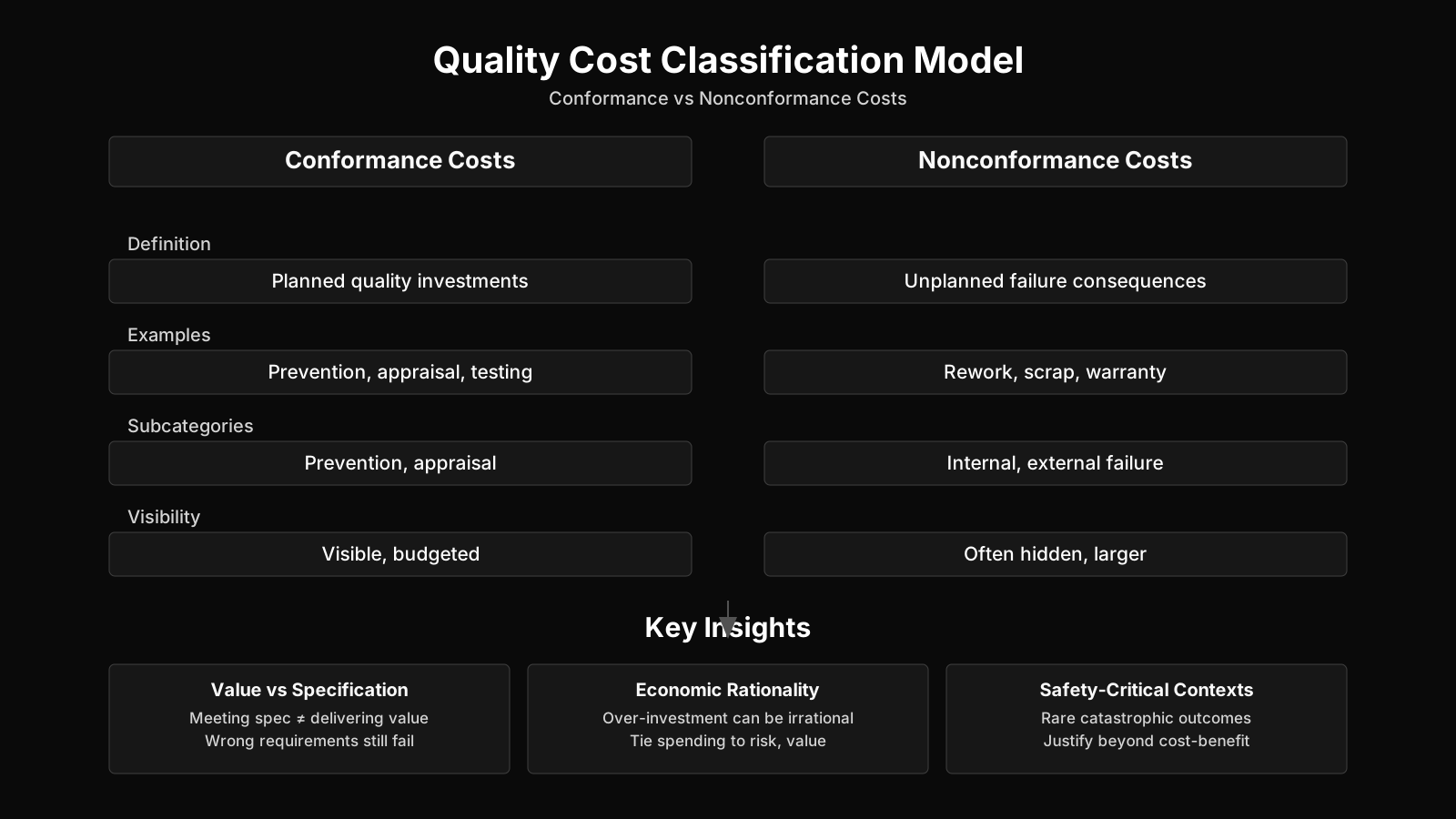
Conformance in cost of quality refers to the money, effort, and resources a project spends to ensure that its processes and deliverables meet specified requirements, standards, and customer expectations. In project management, cost of quality is divided into two broad categories: conformance costs and nonconformance costs. Conformance costs include prevention and appraisal activities. Nonconformance costs include internal and external failure costs. The distinction is important because conformance spending is proactive, while failure costs are reactive and often hidden. A project manager who understands this split can make more rational trade-offs between investing in quality and paying for defects later.
Key Topics: Conformance in Cost of Quality
| Key Concept | Summary |
|---|---|
| Conformance | Conformance represents the total investment a project makes in money, effort, and resources to ensure that its processes and deliverables meet defined requirements, standards, and customer expectations. |
| Cost of Conformance | Cost of conformance captures the proactive investments made to embed quality into project processes and deliverables, reducing the likelihood of defects before delivery. |
| Appraisal Costs | Appraisal costs finance verification activities such as inspection, measurement, testing, and audits that assess whether deliverables meet specified requirements. |
| Nonconformance Costs | Nonconformance costs capture the financial consequences of failures, including rework, scrap, warranty claims, schedule overruns, customer complaints, and reputational damage. |
| Prevention Costs | Prevention costs fund activities that reduce the likelihood of defects, including team training, quality management planning, acceptance criteria definition, design reviews, supplier qualification, and process improvement. |
| Balance Needed | A balanced quality approach uses prevention to reduce the probability of defects and appraisal to verify conformance; prevention alone provides no evidence of quality, while appraisal alone perpetuates recurring defect correction. |
| Software Example | In software delivery, prevention activities include establishing coding standards, writing testable user stories, and conducting early architectural and design reviews. |
| Historical Origins | Joseph Juran and Armand Feigenbaum pioneered cost of quality frameworks that distinguish between the cost of achieving quality and the cost of poor quality; these concepts later migrated from manufacturing into modern project management. |
What Is Conformance in Cost of Quality?
The cost of conformance definition used in project quality management covers all expenditures associated with building quality into the project rather than discovering its absence after the fact. Within the cost of quality framework, conformance costs are the sum of prevention costs and appraisal costs. Prevention costs pay for activities that stop defects from occurring, including training, process design, requirements clarification, and supplier evaluation. Appraisal costs pay for activities that determine whether deliverables actually conform to specification, including inspection, measurement, and testing. Conformance in cost of quality explained this way represents a deliberate investment in avoiding rework, warranty claims, and user dissatisfaction.
In real terms, this is the money spent before a problem reaches the customer. It includes a trained team, clear acceptance criteria, automated test suites, design reviews, and quality audits. It also includes the cost of stopping a project to fix a process flaw before that flaw produces defective outputs. The same logic applies whether the deliverable is a bridge, a software application, or an organizational change.
Conformance in Cost of Quality Definition in the Cost of Quality Framework
The cost of quality framework emerged from the need to make quality spending visible to executives and project sponsors. It recognizes that quality is not free in the sense of zero effort, but that prevention and appraisal are generally cheaper than failure. Conformance costs are the portion of that framework that an organization can plan, budget, and control in advance. They are not the same as the entire cost of quality, because they exclude the very real costs of defects that still happen. A project may have low conformance costs and still have extremely high total quality costs if failure rates are high.
Cost of Quality Categories and Conformance
The cost of quality model places conformance costs alongside nonconformance costs. Nonconformance costs are the expenses linked to failures, including rework, scrap, schedule delays, complaints, and lost reputation. Conformance costs are only the prevention and appraisal portion. This distinction helps project teams see that underfunding prevention and appraisal often shifts spending toward more expensive failure categories. It also helps sponsors understand why a quality budget is not an optional overhead line but a risk mitigation investment.
Core Takeaways on Conformance
- Conformance cost definition
- Conformance costs capture the full investment required to build quality into a project by combining prevention and appraisal expenditures into one category.
- Prevention costs role
- Prevention costs fund proactive activities that eliminate defects at the source, including training, process design, requirements clarification, and supplier evaluation.
- Appraisal costs function
- Appraisal costs support verification activities such as inspection, measurement, and testing, confirming that deliverables conform to their specifications.
Key Components of Conformance Costs
Key components of conformance costs fall into two main groups: prevention costs and appraisal costs. Prevention costs target the root causes of potential defects before work begins or while it is being performed. Appraisal costs target the current state of deliverables and processes by measuring, checking, and validating that requirements have been met. Both categories are necessary. Prevention without appraisal leaves a project without evidence of conformance, while appraisal without prevention often turns into a repetitive cycle of finding and fixing the same types of defects.
Think of it like maintaining a vehicle. Regular oil changes and brake inspections are prevention costs. A state inspection that checks emissions and safety is an appraisal cost. Skipping the oil change may lead to an engine failure, which is a nonconformance cost. The project equivalent is investing in training and reviews before a major build, rather than paying for emergency fixes after release.
Prevention Costs
Prevention costs include training project team members, developing quality management plans, defining acceptance criteria, conducting design reviews, performing supplier qualification, and improving the processes used to produce deliverables. In a construction project, prevention may involve early geotechnical studies or training crews on material handling. In a software project, prevention includes defining coding standards, creating testable user stories, and holding early architectural reviews. These activities do not directly test a final product, but they lower the probability that defects will appear later. Prevention is often the least visible conformance cost because it happens before tangible outputs exist.
Appraisal Activities as Conformance in Cost of Quality
Appraisal costs cover the evaluation of deliverables and processes against established requirements. Examples include inspections, formal reviews, laboratory testing, user acceptance testing, quality audits, and performance measurement. Appraisal does not create the product or improve it directly; it reveals whether the product is conforming. A manufacturing analogy is the inspection station on an assembly line. In project work, appraisal might be a stage gate review that checks whether design documentation is complete before development continues. Appraisal activities are most useful when they are proportionate to the risk of the deliverable. Over-appraisal can waste time, while under-appraisal can let defects escape.
Origins and Cross-Industry Context
Conformance cost origins in quality management trace back to the mid-twentieth century quality movement in manufacturing. Joseph Juran and Armand Feigenbaum developed early cost of quality models that separated the expense of achieving quality from the expense of failing to achieve it. Philip Crosby later reinforced this by defining quality as conformance to requirements, which aligned the idea of conformance with deliberate prevention. These ideas moved from manufacturing into project management as organizations realized that temporary, cross-functional projects needed the same discipline around quality spending.
Outside project management, conformance costs appear in aviation, medicine, software engineering, and construction. In aviation, conformance spending includes certifications, inspections, and airworthiness checks. In medicine, it includes sterilization protocols and clinical audits. Software engineering has adopted continuous integration and automated regression testing as a form of conformance spending. These industries demonstrate that conformance costs are not an administrative burden; they are often the price of operating in environments where failure carries severe consequences. The exact labels vary by industry, but the logic is the same.
Key Insights on Conformance Cost Origins
- Roots in quality management
- Conformance cost thinking grew out of the mid-twentieth century quality movement in manufacturing, where Joseph Juran, Armand Feigenbaum, and Philip Crosby established the core principles.
- Early cost of quality models
- Juran and Feigenbaum created early cost-of-quality models that distinguished the investment required to achieve quality from the losses caused by failing to achieve it, laying the groundwork for modern conformance cost analysis.
- Crosby's conformance definition
- Philip Crosby defined quality as conformance to requirements, positioning conformance as a proactive investment in prevention rather than a reactive expense for correcting defects.
- Adoption by project management
- Project management absorbed these principles once organizations realized that temporary, cross-functional initiatives require the same rigor in quality spending as permanent manufacturing operations.
- Consistent logic across industries
- In aviation, medicine, software, and construction, conformance costs appear as inspections, audits, sterilization protocols, and automated testing, reflecting the disciplined investment required in fields where failure can produce severe consequences.
Conformance in Cost of Quality in Project Management Frameworks
Conformance in cost of quality PMBOK is recognized in the Project Quality Management knowledge area, particularly as a technique for planning quality management. The PMBOK Guide has historically presented cost of quality as a way to evaluate investment decisions related to quality. It divides quality costs into conformance and nonconformance, with conformance further split into prevention and appraisal. The guide positions cost of quality analysis as a technique for balancing the expected cost of quality activities against the potential cost of defects. In the Seventh Edition, the emphasis shifts toward principles and value delivery, but the conformance and nonconformance distinction remains relevant for planning and measuring quality.
In PMBOK terms, conformance costs are not simply a budget category. They are a decision support tool. A project manager can compare the estimated cost of adding another round of design reviews against the likely cost of defects that would be caught later. The process groups involved include planning, where quality activities are selected, and monitoring and controlling, where quality measurements are analyzed. The earned value system may also reflect conformance spending if quality activities are included in work packages.
Conformance in Cost of Quality in PMBOK
The PMBOK Guide has used the cost of quality concept across multiple editions, although the level of detail has changed. Traditional editions described prevention, appraisal, and failure costs within Project Quality Management. The shift toward a principle-based guide in the Seventh Edition does not eliminate those categories but embeds them in a broader focus on quality as a dimension of delivery and value. Conformance costs remain useful because they give a project manager a clear way to discuss quality investment with sponsors who speak the language of budgets and financial returns.
PRINCE2 Treatment of Conformance Costs
PRINCE2 does not label the concept exactly as conformance in cost of quality, but its quality management approach covers the same ground. PRINCE2 requires explicit quality planning through a quality management strategy, product descriptions, and quality registers. It distinguishes between quality planning, quality control, and quality assurance. Conformance costs appear in the investment needed for quality reviews, checking work packages against quality criteria, and maintaining the quality register. The PRINCE2 emphasis on product-based planning means appraisal is tied closely to each product description rather than treated as a vague inspection activity.
Agile and Hybrid Perspectives
In Agile delivery, conformance costs are built into the team's workflow rather than managed as a separate quality department. Prevention appears in practices such as pair programming, test-driven development, definition of done, backlog refinement, and continuous integration. Appraisal appears through automated test suites, peer reviews, sprint demonstrations, and acceptance testing. Agile teams often see conformance as an ongoing activity within each iteration, not a final phase before release. Hybrid projects may combine predictive gate reviews with iterative testing, meaning conformance costs are split between traditional appraisal points and in-sprint quality practices.
BVOP Perspective on Conformance Costs
BVOP product risk management treats conformance costs as a deliberate response to quantified product risk. Business Value-Oriented Project Management uses separate product risk management with quantified loss size units and dynamic filtering. In that view, prevention and appraisal spending is directed toward the risks with the highest expected loss, rather than spread evenly across all deliverables. Defect analysis in BVOP uses predefined root-cause categories, which helps teams link conformance failures to specific process and product risks. This perspective keeps conformance spending connected to business value and avoids quality activities that do not reduce meaningful risk.
Risk-Focused Conformance Spending Takeaways
- Conformance costs as risk response
- BVOP positions prevention and appraisal spending as a deliberate response to quantified product risk, supported by dedicated risk management that uses loss size units and dynamic filtering to align investment with exposure.
- Targeted prevention and appraisal
- Prevention and appraisal budgets are concentrated on risks with the highest expected loss, ensuring scarce quality resources address the most consequential exposures rather than being distributed evenly across all deliverables.
- Root-cause driven defect analysis
- Predefined root-cause categories enable teams to trace conformance failures to specific process and product risks, keeping quality spending tightly linked to measurable risk reduction and business value.
Purpose and Importance of Conformance in Cost of Quality
Purpose and importance of conformance costs lie in their ability to reduce the likelihood and impact of poor quality. Conformance spending creates conditions for reliable delivery by clarifying requirements, building skill, improving processes, and catching defects before they escape to the customer. Without prevention, projects rely on inspection and rework, which are both expensive and demoralizing. Without appraisal, teams fly blind and may not know whether their outputs actually meet expectations until users complain. Conformance costs also support accountability by providing evidence that quality activities were planned, funded, and performed.
The economic logic is straightforward: a small investment in early design review can prevent a much larger expenditure on rework after delivery. This does not mean every possible prevention or appraisal activity is justified. The value of conformance spending depends on the cost of failure, the complexity of the deliverable, and the team's maturity. But treating conformance as optional overhead usually pushes costs into the nonconformance category, where they are harder to control.
There is also a human dimension. Teams that work in an environment with reasonable prevention and appraisal tend to experience less crisis-driven overtime and fewer blame cycles. Conformance spending is not just about the deliverable. It is about creating stable conditions for the people doing the work.
Cost of Conformance in Project Selection and Business Case
Conformance costs in project selection influence whether a proposed project is financially and operationally viable. A business case that omits prevention and appraisal costs may understate the true investment required to deliver an acceptable outcome. For example, a project to build a new customer portal may appear inexpensive if the estimate includes only development hours. Adding security testing, accessibility reviews, and user acceptance testing reveals a fuller cost picture. Sponsors use this information to compare alternatives and set funding expectations. Conformance costs are not always optional additions; they are part of the cost of producing a deliverable that actually meets its intended use.
The business case may also show avoided failure costs as a benefit of conformance spending. This is not always easy to quantify because avoided costs do not appear in traditional financial statements. However, a clear link between conformance investment and risk reduction can strengthen the case for quality. Projects with high external failure consequences, such as safety systems or customer-facing financial services, often justify more conformance spending in selection even when the direct financial return is outside the project.
Key Insights on Conformance Cost Viability
- Understated investment without conformance costs
- Business cases that exclude prevention and appraisal costs understate the full investment required. A customer portal estimate limited to development hours while omitting security testing, accessibility reviews, and user acceptance testing creates an incomplete cost baseline that misleads sponsors.
- Conformance costs are non-optional quality investments
- Prevention and appraisal spending is integral to producing a deliverable that genuinely meets its intended use, not an optional addition. Sponsors depend on this complete cost picture to compare alternatives and establish realistic funding expectations.
- Avoided failure costs justify quality spending
- Although avoided failure costs are difficult to quantify in conventional financial statements, tying conformance investment to measurable risk reduction strengthens the business case. This is especially true for projects where external failure carries severe consequences, such as safety systems or customer-facing financial services.
Practical Application Across the Project Lifecycle
Practical application of conformance costs starts during project initiation and continues through closing. During planning, the project manager and sponsor decide which prevention and appraisal activities belong in the budget. During execution, the team performs those activities and records the results. During monitoring and controlling, quality metrics reveal whether conformance spending is producing the expected reduction in defects. During closing, lessons learned capture which conformance activities were valuable and which were excessive.
In a software project, a typical conformance budget might include user story clarity workshops, automated test development, security reviews, and accessibility audits. In an infrastructure project, it might include material testing, design verification, and safety inspections. The common thread is that these items are planned in advance and linked to known requirements or risks. They are not emergency spending.
Planning and Budgeting
In the planning phase, conformance costs are estimated alongside other project costs. A project may budget for quality training, defect prevention tooling, independent reviews, and user acceptance testing. The cost of quality analysis helps the project sponsor understand why these items are included. A common approach is to compare the expected cost of prevention and appraisal against the probable cost of failure. If a compliance requirement exists, some conformance costs are not optional. In regulated industries, inspection and audit costs may be mandated by external bodies, making them part of the project's license to operate.
Execution and Monitoring
During execution, conformance costs show up as time spent on reviews, testing, audits, and process improvement. Monitoring tracks both the conformance activities themselves and their outcomes. For example, a project may track the number of defects found during code review versus defects found after release. If appraisal finds few issues but customers report many, the appraisal methods may be inadequate. If appraisal finds many design errors late in the project, prevention efforts may have been underfunded. These signals let the team adjust where conformance money goes. Measuring conformance cost alone is not enough. It must be paired with defect data, schedule variance, and stakeholder feedback.
Common Challenges, Pitfalls, and Misconceptions
Challenges in estimating conformance in cost of quality often begin with misclassification. Teams may record training as a general overhead cost instead of a prevention cost. Inspection time may be hidden in task estimates rather than tracked separately. When conformance costs are not visible, sponsors may push to cut them without understanding the consequences. Another challenge is over-appraisal. A project can spend too much on testing and review relative to the risk involved. Conformance spending is not automatically good; it needs to be proportionate to the project's actual failure modes.
Political pressure creates another pitfall. Quality activities with no immediate visible output can be the first to go during budget cuts. This is especially true for prevention work, which produces nothing tangible in the short term. The project manager may need to frame conformance costs in terms of risk reduction to defend them. Without that framing, the project can drift toward a reactive posture where appraisal is minimal and failure costs dominate.
Challenges in Estimating Conformance in Cost of Quality
Estimating conformance costs is difficult because many quality activities are embedded in regular work. A developer who writes unit tests is performing appraisal work, but the time may be included in the task estimate. A business analyst who clarifies ambiguous requirements is performing prevention work, but that effort may never be labeled as a quality cost. This invisibility can lead to underestimation. When the true conformance cost is unknown, the project cannot evaluate whether the investment was worthwhile. Some organizations address this by tracking quality activities in time-tracking systems or using separate work packages for major quality tasks. Others accept that only direct quality activities will be measured and use that partial view with caution.
Misconceptions About Conformance Spending
A common misconception is that conformance costs are the same as non-value-added overhead. Some stakeholders see prevention and appraisal as bureaucratic activity that slows delivery. In reality, effective conformance work often reduces total project duration because it prevents late-stage rework. Another misconception is that high conformance spending guarantees zero defects. No amount of prevention and appraisal can eliminate all uncertainty, especially in complex or novel work. The goal is not perfect conformance at any cost; it is an acceptable level of risk at a rational investment level. Some projects also misapply the concept by treating all testing as conformance. If a test cycle repeatedly finds the same kind of defect, the appraisal cost is real, but the absence of prevention may be the more important signal.
Key Insights on Conformance Costing Pitfalls
- Quality costs often misclassified
- Training is frequently buried in general overhead rather than recognized as a prevention cost, and inspection effort is often embedded in task estimates, which obscures the true cost of quality.
- Invisible conformance costs invite cuts
- Conformance costs that remain invisible become easy targets for elimination, because sponsors rarely see the downstream rework, defect correction, and customer impact that follow reduced quality assurance.
- Conformance spending must match risk
- Excessive spending on testing and review relative to actual risk is a real pitfall, because conformance investment creates value only when it is scaled to the project's genuine failure modes.
- Frame prevention as risk reduction
- Project managers often need to frame conformance costs as risk reduction to secure stakeholder support, since prevention work yields no short-term tangible output and can otherwise appear expendable.
- Quality effort often unlabeled
- Estimating conformance costs is difficult because many quality activities are embedded in routine work, so prevention efforts like a business analyst clarifying ambiguous requirements may never be labeled as a quality cost.
Conformance vs Nonconformance and Related Quality Concepts
Conformance vs nonconformance costs is one of the most useful distinctions in project quality management. Conformance costs are incurred before a defect reaches the customer, and nonconformance costs are incurred after a defect occurs. Nonconformance costs are split into internal failure costs, such as rework and scrap, and external failure costs, such as warranty claims and reputational damage. The two categories are related because underfunding conformance usually increases nonconformance. However, the relationship is not linear in every project. A very simple, low-risk deliverable may not need much conformance spending, while a highly regulated or safety-critical deliverable may require extensive prevention and appraisal.
This distinction is not just a theoretical accounting exercise. It shapes how project managers and sponsors talk about quality. A sponsor who sees a large quality budget may ask why the project is spending so much on quality. If the budget is mostly prevention and appraisal, the answer may be that the project is investing to avoid rework. If the budget is mostly rework and defect correction, the answer is different. The project may be failing to prevent defects in the first place.
Conformance vs Nonconformance Costs
Conformance costs and nonconformance costs operate on different timelines. Prevention and appraisal happen while the team still has control over the deliverable. Internal failure costs happen after a defect is created but before it reaches the customer. External failure costs happen after delivery. This timeline matters because the cost of fixing a defect generally increases the later it is found. A requirements misunderstanding corrected during planning is cheap. The same misunderstanding corrected after launch may require an emergency release, customer communication, and possible liability exposure. Conformance spending is an attempt to move defect discovery earlier in the timeline.
Quality Assurance, Quality Control, and Conformance
Quality assurance focuses on the processes used to produce deliverables, while quality control focuses on the outputs themselves. Prevention costs align more closely with quality assurance because they improve processes. Appraisal costs align with quality control because they measure outputs. This is a useful mental model, though real projects blend the two. A design review may be both a process improvement activity and an output check. Conformance in cost of quality encompasses both assurance and control activities. Treating assurance and control as completely separate can obscure the fact that they draw from the same conformance budget and serve the same goal.
Cost of Poor Quality and Cost of Quality
Practitioners sometimes use cost of quality and cost of poor quality interchangeably, but they are not identical. Cost of quality includes both conformance and nonconformance costs. Cost of poor quality usually refers only to nonconformance costs, especially internal and external failure costs. Using the terms as synonyms can blur the fact that some quality spending is proactive. A sponsor who says the project spends too much on quality may actually mean the project spends too much on rework. Clear definitions prevent that confusion. In many project dashboards, only the cost of poor quality is visible because defects and rework appear in issue logs and change requests. Conformance costs must be made visible separately.
Evolution and Current Thinking in Conformance Cost Management
Evolution of conformance cost thinking has moved from an inspection-heavy mindset to a prevention-first mindset. Early quality approaches in manufacturing relied heavily on end-of-line inspection. As the cost of quality model matured, organizations recognized that appraisal finds defects after they exist, while prevention stops them at the source. Modern software delivery has accelerated this shift through continuous integration, automated testing, and shift-left quality. In these environments, conformance costs are embedded into the daily work of the team. Some current thinking questions whether the traditional four-category cost of quality model captures everything in digital projects. For example, the cost of slow feedback loops or poor developer experience may not fit neatly into prevention, appraisal, or failure. Nevertheless, the conformance and nonconformance split remains a practical starting point for understanding quality investment.
The current best practice is not to maximize conformance spending, but to tie it to risk, value, and the actual failure modes of the specific project. Some teams use defect data to adjust the balance between prevention and appraisal. If a high proportion of defects come from unclear requirements, prevention may need more investment in requirements workshops and acceptance criteria. If defects are escaping despite high appraisal levels, the appraisal methods may need to change. There is also growing interest in value stream mapping and quality engineering, which look at conformance costs as part of the flow of work rather than as a separate budget line.
Debate continues about how to account for intangible conformance benefits. A well-run design review may prevent a defect that would have caused reputational damage. That avoided cost is real but difficult to quantify. This uncertainty means conformance cost analysis should be used as a decision aid, not as a precise financial formula. Project managers who treat it as a rigid calculation may miss the point. The value of the concept lies in making quality investment visible and subject to reasoned trade-off.
Core Insights on Conformance Cost Evolution
- Prevention-first quality mindset
- Quality strategy has shifted from relying on end-of-line inspection to embedding preventive controls directly into the production process, eliminating defects at the source.
- Software delivery accelerates shift
- Continuous integration, automated testing, and shift-left practices have made prevention the operational default, displacing end-of-line appraisal as the primary quality gate.
- COQ model has gaps
- The traditional four-category cost of quality model fails to account for digital-era losses such as delayed feedback cycles, excessive context switching, and degraded developer experience.
- Risk-based conformance investment
- Leading organizations allocate conformance investment according to risk exposure, business value, and observed failure modes rather than treating prevention spending as an end in itself.
- Quality seen as workflow
- Value stream mapping and quality engineering treat conformance costs as an integral element of delivery flow, revealing how quality activities affect cycle time and throughput instead of isolating them as a separate budget category.
