Budget at Completion, abbreviated as BAC and often referred to simply as the project budget at completion, is the total planned budget authorized for the work defined by the project scope. In earned value management, it represents the culmination of all budgeted costs for every control account and work package within the performance measurement baseline. Unlike a rough order-of-magnitude estimate or a financial reserve held outside the baseline, BAC is a formal, approved figure that serves as the foundational reference for measuring cost performance, calculating variances, and forecasting the final financial outcome of a project. It is set at the point of baseline approval and, until a formal change is sanctioned, acts as the immutable yardstick against which all spending is evaluated.
Key Takeaways: Budget at Completion
| Key Concept | Summary |
|---|---|
| BAC Definition | Budget at Completion (BAC) is the authorized, time-phased budget baseline used to assess cost performance, calculate variances, and project the final financial outturn of a project. |
| Measuring Device | BAC functions as the contractual cost comparison baseline, akin to a lump-sum roofing agreement that itemizes materials, labor, permits, and contingency reserves, establishing the benchmark for tracking actual expenditures. |
| Change Orders | When scope changes occur, for instance, uncovering unexpected structural issues, a change order adjusts the approved contract total, and the updated amount becomes the revised BAC. |
| EVM Integration | All core earned value management metrics, including cost variance, schedule variance, cost performance index, and schedule performance index, rely on BAC either directly or through the planned value curve, underlining its central role in cost and schedule integration. |
| Funding Limits | BAC must be distinguished from the total funds allocated by the organization or client; it is the approved performance measurement baseline, not a cash flow forecast or a spending ceiling. |
| Standards Origins | Rooted in defense and aerospace cost management mandates, the BAC concept was formalized through the ANSI/EIA-748 standard for earned value management systems and subsequently adopted by the PMBOK Guide. |
| Industry Use | BAC is now widely applied beyond defense in heavy construction, energy, infrastructure, and any industry where fixed-price or cost-reimbursable contracts demand a clear scope and cost baseline. |
| Governance Role | Finance controllers, procurement teams, and portfolio governance boards rely on the BAC equivalent to authorize spending, monitor fiscal health, and forecast final costs across projects of any scale. |
What Is Budget at Completion?
The Budget at Completion in project management represents the total authorized budget allocated to complete the project scope as defined in the performance measurement baseline. It emerges directly from the cost baseline, which is the time-phased distribution of budget across the project calendar. When a project manager and the sponsor sign off on the project management plan, the cost baseline freezes, and the BAC becomes the sum of all periodic planned values for the project duration. This sum includes direct costs, indirect costs, and any contingency reserves that have been deliberately embedded within the baseline to address known risks. What BAC does not include is the management reserve, an amount set aside by the organization for unforeseen work that falls outside the approved scope baseline. If management reserve must be used, a formal change request moves the corresponding funds into the baseline, thereby altering the BAC.
To grasp this purely as a measuring device, think of a small construction job: you and a homeowner agree that replacing a roof will cost $15,000 based on a detailed breakdown of materials, labor, permits, and a small cushion for weather delays. That $15,000 figure, agreed upon before the first shingle is removed, is the BAC. Every dollar spent afterward is compared against it. If the roofer finds rotten plywood that was not part of the original scope, the homeowner may issue a change order, and the new agreed total might become $16,500. At that point the project is rebaselined and the BAC is officially changed. Without that change order, the BAC would still be $15,000 even if costs have climbed past it.
Budget at Completion in the Context of Earned Value Management
Within the earned value management framework, BAC is the denominator that links cost and schedule measurements into a coherent analytical system. All EVM formulas that calculate cost variance, schedule variance, cost performance index, and schedule performance index use BAC either directly as the budget-at-completion baseline or indirectly through the planned value curve. The planned value curve itself is simply the cumulative representation of BAC spread over time. At any point in the project, the planned value is the portion of BAC that was scheduled to be earned up to that moment. Earned value measures how much of the BAC has actually been earned based on completed work. Actual cost measures what was spent to achieve that earned value. By holding BAC constant, the project can reveal whether it is under or over budget and ahead or behind schedule with a single integrated picture.
How BAC Differs from Funding Limits and Cash Flow
It is not uncommon for project practitioners to confuse BAC with the total funds allocated by the organization or the client. Funding requirements often step higher than BAC because they incorporate management reserve and perhaps a profit margin for the performing organization. The cost baseline itself might be constrained by funding limit reconciliation, where the periodic budget cannot exceed the cash flow available in given months. BAC remains the total cost baseline amount, irrespective of how cash arrives in the bank. In other words, BAC answers the question, “What will the completed scope cost according to the approved plan?” while funding answers, “How much money can be drawn down and when?” The distinction matters because a project can be fully budgeted with a clear BAC yet still face cash flow interruptions that stall execution.
Key Takeaways: Budget at Completion
- Definition and core purpose
- Budget at Completion (BAC) is the total authorized budget assigned to deliver the project scope, establishing the financial baseline that guides all subsequent performance assessments.
- Derived from cost baseline
- The BAC aggregates every periodic planned value within the time-phased cost baseline, encompassing direct costs, indirect costs, and contingency reserves set aside for identified risks.
- Excludes management reserve
- Management reserves lie outside the BAC, and their use requires a formal change request to shift funds into the cost baseline, which correspondingly increases the BAC.
- Change orders alter BAC
- In the roof replacement case, a change order for unforeseen rotten plywood lifted the agreed total from $15,000 to $16,500, illustrating how approved scope changes proportionally modify the BAC.
- Role in earned value management
- Within Earned Value Management, the BAC serves as the essential reference point for computing cost variance, schedule variance, and all performance indices.
The Origins and Cross-Industry Context of Budget at Completion
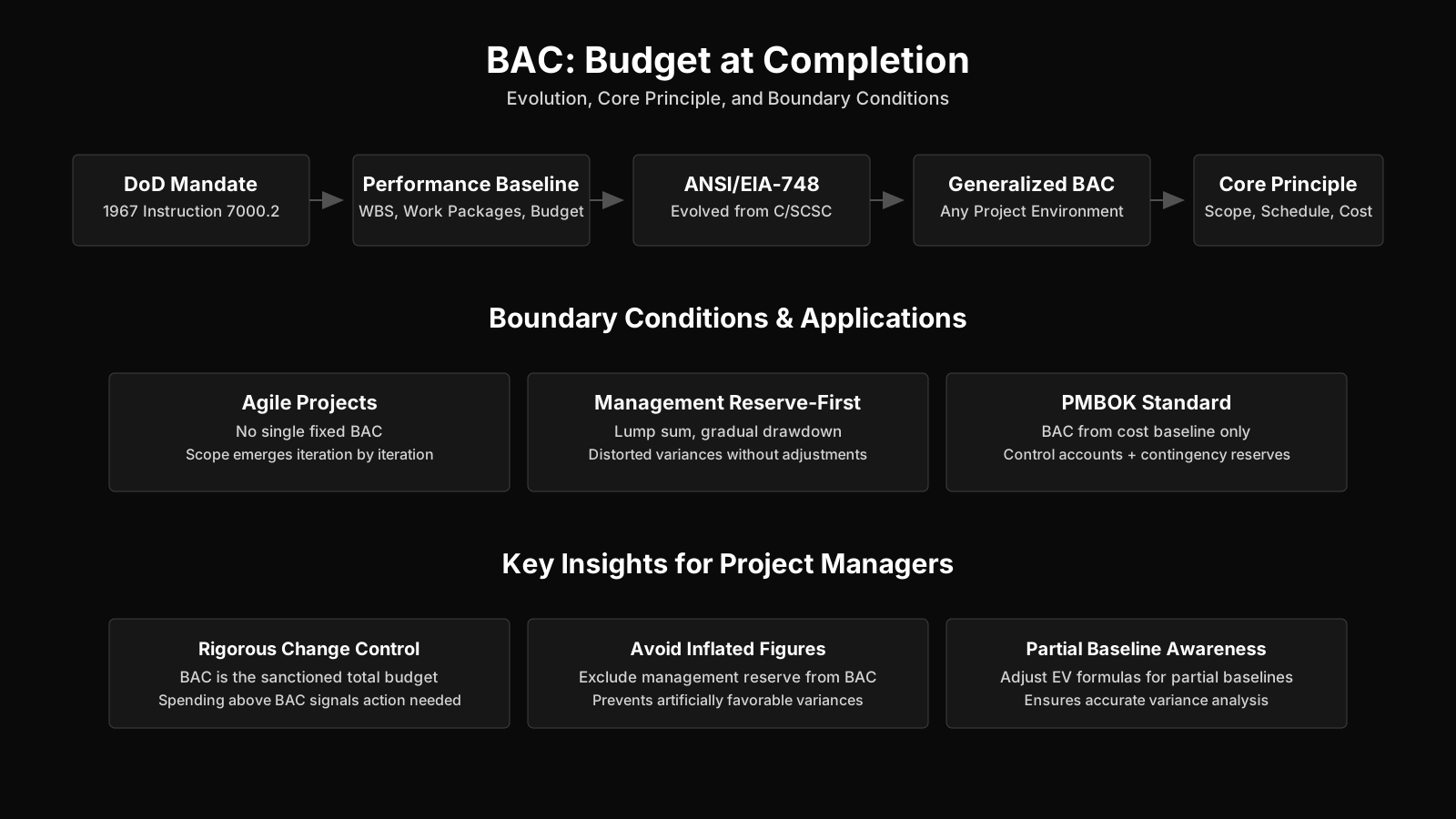
The concept of Budget at Completion originated within cost-schedule control systems developed by the U.S. Department of Defense in the 1960s. At that time, large-scale weapons and aerospace programs suffered notorious cost overruns and schedule slips. The Department of Defense introduced the Cost/Schedule Control Systems Criteria, which mandated contractors to establish a performance measurement baseline and track actual performance against it. The total budget for the contracted work was formally termed the Budget at Completion, and it became a contractual obligation. Over time, these criteria evolved into the ANSI/EIA-748 standard for earned value management systems, and the term BAC migrated into civilian project management practice through the Project Management Institute’s PMBOK Guide and other standards.
Outside of defense and aerospace, BAC appears in heavy construction, energy, infrastructure, and any industry where fixed-price or cost-reimbursable contracts rely on a well-defined scope and baseline. In commercial software development, the term is less pervasive as a formal acronym but the underlying concept of an approved total budget still shapes funding decisions. Even when a technology firm funds a new product development initiative, the business case allocates a specific financial envelope. While they may not rigorously apply EVM formulas, they implicitly treat that envelope as the BAC for the initiative. Financial controllers, procurement departments, and portfolio governance boards all use the BAC equivalent when authorizing spend and monitoring fiscal health.
From Military Standard to Global Practice
The migration of BAC from the defense sector into general management illustrates how rigorous control techniques can become mainstream. The AACE International Recommended Practices and the ISO 21500 series on project management both incorporate earned value concepts that rest on a defined BAC. What changed is the level of rigor. A commercial construction project with a BAC of $20 million might not maintain the same exhaustive control account structure as a $2 billion fighter jet program, but the fundamental logic is identical: the BAC is the authorized baseline, you compare cumulative actuals to it, and you forecast outturn cost using performance efficiency factors that are themselves anchored to BAC. The cross-industry truth is that wherever money meets scope, a figure like BAC exists, whether it is called the contract target cost, the approved project budget, or simply “the number we must not exceed.”
Key Components and Characteristics of Budget at Completion
Key components of Budget at Completion include the integrated scope, schedule, and cost baseline, along with the approved scope statement and work breakdown structure. The BAC cannot exist in isolation. It is the financial translation of the entire work breakdown structure, which decomposes the project scope into deliverable-oriented work packages. Each work package, and the control accounts that group them, carries a budget that rolls up through the WBS hierarchy to produce the total BAC. This structural linkage means that any change to the WBS, whether adding, deleting, or redefining a deliverable, logically necessitates a corresponding change to the BAC. Similarly, the schedule provides the time frame over which the BAC is spread. The cost baseline is simply the BAC distributed across the project timeline, and it becomes the planned value curve against which progress is measured.
A defining characteristic of BAC is its static nature once the baseline is approved. Unlike the estimate at completion, which is a dynamic forecast that can change with every reporting period, the BAC remains frozen until a deliberate rebaseline decision is made through formal change control. This rigidity is not a flaw but a design feature. It forces organizations to confront the consequences of scope growth and performance slippage. When a project manager reports that actual costs are at 90 percent of the BAC but only 70 percent of the work is done, the BAC acts as a stark alarm bell. If the BAC were casually adjusted upward to accommodate the overrun, that early warning would be lost, and the governance team would be making decisions based on sanitized data.
BAC, Control Accounts, and Work Packages
In larger projects, BAC is never managed as a single lump sum. It is decomposed into control accounts, each managed by a control account manager, and further into work packages and planning packages. The BAC at the control account level is the sum of the budgets for the near-term work packages and the time-phased budgets placed in planning packages for future work that has not yet been fully detailed. This hierarchical structure ensures that the BAC is not just a top-down figure but a ground-up aggregation. When rolling wave planning is used, planning packages are progressively elaborated into detailed work packages, and the BAC within that control account remains constant even as its distribution shifts. That consistency across decomposition levels is what makes BAC reliable for earned value calculations at any scale.
Key Insights on Budget at Completion
- Integrated baselines make up the BAC
- The Budget at Completion consolidates the approved scope statement, work breakdown structure, schedule, and cost baseline into a single financial framework against which project performance is measured.
- Work packages roll up through WBS
- Budget allocations at the work package and control account levels roll up through the work breakdown structure to produce the total Budget at Completion, ensuring full coverage of all deliverables.
- WBS changes require BAC adjustments
- Since the Budget at Completion is derived directly from the work breakdown structure, any addition, removal, or redefinition of a deliverable necessitates a recalibration of the total budget.
- Cost baseline is time-phased BAC
- Distributing the Budget at Completion over the project schedule transforms it into the cost baseline, establishing the planned value curve used to monitor and measure actual performance.
- Frozen until formal rebaseline approval
- The Budget at Completion stays frozen until a formal change control process authorizes a rebaseline, thereby preventing arbitrary upward adjustments that would dilute its value as an early warning indicator when actual spending exceeds earned value.
Budget at Completion in PMBOK, PRINCE2, and Traditional Frameworks
Budget at Completion is formally defined within the PMBOK Guide as part of earned value management, specifically tied to the cost baseline and the Plan Cost Management process. In the PMBOK framework, the BAC is developed during the planning process group as part of the Determine Budget process, which aggregates the activity cost estimates, contingency reserves, and the cost baseline into a single authorized budget. It is then used throughout the monitoring and controlling process group, particularly in Control Costs, where it becomes the benchmark for variance analysis and forecasting. The Earned Value Analysis technique described in the guide relies on BAC to compute the schedule variance, cost variance, schedule performance index, cost performance index, and the to-complete performance index. The PMBOK also acknowledges that BAC may change if scope changes are formally approved, and it distinguishes the original BAC from the current baseline in the event of multiple rebaselines.
BAC’s Role in Cost Control and Forecasting
In practice, the project manager and the project management office use BAC to populate performance reports and dashboards. A typical status report will show the cumulative plan, the earned value, and the actual cost, all expressed as percentages of BAC. That one number, BAC, gives context to every cost metric. Without it, a cost variance of minus $50,000 is meaningless. With a BAC of $500,000, that variance represents a ten percent cost overrun, which triggers a specific governance threshold. The PMBOK also highlights the TCPI, which is computed as the ratio of the remaining work to the remaining budget. The formula is (BAC minus EV) divided by (BAC minus AC), or alternatively (BAC minus EV) divided by (EAC minus AC) when BAC is no longer realistic. This index tells the team how efficiently they must perform on future work to meet the BAC, and it becomes a sharp instrument for forcing reality checks on optimistic forecasts.
BAC in PRINCE2 and Plan-Based Environments
PRINCE2 does not use the acronym BAC as prominently as the PMBOK does, but the concept is embedded within its emphasis on the business case and the project plan. In a PRINCE2 project, the Project Board agrees to the project cost tolerance, which is essentially a permissible deviation from the planned budget. The planned budget itself serves the same foundational role as BAC. The project manager monitors costs against the plan, and if the forecast exceeds the agreed tolerance, an exception plan is triggered. The total original budget is recorded in the business case, and any changes to it require formal approval through the change theme and the configuration management strategy. While PRINCE2 does not mandate the full EVM suite, the budget baseline it establishes performs exactly the same function as BAC when EVM is optionally applied. The language may differ; the financial control logic is universal.
Budget at Completion in Agile and Hybrid Environments
Applying Budget at Completion in Agile projects requires a fundamentally different approach, as scope evolves and BAC becomes more of a target than a rigid constraint. In pure Agile frameworks such as Scrum, the scope is deliberately variable within a fixed time and cost box. A team might be given a budget of $400,000 and six months to deliver a product increment. The total budget acts as a BAC-like cap, but the product backlog is continuously groomed and reprioritized. Features that cannot be completed within the budget are simply deferred to a future release. This means the BAC does not strictly sum up a pre-defined WBS because the WBS itself is emergent. The budget is static, but the allocation of that budget across features shifts iteration by iteration based on value and team velocity. The project is considered successful if the highest-priority items are completed within the financial envelope, not if every conceivable feature was delivered.
Hybrid Budgeting and the Use of BAC with Rolling Waves
Hybrid projects often maintain a fixed BAC for the overall initiative while employing rolling wave planning for portions of the scope that are less certain. The early phases might be planned in detail, with work packages and control accounts, while later phases hold an unallocated portion of the BAC as planning packages. As the project proceeds and uncertainty reduces, those planning packages are decomposed, and the BAC is distributed to the emerging WBS elements without changing the top-line number. This approach preserves the governance value of BAC while accommodating the reality that not all requirements are known at the start. Hybrid teams can still track earned value by approximating percent complete on Agile deliverables using techniques like fractional completion of user stories, and they can compute indices against a BAC that is stable yet flexibly allocated.
Key Takeaways on Agile BAC
- BAC as a flexible cap
- In Agile projects, the Budget at Completion serves as a dynamic financial ceiling; teams continuously groom the backlog to defer lower-priority features, protecting the budget for work that delivers the greatest value.
- Emergent work breakdown structure
- Pure Agile frameworks like Scrum do not derive the BAC from a predefined work breakdown structure; instead, the WBS emerges iteratively as the team reprioritizes scope and uncovers new insights throughout the project.
- Priority-based success criteria
- An Agile initiative is considered successful once the highest-priority items are delivered within the financial boundary, not when every conceivable feature has been completed.
- Hybrid BAC with rolling waves
- Hybrid projects lock the top-line BAC while progressively elaborating uncertain planning packages as work unfolds, enabling earned value tracking through fractional user story completion and fluid budget reallocation.
The BVOP Perspective on Budget at Completion
Business Value-Oriented Project Management questions the reliability of a static Budget at Completion due to the inherent inaccuracies of traditional work breakdown structures. In BVOPM, excessive reliance on a BAC that flows from an early, detailed WBS can give a false sense of precision. Instead, BVOPM advocates the use of relational effort points and a five-level scope scale ranging from Definite to Unlikely. Scope that falls into the Unlikely category is not originally budgeted; when it materializes as user feedback, it is treated as valuable input rather than a failure of planning. This reclassifies scope change not as a deviation from a sacred BAC but as a natural evolution, and the budget is reforecast accordingly. From this viewpoint, BAC is still tracked as an initial financial boundary, but per-project methodology choice and constant value reevaluation mean that the static BAC is always subordinate to business value delivery.
BVOPM also warns that a WBS-based BAC often embeds invisible process waste: overwork, perfectionism, and rejected acceptable work. By focusing on business value points instead of solely on financial completion against BAC, a BVOP-oriented project may deliberately stop work when value points decline, even if the BAC has not been fully consumed. This does not mean BAC is discarded. It is retained as a transparent financial ceiling, but the project’s steering committee is empowered to close the initiative early and redirect remaining funds to higher-value endeavors, something a purely BAC-driven culture might resist because it would report an unused budget as a deviation rather than a strategic win.
Practical Application and Use of Budget at Completion
In practice, the Budget at Completion is used as the anchor for earned value calculations that generate variances and performance indices. Every reporting cycle, the project controller compares actual cost to earned value and computes the cost variance. The significance of that variance is instantly interpretable against BAC. A cost variance of negative thirty thousand dollars on a project with a BAC of three hundred thousand dollars signals a ten percent overrun, which might still be within the organizational tolerance of plus or minus fifteen percent. If the same dollar variance occurred on a project with a BAC of sixty thousand dollars, it would be a fifty percent overrun and likely trigger an immediate recovery plan or escalation. BAC contextualizes the raw numbers, making it the silent yardstick in every cost discussion.
Beyond variance reporting, BAC drives the TCPI calculation, which is one of the most honest conversations a project team can have with its sponsor. The TCPI tells the team what cost performance level they must now achieve on the remaining work to bring the project in at BAC. If the project has been performing at a CPI of 0.85 and the TCPI to achieve BAC is now 1.2, the team must achieve a performance level far better than any they have ever demonstrated. This stark figure often triggers a realistic conversation about whether the BAC is still achievable or whether a revised estimate at completion should be approved. The BAC thus serves as a commitment device: it raises the cost of denial and forces governance to confront the gap between plan and reality.
Rebaselining and When BAC Changes
BAC is not immutable in an absolute sense. It can be changed through a formal rebaselining process, typically triggered by a significant scope change, a major risk event that requires drawing from management reserve into the baseline, or a fundamental replanning driven by new information. When a project undergoes rebaselining, the original BAC is preserved in historical records for comparison, and a new current BAC is established. However, organizations that rebaseline too frequently, particularly mid-cycle without genuine scope adjustment, undermine the very purpose of having a baseline. A project that resets its BAC quarterly to match actual spend will always report a CPI of exactly 1.0, rendering EVM meaningless. Mature governance bodies allow rebaselining only when accompanied by a thorough root cause analysis and a change to the project’s charter or scope statement.
Key Insights on BAC Application
- BAC contextualizes cost variance data
- A thirty thousand dollar overrun constitutes only a ten percent variance on a three hundred thousand dollar budget, yet it becomes a fifty percent crisis on a sixty thousand dollar budget, proving that BAC is the indispensable yardstick for interpreting raw cost variance numbers.
- TCPI reveals required remaining performance
- The To-Complete Performance Index quantifies the cost performance ratio needed on the remaining work to meet BAC, often driving a candid conversation with the sponsor about whether the baseline remains viable or a revised estimate at completion should be approved.
- BAC binds through formal rebaselining
- The budget acts as a commitment device that raises the cost of denial and compels governance to confront actual performance; it can only be altered through a formal rebaselining process triggered by significant scope changes, major risk events that draw on management reserve, or fundamental replanning based on new information.
Common Challenges, Pitfalls, and Misconceptions About BAC
A common misconception is that Budget at Completion can be changed without formal governance simply because actual costs are exceeding it. Project teams under pressure sometimes believe that a cost overrun in one work package can be silently offset by underspending in another, as if the BAC were a single bucket of money. While this is true for the total project budget in terms of spending authority, it does not mean the BAC itself is amended. The baseline BAC, which feeds EVM reports, is separate from the ledger of authorized funds. If the team does not initiate a change request to move contingency or adjust the control account budgets, the reported CV and CPI will legitimately show an overrun even if total spending has not yet exceeded the overall authorized budget. This misunderstanding can lead to a false sense of control and delayed corrective action.
Another pitfall is using BAC as the sole indicator of project health. A project can be exactly on plan against a BAC that was fundamentally flawed. If the initial estimating was overly optimistic, hitting the BAC constitutes a failure in forecasting, not a success in delivery. Conversely, a project that finishes below BAC might be celebrated for cost efficiency when in reality critical scope was omitted or corners were cut. The BAC must always be interpreted alongside scope verification and quality metrics. The number itself only tells how much was planned to be spent, not whether that plan was sensible or whether what was spent delivered the right outcomes.
The Danger of Treating BAC as Final Cost
New project managers sometimes equate BAC with the final cost, assuming that if they simply stop when the money runs out, the job is done. This is false. BAC is a planned budget, not a guaranteed cost ceiling. The final cost is the estimate at completion, which can be higher or lower than BAC depending on performance. Treating BAC as a spending limit can lead to the perverse outcome of accelerating low-value work to consume budget before it is lost, a practice that harms value delivery. Senior stakeholders, especially those with a finance background, need to be educated that a project delivering all planned scope at the BAC is the ideal, not the default assumption, and that deviations require analysis, not punishment.
Relationships Between Budget at Completion and Other EVM Metrics
The connection between Budget at Completion and Estimate at Completion is central to forecasting final project costs. BAC defines the starting line; EAC is the runner’s projected finish position based on the pace they have maintained. There are several common methods to calculate EAC, each referencing BAC differently. The simplest method, EAC equals AC plus (BAC minus EV), assumes that future work will proceed as originally planned and that the current cost variance is a one-time anomaly. Another widely used formula, EAC equals BAC divided by cumulative CPI, assumes that the current cost performance trend will continue to the end. A third method blends cost and schedule performance, using both CPI and SPI. In every case, BAC is present either as the total planned budget or as the target that the estimate is trying to match. If the EAC diverges significantly from the BAC, a project is facing a cost overrun that requires management attention, regardless of what the individual period reports show.
Suppose a project has a BAC of $500,000, and halfway through the timeline the team has earned $200,000 of value but already spent $280,000. The CPI is a rather dismal 0.71. If that level of efficiency holds steady, the EAC using the formula BAC divided by CPI comes to roughly $700,000, a $200,000 overrun. That projection exists only because the BAC remained the immovable reference point. If the BAC had been quietly adjusted to $400,000 earlier, the same $280,000 spent against $200,000 earned would produce a CPI of 0.71 and an EAC of $563,000, masking the severity. The discipline of keeping BAC stable is what makes this kind of forecasting credible.
BAC vs. Planned Value and Earned Value
Planned value is the time-phased expression of BAC. At the project’s planned finish date, the cumulative planned value equals the BAC. During execution, PV is always a fraction of BAC. Earned value, on the other hand, measures what portion of the BAC has been legitimately earned through work completed. The relationship is simple but powerful: if EV is less than PV, the project is behind schedule relative to BAC; if AC is greater than EV, the project is over budget relative to BAC. All three metrics orbit around the same total sum, which is why a change to BAC ripples through every EVM chart and dashboard instantly.
BAC and the To-Complete Performance Index
The TCPI is perhaps the most direct mathematical derivative of BAC. It strips away statistical forecasting and asks a brutally simple question: “Given where we are now, what cost performance must we achieve on the remaining work to end at BAC?” The formula, (BAC minus EV) divided by (BAC minus AC), yields a performance ratio. A TCPI above 1.0 indicates that the team must perform better on future work than they have historically or than was originally planned. If the original plan assumed a CPI of 1.0, a TCPI of 1.2 means the remaining work must be done at twenty percent better efficiency. When a project has a persistently high TCPI, prudent project managers initiate a discussion about whether the BAC target is still realistic. If BAC is formally changed to an approved EAC, the TCPI formula shifts its denominator to (EAC minus AC), aligning the target with a more achievable goal.
Key Takeaways: BAC and EAC
- BAC anchors all cost forecasts
- The Budget at Completion serves as the foundational baseline for all cost forecasting, and every Estimate at Completion formula incorporates the BAC either as the original planned expenditure or as the reference point that the revised forecast seeks to equal.
- EAC methods reference BAC differently
- The most straightforward EAC formula adds a single cost variance to the initial plan, the BAC/CPI method projects the current cost performance trend through to completion, and a third approach blends both cost and schedule performance indices to derive a more comprehensive final cost estimate.
- EAC-BAC gap flags overruns
- A substantial gap between the EAC and the BAC signals a cost overrun that demands management intervention, and artificially altering the BAC baseline distorts the CPI to produce an unrealistically low EAC, effectively masking the overrun's true extent.
The Evolution and Future of Budget at Completion
Modern thinking acknowledges that Budget at Completion is often a moving target that requires continuous recalibration alongside evolving scope. The traditional waterfall view of a fixed BAC set at the outset of a multi-year initiative is increasingly challenged by Agile, lean, and beyond budgeting movements. These schools argue that locking a budget to an early, imperfect scope baseline institutionalizes waste by preventing teams from stopping low-value work and reallocating funds. Yet even in these fluid environments, some form of BAC persists. A product team operating under a continuous funding model still has a quarterly or annual financial allocation that the product owner manages as a loose BAC. The vocabulary may soften, but the need for a financial anchor never vanishes.
In large capital projects, the pendulum still swings firmly toward BAC discipline. Governments and infrastructure owners demand auditable baselines, and EVM with a clearly defined BAC remains a contractual requirement. The evolution here is toward more sophisticated risk-adjusted BACs, where Monte Carlo simulations and quantitative risk analysis produce a probabilistic range for the budget from which a risk-based BAC is drawn. This moves the concept away from a single-point deterministic figure and toward a range with a confidence level, often called the P50 or P80 budget. In this model, BAC is still the authorized number, but its derivation is grounded in uncertainty analysis rather than a simple sum of deterministic line items.
Debates on Fixed vs. Adaptive Budgets
The tension between fixed BAC thinking and adaptive budgeting is not going away. Proponents of adaptive budgeting point out that a BAC frozen at inception can incentivize gold-plating of allowed scope and disincentivize discovery of better solutions that might cost less but were not originally planned. On the other side, defenders of a fixed BAC note that without a ceiling, project scope can inflate endlessly as each incremental improvement is justified on its own merits, a phenomenon known as scope creep funded by budget elasticity. The middle ground, increasingly embraced in hybrid models, is to set BAC at the release or phase level, with formal gates to redistribute unused budget across the lifecycle. This maintains fiscal control at the portfolio level while granting teams the flexibility to shift resources within the approved financial boundary.
BAC in Lean and Flow-Based Environments
In lean project management, where the focus is on minimizing work in progress and maximizing flow, BAC appears as the total authorized investment ceiling for a value stream. The team monitors cumulative actual cost against that ceiling, but the primary metrics are flow efficiency and value delivered per dollar spent, not a cost variance from a static plan. Even so, the BAC equivalent serves as a stop-loss mechanism. If cumulative spending reaches the ceiling before expected value milestones are hit, the initiative is either paused, replanned, or cancelled. The BAC still functions as the last line of financial defense, a role that no methodology can responsibly discard. As organizations mature in their use of adaptive methods, the conversation shifts from whether to have a BAC to when and how to set one that balances control with flexibility.