The Development Approach and Life Cycle Performance Domain is a project management performance domain that encompasses the activities and functions associated with selecting a development approach, structuring project life cycle phases, and establishing the delivery cadence needed to produce project deliverables. It is one of the eight project performance domains described in the PMBOK Guide Seventh Edition.
In earlier PMBOK editions, concepts related to life cycle and delivery were embedded in process groups and knowledge areas. The seventh edition isolated them as a distinct performance domain because the choice of how a project develops its deliverables and how often it delivers them shapes nearly every other aspect of project work, from planning rigor to risk management and stakeholder engagement.
This domain exists at the intersection of governance and execution. A project may have a well-defined scope, but if the development approach is mismatched with that scope, or the delivery cadence is disconnected from stakeholder expectations, the project can fail in predictable ways even when technical work is competent.
Development Approach and Life Cycle Performance Domain: Key Topics Summary
| Performance Domain | Summary |
|---|---|
| Domain Focus | Defines how the project selects a development approach, organizes life cycle phases, and establishes the delivery cadence for producing deliverables. |
| Strategic Impact | The selected approach and delivery frequency determine the level of planning discipline, the shape of risk management, and the intensity of stakeholder involvement throughout the project. |
| Common Failure Risk | Projects can fail despite sound technical execution when the development approach conflicts with the project scope or when the delivery cadence does not align with stakeholder expectations. |
| Expected Outcomes | Requires development approaches that match the deliverables, a life cycle that connects business value from initiation to handover, and phases that reinforce the intended delivery cadence. |
| Predictive Approach Fit | Predictive approaches fit projects such as satellite launches, where requirements are stable and late-stage changes carry prohibitive costs. |
| Adaptive Approach Fit | Adaptive approaches suit customer-facing mobile applications, where rapid user feedback is essential and early iterations may be incomplete yet still testable. |
| Phase Gate Function | A phase gate between design and construction verifies that the design maturity justifies committing additional funding before proceeding. |
| Tailoring Considerations | Small internal projects can operate with minimal life cycle overhead, while large programs require clearly defined phases to coordinate funding, resource allocation, and external dependencies. |
What Is the Development Approach and Life Cycle Performance Domain?
Within PMBOK 7, what is the Development Approach and Life Cycle Performance Domain is answered through three related concepts: the development approach, the project life cycle, and the delivery cadence. The domain is defined as the area of project management that addresses activities and functions associated with these elements. The standard states that desired outcomes for this domain include development approaches consistent with deliverables, a life cycle that connects business value from beginning to end, and phases that facilitate the necessary delivery cadence.
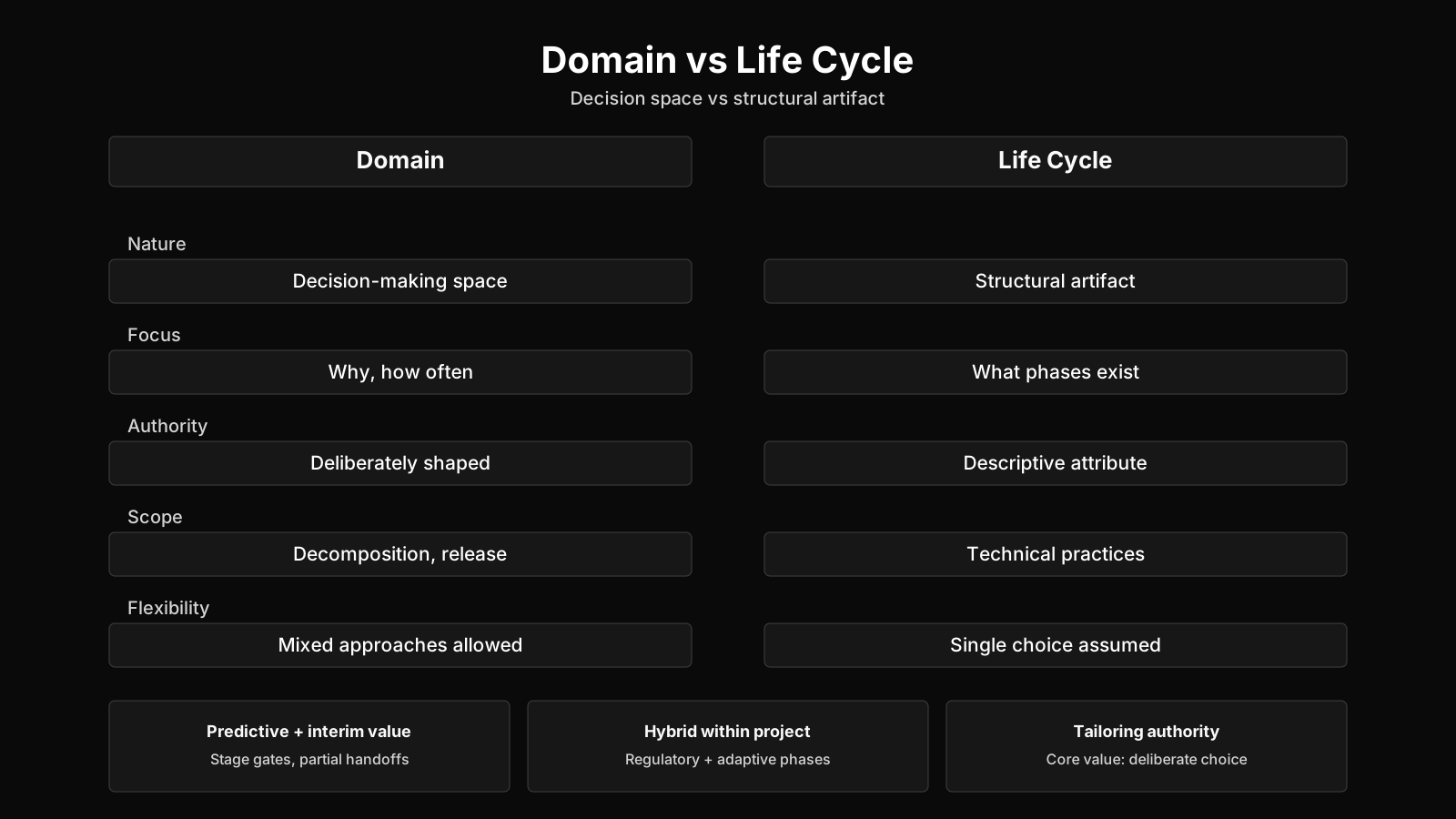
The definition is intentionally broader than a simple methodology choice. It covers both the structural logic of the project, meaning how work is decomposed and ordered, and the temporal logic, meaning when work products become available for use or review. Those two logics are often conflated in practice. A project can have a very structured life cycle yet still produce incremental value, just as an adaptive project can have formal phase reviews.
This domain also recognizes that the project life cycle is a strategic artifact, not merely an administrative artifact. The sequencing of phases influences how quickly benefits can be realized, how much rework is likely, and how much governance overhead the project carries. The performance domain therefore pushes project managers to make these choices deliberately rather than falling back on organizational habit.
Key Insights on Development Approach
- Domain defined by three concepts
- The scope of this performance domain is defined by the interplay among the development approach, the project life cycle, and the delivery cadence.
- Structural and temporal project logic
- This domain integrates structural logic, which determines how work is broken down and sequenced, with temporal logic, which determines when deliverables are ready for use, feedback, or formal review.
- Structured and adaptive are independent
- A structured life cycle can deliver value incrementally, and an adaptive project can include formal phase reviews, so these two dimensions should be assessed independently rather than conflated.
- Life cycle is a strategic artifact
- The sequencing of phases is a strategic choice that directly shapes benefit realization speed, rework risk, and the governance burden the project must carry.
Key Components of the Development Approach and Life Cycle Performance Domain
The key components of the Development Approach and Life Cycle Performance Domain are the development approach, life cycle phases, and delivery cadence. Each component has its own logic, but they must be aligned for the performance domain to function properly. Misalignment among these three components is one of the most common sources of project friction.
Development approach refers to the means used to create and evolve the product, service, or result during the project life cycle. It is not just software delivery; it applies to construction, research, engineering, organizational change, and any effort with a defined deliverable. Life cycle phases are the stages of a project from initiation to closure, such as feasibility, design, development, testing, transition, and closeout. Delivery cadence describes the timing and frequency of project deliverables, which may be a single delivery at the end, multiple deliveries, periodic deliveries, or continuous delivery.
Development Approach
The development approach determines how requirements are handled, how much planning is done up front, and how the team responds to change. The broad categories are predictive, iterative, incremental, adaptive, and hybrid. Predictive approaches emphasize detailed upfront planning and sequential phases. Adaptive approaches emphasize short feedback loops and ongoing refinement. Hybrid approaches combine elements of both within the same project.
In practice this means a project manager might choose a predictive approach for a satellite launch contract because the requirements are fixed and the cost of discovering a late change is extreme. The same organization might choose an adaptive approach for a customer-facing mobile application where user feedback is essential and early versions can be incomplete without harming the final product.
Life Cycle Phases
Life cycle phases provide high-level structure. They help senior management understand where the project is in its journey and when formal decisions are required. A phase gate between design and construction, for example, signals that the design has reached a level of completeness sufficient to commit more funds. The phases themselves do not have to be sequential; they can overlap or repeat depending on the development approach.
One source of confusion is that a phase may contain many iterations. A project with a single overall life cycle of concept, development, and transition can still contain iterative development cycles inside the development phase. The performance domain requires this distinction to be visible, because governance often operates at the phase level while team delivery operates at the iteration level.
Delivery Cadence
Delivery cadence is the timing and frequency of deliverable production. Single delivery projects deliver the final product once, typically at the end. Multiple delivery projects release a few distinct versions over time. Periodic delivery projects follow a regular schedule, such as monthly or quarterly, regardless of whether the full scope is complete. Continuous delivery projects release value as soon as each increment is ready, often automated or near-automated in software environments.
Cadence affects stakeholder psychology as much as technical execution. A sponsor who receives nothing for eighteen months experiences a very different project than one who receives a usable component every six weeks, even if the final deliverable is identical. The performance domain treats cadence as a deliberate value acceleration choice, not a byproduct of the methodology.
Development Approach and Life Cycle Performance Domain in PMBOK
The Development Approach and Life Cycle Performance Domain PMBOK framework appears in the seventh edition as a shift from process compliance to outcome-focused tailoring. PMBOK 7 defines eight performance domains: stakeholders, team, development approach and life cycle, planning, project work, delivery, measurement, and uncertainty. This domain sits among them as the structural bridge between planning and delivery.
In the sixth edition, the project life cycle and development approach were discussed primarily through the lens of project phases and process groups. The seventh edition elevates them to a performance domain because the decisions involved are not one-time planning outputs. They require continuous attention as the project unfolds. A development approach that seemed correct during initiation may need adjustment after early results reveal more uncertainty than expected.
PMBOK 7 does not prescribe a single correct approach. It describes conditions under which different approaches and life cycle choices are appropriate. Predictive approaches tend to fit projects with stable requirements, low change rates, and high cost of late change. Adaptive approaches tend to fit projects with evolving requirements, high ambiguity, and a need for frequent stakeholder feedback. The standard frames these as contingent choices, not ideological positions.
The domain also interacts with tailoring. Project teams are expected to tailor the development approach, life cycle, and delivery cadence based on project characteristics, organizational constraints, and product attributes. This tailoring may differ across deliverables within the same project. A large infrastructure program, for instance, might use predictive methods for civil works while an accompanying data reporting system is developed adaptively.
Desired Outcomes in PMBOK 7
The standard lists three desired outcomes for this performance domain. The first is that development approaches are consistent with project deliverables. The second is that the project life cycle connects delivery of business value and stakeholder value from the beginning to the end of the project. The third is that the life cycle consists of phases that facilitate the delivery cadence necessary to produce the deliverables. These outcomes clarify that the domain is not about selecting a methodology for its own sake, but about enabling value flow.
Key Insights on Life Cycle Domain
- Outcome-focused tailoring shift
- The PMBOK Guide, Seventh Edition positions development approach and life cycle as a performance domain, shifting emphasis from procedural compliance to outcome-driven tailoring that aligns delivery methods with project goals.
- Bridge between planning and delivery
- Functioning as the structural link between planning and delivery, this domain treats approach selection as an iterative decision point that requires adjustment when early results reveal greater uncertainty than initially anticipated.
- Context-dependent approach selection
- Predictive approaches work best for stable requirements and low change frequency, while adaptive methods fit uncertain environments, prompting teams to tailor the life cycle around project characteristics, organizational constraints, and product attributes.
Development Approach and Life Cycle Performance Domain in PRINCE2 and Other Frameworks
Development Approach and Life Cycle Performance Domain in PRINCE2 is not a formal term, but PRINCE2 addresses the same underlying concerns through management stages, technical stages, and tailoring. PRINCE2 projects are organized into management stages that provide senior management with control points. These stages are not identical to development phases, but they overlap with the concept of a project life cycle because they reflect the project’s major decision points.
PRINCE2 separates project management from the specialist delivery method. A PRINCE2 project may use agile delivery, predictive delivery, or a hybrid. PRINCE2 Agile provides guidance on blending PRINCE2 governance with agile techniques such as iterative development, timeboxing, and continuous feedback. The focus remains on project viability and stage control rather than prescribing a single development approach.
In Agile frameworks, life cycle and development approach are often intentionally merged. Scrum, for example, operates through repeated sprints that combine planning, execution, review, and retrospective within each iteration. There is no separate high-level phase gate in the classic PRINCE2 sense, but the project may still have a product vision, release plans, and a defined end state. Kanban uses continuous flow without fixed iterations, yet still requires the team to define how often work is released to users.
Other frameworks, such as the PMI Process Groups model in earlier editions, treated initiating, planning, executing, monitoring and controlling, and closing as process groups that overlay any development approach. The newer performance domain language is different because it does not assume a linear process sequence. It asks the project team to define and manage the life cycle rather than simply move through predetermined groups.
Purpose and Importance of the Development Approach and Life Cycle Performance Domain
The purpose of the Development Approach and Life Cycle Performance Domain is to ensure that the project’s structural choices support value delivery rather than constrain it. A well-managed domain prevents the common failure pattern of a capable team producing the right deliverable at the wrong time or with an approach that causes unnecessary rework. It also aligns stakeholder expectations by making delivery timing explicit and defensible.
When this domain is ignored, projects often inherit a life cycle by default. The default may be the organization’s legacy waterfall template, or it may be an agile process copied from another team without considering the nature of the work. Both defaults create risk. A rigid sequential life cycle on a project with uncertain requirements can lead to expensive late-stage discovery of defects. An adaptive process on a project with fixed regulatory milestones can produce governance chaos and missed assurance reviews.
The importance of this domain grows with project complexity. Small internal projects may have minimal life cycle overhead, but large programs need a clearly defined sequence of phases to coordinate funding, resources, and external dependencies. Portfolio managers also rely on consistent phase definitions to compare projects and allocate capital. Without an intentional life cycle, portfolio-level project selection becomes unreliable.
In practice, this means the project manager and sponsor should be able to explain why a project delivers once at the end, monthly, or continuously. If they cannot, the development approach and cadence have not been genuinely selected. They have merely happened.
Life Cycle Choices Drive Project Value
- Structural choices enable value delivery
- Life cycle decisions made here determine whether structural choices accelerate value delivery or introduce constraints that stall execution.
- Prevents costly delivery mismatches
- Effective life cycle management prevents a common failure pattern in which a capable team delivers the right product at the wrong time or uses an approach that drives unnecessary rework.
- Explicit and defensible timing
- Aligning stakeholder expectations depends on making delivery timing explicit: whether the project ships once at completion, releases monthly, or delivers continuously.
- Avoiding default life cycle inheritance
- Ignoring this domain leads teams to inherit a default life cycle, such as a legacy waterfall template or an agile process copied from another team, without evaluating whether it fits the project's context.
- Match life cycle to project context
- Rigid sequential life cycles struggle when requirements are uncertain, whereas adaptive processes create governance chaos around fixed regulatory milestones, so small projects and large programs require different structural choices.
Development Approaches Explained: Predictive, Iterative, Incremental, Adaptive, and Hybrid
In project management literature, predictive adaptive hybrid development approaches are the main categories used to describe how a project develops its deliverable. A predictive approach, often called plan-driven or waterfall, relies on detailed planning, sequential phases, and change control. It is most effective when requirements are stable, the technology is well understood, and the cost of change is high.
An adaptive approach, often associated with Agile, uses short cycles, frequent feedback, and continuous refinement. Requirements are not expected to be fully known at the start. Instead, they emerge as stakeholders interact with increments of the product. This approach is most effective when uncertainty is high, early delivery of partial value is possible, and stakeholders can provide meaningful feedback throughout the project.
Hybrid approaches combine predictive and adaptive elements. A project may use predictive planning for procurement of long-lead items while using adaptive development for software components. Or a project may have a predictive front end for business case approval and a highly iterative execution phase. Hybrid approaches are common in large organizations because few real projects are purely predictive or purely adaptive.
Iterative and incremental are sometimes incorrectly treated as synonyms for adaptive. Iterative development means refining a product through repeated cycles, while incremental development means building a product in pieces. Adaptive approaches often use both, but a team can iterate without delivering customer-facing increments. Likewise, a predictive project can still have incremental handoffs within phases. The distinctions matter because they affect feedback, testing, and stakeholder involvement.
The development approach is not a permanent commitment. Teams may start with a predictive approach, discover high uncertainty in a specific deliverable, and shift to adaptive methods for that part of the project. This is a tailoring decision, not a failure of planning. The performance domain expects such adjustments to be deliberate and documented.
Life Cycle Models and Delivery Cadence
The term delivery cadence definition in project management refers to the timing and frequency with which deliverables are made available to stakeholders. PMBOK 7 recognizes four broad cadence patterns: single delivery, multiple deliveries, periodic deliveries, and continuous delivery. Each pattern has different implications for risk, stakeholder engagement, and benefit realization.
Single delivery is typical for projects that produce a cohesive physical asset, such as a bridge or a manufacturing facility. The deliverable cannot be value-producing until it is complete. Multiple delivery is common when a project can release an initial version and then follow with enhancements. Periodic delivery often appears in software products that ship on a monthly or quarterly schedule. Continuous delivery is typical in mature software organizations that automate deployment and release features as soon as they pass quality checks.
Life cycle models are the broad structures that contain these cadences. A traditional predictive life cycle might have requirements, design, construction, testing, and transition. An iterative life cycle might repeat a subset of these phases, refining the product with each cycle. An incremental life cycle might produce the product in separately deliverable chunks, each going through its own mini-life cycle. The performance domain requires the chosen life cycle model to match the delivery cadence, not contradict it.
A project that uses a stage-gate life cycle with a gate after design may struggle to maintain continuous delivery because each gate introduces a synchronization point. This is not inherently wrong. Some regulated projects need stage gates for safety assurance. But the tension between continuous cadence and stage-based governance must be managed explicitly. Failure to do so produces hidden bottlenecks and false claims of agility.
Essential Takeaways on Delivery Cadence
- Cadence definition
- Delivery cadence defines how often and when project deliverables are released to stakeholders, shaping expectations, feedback loops, and the pace of value realization.
- Four PMBOK 7 cadence patterns
- PMBOK 7 identifies single, multiple, periodic, and continuous delivery as four distinct cadence patterns, each influencing risk exposure, stakeholder communication, and the speed of benefit capture.
- Single and multiple delivery
- Single delivery works best for indivisible physical assets such as bridges, while multiple delivery allows teams to launch an initial version and then layer in enhancements based on stakeholder feedback.
- Periodic and continuous delivery
- Periodic delivery releases work on fixed monthly or quarterly cycles, creating predictable planning windows, whereas continuous delivery uses automated pipelines to deploy features immediately after they pass quality gates.
- Life cycle interplay with cadence
- Predictive life cycles proceed through sequential phases, incremental life cycles produce independently shippable increments, and stage-gate life cycles may slow continuous delivery by inserting formal review and synchronization checkpoints.
Practical Application of the Development Approach and Life Cycle Performance Domain
The practical application of the Development Approach and Life Cycle Performance Domain occurs throughout the project, but it is most visible during initiation and early planning. The project manager works with the sponsor and key stakeholders to assess deliverable characteristics, uncertainty, regulatory constraints, and stakeholder tolerance for interim results. Those factors inform the initial choice of development approach and life cycle structure.
During execution, the performance domain remains active. The project manager observes whether the chosen cadence is producing useful feedback. If stakeholders are not engaging with monthly releases, the cadence may be too frequent or too infrequent. If a predictive phase is generating significant rework, the team may need to introduce short iterative loops inside that phase. These adjustments are part of the domain’s ongoing oversight.
The domain also shapes project governance. A steering committee may need to meet more frequently for a continuous delivery project because decisions about product direction occur more often. Conversely, a predictive construction project may have fewer but more formal stage gates tied to resource commitments. The governance rhythm should follow the delivery cadence and life cycle phase boundaries, not the organization’s default meeting calendar.
From a Business Value-Oriented Project Management perspective, program realization sets allow individual projects to choose different development approaches within the same program. A program with a data migration project, a physical infrastructure project, and a customer-facing software product may deliberately assign predictive, hybrid, and adaptive approaches to each. The common thread is that each project’s life cycle and cadence must be defensible in terms of value flow and waste reduction, not selected for methodological preference alone.
Common Challenges and Misconceptions in the Development Approach and Life Cycle Performance Domain
Several common misconceptions about the Development Approach and Life Cycle Performance Domain persist in organizations. The most damaging is that adaptive means no planning. Adaptive projects still plan, but planning is distributed across iterations and focused on near-term work. High-level roadmaps, release plans, and product visions exist in most well-run adaptive projects. The absence of a detailed upfront work breakdown structure does not mean the absence of planning.
A related misconception is that predictive projects cannot deliver incrementally. A predictive project may still deliver major subcomponents or early versions, but those deliveries are usually defined in a baseline plan. The distinction is that predictive approaches manage change through formal change control, while adaptive approaches build change absorption into the development method. Neither is universally superior.
Practitioners often observe that organizations select a hybrid approach as a compromise rather than a design choice. A team may call itself hybrid because management wanted a Gantt chart but developers wanted sprints. Without a clear logic for which components are predictive and which are adaptive, the hybrid can inherit the weaknesses of both. The performance domain asks for the selection logic, not just the label.
Another challenge is misaligned governance. A project may adopt continuous delivery but still face a monthly change control board that meets with a traditional agenda. The result is queuing delay. In other cases, a predictive project may be forced into agile ceremonies that create overhead without improving feedback. The life cycle and delivery cadence should determine the governance cadence, not the reverse.
The domain also should not be used to avoid hard conversations about scope. Selecting an adaptive approach does not remove the need for a business case or a clear definition of value. It changes the mechanism for managing uncertainty, not the accountability for outcomes. Project sponsors who ask for agile only because they want to avoid committing to requirements are misusing the development approach.
Key Takeaways on Development Misconceptions
- Adaptive projects still plan
- Adaptive projects are often assumed to operate without planning, yet they replace a detailed upfront work breakdown structure with iterative planning, high-level roadmaps, release plans, and a continuously refined product vision.
- Change control versus change absorption
- Predictive and adaptive approaches differ primarily in how they handle change: predictive projects rely on formal change control processes, whereas adaptive methods embed change absorption into their core development practices.
- Hybrid and agile misapplications
- Hybrid approaches frequently emerge as a compromise between stakeholders with conflicting preferences, such as managers who require Gantt charts and developers who prefer sprints, while sponsors sometimes adopt agile terminology to avoid committing to concrete requirements.
Relationships to Other Performance Domains and Project Management Concepts
The relationships to other performance domains are extensive because the Development Approach and Life Cycle Performance Domain sets the tempo for planning, delivery, measurement, and uncertainty. In PMBOK 7, the planning domain determines how detailed the plans should be, and that depends directly on whether the project is predictive or adaptive. A predictive project may produce a comprehensive project management plan, while an adaptive project may plan at the release and iteration level.
The delivery domain focuses on delivering outputs and outcomes that realize business value. The development approach and life cycle domain shapes how those outputs are sequenced. Measurement also intersects here. Leading indicators, such as iteration velocity or milestone slippage, only make sense if they align with the chosen cadence. A continuous delivery project measuring only end-of-project schedule variance will miss early signals.
The uncertainty domain is tightly linked as well. Development approach is one of the primary tools for managing uncertainty. The more uncertain the requirements or technology, the more likely an adaptive or iterative approach will help. A stable environment may justify a predictive approach. Risk management and life cycle structure must evolve together, especially when a project transitions from exploration to operation.
Commonly confused concepts include project life cycle, product life cycle, and development approach. The project life cycle is the sequence of phases from project initiation to closure. The product life cycle extends from product concept through growth, maturity, and retirement. A project may develop a product during a small segment of the product life cycle. Development approach is the method used during project work, not the same as the project’s phase structure.
The term delivery cadence is also sometimes confused with iteration length. Iteration length is the duration of a work cycle, such as a two-week sprint. Delivery cadence is how often finished value is actually released to stakeholders. A team can have two-week iterations but release only quarterly. That may be a valid choice, but it must be recognized as a cadence decision, not an iteration mechanics decision.
Evolution and Current Thinking in the Development Approach and Life Cycle Performance Domain
The evolution of the Development Approach and Life Cycle Performance Domain reflects a broader shift in project management from prescriptive process models to outcome-based tailoring. Earlier project management practice often treated the waterfall life cycle as the default. Agile methods emerged in software development and gradually influenced other domains by emphasizing early value, iterative feedback, and cross-functional collaboration.
The introduction of PMBOK 7 in 2021 formalized this evolution by replacing the exclusive focus on process groups with principles and performance domains. The Development Approach and Life Cycle Performance Domain became a distinct area of practice, signaling that selecting and managing the life cycle is a professional competency in its own right. This change also acknowledged that organizations increasingly operate portfolios with mixed methodologies.
Current thinking emphasizes context sensitivity. There is growing recognition that no single development approach is inherently better. The quality of the decision depends on the product type, regulatory environment, stakeholder availability, team maturity, and organizational culture. Many mature organizations now maintain a portfolio of delivery models and expect project leaders to choose among them with explicit rationale.
The distinction between project life cycle and product life cycle has also become more important. Digital products often blur the boundary because a project may create the product and then continuous delivery teams keep evolving it. Program and portfolio managers increasingly seek life cycle models that extend beyond a temporary project, which raises questions about where project governance ends and product ownership begins. The performance domain provides language for that conversation without prescribing a single answer.
Debates continue about how much structure is appropriate for agile projects in regulated industries. Some practitioners argue that phase gates can coexist with adaptive delivery if gates focus on outcomes rather than document completion. Others argue that heavy stage controls undermine the feedback speed that adaptive approaches rely on. The performance domain does not resolve this debate, but it frames both sides as tailoring choices rather than violations of a universal standard.
Key Insights on Life Cycle Evolution
- Outcome-based tailoring shift
- Development approaches have shifted from rigid waterfall defaults toward outcome-based tailoring, where delivery methods are calibrated to each project's specific context, constraints, and value objectives.
- PMBOK 7 formalized the change
- The 2021 PMBOK 7 replaced the narrow emphasis on process groups with principles and performance domains, elevating life cycle selection and management into a distinct professional competency rather than a procedural afterthought.
- Mixed methodology portfolios
- Mature organizations increasingly manage portfolios that span several delivery models, and they require project leaders to articulate and defend their life cycle choices with clear, evidence-based rationale.
- Decision factors for life cycles
- The strength of a life cycle decision depends on how well product characteristics, regulatory constraints, stakeholder availability, team maturity, and organizational culture are weighed and integrated.
- Blurred project and product boundaries
- Digital products increasingly blur the boundary between project creation and continuous delivery, forcing organizations to clarify governance accountabilities and define precisely where project management ends and product ownership begins.