Earned Value Management is a project management technique that integrates scope, schedule, and cost to measure project performance and progress in a single monetary baseline. It compares the value of work actually performed with the planned cost of that work and the actual cost incurred. The method produces variances and performance indices that allow project managers to see whether a project is ahead of or behind schedule, over or under budget, and what the likely final cost will be.
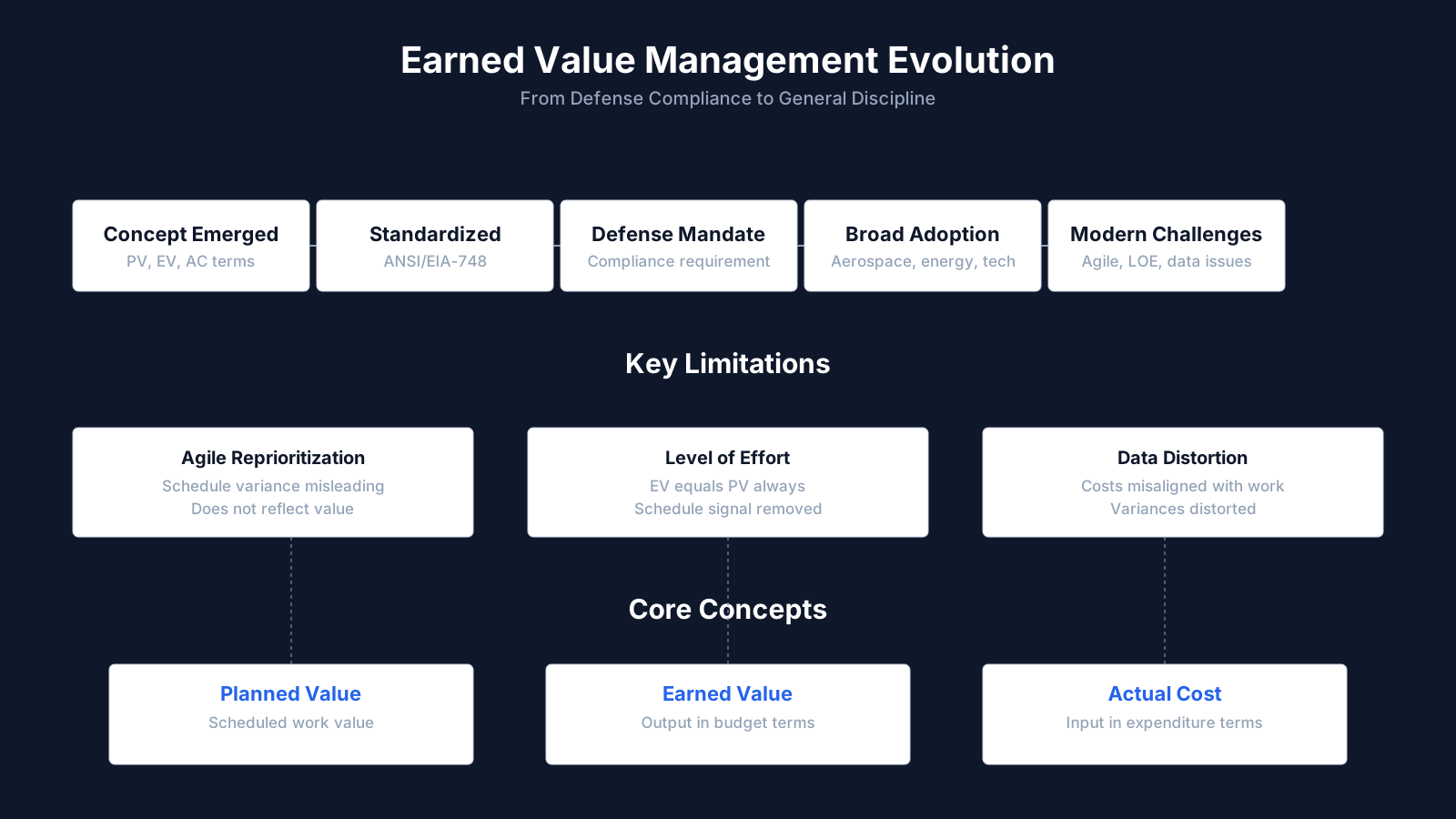
Earned Value Management: Key Topics Summary
| Key Concept | Summary |
|---|---|
| Earned Value Management | Earned value management equips project managers with variance metrics and performance indices that reveal schedule deviations, cost efficiency, and a statistically grounded estimate of final project cost. |
| Origins | The methodology emerged within the United States Department of Defense during the 1960s as a response to the inability of conventional accounting reports to track progress across large, complex defense acquisition programs. |
| Standard Evolution | Cost and schedule control criteria developed by the Department of Defense were later codified as the ANSI/EIA-748 standard, which now governs earned value management systems across industries. |
| Cross-Industry Context | The same underlying logic is reflected in manufacturing standard cost accounting and construction progress payment practices, while aerospace, energy, and public infrastructure sectors have adopted earned value management as a core control discipline. |
| Performance Measurement Baseline | The performance measurement baseline integrates scope, schedule, and budget into a single time-phased plan that serves as the definitive reference for assessing project execution and forecasting outcomes. |
| Planned Value | Planned value represents the time-phased authorized budget assigned to work scheduled for completion by a given date, establishing the benchmark for measuring schedule and cost variance. |
| Agile Environments | Agile projects seldom apply classic earned value techniques because scope is deliberately emergent and work is estimated in relative story points rather than monetary units, making traditional cost-based variance analysis less applicable. |
What Is Earned Value Management?
The earned value management definition rests on three core data points: planned value, earned value, and actual cost. Planned value represents the authorized budget assigned to scheduled work. Earned value is the budgeted amount for the work actually completed by a given date. Actual cost is the money spent to perform that work. When these three figures are compared, they reveal not just how much has been spent, but whether the spending is buying the expected amount of completed work.
Earned value management is sometimes described as a project health check that converts scope completion into currency. A project can be under its cash spend and still be in serious trouble if very little work has actually been delivered. Conversely, a project can appear busy and yet have consumed far more budget than the completed work justifies. EVM exposes these situations by forcing a disciplined distinction between spending, planned work, and delivered work.
On a kitchen renovation with a budget of $50,000, if the cabinets and flooring are 60 percent complete, the earned value is $30,000. The contractor might have spent $35,000, and the planned value at that date might have been $32,000. The numbers would show that the renovation is behind its planned pace and also costing more than the value it has produced. This kind of insight is what earned value management is designed to provide.
Key EVM Takeaways
- Three Core Data Points
- Earned value management integrates planned value, actual cost, and earned value to reveal whether the money spent is matched by the scope and schedule completed.
- Health Check for Projects
- By expressing scope completion in monetary terms, EVM exposes project health issues such as being under budget while falling behind on deliverables, or spending more than the value generated by completed work.
- EVM in Action Example
- For a $50,000 kitchen renovation, completing 60 percent of the cabinets and flooring produces an earned value of $30,000, demonstrating how partial progress is monetized.
Origins and Cross-Industry Context
The origin of earned value management is generally traced to the United States Department of Defense in the 1960s. Defense acquisition programs had become large and complex enough that traditional accounting reports could not reliably answer two basic questions: how much work was supposed to be done, and how much of that work was actually finished. The Department of Defense formalized cost and schedule control systems criteria, which later evolved into the ANSI/EIA-748 standard for earned value management systems.
Outside project management, the underlying logic of earned value appears in manufacturing accounting, where standard costs are earned as units are produced, and in construction management, where contract progress payments are based on measured quantities of completed work. Aerospace, energy, and public infrastructure sectors have adopted EVM because their projects share long durations, fixed baselines, and the need for objective performance reporting to external stakeholders.
The military and government heritage of EVM shaped its reputation as a heavy, documentation-intensive discipline. That reputation is partly accurate. Many of the original requirements were built for massive defense contracts with formal reporting thresholds. Over time, practitioners have borrowed the core calculations and applied them in lighter forms to software, product development, and internal business projects, though the depth of implementation varies widely.
Key Components of Earned Value Management
The key components of earned value management begin with the performance measurement baseline, which is the integrated scope, schedule, and budget plan against which execution is assessed. The baseline is decomposed through a work breakdown structure into control accounts and work packages. Each work package carries a budget at completion, a planned schedule, and a method for measuring earned value as work progresses.
Core Earned Value Management Metrics
Planned value, often abbreviated as PV, is the authorized budget for the work scheduled to be completed by a specific time. Earned value, or EV, is the budget associated with the work that has actually been completed. Actual cost, or AC, is the realized cost incurred for the work performed. These three values are usually expressed in the same currency so they can be compared directly.
Budget at completion, known as BAC, is the total planned budget for the project or for a particular control account. Cost variance is calculated as EV minus AC. A positive cost variance means the work performed cost less than planned. A negative variance means the work cost more than planned. Schedule variance is calculated as EV minus PV. A positive schedule variance indicates that more work has been completed than planned for the date. A negative schedule variance means the project is behind its planned delivery pace.
What often surprises new project managers is that schedule variance is expressed in monetary terms, not in days or weeks. If a project has a schedule variance of negative $8,000, that means the value of work not yet completed compared with the plan is $8,000. It does not directly say the project is eight days late. Duration impact must be analyzed separately through the schedule network.
Performance Indices and Forecasting
Earned value management uses ratios to normalize performance across projects of different sizes. The cost performance index, or CPI, is EV divided by AC. A CPI greater than 1.0 means the project is delivering more value per dollar spent than planned. The schedule performance index, or SPI, is EV divided by PV. An SPI greater than 1.0 means the project is ahead of its planned work completion rate.
Forecasting in EVM involves estimating the final project cost. One common formula assumes that future cost performance will continue at the same rate as past performance. In that case, estimate at completion equals BAC divided by CPI. Another approach adds actual cost to the remaining budget, adjusted by both cost and schedule performance when schedule constraints are critical. Estimate to complete is the difference between estimate at completion and actual cost.
Variance at completion is BAC minus estimate at completion. It shows whether the project is expected to finish under or over its original budget. To complete performance index, or TCPI, calculates the cost performance that must be achieved on remaining work to meet a chosen target, either the original budget or a revised estimate. A TCPI noticeably higher than current CPI signals that the remaining work will require a significant improvement in efficiency.
Key Insights on EVM Components
- Performance measurement baseline
- The performance measurement baseline combines approved scope, schedule, and budget into one integrated plan that serves as the authoritative reference for assessing project execution and performance.
- Baseline decomposition structure
- The baseline is decomposed through the work breakdown structure into control accounts and work packages, each assigned a budget at completion, a planned schedule, and a defined earned value measurement method to enable consistent progress tracking.
- Four core EVM metrics
- Planned value, earned value, actual cost, and budget at completion constitute the core EVM metrics, capturing the budget scheduled over time, the value of completed work, the actual expenditures incurred, and the total approved budget.
- Schedule variance and TCPI
- Schedule variance is expressed in monetary terms rather than days or weeks, and the to complete performance index quantifies the cost performance level required on remaining work to meet a chosen management target.
Earned Value Management in Project Management Frameworks
Earned value management in project management frameworks appears most explicitly in the PMBOK Guide, where it is positioned as a data analysis technique within cost and schedule control processes. PRINCE2 treats it as an optional but compatible progress control method. Agile and hybrid environments adapt the calculations rather than adopting the full baselining discipline. Business value-oriented approaches add a different performance lens alongside traditional earned value metrics.
Earned Value Management in PMBOK
In the PMBOK Guide Sixth Edition, earned value analysis is referenced within the Control Costs process and the Control Schedule process. It relies on inputs from the cost management plan, schedule management plan, and scope baseline. The performance measurement baseline is the integrating artifact that connects the work breakdown structure, schedule, and budget. PMBOK positions earned value as a tool to generate work performance information, which then feeds change requests, forecasts, and performance reports.
The PMBOK Guide Seventh Edition shifted from process groups to principles and performance domains, but earned value remains relevant within the Measurement Performance Domain. Projects still need objective ways to assess progress against a baseline. The shift is more about tailoring than elimination. A small software project might use only CPI and SPI, while a large infrastructure program may apply the full ANSI/EIA-748 framework.
Earned Value Management in PRINCE2
PRINCE2 does not mandate a single performance measurement technique. Its Progress theme requires managers to monitor actuals against baselines and to escalate exceptions when time or cost tolerances are forecast to be exceeded. Earned value management supplies a structured way to calculate those exceptions. Stage-level reporting can use earned value to show whether a stage is delivering its planned products within the agreed tolerances.
PRINCE2 emphasizes management by stages and product-based planning. Earned value aligns well with that structure because each stage can have its own baseline and tolerances. However, PRINCE2 practitioners often use lighter forms of EVM, focusing on variance thresholds and forecasts rather than the full earned value management system documentation used in defense contracting.
Earned Value Management in Agile and Hybrid Environments
Agile projects rarely use earned value in its classic form because scope is intentionally variable and work is estimated in story points rather than currency. A common adaptation is to assign a monetary value to completed story points per iteration, then plot that value against actual costs and a release baseline. This works only when the team has reasonably stable sizing discipline and when the baseline is revalidated as the backlog changes.
Hybrid projects may use earned value at the milestone or release level while leaving iteration-level control to burn charts and cumulative flow diagrams. The earned value calculation then becomes a governance tool rather than a daily team tool. It gives sponsors and steering committees a comparable cost and schedule view across both predictive and adaptive work packages.
The BVOP Perspective on Earned Value
BVOPM adds a value-oriented monitoring layer that traditional earned value does not capture. It introduces process damage as invisible organizational harm and tracks business value points as a leading indicator that may signal project closure when persistently declining. Waste categories such as overwork, perfectionism, and rejected acceptable work can distort earned value because effort may be spent without producing recognized value.
Purpose and Importance of Earned Value Management
The purpose and importance of earned value management lie in its ability to combine scope, cost, and schedule into a single early warning system. Traditional reports often show cost alone, or schedule alone, and miss the interaction between the two. EVM reveals that a project can be under budget and still behind schedule, or ahead of schedule and over budget. That integrated view allows managers to make trade-off decisions with better information.
Earned value management provides a consistent way to measure performance across multiple projects and programs. When a portfolio uses the same metrics, executives can compare project health without needing to understand the unique details of every workstream. This comparability is one reason government agencies and large contractors require earned value reporting as part of their acquisition governance.
EVM also strengthens accountability because variances are tied to specific control accounts and work packages. A negative cost variance is not just an abstract financial problem; it belongs to a defined scope of work owned by a specific team. That makes performance conversations more concrete. Managers can drill into the work breakdown structure to identify exactly where performance is eroding.
The forecasting value of EVM is widely regarded as its most practical benefit. Instead of asking whether the project is on track, stakeholders can see a calculated estimate at completion based on actual performance. This shifts project reviews from backward-looking cost reports to forward-looking risk discussions. The estimate is only as good as the underlying assumptions, but it gives a rational starting point for corrective action.
Core Takeaways on EVM's Value
- Integrated early warning system
- EVM consolidates scope, cost, and schedule into a single performance baseline, exposing early warning signs such as being under budget while falling behind schedule that conventional status reports routinely overlook.
- Better trade-off decisions
- With integrated performance data, managers can assess the downstream consequences of reallocating resources among cost, schedule, and scope before committing to a decision.
- Cross-project comparability
- Consistent EVM metrics allow executives to compare project and program health objectively without relying on detailed knowledge of individual workstreams, a key reason many agencies and contractors make it a contractual requirement.
- Accountability and forecast accuracy
- Because variances are tied to specific control accounts and work packages, stakeholders can review a calculated estimate at completion grounded in actual performance instead of relying on subjective assessments of whether the project is on track.
Earned Value Management vs Traditional Cost and Schedule Tracking
Earned value management versus traditional tracking is often framed as the difference between measuring inputs and measuring outputs. Traditional budget tracking compares planned spend with actual spend. If actual spend is below planned spend, the project may look healthy even if very little work has been completed. Traditional schedule tracking compares planned task dates with actual dates. It may show tasks as on time even when costs are spiraling.
Earned value management closes that gap by asking how much budget value the completed work has actually earned. A project that has spent only 60 percent of its budget but has completed only 40 percent of its planned value is not efficient. It is behind schedule. A project that has completed 80 percent of its work while spending 90 percent of its budget is overrunning, even if all tasks appear to be finishing on time.
Traditional Gantt charts and milestone reports still have value. They communicate timing and dependencies more intuitively than earned value indices. The limitation is that they do not automatically translate percent complete into cost performance. EVM adds that translation. For small or simple projects, the added calculation may not be worth the effort. For complex projects with long durations and multiple funding sources, the translation is often essential.
Common Challenges, Pitfalls, and Misconceptions
Common earned value management pitfalls often begin with the quality of the baseline. If the baseline is poorly structured, EVM will simply measure performance against a bad plan. A baseline built from unrealistic estimates, missing scope, or arbitrary work package splits produces variances that mislead rather than inform. The technique does not fix a broken plan; it exposes it.
Percent complete is a frequent source of distortion. Work packages can be measured by discrete milestones, weighted milestones, physical percent complete, or level of effort. Level of effort tasks, such as project management or quality reviews, earn value based on time elapsed rather than output. That can mask real schedule performance because these tasks will always appear on schedule if the clock keeps running.
A common misconception is that schedule variance tells you how many days late the project is. As noted earlier, schedule variance is expressed in monetary units of unearned planned value. Duration slippage must be assessed through the critical path. A project can have a negative schedule variance but no critical path delay if the underperformance is confined to noncritical work.
Another pitfall is overreliance on CPI in the later stages of a project. As actual costs accumulate, CPI becomes less sensitive to change. A large cost overrun early in the project is hard to reverse, and CPI may stay stubbornly below 1.0 even when recent spending has improved. Managers sometimes prefer to examine a rolling CPI based on the last few reporting periods to see current efficiency trends.
EVM is also not well suited to tiny projects, highly exploratory work, or projects where scope is almost entirely undefined. The overhead of establishing control accounts, assigning earned value methods, and maintaining the data can exceed the benefit. In those cases, a simpler burn chart, milestone trend, or agile velocity measure is more appropriate. Tailoring is a judgment call, not a sign of failure.
Key Takeaways on EVM Pitfalls
- Baseline quality drives EVM value
- A baseline built from unrealistic estimates, missing scope, or arbitrary work package splits generates variances that distort project health instead of revealing it.
- Level of effort masks schedule issues
- Level of effort activities such as project management and quality reviews earn value based on time elapsed rather than completed deliverables, so they can appear on schedule even while the underlying work is falling behind.
- Schedule variance is not days late
- Schedule variance is expressed in monetary units of unearned planned value, and a negative figure does not necessarily signal a critical path delay when underperformance is confined to noncritical work.
- Early cost overruns are hard to reverse
- A large early cost overrun is difficult to reverse because the cumulative cost performance index is anchored by past spending, so it can remain below 1.0 even after recent spending efficiency improves.
Relationships to Other Project Management Concepts
Earned value management and related concepts include the work breakdown structure, control accounts, integrated change control, risk management, and critical path analysis. EVM depends on a well-formed WBS because earned value is measured at the work package level. If the WBS does not decompose scope into manageable, measurable pieces, earned value reporting becomes an exercise in guessing.
Control accounts sit between the work package level and the overall project. They define the management points where scope, schedule, and cost variances are monitored. A control account manager typically owns the performance measurement for a defined set of work packages. This aligns EVM with organizational accountability structures and performance reporting requirements.
Integrated change control has a direct relationship with earned value. Any approved change to scope, schedule, or budget must flow into the performance measurement baseline before variances can be interpreted correctly. If changes are absorbed informally without re-baselining, the EVM data becomes contaminated. Formal baseline maintenance is not bureaucratic busywork; it preserves the integrity of the measurement system.
Risk management interacts with EVM through the likelihood and impact of forecasted variances. A project with a low CPI may be experiencing a known risk event, while a project with strong variances may still carry latent threats that have not yet affected cost or schedule. EVM is a measurement tool, not a substitute for risk identification and response planning.
The critical path method complements earned value by explaining the schedule impact of variances. Earned value shows the magnitude of schedule deviation in cost terms, while critical path analysis shows whether that deviation affects the project end date. The two techniques are often used together in formal schedule and cost reviews.
Evolution and Current Thinking in Earned Value Management
The evolution of earned value management has moved from a rigid defense contracting requirement toward a scalable family of performance measurement practices. Early implementations were heavily document-driven and focused on compliance with detailed system criteria. Current thinking emphasizes integrated baselines, real-time data, and tailored metrics that fit the size and complexity of the project.
One notable development is earned schedule, which converts schedule variance into time units by comparing earned value against the planned value curve. Earned schedule addresses the late-project weakness of SPI, which tends to converge to 1.0 as the project finishes regardless of actual delay. This extension has gained attention in project management literature and practice, though it is not yet as widely adopted as traditional EVM formulas.
Software tools have reduced the administrative burden of EVM considerably. Project management information systems can calculate variances from schedule and financial data automatically. Some organizations now use dashboards that combine earned value metrics with risk registers, change logs, and resource histograms. This integration supports decision making without requiring the manual compilation that historically made EVM expensive.
Debate continues over how much EVM should be applied in Agile and product-centric environments. Some practitioners argue that earned value is fundamentally a predictive planning construct that conflicts with iterative scope discovery. Others find that lightweight earned value at the release level provides necessary governance for sponsors. The most credible position is that EVM is a family of techniques, and the right dosage depends on the project context.
Current best practice focuses on using EVM as a decision trigger rather than a compliance artifact. Variances matter because they prompt analysis, not because they fill a report. A CPI of 0.92 means little until someone investigates the work packages causing the overrun and proposes a corrective action. That investigative discipline is where the real management value resides.
Core Insights on EVM Evolution
- From compliance to tailored practices
- Earned value management now prioritizes scalable, fit-for-purpose metrics over rigid, document-driven defense requirements, reflecting a broader shift toward adaptive project controls.
- Earned schedule improves schedule analysis
- Earned schedule expresses schedule variance in time units and eliminates the late-project distortion seen with SPI, yet its adoption remains limited compared with conventional EVM formulas.
- Integrated data and system automation
- Modern project management information systems not only compute variances automatically but also combine EVM data with risk registers, change logs, and resource histograms in unified dashboards, supporting more timely management decisions.
