A contract in project management is a legally binding agreement between a buyer and a seller that defines the scope of work, deliverables, schedule, payment terms, and the conditions under which goods or services will be provided. In project, program, and portfolio management, contracts function as formal governance instruments that allocate risk, establish performance expectations, and create enforceable obligations for all parties. They are not merely administrative paperwork; they are the primary means by which project organizations procure external resources, services, and products while protecting their strategic and financial interests.
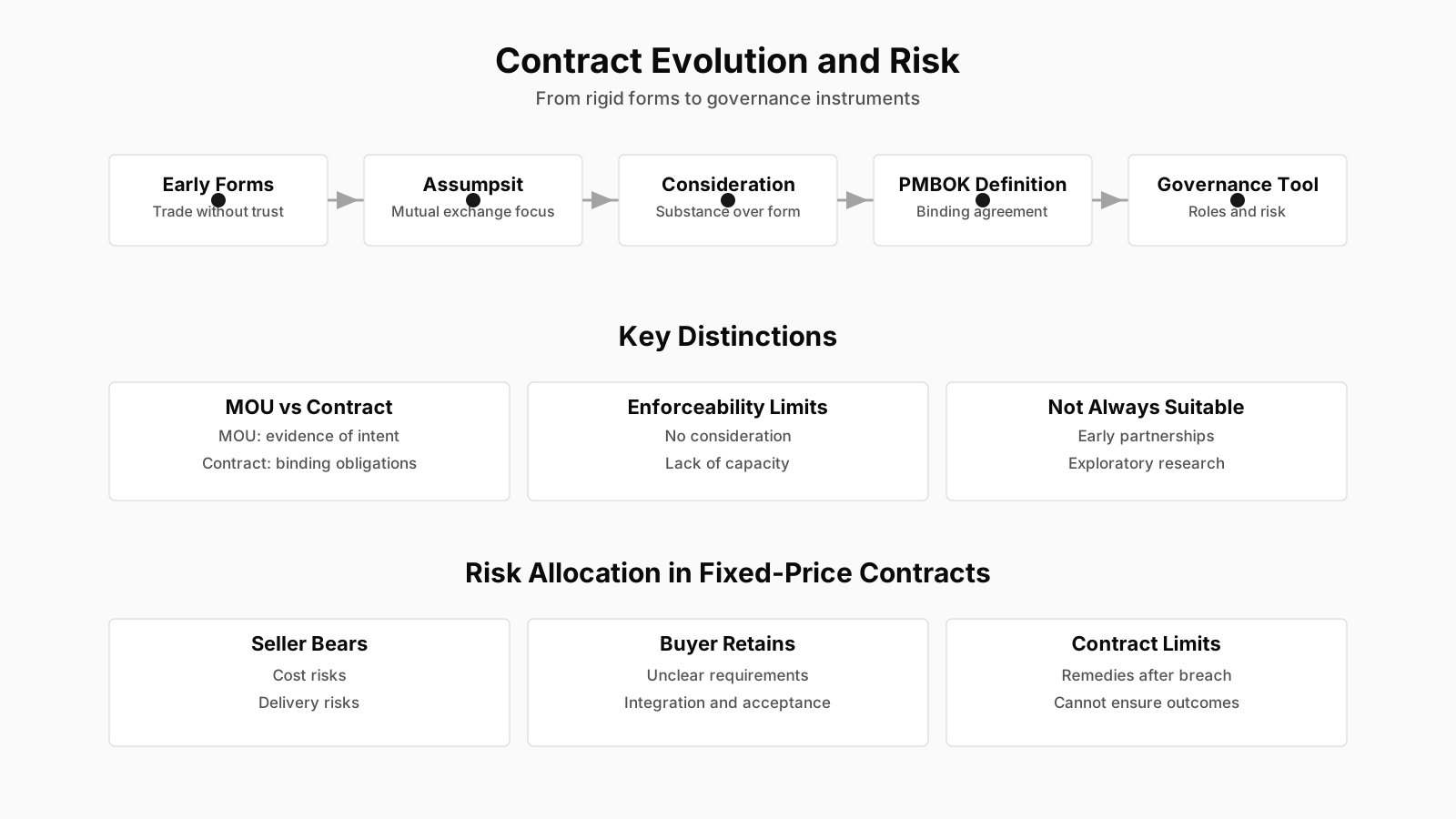
Contracts at a Glance: Key Topics Summary
| Key Concept | Summary |
|---|---|
| Contract definition | A contract is a legally enforceable agreement between two or more parties that specifies scope, deliverables, schedule, payment terms, performance standards, and the conditions governing the supply of goods or services. |
| Governance role | Across project, program, and portfolio management, contracts operate as formal governance instruments that allocate risk, define performance expectations, and establish enforceable rights and obligations for all parties. |
| Procurement function | Contracts form the primary mechanism through which project organizations acquire external resources, services, and products while aligning vendor performance with strategic, financial, and operational interests. |
| Consideration and acceptance | Consideration usually involves monetary compensation in exchange for completed deliverables, while acceptance is determined by formal acceptance criteria specified in the contract or its incorporated attachments. |
| Historical evolution | Contractual frameworks evolved through merchant law, public procurement, and large-scale infrastructure projects, ultimately shaping how private enterprises structure commercial relationships and allocate contractual risk. |
| Industry influences | Long before project management emerged as a distinct discipline, the construction, defense, aerospace, and information technology industries refined contract models and practices, setting precedents still reflected in contemporary project contracting. |
| Modern integration | Contracts have evolved from stand-alone legal documents owned by attorneys into integrated project artifacts jointly managed by project managers, procurement professionals, and legal counsel, supporting delivery rather than only compliance. |
| Contract contents | A well-structured project contract typically defines the scope of work, deliverable specifications, acceptance criteria, schedule milestones, payment and pricing terms, change control procedures, warranties, liability limitations, termination rights, and dispute resolution mechanisms. |
What Is a Contract in Project Management?
The question of what is a contract in project management can be answered in both legal and operational terms. From a legal perspective, a contract is a mutual agreement that creates obligations enforceable by law. From a project management perspective, a contract is a procurement artifact that results from the planning and execution of procurement processes and serves as the authoritative reference for what the seller must deliver and what the buyer must pay. The PMBOK Guide defines a contract as a mutually binding agreement that obligates the seller to provide specified products, services, or results and obligates the buyer to compensate the seller. This dual obligation is the foundation of the buyer-seller relationship in any project with external dependencies.
In operational practice, a contract contains several essential elements that distinguish it from informal agreements or memoranda of understanding. These elements include an offer, acceptance, consideration, legal capacity of the parties, and lawful purpose. Within a project context, consideration usually takes the form of payment in exchange for deliverables, while acceptance is tied to formal acceptance criteria defined in the contract or its referenced attachments. The contract also establishes the terms for changes, disputes, termination, warranties, and liability, all of which directly influence how project managers handle risk and control scope.
A common misunderstanding among new project managers is that a contract transforms a business relationship into a purely legal one. While contracts certainly provide legal remedies, experienced practitioners view them as relationship governance tools that also communicate roles, expectations, and behavioral boundaries. A well-structured contract reduces ambiguity and friction during execution, but it does not replace the need for active stakeholder engagement, communication, and performance monitoring. Contracts set the rules of engagement, but people still execute the work.
Core Insights on Project Contracts
- Dual legal and operational definition
- In project management, a contract functions simultaneously as a legally enforceable mutual agreement and as a procurement instrument that defines the seller's required deliverables and the buyer's corresponding payment obligations.
- PMBOK mutually binding agreement
- According to the PMBOK Guide, a contract is a mutually binding agreement that obligates the seller to deliver specified products, services, or results, and obligates the buyer to provide the agreed compensation.
- Essential elements beyond informal agreements
- A valid contract requires essential elements that informal agreements often lack, including consideration in the form of payment for deliverables and acceptance measured against formal criteria defined in the contract or its referenced attachments.
- Relationship governance and risk tool
- In practice, project professionals rely on contracts not only for legal remedies but also as governance tools that define roles, set expectations, and establish behavioral boundaries, while providing structured mechanisms for managing changes, disputes, termination, warranties, and liability.
Origins and Broader Context of Contracts
Contracts predate modern project management by several millennia. Ancient legal codes, including Roman law and later common law traditions, formalized the concept of binding agreements between parties. These early contractual frameworks evolved through merchant law, government procurement, and large infrastructure projects, eventually influencing how private enterprises structured commercial relationships. The construction, defense, aerospace, and information technology industries refined contract forms and practices long before project management emerged as a distinct discipline. In construction, for example, standardized contract forms such as those published by FIDIC became international benchmarks for allocating risk in major capital projects.
In cross-industry usage, the definition of a contract remains consistent even though the application varies widely. A software development contract may focus on intellectual property rights, licensing, and service levels, while a defense contract may include extensive security, audit, and compliance clauses. Manufacturing contracts often specify tolerances, quality assurance methods, and supply chain penalties. This cross-industry diversity explains why project managers must adapt their contract management approach to the domain, regulatory environment, and organizational procurement policies. The underlying legal principles do not change, but the operational emphasis does.
Project management adopted contracts as a core tool primarily through procurement management, a knowledge area that grew in formal importance during the latter half of the twentieth century. As organizations increasingly outsourced non-core activities and specialized services, the need for rigorous contract planning, negotiation, and administration intensified. Contracts moved from being purely legal documents handled by attorneys to become integrated project artifacts managed collaboratively by project managers, procurement professionals, and legal counsel. This shift reflected a broader recognition that contract performance is inseparable from project performance.
Key Components and Types of Contracts in Project Management
Understanding the key components of contracts is essential for effective procurement and delivery. A typical project contract includes a detailed scope of work or statement of work, deliverable descriptions, acceptance criteria, schedule milestones, payment terms, pricing structure, change management procedures, warranty provisions, liability limitations, termination rights, and dispute resolution mechanisms. Some contracts also include confidentiality, intellectual property, data protection, and sustainability clauses, especially in regulated industries or when sensitive information is exchanged. The absence or vagueness of any of these components can create significant project risk, because the contract becomes the fallback reference when expectations diverge.
Contract types are generally categorized by how payment is calculated and how risk is allocated between the buyer and the seller. The three primary categories are fixed-price contracts, cost-reimbursable contracts, and time and materials contracts. Each category has multiple variants that shift risk in subtle ways. Selecting the appropriate contract type is one of the most consequential decisions in procurement planning, because it directly influences seller behavior, cost predictability, and the buyer's administrative burden. A project manager who selects a contract type without analyzing scope certainty, market conditions, and the seller's risk tolerance is setting the stage for later disputes.
Fixed-Price Contracts
Fixed-price contracts establish a set price for a defined scope of work. The seller assumes most of the cost risk, because any cost overrun beyond the agreed price is typically absorbed by the seller unless the scope changes. In exchange, the buyer gains cost certainty and reduced financial risk, provided the scope remains stable. Common variants include firm fixed price, fixed price with economic price adjustment, and fixed price incentive fee, where the seller can earn additional profit for outperforming cost or schedule targets.
Fixed-price contracts work well when requirements are well understood, the scope is stable, and the market has enough competition to provide reasonable pricing. However, they become problematic when requirements are vague or subject to frequent change, because sellers will often inflate the price to cover uncertainty, or they will aggressively pursue change orders to recover margins. A common trap in fixed-price contracting is assuming that transferring cost risk to the seller automatically protects the buyer. In reality, excessive risk transfer can lead to poor quality, adversarial relationships, or even seller failure, all of which harm the project.
Cost-Reimbursable Contracts
Cost-reimbursable contracts pay the seller for legitimate costs incurred plus a fee representing profit. The buyer assumes most of the cost risk because the final price is not known until the work is complete, while the seller is protected from cost overruns caused by uncertainty or evolving requirements. Variants include cost plus fixed fee, cost plus incentive fee, and cost plus award fee, each with different mechanisms for motivating seller performance. These contracts are appropriate when the scope cannot be defined precisely at the outset, such as in research and development, innovative software projects, or emergency response work.
Because the buyer bears cost risk, cost-reimbursable contracts require rigorous cost monitoring, auditing rights, and clear allowable cost definitions. Without active cost control, these contracts can become open-ended commitments that erode project budgets. Project managers must understand that cost-reimbursable does not mean uncontrolled; the contract must specify reporting frequency, cost categories, and performance milestones to ensure that the buyer can still manage value delivery. In practice, many buyers combine cost-reimbursable arrangements with a guaranteed maximum price or a target cost to cap exposure while preserving flexibility.
Time and Materials Contracts
Time and materials contracts combine elements of fixed price and cost reimbursement by paying the seller for direct labor hours at agreed rates plus materials and other direct costs. This type of contract is common when the scope is not fully defined but the buyer wants to begin work quickly, such as in staffing augmentation, maintenance, or iterative software development. The buyer retains some cost risk because the total price depends on the hours consumed and materials used, but the seller carries little productivity risk as long as the hours are legitimate.
Time and materials contracts are often used in Agile projects where requirements evolve through iterative delivery. They provide flexibility to adjust scope, team size, and priorities without constant contract renegotiation. The main limitation is the lack of inherent cost control from the seller's side; the buyer must actively manage utilization, deliverables, and productivity to avoid cost escalation. For this reason, many organizations impose not-to-exceed limits or pair time and materials contracts with periodic performance reviews.
Key Takeaways on Contract Essentials
- Complete contracts mitigate project risk
- A contract needs to define scope, deliverables, acceptance criteria, milestones, payment terms, and dispute resolution mechanisms so that when expectations diverge, the written terms remain the authoritative reference and prevent costly misunderstandings.
- Contract type shapes buyer-seller dynamics
- The chosen contract type sets the balance of risk between buyer and seller, shapes cost predictability, and influences seller incentives, so procurement teams must evaluate scope certainty and market conditions before committing.
- Fixed price demands clear requirements
- Firm fixed price and incentive fee contracts perform well only when the scope is fully defined, because sellers facing ambiguous requirements tend to raise initial prices or pursue change orders aggressively to protect their margins.
- Cost-reimbursable needs strict controls
- Cost-reimbursable contracts should require regular cost reporting, predefined allowable cost categories, and measurable performance milestones so the buyer can detect spending drift early and maintain control over delivered value.
Contracts in PMBOK and PRINCE2
Within the PMBOK framework, contracts are central to Project Procurement Management, one of the ten traditional knowledge areas in the PMBOK Guide Sixth Edition. The processes that produce and govern contracts include Plan Procurement Management, Conduct Procurements, and Control Procurements. During planning, the project manager and procurement team decide whether to make or buy, select a contract type, and prepare procurement documents such as requests for proposal or invitations for bid. During conduct, sellers are selected, negotiations occur, and a contract is awarded. During control, the project manager monitors contract performance, processes change requests, and manages claims and disputes.
The PMBOK Guide Seventh Edition, which shifted from process groups to principles and performance domains, retains contract management as an essential practice within the Delivery and Uncertainty performance domains. Even without the rigid process terminology, the expectation remains that project managers understand legal agreements, risk allocation, and supplier performance. Contracts in PMBOK are not treated as isolated legal documents; they are integrated with scope management, schedule management, risk management, and stakeholder management. A change to the contract often triggers changes to multiple project baselines, which is why formal change control is tightly linked to contract administration.
In PRINCE2, contracts are managed primarily under the Plans, Risk, and Change themes rather than as a standalone knowledge area. PRINCE2 emphasizes that the project board owns the business case and authorizes major commitments, including supplier contracts. The senior supplier role on the project board is specifically responsible for representing the interests of those providing goods and services. PRINCE2 does not prescribe a single contract type; instead, it requires that contracts align with the project's management stages, tolerances, and exception management. Supplier contracts are often reviewed at stage boundaries to ensure that the remaining work still represents value for money.
Agile and hybrid environments approach contracts with a different emphasis. The Agile Manifesto's value of customer collaboration over contract negotiation does not mean contracts are irrelevant; it means that the contract should not become a barrier to collaborative adaptation. Agile contracts often favor time and materials arrangements, increment-based fixed price, or contracts with options for scope changes. In hybrid delivery, a base contract may cover known fixed-scope elements while a separate agile component allows iterative discovery. The challenge is balancing legal predictability with the need to respond to changing product requirements, which often requires early involvement of legal counsel in drafting flexible change mechanisms.
Purpose and Importance of Contracts in Project Management
The purpose of contracts in project management extends well beyond legal protection. Contracts formalize the allocation of risk by specifying which party bears responsibility for cost overruns, delays, defects, and unforeseen conditions. They establish a common understanding of what success looks like through defined deliverables and acceptance criteria. They also provide a mechanism for recourse when one party fails to meet its obligations, which is essential for maintaining accountability in complex multi-party engagements. Without a clear contract, project managers are left relying on informal agreements that are difficult to enforce and subject to conflicting interpretations.
Contracts also serve as planning and control instruments. The contract's schedule milestones, payment terms, and reporting requirements become inputs to the project schedule, budget, and communication plan. When a seller's performance deviates from the contract, the project manager has a documented basis for issuing corrective actions, withholding payment, or escalating through formal dispute resolution. In program and portfolio management, aggregated contract obligations influence cash flow forecasting, resource capacity, and strategic supplier relationships. A portfolio manager may examine the total risk exposure across multiple contracts to determine whether the organization is over-reliant on a single vendor or carrying too much contingent liability.
In practice, contracts also shape the working relationship between buyer and seller. A well-designed contract includes incentives that align seller behavior with project objectives, such as bonuses for early delivery or penalties for quality failures. Conversely, a poorly designed contract can create perverse incentives, such as rewarding the seller for billing more hours rather than completing work efficiently. The contract is therefore a performance management tool, not just a protective shield. This dual role is often underappreciated by project managers who view contracts as purely legal artifacts to be signed and filed away.
Core Insights on Contract Fundamentals
- Contracts formalize risk allocation
- By assigning responsibility for cost overruns, delays, defects, and unforeseen conditions, a contract converts informal handshake arrangements into enforceable obligations that reduce ambiguity and strengthen risk governance.
- Defining success through deliverables
- A contract creates a common definition of success by specifying measurable deliverables and acceptance criteria that every party can use to evaluate performance and confirm completion.
- Accountability and recourse mechanisms
- When obligations are not met, the contract supplies a documented foundation for corrective action, payment withholding, or formal dispute resolution, ensuring accountability across complex multi-party engagements.
- Contract terms drive project planning
- Schedule milestones, payment terms, and reporting requirements contained in the contract serve as direct inputs for building the project schedule, budget, and communication plan.
- Portfolio impact and behavioral incentives
- At the portfolio level, aggregated contractual obligations shape cash flow forecasts, resource capacity planning, and supplier risk exposure, while carefully designed incentives such as early-delivery bonuses or quality penalties help align seller behavior with project objectives.
Common Challenges, Pitfalls, and Misconceptions
One of the most persistent common misconceptions about contracts in project management is that a fixed-price contract eliminates all cost risk for the buyer. While the buyer's financial exposure is capped for a defined scope, the practical reality is that sellers often embed contingency in fixed-price bids to cover uncertainty, and they may aggressively pursue change orders when scope is ambiguous. Another misconception is that signing a contract guarantees seller performance. A contract provides legal remedies after a failure occurs, but it does not prevent failure from happening. Active performance monitoring and relationship management are still required.
A frequent pitfall in project contract management is the separation between the negotiation phase and the execution phase. The person who negotiated the contract may not be the same person who administers it, leading to lost context and unintended interpretations. Project managers may inherit a contract without fully understanding its terms, especially around change control, payment schedules, and acceptance procedures. This knowledge gap can cause delays when changes arise or disputes occur. Organizations that treat contract handoff as an administrative formality rather than a structured knowledge transfer create avoidable risk.
Another challenge arises from vague or incomplete scope definitions. When the statement of work is poorly written, the contract becomes a source of conflict rather than clarity. Sellers may claim that certain work falls outside the scope, while buyers may assume it is included. This is particularly common in fixed-price projects where the seller has little financial incentive to absorb additional work. Project managers should not assume that a signed contract resolves ambiguity; the contract's value depends on the precision of its scope, acceptance criteria, and change management provisions.
Agile practitioners sometimes hold the misconception that contracts are inherently anti-agile. In reality, Agile projects still require legal agreements, especially when external vendors or contractors are involved. The difference lies in how the contract is structured, not whether it exists. Agile-friendly contracts allow for iterative scope adjustment, frequent feedback, and shared risk, rather than locking in detailed requirements upfront. The failure to adapt contract structures to agile delivery methods can undermine the very flexibility the project is trying to achieve.
Contracts vs Related Project Management Concepts
A clear understanding of contract vs statement of work is important for avoiding confusion in procurement. A statement of work, or SOW, is a narrative description of the products, services, or results to be supplied. It is often an attachment or exhibit to a contract, but it is not itself a legally binding agreement. The contract provides the legal framework, consideration, and remedies, while the SOW defines the technical scope and acceptance criteria. In many organizations, the SOW is written by the project team and the contract is drafted by legal and procurement professionals, which can create a disconnect if the two documents are not reconciled carefully.
Contracts are also distinct from purchase orders and service level agreements. A purchase order is a commercial document issued by a buyer to a seller indicating types, quantities, and agreed prices for products or services. It can become a binding contract when accepted by the seller, but it is generally narrower in scope than a full project contract. A service level agreement, or SLA, defines the expected level of service, such as uptime, response time, or throughput, and is often part of a broader contract for ongoing or managed services. While an SLA can be legally enforceable when embedded in a contract, it is not a standalone contract by itself.
The relationship between a contract and a project charter also deserves attention. A project charter formally authorizes a project and gives the project manager authority to apply organizational resources. It is an internal document, whereas a contract is an external agreement between the performing organization and another legal entity. In some projects, especially those delivered for an external client, the contract predates the charter and serves as a key input to it. The charter may summarize the contract's high-level requirements and constraints, but it does not replace the contract's legal obligations. Understanding this distinction helps project managers avoid using internal project artifacts to modify external legal commitments.
Key Takeaways on Contract Concepts
- Contract versus statement of work
- The contract establishes the enforceable legal framework, consideration, and remedies, while the statement of work specifies the technical scope, deliverables, and acceptance criteria that govern delivery.
- Purchase order as narrow contract
- A purchase order becomes legally binding once the seller accepts it, but it remains narrower than a full project contract in both coverage and risk allocation.
- Service level agreement essentials
- A service level agreement defines measurable performance targets such as uptime, response time, and throughput, and it normally sits within a broader contract for ongoing or managed services.
- Charter and contract relationship
- A project charter formally authorizes the project and grants the project manager authority, although for external clients the contract often precedes the charter and serves as a key input.
Evolution and Current Thinking in Contract Management
The practice of contract management in projects has evolved from a purely transactional, legally defensive activity into a more collaborative and strategic discipline. Modern thinking recognizes that adversarial contracting often increases overall project cost and duration, while relational contracting can improve outcomes by aligning incentives and encouraging joint problem-solving. Approaches such as integrated project delivery, alliance contracting, and target cost with shared pain and gain mechanisms reflect this shift. These models are used selectively in construction, infrastructure, and complex technology projects where long-term collaboration is more valuable than short-term adversarial leverage.
Current best practices emphasize the importance of early legal involvement, standardized contract templates, and contract lifecycle management software. Digital tools now enable automated clause analysis, risk scoring, and deadline tracking, reducing the administrative burden on project managers. There is also growing attention to sustainability clauses, data protection requirements, cybersecurity obligations, and social value commitments in project contracts. These emerging dimensions reflect broader societal expectations and regulatory pressures, not just traditional cost and schedule concerns. A project manager who ignores these evolving contract terms may expose the organization to reputational and compliance risks that are difficult to quantify.
Debate continues over the optimal level of risk transfer in project contracts. Some scholars and practitioners argue that fixed-price contracts incentivize efficiency but discourage collaboration and innovation. Others maintain that cost-reimbursable contracts encourage transparency but reduce cost discipline unless paired with strong oversight and incentives. The current professional consensus is that no single contract type is universally superior; the choice must reflect the project's scope clarity, complexity, market conditions, and the maturity of the buyer-seller relationship. In this context, contract management is not a one-time event but an ongoing process of negotiation, adaptation, and performance governance throughout the project life cycle.