In the context of project, program, and portfolio management, the term “capabilities in PMO” refers to the collective bundle of skills, processes, tools, knowledge, and organizational enablers that allow a Project Management Office to perform its designated functions and deliver measurable value to the enterprise. It is not a simple checklist of services, but rather the underlying capacity that determines how well a PMO can execute everything from basic administrative support to strategic portfolio governance. When practitioners speak of a PMO’s capabilities, they are describing what the office is actually equipped to do, in terms of human competence, methodological maturity, and technological infrastructure, and how reliably it can do it under real-world constraints.
Summary of Core PMO Capabilities
| Key Concept | Summary |
|---|---|
| Definition | PMO capabilities are the integrated combination of skills, methodologies, digital tools, institutional knowledge, and organizational support structures that enable a Project Management Office to execute its mandate and generate tangible business value. |
| Origins | The concept is grounded in organizational capability theory and the resource-based view of the firm, which gained prominence in strategic management literature during the 1990s. |
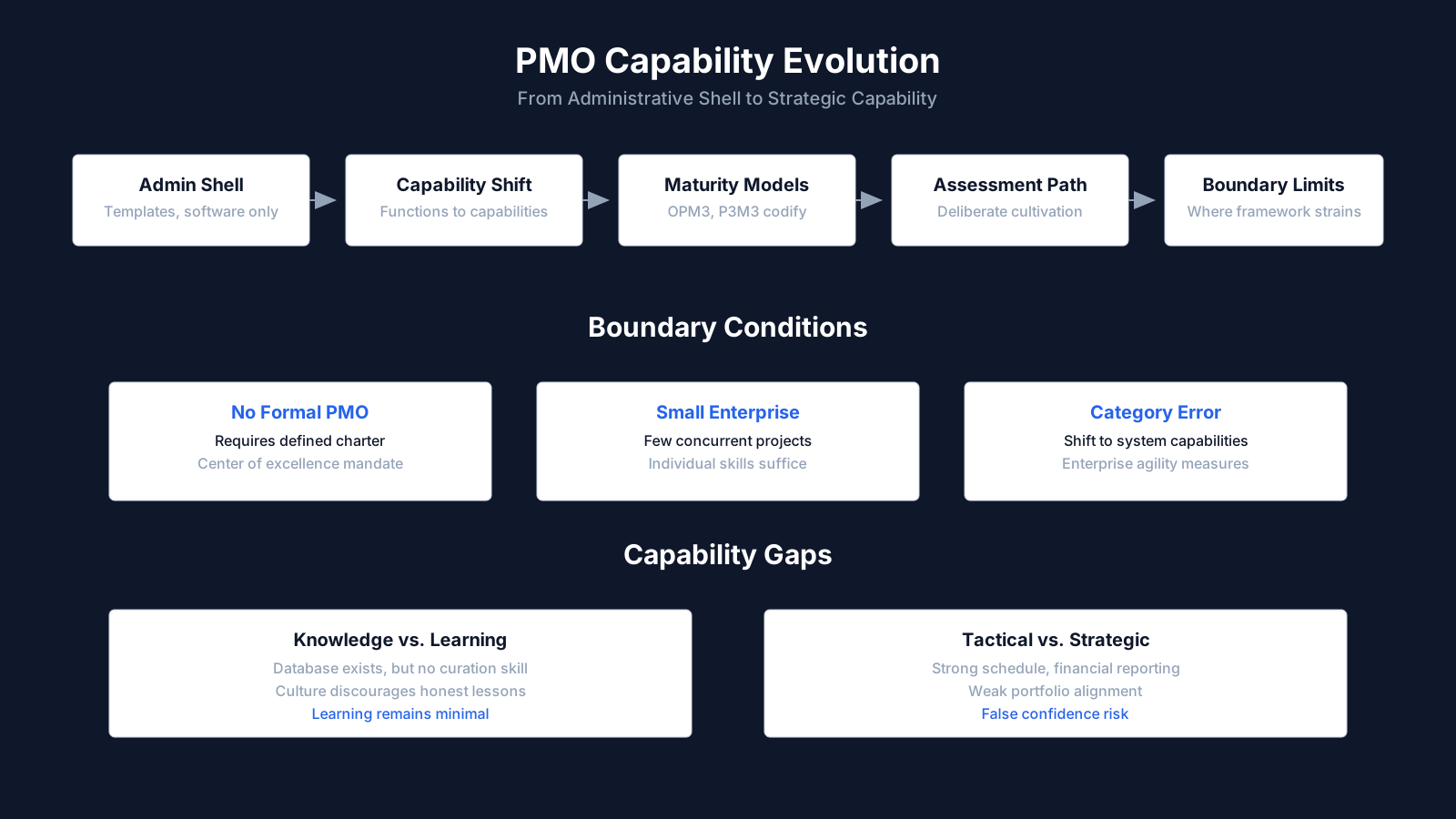
| Evolution | In the 1950s and 1960s, early project offices in aerospace and construction functioned primarily as administrative units, their capability limited to manual schedule tracking and typewritten status reports. |
| Professional Competence | Genuine capability extends far beyond credentialing such as PMP certification; it demands seasoned judgment, advanced facilitation, and analytical rigor to detect early warning signals in project data and address issues before they escalate into crises. |
| Talent Composition | A PMO composed exclusively of junior administrators possesses a severely limited capability profile when compared to one that integrates senior program managers with hands-on experience in turning around distressed projects. |
| Methodological Maturity | Advanced capability maturity is evident when a PMO simultaneously provides a lean, Agile-aligned framework for a digital product team and maintains a rigorous earned value management system for a complex defense program. |
| Technology Maturity | Technology maturity spans from rudimentary spreadsheet trackers to sophisticated enterprise PPM platforms that unify resource capacity planning, financial forecasting, and Monte Carlo risk modeling. |
| Strategic Value | Strategic capability distinguishes a PMO that merely reports project status from one that can authoritatively advise terminating a high-visibility initiative when the benefit-cost ratio has deteriorated beyond recovery. |
Core Definition and Origins of PMO Capabilities
A precise definition of PMO capabilities must account for both tangible and intangible assets. Tangibly, capabilities encompass documented processes, project management information systems, role definitions, and training programs. Intangibly, they include the tacit knowledge held by PMO staff, the degree of organizational trust the office enjoys, and the cultural willingness to accept its governance. The concept originates from the broader organizational capability theory that emerged in strategic management literature during the 1990s, rooted in the resource-based view of the firm. That theory argues that durable competitive advantage stems not merely from resources, but from an organization’s ability to deploy those resources effectively. Applied to project management, this thinking helped shift the conversation away from the mere existence of a PMO and toward how capable that PMO actually is.
In the early days, project offices in aerospace and construction during the 1950s and 1960s were often little more than clerical support units, their capability limited to tracking schedules on paper and typing status reports. As projects grew in complexity, the demand for sophisticated cost control, risk analysis, and resource forecasting pushed the development of more advanced capabilities. The gradual acceptance of project management as a strategic organizational competency throughout the 1990s and 2000s led organizations to invest in PMOs that could do much more than administer templates. This evolution established the idea that a PMO’s capabilities are not static; they must be deliberately built, assessed, and refreshed over time.
Key Insights on PMO Capability Origins
- Tangible and intangible assets
- Effective PMOs combine explicit process documentation and training programs with less visible but equally critical factors, such as deep staff expertise, earned organizational trust, and a culture that genuinely embraces governance.
- Roots in resource-based theory
- The concept originated in the resource-based view of the firm from 1990s strategic management, which demonstrated that competitive advantage flows from how effectively resources are deployed rather than from their mere possession.
- Evolution from clerical support
- Early project offices of the mid-twentieth century functioned primarily as clerical support in industries such as aerospace and construction, before evolving into sophisticated PMOs as growing project complexity drove demand for advanced cost control, risk analysis, and forecasting capabilities.
- Capabilities require continuous renewal
- Sustaining a PMO's strategic value demands a proactive cycle of regular capability assessment and deliberate renewal to prevent obsolescence as organizational priorities and market conditions shift.
Key Components of PMO Capabilities
Understanding the key components of PMO capabilities means dissecting the office into its functional building blocks. These components rarely operate in isolation; they weave together to form a coherent delivery system. The most frequently cited categories include people competencies, process assets, enabling technology, governance structures, and knowledge management.
People competencies refer to the depth and breadth of expertise within the PMO team. This is not only about holding certifications like PMP or PRINCE2 Practitioner, but about having the practical judgment to tailor methodology without losing control, the facilitation skills to mediate between a project sponsor and a resistant functional manager, and the analytical rigor to interpret troubled project data before it becomes a crisis. A PMO populated solely with junior administrators will have a fundamentally different, more constrained capability set than one that includes seasoned program managers who have recovered failing projects.
Process assets form the methodological backbone. They include standard operating procedures, lifecycle templates, stage gate criteria, risk matrices, and variance reporting thresholds. The capability here is not measured by the number of documents on a shared drive, but by how usable and adaptive those processes are. A PMO that can offer a lightweight Agile-compatible process to a digital team while simultaneously supporting a full earned value management approach for a defense contract demonstrates a higher capability maturity than one that enforces a single rigid waterfall template.
Technology enablement is another critical component. The tools landscape ranges from basic spreadsheet trackers to enterprise PPM platforms that integrate resource pools, financial forecasts, and Monte Carlo risk simulations. A PMO’s technological capability includes not only the tools themselves but also the data architecture, integration quality, and user adoption practices that make those tools reliable. A common failure point is purchasing a sophisticated platform and then lacking the capability to configure it or to train project managers in its use, resulting in an expensive digital ghost town.
Governance as a capability element refers to the framework of decision rights, escalation paths, and portfolio prioritization criteria that the PMO upholds. It is the difference between a PMO that simply compiles project status and one that can credibly recommend stopping a high-profile initiative because the benefit-cost ratio has collapsed. That authority does not come from a charter alone; it is earned through consistent, transparent, and fact-based governance practices over time.
Knowledge management capabilities ensure that lessons learned do not vanish at project closure. A capable PMO creates feedback loops where post-mortem insights influence estimation models, risk checklists, and onboarding procedures for new project managers. This institutional memory, when properly curated, can dramatically shorten the learning curve for future initiatives.
Types and Levels of PMO Capabilities
A single PMO is rarely uniform in its capability set across all dimensions. Practitioners often categorize types of PMO capabilities along a spectrum from supportive to controlling to directive, echoing the classic PMBOK typology of PMOs. A supportive PMO’s capabilities are largely advisory: it maintains a repository of templates, offers training, and provides project managers who can be consulted. Its process enforcement capability is low, and its access to sensitive financial data may be limited. A controlling PMO ratchets up the capability by introducing mandatory compliance checks, standardized reporting rhythms, and formal gate reviews. At the directive end, the PMO actually takes ownership of project delivery, with program managers directly running projects. Here, capabilities must be deep in stakeholder negotiation, resource ownership, and delivery accountability.
Another way to conceptualize levels of capability is through maturity models, such as those influenced by OPM3 or the Portfolio, Programme, and Project Management Maturity Model (P3M3). At the lowest level, a PMO may have only initial, ad-hoc capabilities, where each project manager follows personal habits. As the office matures, it standardizes processes, then measures compliance and performance, then continuously improves, and eventually optimizes capabilities to anticipate strategic needs. A PMO at the highest maturity level might have the capability to run predictive scenario modeling for the entire portfolio, something unimaginable for an office still struggling to get project status reports submitted on time.
Core Insights into PMO Capability Levels
- Types range from advisory to directive
- A single PMO can operate across a continuum, shifting from providing advisory support to enforcing compliance standards and ultimately taking full ownership of project delivery.
- Controlling and directive roles compared
- A controlling PMO ensures consistency by mandating standardized reporting and conducting formal stage-gate reviews, whereas a directive PMO embeds its own program managers to lead projects directly.
- Maturity models track capability growth
- Maturity frameworks such as P3M3 chart a deliberate evolution, moving from ad hoc, individual-driven practices through standardized processes to advanced capabilities that forecast portfolio-wide scenarios.
The Role of PMO Capabilities in Project Management Frameworks
PMO capabilities in project management frameworks are not defined in isolation; each major framework offers a different lens on what a PMO should be capable of and how those capabilities interface with project delivery structures.
PMBOK and the PMO
In the PMBOK Guide, the PMO is recognized primarily as a stakeholder and an organizational structure. Its capabilities are implied through the support it provides to project managers: standardizing governance processes, managing shared resources, coordinating communication across projects, and maintaining a repository of process assets. A capable PMO, in PMBOK terms, enables project managers to execute processes across all process groups and knowledge areas more efficiently. For instance, if the organization’s risk management capability is weak, a strong PMO capability in risk facilitation can fill that gap by coaching teams on qualitative risk analysis and maintaining risk registers for the portfolio. PMBOK’s emphasis on tailoring also implies that a high-capability PMO understands when to apply which processes and can guide project managers in adapting the framework.
PRINCE2 and Capabilities
PRINCE2 treats the project support office as an integral function, often responsible for maintaining project files, administering change control, and providing specialist tools. Here, PMO capabilities are tightly coupled with the principles of continued business justification and defined roles. A capable PMO in a PRINCE2 environment ensures that the project board receives accruate information to make direction-level decisions. Moreover, in organizations managing multiple PRINCE2 projects, the office may develop a center of excellence capability, housing subject matter experts who can advise on tailoring PRINCE2 themes to the project’s size and risk profile. The capability to adapt the method without violating its principles is a mark of genuine maturity, not just administrative diligence.
Agile and Hybrid Environments
In pure Agile contexts, the word “PMO” might initially seem antithetical, but the concept of capabilities is highly relevant. An Agile PMO, often called a value delivery office, develops capabilities around agile coaching, flow metrics tracking, impediment removal, and fostering psychological safety. Its capability is measured not by plan variance but by delivery throughput, cycle time trends, and team health indicators. In a hybrid setting, the PMO needs the even more complex capability to support both predictive and empirical process control. It might maintain a work breakdown structure template for a traditional construction project while simultaneously helping a software team interpret a cumulative flow diagram. This dual fluency is fundamentally a capabilities challenge; without it, the PMO will alienate one side of the delivery organization.
BVOP and PMO Capabilities
Within the BVOP framework, a PMO’s capability to deliver business value is explicitly prioritized over administrative conformance. A BVOP-aligned PMO would build capabilities around tracking business value points over time, enabling the office to signal when persistent value decline justifies project closure. It would also cultivate the ability to recognize and mitigate process damage, that invisible erosion of trust, engagement, and system health caused by overwork, rejected acceptable deliverables, or perfectionism. Additionally, the PMO might adopt the BVOP principle of a transparent board of project issues, where any team member can flag concerns at any stage, thereby enhancing the governance capability with relentless transparency. These are not separate processes but enhancements to existing monitoring and control capabilities, shifting the office’s focus from pure output to outcome.
Practical Application of PMO Capabilities
Practical application of PMO capabilities unfolds across every phase of the project lifecycle. During initiation, the PMO’s capability to facilitate business case development and conduct consistent selection scoring determines whether the project pipeline is strategically aligned or merely a collection of pet initiatives. A capable PMO might provide a fit-for-purpose decision matrix, historical benefit realization data, and risk appetite guardrails that help executives say no to ill-conceived projects. If the office lacks the analytical capability to challenge overoptimistic cost estimates, its portfolio will inevitably bloat.
In planning, PMO capabilities manifest as robust estimation models, resource planning coordination, and baseline governance. For example, a PMO with solid capability in reference class forecasting can dramatically reduce the systematic optimism that plagues project schedules. Instead of passively accepting a project manager’s bottom-up estimate, the office can provide calibrated historical data showing that similar projects experienced a certain percentage overrun, prompting a more honest conversation with the sponsor. Execution sees the PMO offering project health dashboards, issue escalation facilitation, and quality reviews. The capability here is not the dashboard itself but the wisdom to interpret the variancethat matters. A PMO that flags every amber metric will quickly become noise; one that can distinguish between a healthy team’s temporary turbulence and a project sliding into irrecoverable delay adds tremendous value.
Monitoring and controlling is often where capability gaps become embarrassingly visible. A PMO capable of conducting independent project audits, performing deep-dive risk analysis, and running portfolio-level what-if scenarios can actually steer the organization away from disaster. Without these capabilities, the PMO becomes a reporting aggregator with no real authority. At closing, the PMO’s capability to harvest lessons, ensure contractual closure, and shepherd benefits into operations determines whether the organization learns or merely repeats mistakes.
Key PMO Capability Takeaways
- Initiation shapes portfolio quality
- A PMO that uses structured business case scoring and decision matrices ensures the project pipeline consistently reflects strategic priorities rather than individual advocacy.
- Historical data corrects optimism bias
- Using reference class forecasting and calibrated overrun data during planning replaces optimism bias with evidence-based schedule estimates and encourages transparent sponsor discussions about risk tolerance.
- Selective escalation preserves trust
- A PMO that escalates only substantiated threats while absorbing temporary team turbulence avoids becoming background noise and remains a trusted, credible voice with executives.
- Closing drives organizational learning
- Systematically capturing lessons, achieving full contractual closure, and transitioning benefit ownership into operations at project close determines whether the organization institutionalizes learning or perpetuates prior missteps.
Common Challenges, Pitfalls, and Misconceptions
One of the most pervasive common challenges in PMO capabilities is the assumption that purchasing a PPM toolset equates to building capability. Technology is an enabler, not a substitute for skilled judgment and mature processes. Organizations often fall into this trap, spending enormous sums on software while neglecting to hire or develop the people who can configure, interpret, and advocate for its use. The result is a PMO that appears capable on paper but cannot answer a basic question about portfolio capacity without hours of manual spreadsheet wrangling.
Another misconception is that PMO capabilities are a binary toggle. Leaders sometimes believe they can flip a switch and get a strategic PMO overnight. In practice, capabilities accumulate incrementally. A PMO that tries to jump from offering templates to enforcing rigorous gate criteria without building trust and demonstrating value will provoke fierce resistance and may find its very existence questioned. Also, there is the pitfall of capability inflation: a PMO that claims to have a mature risk management capability because it maintains a risk register, when in reality nobody updates it after the initial workshop and risk mitigation actions are never tracked. Self-assessment without honest external benchmarking often leads to a dangerous overestimation of real capability.
The human dimension introduces challenges as well. Capable individuals can leave, taking tacit knowledge with them and suddenly downgrading the PMO’s ability to mentor project managers or conduct complex procurement reviews. Succession planning and documentation are themselves capabilities that must be deliberately cultivated. Moreover, PMOs in highly matrixed organizations may have the formal capability to govern but lack the informal influence to get project managers to comply when times get tight, revealing a stark difference between de jure and de facto capability.
Relationship to Other PM Concepts
The relationship of PMO capabilities to other concepts like organizational project management (OPM), portfolio management, and individual competency frameworks is fundamental. OPM, as defined by PMI, is the systematic management of projects, programs, and portfolios to achieve strategic objectives. The PMO is the structural embodiment of OPM, and its capabilities are the engine that makes the system run. A robust portfolio management process cannot function without a PMO capable of aggregating resource data, normalizing project estimates, and providing impartial project vetting. Thus, portfolio governance capability is often a direct reflection of underlying PMO capability.
Distinguishing between PMO capabilities and individual project manager competencies is important. A PMO can have the capability to deliver training and development for project managers, but that is different from a project manager’s personal competency in stakeholder engagement. The PMO’s capability is organizational and systemic; it persists beyond any single project or individual. In fact, a well-designed PMO capability can compensate for individual gaps by providing templates, checklists, and peer reviews that elevate the floor of project performance.
It is equally important to differentiate capabilities from PMO services or functions. A service is something the PMO offers, like “weekly status reporting.” The underlying capability is the combination of automated data collection scripts, analyst review habits, and distribution mechanisms that make that service timely, accurate, and insightful. A PMO can list dozens of services but possess very shallow capability to back them up. Capabilities, in this sense, are the invisible infrastructure that determines service quality.
PMO Capability Relationship Essentials
- PMO as the OPM embodiment
- The PMO is the structural embodiment of organizational project management, and its capabilities serve as the engine driving the entire system toward strategic objectives.
- Portfolio governance relies on the PMO
- Robust portfolio management depends on PMO capabilities, including the aggregation of resource data, the normalization of project estimates, and impartial project vetting; portfolio governance thereby directly reflects the maturity of those capabilities.
- Organizational versus individual competency
- The PMO's capacity to provide training represents an organizational asset, standing apart from the personal competencies that individual project managers apply in areas such as stakeholder engagement.
- Systemic persistence beyond individuals
- PMO capabilities are systemic and organizational; they persist beyond any single project or individual and do not reside in any one person's skills.
- Compensating for individual gaps
- A well-designed PMO raises the performance baseline across projects by deploying templates, checklists, and peer reviews to offset individual competency gaps.
Evolution and Current Thinking
The evolution of PMO capabilities over the past two decades mirrors the profession’s broader shift from enforcement to enablement. In the early 2000s, PMO capability-building efforts focused heavily on standardizing methodology and ensuring compliance. The thinking was that uniform processes would reduce variance and improve predictability. Experience showed, however, that rigid standardization often suffocated innovation and drove project teams to work around the PMO rather than with it. Today’s best practice emphasizes adaptive capabilities: the ability to tailor governance to context, to support Agile and predictive teams under one roof, and to pivot from controlling to coaching as the situation demands.
Current debates center on capability as a dynamic, not static, asset. The rise of organizational agility has prompted some to argue that a permanent PMO structure is itself a bottleneck, and that capabilities should be distributed across value streams or managed through a floating pool of methodologists and coaches. Others counter that a centralized PMO remains the most efficient way to nurture scarce competencies like portfolio financial analysis or enterprise risk management. The discussion is becoming more nuanced, focusing on which specific capabilities are best centralized and which can be federated without losing coherence.
Another development is the growing expectation that PMOs build capability around data analytics and artificial intelligence. The ability to parse historical project data to generate early warning indicators, or to simulate portfolio outcomes under different resourcing scenarios, is moving from a futuristic aspiration to a competitive necessity in large enterprises. This does not eliminate the need for human judgment; rather, it elevates the PMO’s capability to ask smarter questions and challenge assumptions more effectively. A PMO that remains stuck in static reporting, no matter how accurate, is increasingly seen as under-invested in its own future relevance.
Simultaneously, there is a renewed focus on the softer capabilities: organizational change management, executive storytelling with data, and culture shaping. A technically brilliant PMO with no capability to influence senior leaders or to help project teams understand why a governance step exists will struggle to gain the mandate it needs. The most recognizable trait of a highly capable PMO in contemporary practice is not its Gantt chart precision but its ability to make the path from strategy to delivery feel navigable, honest, and sustainable for everyone involved.