In project management, appraisal costs are the expenditures associated with assessing, measuring, and evaluating deliverables and processes to confirm that quality requirements have been met. This concept sits squarely within the broader discipline of Cost of Quality, where money spent on appraisal serves as a checkpoint to catch defects before they reach the customer. Rather than preventing problems from occurring in the first place, appraisal activities focus on detection—testing a module, inspecting a physical component, reviewing documentation against standards, or auditing a process for compliance.
Appraisal Costs: Key Topics Summary
| Key Concept | Summary |
|---|---|
| Appraisal Activities | Appraisal activities are inherently detective, encompassing testing, inspection, review, and audit, all aimed at identifying existing defects rather than proactively preventing their occurrence. |
| Appraisal Cost | Every verification effort, from regression testing and rebar inspection to legal contract review, incurs an appraisal cost, reflecting resources spent solely to confirm conformance rather than to build quality in. |
| Common Misunderstanding | A common misunderstanding is viewing appraisal as a quality improvement activity, whereas it merely reveals the current conformance state without modifying it. |
| Overspending Risk | When upfront planning is deficient, organizations often overspend on appraisal, using inspection as a compensatory mechanism for ambiguous requirements and immature processes. |
| Historical Origins | Appraisal costs emerged from the mid-20th century quality movement, when pioneers like Juran and Feigenbaum codified the Cost of Quality framework, identifying appraisal as a distinct economic burden. |
| Industry Examples | Appraisal practices are deeply embedded across regulated sectors such as automotive, aerospace, and medical devices, as well as digital platforms, manifesting in safety testing, non-destructive testing, and accessibility audits. |
| Cost Categories | Appraisal costs are categorized into inspection costs, for direct examination of deliverables, and testing costs, for formal verification activities. |
| Frameworks | PMBOK stresses continuous monitoring; PRINCE2, by contrast, aligns appraisal with stage boundaries and exception situations, enhancing governance but potentially postponing defect identification. |
What Is Appraisal Costs in Project Management?
The appraisal costs definition encompasses all financial outlays tied to measurement, inspection, and testing activities performed during a project’s lifecycle. In essence, every time a team stops to verify something—running a regression test on a software build, calling in a structural engineer to examine rebar placement, or sending a contract draft for legal review—it incurs an appraisal cost. These are not the costs of fixing defects; they are the costs of discovering them. The Project Management Body of Knowledge (PMBOK Guide) classifies appraisal costs under the Cost of Quality framework, alongside prevention costs and failure costs. Appraisal costs are often seen as a necessary investment to avoid far higher failure costs later, but the relationship is not linear. Spending more on appraisal beyond a certain point yields diminishing returns and can signal a process that is fundamentally unstable.
Project teams encounter appraisal costs in both predictive and adaptive environments, though the forms differ. In a construction project, appraisal costs might include materials testing, third-party inspections, and on-site quality audits. In a software initiative, they cover code reviews, user acceptance testing cycles, and performance benchmarking. What links all these activities is the act of checking—confirming that what was produced aligns with what was specified. This makes appraisal costs inseparable from the quality control function, and yet they remain distinct from prevention efforts like training or process design improvements. A common misunderstanding is to treat appraisal as a quality investment that automatically raises overall project quality; in reality it only provides information about the current level of conformance, without inherently changing it.
Practitioners often observe that organizations with weak upfront planning tend to overspend on appraisal, using inspection as a crutch to compensate for unclear requirements or immature processes. This reactive pattern can become culturally embedded, creating a false sense of security. The project may appear to have rigorous quality checks while actually bleeding time and budget on detection instead of prevention. Recognizing this distinction is critical for project managers who must allocate limited resources wisely and avoid the trap of measuring quality into existence after the fact.
Key Takeaways on Appraisal Costs
- PMBOK classifies appraisal costs
- Appraisal costs capture the total expenditures for measurement, inspection, and testing across a project's lifecycle, and the PMBOK Guide classifies them within the Cost of Quality framework alongside prevention and failure costs.
- Diminishing returns on appraisal
- The relationship between appraisal spending and quality improvement is non-linear because additional verification investment beyond an optimal point yields diminishing returns and often signals an unstable process best addressed through prevention rather than further inspection.
- Appraisal measures, does not improve
- Across predictive and adaptive environments, appraisal costs take distinct forms, ranging from materials testing and inspections in construction to code reviews and acceptance testing in software, yet these activities only reveal current conformance levels without improving them.
Origins in Quality Management and Cross-Industry Context
The origins of appraisal costs trace back to the quality revolution of the mid-20th century, when thinkers like Joseph Juran and Armand Feigenbaum formalized the Cost of Quality concept. Feigenbaum, in particular, framed quality costs as a system of hidden expenses that manufacturing firms could quantify and control. Appraisal costs emerged as one of the four classic categories: prevention, appraisal, internal failure, and external failure. In automotive and aerospace manufacturing, where safety and precision are paramount, appraisal activities became deeply institutionalized—think of factory floor inspection stations, material certification labs, and non-destructive testing protocols. These industries demonstrated that planned appraisal, when integrated into a stable production system, could be a rational cost of doing business.
Outside manufacturing, medicine and pharmaceuticals adopted rigorous appraisal regimes in the form of clinical trials, batch testing, and regulatory audits. Aviation adopted layered inspection systems where every critical component undergoes multiple checkpoints. In software engineering, the concept migrated into verification and validation activities—unit testing, integration testing, static analysis, and peer reviews. The common thread across these sectors is that appraisal costs are incurred to generate confidence that a deliverable is fit for its intended purpose before release.
Bringing this cross-industry understanding into project management reveals that appraisal is not merely a line item but a strategic choice. A project manager overseeing a medical device development effort must budget for ISO compliance testing and notified body audits, just as the manager of a digital platform must budget for penetration testing and accessibility audits. The origin story matters because it reminds teams that appraisal, when thoughtfully designed, reduces uncertainty. When mindlessly applied, however, it becomes bureaucratic overhead that drains morale and velocity.
Key Components and Types of Appraisal Costs
The key components of appraisal costs can be broken down into several distinct types that recur across industries and project methodologies. First, there are inspection costs, which cover the direct examination of work products—walking a construction site to check rebar spacing or running a visual inspection on manufactured parts. Second, testing costs encompass all forms of formal verification, from automated integration tests in a continuous delivery pipeline to destructive testing of materials in a lab. Third, auditing costs arise when an independent party reviews processes, documentation, or compliance against a standard, such as a configuration audit on a defense project or a security audit mandated by a contract. Fourth, calibration and maintenance of measurement equipment—because if the tool used to measure quality is itself out of tolerance, every appraisal activity based on it is suspect.
Another component that practitioners frequently underestimate is the labor cost embedded in peer reviews and walkthroughs. When a senior developer spends four hours reviewing code for adherence to architectural standards, that time represents an appraisal cost. Similarly, when a project manager reviews a deliverable against the scope baseline before submitting it for client sign-off, that review effort is an appraisal activity. Even the cost of staging environments, test data generation, and the infrastructure supporting automated tests falls under appraisal costs if the primary purpose is to evaluate quality.
Distinguishing between internal and external appraisal is also useful. Internal appraisal happens within the project team or organization, like unit testing performed by the development team. External appraisal involves third parties—regulatory bodies, client-hired inspectors, or independent verification and validation teams. External appraisal often carries higher overhead because of contractual formalities, travel, and reporting requirements, but it can provide objectivity that internal reviews lack. The classification matters when project managers build quality cost baselines and need to understand where money is going and what leverage they have to shift spending toward prevention.
Core Insights on Appraisal Cost Types
- Inspection and testing costs
- Inspection relies on direct, often human-driven examination of deliverables like site conditions or component appearance, while testing employs systematic, instrumented protocols including automated scripts and destructive analysis to verify conformance to specifications.
- Auditing and equipment calibration
- Auditing provides an objective, independent evaluation of processes, documentation, and compliance with standards, whereas calibration sustains measurement tool accuracy within specified tolerances, upholding the integrity of quality assessments.
- Hidden labor and infrastructure expenses
- When peer reviews, walkthroughs, staging environments, and test data generation are undertaken chiefly to evaluate quality, they constitute appraisal costs, and acknowledging them is vital for constructing precise cost baselines.
Appraisal Costs Within the PMBOK Framework
The appraisal costs in PMBOK are formally addressed within the Project Quality Management knowledge area, specifically under the Plan Quality Management, Manage Quality, and Control Quality processes. The PMBOK Guide, Sixth and Seventh Editions, integrates the Cost of Quality model, noting that appraisal costs belong to the conformance side of the equation—money spent to ensure compliance rather than money lost due to non-conformance. In the Plan Quality Management process, the project manager and team identify which appraisal activities are necessary, estimate their cost, and incorporate them into the project budget and quality management plan.
During the Manage Quality process, which focuses on quality assurance, appraisal costs appear in the form of process audits, quality reviews, and analysis that evaluates whether the project’s approach to quality is effective. The Control Quality process is where the bulk of tangible appraisal activities occur: measuring deliverables, checking against acceptance criteria, logging defects, and deciding on disposition. In earned value management terms, appraisal work translates into planned value and actual cost. It is not free overhead, and teams that treat quality control as an afterthought often find their cost performance index deteriorating because unplanned appraisal activities consume budget without corresponding earned value.
PMBOK also emphasizes that appraisal costs should be proportional to risk. A high-risk deliverable, such as a safety-critical flight control system, warrants much more intensive appraisal than a low-risk internal report. The framework encourages documenting the rationale for appraisal intensity in the quality management plan so that stakeholders understand why specific inspections were chosen. Without that rationale, appraisal costs can become a political football; someone will inevitably ask why the team is spending so much on testing, and the project manager needs a documented, risk-based answer.
Appraisal Costs in PRINCE2 and Other Methodologies
The appraisal costs in PRINCE2 are addressed primarily through the Quality theme and the associated Quality Management Strategy. PRINCE2 defines quality as the degree to which a set of inherent characteristics fulfills requirements, and it distinguishes between quality planning, quality control, and quality assurance. Appraisal costs fall squarely under quality control—the activities that verify products against their product descriptions. The framework insists that quality control activities, and their costs, be specified in the Product Description for each major deliverable, with clear quality methods, responsibilities, and tolerances.
PRINCE2’s focus on management by stages creates a natural rhythm for incurring appraisal costs. At the end of each management stage, the Project Manager produces a Highlight Report that may include quality metrics, and completed products undergo the agreed-upon quality checks before moving to the next stage. The cost of these stage-end reviews, including any specialist inspections, is an appraisal cost that must be factored into stage budgets. Unlike PMBOK, which emphasizes continuous monitoring, PRINCE2 ties appraisal heavily to stage boundaries and exception situations, providing a structured cadence that helps control spending but can sometimes delay detection if problems arise mid-stage.
Other methodologies, such as Six Sigma within a project context, frame appraisal costs as part of the Cost of Poor Quality and relentlessly seek to shift the balance toward prevention. The Define-Measure-Analyze-Improve-Control (DMAIC) cycle often reveals that appraisal activities are consuming disproportionate resources precisely because the process does not yet produce quality consistently. The methodology then targets root causes so that appraisal can be scaled back. This perspective is instructive: appraisal costs can serve as a diagnostic signal, not just a budget line. When they keep rising, it suggests the project’s prevention activities are insufficient.
Key Takeaways on Appraisal Costs
- Quality control verification in PRINCE2
- Within PRINCE2, appraisal costs are formalized as quality control activities that verify each deliverable against its Product Description using predefined methods, roles, and tolerances, ensuring accountability and early defect detection.
- Stage-gate appraisal cadence
- PRINCE2 concentrates appraisal costs at stage boundaries via Highlight Reports and mandatory quality checks, producing a predictable, stage-gated spending pattern that contrasts with PMBOK's ongoing inspection model.
- Six Sigma's prevention focus
- Within Six Sigma's DMAIC framework, appraisal costs are classified under the Cost of Poor Quality, and analysis often shows that high appraisal expenditure signals an opportunity to shift investment upstream into prevention activities.
The Role of Appraisal Costs in Agile and Hybrid Environments
The appraisal costs in Agile Agile delivery take on a different character but do not disappear. Agile frameworks shift emphasis from end-of-lifecycle inspection to continuous, built-in quality practices, yet appraisal still occurs. Automated unit tests, which run with every build, are an appraisal activity—they check existing code for defects. Continuous integration pipelines that execute integration tests and static analysis tools incur compute costs and maintenance effort, all classifiable as appraisal costs. Story acceptance sessions, where the product owner reviews completed work against acceptance criteria, are essentially appraisal activities that consume time from key stakeholders.
A particularly interesting dynamic in Agile is the attempt to minimize appraisal costs by shifting quality left. Pair programming, for instance, acts as a real-time code review that simultaneously prevents defects and appraises the work as it is produced. This blending makes it hard to separate prevention from appraisal in accounting terms, but the cost of the second developer’s time can legitimately be viewed as an appraisal investment—a continuous quality check. Sprint reviews and demos introduce another layer of appraisal: stakeholders examine the increment and provide feedback, which often uncovers mismatches between expectations and delivered functionality.
In hybrid environments, where predictive planning governs some work streams and iterative development governs others, appraisal costs must be budgeted across both. A hybrid project might have traditional stage-gate inspections for regulatory deliverables while running automated test suites for software components. The challenge for the project manager is to avoid double-dipping—paying for both extensive manual inspection and extensive automated testing when one informed-by-risk approach would suffice. Hybrid teams often find that they need to reconcile their appraisal spend explicitly during integrated planning sessions, otherwise each sub-team optimizes its own quality checks in isolation, driving up cumulative appraisal costs without commensurate benefit.
Appraisal Costs and Business Value-Oriented Thinking
Contemporary project management methodologies that emphasize value delivery, waste reduction, and stakeholder involvement bring a sharp lens to appraisal costs. The BVOP appraisal costs perspective treats excessive inspection as a form of overwork waste that should be minimized by embedding quality directly into the product development cycle. Rather than bolstering appraisal, BVOP urges teams to improve prevention and to use appraisal sparingly, targeting only those areas where risk or complexity genuinely justifies the cost. This is consistent with lean thinking, where any activity that does not add value from the customer’s perspective is suspect, and inspection, by its nature, adds no direct value to the product—it only confirms what should already be there.
Some organizations track a “Business Value Points” metric that aggregates value indicators; a persistent decline can signal that appraisal costs are devouring resources that could have been directed toward value-producing activities. When appraisal becomes the dominant quality expense, it often masks deeper process damage—definitional gaps, skill shortages, or communication breakdowns—that no amount of checking will fix. The BVOP approach recommends predefined root-cause categories for defect analysis, allowing teams to trace issues back to their origin and then deliberately reduce reliance on appraisal as the primary safeguard.
This value-oriented thinking does not call for eliminating appraisal entirely; it calls for making appraisal purposeful and proportional. A project that must meet stringent safety regulations cannot skip mandatory inspections, but it can question whether every internal review ritual still serves a purpose or has simply become habit. Project managers who adopt this mindset audit their appraisal activities as rigorously as they audit their deliverables, pruning those that no longer catch meaningful defects or that duplicate checks already performed upstream.
Core Takeaways on Value-Oriented Appraisal
- Inspection as overwork waste
- The BVOP framework views excessive appraisal as overwork waste and advocates embedding quality directly into the development process, reducing dependence on late-stage checking.
- Lean alignment on appraisal
- Since inspection adds no direct customer value, appraisal should be applied sparingly, reserved for areas where high risk or complexity genuinely justifies the investment.
- Declining Business Value Points
- A sustained decline in the Business Value Points metric often signals that appraisal costs are siphoning resources away from value-generating activities, eroding overall business outcomes.
- Root-cause defect analysis
- Heavy appraisal spending frequently conceals deeper process breakdowns; using predefined root-cause categories helps teams trace defects to their origin and transition from inspection-heavy approaches to preventive quality measures.
Practical Application: When and How Appraisal Costs Are Incurred
In practice, appraisal costs are incurred at multiple points across the project lifecycle, generally intensifying as deliverables near completion and the cost of failure becomes more severe. During early planning, appraisal activities might include requirements reviews, design walkthroughs, and prototype testing—relatively inexpensive checks that catch conceptual misalignments before they harden into code or concrete. As the project moves into execution, appraisal shifts toward physical inspection, integration testing, and formal audits. During closing, final acceptance testing and regulatory sign-off inspections represent the last line of appraisal before handover.
Who bears these costs depends on organizational structure and contracting arrangements. In a fixed-price contract, the seller typically builds appraisal costs into its fee; in a time-and-materials arrangement, the buyer may see them as direct expenses. Project managers working with subcontractors often face a hidden dynamic: the subcontractor may skimp on appraisal to protect margin, only for defects to surface during integration, shifting failure costs back to the prime contractor. Structuring contracts to include specific quality milestones and inspection rights can surface these incentives early.
Projects that operate under earned value management systems register appraisal costs as actual costs, and clever project controllers will establish separate control accounts for quality activities to track spending trends. When the cumulative appraisal cost curve starts to outpace the planned curve without a corresponding reduction in defect escape rate, it signals that something is wrong—perhaps the testing strategy is misaligned with the risk profile, or the team is compensating for unfamiliar technology with excessive babysitting of the output. Interpreting these signals requires judgment, not just spreadsheets, which is why experienced project managers pay more attention to the ratio of failure costs to appraisal costs than to absolute numbers.
Common Challenges, Pitfalls, and Misconceptions
One of the common misconceptions about appraisal costs is that higher appraisal spending automatically translates to higher quality. In reality, appraisal only detects defects; it does not prevent them. A project that subjects its output to ten layers of testing will indeed catch more bugs, but that does not mean the underlying development process is healthy. In fact, the very need for so much appraisal often indicates a broken process, and the extra spending merely creates a more expensive way to remain mediocre. This misconception leads to what some practitioners call the “test-quality illusion,” where exhaustive testing budgets are mistaken for a quality culture.
Another pitfall is the tendency to treat all appraisal costs as equally valuable. A thousand hours of manual regression testing may find fewer defects than a few hours of targeted exploratory testing guided by risk analysis. Yet organizations frequently default to the high-volume, low-yield activity because it feels safer and generates impressive-looking metrics. Project managers can fall into this trap when stakeholders demand visible evidence of quality effort, and massive test logs become a proxy for due diligence. The real skill lies in designing appraisal activities that yield high information content per dollar spent.
Resource contention also creates challenges. When a project is behind schedule, management pressure often compresses or eliminates appraisal steps to meet deadlines. This reduces appraisal costs in the short term but almost always inflates failure costs later. The decision to cut testing is rarely framed as a trade-off between appraisal costs and future rework, because future rework is uncertain and politically easy to dismiss. Experienced project managers document these decisions explicitly, making the risk transparent, so that when defects do materialize, the choice is remembered rather than rewritten as poor execution.
Appraisal Cost Misconceptions Summarized
- Appraisal does not equal prevention
- Increased spending on appraisal merely reveals defects without addressing their root causes, meaning a thoroughly tested product can still originate from an unsound development process.
- The test-quality illusion
- Organizations often mistake large testing budgets for a genuine quality culture, but exhaustive test execution frequently detects fewer critical defects than risk-guided exploratory testing.
- Documenting appraisal trade-offs
- Project managers should formally record any decisions to scale back testing, ensuring the associated risk of downstream rework is clearly visible, so that future setbacks are not unfairly attributed to poor execution.
Relationship to Prevention Costs, Failure Costs, and Other Concepts
The relationship between appraisal costs and prevention costs is often portrayed as an investment trade-off: spend more on prevention and you can spend less on appraisal and failure. While directionally true, the interplay is more nuanced. Prevention activities like training, robust design standards, and root cause analysis build long-term capability and reduce the defect injection rate. Appraisal costs then serve to catch the residuals. But prevention cannot address every source of variation, and in complex systems, even well-designed processes produce occasional surprises that only appraisal can catch. The optimal balance depends on the project’s risk appetite, regulatory requirements, and the maturity of the team.
Failure costs, both internal and external, form the other side of the triangle. Appraisal costs that successfully intercept a defect before it escapes to the customer convert a potential external failure cost into a manageable internal failure cost or perhaps into a minor correction. From a financial perspective, this justifies appraisal spending only if the cost of appraisal is less than the probable cost of the failures it prevents, discounted by detection probability. That calculation is rarely performed with precision on projects, but the mental model helps prioritize where to apply appraisal. For a low-impact cosmetic defect, extensive appraisal is wasteful; for a defect that could cause regulatory penalties or safety incidents, heavy appraisal is eminently sensible.
Appraisal costs also intersect with the concept of quality tolerance. Just as projects have tolerance levels for cost and schedule, they can define tolerance for the amount of appraisal that is acceptable before escalation. This prevents the quality assurance function from endlessly expanding its scope and becoming a cost center without accountability. Tying appraisal costs directly to the organizational quality policy, and having that policy reviewed at governance board meetings, anchors appraisal in a business context rather than letting it float on the whims of individual test managers.
Evolution and Current Thinking on Appraisal Costs
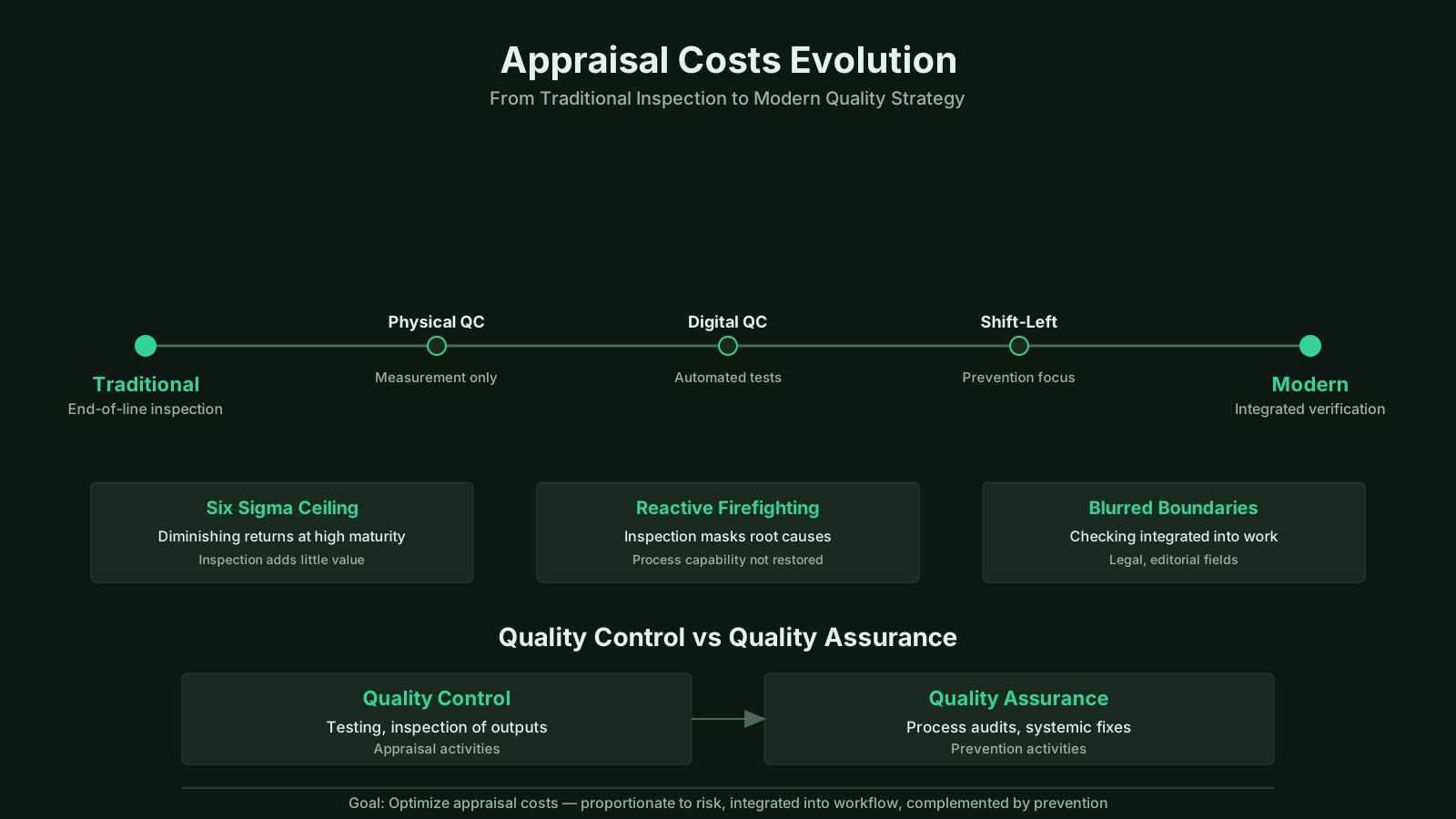
The modern thinking on appraisal costs reflects a shift from inspection-heavy approaches toward embedded quality and risk-based testing. Decades ago, in manufacturing-centric project management, appraisal was often the primary quality lever because prevention was hard to influence in a subcontracting-heavy supply chain. Today, with increased emphasis on systems thinking, many organizations recognize that appraisal should be the last line of defense, not the first. The proliferation of DevOps practices has accelerated this shift in software projects, where automated appraisal runs so frequently and so cheaply that its unit cost becomes almost negligible—but the total cost of maintaining and interpreting these automation suites is not zero and must still be managed.
Current best practices encourage project managers to build a quality cost baseline early, track the ratio of prevention to appraisal to failure costs over time, and use that ratio as a leading indicator of project health. There is healthy debate, however, about how much appraisal is “enough.” Some schools of thought advocate for continuous appraisal through techniques like mutation testing and chaos engineering, believing that proactive discovery of weaknesses strengthens resilience. Others warn that such techniques, if not risk-justified, amount to expensive academic exercises that add little customer value. This debate reflects a larger tension in project management between the desire for certainty and the acceptance of inherent uncertainty.
The conversation has also expanded to include the human side of appraisal. When people spend their days checking the work of others, it can create an adversarial dynamic between “builders” and “checkers,” damaging team cohesion. Forward-looking project environments treat appraisal as a collaborative learning opportunity, where defects uncovered are not failures to be punished but signals that lead to process improvement. That cultural shift, intangible as it might seem, can have a tangible effect on appraisal costs over time, because teams that trust each other need fewer formal checks to achieve the same level of quality confidence.
Key Takeaways on Appraisal Costs
- From inspection to embedded quality
- Appraisal has evolved from the primary quality mechanism in traditional manufacturing to a final safeguard in modern systems, where prevention and embedded quality take precedence.
- DevOps reduces appraisal unit costs
- In DevOps, automated inspection is so rapid and inexpensive that per-unit cost effectively disappears, yet the ongoing overhead of maintaining, tuning, and interpreting test suites demands disciplined cost oversight.
- Track quality cost ratios
- Leading project managers establish a quality cost baseline at the project's outset and track the ratio of prevention to appraisal to failure costs as a forward-looking indicator of process stability and risk.
- Debate over continuous appraisal
- Some promote continuous appraisal via mutation testing and chaos engineering, while critics caution that adopting such techniques without clear justification turns them into costly academic pursuits that deliver negligible customer value.
- Appraisal as collaborative learning
- Progressive organizations view defects as prompts for systemic refinement, not grounds for blame, and high-trust teams reduce the need for formal approvals because they rely on shared ownership to achieve quality confidence.
