The Closing Process Group is the set of project management processes used to formally complete a project, phase, or contractual relationship. Within the PMBOK framework, it is one of five process groups and represents the final stage of the project lifecycle, following the executing and monitoring and controlling process groups. The term encompasses obtaining final acceptance, transferring deliverables to operations, releasing resources, closing contracts, and archiving project information. Its primary purpose is to ensure that a project concludes in a controlled and verifiable manner rather than simply stopping when work runs out.
In practice the closing process group operates like a formal handoff. A contractor does not walk away from a construction site without an inspection, a signed completion certificate, and a transfer of keys. Likewise a project team cannot simply disband after the last task is done. Someone must confirm that the work satisfies the original request, loose ends are tied, and the organization retains what it learned.
Closing Process Group: Key Topics Summary
| Key Concept | Summary |
|---|---|
| Definition and Purpose | The closing process group governs the formal conclusion of project work, covering both successful delivery and termination driven by strategic, financial, or performance factors. |
| Core Components | Formal acceptance, deliverable handover, lessons learned, financial closeout, contract closeout, resource release, and archival of project records form the core components of a disciplined closure. |
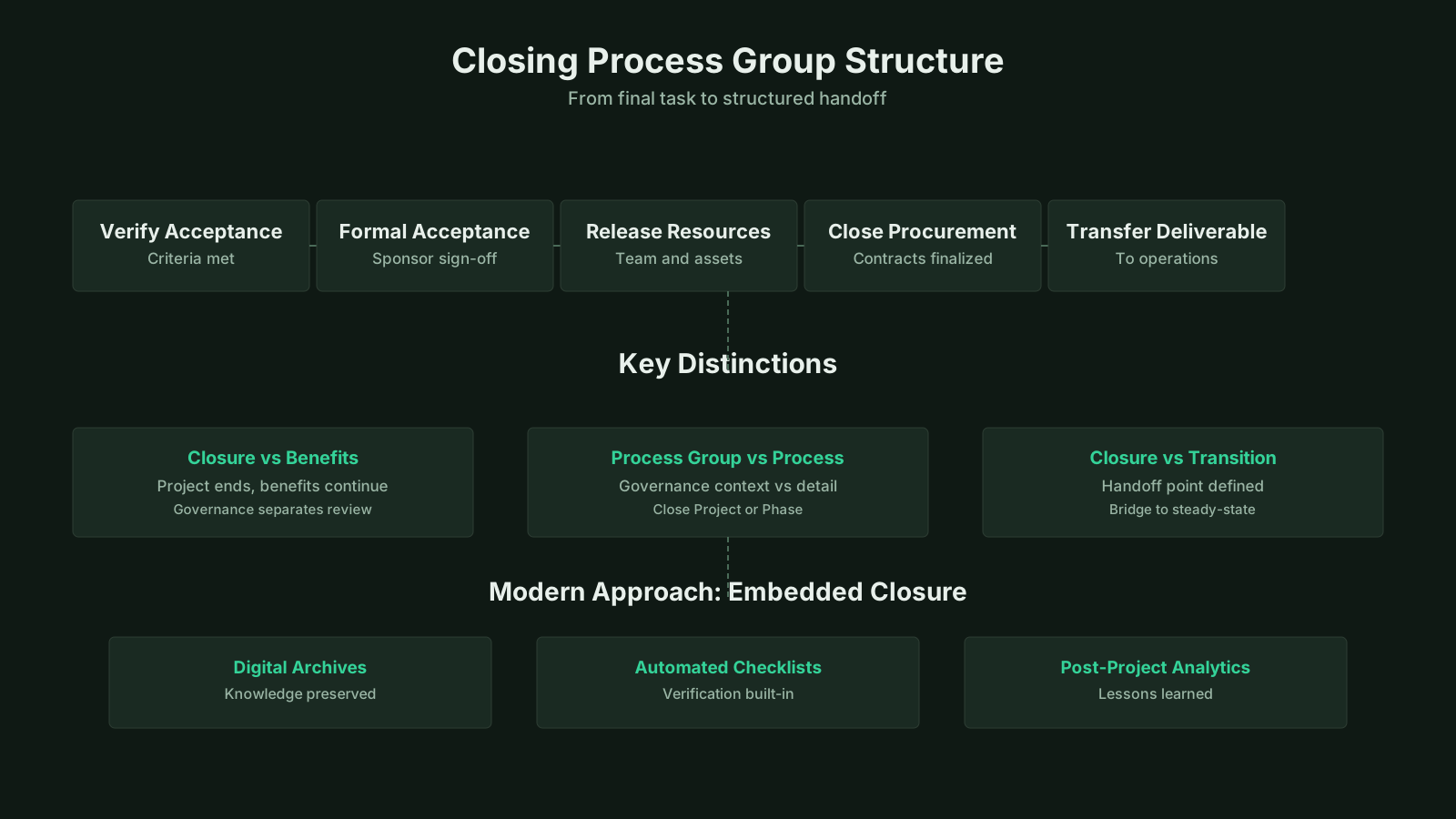
| Scope of Closing | The scope of closing includes securing final acceptance, transitioning deliverables into operations, releasing project resources, closing contracts, and archiving project information to support organizational memory and future reference. |
| Process Group Interactions | Initiating authorizes the work, planning defines the delivery path, executing produces the outputs, monitoring and controlling tracks performance and corrects deviations, and closing formally concludes the project. |
| Transition and Handover | A successful handover includes training operational staff, transferring complete documentation, establishing maintenance agreements, and verifying operational readiness. A rushed handover often leaves the business unable to operate or sustain the delivered result. |
| Organizational Learning | Lessons learned records may capture retrospective analysis, risk register insights, technical decisions, and actionable recommendations. Their value depends on whether the organization systematically retrieves and applies these insights in future projects. |
| PMBOK Perspective | The PMBOK defines closing as finalizing all activities across every process group, confirming that the project management plan has been fully executed, obtaining formal acceptance, conducting final reviews, and documenting lessons learned. |
| Nature of Closing | Closing is not a single administrative step but a coordinated set of processes that verify completion, secure stakeholder acceptance, and preserve a documented trail for governance and future reference. |
What Is the Closing Process Group?
The closing process group definition centers on the controlled conclusion of project work, whether the project has delivered its intended result or has been terminated for other reasons. It is not a single activity but a collection of processes that verify completion, secure acceptance, and leave a documented trail for the organization.
The closing process group is best understood by contrast with other process groups. Initiating authorizes the work, planning defines the route, executing produces the outputs, and monitoring and controlling keeps the work on track and corrects variance. Closing, by contrast, asks whether the project has satisfied its acceptance criteria and whether the organization is ready to support the deliverable going forward. This is not a rubber stamp. It is a governance checkpoint.
The concept maps to similar practices in other disciplines. In construction and engineering, final inspections, commissioning, and certificate of occupancy are closing activities. In manufacturing, a production run closes with quality sign-off, scrap analysis, and line changeover. The military conduct after-action reviews and formal demobilization. Software engineering has release to production, decommissioning of legacy systems, and post-launch stabilization. The common thread is the transition from temporary work to steady-state operation or disposal.
In project management literature the closing process group has historically been the least glamorous phase. Practitioners often observe that teams invest enormous energy in planning and executing but treat closure as an afterthought. That asymmetry creates risk. Unresolved issues, undocumented assumptions, and unclaimed lessons do not disappear. They migrate into operations or the next project.
Core Takeaways on Project Closure
- Controlled conclusion of project work
- The closing process group validates that all deliverables meet their acceptance criteria, obtains formal sign-off from the client or sponsor, and archives project documentation for future reference, regardless of whether the initiative was completed successfully or terminated early.
- Distinct from other process groups
- Unlike initiating, planning, executing, or monitoring, closing confirms that the final product satisfies the original scope and acceptance standards, and that the organization has the operational capacity, documentation, and resources to sustain the deliverable after handover.
- Parallels across multiple disciplines
- Closing practices vary by industry: construction uses final inspections, commissioning, and as-built documentation; manufacturing uses quality sign-off, line clearance, and changeover; and software uses release to production, user acceptance, and system decommissioning, each of which confirms that the output meets its requirements and the receiving organization is ready to take ownership.
Key Components of the Closing Process Group
The key components of the closing process group include formal acceptance, handover, lessons learned, financial closure, contract closure, resource release, and archiving. Each component serves a distinct governance purpose, and together they create the documentary baseline for post-project evaluation.
Formal Acceptance and Handover
Formal acceptance is the confirmation by the sponsor, customer, or product owner that the deliverables meet the agreed acceptance criteria. This confirmation is usually recorded in a formal sign-off document, which may take different forms depending on the delivery environment. Predictively managed projects often use a formal acceptance certificate or user acceptance testing sign-off. Agile teams may rely on the definition of done and the product owner's acceptance of the product increment. In every case the acceptance is more than a signature. It shifts accountability for the deliverable from the project team to the operational owner.
The handover, or transition, is the process of moving deliverables into the operational environment. This includes training support staff, transferring documentation, establishing maintenance and support agreements, and confirming that operational teams have the capacity to sustain the output. A handover that is rushed or omitted produces the classic situation where the project is declared complete but the business cannot actually use the result.
Lessons Learned and Knowledge Transfer
Lessons learned capture what the project team discovered about what worked, what did not, and what should be done differently next time. The closing process group formalizes this capture so that organizational knowledge is not trapped in individual memory. Records may include retrospective outputs, risk registers that reveal recurring issues, technical decisions, and recommendations for future initiatives. The value of this component depends heavily on whether the organization actually retrieves and applies the lessons, which is a point of frequent failure in practice.
A project that closes without an honest lessons learned discussion loses the compound interest of experience. Teams that repeat the same estimation error or the same vendor coordination failure across multiple projects have not lacked intelligence. They have lacked a mechanism to carry insight from one temporary organization to the next.
Financial and Contractual Closure
Financial closure involves finalizing project accounts, verifying that all invoices have been paid or received, reconciling budgets, and confirming cost codes are closed. Contractual closure addresses procurement relationships. In some organizations this used to be a separate process under the PMBOK, but current editions integrate procurement closure into the Close Project or Phase process. The goal is to ensure that no open liabilities remain and that vendor performance is evaluated against the contract.
Open contracts are one of the most common symptoms of weak closing discipline. A project may be considered done internally while a vendor still has outstanding deliverables, unresolved change orders, or an unpaid final invoice. Those loose ends create legal and financial exposure long after the project team has moved on.
Resource Release and Archiving
Resource release returns team members, equipment, and facilities to the organization for reassignment. Without a deliberate release step, resources linger in unofficial project limbo, which distorts capacity planning and creates confusion about who is available for new work. Archiving ensures that project records, including communications, change logs, and technical documentation, are stored in compliance with organizational retention policies and can be retrieved for audits or future reference.
Closing Process Group in PMBOK
In the PMBOK Guide, the closing process group PMBOK is organized under the Integration Knowledge Area through the Close Project or Phase process. This single process consolidates the activities required to conclude a project or phase and is often cited as the most compressed process group in the standard.
The PMBOK definition of the closing process group includes finalizing all activities across all process groups, confirming that the project management plan has been completed, obtaining acceptance, conducting final reviews, and documenting lessons. It also includes updating project records with final information and archiving them for future use. The Close Project or Phase process is performed one time or repeatedly, once for each phase of a multi-phase project. That point matters. Closing is not reserved for the end of the project alone. Phases can be closed independently.
Evolution from PMBOK 5th to 6th Edition
Earlier versions of the PMBOK Guide, including the fifth edition, recognized two processes in the closing process group: Close Project or Phase and Close Procurements. In the sixth edition the procurement closure process was absorbed into Close Project or Phase, reducing the process count and reflecting a more integrated view of closure. Project managers should be aware of this evolution because older training materials and templates may still list Close Procurements as a separate activity.
Role of the Project Management Plan
The project management plan provides the criteria for closure, including the acceptance criteria, the method for handover, and any specific procedures for archival. When a project is closed, the plan's final version becomes part of the historical record. The baselines are not simply discarded. They serve as reference points for benefit tracking and future estimation.
Key Takeaways on Closing Process
- Single process under Integration
- As the sole closing process defined in the PMBOK, Close Project or Phase sits within the Integration Knowledge Area and unifies every required closure activity into a single, coherent workflow.
- Most compressed process group
- The Closing Process Group is the most compact in the standard because a single process must finalize all work, secure formal acceptance, conduct performance reviews, and capture lessons learned.
- Procurement closure absorbed
- The PMBOK Guide Sixth Edition folded Close Procurements into Close Project or Phase, making it important to recognize outdated materials that still present procurement closure as a separate process.
- Applicable to each phase
- Closure occurs at least once for every phase in a multi-phase project, not only when the overall project ends, so repeated application is the norm in phased life cycles.
- Plan defines closure criteria
- The project management plan defines the closure framework by specifying acceptance criteria, handover responsibilities, and archival standards that ensure project records are retained and transitioned correctly.
Closing Process Group in PRINCE2
PRINCE2 refers to the equivalent activity as the closing a project process, which is one of seven processes in the methodology. The process is owned by the project manager and submitted to the project board for approval, which reinforces the governance character of closure.
The PRINCE2 closing a project process includes activities such as preparing planned closure, preparing premature closure, handing over products, evaluating the project against its baseline, and recommending closure to the project board. The evaluation considers whether the project met its objectives and how the project performed against its planned budget, schedule, quality, and benefits. The project board then makes the formal decision to close.
Premature Closure
PRINCE2 places notable emphasis on premature closure. If the project board determines that the business case is no longer viable, PRINCE2 provides a controlled path to stop the project and capture any value and lessons. This is not treated as failure. It is a legitimate governance outcome that preserves organizational resources. The closing process group in PMBOK also addresses this through terminated projects, though the language is less explicit.
Benefits Review
A distinctive PRINCE2 feature is that closure does not mean the end of benefit tracking. After the project is closed, the organization continues to measure benefits through the benefits management approach. This underscores a point that many PMBOK-trained practitioners discover late: project closure and benefits realization are related but distinct moments. A project can be closed successfully while benefits have not yet materialized.
Closing Process Group in Agile and Hybrid Environments
The closing process group in Agile environments is less formalized than in predictive ones, but the underlying intent remains the same. Agile frameworks do not use the term process group, yet they embed closure-like activities in release management, product retirement, and final retrospectives.
In Scrum the final sprint review demonstrates the product increment, and the product owner decides whether the release is done. The final sprint retrospective then serves as the project-level lessons learned session if the product is being released and the team is disbanding or moving to another product. Agile teams also handle handover through the definition of done, which includes documentation, operational readiness, and training as necessary. The product backlog itself may be archived or transitioned to a support team.
Hybrid Adaptation
Hybrid projects often retain a formal closing process group while borrowing agile practices for retrospectives and iterative handovers. For example a hybrid project may hold a final governance review with the project board, then conduct a project retrospective, and finally release the team. This blend works well when regulatory or contractual requirements demand formal documentation, but the delivery team values the continuous improvement aspects of agile.
Kanban and Release Closure
In Kanban environments closure is tied to the retirement of a service or the completion of a major release. The focus shifts from a milestone event to a flow-based evaluation. Work items are reviewed at the final stage, and the team examines cumulative flow data to identify bottlenecks that affected the release. Closure in this context is about understanding flow and making future work more predictable.
Agile and Hybrid Closure Insights
- Agile closure, same intent
- In agile environments, closure activities are embedded within release management, product retirement, and final retrospectives, serving the same purpose as formal process groups without requiring a separate closure phase.
- Scrum final reviews and retrospectives
- The final sprint review gives the product owner a clear checkpoint to confirm release readiness, while the final sprint retrospective captures lessons learned whether the team disbands or transitions to another product.
- Definition of done enables handover
- A comprehensive definition of done incorporates documentation, operational readiness, and any required training, ensuring a clean handover while the product backlog is archived or transitioned to a support team.
- Hybrid projects blend formal and agile
- Hybrid projects combine formal governance reviews that satisfy regulatory or contractual obligations with agile retrospectives, iterative handovers, and cumulative flow analysis to confirm both control and learning before the team is released.
Purpose and Importance of the Closing Process Group
The purpose of the closing process group is to ensure orderly, transparent, and accountable conclusion of temporary work so that value can be handed over to operations and organizational learning can begin. It is the structured end that prevents a quiet, unexamined stop.
Without a closing process group several practical problems emerge. Project teams melt away without documenting handoffs, unresolved risks remain invisible, and procurement obligations become loose ends. More fundamentally the organization cannot distinguish between a project that is finished and one that simply stopped. That distinction matters for governance, auditing, and organizational learning. When a project is closed formally the business has a clear record of what was delivered, what was accepted, and why decisions were made.
The closing process group is also the moment when the temporary project organization dissolves intentionally. People return to their functional roles, contractors are released, and team dynamics are formally ended. A deliberate closing phase provides psychological closure for the team and signals that the work is complete. Teams that skip this step often experience lingering ambiguity about follow-on responsibilities.
Benefits Realization Handoff
Project closure creates the handoff point to benefits realization. In predictive environments the project manager often leaves after closure while a business owner or program manager assumes responsibility for measuring benefits. In PRINCE2 this is explicit. The closing process group therefore functions as a boundary between project management and operations management. If that boundary is fumbled, benefits tracking has no clean starting point.
Common Misconceptions About the Closing Process Group
A common misconception about the closing process group is that it is purely administrative paperwork with little managerial value. This belief leads many organizations to treat closure as a filing exercise rather than a governance checkpoint.
Another misconception is that closing only happens when a project is successful. In reality projects can be closed for reasons including cancellation, changed priorities, loss of funding, or loss of business case. The closing process group applies equally to these outcomes. A prematurely closed project still requires final acceptance of whatever was delivered, lessons learned, contract termination, and resource release. Skipping closure on a failed project doubles the loss because nothing is learned.
Some practitioners assume that because a project has delivered its deliverables, closure is automatic. Delivery and closure are separate. A project can deliver a product that the customer has not formally accepted, or can deliver all outputs but leave documentation, training, or financial accounts incomplete. Closure confirms the delivery and completes the administrative envelope around it.
When Not to Skip Closure
There are very few legitimate reasons to skip closure. Even small internal projects benefit from a lightweight closure discussion and a brief lessons learned note. The cost of closure is disproportionately small compared to the cost of unresolved issues, unclaimed lessons, and unfinalized contracts. What varies is not whether closure happens but how heavy the process needs to be. A two-week project needs a short closure memo. A two-year infrastructure program needs a full formal closing review.
Closing Myths and Realities
- Closure is a governance checkpoint
- Closure functions as a formal governance checkpoint, ensuring that project execution, outcomes, and lessons are systematically reviewed before resources are released.
- Projects close for many reasons
- Projects may end because of cancellation, reprioritization, loss of funding, or erosion of the original business case; each scenario requires a deliberate closing process to protect value and capture lessons.
- Failed projects still need closing
- When a project ends prematurely, formal closure still demands final acceptance of completed work, extraction of lessons, termination of contracts, and release of resources so that losses are contained rather than extended.
- Deliverables do not equal closure
- Producing deliverables is not the same as closing a project; without customer acceptance, finalized documentation, and settled financial accounts, the project remains administratively and contractually open.
- Small projects warrant closure
- Small or internal projects also merit a concise post-project review, because the modest effort required is far outweighed by avoiding unresolved issues and capturing useful lessons.
Closing Process Group vs Monitoring and Controlling Process Group
The distinction between the closing process group vs monitoring and controlling process group is a source of confusion for many project management students. Monitoring and controlling examines work during execution to identify variances and direct corrective action. Closing verifies that the work is complete, accepted, and appropriately wound down.
Monitoring and controlling is iterative and ongoing throughout the project, while closing is terminal for that project or phase. Monitoring and controlling may reject a deliverable and send it back for rework. Closing is concerned with formal acceptance and handover. The two groups interact because the outputs of monitoring and controlling, such as performance reports and validated changes, provide input to closing. Closing relies on the documented evidence that monitoring and controlling produced.
Where Overlap Occurs
There is a practical overlap in the area of procurement. Monitoring and controlling includes control procurements, which manages vendor performance, contract changes, and payment approval. Closing then verifies that all procurement work is complete and that contracts are closed administratively. In older PMBOK editions close procurements was a separate closing process, which made the overlap explicit. Current editions retain the activity within Close Project or Phase, but the underlying work is the same.
Relationships to Benefits Realization and Portfolio Management
The relationship between the closing process group and benefits realization is often misunderstood because benefits are frequently not measurable until long after the project team has dispersed. The closing process group establishes the formal transfer point at which benefit accountability moves from the project to the business owner or program.
In portfolio management closure is a signal for portfolio reviews. A closed project frees resources that can be reassigned to new initiatives, which is a significant portfolio-level decision. Portfolios also use project closure data to evaluate whether the organization is completing the right projects and whether closure decisions are being made in alignment with strategic goals. A portfolio with too many projects that never formally close is a signal of weak governance.
Program management treats closure differently. A program may close project by project while the program itself continues to realize benefits over years. The program management layer often owns the benefits realization plan and the transition of project outputs into operational use. This layered model is why the closing process group cannot be isolated from the broader governance ecosystem.
Key Takeaways on Closure Governance
- Closure transfers benefit accountability
- The closing process group establishes a formal handover point at which benefit accountability shifts from the project team to the business owner or program, while acknowledging that benefits may remain unmeasurable long after the team has dispersed.
- Portfolio reviews rely on closure
- Project closure initiates portfolio reviews and releases resources for redeployment to new initiatives, and the resulting closure data enables portfolio leaders to assess whether the portfolio is completing the right projects and whether governance controls remain effective.
- Programs close projects progressively
- Within program management, individual projects close sequentially while the program continues to realize benefits over several years, and the program layer retains ownership of the benefits realization plan as well as the transition of outputs into operational use.
Evolution and Current Thinking on Project Closure
The evolution of the closing process group reflects a broader shift in project management from activity-based process compliance toward value delivery and continuous learning. Early PMI standards treated closure primarily as administrative closure, that is, generating the required documentation and closing contracts. Later editions have gradually elevated the importance of lessons learned and benefits handoff.
The PMBOK Guide 7th edition, which adopts a principle-based approach rather than a process-based one, does not describe the five process groups in the same way. Instead it presents a system for value delivery and twelve principles that apply across the project lifecycle. In that context closing is reconceived as a stewardship and system interaction activity. This does not mean closure no longer exists. It means organizations are expected to tailor closure to their delivery system rather than follow a fixed process list.
Current thinking also emphasizes continuous closure at multiple levels: closing a sprint, closing a phase, closing a project, and closing a program. This multi-level view has gained traction as organizations adopt scaled agile approaches. In scaled environments a project may be one increment in a larger product lifecycle, and closure is a recurring event rather than a one-time milestone. The classic closing process group is thus being reinterpreted as a set of closing practices that can be applied recursively.
BVOPM adds a similar note on program-level closure. It includes non-financial program benefits such as employee engagement and future risk reduction when evaluating whether a program has been successfully closed. It also proposes that program realization sets allow each project within a program to choose its own methodology while still feeding into a unified closing and benefits tracking framework. This is consistent with the broader industry movement toward outcome-based closure rather than output-based closure.
Looking forward the closing process group is likely to become more integrated with organizational knowledge management and benefits tracking systems. The old model of a separate, often ignored closure phase is giving way to a model where closure is embedded in the workflow and supported by digital archives, automated checklists, and post-project analytics. The core question of closure remains unchanged: did the project deliver value, and is the organization ready to sustain it.