A business case is a documented economic feasibility study used to establish the validity of the benefits of a selected component lacking sufficient definition and that is used as a basis for the authorization of further project management activities. In project, program, and portfolio management, the business case answers the fundamental question: why should this initiative be undertaken? It captures the justification for the investment, comparing the expected benefits with the estimated costs, risks, and strategic alignment, and serves as the primary decision-making artifact that determines whether a project moves forward, is modified, or is terminated.
Business Case Key Points at a Glance
| Definition | Summary |
|---|---|
| Business Case | A business case is a structured, evidence-based feasibility analysis that substantiates the investment decision for a chosen initiative and authorizes the allocation of resources for formal project management delivery. |
| Decision Artifact | As a decision-making artifact, it synthesizes the investment justification by weighing projected benefits against costs, risks, and strategic fit, providing the basis for a go/no-go decision, scope adjustment, or termination. |
| Living Document | More than a static cost-benefit snapshot, a business case functions as a living document that articulates the strategic reasoning behind launching a project, program, or portfolio component and is continually refined as new information emerges. |
| PMBOK Role | Per the PMBOK Guide, the business case is a critical input to the Develop Project Charter process, typically developed during pre-project phases by sponsors, product managers, or business analysts to ensure alignment before formal initiation. |
| Key Components | It typically comprises strategic context, a clear problem or opportunity statement, a comparative options analysis, a recommended solution, a quantified benefits forecast, detailed cost estimates, a risk assessment, and a high-level implementation plan outline. |
| Options Analysis | The options analysis evaluates a range of viable solutions, including the 'do nothing' baseline and a preferred path, using financial metrics such as net present value (NPV), internal rate of return (IRR), and payback period to determine the most value-driving choice. |
| Benefits Types | Benefits represent measurable improvements, categorized as tangible (e.g., incremental revenue, cost savings) or intangible (e.g., enhanced brand equity and increased employee engagement), each requiring distinct measurement approaches. |
| Scale & Frameworks | The depth and formality scale with investment magnitude, ranging from a concise two-page brief for minor enhancements to a comprehensive hundred-page submission for large-scale programs; complementary frameworks such as the Business Model Canvas or Weighted Shortest Job First (WSJF) further support value articulation in lean or agile environments. |
Definition and Core Meaning of a Business Case
The term refers to a structured proposal that outlines the business need, the options considered, the recommended solution, and the expected net benefits. A business case definition encompasses far more than a simple cost-benefit analysis; it is a living document that explains the rationale for undertaking a project, program, or portfolio component. The Project Management Institute’s PMBOK Guide positions the business case as an input to the Develop Project Charter process, typically created during the pre-project phases by sponsors, product managers, or business analysts. Its primary function is to provide sufficient information for governance bodies to make an informed authorization decision.
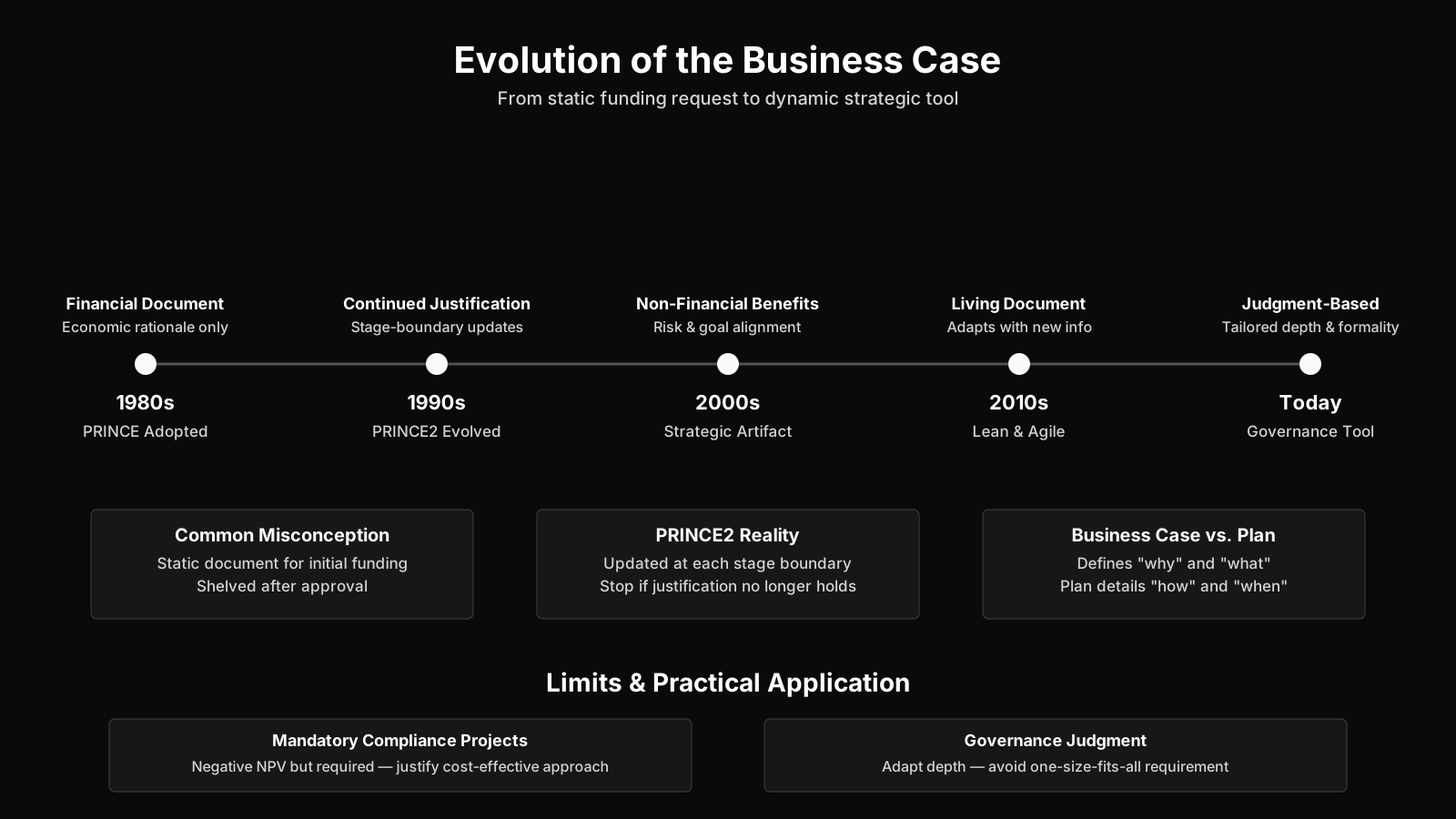
According to PRINCE2, the business case is a formal document that captures the justification for the project, forming the basis for continued business justification throughout the project lifecycle. PRINCE2 mandates that the business case be created at the start of the project, updated and validated at each stage boundary, and confirmed during the Managing a Stage Boundary process. This ensures that if the underlying assumptions change, the project can be adjusted or even closed prematurely if it no longer makes sense.
In an Agile context, the concept often manifests as a “business case” document that is deliberately leaner, sometimes reduced to a one-page canvas or a set of hypotheses in a value proposition. Agile frameworks such as Scrum or SAFe emphasize responding to change, and so the business case in these environments is treated as a lightweight, evolving artifact. It is not uncommon to see the business case expressed as a set of expected outcomes, with the understanding that the precise path to those outcomes will emerge as the team learns more through iterative delivery.
What this really means in practice is that a business case is the project’s formal permission slip. Imagine a homeowner considering a major renovation. They would jot down the reasons—more space for a growing family, increasing resale value, fixing safety issues—then rough out the cost against the expected payoff. If the numbers look solid, they apply for a loan. If halfway through the renovation, they discover the foundation is unsound and costs triple, they might stop and reassess. The business case plays that same role for organizations, but with the rigor of financial metrics, strategic alignment, and governance oversight.
Core Takeaways on Business Case Definition
- Structured proposal quantifying net benefits
- A business case delineates the full investment rationale by capturing the business need, evaluated options, recommended solution, and projected net benefits, thereby functioning as a comprehensive decision document rather than a mere cost-benefit snapshot.
- Governance and authorization function
- The primary role of a business case is to supply governance groups with sufficient evidence for confident go/no-go decisions, fulfilling the formal justification required by methodologies such as PMBOK and PRINCE2.
- Agile contexts require leaner business cases
- In Agile frameworks such as Scrum and SAFe, the business case is intentionally lightweight and emerges iteratively, often captured as a one-page canvas, a set of testable hypotheses, or expected outcomes that teams refine throughout successive delivery cycles.
Key Components of a Business Case
A well-structured business case is not a monolithic block of text; it is composed of several interdependent components that collectively paint a full picture of the investment. The key components of a business case typically include the strategic context, the problem or opportunity statement, an options analysis, the recommended solution, a detailed benefits forecast, a cost estimate, a risk assessment, and an implementation plan outline. Each of these sections addresses a specific decision-maker question: what is wrong or what could be improved, what are the alternative paths, what value does each path bring, and what is the price tag in money, time, and organizational disruption?
The strategic context anchors the initiative within the broader organizational vision and goals. A project that aligns with no clear strategic objective will struggle to secure funding. The problem statement defines the gap between current and desired states, using factual evidence, stakeholder input, and market data. The options analysis explores multiple solutions, including the “do nothing” baseline, a minimal viable approach, and the preferred option, comparing them through metrics like net present value, internal rate of return, or payback period.
Benefits are the heart of the business case. They are the measurable improvements that the investment is expected to deliver, classified as tangible (e.g., revenue increase of 12 percent, cost reduction of $500,000 annually) or intangible (e.g., brand reputation enhancement, employee satisfaction gains). Costs, on the other hand, must be captured in their full lifecycle: capital expenditure, operational costs, transitional costs, and even decommissioning expenses. A realistic risk section acknowledges uncertainties in both benefits and costs and often includes sensitivity analysis, showing how changes in key assumptions impact viability.
What often surprises newcomers is the amount of honest skepticism a good business case demands. It is not a sales pitch but a balanced argument. If a given option has a high chance of failure, the business case must say so. If the intangible benefits cannot be quantified, that limitation is disclosed. The level of detail scales with the size and complexity of the investment: a small internal process improvement might merit a two-page document, while a multi-year infrastructure program could require a hundred-page submission reviewed by a portfolio board.
The Business Case in PMBOK and PRINCE2 Frameworks
Within the PMBOK Guide, the business case is not a process group or a knowledge area but an essential document that influences several stages of project management integration. The business case in PMBOK is first encountered in the Initiating Process Group, specifically as an input to Develop Project Charter. It provides the project’s raison d’être and contains the information that the project charter will summarize for the project manager and team. However, its role extends beyond initiation. In the Monitoring and Controlling Process Group, performance data is often compared back to the original business case assumptions. If actual benefits diverge significantly, the project may be subject to a benefits review or even termination.
The business case also ties into key knowledge areas such as Project Integration Management, Risk Management, and Stakeholder Management. Integration because it justifies the project’s existence; risk because it identifies threats to benefit realization; and stakeholder because it communicates the value proposition to those whose support is needed. PMBOK emphasizes that the business case is typically owned by the project sponsor, who is accountable for its ongoing validity.
PRINCE2 elevates the business case to a central, non-negotiable theme. It demands that the business case be created using a defined template and be continuously maintained throughout the project. At each stage boundary, the project manager updates the business case and submits it to the project board for review. The board uses this updated document to decide whether to authorize the next stage. PRINCE2’s principle of “continued business justification” means that if the business case becomes unviable, the project must be closed—no exceptions. This bakes in the discipline that projects are not pursued out of inertia or sunk-cost mentality.
In both PMBOK and PRINCE2, the business case is distinguished from the project charter. The charter authorizes the project’s existence and appoints the project manager, while the business case justifies the project. The charter references and summarizes key points from the business case but does not replace it. The distinction is subtle but important: the charter is a project management document, while the business case is a business document. One tells the team what they are doing and who is responsible; the other tells the organization why they are doing it.
Core Takeaways on Business Case Roles
- PMBOK initiating process role
- Within the PMBOK framework, the business case serves as a foundational input during the Initiating Process Group, providing the essential justification that the project charter condenses and authorizes.
- PMBOK monitoring and control
- During Monitoring and Controlling, actual performance is continuously measured against the original business case assumptions, with significant variances triggering formal benefits reviews or potential project termination.
- Sponsor ownership in PMBOK
- PMBOK designates the project sponsor as the business case owner, holding that individual accountable for maintaining its ongoing validity and strategic alignment throughout the project life cycle.
- PRINCE2 continued justification
- In PRINCE2, the business case is a central theme that underpins the principle of continued business justification, mandating project closure if the justification ceases to be viable, irrespective of sunk costs.
The Business Case in Agile and Hybrid Environments
Agile delivery models introduced a tension with the traditional business case, because upfront detailed planning is antithetical to empiricism. The business case in Agile environments often takes the form of a “lean business case” or a “product vision statement” accompanied by a high-level economic framework. For example, a product owner might articulate the value using a Business Model Canvas or a Vision Box exercise, while financial justification may be handled through cost of delay or Weighted Shortest Job First (WSJF) prioritization techniques. The core idea is to provide enough justification to start the initiative and fund the first increment, then use feedback loops to validate whether further funding is warranted.
In a hybrid model, where a traditional governance structure oversees an Agile delivery team, the business case may retain its detailed format at the portfolio level but treat scope as flexible within time and cost constraints. The funding decision is predicated on the ability to deliver a minimum viable product that will start returning value quickly, and subsequent releases are re-evaluated through lightweight checkpoints rather than formal stage gates. Practically, this means the business case might set a not-to-exceed budget and a target benefit range, while the specifics of features are left for the backlog to define iteratively.
One common pattern is the “rolling wave” business case, where the justification for the near-term is detailed, but the longer-term is expressed as a hypothesis with high-level assumptions. As evidence accumulates from delivered increments, those assumptions are revised and the business case updated. This preserves the governance need for economic discipline without suffocating the team’s ability to pivot. Many Agile practitioners argue that the healthiest business case is one that is repeatedly validated against real user data, not a static document gathering dust in a shared drive.
The BVOP Perspective on the Business Case
Business Value-Oriented Project Management (BVOPM) places a unique emphasis on the organizational context in which a business case is reviewed and authorized. The BVOP approach to business case validation requires that all key stakeholder groups have formal input during the initiation phase. Rather than a small sponsor group drafting the case in isolation, BVOPM advocates for a Transparent Board of Project Issues, where representatives from operations, development, quality, and even end-user proxies can raise concerns before any commitment is made. This upfront cross-functional scrutiny aims to surface hidden assumptions, conflicting interests, and unrealistic expectations that might otherwise remain buried until execution, when they become expensive surprises.
BVOPM does not prescribe a different document structure for the business case itself. Instead, it changes the social process around its creation and approval. The business case becomes a product of collective intelligence rather than a lobbying tool used by a single sponsor to secure funding. While this approach can slow down the initial go/no-go decision, proponents find that it significantly reduces the downstream waste caused by poorly vetted initiatives, especially in organizations where political pressure often overrides honest analysis.
Core Insights on Collaborative Case Review
- Transparent cross-functional review board
- BVOPM mandates a Transparent Board of Project Issues where representatives from operations, development, quality, and end-user proxies raise concerns and align expectations before any commitment is made.
- Collective intelligence replaces isolated sponsorship
- The BVOP approach transforms the business case from a funding lobbying tool into a product of collective intelligence, replacing isolated drafting by a small sponsor group.
- Slower approval, reduced execution waste
- Although cross-functional scrutiny may extend the initial decision timeline, it dramatically cuts downstream waste by surfacing hidden assumptions, conflicting interests, and unrealistic expectations early in the process.
Purpose and Importance of the Business Case
The business case exists to prevent organizations from investing resources in initiatives that do not deliver sufficient value. Its purpose and importance in project management cannot be overstated: it is the financial and strategic filter that aligns project selection with corporate objectives. Without a credible business case, decision-makers rely on intuition, political influence, or the loudest voice in the room, resulting in a portfolio cluttered with pet projects and underperforming assets.
A robust business case also establishes a baseline for benefits realization. Once the project delivers its outputs, the organization can measure actual benefits against the promised ones, closing the accountability loop. This traceability strengthens the culture of results over activity. For the project manager, the business case provides the context necessary to make intelligent trade-off decisions. When a scope change request arrives, the project manager can return to the business case and ask: does this change move us closer to the stated benefits, or is it a distraction dressed as an improvement? That clarity protects the project from scope creep and keeps the team focused on value delivery.
In program management, the business case aggregates the justifications of multiple component projects, showing how they collectively contribute to a larger outcome. The program business case must demonstrate that the whole is greater than the sum of its parts—often involving economies of scale, shared resources, or interdependent benefits. Portfolio management uses business cases to rank and select projects in a way that optimizes the entire investment mix, balancing risk and return across the enterprise.
Practical Application: When and How a Business Case Is Used
A business case is typically developed during the pre-initiating or concept phase of the project lifecycle, before any significant funds are committed to planning or execution. When a business case is used depends on the organization’s governance framework; in larger entities, a business case may be required at multiple tollgates—first for initial seed funding, then for full project approval, and again at major milestone reviews. The business case is presented to a governance body, often called a portfolio review board, investment committee, or steering group, which has the authority to approve, reject, or defer the initiative.
The actual preparation of the business case is usually led by a sponsor or a business analyst, with input from subject matter experts across finance, operations, technology, and legal departments. The project manager often contributes during the drafting stage, especially around cost and schedule estimates, but the business case remains a business-side artifact. Once approved, the business case becomes a reference for the project charter and the project management plan. During execution, the project manager may be tasked with flagging variances that could invalidate the original assumptions—for instance, a regulatory change that eliminates the expected benefit or a supplier cost increase that makes the project unprofitable.
In smaller organizations or less formal settings, a business case might be a short slide deck or even a verbal pitch backed up by a spreadsheet. The formality scales with the stakes. What does not change is the underlying logic: show that the benefits outweigh the costs and that the risks are acceptable. Human decision-making is fallible, so organizations that enforce even a minimal business case discipline inoculate themselves against the worst impulses of unchecked enthusiasm.
Core Takeaways on Business Case Use
- Early lifecycle development
- The business case takes shape in the pre-initiating or concept phase, ensuring that no significant project funds are committed to planning or execution until the initiative's viability is validated.
- Multiple governance checkpoints
- In larger organizations, the business case is often required at multiple control gates, including initial seed funding approval, full project authorization, and subsequent milestone reviews.
- Governance body decision authority
- A portfolio review board, investment committee, or steering group assesses the business case and determines whether to approve, reject, or defer the proposed initiative.
- Sponsor-led preparation approach
- A sponsor or business analyst spearheads development, gathering input from subject matter experts, while the project manager provides cost and schedule estimates but does not own the final document.
- Ongoing reference and variance checks
- Once approved, the business case serves as the foundation for the project charter and management plan, requiring the project manager to actively flag any deviations that might invalidate its underlying assumptions.
Common Challenges, Pitfalls, and Misconceptions
One of the most persistent business case challenges is optimism bias: the systematic tendency for estimators to underestimate costs and overestimate benefits. This is not malfeasance but a cognitive distortion that arises from the excitement of a new idea. Left unchecked, it leads to business cases that promise unrealistic returns and set projects up for eventual perception of failure, even when they deliver reasonable value. Techniques like reference-class forecasting, where historical data from similar projects are used to calibrate estimates, can mitigate this bias.
Another common pitfall is the treatment of the business case as a one-time sales document, created to get funding and then filed away. When this happens, the justification becomes stale. Market conditions shift, competitor actions change, and technology evolves, rendering the original numbers irrelevant. PRINCE2’s insistence on continuous justification is a direct antidote to this problem, but many organizations fail to operationalize it. The business case must be a living document, revisited as frequently as internal and external conditions warrant.
A widespread misconception is that a positive business case is all that is needed to greenlight a project. In reality, strategic fit, resource availability, mandatory regulatory requirements, and portfolio balance all influence the final decision. A project can have a stellar projected return on investment yet be rejected because it does not align with the company’s long-term direction or because the organization lacks the capacity to execute it without jeopardizing higher-priority work. Another misconception equates the business case with the project charter. While the two overlap, the charter is about authorization and high-level scope; the business case is about justification. Confusing them causes governance confusion, with accountability for benefits becoming blurred.
The “do nothing” option is often shortchanged. Many business case authors give it a perfunctory paragraph, assuming it is obvious that inaction is worse. However, the do-nothing scenario can be the wisest choice if the risks of change are high or the expected uplift is marginal. A rigorous business case treats the status quo as a legitimate alternative, modeling the baseline trajectory and letting the decision emerge honestly from comparison rather than assumption.
Relationships to Other Project Management Concepts
The business case is deeply connected to the benefits management plan, the project charter, the feasibility study, and the prioritization backlog. The business case vs project charter distinction is particularly instructive. While the business case establishes why the project should be done, the project charter formally authorizes the project and gives the project manager the authority to apply resources. The charter often includes a section summarizing the business case, but the full business case is a separate, more detailed artifact that precedes the charter in the lifecycle.
Feasibility studies sometimes get confused with business cases, but they serve different purposes. A feasibility study investigates whether a solution is possible and practical from technical, operational, and legal standpoints, without necessarily quantifying the net benefit in monetary terms. A business case assumes feasibility and focuses on value for money. Many organizations combine these into a single document, but the intellectual separation remains: feasibility asks “can we?”, the business case asks “should we?” given the cost.
The benefits management plan, as described in PMBOK, is the roadmap for how benefits will be measured, reported, and sustained after the project closes. The business case identifies the promised benefits; the benefits management plan operationalizes them. If the business case is the promissory note, the benefits plan is the collection process. In Agile environments, the product backlog and its prioritization serve as a dynamic extension of the business case, with each backlog item contributing to the overall value hypothesis. The connection extends to risk management as well, because the business case’s sensitivity analysis feeds directly into the risk register, highlighting which uncertainties could topple the entire investment.
Core Insights on Business Case Relationships
- Charter authorizes what case justifies
- The business case establishes why the project should be funded; the project charter then crystallizes that rationale into a formal authorization document, granting the project manager explicit authority to commit resources and thereby turning the case’s justification into an actionable mandate.
- Feasibility explores, business case decides
- The feasibility study answers “Can we do it?” by evaluating technical, operational, and legal constraints; the business case then answers “Should we do it?” by weighing lifecycle costs against projected returns.
- Benefits plan tracks delivered value
- The benefits management plan converts the business case’s value assumptions into measurable targets, defining the metrics, reporting timelines, and sustainment mechanisms needed to realize and safeguard the promised benefits post-delivery.
- Backlog and risk register link back
- In Agile environments, product backlog ordering dynamically extends the business case by aligning each increment to the value hypothesis, while sensitivity analysis findings from the business case seed the risk register with critical uncertainties that could threaten the entire investment.
Evolution and Current Thinking on the Business Case
The concept of a business case has evolved from a rigid financial document into a more adaptive, value-centric tool. Evolution of the business case in modern management reflects the shift from predictive to empirical planning. Traditional approaches, rooted in 20th-century capital budgeting techniques, treated the business case as a fixed contract. Today, influenced by Agile, Lean, and design thinking, many organizations view it as a hypothesis to be tested. This does not mean financial discipline is abandoned; rather, the assumption is that the initial numbers will be refined as real evidence emerges.
The debate around continuous versus gate-based justification continues. Proponents of rolling-wave business cases argue that approving funding in smaller increments forces more frequent and honest reappraisal. Critics caution that incremental funding can lead to “death by a thousand cuts,” where a project limps along without ever delivering strategic value because no one has the courage to kill it outright. The most mature organizations combine both: a full business case for initial funding with scheduled deep-dive reviews at predetermined checkpoints, where the document is torn apart and rebuilt if necessary.
Another trend is the integration of sustainability and social impact metrics into the business case. Historically, these were considered intangibles and often ignored. Now, as environmental, social, and governance (ESG) criteria gain prominence, business cases are increasingly required to quantify carbon footprint reductions, diversity outcomes, or community benefits. This expansion tests the limits of traditional financial modeling but pushes the profession toward more holistic value definitions. In parallel, digital tools now allow business cases to be linked to real-time data dashboards, so that benefit indicators are updated automatically, making the “living document” aspiration a practical reality.
There is also a growing recognition that the business case is not just a rational tool but a political one. It can be manipulated through assumption bias, selective data, or excessive complexity to steer decisions. Organizational maturity manifests in the ability to separate robust analysis from advocacy, ensuring that the scrutiny applied to the business case is as rigorous as the document itself. The project management profession continues to refine how business cases are created, challenged, and maintained, recognizing that the quality of an organization’s investment decisions is only as good as the honesty of its justification documents.