A Basic Ordering Agreement (BOA) is a written instrument of understanding negotiated between a buyer and a seller that establishes the general terms, conditions, and procedures under which future orders for supplies or services may be placed. It is not a contract itself and does not commit either party to any purchase or sale; rather, it serves as a pre-established framework designed to streamline and expedite the procurement process once specific needs arise during a project.
Basic Ordering Agreement: Key Points at a Glance
| Concept | Summary |
|---|---|
| Foundational Purpose | A Basic Ordering Agreement is a negotiated written instrument between a buyer and supplier that codifies the overarching terms, conditions, and ordering protocols for future procurements, enabling streamlined transactions without imposing any immediate financial commitment. |
| Non‑Contractual Framework | The BOA is not a standalone contract and carries no obligation to buy or sell; it serves solely as a pre‑agreed procedural and legal framework that accelerates procurement once a specific need materializes. |
| Pre‑Negotiated Provisions | The document sets forth administrative, legal, and operational ground rules spanning pricing formulae, delivery conditions, quality benchmarks, intellectual property ownership, warranty terms, and dispute resolution, all activated only upon issuance of an order. |
| Contract Activation | A legally binding contract materializes under the BOA when the parties lock in the specific quantity, statement of work, delivery timeline, and either a fixed price or a confirmed pricing mechanism for a discrete order. |
| Expedited Procurement Cycle | With an existing BOA, a project team can convert a requirement into a binding order within days by bypassing re‑negotiation of indemnity clauses, payment schedules, and other boilerplate terms, as observed in the specialized testing services example. |
| Scope Guardrails | A well‑drafted BOA begins with a scope clause that delineates the covered categories of supplies or services, striking a balance between sufficient breadth to capture evolving requirements and sufficient specificity to confirm the supplier’s technical capability and willingness to perform. |
| Market‑Responsive Pricing | The BOA incorporates price adjustment mechanisms, typically linked to a publicly available cost index, to preserve commercial viability over time as input costs, labor rates, or currency fluctuations evolve. |
| Historical Evolution | The BOA emerged from military logistics for procuring specialized components and services from a narrow industrial base, later adopted by civilian federal agencies and large commercial enterprises across construction, energy, and pharmaceuticals to manage repetitive but customized procurement needs. |
What Is a Basic Ordering Agreement?
At its core, a Basic Ordering Agreement definition centers on its role as a procurement enabler rather than a procurement commitment. The document outlines all the administrative, legal, and procedural ground rules, including clauses covering pricing mechanisms, delivery terms, quality standards, intellectual property rights, warranties, and dispute resolution, but contains no obligation for the buyer to actually order anything. Actual purchases occur only when the buyer issues a separate order against the BOA, often called a task order, delivery order, or call. At that moment, the specifics of quantity, exact scope, delivery schedule, and firm price or pricing formula are locked in, and a binding contract under the umbrella of the BOA springs into existence.
This dual nature confuses many who encounter a BOA for the first time. The signed agreement sits in a drawer, inert, until an order breathes life into it. For project managers accustomed to discrete, standalone contracts with clear start and end dates, the BOA can feel disconcertingly open-ended. Yet that openness is precisely its value. By separating the negotiation of boilerplate terms from the transaction-specific details, organizations can compress the lead time for procurement from weeks to days. A project team that identifies a need for specialized testing services on Monday can, if a BOA with a qualified lab already exists, have a binding order in place by Wednesday without renegotiating indemnity clauses or payment terms.
It helps to think of the BOA as a pre-approved rulebook for a recurring game. The rules are fixed and agreed upon, but whether a game is played, how many rounds occur, and what the stakes are each time remain entirely at the discretion of the players. The rulebook itself costs nothing to maintain other than the initial effort to draft and agree upon it, yet it eliminates the need to reinvent the rules for every match. This layering of agreement makes the BOA a uniquely flexible tool in environments where needs are predictable in type but unpredictable in timing or volume.
Key Takeaways on Basic Ordering Agreements
- Procurement enabler, not commitment
- A Basic Ordering Agreement codifies administrative, legal, and procedural ground rules while imposing no purchase obligation on the buyer.
- Orders activate the agreement
- Actual purchases materialize only when the buyer issues a separate task order, delivery order, or call that definitively specifies quantity, scope, schedule, and price.
- Dual nature causes confusion
- The signed BOA remains dormant until activated by an order, which can feel unsettlingly open-ended to managers accustomed to the finality of standalone contracts.
- Compresses procurement lead times
- By divorcing boilerplate negotiations from transaction-specific details, a BOA can compress procurement lead times from weeks to mere days.
- Ideal for variable demand patterns
- The BOA thrives in settings where demand types are predictable but timing and volume remain variable, providing flexible, pre-qualified access to selected suppliers.
Key Components of a Basic Ordering Agreement
Understanding the key components of a Basic Ordering Agreement reveals why it takes considerable upfront effort to craft one, but pays dividends over its lifespan. The document typically begins with a scope clause that defines the categories of supplies or services covered, not in exhaustive technical detail but in terms broad enough to encompass a range of future needs while still narrow enough to ensure the seller is actually capable and willing to perform. A BOA for geotechnical drilling services, for example, might cover soil sampling, standard penetration tests, and lab analysis across a specific geographic region, but would not extend to environmental remediation work.
Pricing arrangements form the next critical layer. Since the exact quantities and timing are unknown, the BOA often uses unit prices, labor rates, catalog prices with pre-negotiated discounts, or cost-reimbursement structures with ceiling rates. A well-drafted BOA will include mechanisms for price adjustment over time, often tied to a publicly available index, to prevent the agreement from becoming financially unworkable for either party as market conditions shift. The ordering procedures then spell out exactly how an order is placed—who is authorized, what format the order must take, how quickly the seller must acknowledge receipt, and what constitutes acceptance of the order.
Period of performance is another essential component. A BOA is typically established for a defined term, perhaps three to five years, after which it expires unless extended. This prevents permanently dormant agreements from cluttering procurement systems and ensures periodic reassessment of terms. The agreement also addresses termination, either for convenience or for cause, and the effect of termination on orders already placed. Finally, the BOA will include standard government or commercial clauses covering changes, inspections, payments, and compliance, often incorporating by reference a vast body of regulations if the buyer is a public agency.
Origins and Cross-Industry Context
The origins of the Basic Ordering Agreement lie squarely in United States government procurement, where it was formalized in the Federal Acquisition Regulation (FAR) Part 16.7. The defense establishment, faced with the need to acquire highly specialized spare parts, engineering services, and research support from a limited industrial base, needed a way to maintain relationships with critical suppliers without the delay of negotiating a new contract for every small order. A BOA with a jet engine manufacturer could cover a decade’s worth of potential spare parts buys, yet obligate no funds until an aircraft wing actually grounded a plane for maintenance.
From that military logistics origin, the concept migrated into civilian federal agencies and then into large commercial enterprises, particularly in sectors like construction, energy, and pharmaceuticals, where projects routinely require repeated procurement from the same specialist vendors. A pharmaceutical company building a new production line might put a BOA in place with an instrumentation supplier for all the pressure transmitters and flow meters to be ordered over the two-year construction phase. This allows the project team to pull individual instruments as detailed engineering designs are finalized, without holding up the overall schedule while contracts are drafted each time the bill of materials gets updated.
Outside project management, the BOA finds parallels in manufacturing’s blanket orders and in service industries’ master service agreements. The common thread is the recognition that in many business relationships, the transaction costs of repeated negotiation far outweigh any gains from customizing every purchase. By investing once in a thorough baseline agreement, both parties reduce ongoing friction and free up their commercial teams to focus on exceptions and value-added collaboration rather than administrative paper shuffling.
Core Takeaways on BOA Origins
Purpose and Importance in Project Management
The purpose of a Basic Ordering Agreement in project management is to decouple procurement lead time from project schedule critical path decisions. In capital projects, research and development programs, and large IT implementations, the precise specifications of many purchased items or services are not fully known at project initiation. Waiting until designs are complete to begin the procurement cycle can push the finish date out by months. A BOA lets the project manager compress that sequence; the lengthy negotiation of terms happens in parallel with early design work, so that when an engineer finalizes a spec, the purchase order can flow almost immediately.
This tool also brings predictability to cost estimating. Since the BOA contains agreed-upon unit prices or labor rates, the project team can develop cost estimates with much higher confidence than if they were guessing what the market will bear months from now. For a program manager overseeing a portfolio of similar projects, having a set of BOAs with key suppliers acts as a strategic capability. It ensures that the organization’s aggregate demand can be leveraged for better pricing without locking into volume commitments that individual projects might not be able to guarantee.
From a risk perspective, the BOA addresses a subtle but persistent threat: the risk of procuring under duress. When a project faces an urgent need and no contract vehicle exists, the buyer often pays a premium or accepts unfavorable terms. A BOA preempts this scenario by having the agreement ready, so that even urgent orders are placed under pre-negotiated, balanced conditions. This is not a theoretical concern; it is routinely observed in shutdowns, turnarounds, and outage projects in heavy industry, where the cost of delay can dwarf the cost of any single procurement.
The Basic Ordering Agreement in PMBOK and Other Frameworks
Within the PMBOK framework, the Basic Ordering Agreement in PMBOK terms is not named explicitly, but its function maps clearly to the Project Procurement Management knowledge area, specifically the Plan Procurement Management and Conduct Procurements processes. When developing the procurement management plan, a project manager might identify certain categories of purchases as candidates for a BOA based on their repetitive nature and strategic importance. The actual creation of the BOA is a procurement activity that happens during planning, while issuing orders against it falls under the Conduct Procurements process during execution and monitoring.
PRINCE2 does not contain a direct equivalent concept, as its guidance on procurement is less prescriptive about contract instruments and more focused on the management of the commercial relationship within the project’s stages. However, a PRINCE2 project manager working in a government environment would still encounter BOAs and would treat them as part of the project’s supply chain management strategy, ensuring that the Project Board is aware of any constraints or flexibilities the BOA introduces. The emphasis would be on defining the authority for placing orders, likely resting with the Senior User or a delegated Change Authority.
In Agile environments, procurement often takes a back seat to team delivery, but when external services or tools are needed, the principles of rapid iteration and flexibility align well with the BOA concept. An organization practicing Agile at scale might establish a BOA with a cloud services provider, allowing individual product teams to spin up infrastructure on demand without renegotiating enterprise agreements each time. The BOA functions as a guardrail that empowers teams to self-serve while maintaining organizational standards around cost, security, and compliance. The inherent flexibility of the BOA supports the Agile value of responding to change over following a plan.
Cross-Framework BOA Key Insights
Practical Application in Project Procurement
Applying a Basic Ordering Agreement in a real project setting requires close collaboration between the project manager, the procurement department, and often legal counsel. The initiative usually begins during the planning phase when the project’s procurement requirements are analyzed. Items or services that are needed repeatedly, that come from a limited or preferred supplier base, or that have long lead times for contract negotiation are prime candidates. The project manager articulates the technical scope and expected usage patterns, while procurement leads the negotiation of the agreement itself.
Once the BOA is in place, the rhythm of day-to-day procurement changes noticeably. When a work package is ready to proceed and needs to purchase items covered by the BOA, the project team does not initiate a full procurement cycle. Instead, they draft an order using a very simplified form or system, referencing the BOA number and specifying the items, quantities, delivery location, and required dates. The seller typically has a pre-agreed response window, perhaps 48 hours, to confirm acceptance. This streamlined process eliminates the need for repetitive solicitation, evaluation, and negotiation, allowing the project to maintain momentum even when many small purchases are required.
It is important to recognize that the BOA does not replace project management judgment. The project manager remains accountable for ensuring that each order placed is necessary, within scope, and funded. A BOA can become a tempting shortcut that encourages placing orders without sufficient scrutiny, simply because the friction is so low. Disciplined projects will still require a purchase requisition approval process that validates the business need and budget availability before any order is released against the BOA. The administrative ease is a benefit, not a license to bypass internal controls.
Common Challenges and Misconceptions
One of the most persistent challenges with Basic Ordering Agreements is the confusion over their legal standing. It is not uncommon for junior project staff, and occasionally senior managers, to treat a signed BOA as if it were a binding commitment for the seller to deliver work or for the buyer to pay. When expectations founder because no actual order was placed, the dispute reveals a fundamental misunderstanding. A BOA is a framework, not a guarantee. The seller has no claim for lost profits on business that never materialized, and the buyer cannot demand performance without a specific order.
Another pitfall is the assumption that a BOA, once established, provides unlimited flexibility. In practice, the scope clause defines boundaries, and orders that fall outside those boundaries cannot simply be forced into the agreement. A BOA for IT hardware cannot be stretched to cover facilities construction, even if the same seller happens to offer both. Attempting to do so exposes the organization to audit findings in government contexts and to potential legal challenges in commercial ones. Periodic audits of BOA usage are necessary to ensure that orders remain within the negotiated scope and that pricing remains competitive with current market conditions.
There is also a subtle version of the "sunk cost" fallacy that appears with BOAs. An organization that invested significant effort in negotiating a BOA may feel compelled to use it, even when a spot buy from an alternative source would be cheaper or faster. The existence of the agreement should not cloud business judgment. The BOA is a tool to be used when it adds value, not an obligation to be fulfilled. Disciplined procurement functions will benchmark the BOA pricing against the market at regular intervals and will not hesitate to go elsewhere if the agreement is no longer competitive.
Key Takeaways on BOA Misconceptions
Relationship to Other Procurement Instruments
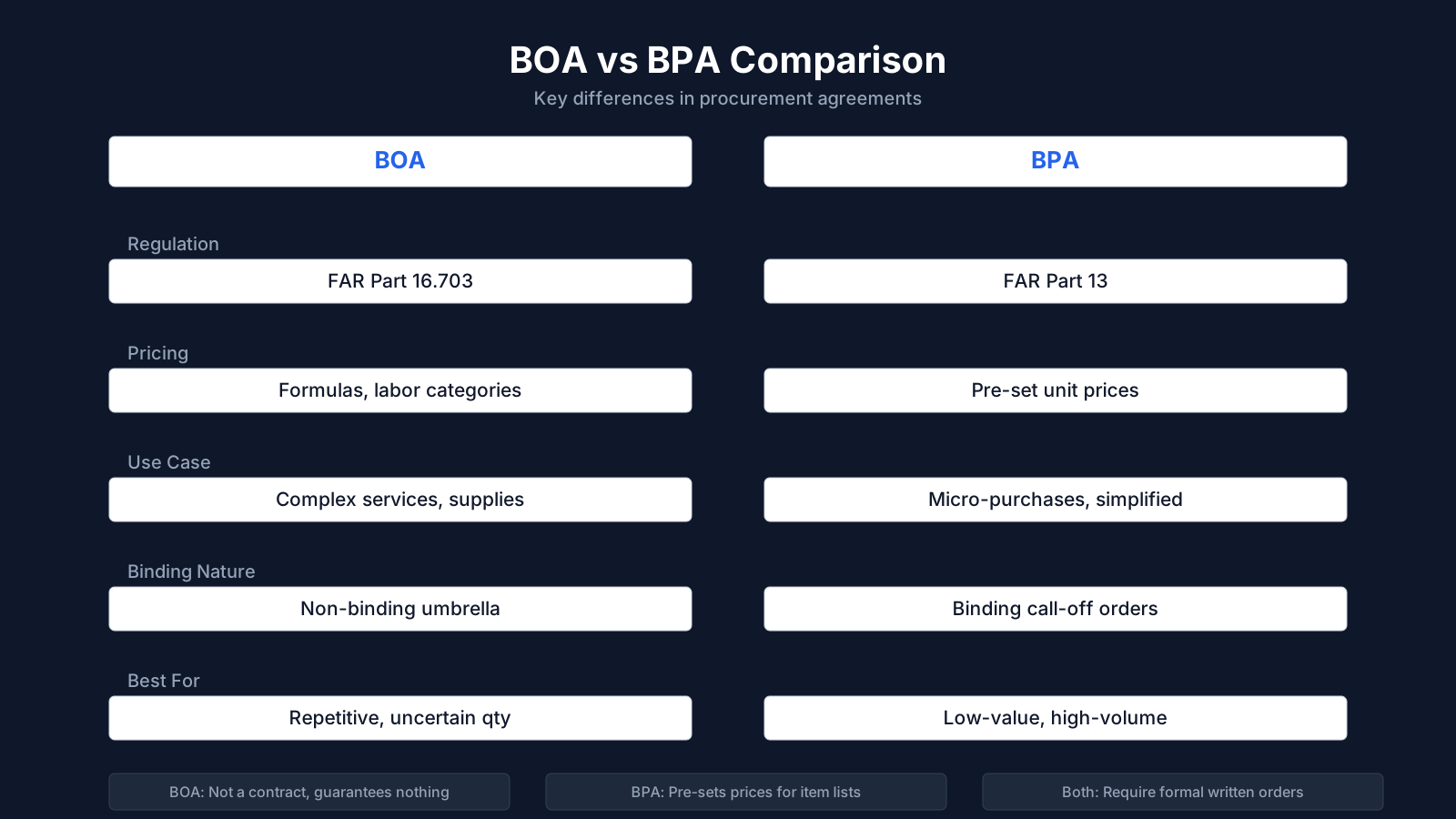
Distinguishing a Basic Ordering Agreement vs Blanket Purchase Agreement is a frequent source of confusion, particularly in government settings where both terms appear. A Blanket Purchase Agreement (BPA) is generally a simpler, more transactional instrument intended for repetitive purchases of commercial off-the-shelf items with a single supplier. BPAs often have a total dollar ceiling and are frequently used for things like office supplies or maintenance parts. A BOA is typically more complex and is used when detailed terms and conditions need to be negotiated upfront for more specialized requirements, and it may not have an aggregate dollar ceiling because the buyer makes no commitment.
Another closely related instrument is the Indefinite Delivery Indefinite Quantity (IDIQ) contract, which does carry a minimum purchase obligation and a maximum ceiling, with the government guaranteeing at least the minimum amount. A BOA has no minimum guarantee whatsoever. This makes the BOA less attractive to sellers who might otherwise invest significant capacity in anticipation of orders, but it also gives the buyer greater flexibility and lower exposure. Project managers moving between government and commercial environments should be aware that these terms are not always used consistently; some organizations call what is effectively a BOA by another name, and the legal substance should always be verified over the label.
In the commercial world, the common counterpart is the Master Service Agreement (MSA) coupled with Statements of Work (SOWs). The MSA contains the general terms, and each SOW functions as an order. While structurally similar, the BOA carries with it a certain heritage of government contracting precision, often including more rigorous flow-down clauses and compliance requirements. For a project manager, the practical difference is that a BOA typically demands more involvement from legal and contracts specialists than a simpler MSA, but it also provides more robust protections in highly regulated or litigious environments.
Evolution and Current Thinking
Current thinking on Basic Ordering Agreements reflects a broader shift in procurement philosophy away from adversarial, transaction-focused relationships toward collaborative, partnership-based models. The traditional view of the BOA as a convenient administrative shortcut is being augmented by its recognition as a strategic tool for supplier relationship management. By investing in a well-structured BOA with a critical supplier, the project organization signals a long-term intent that can foster innovation sharing, joint problem-solving, and preferential allocation of scarce resources during market peaks.
Digital transformation is reshaping how BOAs are managed. Modern procurement platforms can host the BOA document, track all orders placed against it, automate pricing validations, and provide real-time visibility into order status and spend against any notional budgets. This addresses a historical weakness of BOAs: the difficulty of maintaining organizational memory when key negotiators leave and paper files gather dust. With a centralized system, a new project manager can instantly see what agreements exist, what they cover, and how to use them, dramatically lowering the barrier to adoption.
There is also a growing recognition that BOAs can support sustainability and diversity goals. Organizations are using BOAs to lock in commitments from suppliers around carbon footprint reporting, ethical sourcing, and small business subcontracting, embedding these values into the standard terms that flow down to every order. A project that issues a hundred small orders under a single BOA with strong sustainability clauses achieves far greater impact than if each order stood alone with minimal leverage. This evolution positions the BOA not just as a procurement expediter, but as a governance instrument that channels organizational values into the supply chain with consistency and force.
Key Insights on BOA Evolution
- Strategic supplier partnership tool
- BOAs have evolved from administrative conveniences into strategic instruments that signal unwavering long-term commitment, encouraging collaborative innovation, joint problem-solving, and privileged access to supplier capacity during periods of peak demand.
- Digital platforms enable oversight
- Modern digital platforms consolidate BOA management with real-time visibility into order status, automated price validation, and cumulative spend analytics, effectively preserving institutional knowledge that was once lost when key negotiators departed.
- Values embedded in supply chain
- Organizations now deploy BOAs as governance instruments to embed rigorous supplier commitments on carbon reporting, ethical sourcing, and diverse subcontracting, with sustainability clauses cascading to every individual order to ensure consistent and amplified impact.