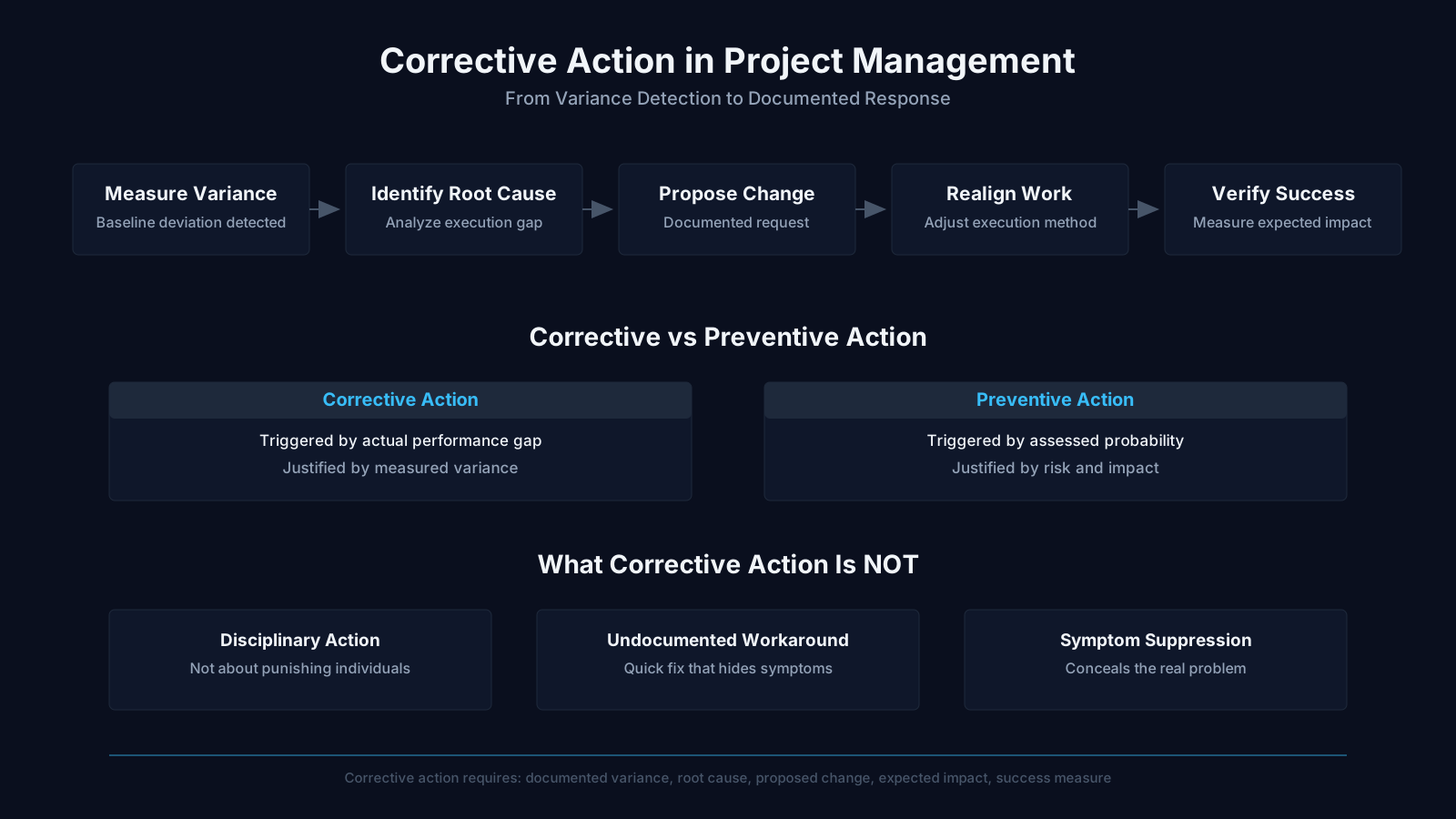
Corrective action in project management refers to a deliberate, documented intervention intended to realign project work performance with the project management plan after a measured variance has occurred. It is a core mechanism in project monitoring and controlling, where actual results are compared against planned targets and the project manager decides what must change in the way work is being executed rather than simply accepting an unfavorable trend. The term appears across predictive, hybrid, and agile environments, although the formality and terminology vary. Corrective action is closely related to, but distinct from, preventive action and defect repair, and it sits inside wider project control systems together with change requests, issue logs, earned value analysis, and risk response.
Corrective Action: Key Topics at a Glance
| Concept | Summary |
|---|---|
| Core Mechanism | Corrective action is a core project monitoring and controlling process that compares actual performance against planned targets and requires the project manager to adjust work execution rather than allow an unfavorable trend to continue. |
| Distinct Types | Corrective action is distinct from preventive action and defect repair, and it functions within integrated project control systems that include change requests, issue logs, earned value analysis, and risk response planning. |
| Performance Gaps | When a work package runs late, exceeds budget, or fails quality inspections, corrective action targets the underlying cause by adjusting the execution approach, resource allocation, quality controls, or technical methods. |
| Change Control | Formal corrective action requests are typically routed through integrated change control, since altering how work is performed may affect cost, schedule, risk, or scope baselines. |
| Industry Applications | Aviation and aerospace programs mandate corrective action after incidents, audit findings, or test failures, while pharmaceutical and medical device companies use it as a required response to deviations from established procedures. |
| Historical Roots | Military quality standards established disciplined nonconformance handling, and software engineering contributed defect tracking and root cause analysis methods that support continuous iterative improvement. |
| Key Components | Effective corrective action requires a documented baseline variance, an identified root cause, a proposed change to execution, an approval decision, implementation, and a follow-up assessment to confirm the fix is effective. |
| Detection Triggers | Corrective action is initiated by signals such as a schedule performance index below 1.0, repeated defects exceeding acceptance thresholds, or a risk review indicating that a known threat has materialized. |
What Is Corrective Action in Project Management?
Corrective action is defined as an intentional activity that realigns the performance of project work with the project management plan after a deviation has been identified. Corrective action in project management is not a general reaction to bad news; it is a structured response to a realized variance that has already occurred. If a work package is late, over budget, or failing quality inspections, corrective action targets the cause of that performance gap and changes the execution approach, resource allocation, quality controls, or technical method. In formal project controls, the request for corrective action often moves through integrated change control, because changing how work is performed may also affect cost, schedule, risk, or scope baselines. What distinguishes corrective action from a simple fix is that the action must be based on an assessment of why the deviation happened, not just a desire to speed up work or hide the symptom.
A common misunderstanding is that corrective action always means accelerating the schedule or adding resources. In many cases, the most effective corrective action is to rework a flawed activity, adjust coordination procedures, reassign responsibilities, or improve the quality of inputs. Corrective action may be proposed by the project manager, a team member, a control account manager, or a quality auditor. The action is documented and approved according to the governance rules of the project. In practice, a corrective action request will describe the variance, the underlying cause, the proposed change to work performance, the expected impact, and the method for measuring whether the action worked.
Core Insights on Corrective Action
- Definition of corrective action
- Corrective action is a deliberate intervention that brings project performance back into alignment with the project management plan once a deviation from expected results has been detected.
- Structured response targeting causes
- It represents a structured response to an actual variance, addressing the underlying cause of the performance gap rather than the symptom by modifying the execution approach, resource allocation, quality controls, or technical methods.
- Integrated change control involvement
- Because changes to how the work is performed can alter cost, schedule, risk, or scope baselines, corrective action requests frequently require review through the integrated change control process.
- Root cause assessment required
- What separates corrective action from a superficial fix is the requirement to understand why the deviation occurred, rather than simply accelerating work or concealing the symptom.
- Misconception about acceleration
- A frequent misunderstanding is that corrective action always involves schedule acceleration or additional resources, whereas in practice it often consists of rework, coordination adjustments, reassignment of responsibilities, or quality improvements.
Origins and Cross-Industry Context
The concept of corrective action did not originate in project management. It has strong roots in quality management, industrial engineering, and safety-critical industries. Corrective action explained through the lens of manufacturing often appears as part of a corrective and preventive action system, where a nonconformity is investigated, its root cause is eliminated, and a verification step confirms the fix. Aviation and aerospace programs use corrective action after incidents, audit findings, or test failures, requiring operators to show that the underlying technical or procedural cause has been addressed before flight or production continues. Pharmaceutical and medical device companies operate under regulatory frameworks that treat corrective action as a required response to deviations from standard operating procedures or product specifications. These industries share a common logic: measure a deviation, identify its source, implement a remedy, and verify that the remedy prevents recurrence.
Military and software engineering communities also influenced the project management view. Military quality standards emphasized disciplined nonconformance handling, while software engineering evolved defect tracking and root cause analysis practices that fed into iterative improvement. When project management bodies codified corrective action, they absorbed this evidence-based tradition. That historical influence explains why project corrective action is supposed to include root cause analysis and verification, even when real-world projects sometimes reduce it to a hurried schedule recovery.
Key Components of Corrective Action
Corrective action has several defining components that separate it from informal problem solving. Key components of corrective action include a documented variance from the planned performance baseline, an identified root cause or contributing factor, a proposed change to work execution, an approval decision, implementation, and a follow-up assessment. Without these components, the action may be little more than an unverified attempt to push the project back on track. In formal project environments, the corrective action request is recorded in the change log or issue register and tracked to closure.
One component that often gets too little attention is the variance threshold. Projects do not need corrective action for every minor deviation. Management plans may define tolerances for schedule, cost, quality, or other performance measures. A work package running one day late on a one-year project might simply be absorbed by float or managed through routine coordination. Corrective action becomes appropriate when the deviation exceeds a threshold or when the pattern of small deviations indicates a systemic problem. This threshold-based thinking prevents overcorrection and control-related overhead from consuming the team.
Variance Trigger and Approval Threshold
The trigger for corrective action is usually an output from monitoring and controlling processes. Earned value analysis may reveal a schedule performance index trending below 1.0, quality control measurements may show repeated defects above an acceptance limit, or a risk review may detect that a known threat has begun to materialize. The trigger is documented in the project management plan, often in the form of control limits or management tolerances. Once a trigger is met, someone with authority decides whether to request corrective action or to escalate the issue. Approval is not automatic, because the proposed action may require resources, time, or budget that the project does not have without adjusting other components.
Root Cause and Verification
Root cause analysis is the intellectual core of corrective action. Techniques such as the five whys, fishbone diagrams, fault tree analysis, or a simple structured review help distinguish the actual source of variation from symptoms. A project that is behind schedule because of unclear requirements needs a different corrective action than a project that is behind because of insufficient testing capacity. A late software release is not corrected by simply asking developers to work weekends. If the real cause is unstable integration environments, the corrective action changes the environment provisioning process, and the team then measures whether integration failures decline. After the action is implemented, verification closes the loop. The project team checks whether the variance has been reduced, whether the work is now aligned with the plan, and whether the action introduced any new risks.
Core Insights on Corrective Action
- Documented variance from planned baseline
- A corrective action is triggered by a formally documented deviation from the performance baseline, which separates it from informal problem solving and creates an auditable starting point.
- Root cause identification required
- Root cause analysis or identification of contributing factors is a prerequisite, ensuring that any proposed change to work execution addresses the underlying issue rather than its symptoms.
- Approval, implementation, and follow-up
- A complete corrective action cycle requires formal approval, structured implementation, and a follow-up assessment that verifies whether the action achieved the intended effect.
- Tracking in formal registers
- In formal project environments, corrective action requests are recorded in the change log or issue register and actively tracked through to closure, ensuring accountability and traceability.
- Variance threshold as trigger
- Corrective action is warranted when a deviation exceeds a defined threshold or when recurring minor deviations point to a systemic problem, allowing teams to intervene precisely without overcorrecting.
Corrective Action in PMBOK and PRINCE2
Within the PMBOK Guide, corrective action appears as one of the formal change request types. Corrective action PMBOK guidance places it inside the Monitor and Control Project Work process, where performance data is analyzed and change requests are generated. The PMBOK framework identifies four types of change requests: corrective action, preventive action, defect repair, and updates. Corrective action is specifically described as an intentional activity to realign work performance with the project management plan. It is processed through Perform Integrated Change Control when it affects baselines, constraints, or project documents. The key distinction is that corrective action changes the work, not necessarily the plan, although in practice many corrective actions do require some plan adjustment because resources or sequencing may shift.
This does not mean the project manager simply executes any corrective action that seems useful. The change control system evaluates the impact on scope, schedule, cost, quality, resources, communications, risk, procurement, and stakeholder expectations. If a corrective action would require additional funding or time, those implications must be analyzed and approved at the appropriate level. That governance is designed to prevent well-intentioned recovery efforts from creating new problems elsewhere in the project.
Corrective Action in PMBOK Processes
In predictive projects, corrective action most commonly originates in performance reviews. The project team compares actual work performance data against the performance measurement baseline. If a variance exceeds the agreed threshold, the project manager issues a change request. This request may be presented to the change control board if the action affects a baseline. For example, crashing the schedule by adding resources is corrective action when it addresses an actual delay, but it may require a budget increase and a revised schedule baseline. The action is recorded, approved, implemented, and then its effect is measured in subsequent performance reports.
Corrective Action in PRINCE2
PRINCE2 handles corrective action through its progress theme and the principle of management by exception. The methodology defines tolerances for time, cost, quality, scope, risk, and benefits at the project, stage, and work package levels. When actual or forecast performance is expected to exceed a tolerance, the project manager must escalate through an exception or highlight report rather than silently absorb the deviation. Corrective action may be one possible response, but the decision authority depends on the level of tolerance that would be exceeded. At the work package level, the team manager may implement corrective action within agreed limits. At the stage or project level, the project board decides. PRINCE2 thereby links corrective action to governance, not just to technical recovery.
Corrective Action in Agile and Hybrid Environments
Agile frameworks rarely use the formal label corrective action request, but the underlying behavior is deeply embedded in empirical process control. Corrective action in agile takes the form of adaptation during the sprint, in a retrospective, or in a review. A Scrum team that sees its sprint burn-down deviating from the expected path may adjust daily work, limit work in progress, remove an impediment, or renegotiate the sprint goal with the product owner. These are corrective actions because they realign actual execution with the iteration plan and the product goal. The lack of formal change control does not mean the action is unstructured; the Definition of Done, sprint goal, and empirical feedback loops provide the control framework.
In Kanban, workflow metrics such as cycle time, work item age, and cumulative flow diagrams serve as variance triggers. When work items age beyond the team's service level expectation, the team investigates and corrects the bottleneck. Hybrid projects combine predictive governance with iterative delivery. A corrective action in a hybrid environment may appear in a stage gate review, a change request, or a retrospective action item. The key adaptation is that hybrid teams often shorten the feedback loop so corrective action is taken before a variance becomes large enough to threaten a project baseline.
Core Takeaways on Agile Correction
- Adaptation as corrective action
- Agile teams treat correction as an ongoing discipline in empirical process control, using daily standup meetings, sprint reviews, and retrospectives to identify and resolve deviations without relying on formal corrective action labels.
- Scrum and Kanban variance triggers
- Scrum teams use burndown charts to spot schedule drift and then adjust the remaining work or renegotiate sprint goals, whereas Kanban teams monitor cycle time and work item age to expose bottlenecks and trigger corrective flow changes.
- Hybrid shortened feedback loops
- Hybrid projects combine predictive governance with iterative delivery, using stage gate reviews and controlled change requests as formal correction points while shorter iteration cycles surface variances early enough to protect the baseline.
BVOP Perspective on Corrective Action
In Business Value-Oriented Project Management, corrective action is not limited to schedule and cost variance. BVOP corrective action can be triggered by a persistent decline in Business Value Points, which signals that the work is no longer generating the expected value despite meeting traditional performance targets. The methodology also treats corrective action as a response to invisible organizational harm called process damage, along with categorized waste such as overwork, perfectionism, and rejected acceptable work. Under BVOP, a corrective action may therefore focus on removing waste or restoring healthy cross-functional collaboration rather than simply compressing the schedule.
Purpose and Importance of Corrective Action
The fundamental purpose of corrective action is to keep the project within its performance baselines or to return it to those baselines before accumulated variance becomes irreversible. Every unaddressed deviation tends to compound. A two-day delay in one path may steal float from later activities, force overlapping work, increase rework, and raise the likelihood of quality failures. Corrective action interrupts that chain. It gives project governance a formal mechanism to recognize that actual work has drifted from the plan and to make a deliberate choice about how to respond.
Corrective action also protects the business case. When schedule or cost performance deteriorates, the expected benefits may still be achievable, but only if intervention happens early. A delayed product launch can reduce market opportunity. An over-budget phase can consume contingency needed for later risks. Corrective action lets the project manager and sponsor decide whether to invest in recovery, adjust the plan, or in extreme cases reconsider project viability. The decision may be as important as the technical fix.
There is also a learning function. Projects that treat corrective action as a blame mechanism lose the chance to understand how work actually behaved. But projects that document root causes and verify results build organizational memory. That learning often surfaces during retrospectives, phase-end reviews, or lesson learned sessions, and it can influence future planning assumptions and risk registers. Corrective action is therefore not only a recovery tool; it is also an input to organizational process improvement.
Corrective Action Essential Takeaways
- Restoring performance baselines
- Corrective action is the mechanism that keeps project execution aligned with approved performance baselines and restores alignment before cumulative variances become irreversible.
- Unaddressed deviations compound
- Unaddressed deviations tend to compound because a two-day slip on one path consumes float from later activities, forces overlapping work, generates rework, and raises the likelihood of quality failures.
- Formal governance mechanism
- As a formal governance mechanism, corrective action requires the project to acknowledge when actual performance has drifted from the plan and to make a deliberate choice about the appropriate response.
- Early intervention is critical
- Schedule or cost deterioration does not automatically negate expected benefits, but preserving those benefits depends on early intervention because each delay can reduce market opportunity and competitive positioning.
- Learning over blame mindset
- Projects that treat corrective action as a blame mechanism forfeit the opportunity to understand how work actually behaved, while lessons from retrospectives and phase-end reviews can strengthen future planning assumptions and risk registers.
Corrective Action vs Preventive Action and Defect Repair
One of the most persistent points of confusion in project management is the difference between corrective action, preventive action, and defect repair. Corrective action vs preventive action hinges on timing and certainty. Corrective action responds to a variance that has already happened. Preventive action addresses a potential future deviation that has not yet occurred but is considered likely based on risk analysis, trends, or lessons learned. Defect repair, by contrast, focuses on fixing a nonconforming component or deliverable after quality control has identified the defect. The three categories can overlap, but they serve different purposes in the change control system.
Consider a software project where a release build fails automated tests. The immediate defect repair is to correct the failing code so the build passes. The corrective action might be to change the way developers integrate code, improve test environment stability, or refine the Definition of Done so that the root cause is addressed. A preventive action might then introduce static code analysis or earlier integration checkpoints to reduce the chance of similar failures in future sprints. None of these actions replaces the others, and mature project teams learn to distinguish them because each enters the change control or improvement system with different evidence requirements.
A common misconception is that preventive action is always better because it is proactive. In reality, preventive action often carries more uncertainty because it responds to a risk that may not materialize. Corrective action benefits from concrete evidence of an actual variance, which can make its value easier to defend. The project manager should avoid overloading the team with preventive activity while ignoring current performance signals. Balanced control systems use both, but they are recorded and tracked separately.
Common Challenges, Pitfalls, and Misconceptions about Corrective Action
Despite being a well-established concept, corrective action frequently fails in practice. Corrective action challenges begin with weak problem definition. Teams often jump to a solution before identifying the actual root cause. A late milestone is met with mandatory overtime when the real cause is ambiguous requirements or a supplier delay. The overtime may temporarily recover the schedule, but if the underlying issue remains, the variance will reappear. Rushed corrective action without root cause analysis is one of the most common failures in project control.
Another pitfall is treating corrective action as blame. When the action is framed as who made the mistake rather than what condition produced the variance, people hide bad news and the project loses valuable early warning signals. This is particularly damaging in high-stakes projects where timely escalation matters. Practitioners observe that a blame-oriented culture drives variance underground, making corrective action late, narrow, or cosmetic. Focusing on the work and the process, rather than personal fault, is not just an ethical preference; it is a practical necessity for accurate performance information.
Overcorrection is a third problem. A single cost overrun in one work package can lead to across-the-board budget freezes, mandatory approval gates, and reduced testing, which then creates quality defects. Corrective action should be proportionate to the variance and focused on the affected area. Applying broad restrictions to the whole project often punishes healthy activities and consumes management attention. Similarly, changing the plan instead of the work can become a quiet form of avoidance. If the project constantly revises baselines to match actual performance, no corrective action ever appears necessary, but the project no longer has a meaningful plan. Baselines should be changed through formal change control only when the original plan is no longer valid, not to absorb poor execution.
Verification is often skipped. Teams may record that a corrective action was implemented without measuring whether the variance actually disappeared. If the action did not work, the project loses another cycle. Corrective action should include a follow-up assessment, typically using the same performance measure that triggered it. If the schedule performance index remains below target, the action was insufficient or misdirected. Without verification, the project control system becomes a documentation exercise rather than a management tool.
Corrective action is also not always the right response. If the variance is within tolerance, if it results from an approved change, or if the cost of correcting exceeds the expected benefit, then the project may instead accept the deviation and update the forecast. Applying corrective action to every minor fluctuation generates unnecessary churn. The decision to act should be based on thresholds, trends, and the importance of the affected objective. Not all deviations are equal.
Core Insights on Corrective Action
- Symptoms treated, root causes ignored
- Corrective actions that treat surface symptoms such as schedule slippage by adding overtime rarely succeed when the root causes, like ambiguous requirements or supplier delays, are left unaddressed and the same variances resurface.
- Blame culture hides bad news
- Corrective action that skips root cause analysis and focuses on who made the mistake rather than what condition produced the variance encourages people to conceal problems, thereby cutting off the early warning signals essential for proactive management.
- Overreaction creates new defects
- A single cost overrun in one work package frequently leads to blanket budget freezes, additional approval gates, and reduced testing, all of which generate new quality defects and degrade the project's overall performance.
Corrective Action and Related Project Controls
Corrective action does not operate in isolation. Corrective action and project controls intersect with integrated change control, issue management, risk response, earned value analysis, quality management, and lessons learned. The change control system is the formal home for many corrective actions, because changing work execution may affect cost, schedule, resources, or procurement. The issue register often captures the initial variance or problem, while the change log tracks the corrective action request and its disposition. Risk management connects to corrective action when a realized risk triggers the deviation, and the corrective action may be the implementation of a planned risk response or an unplanned workaround.
Earned value management provides the leading indicators that frequently justify corrective action. Cost performance index, schedule performance index, variance at completion, and to-complete performance index quantify the gap and help the project manager decide how aggressive the corrective action needs to be. A project with a schedule performance index of 0.9 early in the project may need modest corrective action, while a project with a to-complete performance index above 1.2 may require significant structural changes. Quality control measurements define the acceptance standards that corrective action must restore. Configuration management ensures that changes to the product or its documentation remain controlled after the corrective action is implemented.
Lessons learned are both an input and an output of corrective action. Effective actions from previous projects, recorded as historical information, shape the choice of corrective action in the current project. At the same time, the current project's corrective actions become lessons learned for the organization. This feedback loop improves future planning estimates, risk registers, and quality checklists. Corrective action is thus a bridge between operational performance recovery and organizational learning.
Evolution and Current Thinking on Corrective Action
Current thinking on corrective action has shifted significantly from a punitive, rear-view inspection model to a continuous feedback and learning model. Current thinking on corrective action emphasizes early detection, tolerance-based decision making, root cause rigor, and verification rather than simply fixing the schedule. Traditional project management treated corrective action as part of the monitor and control cycle, often after a variance had grown large. Modern practice, influenced by lean, agile, and systems thinking, tries to shorten the time between variance occurrence and corrective response.
In predictive projects, leading indicators such as productivity trends, quality inspection rates, and technical performance measures are now used to trigger corrective action before the cost and schedule baselines are breached. This is a meaningful evolution because earned value metrics are lagging by nature; they report work performed, often after a delay. Combining lagging earned value data with leading quality and technical measures gives the project team earlier warning. Automation and project management information systems have also made corrective action tracking more visible, but the quality of the decision still depends on human root cause analysis.
A debate in the project management community concerns how much corrective action should be formalized. Some practitioners argue that every corrective action must go through change control to preserve baseline integrity. Others, especially in agile and hybrid contexts, believe that local teams should be empowered to self-correct within their tolerances without central approval. Both views have merit depending on the project's complexity, regulatory environment, and governance needs. The broadly accepted principle is that tolerance boundaries determine the level of authority. Small, reversible corrections can be local; large, baseline-threatening corrections need integrated change control.
Another shift is the recognition that corrective action is a normal part of managing complex work, not a sign of project failure. Projects almost never proceed exactly as planned. The value of corrective action lies in the project's ability to notice drift and respond deliberately before the drift becomes a crisis. This reframing reduces the incentive to hide bad news and strengthens the project team's psychological safety. When implemented well, corrective action is not an exception process; it is a disciplined feedback loop that keeps the project aligned with its objectives.
Core Insights on Corrective Action
- From punitive to learning model
- Modern corrective action has shifted from a reactive, compliance-focused inspection model to a continuous learning system built on early detection, rigorous root cause analysis, and verification of effectiveness.
- Leading indicators trigger early action
- Predictive projects increasingly rely on leading indicators such as productivity trends, quality inspection rates, and technical performance measures to initiate corrective action before cost or schedule baselines are exceeded.
- Pairing lagging and leading data
- Since earned value metrics inherently reflect past performance, pairing them with forward-looking quality and technical measures gives project teams earlier visibility into emerging problems.
- Human judgment still essential
- Although project management information systems now provide greater transparency in corrective action tracking, the quality of any decision still hinges on human root cause analysis.
- Central approval versus local autonomy
- While some organizations mandate central approval for corrective action, agile and hybrid environments typically authorize local teams to self-correct within defined tolerances, so the right balance depends on project complexity, regulatory requirements, and governance needs.