In project management, a discretionary dependency is defined as a relationship between two project activities in which the sequence is based on best practices, team preference, or historical experience rather than a physical or contractual obligation. The term is often used interchangeably with soft logic, preferential logic, or preferred logic. Unlike a mandatory dependency, which reflects an inherent requirement, a discretionary dependency can be adjusted or removed if the project team decides a different sequence makes better sense. This flexibility makes it one of the most useful concepts in schedule planning and also one of the most frequently misunderstood.
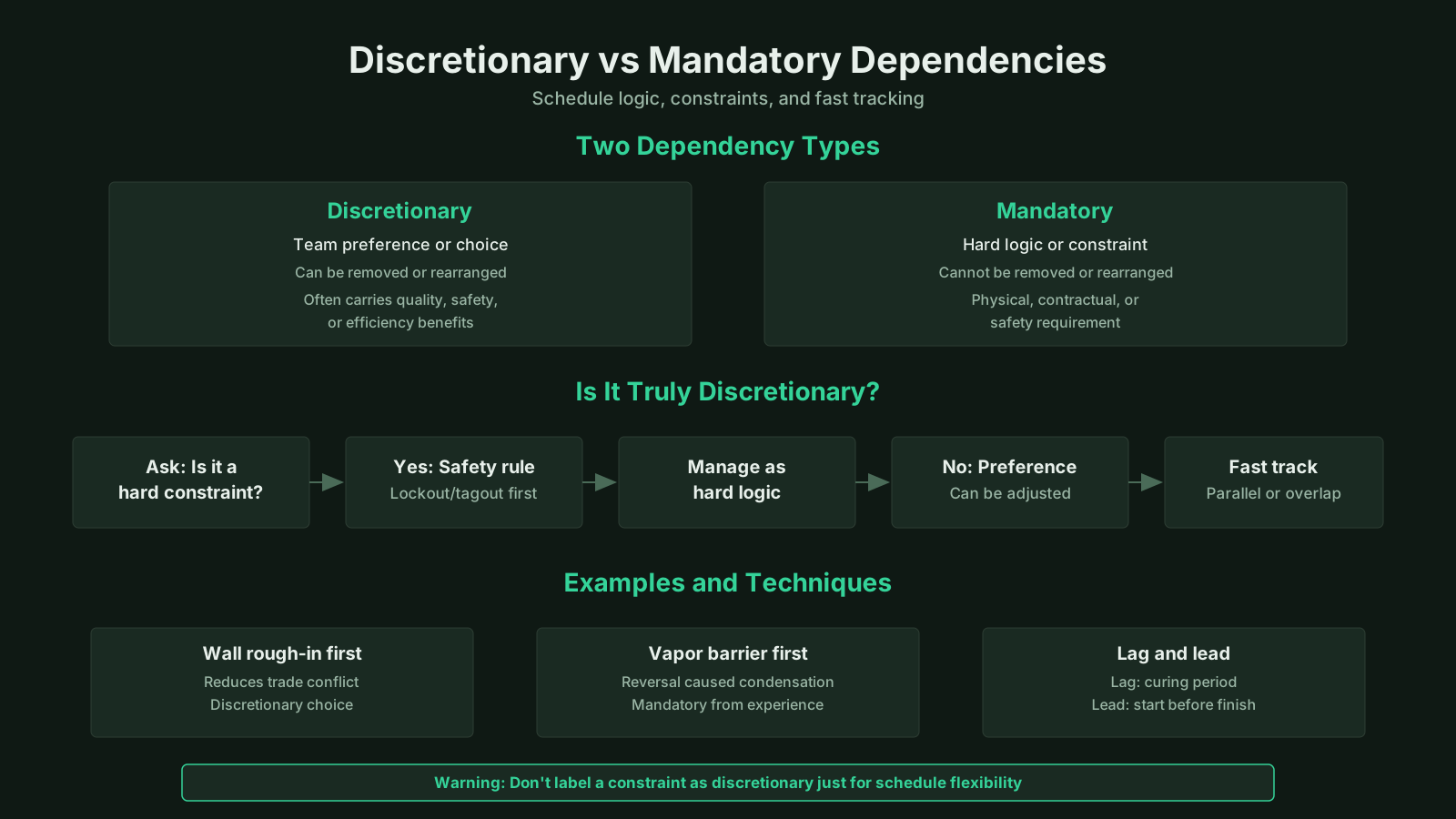
Discretionary Dependency: Key Topics Summary
| Key Concept | Summary |
|---|---|
| Definition | A discretionary dependency is a scheduling relationship between project activities that reflects a preferred sequence based on organizational best practices, team judgment, or historical performance rather than an inherent physical, legal, or contractual constraint. |
| Distinction from Mandatory Dependencies | Unlike mandatory dependencies, which are legally or physically required, discretionary dependencies remain flexible and can be resequenced, compressed, or removed when analysis shows an alternative order delivers better schedule performance or lower risk. |
| PMBOK Framework Guidance | The PMBOK framework describes discretionary dependencies as preferred logic established through domain expertise, proven practices, or unique project characteristics where a specific activity order is expected to improve outcomes. |
| Illustrative Example | A common example is painting walls before installing carpet; teams typically choose this sequence because touch-ups and minor spills are easier to manage without finished flooring in place. |
| Historical Origins | The concept emerged from critical path method scheduling and production sequencing in construction, engineering, and manufacturing, where preferred activity logic helped reduce rework and improve coordination before spreading to other industries. |
| Cross Industry Applications | Software teams often build foundational platform services before features that users interact with directly, while aviation maintenance teams complete inspections before ordering replacements; both apply the same principle that a deliberate sequence improves quality and reduces expensive downstream corrections. |
| Documented Rationale | A discretionary dependency is typically justified in the schedule documentation by a specific benefit, such as lower rework rates, better alignment with specialist availability, stronger safety margins, or a proven quality sequence from prior projects. |
| PMBOK Seventh Edition Perspective | The PMBOK Seventh Edition emphasizes principles and performance domains over process prescriptions, but preferred activity sequencing remains a critical input for schedule development, optimization, and delivery predictability in both predictive and hybrid environments. |
What Is a Discretionary Dependency?
The question of what is a discretionary dependency often comes up when teams are sequencing activities and realize that more than one valid order exists. According to the PMBOK framework, a discretionary dependency is established based on knowledge of best practices within a particular application area or some unusual aspect of the project where a specific sequence is desired. It does not come from a legal, physical, or technical requirement. Instead, it reflects a choice made by the project team because that choice is expected to reduce risk, improve quality, or make execution smoother.
In everyday terms, a mandatory dependency is like needing to pour a foundation before framing walls. A discretionary dependency is like deciding to paint the walls before installing carpet because the team learned that touch-ups are easier without finished floors. Either order could work, but the team prefers one because it reduces cleanup or rework. That preference is real and often valuable, but it is not the same as a physical constraint.
The label soft logic sometimes leads people to dismiss these dependencies as unimportant. That is a mistake. Soft logic can be just as strongly held as hard logic in practice, especially when it comes from lessons learned on previous projects. The key difference is that the team controls the preference. If a schedule becomes too long, the project manager can challenge discretionary dependencies and remove or rearrange them without violating a physical or contractual requirement.
Key Insights on Discretionary Dependencies
- Defined by best practices
- Discretionary dependencies are established from domain expertise and proven practices, typically when an unusual project characteristic makes a particular sequence preferable.
- Not a hard requirement
- These dependencies are not imposed by legal, physical, or technical constraints; instead, they reflect a deliberate team decision intended to reduce risk, improve quality, or simplify execution.
- Illustrated by paint before carpet
- A classic example is painting walls before installing carpet, where either order is viable but the preferred sequence minimizes cleanup and rework.
- Soft logic can be strong
- Even though they are called soft logic, these dependencies can be enforced just as strictly as mandatory ones, particularly when they originate from lessons learned on prior projects.
- Can be challenged when needed
- If the schedule becomes too long, the project manager can remove or resequence discretionary dependencies without breaching any physical or contractual constraint.
Origins and Cross-Industry Context of Discretionary Dependency
The origin of discretionary dependency is closely tied to the development of critical path method and scheduling techniques in construction, engineering, and manufacturing. Early schedulers recognized that not every sequence in a network diagram was dictated by physical necessity. Some sequences were simply the way experienced planners preferred to do the work. That distinction became important because it allowed schedulers to identify where the plan could be compressed without breaking fundamental constraints.
Construction planners have long used soft logic to sequence trades in a way that minimizes rework. For example, a general contractor might schedule drywall finishing before cabinet installation even though both could technically occur in a different order. The preference is based on avoiding damage and maintaining a cleaner work environment. Software development teams use a similar idea when they choose to build foundational components before user-facing features, even if the features could be delivered first.
Manufacturing and maintenance operations also rely on preferred sequencing. An aviation maintenance team may decide to complete certain inspections before replacing components because that order reduces the chance of rework or improves access. The underlying principle is the same across industries: some dependencies are chosen because experience says the sequence produces better results, not because the work cannot physically happen any other way.
Key Components and Characteristics
Understanding the key components of discretionary dependencies requires looking at both the formal elements of a schedule relationship and the reasoning behind it. In a schedule network diagram, every dependency has a predecessor activity and a successor activity. The relationship between them can be finish-to-start, start-to-start, finish-to-finish, or start-to-finish. A discretionary dependency can use any of these relationship types, but the logic is based on preference rather than an absolute constraint.
The rationale behind the dependency is what separates it from other sequencing decisions. A discretionary dependency usually has a documented reason such as reducing rework, aligning with a subject matter expert's availability, improving safety, or following a proven quality sequence. That rationale may be strong or weak, but it should be visible. When the reason is not documented, a future scheduler may mistake the soft logic for a mandatory constraint and lose a significant schedule improvement opportunity.
Another characteristic is reversibility. Mandatory dependencies generally cannot be reversed without breaking the laws of physics or violating a contract. Discretionary dependencies can be reversed, removed, or modified if the team accepts the consequences. The consequences are often minor, such as more cleanup, a slightly higher defect risk, or increased coordination effort. This reversibility is what makes soft logic valuable during schedule compression and what also makes it vulnerable to arbitrary changes if the original rationale is forgotten.
Common Categories of Preferred Logic
Preferred logic falls into several recognizable categories. Best-practice logic comes from industry norms or organizational standards, such as completing design reviews before procurement in an engineering environment. Risk-reduction logic sequences activities to retire uncertainty early. Quality-control logic places inspections or testing before a handoff to reduce the cost of rework. Stakeholder-preference logic reflects the desires of a client or sponsor, such as prioritizing a visible milestone early in the project even if internal logic suggests otherwise.
Each category behaves differently when challenged. A stakeholder preference may be negotiable if the stakeholder understands the schedule impact. A quality-control preference may be more resistant to removal because the team has strong evidence that the sequence prevents defects. Recognizing the category helps the project manager decide how aggressively to question the dependency during schedule reviews.
Core Takeaways on Discretionary Dependencies
- Preference-based sequencing logic
- Discretionary dependencies establish sequencing based on documented project preferences, such as reducing rework or accommodating expert availability, rather than on physical, contractual, or safety constraints.
- Documentation preserves scheduling flexibility
- Failing to record the rationale behind a discretionary dependency increases the risk that future schedulers will treat it as a mandatory constraint, thereby forfeiting opportunities to compress the schedule or reoptimize resource use.
- Reversibility creates value and risk
- Soft logic can be reversed or removed to support schedule compression and resource leveling, yet this same flexibility becomes a liability when the original reasoning is undocumented, inviting arbitrary changes that may undermine project outcomes.
- Industry norms guide best practices
- Established industry or organizational standards often define preferred discretionary logic, such as completing design reviews before procurement in engineering environments, helping teams align with proven sequencing patterns while preserving adaptability.
Discretionary Dependency in Project Management Frameworks
The placement of discretionary dependency in project management frameworks is most explicit in the PMBOK guide. Within the Schedule Management knowledge area, the Sequence Activities process produces the project schedule network diagram by identifying and documenting dependencies among activities. The PMBOK classifies dependencies as mandatory or discretionary and also as internal or external. This four-way classification helps project teams understand why each relationship exists and how much control they have over it.
In PMBOK 6th edition terms, discretionary dependencies are sometimes called preferred logic, and they are identified during the Planning process group. The project management plan, activity list, and activity attributes feed into the sequence activities work. The resulting network diagram and schedule then guide execution and monitoring. PMBOK 7th edition moves away from prescriptive processes toward principles and performance domains, but the concept of preferred sequencing remains relevant when developing and optimizing schedules in predictive and hybrid environments.
PRINCE2 does not use the term discretionary dependency as prominently as PMBOK, but the idea appears in product-based planning. A project manager using PRINCE2 creates a product breakdown structure and product flow diagram to show the order in which products should be developed. Some of those sequences are mandatory because one product cannot exist before another. Others are chosen because the project team believes the order reduces risk or improves control. Those chosen sequences serve the same purpose as discretionary dependencies in PMBOK.
In Agile environments, discretionary dependencies often appear as sequencing choices in a product backlog. A product owner may decide to deliver one user story before another because it reduces uncertainty, builds customer confidence, or aligns with a marketing campaign. The team is not forced into that order by a physical constraint. Instead, the order is a preference based on value, risk, and feedback. Kanban teams also create discretionary sequencing through work item selection and class of service decisions.
Hybrid frameworks use discretionary dependencies at the milestone and phase level while allowing detailed work to flow through iterative cycles. A hybrid team may have a preferred sequence for major releases or integration points even though the internal development order is flexible. Business Value-Oriented Project Management also treats discretionary dependencies as planning choices rather than fixed constraints. In BVOPM, relational effort points and a five-level scope scale treat scope change as user feedback, and a discretionary dependency that no longer serves value delivery can be removed without stigma. The methodology also warns that work breakdown structures can be inaccurate, so preferred sequences need regular validation.
Purpose and Importance in Schedule Management
The purpose of discretionary dependencies is to embed organizational learning and risk awareness into the project schedule without turning every preference into a hard constraint. They allow project managers to reflect proven sequencing practices in the plan while keeping the door open for alternatives. This dual nature is what gives soft logic its practical value. A schedule filled only with mandatory dependencies might be technically feasible but operationally risky. A schedule filled with too many discretionary dependencies might be unnecessarily rigid.
Discretionary dependencies also play a major role in schedule compression. When a project falls behind, the project manager can look for discretionary relationships that can be removed or changed to a less restrictive type. Changing a finish-to-start relationship to a start-to-start relationship, or removing a preferred wait between activities, can shorten the critical path without additional cost. This is often faster and cheaper than crashing, which adds resources and cost. Practitioners often observe that soft logic is the first place to look when trying to recover lost time.
The importance of these dependencies grows as projects become more complex. In large programs, many schedule constraints are institutional preferences disguised as hard dependencies. A skilled scheduler separates the real constraints from the preferred ones and presents that distinction to leadership. Doing so creates transparency and allows more informed trade-offs. Without that separation, a program can carry unnecessary schedule risk for years because nobody remembers why a particular sequence was originally chosen.
Core Insights on Soft Logic Value
- Learning embedded without rigidity
- Discretionary dependencies embed institutional knowledge and risk awareness directly into the schedule while preserving the flexibility to re-sequence work when project conditions shift.
- Mandatory-only schedules carry risk
- A schedule built solely on mandatory constraints can appear technically valid while leaving zero latitude for field teams to adapt when site conditions, resources, or priorities change.
- Key tool for schedule compression
- When a project slips, selectively relaxing or removing discretionary dependencies can compress the critical path without incurring added cost, making soft logic a primary lever for recovery.
- First place to recover time
- Experienced planners turn to soft logic first for schedule recovery because adjusting discretionary sequencing typically delivers near-term time savings at minimal expense.
- Separating hard from preferred logic
- A skilled scheduler separates true physical or contractual constraints from preferred sequencing and surfaces that distinction to leadership, preventing avoidable schedule risk from hardening into the baseline over time.
Practical Application in Real Project Work
The practical application of discretionary dependencies appears throughout the project lifecycle, but it is most visible during schedule development and schedule control. Planners and schedulers use project management software to create network diagrams and assign dependencies. They often mark discretionary dependencies with a note or custom field so that the rationale survives as the plan evolves. Project managers then review those dependencies during execution to see whether any preferred sequences need to change based on actual progress.
In a software project, a team might sequence database design before API development because the data model reduces rework when interfaces are built. That is a discretionary dependency if both could technically proceed in parallel. The team accepts the preferred sequence because it believes the quality gain is worth the schedule impact. Later, if the release date moves up, the same team may decide to overlap the two activities and accept a higher risk of rework.
Construction project managers use discretionary dependencies to coordinate subcontractors in a way that reduces conflicts. Electricians might prefer to rough in before plumbers because their work is easier to adjust after the fact. That preference is not mandatory, but it prevents a costly standoff between trades. When site conditions change, the sequence can be renegotiated as long as all parties understand the trade-offs.
Product managers and product owners apply discretionary sequencing in backlog refinement. They may choose to deliver a low-risk feature before a high-risk feature to build confidence with users and stakeholders. That order is not forced by a dependency, but it is a deliberate choice. The product owner can revisit it after each sprint review based on feedback. In this sense, Agile teams treat discretionary dependencies as hypotheses about value rather than permanent schedule logic.
Common Challenges, Pitfalls, and Misconceptions
A frequent set of common misconceptions about discretionary dependencies begins with the belief that soft logic means optional or unimportant. In many schedules, discretionary dependencies are treated as if they were mandatory simply because they have survived unchanged for months or years. The original reason may have been valid, but nobody documented it. Over time, the preference hardens into an assumed constraint and becomes invisible to schedule reviewers.
Another pitfall is using discretionary dependencies to hide resource conflicts or political preferences. A project manager might sequence two activities one after another because the same team would otherwise be overloaded. That is really a resource dependency dressed up as soft logic. If it is not identified correctly, the schedule may show idle time that does not reflect the true constraint. The result is a misleading critical path and a false sense of schedule certainty.
Teams also tend to overuse soft logic. Too many discretionary dependencies can freeze a schedule into a single rigid path and reduce the project's ability to respond to change. When every activity has a preferred predecessor, the network diagram becomes crowded with constraints that may not add value. Project managers should challenge discretionary dependencies in regular schedule reviews and ask whether each one still serves a documented purpose.
A more subtle challenge occurs when stakeholders interpret the removal of a discretionary dependency as a quality compromise. If a preferred testing sequence is removed to shorten the schedule, the team may feel that the project manager is sacrificing quality. Clear communication about the difference between hard and soft logic helps, but the project manager must also acknowledge that some preferred sequences are strongly tied to quality outcomes. Removing them may indeed increase risk, and that risk should be accepted consciously rather than hidden.
Core Insights on Discretionary Dependency Risks
- Soft logic mistaken as optional
- Discretionary dependencies are often dismissed as soft logic rather than recognized as scheduling decisions that can materially shift the critical path when sequencing choices interact.
- Unchanging preferences become assumed constraints
- Dependencies that persist across schedule updates gradually harden into de facto constraints, so teams continue to respect them even after the original rationale has disappeared and reviewers stop scrutinizing the logic.
- Hidden conflicts and rigid paths
- When discretionary links are inserted to disguise resource contention or political preferences, they introduce artificial float that distorts schedule health, and a dense network of such links can lock the project into a single brittle sequence with no room for adaptation.
- Challenging dependencies in reviews
- During schedule reviews, project managers should interrogate each discretionary dependency to verify that its documented purpose remains valid, while acknowledging that some deliberately chosen sequences do protect quality, safety, or stakeholder commitments.
Discretionary Dependency vs Mandatory Dependency and Related Concepts
The comparison of discretionary dependency vs mandatory dependency is central to understanding schedule logic. A mandatory dependency, sometimes called hard logic, arises from a physical or contractual limitation. One foundation must cure before a wall can be built on top of it. A contract may require regulatory approval before construction begins. These dependencies cannot be removed without breaking a physical law or violating an agreement. Discretionary dependencies can be changed because they are based on judgment and preference.
External and internal dependencies are another axis of classification. An external dependency involves work outside the project team's control, such as a vendor deliverable or a government permit. An internal dependency lies within the team's control. Discretionary dependencies are often internal, but they can also involve an external party if the project team chooses to wait on an external deliverable even though other work could proceed. The distinction matters because the project manager has less authority to change external dependencies.
Resource dependencies are frequently confused with discretionary dependencies. A resource dependency exists when the same person or equipment is needed for two activities, and the schedule must account for that limited availability. The sequence may look discretionary, but it is driven by a real capacity constraint. Project managers should label resource constraints separately so that the schedule can be optimized when resources change.
Lead and lag are related timing adjustments rather than dependencies themselves. A lead allows a successor to start before the predecessor finishes, while a lag inserts a delay between activities. Discretionary dependencies often include lag because a team prefers to wait a day after pouring concrete before starting adjacent work. That lag is based on judgment and can be reduced or eliminated under different conditions. Understanding this relationship helps schedulers see where compressed timelines can be found.
Evolution and Current Thinking
The current thinking on discretionary dependencies reflects a shift from treating them as fixed schedule details to treating them as assumptions that should be tested and revisited. Early critical path scheduling often recorded soft logic without much scrutiny. Modern scheduling practice encourages project managers to document the rationale for each discretionary dependency and to review the entire network for unnecessary soft logic before baseline approval. The goal is not to eliminate all preferences but to make them visible and defensible.
Debates continue about how much discretionary logic should remain in a projected schedule. Some schedulers argue that a critical path should be calculated with only mandatory dependencies so that the true minimum duration is visible. Others point out that a schedule without soft logic is unrealistic because it ignores operational risk and organizational learning. Both perspectives have merit. The most balanced approach is to maintain two views: one with mandatory logic only and one with the preferred sequence included. Comparing the two views shows how much schedule time is being purchased by each preference.
Agile and hybrid thinking has also influenced the evolution of this concept. Instead of locking in all preferred sequences during upfront planning, teams can defer sequencing decisions to the last responsible moment. This keeps discretionary dependencies flexible and allows new information to shape the order of work. The result is a schedule that is more resilient to change and less burdened by outdated assumptions. At the same time, some long-range preferences still need to be fixed for procurement, staffing, and contractual commitments.
The growing use of scheduling tools and analytics has made it easier to identify soft logic and run what-if scenarios. Project managers can toggle dependencies on and off, examine the schedule impact, and present options to sponsors. This capability reinforces the idea that discretionary dependencies are not permanent fixtures. They are planning instruments that should earn their place in the schedule through clear rationale and measurable benefit.
Key Takeaways on Soft Logic
- Soft logic as testable assumptions
- Soft logic is now treated as a set of testable assumptions to be validated and revisited as project conditions change, rather than as fixed sequencing details entered without critical review.
- Documentation and review of rationale
- A rigorous scheduling practice requires documenting the rationale behind each discretionary dependency and reviewing the entire logic network to remove unsupported soft logic before baseline approval.
- Debate on mandatory-only critical paths
- One perspective argues that critical paths should contain only mandatory dependencies to surface the true minimum duration, while another holds that a schedule without soft logic becomes unrealistic because it omits operational constraints, risk absorption, and team learning.
- Dual-view balanced schedule approach
- The balanced method maintains two schedule views in parallel: a mandatory-only logic view that reveals the theoretical minimum duration and a preferred-sequence view that reflects realistic execution, so both perspectives remain visible for decision making.
- Defer decisions to last responsible moment
- Delaying sequencing decisions to the last responsible moment keeps discretionary dependencies open to change and allows new information to shape the sequence of work before commitments harden.