The critical path in project management is defined as the sequence of dependent activities with the longest total duration through a project schedule network. Any delay to an activity on this sequence forces a corresponding delay to the project finish date, unless the schedule is compressed or the dependency logic is changed. The critical path method, abbreviated CPM, is the analytical technique used to identify this sequence by calculating early and late start and finish dates for every activity.
At its foundation, the critical path explained in project terms is the chain of work that directly controls how long the project takes. Other work might be important, urgent, or risky, but if it sits on a shorter parallel chain, it has some room to slip before the final deadline moves. That distinction separates schedule criticality from general task importance, and it is the reason the critical path occupies such a central place in schedule management.
Critical Path: Key Topics at a Glance
| Concept | Summary |
|---|---|
| Critical Path Definition | The critical path represents the longest chain of dependent activities in the project schedule, defining the shortest achievable completion date and identifying where any slip will directly extend the overall timeline. |
| CPM Calculation Method | Critical path analysis calculates early and late start and finish dates for every activity, then isolates the sequence with zero total float to reveal the work that directly drives project completion. |
| Criticality Versus Schedule Impact | A task may be strategically important, highly urgent, or carry significant risk, but if it belongs to a shorter parallel branch with available float, it does not govern the final deadline. |
| Historical Origins | DuPont and Remington Rand pioneered CPM for industrial scheduling, while the U.S. Navy developed PERT for the Polaris missile program, creating two complementary analytical approaches in the same era. |
| Core Components | Essential inputs include activity definitions, duration estimates, dependency logic, scheduling constraints, and forward and backward pass calculations that reveal total float and schedule flexibility. |
| Negative Float | When an imposed finish date precedes the calculated late finish, negative float emerges, indicating an overconstrained plan that requires schedule compression, constraint relief, or formal authorization. |
| BVOPM Perspective | BVOPM regards baselines as provisional and uses relational effort points, positioning critical path analysis as a coordination mechanism rather than a rigid control instrument. |
| Management Value | Critical path analysis gives project managers a defensible basis for prioritizing schedule drivers, evaluating the impact of proposed changes, and directing compression efforts where they will produce the greatest effect. |
What Is the Critical Path?
A critical path definition in common use refers to the longest path through the schedule network where total float is zero. In a properly constructed network, the sum of durations along the critical path equals the minimum project duration. The phrase may sound contradictory because the longest sequence produces the shortest possible overall timetable. That happens because parallel paths run at the same time. One path may take twenty days and another may take thirty days, so the project cannot finish before day thirty, even though the twenty-day path is complete earlier. The thirty-day path is therefore critical.
Imagine a corporate relocation where one team packs servers over five days while another team packs furniture over two days. The furniture team has three days of breathing room. The server packing path dictates when the move can happen. If server packing slips by a day, the move slips by a day. That simple logic is the foundation of every critical path calculation, whether the schedule contains five activities or five thousand.
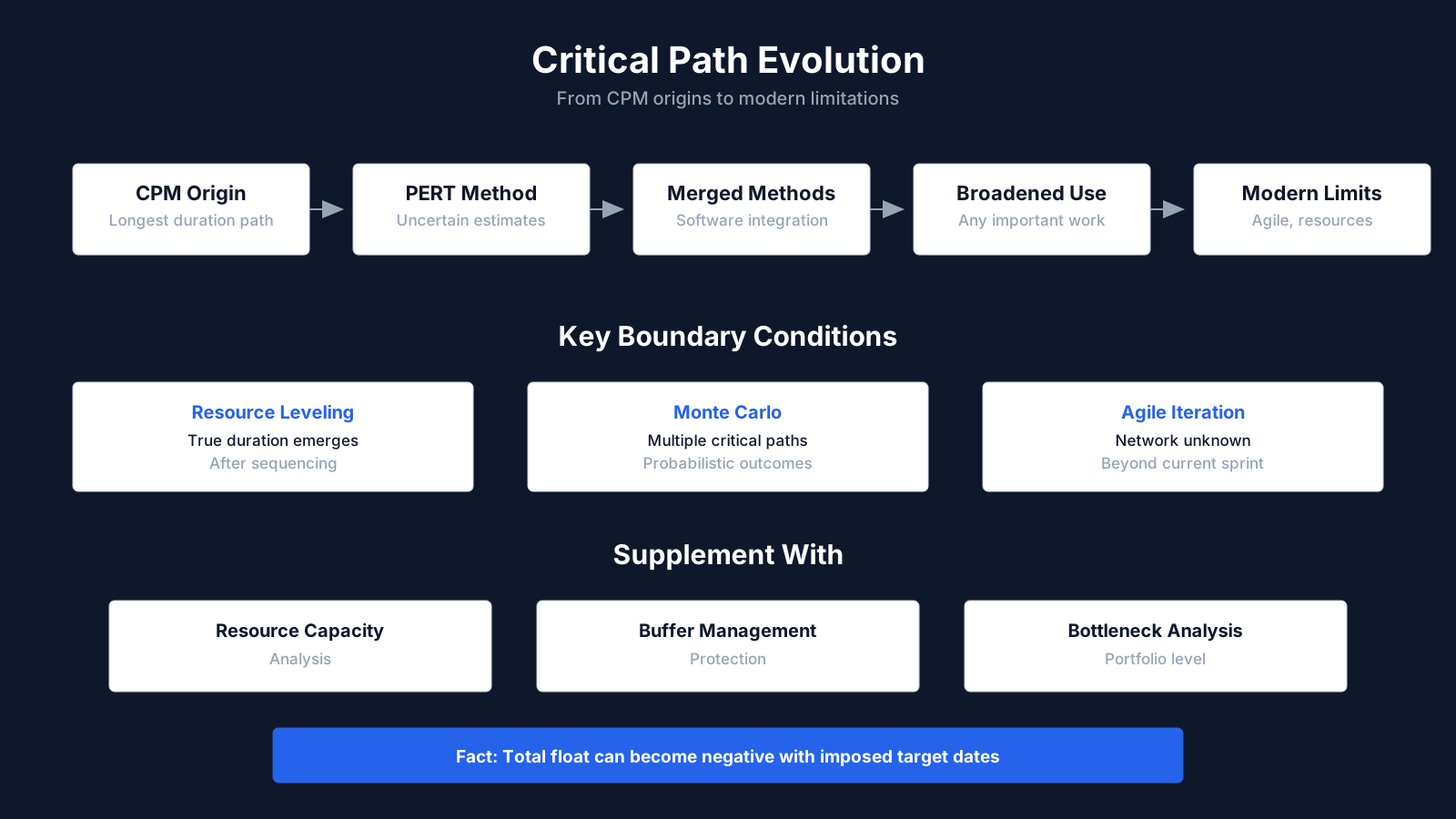
The concept emerged in the late 1950s within the broader development of network-based scheduling. DuPont and Remington Rand developed the critical path method for industrial maintenance and construction work, while the United States Navy developed the Program Evaluation and Review Technique around the same time for the Polaris missile program. CPM originally used deterministic activity durations, whereas PERT incorporated probabilistic estimates. Modern project management tools blend the two approaches, but the core idea of a controlling activity chain remains unchanged.
Core Insights on the Critical Path
- Longest path with zero float
- The critical path represents the longest sequence of scheduled activities with zero total float, and it sets the earliest possible completion date for the project.
- Parallel paths define duration
- Since several task chains run concurrently, the longest parallel path controls the overall finish date, regardless of when shorter paths complete.
- Origin in the late 1950s
- DuPont and Remington Rand originated the critical path method for industrial scheduling, while the U.S. Navy developed PERT specifically for the Polaris missile program.
- Deterministic versus probabilistic estimates
- CPM originally relied on fixed activity durations and PERT on probabilistic estimates; modern scheduling tools combine both approaches while preserving the concept of a controlling chain.
Key Components of Critical Path Analysis
The key components of critical path analysis include activities, duration estimates, dependency relationships, schedule constraints, and the mathematical forward and backward passes that reveal float. Each component relies on the schedule network diagram, which shows the logical order of work. Without a defensible activity list and realistic dependencies, critical path calculations produce a misleading picture. The technique is not independent from the quality of the schedule model.
Dependency relationships typically use finish-to-start logic most often, but start-to-start and finish-to-finish relationships with leads and lags can also appear in precedence diagramming. These modifiers influence the forward and backward pass results. A lag inserted into a dependency can create a longer path even if the activity durations themselves are short.
Forward and Backward Pass
The forward pass calculates the earliest possible start and finish dates by moving from the project start to the end. Each activity receives an early start based on the latest early finish of its predecessors plus any lag. The backward pass then calculates the latest allowable start and finish dates by moving from the project end backward. Total float is the difference between late start and early start. Activities with zero total float form the critical path. If a finish date constraint forces an earlier end, some paths may show negative float, which signals an unrealistic plan that requires schedule compression or approval of a later date.
Total Float and Free Float
Total float is the amount of time an activity can be delayed without delaying the project finish date. Free float is the amount of time an activity can be delayed without delaying any successor activity. These two measures are often confused. Total float belongs to the path, not to an individual activity in isolation. If one activity on a path consumes five days of shared float, the remaining activities on that same path lose five days of their own float. Free float is narrower and relates only to the immediate successor. Understanding this distinction prevents a project team from treating float as independent spare time that can be used in many places at once.
Near-Critical Paths
A near-critical path is a sequence with very little total float, sometimes only a day or two. It is not shown as critical in many reports because its float is positive, but small variances can quickly convert it into a second critical path. Experienced project managers monitor near-critical paths with the same discipline as the critical path. In complex schedules, there may be several near-critical paths, and ignoring them is a common reason a project slips even when the original critical path stays on schedule.
Critical Path in Project Management Frameworks
In formal project management standards, critical path in project management is not an isolated calculation. It is a schedule network analysis technique embedded in broader planning and control processes. The PMBOK Guide places the critical path method within the Develop Schedule process in the Schedule Management knowledge area. PRINCE2 treats activity scheduling as part of the Plans theme. Agile and hybrid methods use the concept selectively because iterative delivery changes how schedules are controlled.
PMBOK and Predictive Delivery
The critical path PMBOK usage appears in schedule development after activities have been defined, sequenced, and assigned durations. The PMBOK Guide describes the critical path method as a technique for estimating the minimum project duration and determining schedule flexibility. It is most common in predictive life cycles where scope is largely stable and deliverables are defined early. Schedule network analysis, of which CPM is one approach, supports the creation of the schedule baseline. The baseline then becomes the reference point for schedule variance measurement during monitoring and controlling.
PRINCE2 and Stage-Based Planning
PRINCE2 does not mandate a specific scheduling algorithm, but its Plans theme requires product-based planning and then activity sequencing. Once activities and dependencies are identified, critical path analysis fits naturally into stage and project plans. PRINCE2 emphasizes management stages and tolerance, so the critical path is often calculated at stage level rather than across the entire project in a single pass. A stage plan may identify a critical path that controls the delivery of a major work package, while the project plan tracks higher-level milestones.
Agile and Hybrid Environments
In Agile delivery, the critical path concept has a reduced role because requirements emerge and priorities change frequently. Teams pull work by value and may not build a detailed activity network for an entire release. However, dependency maps in scaled Agile frameworks can still expose a de facto critical path. When several teams must integrate their output for a release, the longest dependency chain controls the earliest release date. In hybrid projects, predictive phases such as procurement, infrastructure setup, or regulatory review may be tracked with a critical path while iterative development proceeds in parallel. BVOPM similarly treats fixed schedule baselines as provisional and uses relational effort points rather than single-point duration estimates, meaning critical path analysis becomes a coordination aid rather than a rigid control mechanism.
Critical Path Across Management Frameworks
- Embedded in planning processes
- Critical path analysis functions as a schedule network analysis technique embedded in formal planning and control processes rather than as a standalone calculation.
- PMBOK Develop Schedule placement
- Within the PMBOK Guide, the critical path method sits in the Develop Schedule process of Schedule Management, where it determines the shortest viable project duration and quantifies scheduling flexibility.
- Predictive lifecycle suitability
- Critical path analysis is most effective in predictive life cycles, where scope remains relatively stable and deliverables are specified early enough to support detailed sequencing.
- Selective agile and hybrid use
- Agile and hybrid approaches use critical path concepts selectively, since iterative delivery reshapes schedule control and reduces reliance on fixed activity sequencing.
- BVOPM provisional baseline approach
- BVOPM treats schedule baselines as provisional and replaces single point duration estimates with relational effort points, positioning critical path analysis as a coordination aid rather than an inflexible control tool.
Purpose and Importance of the Critical Path
The purpose of critical path analysis is not simply to draw a red line through a Gantt chart. It gives project managers a defensible way to focus attention on schedule drivers, assess the impact of changes, and decide where schedule compression is worth the cost and risk. Knowing the critical path also helps executives understand why adding resources to non-critical work will not pull in the project finish date.
This filtering function matters in large projects where hundreds or thousands of activities compete for attention. The critical path reduces that complexity to the specific chain that actually sets the completion date. It also supports what-if scenario analysis. A project manager can modify a duration or dependency and immediately see whether the critical path shifts. This capability is valuable for negotiating change requests, assessing vendor delays, or evaluating whether a milestone constraint is achievable.
When stakeholders ask why a project cannot finish earlier, the critical path provides an evidence-based answer. Instead of relying on general effort or optimism, the schedule shows the sequence of work that must complete first. That transparency is especially important when a sponsor pushes for aggressive acceleration. The project manager can point to the controlling chain and explain what would need to be overlapped or resourced differently to change the outcome.
Criticality is not the same as risk. A task can be on the critical path and relatively low risk, while a non-critical task with significant float may carry serious technical risk. Some practitioners incorrectly assume all risky work must be critical. In reality, the critical path is a schedule property, not a risk ranking. However, when critical activities also contain high uncertainty, the schedule exposure is magnified because there is no float to absorb the variance.
Critical Path vs Critical Chain
A useful contrast is the critical path vs critical chain distinction. The critical chain method, rooted in the Theory of Constraints, modifies the critical path approach by accounting for resource constraints and by inserting buffers instead of relying on distributed activity float. Traditional CPM assumes unlimited resources within the schedule logic and hides contingency inside individual activity estimates. Critical chain removes that embedded padding, schedules the constraint chain, and places a project buffer at the end plus feeding buffers where non-critical chains connect.
The practical effect is a different management focus. Critical path management concentrates on dates and float. Critical chain management concentrates on buffer consumption and resource availability. The critical chain may not match the longest path because a resource bottleneck can force activities out of sequence. That difference explains why many teams adopt elements of both approaches. They use the critical path to understand logical dependencies and the critical chain mindset to protect the project against variability.
Some people treat critical chain as merely an upgraded critical path. That oversimplifies the shift. Critical chain challenges the assumption that local task completion dates are the right control points. It argues that protecting individual activities leads to padded estimates, procrastination, and late integration. By contrast, CPM can still operate with local dates and float. Each approach has strengths, and the choice depends on project uncertainty, resource flexibility, and organizational culture.
Key Insights on Scheduling Methods
- Resource constraints and buffers
- Critical chain extends the Theory of Constraints by explicitly modeling resource capacity constraints and consolidating protection into project and feeding buffers, rather than dispersing float across individual activities.
- Distinct management focus
- Critical path management prioritizes calendar-based milestones and total float, while critical chain directs attention to the sequence of resource-constrained activities, which often diverges from the longest duration path when bottlenecks are present.
- Protecting the whole project
- Because critical chain rejects protecting individual task dates on the grounds that embedded padding encourages procrastination and late integration, the appropriate scheduling method depends on uncertainty, resource flexibility, and organizational culture.
Common Challenges and Misconceptions
Several common critical path misconceptions create project control problems. One persistent error is treating any activity with zero float as the only schedule concern, while ignoring near-critical paths. Another is assuming that float belongs to a specific task and can be consumed without affecting other tasks. Because total float is shared along a path, multiple activities cannot each use the same five days of float. A third misconception is that the critical path will not change during execution. In fact, once a non-critical activity consumes its float or a duration estimate changes, the critical path can shift to a different sequence of work.
Estimation and Dependency Errors
The accuracy of a critical path calculation depends entirely on the quality of the underlying data. Optimistic duration estimates produce an artificially short path. Missing dependencies create false float. External dependencies, procurement lead times, and approval gates are often omitted from initial schedules, which hides true constraints. When those omitted items are added later, the critical path can lengthen and shift. The method is computationally reliable, but it cannot correct a weak activity list or unrealistic logic.
Float Misuse and Near-Critical Blindness
Float misuse appears when team members see slack as personal flexibility rather than shared schedule risk. An engineer might delay a non-critical task because the software shows three days of float, only to consume the buffer a later trade needs for the same path. Near-critical blindness is equally damaging. A path with two days of float may be perceived as safe, but a weather delay, supplier slip, or rework can absorb the buffer quickly. Project managers should review not only the critical path but also paths with small positive float and negative float.
Resource Constraints and Multiple Critical Paths
Traditional critical path analysis does not resolve resource conflicts. Two activities may be on separate paths with float, yet require the same specialized engineer. Once the resource is loaded, that engineer's availability may create a new constraint that is longer than the logical path. Resource leveling can shift activities and expose a resource critical path. Multiple critical paths are also possible when two or more sequences have zero float. Multiple critical paths reduce schedule resilience because a delay on any one of them immediately affects the finish date.
Practical Application in Real Project Work
In practice, critical path in real projects is calculated and tracked using scheduling software rather than by hand. Tools such as Microsoft Project, Primavera P6, and various cloud-based work management platforms compute forward and backward passes automatically once activities, durations, and dependencies are entered. The project manager still has to validate the logic and maintain the schedule as reality changes. A common practice is to review the critical path during weekly schedule updates, looking for newly critical activities, changing float values, and activities that are slipping against the baseline.
Consider a data migration project with server provisioning, data cleansing, migration mapping, test runs, and cutover. If data cleansing sits on the critical path and falls behind, the project manager might crash the schedule by adding data engineers or fast-track by starting test runs on partially cleansed data. Both options carry trade-offs. Crashing increases cost. Fast-tracking increases rework risk. The critical path tells the project manager where the schedule problem is, but not which compression technique is best.
Schedule Compression and Change Management
Schedule compression techniques are directly linked to critical path analysis. Crashing only helps if the targeted activity is on the critical path. Adding resources to an activity with ample float does not shorten the project. Fast-tracking requires changing dependency logic, typically by overlapping activities that were originally sequential. That can be done only where the nature of the work allows. The critical path after compression may shift, which means the project manager must recalculate the network rather than assume the same tasks remain critical.
Earned Value and Progress Reporting
Critical path analysis and earned value management answer different questions. Earned value measures cost and schedule performance against the baseline. A project can show a positive schedule variance because a large volume of non-critical work finished early, while the critical path is actually late. For this reason, schedule performance should be interpreted with the critical path in mind. The two techniques are complementary. Earned value gives a financial and progress snapshot; the critical path explains whether the finish date is truly at risk.
Key Takeaways on Applying Critical Path
- Software automates, managers validate
- Tools such as Microsoft Project and Primavera P6 calculate forward and backward passes automatically, yet the project manager remains accountable for verifying the underlying schedule logic and keeping it current as project conditions change.
- Weekly reviews reveal schedule shifts
- Carrying out critical path reviews during weekly updates surfaces newly critical activities, shifting float values, and deviations from baseline targets before they escalate into broader schedule problems.
- Critical path points, not prescribes
- The critical path reveals where schedule risk is concentrated, but determining the most suitable compression method, whether crashing or fast-tracking, remains a deliberate analytical judgment for the project manager.
Evolution and Current Thinking
The critical path method evolution began with manual calculations and mainframe computing in the 1950s and 1960s. Over time, scheduling software made CPM accessible on large capital projects, construction programs, aerospace initiatives, and IT implementations. The underlying algorithm has not changed fundamentally, but the way practitioners apply it has evolved. Modern schedule analytics often combine critical path analysis with Monte Carlo simulation to model duration uncertainty across thousands of scenarios. This probabilistic view moves beyond a single deterministic critical path and identifies which activities are most likely to appear on the critical path.
Two useful concepts in contemporary schedule risk analysis are critical path drag and criticality index. Critical path drag measures how much a single activity contributes to the overall project duration. Criticality index measures how often an activity appears on the critical path across simulated schedule outcomes. These metrics help project teams prioritize risk response and compression efforts without assuming that one fixed sequence remains critical forever. The indices are not universally used, but they represent a more mature treatment of schedule uncertainty than the original CPM.
Current debate also centers on whether the critical path remains relevant in high-uncertainty, innovation-driven work. Agile practitioners often argue that fixed activity networks are too brittle and that value-based prioritization replaces dependency logic. Predictive practitioners counter that large physical projects and regulated programs cannot avoid the reality of physical and contractual dependencies. Many hybrid teams now use the critical path only for the stable parts of a project, such as procurement, construction, infrastructure, and compliance, while allowing iterative delivery to flow around it. That selective use reflects a broader shift from treating the critical path as the entire control system to treating it as one useful lens on schedule performance.