Design reviews are structured evaluations of a design deliverable within a project, used to verify that a proposed solution aligns with requirements, technical standards, and business objectives before significant resources are committed to building or implementing it. The design deliverable can range from a software architecture description and a civil engineering drawing to a service process map or a product specification. In project management, the term carries a control-oriented meaning rather than a purely creative connotation. A design review examines whether the design is fit for its intended purpose, feasible, and complete enough to support the next stage of work.
Design Reviews: Summary of Key Topics
| Key Concept | Summary |
|---|---|
| Design Reviews | A design review is a structured evaluation at a defined project phase that verifies a design deliverable against approved requirements, technical standards, and business objectives before significant resources are committed. |
| Formality Levels | Formality levels range from chaired review sessions with appointed reviewers and formal minutes to semi-formal technical walkthroughs facilitated by subject matter experts. |
| Purpose | The primary purpose is to identify defects, omissions, and requirement misalignments while correction costs remain low and before downstream dependencies compound. |
| Benefits | Detecting design flaws before procurement or implementation prevents costly change orders, schedule slippage, and unnecessary rework later in the project lifecycle. |
| Origins | The practice originated in mechanical and civil engineering as a safety and integration check, then expanded into software architecture, hardware engineering, and code reviews. |
| Common Principle | The common principle is independent examination of a design artifact against agreed project criteria before irreversible commitments or major capital expenditures are authorized. |
| Key Components | Core components include a complete design package, an approved requirements baseline, named reviewers with defined responsibilities, explicit entry and exit criteria, and a documented findings log with resolution tracking. |
What Is a Design Review?
In project management, a design review definition centers on a structured checkpoint at which a design package is examined against requirements, standards, and constraints. The review is documented, time-bound, and intended to produce a decision or a set of required actions. It can be formal, with an appointed chairperson and formally invited reviewers, or semi-formal, such as a technical walkthrough with subject matter experts. The design itself may be anything from a process flow diagram to a three-dimensional model or a software interface specification.
Think of a hospital building plan being checked by structural, mechanical, and clinical specialists before excavation begins. They read the drawings, compare them to safety codes, calculate equipment clearances, and raise objections about corridor widths or airflow. That session, if structured with a recorded outcome, is a design review in practice. It does not build anything, but it prevents the project from building the wrong thing or discovering fatal flaws after concrete is poured.
Design Review Definition and Core Meaning
The core meaning of a design review is evaluation rather than creation. It answers whether the design is feasible, complete enough for the next phase, and consistent with the approved requirements baseline. Some organizations use the term design appraisal or technical review, but the underlying discipline remains the same. The outcome is usually one of three states: accepted, accepted with conditions, or rejected with rework required.
Key Insights on Design Reviews
- Structured checkpoint against requirements
- A design review is a documented, time-bound checkpoint that evaluates the design package against requirements, standards, and constraints, and ends with a clear decision or a defined set of required actions.
- Formal or semi-formal formats
- Reviews range from formal sessions led by an appointed chairperson and attended by formally invited reviewers to semi-formal technical walkthroughs facilitated by subject matter experts.
- Applies to varied design types
- The design under review may take diverse forms, including process flow diagrams, three-dimensional models, and software interface specifications, allowing the review process to adapt to a wide range of engineering disciplines.
- Prevents costly downstream failures
- Although the review itself builds nothing, it prevents the project from constructing the wrong solution and identifies fatal flaws before construction starts, such as when specialists verify a hospital plan before excavation begins.
- Consistent discipline across names
- Organizations may call this practice a design appraisal or a technical review, but the underlying discipline remains constant: verifying feasibility, completeness, and alignment with the requirements baseline.
Purpose and Importance of Design Reviews
The purpose of design reviews in project management is to identify defects, omissions, and misalignments while the cost of correction is still relatively low. A design flaw caught before procurement or coding avoids downstream change orders, schedule delays, and expensive rework. Design reviews also serve as a formal mechanism to confirm that stakeholder needs and technical standards have been translated correctly into the design.
In practice, this matters because many projects fail from integration problems rather than from the failure of individual components. A design review forces specialists from different disciplines to look at the same artifact together. The structural engineer might notice a pipe routing conflict that the mechanical engineer would not see until installation. That cross-functional examination is often where the most serious issues surface.
Design reviews also provide an early risk reduction function. When a design passes through independent eyes, assumptions that were never written down become visible. The review can expose contradictions between different parts of the design, gaps in regulatory compliance, or unrealistic performance expectations. This is why design reviews are considered a preventive quality activity rather than an appraisal activity that happens only after defects appear.
Origins and Cross-Industry Context
The origin of design reviews lies in engineering disciplines where complex systems had to be checked for safety and integration before they could be fabricated or deployed. Aerospace, defense, nuclear, and civil engineering established formal review gates such as preliminary design reviews and critical design reviews. These reviews became part of the systems engineering lifecycle and were later adopted by software engineering, manufacturing, and product development.
Construction projects have long used design reviews to examine drawings for code compliance, constructability, and coordination among architectural, structural, and mechanical systems. In software engineering, design reviews came into common use as a way to evaluate software architecture before coding began, and later evolved into code reviews and design walkthroughs. The underlying idea is the same across industries: a design artifact is examined by people who did not create it, against criteria that matter to the project, before irreversible commitments are made.
Key Insights on Design Review Origins
- Engineering roots of reviews
- Design reviews trace their origins to high-stakes engineering fields like aerospace, defense, nuclear, and civil engineering, where the cost of failure demanded rigorous safety and system integration checks long before any component reached fabrication or deployment.
- Formal review gates established
- The aerospace and defense sectors institutionalized formal review gates, most notably preliminary and critical design reviews, embedding these checkpoints as non-negotiable milestones within the systems engineering lifecycle.
- Cross-industry adoption pattern
- From engineering, the practice migrated into software development, manufacturing, product design, and construction, where each sector recalibrated the review process to align with its specific risk profile, deliverable types, and decision-making cadence.
- Construction and software variants
- In construction, reviews scrutinize drawings for code compliance, constructability, and interdisciplinary coordination across architectural, structural, and mechanical systems; in software, the practice evolved from early architecture assessments into iterative code reviews and collaborative design walkthroughs.
- Shared underlying principle
- Regardless of industry, the underlying principle remains constant: independent reviewers examine design artifacts against project-critical criteria before the team commits to irreversible decisions, ensuring that blind spots are surfaced while correction costs are still minimal.
Key Components of Design Reviews
The key components of design reviews include the design package, the requirements baseline, named reviewers, clear entry and exit criteria, and a documented record of findings. The design package is the actual artifact under review, such as a drawing set, model, specification, or architecture description. The requirements baseline is the reference point against which the design is judged. Reviewers are selected for their technical competence and their ability to represent affected disciplines or stakeholder groups.
Entry criteria define what must be complete before the review can begin. Exit criteria define what qualifies as a satisfactory outcome. Without both, design reviews drift into unstructured discussion and lose their decision-making authority. Findings are typically logged with severity, description, location, and a responsible owner. Actions may be required before approval, or they may be deferred to a later phase with explicit risk acceptance.
Review Inputs, Participants, and Decision Outcomes
Inputs also include applicable regulations, interface requirements, assumptions, and lessons learned from previous projects. Participants commonly include a facilitator, the design author, independent reviewers, a project manager, and sometimes a representative from operations or maintenance. The decision outcome is recorded in a review report, which then becomes a formal project artifact. In environments with strict configuration control, the design package is updated before the review is formally closed.
The design package itself must be sufficiently mature. Reviewing a concept sketch as if it were a final drawing leads to wasted effort and false confidence. At the same time, waiting until the design is fully complete reduces the value of the review because the cost of change is much higher. A well-defined set of entry criteria resolves this tension by specifying the expected level of detail for each type of review.
Types of Design Reviews
Several types of design reviews are recognized in project management, ranging from early conceptual evaluations to final pre-production checks. A preliminary design review evaluates the feasibility and basic architecture of the solution before detailed design begins. A critical design review examines the detailed design for completeness and readiness to proceed to implementation, fabrication, or coding. These terms originated in systems engineering and are common in aerospace, defense, and large infrastructure programs.
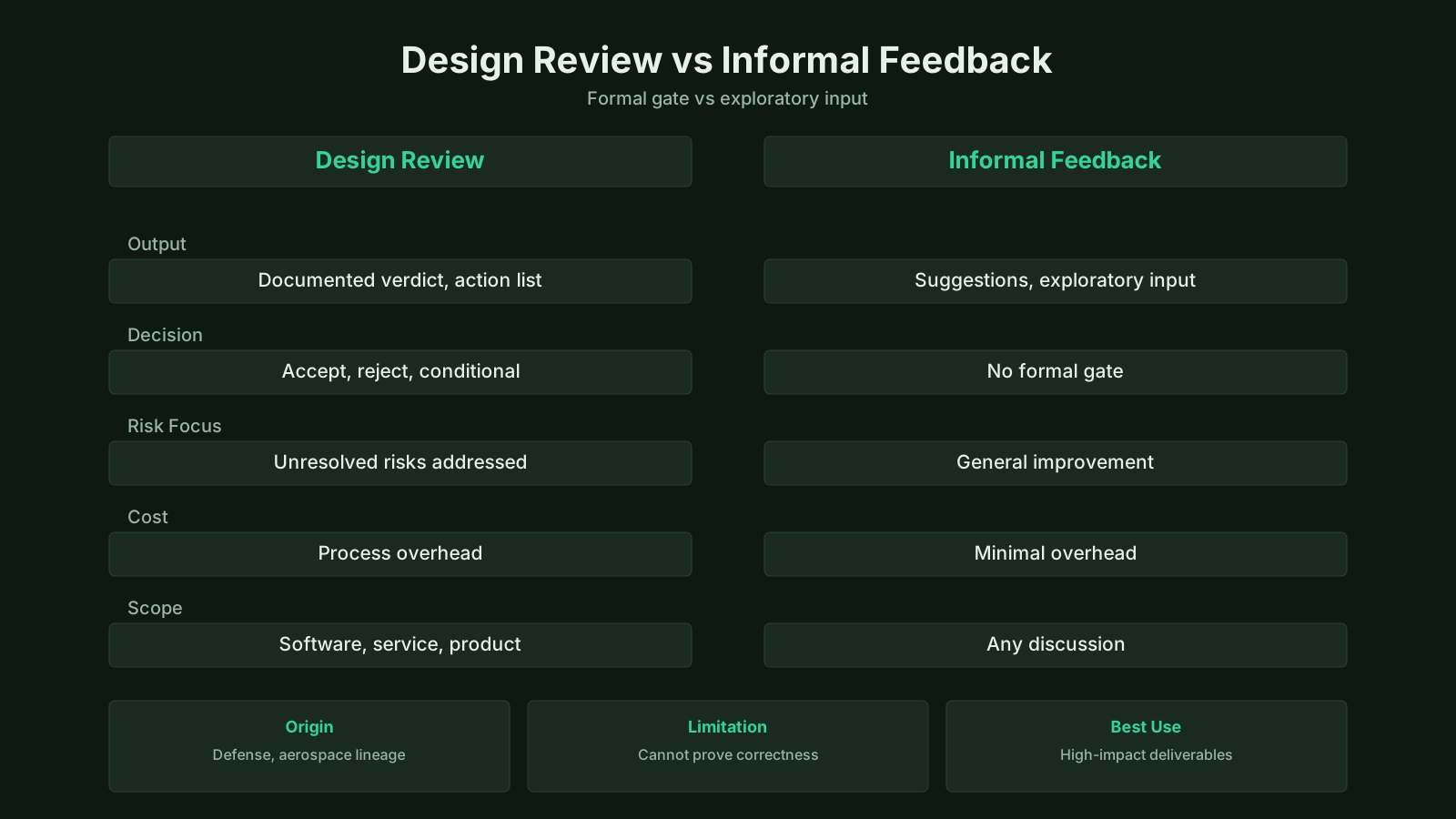
Organizations also use informal design walkthroughs, peer design reviews, and stakeholder-facing design reviews. The informal walkthrough is less structured and is used early in the design process to test ideas. The peer review uses technical colleagues to examine specific calculations or components. A stakeholder-facing review focuses on whether the design meets operational needs, usability expectations, and business requirements, rather than deep technical detail.
Formal and Informal Design Reviews
The difference between formal and informal design reviews is not about importance; it is about rigor and documentation. Formal reviews have a predetermined agenda, a qualified chairperson, preparation time for reviewers, and a formal disposition of findings. Informal reviews may be a meeting or a shared document comment cycle. In regulated industries, formal design reviews are often mandatory before moving from one lifecycle phase to the next.
Key Insights on Review Types
- Preliminary and critical design reviews
- A preliminary design review establishes technical feasibility and validates the top-level architecture before detailed engineering begins, while a critical design review verifies that the design is fully specified, meets all requirements, and is ready to transition into production or implementation.
- Informal reviews serve varied purposes
- Informal walkthroughs help teams pressure-test early concepts in a low-stakes setting, peer reviews focus on verifying technical calculations or isolated components, and stakeholder-facing reviews confirm that a design satisfies operational, usability, and business needs before formal approval.
- Formal reviews follow strict protocols
- Formal design reviews follow a structured protocol that includes a pre-approved agenda, an independent chairperson, adequate reviewer preparation, and documented resolution of all findings; in regulated industries they are typically a mandatory gate before a project may advance to the next lifecycle phase.
Design Reviews in PMBOK and Predictive Frameworks
Within the PMBOK framework, design reviews in PMBOK are best understood as a technique within quality management and controlling processes rather than as a standalone knowledge area. They are used to evaluate whether a deliverable's design meets quality standards and requirements, and their outputs frequently feed integrated change control. In predictive project lifecycles, design reviews are often aligned with phase gates, such as moving from detailed design to construction or from solution design to development.
The PMBOK perspective treats design reviews as part of the broader review and inspection toolbox. They are distinct from status meetings because they focus on the technical content of a design artifact. A project manager may convene a design review when a major design deliverable is submitted for approval, when a design change is proposed, or when an external dependency affects the design. The results can lead to change requests, preventive actions, defect repairs, or updates to project documents.
Design Reviews in the Quality Management Processes
In the PMBOK quality management processes, design reviews support both quality planning and quality management. During planning, the project team defines which design artifacts will be reviewed, what criteria will apply, and who must participate. During execution, the design review itself is conducted, findings are documented, and decisions are tracked. Because design reviews prevent defects rather than rely on inspection after the fact, they align with the quality management principle that prevention is generally less expensive than correction.
Design Reviews in PRINCE2
PRINCE2 does not mandate a separate design review process, but its Quality theme provides a structured quality review technique that is often used to perform design reviews. In PRINCE2, a design review would typically be applied to a product that has been specified in a product description. The product description defines quality criteria, quality methods, and the required approval authority. The quality review technique uses defined roles, including a chair, a presenter, a reviewer, and an administrator.
This structured approach is well suited to design reviews because it separates the product under review from the person who created it. The presenter may be the designer, but the chairperson is responsible for ensuring the review stays on track and that decisions are recorded. Reviewers raise questions and confirm whether the design meets the quality criteria. The administrator manages documentation and follow-up actions. PRINCE2 treats this as a product-focused review rather than a general progress meeting.
Quality Review Technique and Design Reviews
Under PRINCE2, the quality review technique can be used during stage boundaries and during product delivery. Design reviews in this context are often tied to the stage boundary control, where the project board or its delegated authority reviews completed products before the next stage is authorized. This creates a clear link between design quality and stage-level governance.
Design Review Governance Insights
- Quality review technique for designs
- Because PRINCE2 does not prescribe a separate design review process, the Quality theme offers a structured quality review technique as the standard approach for assessing a product against its product description.
- Defined roles separate product from creator
- By assigning a chair, presenter, reviewers, and administrator, the review creates an objective setting where the design is judged on its own merits while the chair keeps the discussion on track and records every decision.
- Stage boundary control links design to governance
- Design reviews typically occur at stage boundaries, where the project board or a delegated authority verifies that completed products meet quality criteria before authorizing the next stage.
Design Reviews in Agile and Hybrid Environments
In Agile environments, design reviews in Agile are typically continuous, lightweight, and embedded in the team's regular cadence rather than staged as a single large gate. A Scrum team may discuss design during sprint planning, backlog refinement, or a dedicated design spike. Extreme Programming uses practices such as pair programming and collective code ownership, which embed design review into the creation process itself. The emphasis shifts from approving a design document to inspecting the actual working increment and adapting the design as understanding improves.
Agile teams still need some kind of design review when an architectural decision affects multiple teams or cannot be easily reversed. In those cases, a short design session or an architecture review may be called, but the output is typically decisions and experiments rather than a formal approved baseline. The review is often time-boxed and attended by people with direct technical involvement, rather than by a large steering committee.
Design Reviews in Iterative Delivery
Hybrid projects combine predictive governance with iterative delivery. A hybrid design review might occur at the start of a project to approve a high-level architecture, and then be repeated in smaller forms at the start of each release or iteration. This approach allows teams to manage technical debt and architectural risk without recreating the burdensome upfront documentation cycles that Agile methods were intended to avoid.
The BVOP Perspective on Design Reviews
The BVOP perspective on design reviews treats them as value assurance activities rather than purely technical gatekeeping events. Business Value-Oriented Project Management links design review findings to product risk management, where risks are assessed using quantified loss size units and filtered dynamically based on their potential impact on business value. A design review in this context does not only ask whether the design works; it also asks whether the design introduces unnecessary complexity, overwork, or perfectionism that consumes capacity without adding value.
BVOPM also connects defect analysis to predefined root-cause categories. When a design review uncovers a defect or a weakness, the analysis follows those categories rather than relying on unstructured opinion. This supports consistency across projects and helps the organization identify whether design defects tend to arise from ambiguous requirements, integration gaps, or resource constraints. The emphasis on waste reduction means that design reviews should not become opportunities to reject acceptable work or to gold-plate the design.
Key Insights on Value-Driven Reviews
- Reviews as value assurance
- BVOP treats design reviews as value assurance activities rather than technical gatekeeping, and connects each finding to product risk management using quantified loss size units, which exposes the business impact of defects.
- Structured root-cause analysis
- Defect analysis applies predefined root-cause categories such as ambiguous requirements, integration gaps, or resource constraints, which ensures consistent classification across projects and replaces unstructured opinion with evidence-based diagnosis.
- Waste reduction focus
- Design reviews challenge unnecessary complexity or perfectionism that consumes capacity without adding value, and they must never be used to reject acceptable work or to gold-plate the design.
Practical Application and Use of Design Reviews
In real project work, the design review process is usually triggered by the submission of a design deliverable, a phase gate, or a proposed change that affects the design baseline. A construction project may hold a design review before issuing drawings for tender. A software program may hold one before committing to a particular cloud architecture. A product development initiative may conduct a review before ordering long-lead tooling. The project manager coordinates the review, but the technical evaluation is performed by subject matter experts who are not necessarily part of the core project team.
The review is not a status report. It examines specific design documents, models, calculations, or prototypes against previously agreed criteria. The project manager uses the output to update the risk register, schedule, cost estimate, and procurement plan. If the review results in design changes, those changes are routed through integrated change control in predictive environments or added to the product backlog in Agile environments.
When Design Reviews Are Used
Design reviews are most valuable when the design is complex, cross-functional, safety-critical, or expensive to change later. They are used less often for simple or low-risk design decisions where the cost of a formal review outweighs the benefit. Many organizations scale the design review according to risk, using a quick peer check for minor changes and a full formal review for major design decisions. The choice depends on the project's regulatory environment, the consequences of failure, and the maturity of the design.
Common Challenges, Pitfalls, and Misconceptions
One of the most common design review challenges is the rubber stamp. A design review can become a formality when participants lack time to prepare, when the designer and chairperson are the same person, or when organizational culture treats approval as automatic. In those cases, the review creates a false sense of confidence without actually reducing risk. Another challenge is holding the review too late, after construction contracts have already been signed or code has already been written, so that findings become expensive to act on.
Unclear criteria also undermine design reviews. If reviewers do not know which standards apply or which requirements are mandatory, they will fall back on personal preference. The result is often a list of subjective comments rather than a defensible set of findings. A multidisciplinary review can also become dominated by the loudest participant, pushing out valid concerns from quieter specialists. Good facilitation is therefore part of the design review process, not an administrative detail.
Common Misconceptions About Design Reviews
A common misconception is that a design review approves the design, when in reality it evaluates the design and produces findings. Approval may follow, but the review itself is an assessment. Another misconception is that design reviews are a substitute for testing or validation. They are not. A design review examines the design on paper or in a model; testing examines the actual product or prototype. Both are needed in most complex projects.
Core Takeaways on Review Pitfalls
- Rubber stamp reviews create false confidence
- When reviewers arrive unprepared, the designer controls the discussion, or approval is treated as a routine sign-off, the review yields a hollow sense of assurance without meaningfully lowering project risk.
- Late reviews and vague criteria amplify costs
- If the review takes place after contracts are signed or code is frozen, every finding becomes a costly change request, and when objective acceptance criteria are missing, reviewers substitute personal taste for evidence, leaving the team with opinions rather than defensible findings.
- Strong facilitation and the review versus testing distinction
- Because the loudest voice can easily dominate the discussion, skilled facilitation is essential to keep the conversation balanced and evidence-based, and it is equally important to separate a design review, which inspects the design in documents or models, from testing, which evaluates the actual product or prototype.
Design Reviews vs Related Concepts
A design review vs quality audit comparison clarifies the role of each. A quality audit examines whether the project's processes are being followed and whether records are complete. A design review examines the technical content of a specific design artifact. The audit asks whether the process works; the design review asks whether the design works. Both are useful, but they answer different questions and require different participants.
Design reviews are also distinct from design verification and design validation. Verification asks whether the design meets specified requirements. Validation asks whether the resulting product meets the user's actual needs in the operational environment. A design review may assess both aspects, but it is a documentation and judgment exercise, not a test. Peer review is a related but often less formal activity, while a design freeze is a configuration control decision that often follows a successful design review.
The relationship to a stage gate is also worth noting. A design review can be part of a stage gate, but the gate is a broader governance decision about whether to continue funding the project. The design review provides technical evidence that informs the gate decision. Confusing the two can lead to a project board making technical judgments without adequate analysis, or a technical team making business decisions without full context.
Evolution and Current Thinking
The evolution of design reviews reflects a broader shift from document-heavy, gate-based approvals to risk-based, continuous assessment. In the past, design reviews were often large formal events held at major milestones, with binders of documentation and long comment lists. Many industries still use that model for high-risk or regulated work, but contemporary practice tends to favor smaller, earlier, and more frequent reviews. Digital tools, shared models, and collaborative platforms allow reviewers to inspect a design as it evolves rather than waiting for a finished package.
Current best practice emphasizes clear entry and exit criteria, prepared reviewers, independent facilitation, and proportionate rigor. There is also a recognized debate about how much formality is appropriate. Some practitioners argue that heavyweight design reviews add delay and encourage documentation theater. Others argue that in safety-critical or highly integrated systems, formal design reviews remain essential regardless of development philosophy. The most defensible position is contextual: the design review should be scaled to the risk, complexity, and regulatory requirements of the project.
One emerging view is that design reviews should focus on decision quality rather than document completeness. In this view, the reviewer's job is to test whether the design assumptions are valid, whether trade-offs are understood, and whether the project can explain why the design was selected. This approach keeps the discipline of independent scrutiny while reducing the administrative burden that often made traditional design reviews slow and expensive.
Evolution of Design Review Practices
- Shift to continuous assessment
- Design reviews have shifted from heavyweight, milestone-bound approvals toward smaller, earlier, and more frequent touchpoints, with digital tools and shared models enabling faster, evidence-based feedback.
- Contextual rigor and scaling
- The appropriate level of review rigor scales with project risk, complexity, and regulatory exposure, so a contextual approach is more defensible than either rigid formality or unchecked minimalism.
- Validating design assumptions
- A review should test whether the underlying design assumptions remain valid, trade-offs are transparent, and the rationale for key choices can be explained clearly, preserving independent scrutiny without slowing progress through administrative overhead.