A Backlog Refinement Meeting, frequently called backlog grooming, is a recurring event in Agile project management where the product owner, development team, and other relevant stakeholders collaboratively review, clarify, detail, estimate, and order product backlog items. The primary goal is to ensure that upcoming work is understood well enough to be selected for future sprints without last‑minute chaos. Unlike a planning session that commits to a sprint scope, refinement prepares the ground, making the backlog a living, prioritized inventory of value that is gradually sharpened over time. In practice, this meeting is not a single ceremonial event but a continuous conversation that gets scheduled periodically, often once per sprint, to maintain the health of the product backlog.
The concept emerged from the need to avoid the waterfall trap of attempting to define everything upfront, while still making sure that the team isn't pulling vague, half‑formed requirements into a sprint. It is often described as the bridge between high‑level product vision and actionable development tasks. Without it, teams find themselves spending the first days of each sprint asking fundamental questions about what a user story actually means, which defeats the purpose of time‑boxed iteration. The meeting's informal nature and varying cadences make it one of the least prescriptive ceremonies in Agile, yet its impact on throughput and predictability is among the most significant.
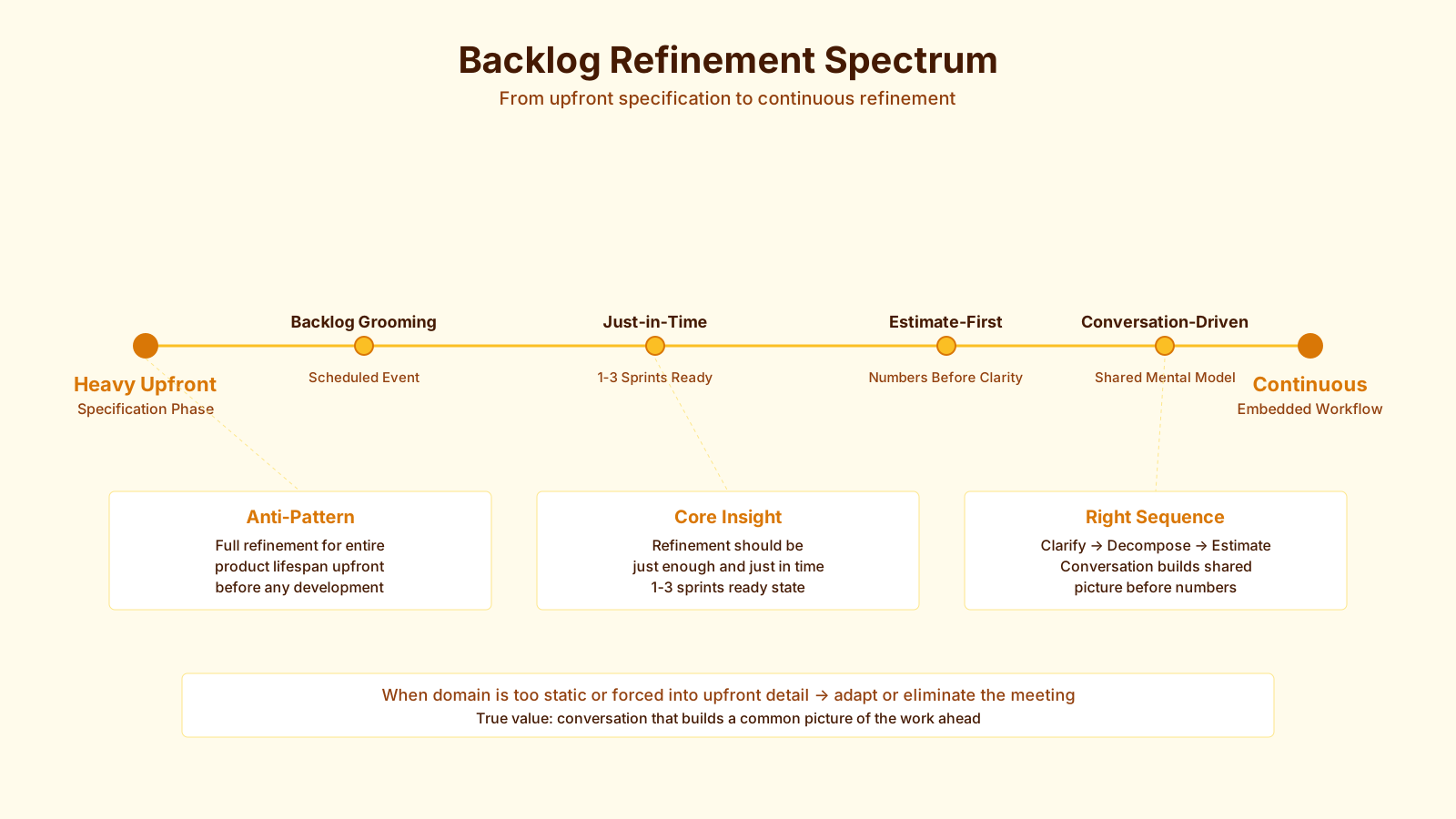
Backlog Refinement Meeting: Key Points Summary
| Key Concept | Summary |
|---|---|
| Definition | Backlog refinement is a recurring Agile practice in which the product owner, development team, and stakeholders collaborate to review, clarify, decompose, estimate, and prioritize product backlog items ahead of future sprints. |
| Purpose | While sprint planning commits to a fixed scope for the iteration, refinement keeps the backlog curated as a consistently prioritized, actionable inventory that reduces uncertainty before commitment. |
| Rationale | The practice emerged to counter the waterfall tendency toward exhaustive upfront specification, ensuring teams never pull insufficiently defined work into a sprint and thereby reducing rework and delivery risk. |
| Process | The product owner presents upcoming high-priority items; the team probes for clarity, exposes gaps, splits epics into right-sized user stories, and assigns relative effort estimates to inform sequencing decisions. |
| Time Allocation | The Scrum Guide recommends reserving up to ten percent of each sprint's capacity for refinement, though cadence-driven teams may need less and exploration-heavy contexts may warrant a higher investment. |
| Origins | Although positioned as an Agile practice, the discipline of progressive requirements elaboration traces back to established principles in software engineering, lean manufacturing, and iterative systems design. |
| Lean Connection | Refining work packages on a just-in-time basis mirrors lean manufacturing: it minimizes work-in-process inventory, reduces batch sizes, and ensures value flows with less waste. |
| Broader Adoption | Scrum's refinement model has become the dominant reference, with its techniques adapted across adjacent fields including UX research operations, product strategy, and policy formulation. |
What Is a Backlog Refinement Meeting?
A backlog refinement meeting definition centers on the ongoing process of decomposing large, ambiguous items into smaller, concrete work packages and ensuring each item meets a shared understanding threshold before it enters a sprint. The event typically involves the product owner presenting the highest‑priority items, while the team asks clarifying questions, identifies missing details, breaks down epics into user stories, and assigns relative size estimates. The discussion often leads to rewriting story descriptions, adding acceptance criteria, or identifying dependencies and risks. Unlike a formal gate review, the atmosphere is collaborative and exploratory. The output is not a signed document but a shared mental model that reduces rework and surprises later.
Many practitioners observe that the term “grooming” fell out of favor due to its negative connotations in some cultural contexts, so “refinement” became the preferred language in the Scrum Guide and across the Agile community. Regardless of terminology, the activity remains the same: it is the mechanism by which a product backlog transforms from a wish list into a reliable queue of deliverable work. The time spent in refinement varies widely, with the Scrum Guide suggesting up to ten percent of the sprint capacity, though teams in fast‑paced environments might spend less and those handling complex, research‑heavy domains might allocate more. The key is that refinement is a pull activity driven by the team’s need for clarity, not a push activity where stakeholders force definitions on developers.
It is worth noting that despite its name, the meeting does not have to be a single sitting. Many distributed teams spread refinement across multiple short sessions or use asynchronous tools to comment on backlog items before a synchronous sync. This distributed approach helps avoid meeting fatigue and keeps the focus on the substance rather than the format.
Core Insights on Refinement
- Collaborative backlog decomposition process
- Backlog refinement is a continuous, team-driven activity in which the product owner surfaces high-priority items and the entire team dissects ambiguous requirements into well-defined, actionable tasks complemented by explicit acceptance criteria.
- Shared mental model as output
- Instead of functioning as a formal gate review, refinement builds a collective mental model that aligns all participants, drastically reducing rework and late-breaking surprises during the sprint.
- Pull activity with flexible duration
- Refinement operates as a pull mechanism driven by the team's need for clarity rather than external pressure, with the Scrum Guide recommending up to 10% of sprint capacity; many distributed teams sustain momentum by leveraging asynchronous tools or multiple short, focused sessions.
Origins and Cross‑Industry Context
While the backlog refinement meeting in project management is a distinctly Agile construct, the underlying discipline of progressively elaborating requirements has deep roots in software engineering, manufacturing, and systems design. The idea that work packages should be refined just in time rather than fully defined at the outset echoes lean manufacturing’s principle of reducing work‑in‑process inventory and delivering value in smaller batches. In knowledge work contexts like marketing campaign development or R&D, teams often hold regular “work intake” sessions that closely mirror refinement, even if they do not use the Scrum terminology.
In non‑software industries, the practice appears under different labels. For instance, editorial teams in publishing might have a “content backlog review” where article ideas are fleshed out and prioritized before assigning to writers. In construction, design‑build firms sometimes use rolling wave planning sessions that refine the next phase of detailed design while leaving later phases less defined. These analogues reinforce the universality of the need: large amounts of potential work must be distilled into actionable chunks without over‑investing in planning too early. The refinement meeting, therefore, is not unique to IT but is a manifestation of a broader project management principle of progressive elaboration, albeit with a lightweight and highly collaborative twist.
Nevertheless, the formal ceremony of a backlog refinement meeting as described in Scrum has become the most widely referenced model, and its techniques have influenced disciplines ranging from UX design operations to policy development. By keeping the cross‑industry roots in mind, project managers can adapt the practice to any domain where a list of potential deliverables needs to be kept fresh and actionable.
Key Components and Characteristics
Understanding the key components of backlog refinement is essential to distinguishing it from other Agile ceremonies. At its core, the meeting consists of three intertwined activities: detail elaboration, estimation, and prioritization. Detail elaboration involves breaking down large user stories or epics into smaller, independently valuable pieces. Teams often use techniques like user story mapping or story splitting patterns to ensure each resulting item is small enough to be completed within a sprint. Without this decomposition, work items remain too large to be reliably estimated, and the team cannot forecast capacity with confidence.
Estimation usually happens using relative sizing methods such as story points, t‑shirt sizes, or ideal days. The goal is not to produce precise man‑hour predictions but to foster a conversation that reveals hidden complexity and assumptions. When team members assign a large estimate to a story, it triggers a discussion about why it feels big, often surfacing missing acceptance criteria, technical dependencies, or unclear interfaces. This social process of estimation is arguably more valuable than the number itself. Prioritization, meanwhile, is led by the product owner and influenced by business value, risk, dependencies, and stakeholder input. The product backlog is re‑ordered during refinement so that the most important items are sufficiently detailed at the top, while lower‑priority items can remain vague. This yields a “ready” funnel where the top portion of the backlog is in a state of high clarity.
A subtle but critical characteristic is the definition of ready, a shared checklist that an item must meet before the team will accept it into a sprint. While not an Agile mandate, many teams use a Definition of Ready to make refinement outputs tangible. Typical criteria include having clear acceptance conditions, a reasonable size estimate, and resolved external dependencies. The refinement meeting is the workshop where these criteria are met for upcoming items. Additionally, the meeting often results in the removal of obsolete or duplicate items, keeping the backlog lean and navigable. This housekeeping role is frequently overlooked but prevents the backlog from degenerating into a garbage heap of stale ideas.
Core Elements of Backlog Refinement
- Three intertwined refinement activities
- Elaborating details, estimating effort, and prioritizing items are the three integrated activities that define backlog refinement and distinguish it from other Agile ceremonies.
- Detail elaboration breaks down stories
- Teams break down large user stories or epics into smaller, independently valuable increments, often applying techniques such as user story mapping or structured splitting patterns to ensure each piece delivers standalone value.
- Relative sizing drives estimation
- Relative estimation methods, such as story points, t-shirt sizes, or ideal days, spark collaborative discussion that uncovers hidden complexity and shifts the focus away from exact man-hour forecasts.
- Large estimates surface hidden assumptions
- When a story receives a large effort estimate, the resulting team discussion typically reveals missing acceptance criteria, technical dependencies, or ambiguous interfaces that were not initially apparent.
- Product owner leads prioritization
- The product owner continuously re-orders the backlog based on business value, risk, dependencies, and stakeholder feedback, ensuring that high-priority items are refined in detail while lower-priority items stay loosely defined until their turn approaches.
Backlog Refinement Meeting in Project Management Frameworks
The backlog refinement meeting in Scrum is not a mandated event like the sprint review or daily standup, but the Scrum Guide explicitly mentions it as the act of adding detail, estimates, and order to the backlog. It is an ongoing activity that the product owner and development team can schedule as needed. Many Scrum teams reserve a mid‑sprint timebox, often two hours for a two‑week sprint, to perform refinement together. In this context, the product owner ensures that the highest‑ordered product backlog items are prepared and that the team has the opportunity to question and reshape them before sprint planning. The lack of rigid rules around the refinement ceremony in Scrum gives teams the flexibility to tailor frequency, duration, and attendees based on context. For distributed or cross‑time‑zone teams, online whiteboards and comment threads act as persistent refinement channels.
Backlog Refinement Meeting in Kanban
In Kanban systems, formal backlog refinement meetings are less structured but equally present. Since Kanban does not prescribe time‑boxed iterations, the refinement occurs as a continuous activity triggered by the pull of work into the “ready” column. The team might hold a regular replenishment meeting to review and refine upstream items before they become urgent. The meeting serves to ensure that the input queue never runs dry and that every work item entering the system is clear enough to be worked on without excessive clarification loops. Kanban practitioners often emphasize a flow‑based refinement where small batches of items are discussed as needed rather than in a large batch session. This minimizes the planning overhead and aligns with the just‑in‑time philosophy.
Backlog Refinement Meeting in SAFe
The Backlog Refinement Meeting in SAFe takes on a scaled dimension. At the team level, refinement looks similar to Scrum, but SAFe introduces the concept of the “PI Planning” event where program backlogs are refined, and features are decomposed into stories. In addition, there are ongoing Product Owner syncs and periodic backlog refinement workshops at the solution and portfolio levels. The refinement meeting at each tier ensures alignment from strategic themes down to sprint‑sized stories. In practice, SAFe teams often hold a weekly refinement session to break down features into user stories with acceptance criteria, estimate them, and align them with the upcoming Program Increment objectives. The scaled nature means that refinement discussions may need to involve system architects, UX designers, and other specialists to resolve cross‑team dependencies before the item reaches the team backlog.
Backlog Refinement Meeting and PMBOK
Within the PMBOK framework, there is no direct equivalent to the backlog refinement meeting because the guide is built around predictive project life cycles. However, PMBOK’s emphasis on progressive elaboration resonates with the purpose of refinement. In a predictive project, scope is defined in the WBS and elaborated through detailed requirements workshops early on. The backlog refinement meeting can be seen as an Agile‑specific practice that fulfills the same underlying intent: systematically detailing work packages just before they are executed to avoid rework and misalignment. When a project uses a hybrid approach, the project manager might schedule periodic “scope refinement” sessions that resemble backlog refinement, blending change control practices with Agile story decomposition. PMBOK’s processes like “Collect Requirements” and “Define Scope” are, in a sense, front‑loaded versions of what backlog refinement does iteratively. Practitioners often bridge the two by holding refinement meetings but documenting outcomes in a traceability matrix to satisfy governance requirements.
Backlog Refinement Meeting in PRINCE2 Agile
PRINCE2 Agile deliberately integrates the concept of a product backlog and refinement into its guidance. The backlog refinement meeting in PRINCE2 Agile is positioned as a mechanism to continuously assess and update the project product description and the priority of work packages. PRINCE2’s focus on continued business justification means that the product owner uses refinement to re‑evaluate value and alignment with the business case. The Agile extension to PRINCE2 recommends that teams hold regular refinement sessions to prepare backlog items for upcoming delivery stages, and these sessions feed into the stage plan and work package authorizations. The PRINCE2 principle of “manage by stages” dovetails with refinement because the stage boundary is an appropriate point to review the detailed backlog for the next stage. This ensures that the team works on the right things without sacrificing governance.
Purpose and Importance of Backlog Refinement Meetings
The purpose of backlog refinement meetings extends beyond simple task preparation; it is a risk reduction activity that prevents the development team from making costly assumptions. When a user story is vague, developers fill in the gaps themselves, often in ways that do not match stakeholder expectations, leading to rework and frustration. Refinement aligns everyone’s understanding and reveals edge cases, non‑functional requirements, and technical constraints early, when they are cheap to address. A well‑refined backlog also smoothes sprint planning by eliminating the need for lengthy storytelling during the time‑boxed planning session. Instead of spending the first hour explaining what each item means, the team can focus on commitment and capacity planning, making the sprint start with momentum.
Another critical purpose is to create a predictable flow of value. When the top items in the backlog are consistently ready, the team rarely encounters the situation where a sprint is delayed because a promised story turns out to be infeasible or too large. Over multiple sprints, this predictability builds stakeholder trust and allows the product owner to make reliable release forecasts. Refinement also serves as a communication bridge between the business and technical sides. It forces the product owner to articulate business intent in enough detail that developers can translate it into code, tests, and design. Conversely, developers bring technical feasibility into the conversation, keeping the product owner from investing in refining items that are architecturally impossible or prohibitively expensive. This mutual learning loop is perhaps the most underappreciated value of the meeting.
Essential Benefits of Refinement
- Risk reduction and alignment
- Refinement systematically uncovers edge cases, non-functional requirements, and architectural constraints early, when corrections are orders of magnitude cheaper than during development or testing.
- Faster, focused sprint planning
- A well-groomed backlog eliminates time lost to story clarification during planning, converting that session into a sharp negotiation of scope and a clear commitment the team can confidently own.
- Predictable flow of value
- Continuously ready work items remove the friction of sprint-start ambiguity, bolstering stakeholder trust and producing reliable delivery forecasts by enforcing joint rigor around business intent and technical feasibility.
Common Challenges, Pitfalls, and Misconceptions
One major backlog refinement meeting challenge is the tendency for the session to morph into a design workshop or technical deep‑dive that excludes the product owner. When architects and senior developers dominate the conversation with implementation details, the product owner checks out, and the business perspective is lost. The result is a well‑engineered solution that misses the mark on actual value. Conversely, a refinement meeting that becomes a product owner monologue drowns out technical reality, and the team nods along without surfacing concerns. The facilitator, often the Scrum Master or a senior developer, must guard these boundaries and keep the focus on what the story means and whether it is feasible, not on how to implement every last method.
Another pitfall is treating refinement as a mandatory checkbox for every backlog item. Not all stories need the same depth of refinement; lower‑priority items can remain coarse until they rise in rank. Over‑refinement wastes time and creates a false sense of certainty because requirements change. When a team spends hours detailing an item that might never be worked, it generates attachment to that scope and frustration when it is later dropped. There is a natural sweet spot where items are refined just enough for the next sprint or two, leaving room for new information. Teams new to Agile often mistake refinement for a commitment, thinking that a refined item is promised to stakeholders. In reality, the backlog is dynamic, and a refined item can still be removed or deprioritized if business conditions shift.
A widespread misconception is that refinement replaces sprint planning. In truth, refinement prepares items whereas sprint planning selects them and creates a concrete plan for the sprint. Another myth is that the product owner must have every acceptance criterion perfectly scripted before the meeting; refinement should be collaborative, with the team helping to shape the details. The belief that estimation equals a promise also persists, even though Agile estimation is a conversation tool, not a contract. Finally, some organizations assume that refinement is only for new features, overlooking the critical need to refine technical debt stories, enabler work, and spike investigations. Neglecting these leads to a backlog that looks healthy but hides a mountain of hidden work that destabilizes delivery.
Relationship to Other Agile Ceremonies and Artifacts
The backlog refinement meeting vs sprint planning distinction is fundamental. While both events deal with the product backlog, they serve different purposes and occur at different times. Refinement is a preparatory, ongoing activity that ensures items are understood, sized, and ordered; sprint planning is a time‑boxed ceremony where the team selects a set of refined items and commits to delivering them within the sprint. Any overlap in content indicates that the team is under‑refined, and sprint planning becomes inefficient. The natural handoff is that refinement does the heavy lifting of clarification, while planning focuses on capacity, task breakdown, and sprint goal formulation. Confusing the two leads to marathon planning sessions that frustrate everyone.
Backlog Refinement and the Daily Standup
Although distinct, the daily standup often surfaces impediments that can be traced back to fuzzy backlog items. When a developer reports being blocked because a story’s acceptance criteria are unclear, it signals that refinement was insufficient. Teams with a strong refinement practice experience fewer such blockers, and the standup shifts toward genuine coordination rather than perpetual requirement clarification. Some teams even use part of their standup to identify which items might need additional refinement in an upcoming session, creating a tight feedback loop between the two ceremonies.
Backlog Refinement and the Definition of Ready
The definition of ready is the checklist that makes refinement outcomes explicit. During a refinement meeting, the team essentially works the backlog items toward meeting that definition. For example, if the definition of ready requires that every story have wireframes attached and clear performance criteria, the meeting becomes the place to verify and fulfill those conditions. Without a definition of ready, refinement meetings risk becoming open‑ended discussions with no clear exit criteria, and stakeholders might push under‑prepared stories into a sprint. The definition of ready thus acts as a quality gate that the refinement process is designed to satisfy.
Essential Insights on Ceremony Interplay
- Distinct ceremony purposes
- Backlog refinement is an ongoing, collaborative process that ensures items are well understood and sized, while sprint planning is a dedicated event where the team commits to delivering work; treating them interchangeably blurs their distinct purposes and reduces sprint effectiveness.
- Overlap signals under-refinement
- Content spillover from refinement into sprint planning reveals an immature backlog, causing planning sessions to lose focus and become inefficient as teams scramble to clarify requirements instead of committing to sprint goals.
- Natural division of labor
- Refinement clarifies, sizes, and prioritizes backlog items to ensure readiness, whereas sprint planning allocates team capacity, decomposes work into tasks, and solidifies a cohesive sprint goal.
- Standup connection loop
- Daily standups expose blockers often rooted in unclear backlog items; teams that refine thoroughly encounter fewer such impediments and can leverage standups to proactively identify items requiring deeper refinement in upcoming sessions.
- Definition of ready value
- A well-defined definition of ready establishes tangible exit criteria for refinement, curtailing prolonged debates and ensuring that only adequately prepared stories enter sprint planning, shielding the team from stakeholder pressure.
Evolution and Current Thinking in Backlog Refinement
The evolution of backlog refinement meetings has been shaped by the broader shift toward continuous discovery and delivery. Early Agile teams often treated refinement as a single, lengthy session occurring once per sprint. Today, many practitioners advocate for continuous refinement using asynchronous collaboration tools. Online backlogs allow team members to comment on stories, raise questions, and suggest splits throughout the sprint, so that the synchronous meeting becomes a focused alignment checkpoint rather than a reading session. This reduces cognitive load and respects the team’s time, especially in distributed and hybrid work environments.
Another trend is the integration of product discovery techniques into refinement. Rather than simply clarifying existing items, teams use the session to validate assumptions with data, user interviews, and prototypes before finalizing story details. This fuses backlog management with product strategy and ensures that the team is not merely building the backlog right but building the right backlog. Additionally, some organizations experiment with AI‑assisted backlog tools that automatically flag ambiguous stories, suggest missing acceptance criteria, or recommend splits based on past patterns. While still nascent, these tools promise to amplify the collaboration rather than replace it.
From a Business Value‑Oriented Project Management perspective, the backlog refinement meeting becomes an ideal venue to apply relational effort points and treat scope change as user feedback rather than failure. When a refined scope item shifts, BVOPM sees that as a signal of learning, not a planning defect. The refinement session thus transforms into a value discussion where estimates reflect business impact as much as effort, and where the backlog is dynamically filtered to maximize value delivery without punishing the team for adapting to new insights.
Looking ahead, the backlog refinement meeting will likely evolve further as the line between delivery and discovery continues to blur. Rather than a ceremony owned by a single team, it might become a collaborative event involving multiple teams and stakeholders, especially in complex product ecosystems. As organizations embrace product‑centric operating models, the refinement meeting will serve less as a planning input and more as a strategic alignment checkpoint that ensures every piece of work connects to measurable outcomes. In that sense, the meeting’s real value has never been in the artifacts it produces but in the conversations and shared understanding it fosters.