Assumption and Constraint Analysis refers to the systematic process of identifying, documenting, validating, and managing the presumptions and limitations that shape a project’s planning and execution. It is a foundational discipline in project management, serving as the lens through which uncertainty is acknowledged and boundaries are made explicit before a single deliverable is produced. Without this analysis, project plans rest on unspoken guesses about resource availability, stakeholder support, technical feasibility, and regulatory stability, while teams struggle against invisible fences they did not even know existed.
In plain terms, every project begins with things we take for granted and things we cannot change. Assumptions are the beliefs we hold about the future—like expecting a key expert to remain on the team or assuming a vendor will deliver on time—while constraints are the hard limits we must accept, such as a fixed budget or a regulatory deadline. This analysis forces those implicit notions into the open so they can be tested, tracked, and acted upon. A project leader who skips this step is essentially navigating without a map, unaware of the cliffs and quicksand that might swallow the schedule whole. It is not about eliminating uncertainty; it is about making uncertainty visible and manageable, so decisions are grounded in reality rather than wishful thinking.
Key Topics Summary: Assumption and Constraint Analysis
| Key Concept | Summary |
|---|---|
| Core Distinction | Assumptions are forward-looking beliefs taken as given, such as the continued availability of a critical expert. Constraints are fixed boundaries that must be respected, including predetermined budgets or regulatory deadlines. |
| PMBOK Definition | The PMBOK Guide defines an assumption as a factor treated as true for planning purposes, without proof, and a constraint as any restriction that limits project execution options. |
| PRINCE2 Approach | PRINCE2 does not combine the terms into a single phrase; however, its principles of management by exception and clearly defined roles require precise differentiation between assumptions and constraints. |
| Agile Practices | In Agile environments, assumptions often emerge as unresolved questions tied to backlog items, while constraints are explicitly managed through timeboxed iterations, team capacity limits, and defined non-functional requirements. |
| Constraint Types | Constraints are traditionally organized around the triple constraint of scope, schedule, and cost; however, contemporary project management acknowledges an expanded set of categories. |
| Additional Constraint Categories | Beyond the triple constraint, quality constraints enforce minimum acceptance standards, resource constraints cap available talent and materials, legal constraints require regulatory compliance, and stakeholder constraints reflect nonnegotiable sponsor expectations. |
| Analysis Value | Without thorough analysis, project plans are built on untested assumptions regarding resource availability, stakeholder alignment, and technical feasibility, forcing teams to navigate hidden obstacles. |
| Software Origins | Constraint analysis in software engineering originated from the imperative to define physical and temporal limitations like memory, processor speed, and market windows, ensuring products remain viable upon delivery. |
What Is Assumption and Constraint Analysis?
At its core, assumption and constraint analysis is the structured examination of factors that are presumed true for planning purposes and those that impose restrictions on project execution. In the PMBOK framework, this process is woven into several knowledge areas, most prominently in Develop Project Charter, Identify Risks, and Define Scope. The analysis begins during project initiation when high-level assumptions and constraints are captured, then deepens during planning as the team refines their understanding of what can and cannot be altered. PRINCE2 similarly treats assumptions as entries in the project log, linking them to risk management, while constraints are addressed through tolerances and the project’s defined boundaries.
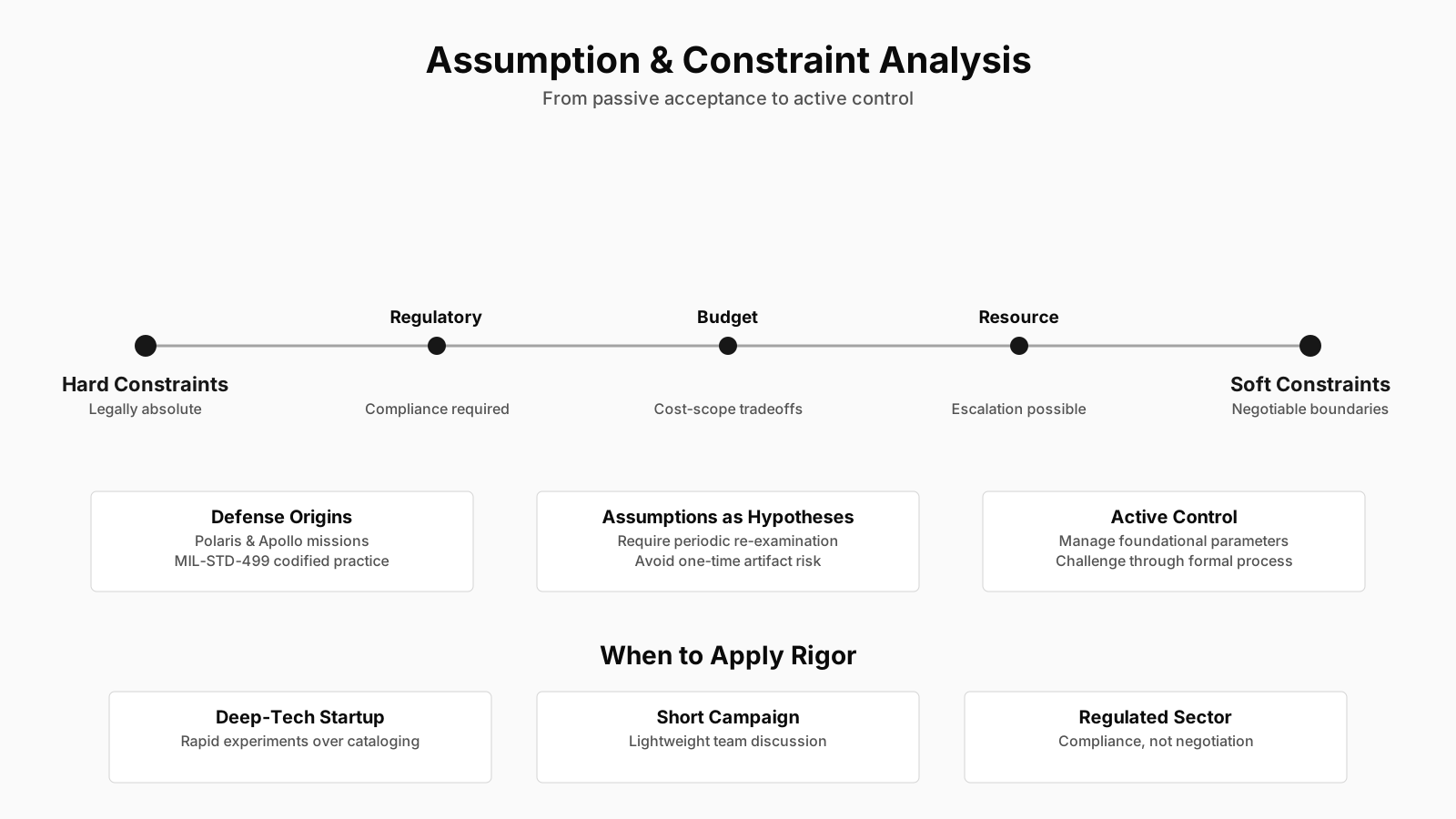
Historically, the practice has roots in systems engineering and military planning, where ignoring a single false assumption could cascade into catastrophic failure. Defense programs in the mid-20th century formalized the tracking of assumptions as a countermeasure against the “unknown unknowns” that Donald Rumsfeld later made famous. In software engineering, constraint analysis grew out of the need to define resource limitations—memory, processing power, time-to-market—that could render a product obsolete before launch. These cross-industry origins taught project managers that unexamined assumptions and invisible constraints are the silent killers of even the most meticulously planned undertakings. The lesson carried into construction, healthcare, finance, and everywhere else humans attempt to orchestrate complex work under uncertainty.
Core Definition and Framework Recognition
PMBOK defines an assumption as “a factor in the planning process that is considered to be true, real, or certain, without proof or demonstration,” while a constraint is “a limiting factor that affects the execution of a project, program, portfolio, or process.” These definitions sit in the glossary but their full weight is felt only when they collide with real project pressure. PRINCE2 does not separate them linguistically as a single phrase, but the principles of “manage by exception” and “defined roles and responsibilities” inherently demand clarity on what is assumed and what is constrained. In Agile practices, assumptions often emerge as unanswered questions on a backlog item, and constraints are acknowledged through timeboxes, team capacity limits, and explicit non-functional requirements.
Core Insights on Assumptions and Constraints
- Systematic review of assumed-true factors and limits
- A disciplined assumption and constraint analysis validates planning premises and clarifies the operational boundaries that set realistic project parameters.
- Embedded across PMBOK and structured methods
- PMBOK integrates this review directly into the Develop Project Charter, Identify Risks, and Define Scope processes, while PRINCE2 captures assumptions in the project log and governs constraints through tolerance thresholds.
- Roots in defense-driven systems engineering
- The discipline emerged from mid-20th century defense and systems engineering programs, where a single unchallenged assumption could cascade into catastrophic failure, prompting the formal tracking of assumptions.
- Agile’s approach to assumptions and constraints
- Agile teams surface assumptions as open questions linked to backlog items, and they express constraints through timeboxes, capacity limits, and explicitly stated non-functional requirements.
Key Components and Characteristics of Assumption and Constraint Analysis
A thorough assumption and constraint analysis process breaks down into several interrelated components, each with its own characteristics and behavioral patterns. It is not simply a checklist but a dynamic mental model that project teams must continually revisit. The primary division, of course, is between assumptions and constraints themselves, but within each category lie nuances that separate a superficial log entry from a genuinely useful piece of intelligence.
Assumptions: Definitions, Categories, and Behavioral Patterns
Assumptions can be strategic, technical, resource-based, environmental, or political. A strategic assumption might be that a merger will close by a certain date, freeing up capital for the project. A technical assumption might be that the chosen platform will support a certain throughput without refactoring. Resource assumptions often revolve around personnel: the guru who knows the legacy code will not quit mid-sprint. Environmental assumptions include stable exchange rates, no new regulations, and the continued existence of a key supplier. Political assumptions are the trickiest—assuming that an executive sponsor will protect the project from organizational turbulence, or that competing departments will cooperate when asked.
The behavioral pattern of assumptions is that they start as invisible certainties and only become visible when someone challenges them. Most project managers have experienced the moment when a seemingly solid plan crumbles because the team discovers the server upgrade was expected to happen magically, without budget or downtime. The analysis therefore demands a posture of skeptical inquiry. Teams must ask: What are we taking for granted? What would cause the plan to fail if it were not true? These questions are uncomfortable, which is why many organizations avoid them until the discomfort of a crisis forces the issue.
Constraints: Nature, Sources, and Hidden Variants
Constraints are typically categorized by the triple constraint framework—scope, schedule, cost—but modern project management recognizes many more. Quality constraints define the minimum acceptable standards; resource constraints limit the type and amount of talent, equipment, or materials; legal and regulatory constraints mandate compliance measures that cannot be negotiated; and stakeholder constraints arise when a powerful sponsor dictates non-negotiable design choices. Some constraints are self-imposed, like an internal policy that prohibits certain vendors, while others are externally imposed by regulators, market conditions, or contractual obligations.
The hidden variant is the cultural constraint—unwritten rules about how fast decisions can be made, who must approve what, or how much risk the organization will tolerate. These are rarely documented but exert enormous force. A project manager might have ample budget and a generous timeline, yet still be unable to deliver because every change request requires three committee reviews that meet quarterly. Identifying these soft constraints is as important as logging the hard ones, though considerably more delicate. Calling out the organization’s bureaucracy as a constraint requires political finesse, but the analysis is incomplete without it.
The Interplay Between Assumptions and Constraints
Assumptions and constraints are often tangled. An assumption about resource availability may become a constraint if it proves false: the developer was not available, so now the team is constrained by a knowledge gap. Conversely, a constraint like a hard deadline may force certain assumptions about scope reduction or quality trade-offs. The analysis must examine these interconnections, because adjusting a constraint can invalidate an assumption, and vice versa. A mature project team maps these relationships visually, looking for domino effects that could topple the entire plan if one link snaps.
Assumption and Constraint Analysis in Project Management Frameworks
How assumption and constraint analysis in project management is executed depends heavily on the methodology governing the work. Predictive, Agile, and hybrid frameworks each approach the discipline with different rhythms, tools, and cultural expectations, though the underlying need remains identical. Understanding these variations helps practitioners adapt the analysis to their environment rather than treating it as a one-size-fits-all ritual.
PMBOK Perspective and Process Integration
The PMBOK Guide ties assumption and constraint analysis to several processes. During Develop Project Charter, the project sponsor and manager identify high-level assumptions and constraints that later feed into the project plan. In Develop Project Management Plan, these are refined and documented in the assumption log, which becomes a living document. Identify Risks relies heavily on assumptions analysis, because every assumption is a potential risk if it proves false. The process of Plan Risk Responses often involves converting critical assumptions into risk triggers or contingency plans. Constraints appear in the scope statement, the schedule, and the cost baseline as boundaries that shape what is possible.
A practical subtlety within this framework is the distinction between business assumptions and project assumptions. Business assumptions relate to the project’s justification—market demand, competitive positioning, return on investment—while project assumptions concern execution. The PMBOK framework expects both to be logged, but in practice they often live in separate documents owned by different stakeholders. The project manager must ensure that business assumptions are not forgotten, because if the market shifts, the perfectly executed project still fails.
PRINCE2 Treatment and the Role of Tolerances
PRINCE2 embeds assumption management within its risk theme and its emphasis on continued business justification. Assumptions are recorded in the project log as risk sources, and the project board reviews them at stage boundaries. Constraints are handled through the concept of tolerances: the project board sets allowable deviations for time, cost, scope, risk, quality, and benefits. The project manager has authority to operate within those tolerances; an exception occurs if a constraint forces the project beyond them. This structured delegation forces clarity about what limits are truly non-negotiable and what can be adjusted without escalation.
The PRINCE2 method also emphasizes management products—specific documents with defined purposes. The Business Case explicitly lists major assumptions underpinning the project’s viability. If any of those change, the project’s continued justification is automatically called into question. This creates a direct feedback loop between assumption analysis and governance that is less formalized in other frameworks. It is a powerful mechanism, though it can feel bureaucratic if the log is treated as a mere administrative artifact rather than a decision tool.
Agile and Hybrid Environments
Agile frameworks do not typically use the formal language of assumption and constraint analysis, but the thinking is embedded in everyday practices. Sprint planning begins with assumptions about velocity, team stability, and the completeness of user stories; the daily standup surfaces assumptions that are breaking down. Constraints are visible in the sprint goal, the definition of done, and the timebox itself. In Scrum, a constraint like a fixed release date may force early negotiation about the scope of a product increment. Kanban systems make constraints visible through work-in-progress limits that expose bottlenecks.
Hybrid environments blend predictive analysis with iterative validation. A project charter might document initial assumptions and constraints using traditional templates, while sprints test those assumptions rapidly through working software. The assumption log becomes a backlog of hypotheses to be verified, and constraint violations trigger exception reports to a steering committee that meets monthly rather than weekly. This pragmatic fusion recognizes that some assumptions can be tested empirically while others must be tracked as risks, and that constraints demand different governance styles depending on their source and severity.
Core Takeaways on Framework Differences
- Methodology shapes analysis rhythms
- While Predictive, Agile, and hybrid frameworks conduct assumption and constraint analysis through different tools, cadences, and cultural expectations, the essential discipline of surfacing and managing them does not vary.
- Assumptions fuel risk management processes
- In PMBOK-based practice, assumption analysis anchors the Develop Project Charter, Identify Risks, and Plan Risk Responses processes because any incorrect assumption becomes a risk that demands triggers and contingency plans.
- PRINCE2 manages constraints through tolerances
- PRINCE2 embeds assumption management within its risk theme and the principle of continued business justification, while controlling constraints through project board tolerances on time, cost, scope, risk, quality, and benefits.
BVOP Perspective on Assumption and Constraint Analysis
Business Value-Oriented Project Management (BVOPM) integrates assumption analysis into value-driven planning by treating unvalidated assumptions as sources of process damage and potential business value erosion. In BVOPM, assumptions are not merely logged; they are subjected to relational effort point modeling to gauge their impact on delivery confidence. The methodology warns that work breakdown structures, often built on cascading assumptions, suffer from inherent inaccuracy, and it defines a five-level scope scale ranging from Definite to Unlikely, where assumptions about Unlikely scope items are flagged for early validation or deferral. When assumptions are challenged by new user feedback, BVOPM treats the resulting scope change not as failure but as a normal refinement of understanding, which reduces the organizational resistance to surfacing flawed assumptions early.
Regarding constraints, BVOPM introduces the concept of “process damage” as an invisible organizational cost that accumulates when teams work under unrealistic constraints without raising exceptions. A constraint that forces excessive overtime, perfectionism on low-value features, or rejection of acceptable work is categorized as waste and tracked via Business Value Points. If a persistent downward trend in those points is observed, the methodology permits closure of the project or program, reframing constraint-driven failure as a value-protection decision rather than a stigma.
Practical Application and Use of Assumption and Constraint Analysis
The real-world use of assumption and constraint analysis unfolds across the entire project lifecycle, though its intensity peaks during initiation and planning. It is not a one-off activity but a discipline woven into status reviews, risk workshops, and change control. The analysis is conducted by project managers, business analysts, technical leads, and sponsors, each bringing a unique angle on what is being taken for granted and what boundaries truly exist.
When It Occurs in the Project Lifecycle
During initiation, the analysis surfaces the strategic assumptions that justify the project’s existence and the high-level constraints that define its shape. A feasibility study might reveal that the project assumes a certain technology will be available within budget, and that the constraint of a federal compliance deadline cannot be shifted. As planning progresses, the team decomposes these into tactical assumptions about task durations, resource assignments, and vendor performance. Execution demands continuous monitoring: a change request often signals that an assumption has turned out to be false, while a constraint violation triggers an escalation. Closing activities include a retrospective review of how assumptions and constraints were managed, feeding lessons learned into future projects.
Roles and Responsibilities
The project manager owns the assumption log and constraint register, but the content must be crowdsourced from the team and stakeholders. Sponsors are uniquely positioned to identify political and organizational constraints that the project manager might not see, or might not be willing to document without high-level backing. Technical leads are the sentinels for architectural assumptions that could sink a project if they prove false. Business analysts excel at uncovering assumptions embedded in requirements language—phrases like “the system will integrate easily with the existing platform” are red flags. The effective practice is not to assign blame but to create a psychologically safe environment where anyone can flag a shaky assumption or a hidden constraint without fear of reprisal.
Documentation and Tools
Assumption logs and constraint registers are the most common artifacts, though their format varies from simple spreadsheets to enterprise project management software modules. The log typically records the description, the date identified, the owner, a confidence rating, a validation plan, and the status. Constraints are documented with their source, the impact of violation, and the escalation path. Agile teams might track assumptions on a dedicated section of their information radiator, or as tagged items in the backlog. In programs, assumption dependencies across projects create a web that demands portfolio-level visibility; a change in one project’s assumption can ripple across an entire program, which is why program managers invest heavily in assumption mapping.
Core Takeaways on Assumption Analysis
- Lifecycle-wide analysis scope
- Assumption and constraint analysis extends across the entire project lifecycle, but it is most intensive during initiation and planning when foundational uncertainties are identified and questioned.
- Multidisciplinary stakeholder involvement
- Project managers, business analysts, technical leads, and sponsors each bring unique viewpoints that surface hidden assumptions and clarify genuine constraints, reducing blind spots.
- Phase-specific focus areas
- Initiation uncovers strategic assumptions and non-negotiable constraints; planning translates them into detailed tactical considerations; execution actively monitors for breaches; and closing extracts lessons to refine future projects.
- Documentation and program visibility
- Assumption logs and constraint registers serve as standard reference documents, and at the program level, assumption mapping visualizes cross-project dependencies whose unexpected changes can cascade through an entire portfolio.
Common Challenges, Pitfalls, and Misconceptions
Understanding the common pitfalls of assumption analysis is as important as knowing the formal steps. The discipline is deceptively straightforward, and many experienced project managers have learned hard lessons when their seemingly robust analysis failed in the face of organizational complexity.
The Trap of Unvalidated Assumptions
The gravest error is documenting assumptions without a validation plan. An assumption that “the client will provide access to the test environment by phase two” written in the log becomes a weapon when phase two arrives and access has not been granted. The log entry alone does nothing; it only creates value when it triggers a verification action, a risk response, or a contingency allocation. Many teams fall into the pattern of logging and forgetting, mistaking documentation for management. Validation might involve a direct conversation with the stakeholder, a technical prototype, or a contractual clause, but it must happen before the assumption becomes a project emergency.
Confusing Assumptions with Risks or Constraints
A frequent misconception is that assumptions and risks are interchangeable. An assumption is a statement treated as true; a risk is an uncertain event that could affect objectives. When an assumption is threatened, it becomes a risk. But the initial distinction matters because risks may warrant active response strategies, while assumptions simply require monitoring. Treating an assumption as a risk prematurely drains resources. Another error is calling a constraint an “assumption” to avoid the political heat of naming a limit. A hard release date is a constraint, not an assumption, and the analysis must name it accurately so the team can plan around reality rather than wishful thinking.
Hidden Constraints and Political Realities
Some constraints are socially off-limits. The fact that a senior executive’s pet feature cannot be cut, even if it adds no value, is a constraint that few project managers would dare to document. The unspoken rule that the project cannot disturb the current operations team’s weekend rest is a constraint with schedule implications. These invisible fences shape decisions more powerfully than the official ones. Skilled practitioners learn to address these without threatening the established order, often by reframing the issue as a risk or by seeking private confirmation from a trusted mentor. It is not a process problem as much as a political one, and ignoring it turns assumption and constraint analysis into a polite fiction.
Relationship to Other Project Management Concepts
Assumption and constraint analysis does not exist in a vacuum. It connects assumption analysis to risk management and other domains, forming a web of interdependencies that define the project’s resilience. Understanding these connections helps practitioners avoid narrow thinking and leverage the analysis across the full spectrum of project activities.
Assumptions and Risk Management
The link is direct and profound. Every assumption is a potential risk source if it proves invalid, and many risk identification techniques explicitly include assumptions analysis as an input. In quantitative risk analysis, the stability of key assumptions can be modeled to determine the probability of meeting objectives. A false assumption about vendor performance might be the single point of failure that a Monte Carlo simulation reveals as the most critical threat. Risk workshops often begin with a review of the assumption log precisely because assumptions that go unchallenged become the risks nobody sees coming.
Constraints and Success Criteria
Constraints directly shape what “success” can mean. If the triple constraint includes an immovable deadline and a fixed budget, the only remaining variable is scope, which may need to be drastically reduced to meet the other two. Success criteria that ignore real constraints are fantasies. A project that sets a quality bar that exceeds the budget’s capacity is doomed to disappoint, and the constraint analysis should surface that tension before commitments are made to stakeholders. This is not pessimism; it is the honest acknowledgement that project management is fundamentally an exercise in operating within limits while trying to maximize value.
Assumptions vs. Dependencies and Constraints vs. Requirements
Assumptions are often confused with dependencies, but a dependency is a relationship between tasks or deliverables, while an assumption is a belief about the conditions under which those tasks will be performed. You might assume a dependency will be resolved by a certain date, but the dependency itself is a structural fact. Constraints and requirements are similarly distinct: a requirement describes what the product must do, while a constraint limits how it can be done. A requirement for a mobile app is distinct from the constraint that it must work on a specific outdated operating system version. Blurring these distinctions leads to incomplete analysis and confused documentation.
Linking Analysis Across Project Concepts
- Assumptions feed risk identification
- Each assumption represents a latent risk if invalidated, so assumption analysis directly feeds risk identification and frequently triggers dedicated risk workshops.
- Quantitative modeling of assumptions
- Quantitative methods like Monte Carlo simulation stress-test key assumptions, exposing substantial threats such as an optimistic vendor performance assumption that could fail under real-world conditions.
- Triple constraint scope trade-offs
- With a fixed deadline and budget, scope is the sole adjustable variable, and constraint analysis must highlight mismatches, such as a quality target that the budget cannot support.
- Assumptions versus dependencies
- Dependencies establish relationships between scheduled activities or deliverables, while assumptions reflect the expected conditions under which those activities take place.
Evolution and Current Thinking in Assumption and Constraint Analysis
The practice has evolved from static documentation to dynamic assumption management, reflecting the increasing complexity and speed of modern projects. Early approaches were rooted in waterfall planning, where assumptions were gathered upfront and rarely revisited. Today’s thinking emphasizes continuous scanning, empirical validation, and integrated feedback loops that treat assumptions as hypotheses to be tested rather than facts to be recorded.
From Static Logs to Living Models
Modern tools allow assumption logs to be linked to risk registers, schedules, and dashboards so that a change in status propagates automatically. Predictive analytics can flag assumptions that are becoming stale based on historical data patterns. In the program and portfolio space, assumption mapping has become a specialized discipline, with complex dependency webs visualized to identify fragile nodes. This shift treats the assumption log not as a compliance artifact but as a strategic asset for decision-making. The human side remains challenging, however: no tool can force a team to speak up about an uncomfortable assumption, and the political dynamics that cause hidden constraints persist regardless of software sophistication.
Debates and Divergent Schools of Thought
A persistent debate concerns the level of detail that is useful. Some practitioners advocate logging every conceivable assumption, creating exhaustive lists that become unmanageable. Others argue for a lean approach, documenting only those assumptions that would cause significant rework if false. Both extremes have merit depending on the project’s risk tolerance and regulatory environment, but the sensible middle ground is to apply a materiality filter: if the assumption’s failure would force a schedule delay beyond a threshold, a cost overrun beyond a contingency reserve, or a stakeholder escalation, it belongs in the log. Another debate centers on whether constraints can ever be truly negotiated. The correct answer is that some can and some cannot, and the analysis must distinguish them honestly, even if organizational culture prefers to treat all constraints as immutable to avoid discomfort.
Current Best Practices and Emerging Trends
Leading organizations now treat assumption and constraint analysis as a collaborative, iterative discipline rather than a planning phase gate. They use visual management techniques like assumption boards during project kickoffs, and they reserve time in retrospectives to examine which assumptions held and which broke. In hybrid environments, automated testing and continuous integration serve as validation mechanisms for technical assumptions, providing empirical feedback within days instead of months. The most forward-thinking project managers are experimenting with AI-assisted analysis to scan project documents and meeting notes for implied assumptions that no one has stated explicitly, though the technology remains immature. As the profession advances, one truth endures: the projects that fail most spectacularly are not those with the most assumptions, but those where the key assumptions remained invisible until the moment of collapse. Making them visible is the analysis’s fundamental and irreplaceable function.