Alternatives Analysis is defined as a systematic evaluation technique used in project management to identify, compare, and select the most viable option among multiple potential courses of action for achieving project objectives. The process involves examining different approaches, solutions, methodologies, or strategies against a set of predefined criteria—such as cost, schedule, risk, quality, and alignment with organizational goals—to determine which alternative offers the best overall value. Within the discipline of project management, the term appears as a recognized tool and technique in several PMBOK processes, most prominently in planning activities where scope, schedule, cost, and resources are being defined. Project teams use it to avoid rushing toward a single solution without first considering whether other paths might deliver better results with fewer trade-offs.
What this actually means on the ground is that before committing serious money and time to one approach, a project manager pauses to ask, “What else could we do, and what would that look like?” It might mean comparing whether a feature should be built in-house or outsourced, whether a new software module should use an off-the-shelf component or a custom-developed one, or whether a bridge should be constructed using steel versus reinforced concrete. The analysis does not have to be a massive, document-heavy exercise—though it can be—but it must be structured enough that the decision is transparent, defensible, and based on something more than the loudest voice in the room.
Key Topics in Alternatives Analysis
| Key Concept | Summary |
|---|---|
| Definition | Alternatives analysis is a structured decision making framework that enables project teams to systematically identify, evaluate, and select the optimal course of action from a set of competing solutions. |
| Purpose | It mitigates the risk of premature or biased decisions by mandating a transparent, evidence based comparison of viable paths, thereby strengthening stakeholder confidence and audit defensibility. |
| PMBOK Role | The PMBOK Guide classifies it as a core data analysis technique applied across multiple planning processes, including scope definition, schedule development, cost estimation, and resource planning. |
| Practical Scope | It governs tangible trade off decisions such as build versus buy, off the shelf versus custom software, or selecting among competing materials, vendors, and technical architectures. |
| Historical Roots | The approach inherits its rigor from military course of action analysis and mid twentieth century trade studies developed within systems engineering and aerospace programs. |
| Cross-Industry Use | Beyond project management, manufacturing firms employ it for process design, operations research uses it for optimization modeling, and clinical medicine applies it in treatment pathway selection. |
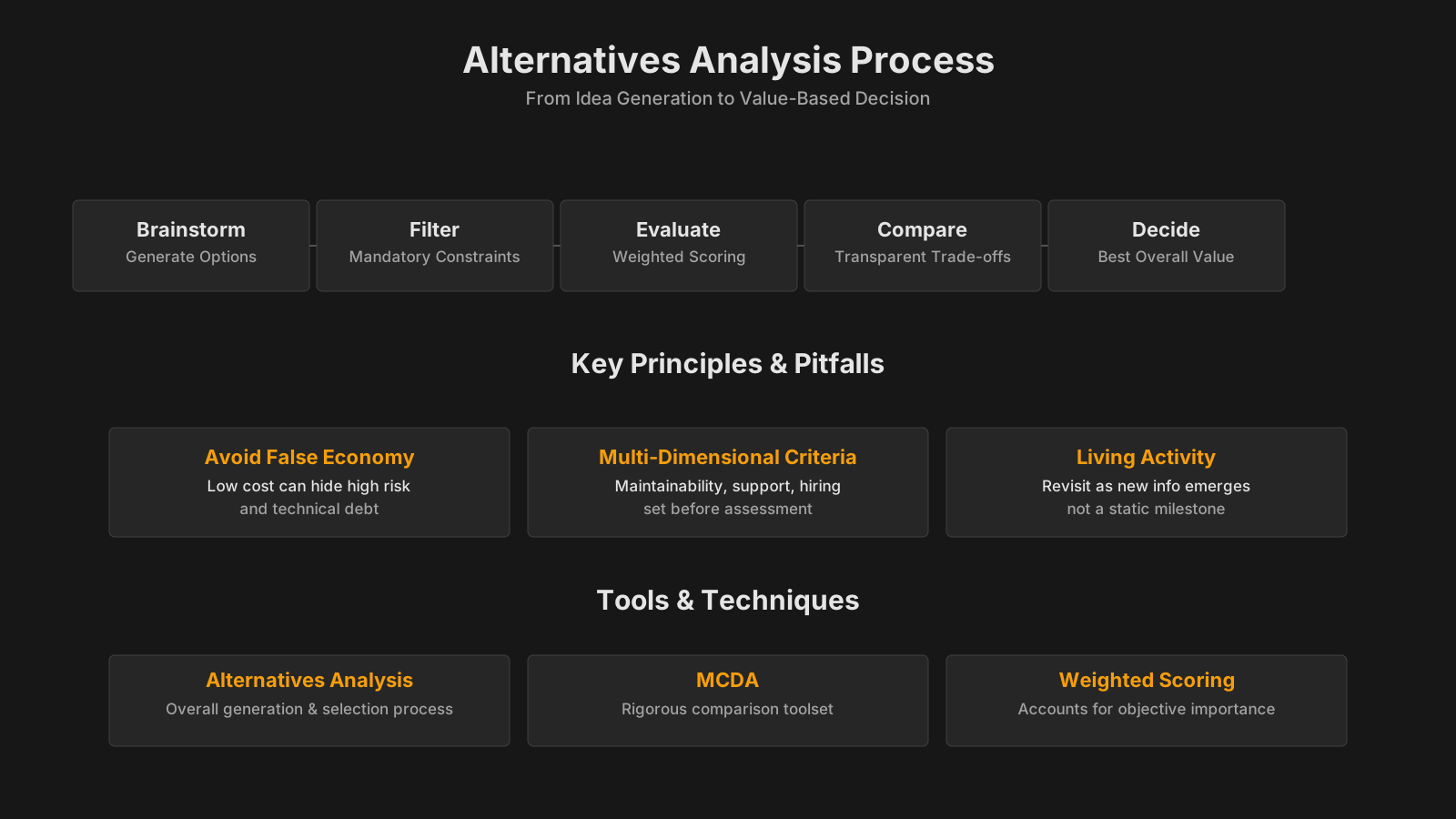
| Key Components | The process begins by generating a broad and divergent candidate list, then eliminates options that violate nonnegotiable constraints, and finally conducts a focused comparative evaluation of the shortlisted alternatives. |
| Comparison Methods | Quantitative methods apply financial metrics such as net present value, internal rate of return, and payback period, while qualitative methods assess subjective factors like organizational culture alignment, ease of maintenance, and scalability. |
| MCDA | Multi criteria decision analysis formalizes the evaluation by weighting each factor according to strategic priority and scoring each alternative, thereby surfacing assumptions, reducing dominant stakeholder bias, and creating an auditable rationale. |
| Methodology Coverage | Both PMBOK and PRINCE2 embed the technique; PRINCE2 specifically mandates it within the Options Identification and Analysis activity during the Starting Up a Project and Initiating a Project processes. |
What Is Alternatives Analysis?
A Alternatives Analysis definition in the context of project management describes a decision-support method that generates and assesses different ways to accomplish a defined scope of work. The concept is sometimes referred to as alternatives identification, options analysis, or trade-off analysis, though each of these terms carries slightly different nuances. The PMBOK Guide places it as a data analysis technique used in several planning processes, including Plan Scope Management, Plan Schedule Management, Plan Cost Management, and Plan Resource Management. In each of these processes, the project team uses alternatives analysis to explore different strategies—like crashing versus fast-tracking a schedule, or leasing versus purchasing equipment—and selects the one that best balances competing constraints.
The underlying premise is straightforward: for almost any project decision, multiple solutions exist, and choosing among them without structured evaluation invites unnecessary risk. The process forces a comparison of trade-offs, often surfacing hidden assumptions about what is truly important on a project. It also creates an audit trail that can be useful when stakeholders later question why a particular path was chosen. In practice, the level of formality ranges from a quick whiteboard session with a small agile team to a full-blown feasibility study with weighted scoring models in a large infrastructure program.
Core Takeaways on Alternatives Analysis
- Decision-support method
- Alternatives analysis systematically identifies and evaluates multiple viable approaches to achieve a defined scope, enabling informed decisions that balance cost, time, and quality.
- Multiple synonymous names
- The technique is known interchangeably as alternatives identification, options analysis, or trade-off analysis, each term emphasizing a different facet: ideation, comparative evaluation, or balancing competing factors.
- PMBOK planning technique
- The PMBOK Guide categorizes it as a data analysis technique applied across key planning processes, including scope definition, schedule development, cost estimating, and resource planning, to compare potential courses of action.
- Surfaces trade-offs and assumptions
- By explicitly comparing trade-offs, the process surfaces hidden assumptions and clarifies stakeholder priorities, enabling more transparent and defensible decision-making.
- Flexible formality and audit trail
- Application spans from informal whiteboard sessions with agile teams to rigorous feasibility studies using weighted scoring models, consistently producing an audit trail that supports future governance and stakeholder inquiries.
Origins and Cross-Industry Context
The intellectual roots of systematic alternatives evaluation stretch back far beyond modern project management. Military planning has long used a structured approach to weigh different tactical options, often under the banner of “courses of action analysis.” In systems engineering and aerospace, trade studies have been standard practice since the mid-20th century, used to compare design alternatives for complex hardware like aircraft or satellites. These fields developed rigorous multi-criteria decision frameworks to manage the reality that no single option is ever best on every dimension.
Manufacturing and operations research contributed significantly as well, with techniques like linear programming and decision tree analysis offering mathematical ways to compare alternative production methods or supply chain configurations. The medical field uses a form of alternatives analysis in clinical decision-making, where treatment options are weighed against patient outcomes, risks, and costs. While project management did not invent the concept, it has absorbed and adapted these practices into a lightweight, context-sensitive toolkit tailored to temporary endeavors with finite resources. The project management profession essentially democratized the approach so that small software teams and large construction firms alike can apply it without needing a PhD in decision science.
Key Components and Types of Alternatives Analysis
Understanding the key components of Alternatives Analysis begins with the recognition that the process is not a single monolithic technique but a family of approaches that vary by complexity. At its simplest, it involves generating a list of possible alternatives and then filtering them through a basic feasibility check—discarding anything that violates a non-negotiable constraint like a regulatory requirement or a hard budget ceiling. More sophisticated versions layer on formal comparison methods such as cost-benefit analysis, multi-criteria decision analysis, or even simulation modeling to predict performance under uncertainty.
Generating and Screening Alternatives
The generation phase often draws on brainstorming, expert judgment, lessons learned from previous projects, and market research. The goal is not to produce an exhaustive list but a sufficiently diverse set that covers the realistic solution space. Screening then eliminates alternatives that are obviously non-viable—those that cannot meet a core requirement, exceed a hard constraint, or introduce unacceptable risk. What remains is a shortlist that warrants deeper comparison.
Quantitative and Qualitative Comparisons
Comparison methods split broadly into quantitative and qualitative camps. Quantitative alternatives analysis typically relies on financial metrics like net present value, internal rate of return, payback period, or life-cycle cost. These methods work well when the primary concern is cost and the alternatives have clearly calculable financial implications. Qualitative approaches, meanwhile, handle the softer criteria—team expertise, stakeholder alignment, organizational culture fit, and long-term maintainability. Most real-world analyses blend both, using a weighted scoring model where qualitative ratings are assigned numerical values to produce a composite score.
Multi-criteria decision analysis, often called MCDA, represents a more formalized way to combine diverse criteria. Project managers assign weights to factors like cost, duration, quality, risk, and strategic alignment, then score each alternative against these weighted dimensions. The result is not a perfect answer, but it makes the reasoning explicit and reduces the chance that a single vocal stakeholder will skew the decision with personal preference.
Core Insights on Analysis Methods
- Family of analysis approaches
- Alternatives analysis encompasses a spectrum of methods, from rapid feasibility checks to formal evaluation frameworks such as cost-benefit analysis, multi-criteria decision analysis, and simulation modeling.
- Generation and screening process
- Ideas are sourced through brainstorming, expert judgment, lessons learned, and market research, then screened to discard any option that fails to meet core requirements, violates hard constraints, or poses unacceptable risk.
- Quantitative comparison methods
- Quantitative comparison relies on financial metrics including net present value, internal rate of return, payback period, and life-cycle costing, and proves most effective when each alternative's financial impact is readily quantifiable.
- Qualitative comparison criteria
- Qualitative criteria capture intangible factors such as team capability, stakeholder alignment, cultural fit, and long-term maintainability, frequently translating subjective ratings into numerical scores within a weighted scoring model.
- Multi-criteria decision analysis
- MCDA structures decisions by weighting criteria like cost, schedule, quality, risk, and strategic fit, making the rationale transparent and guarding against undue influence from any single stakeholder.
Alternatives Analysis in PMBOK and PRINCE2
The PMBOK Guide seventh edition mentions alternatives analysis as a method within several performance domains, while earlier editions explicitly listed it as a tool and technique for plan development processes. Alternatives Analysis in PMBOK typically appears during the creation of management plans—scope, schedule, cost, and resource plans—where the project team evaluates different approaches before finalizing the plan. For example, when developing the schedule management plan, the team might compare a rolling wave planning approach against a fully detailed critical path method to decide which suits the project’s uncertainty profile.
In the PRINCE2 methodology, the concept surfaces in the “Options Identification and Analysis” step, which is part of the Managing a Stage Boundary process or, often, in the early Starting up a Project phase. PRINCE2 is also explicit about evaluating alternatives within a business case, demanding that if the current project approach no longer seems viable, the project board should consider whether an alternative way to achieve the same benefits exists. This is more than just a planning technique under PRINCE2; it is a governance obligation, closely tied to the principle of continued business justification. The methodology encourages project teams to ask, “Is there a better way to deliver the same or better benefits for less cost or risk?” and if the answer is yes, to change course rather than blindly executing a plan that has become suboptimal.
Alternatives Analysis in Agile and Hybrid Environments
Agile teams might not use the formal label “alternatives analysis,” but they perform this cognitive work constantly. Alternatives Analysis in Agile manifests during backlog refinement, sprint planning, and design spikes. An agile team facing a user story might debate whether to implement a full feature with a complex algorithm, a simplified version that meets 80 percent of the need, or a manual workaround that buys time to learn more. The decision is made quickly, often in a single conversation, but it still follows the core pattern of generating options, evaluating trade-offs, and selecting a path.
Spikes in extreme programming and Scrum are essentially a lightweight alternatives analysis mechanism—a time-boxed investigation to evaluate a technical approach or compare two conflicting architecture decisions. The team invests a small, fixed amount of effort to reduce uncertainty before committing to a direction. Lean thinking, which heavily influences agile, also contributes the idea of set-based concurrent engineering, where teams explore multiple solutions simultaneously and then narrow down based on emerging knowledge. This is the opposite of picking one alternative early and riding it to completion; it recognizes that keeping options open, for a time, can lead to a better final choice.
Hybrid environments often see a blend: a high-level alternatives analysis during upfront planning for major architectural decisions, followed by more frequent, informal alternatives discussions within each iteration. The key challenge in such environments is ensuring that the formality of the analysis matches the magnitude of the decision. A hybrid project manager might use a detailed scoring model for a vendor selection that commits the project to a million-dollar license, but a simple pros-and-cons list for choosing between two JavaScript frameworks.
Core Takeaways on Agile Alternatives Analysis
- Informal agile option evaluation
- During backlog refinement, sprint planning, and design spikes, agile teams routinely generate multiple alternatives, weigh trade-offs, and commit to a direction through rapid, high-bandwidth conversations that mirror the pattern of formal analysis without its overhead.
- Spikes reduce uncertainty efficiently
- Spikes function as focused, time-boxed experiments that validate technical approaches or resolve conflicting architectural preferences, delivering just enough data to commit to a sound direction with confidence.
- Set-based concurrent engineering
- Rooted in Lean thinking, this discipline requires teams to develop multiple solution candidates simultaneously and converge on the fittest as knowledge accumulates, thereby preventing premature lock-in to a suboptimal alternative.
- Scaled formality in hybrid settings
- Hybrid environments pair structured upfront analysis for strategic architectural bets with frequent, lightweight options reviews inside iterations, ensuring that analytical depth scales proportionally with the decision’s impact and irreversibility.
The BVOP Perspective on Alternatives Analysis
Business Value-Oriented Project Management (BVOPM) brings a distinct lens to the practice of evaluating alternatives, one that emphasizes not just feasibility but the net business value generated with minimal organizational waste. Alternatives Analysis in BVOPM is closely tied to the concept that project scope exists on a five-level scale ranging from Definite to Unlikely, and that scope change should be seen as user feedback rather than failure. When a team identifies alternatives, they are essentially operating on that scale—some options represent Definite scope that must be delivered, while others fall into Possible or Unlikely categories that may deliver additional value if resources permit. The analysis, then, is not just about choosing the best way to deliver fixed scope but about deciding which scope alternatives themselves are worth pursuing.
BVOPM also encourages the reduction of waste by avoiding over-analysis. Instead of exhaustive alternatives comparison documents, teams are urged to produce just enough information to make an informed choice, and to involve cross-functional roles early so that hidden dependencies—like training or hiring needs—surface quickly. The framework tracks Business Value Points, meaning that when multiple alternatives are on the table, the analysis must quantify or at least directionally indicate how much business value each alternative is expected to deliver relative to its cost and risk. In this sense, alternatives analysis becomes a value-for-effort decision, not merely a technical feasibility check.
Practical Application of Alternatives Analysis in Projects
In a typical project lifecycle, alternatives analysis is applied most intensively during the planning stages, but it remains relevant through execution and even into closure. During initiation, a project charter may reference an initial alternatives analysis that justified the chosen project approach over others that were considered and rejected. That initial analysis, often done before the project manager is even assigned, sets the strategic direction.
Once detailed planning begins, the project manager and team use alternatives analysis to make tactical decisions: which methodology to adopt, how to sequence work packages, which technology stack to use, whether to build or buy, how to source resources, and how to structure contracts. In execution, the technique is invoked whenever a deviation from the plan is required—when a risk materializes, when a vendor fails to deliver, or when a stakeholder requests a significant change. The alternatives analysis at that point morphs into what is sometimes called a “replanning” exercise, but the core logic is identical.
```Project managers in infrastructure or construction projects might evaluate alternative materials, construction methods, or equipment choices using life-cycle cost analysis. In IT projects, alternatives analysis often centers on software architecture decisions, platform choices, and cloud versus on-premise hosting models. A common scenario involves the “build versus buy” decision, where the team must compare the total cost, risk, and value of developing a custom solution against purchasing an existing product and potentially customizing it. The analysis in such cases will consider not just acquisition cost but also maintenance, support, integration effort, and the long-term roadmap of the product.
Who typically performs the analysis varies. In a predictive environment, the project manager usually leads it, pulling in subject matter experts for technical input. In an agile team, the whole team participates, with the product owner providing the value perspective and the developers providing the technical feasibility assessment. Program managers may conduct alternatives analysis across multiple projects to decide how to allocate shared resources or to select which projects to accelerate or defer. At the portfolio level, alternatives analysis becomes a fundamental tool for selecting which initiatives to fund in the first place, typically using financial models and strategic alignment scoring.
Essentials of Applying Alternatives Analysis
- Lifecycle-wide relevance
- While alternatives analysis is most intensive during planning, it remains indispensable throughout execution and closure whenever deviations, emerging risks, or change requests demand a revised course of action.
- Tactical decision support
- In detailed planning, the project manager and team apply alternatives analysis to determine the most suitable methodologies, work sequences, technology platforms, resource sourcing strategies, and contract models.
- Build versus buy analysis
- A common application is the build versus buy decision, which weighs custom development against purchasing an existing product by comparing acquisition cost, maintenance burden, support requirements, integration effort, and the vendor's long-term product roadmap.
- Role-based execution
- Execution varies by environment: in predictive projects, the project manager leads the analysis; in agile settings, the full team evaluates options with input from the product owner and developers; and at the program or portfolio level, it guides resource allocation and funding decisions.
Common Challenges, Pitfalls, and Misconceptions
One of the most persistent challenges of Alternatives Analysis is the tendency to frame the alternatives too narrowly. A team might present two options—Option A and Option B—when in reality a range of hybrid possibilities exists. This false dichotomy reduces creativity and can force a suboptimal choice. Skilled facilitators will push back, asking, “What does Option A-plus look like, or a completely different approach we have not yet considered?”
Another trap is what practitioners sometimes call “analysis for the sake of analysis.” A team invests days or weeks comparing alternatives for a minor component whose total impact on project outcomes is negligible. The analysis itself becomes a form of waste, eating up time that could be spent delivering work. The discipline of agile spikes and time-boxing helps mitigate this, but in highly governance-driven organizations, the pressure to produce voluminous documentation can override common sense.
Confirmation bias also sneaks in. A project sponsor or an influential architect may have already decided on a preferred solution, and the alternatives analysis becomes a ritualized justification rather than an honest evaluation. When that happens, the criteria and weights get tuned to favor the predetermined option. An effective project manager recognizes this dynamic and works to insulate the analysis from undue influence by involving neutral experts or by blinding the evaluation, where feasible.
A subtle misconception is that alternatives analysis must always end with a clear winner. In truth, the analysis might reveal that two options are essentially equivalent within the margin of uncertainty, and either would work. The decision might then come down to factors that cannot be quantified, like a gut-level confidence in one vendor over another. Accepting that and documenting the rationale honestly is better than fabricating a spurious precision that collapses under scrutiny later.
Relationships to Other Project Management Concepts
Alternatives Analysis vs other project management concepts is often a source of confusion for practitioners early in their careers. It is closely related to, but distinct from, feasibility analysis, trade-off analysis, and decision tree analysis. Feasibility analysis asks, “Can this be done?” and typically examines a single proposed solution for viability. Alternatives analysis goes further, asking, “Among the things that can be done, which should we do?” and compares multiple feasible paths. Trade-off analysis is a subset of alternatives analysis that focuses specifically on the exchange between constraints—like time versus cost—and often uses techniques like what-if scenario analysis.
Decision tree analysis is a particular quantitative method within the broader alternatives analysis umbrella. It is especially useful when decisions must be made under uncertainty, with probabilities assigned to different outcomes. Earned value analysis can also feed into alternatives analysis when a project is deviating from plan and the team must choose a corrective action: recover the schedule by adding resources, reduce scope, or adjust the performance measurement baseline.
The concept also ties directly into the broader risk management process. Each alternative carries its own risk profile; evaluating alternatives without considering the associated risks produces an incomplete picture. This is why risk-adjusted cost-benefit analysis is often preferred in complex projects. In program management, alternatives analysis interconnects with benefits management; the choice between program components is driven by which ones contribute most to the realization of the program’s intended benefits.
Core Insights on Alternatives Analysis
- Distinct from feasibility analysis
- Alternatives analysis evaluates multiple viable options to determine the optimal course of action, while feasibility analysis simply assesses whether a single proposed solution is achievable.
- Quantitative decision tree method
- Decision trees are a quantitative technique within alternatives analysis that assign probabilities to outcomes, making them especially effective for decisions made under uncertainty.
- Risk and benefits integration
- Because every alternative carries a unique risk profile, evaluations must integrate risk-adjusted cost-benefit analysis; in program management, choices should prioritize the components that best realize the intended benefits.
Evolution and Current Thinking
The evolution of Alternatives Analysis reflects a shift from being a purely analytical, number-driven exercise to a more human-centered, adaptive practice. Early project management textbooks, influenced by operations research, presented it as a step in a rational planning machine: define criteria, assign weights, score alternatives, pick the highest score. That model still holds value, but experienced practitioners recognized it could not capture the full complexity of real-world decisions.
More recent thinking, influenced by complexity theory and agile values, emphasizes that for many decisions the best alternative only becomes clear after some degree of experimentation or incremental delivery. The “decide as late as possible” principle from lean software development suggests that delaying a decision keeps more options viable until the last responsible moment, when additional information has reduced uncertainty. This is a significant departure from the classic “analyze once, then execute” mindset and reflects a deeper understanding that project environments are often too dynamic for a static alternatives analysis to remain valid for long.
Current best practices also stress transparency and stakeholder involvement. The analysis is not something done behind closed doors by a planner and then presented as a fait accompli. Involving the people who will implement the decision and those affected by it often surfaces practical constraints and creative options that a solo analysis would miss. The expected outcome is not always to produce a perfect decision but to create a shared understanding of why a particular path was chosen, which builds commitment and reduces second-guessing during execution.
There is also growing recognition that alternatives analysis should not be a one-time event. As a project progresses, new alternatives emerge, old assumptions prove wrong, and earlier choices may need to be revisited. The concept of “rolling wave” alternatives analysis, analogous to rolling wave planning, suggests that near-term decisions get detailed analysis while longer-term options are kept broad until more information is available. This approach avoids wasteful over-analysis of future states that may never materialize.
Ultimately, what distinguishes effective alternatives analysis from a bureaucratic exercise is whether it leads to better decisions faster. If it becomes a checklist item that teams endure without genuinely informing their choices, it has failed. When it works, it is almost invisible—a natural part of how a smart team thinks about the work, surfacing the hidden assumption that “this is just how we do it” and replacing it with a deliberate, value-driven selection process.