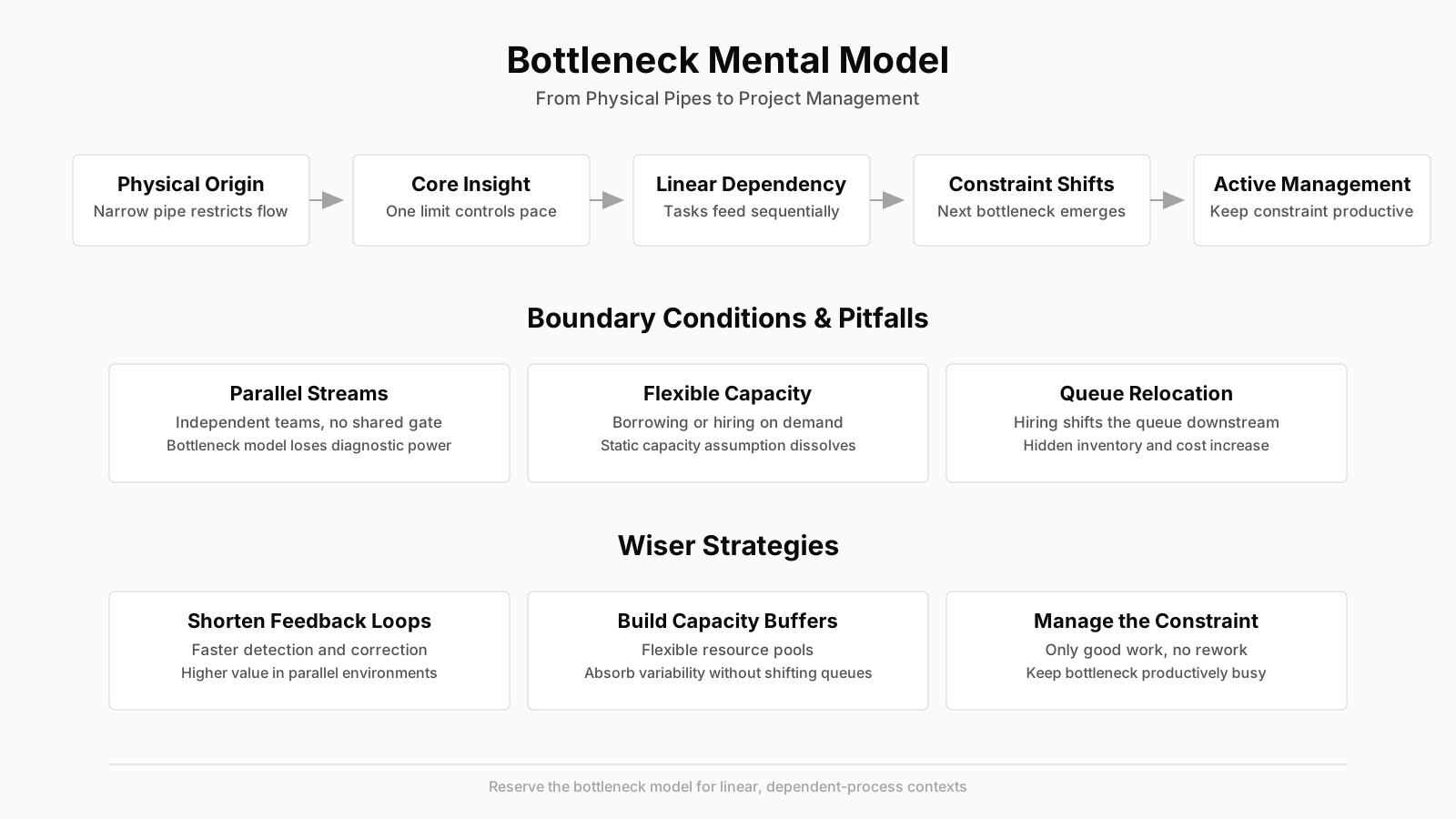
A bottleneck in project management is defined as any point in a workflow, process, or resource chain where the capacity to complete work is less than the demand placed upon it, causing work to queue, delays to accumulate, and overall throughput to degrade. The term is borrowed directly from the physical neck of a bottle, the narrowest part that restricts the rate at which liquid can pour out. In projects, the bottleneck is the constraint that dictates the maximum speed at which a task sequence, phase, or entire initiative can progress, regardless of how efficiently other stages operate. When a bottleneck exists, all upstream activities pile up behind it, and all downstream activities starve for input, creating a rhythm of congestion and idle time that frustrates teams and erodes schedule predictability.
Bottlenecks: Key Topics at a Glance
| Key Concept | Summary |
|---|---|
| Core Definition | A bottleneck is any process step or resource where demand consistently exceeds capacity, causing work to queue, delays to cascade, and overall throughput to degrade. |
| System Constraint | It functions as the primary constraint that sets the absolute pace for a task sequence, project phase, or the entire effort, independent of how efficiently other stages operate. |
| Operational Impact | Bottlenecks force upstream work to pile up while downstream activities remain starved, creating congestion, idle time, team frustration, and eroded schedule predictability. |
| Common Manifestations | Typical examples include a uniquely skilled specialist, a sequential approval gate that serializes decisions, an under-provisioned testing environment, or a documentation standard that triggers iterative rework loops. |
| Strategic Management | Rather than attempting to eliminate all bottlenecks, the objective is to identify the active one, maximize its output, subordinate non-bottleneck activities to protect that output, and only then elevate its capacity. |
| Origins & Evolution | The concept was formalized in project management through Goldratt’s Critical Chain method, later reinforced by Lean’s pursuit of flow efficiency and Agile’s emphasis on limiting work in progress. |
| Concealed Bottlenecks | Bottlenecks often hide in invisible forms such as slow approval chains, decision latency, or cognitive overload. The absence of obvious backlogs is deceptive; queues can manifest as unanswered emails, pending sign-offs, or growing mental to-do lists. |
| Systemic Redesign | The goal is to reconfigure the surrounding system so the constraint does not resurface, consistent with waste reduction principles: overburdening resources and rejecting otherwise acceptable work are preventable losses. |
What Is a Bottleneck in Project Management?
The definition of a bottleneck in project management centers on a mismatch between load and capability at a specific node in the project system. That node might be a person with a unique skill who cannot keep pace with incoming requests, a review gate that requires sequential approvals from an overbooked governance board, a testing environment that lacks sufficient server capacity, or a documentation standard that creates rework loops. What distinguishes a genuine bottleneck from ordinary busyness is its systemic effect. A developer working at full capacity is not a bottleneck if downstream testing can still consume her output without waiting. She becomes a bottleneck only when the queue in front of her workstation begins to grow and the testing team repeatedly falls idle while awaiting her deliverables.
Project management literature draws heavily on the Theory of Constraints, popularized by Eliyahu Goldratt in the manufacturing context, to explain bottlenecks. The central idea is that every system has exactly one tightest constraint at any given moment, and improving anything other than that constraint yields zero additional throughput. In a project setting, the bottleneck may shift as work progresses, which means project managers must continually re-evaluate where the constraint currently lives. A project that starts with a bottleneck in architectural design might later encounter a bottleneck in procurement lead times or end-user acceptance testing. The challenge is never to eliminate bottlenecks entirely (that would require infinite capacity) but rather to identify the active one, exploit it to its maximum productive output, subordinate all other activities to it, and then elevate its capacity if necessary. When the bottleneck moves, the cycle repeats.
Origins of the Bottleneck Concept
The bottleneck concept originated outside project management, in fields where physical flow rates visibly determined success. Manufacturing plants observed it on production lines, where the slowest machine or work station dictated the pace of the entire factory floor. In logistics, bottlenecks appear as port congestion or warehouse throughput constraints. Software engineering inherited the metaphor from hardware systems, where a slow processor or limited memory bus throttles entire application performance. These cross-industry roots gave project management a rich vocabulary for describing invisible constraints that affect knowledge work. While a factory bottleneck can be seen and touched, a project bottleneck often hides in approval processes, decision-making latency, or cognitive overload on a specific subject matter expert. The concept entered formal project management discipline gradually, first through the critical chain method, which explicitly addresses resource constraints as the primary driver of project duration, and later through lean and Agile thinking that made flow efficiency a central concern.
Key Characteristics of Bottlenecks
A bottleneck exhibits several identifiable traits that help practitioners distinguish it from other performance problems. The most obvious is a persistent queue of work items waiting to enter a specific activity, while downstream activities regularly run out of work. Utilization at the bottleneck point hovers consistently near one hundred percent, while non-bottleneck resources experience uneven demand, sometimes overworked and sometimes idle. Throughput of the entire value stream becomes equal to the throughput of the bottleneck, which means that measuring project velocity at any other point provides a false picture of progress. The bottleneck also tends to have a cascading effect on risk. When it breaks, fails, or faces an unexpected delay, the entire project feels it immediately. By contrast, a delay at a non-constraint resource can often be absorbed by slack elsewhere.
Another crucial characteristic is that the bottleneck almost always has a protective layer of accumulated work-in-progress in front of it. Project teams sometimes misinterpret the absence of an obvious pileup as evidence that no bottleneck exists, but in knowledge work, the pileup may exist in the form of ignored emails, unread change requests, or mental to-do lists rather than physical inventory. The psychological component matters as well: bottlenecks often become invisible because the person or team at the constraint develops coping mechanisms that mask the queue. They start working overtime, cutting corners, or sequencing tasks in a way that prioritizes urgent firefighting over steady flow. This makes the bottleneck harder to spot but does not remove its systemic impact.
Key Insights on Project Bottlenecks
- Definition of a bottleneck
- A bottleneck occurs when the volume of work arriving at a specific step consistently exceeds that step's processing capacity, throttling the flow of deliverables.
- Common bottleneck forms
- Common bottlenecks include a specialist whose expertise creates a single-threaded resource, a review gate demanding serial approvals, a shared testing environment with limited slots, and rigid documentation standards that trigger repetitive revision cycles.
- Rooted in the Theory of Constraints
- Grounded in Goldratt's Theory of Constraints, the principle asserts that every system has exactly one tightest constraint at any given moment, and efforts spent elsewhere deliver no increase in throughput.
- Bottlenecks shift during projects
- As a project progresses, the binding constraint often migrates from architectural design to procurement lead times and later to user acceptance testing, so managers must continually reassess where it currently resides.
- Manage rather than eliminate
- Since eliminating all bottlenecks would demand infinite capacity, the practical objective is to identify the active constraint, exploit its maximum output, subordinate all other activities to its pace, and only then expand capacity when necessary.
Bottlenecks in Project Management Frameworks
Bottlenecks in Predictive and PMBOK Environments
Within the PMBOK framework, bottlenecks are most frequently encountered in the context of resource management and schedule management knowledge areas. The Process Groups do not dedicate a standalone process to bottleneck identification, but the concept permeates the Develop Schedule and Control Schedule processes, especially when using critical path method analysis. A bottleneck on a critical path activity is lethal because it directly delays the project end date. Bottlenecks on non-critical path activities are less dangerous but can still starve successor tasks and increase the risk that the activity becomes critical. In the Plan Resource Management process, project managers identify critical resources whose scarcity threatens flow. These resources, whether human experts or specialized equipment, are bottleneck candidates. The Monitor and Control Project Work process then provides the feedback loops for detecting when actual performance reveals an emerging constraint. EVA (Earned Value Analysis) can sometimes hint at bottlenecks when the Schedule Performance Index drops while the Cost Performance Index holds steady, suggesting that money is being spent but outputs are not arriving because work is stuck somewhere.
Bottlenecks in PRINCE2
PRINCE2 addresses bottlenecks indirectly through its principle of management by stages and its emphasis on controlled handoffs between processes. The Managing Product Delivery process is where bottlenecks frequently materialize, particularly at quality review gates and during product handoffs from one team to another. PRINCE2’s quality review technique requires that review panels convene with enough time and authority to approve products, and any delay at this approval stage creates a bottleneck that halts subsequent work packages. The Managing a Stage Boundary process provides a formal moment to reflect on whether bottlenecks in the current stage are predictable for the next stage, allowing the project manager to adjust Work Packages or stage plans accordingly. However, PRINCE2 does not prescribe specific bottleneck analysis tools. Practitioners often supplement it with techniques from other disciplines, such as cumulative flow diagrams or simple work-in-progress limits, to visualise queuing behaviour between PRINCE2’s defined processes.
Bottlenecks in Agile and Hybrid Approaches
Agile methodologies bring bottleneck management to the forefront by making work visible on Kanban boards and Scrum task boards. A visual board immediately exposes where cards are piling up. In Scrum, the Daily Scrum meeting often reveals bottlenecks when team members consistently report that they are waiting for code review from a particular colleague or for test data from an external team. Sprint retrospectives examine flow data, and bottlenecks that repeatedly limit sprint velocity become focal points for process improvement experiments. Kanban systems explicitly define work-in-progress limits per column precisely to prevent queues from forming at a bottleneck. When a column reaches its WIP limit, team members must swarm to that column to help clear the blockage rather than pulling new work. This is subordination to the constraint in action. In hybrid environments that blend predictive planning with iterative delivery, bottlenecks often emerge at the integration points. A predictive hardware procurement process can become the bottleneck for an Agile software team that needs the physical device to test features. Managing these hybrid bottlenecks requires cross-functional collaboration and realistic rolling-wave planning that acknowledges the constraint’s lead time.
BVOP Perspective on Bottlenecks
Business Value-Oriented Project Management treats bottlenecks as a form of process damage that silently degrades the flow of business value to stakeholders. Within BVOPM, when a bottleneck persists, it generates invisible organizational harm by delaying feedback loops, increasing work-in-progress, and consuming team morale. The methodology’s approach to monitoring and controlling emphasizes tracking Business Value Points, and a persistent decline in those points may signal an unresolved bottleneck in a critical value stream. BVOPM encourages cross-functional teams to minimise handoff-induced delays and to detect bottlenecks early through transparent issue boards. The focus is not solely on accelerating the bottleneck but on redesigning the surrounding system so that the constraint does not continuously recur, aligning with the BVOPM principle of waste reduction where overwork and rejected acceptable work are categorized as avoidable losses.
Practical Application and Common Scenarios
Applying bottleneck theory in real project management involves more than academic recognition; it demands shifting the team’s mindset away from local efficiency toward global throughput. A typical scenario arises in software projects with a designated architect or principal engineer who must approve every significant design decision. As the project scales, a queue of design requests forms. Developers work around the queue by making local assumptions, creating rework later. The project manager’s instinct might be to add more developers, but that only lengthens the queue. The systemic response is to subordinate all other activities to the architect’s approval capacity. This might mean pre-filtering requests, batch-processing similar decisions, or temporarily reducing feature scope until the bottleneck is elevated by training others to share the approval authority.
Another common scenario occurs in construction or infrastructure projects where a single piece of heavy machinery must perform multiple sequential operations. The bottleneck is physical and obvious, but project managers still sometimes schedule other trades on site prematurely, expecting the bottleneck machine to catch up. The result is idle labour costs and safety congestion. In pharmaceutical validation projects, a bottleneck often sits at the quality assurance documentation review desk, where too few qualified reviewers face a mountain of batch records. Delaying submission for regulatory approval can cascade into market launch delays worth enormous sums. Each scenario reinforces the same lesson: the health of the whole project is not measured by how busy everyone is, but by how smoothly work passes through the tightest constraint.
Identifying Bottlenecks in Real Projects
Identification methods range from simple observation to quantitative flow metrics. Walking the Gemba, or the actual place where work happens, reveals queues that might not appear on Gantt charts. A project manager who routinely checks team folders for a growing backlog of unprocessed change requests, or who notices that the same person’s name comes up in every Standup as a blocker, is practicing bottleneck detection. Cumulative flow diagrams (CFDs) provide a data-driven view: a widening band on a CFD indicates work arriving faster than it departs a particular column, a telltale bottleneck signature. Cycle time scatterplots show clusters of high cycle times for specific activity types. In highly constrained environments, Little’s Law can be applied to estimate the waiting time as work-in-progress divided by throughput, and when the calculated waiting time is unacceptably high, a bottleneck is at work.
Common Misconceptions About Bottlenecks
One persistent misconception is that a bottleneck is always a bad thing to be eliminated. In reality, a stable, known bottleneck is far preferable to a system with shifting, unpredictable constraints. A project can plan around a well-understood bottleneck; it cannot plan around random capacity crashes. Another fallacy is that adding resources to a bottleneck always helps. If the bottleneck is caused by coordination overhead rather than pure capacity shortfall, adding more people can worsen the situation through increased communication paths and decision latency. Some project managers mistakenly believe that if everyone is busy, no bottleneck exists. High utilisation across all resources is often the symptom of a badly managed constraint, because non-bottleneck resources have been loaded to match the bottleneck, removing all protective capacity and creating a fragile system where any hiccup triggers delay cascades. The most dangerous misconception, however, is that bottlenecks only exist in manufacturing. In project environments, the bottleneck might be an approval culture, a contracting process, or even the project manager themselves if all decisions require their personal sign-off.
Core Insights on Bottleneck Management
- Shift focus to global throughput
- Effective bottleneck management requires reorienting team priorities toward overall system throughput, deliberately subordinating the efficiency of individual resources to accelerate project delivery.
- Real-world bottleneck examples
- In practice, constraints manifest as a single design authority whose approval blocks all code releases, a critical excavator that governs the entire earthmoving sequence, or an understaffed QA team struggling to clear pharmaceutical batch documentation, which stalls downstream operations.
- Detect constraints using flow metrics
- Managers identify bottlenecks by monitoring growing queues, repeatedly encountering the same person or team as a blocker, or analyzing cumulative flow diagrams where a widening band signals that work is arriving faster than it is being completed at a particular stage.
Relationships to Other Project Management Concepts
Bottlenecks and constraints are closely related but not interchangeable in project management terminology. A constraint is any limitation that restricts the project’s degrees of freedom: time, cost, scope, quality, risk, resources. A bottleneck is a specific type of constraint dynamic that restricts throughput within the project’s operational flow. The critical path method analyzes task dependencies and durations to find the longest sequence of dependent tasks, which is a time bottleneck, but it assumes unlimited resources. The critical chain method adds resource dependencies to the analysis and treats resource constraints as the primary bottleneck drivers, buffering the project accordingly. Bottlenecks also relate to the concept of work-in-progress limits from Kanban; both seek to prevent overloading the constraint. In portfolio management, a bottleneck might shift to the portfolio level when too many projects compete for a single enterprise architecture review board or a finite capital budget. The systemic thinking is the same: you improve portfolio throughput by optimizing the capacity of that board, not by launching more projects in parallel.
Bottlenecks vs. Critical Path
A common confusion arises between the bottleneck and the critical path. The critical path is a network of logically dependent tasks with the least total float; any delay on a critical path task delays the project finish date. A bottleneck may or may not lie on the critical path. A resource that is a bottleneck for pipeline flow could be on a non-critical branch that nevertheless starves the critical path later. Likewise, a critical path task can be resource-loaded without being a bottleneck if it has plenty of capacity to handle its workload. The key distinction is that the critical path is a schedule network artifact, while a bottleneck is a flow and capacity artifact. Understanding both is necessary because a project can be on schedule from a critical path perspective yet hemorrhaging flow from a bottleneck that will eventually push the critical path off track when a non-critical branch goes critical due to starvation.
Bottlenecks and Resource Management
Resource management processes aim to assign the right people to the right tasks at the right time, and bottlenecks are essentially resource management failures made visible. When a WBS (Work Breakdown Structure) decomposes work into packages without accounting for the limited throughput of a specific specialist, the resulting schedule contains an embedded bottleneck that will reveal itself the moment execution begins. Resource histograms and levelling algorithms attempt to smooth peaks, but they often mask the underlying constraint instead of exposing it. A project manager who embraces bottleneck theory will intentionally over-allocate the constraint resource in the plan while slightly under-allocating non-constraint resources to create protective capacity. This looks inefficient on paper but produces far more reliable flow in execution. The conflict between traditional utilisation metrics and constraint-aware planning remains a source of tension in many organisations.
Bottlenecks and Risk
Bottlenecks amplify project risk in specific ways. A single-point-of-failure resource bottleneck introduces key person dependency risk. If the bottleneck person becomes ill or leaves, the project stalls entirely. Bottlenecks also increase integration risk because work completed by non-constraint resources sits in queue and can grow stale, leading to compatibility issues when it finally meets the bottleneck’s output. Schedule risk concentrates around the bottleneck, because any variance at the constraint translates one-to-one into project delay. Risk response planning often overlooks the bottleneck because risk registers focus on events rather than systemic capacity constraints. A more mature approach treats the existence of an unmanaged bottleneck as a risk in itself, quantifying its potential impact on the project end date and developing mitigation strategies that might include cross-training, buffer management, or temporary external capacity.
Evolution and Current Thinking on Bottlenecks
The evolution of bottleneck management in project environments has moved from purely reactive identification toward proactive system design. In the early days of project management, bottlenecks were managed reactively: the project hit a wall, a hero was dispatched to fix it, and the cycle repeated. The influence of lean thinking shifted the emphasis toward preventing bottlenecks through pull systems and continuous flow. The Theory of Constraints introduced the five focusing steps and the concept of a drum-buffer-rope scheduling mechanism adapted from manufacturing to projects as critical chain. Today, the Agile and DevOps movements have normalized the idea that flow efficiency is a primary success metric, and that optimizing for flow means accepting that some resources will intentionally have slack. The debate now centers on whether a project should design its process around a single known bottleneck or whether it should invest in multi-skilled, cross-functional teams that make bottlenecks dynamic and easier to share across the team.
Another strain of thinking explores the role of cognitive bottlenecks in knowledge work. Research into task switching and cognitive load suggests that knowledge workers who are forced to juggle multiple parallel streams become bottlenecks not because of skill shortages but because of mental context switching. This insight is leading some organisations to enforce single-piece flow even in white-collar work, ensuring that a developer, for instance, works on exactly one feature until it reaches a certain state before picking up another. This reduces the hidden queue forming in the worker’s head. The growing use of flow metrics like flow time, flow efficiency, and work item age is making bottlenecks more visible at enterprise levels, not just within individual teams. Portfolio managers now examine cumulative flow diagrams across multiple projects to spot enterprise-wide bottlenecks in functions like legal review, security assessment, or user acceptance testing, and they are beginning to manage these constraints at the portfolio level rather than firefighting them project by project.
Core Insights on Bottleneck Management
- Reactive to proactive evolution
- Bottleneck management has evolved from relying on heroic individual interventions after failures occur to building systems that prevent constraints through lean thinking, the Theory of Constraints, and flow-based methodologies.
- Single constraint versus dynamic teams
- The current debate focuses on whether to design processes around one identifiable bottleneck or to invest in cross-functional teams that distribute work dynamically, making constraints more visible and collectively manageable.
- Cognitive switching creates bottlenecks
- Knowledge workers become bottlenecks not from lack of skill but from the mental toll of constant context switching across multiple streams, which has led some organizations to enforce single-piece flow even in cognitive work.
- Enterprise flow metrics visibility
- Flow metrics such as flow time, flow efficiency, and work item age now surface bottlenecks at the portfolio level, enabling managers to systematically address constraints like legal review or security assessment across all projects rather than reacting to each instance separately.
Challenges and Pitfalls in Managing Bottlenecks
The practical reality of managing bottlenecks is riddled with organisational resistance. Declaring a specific team member or department as the bottleneck often provokes defensive behaviour, even when the declaration is factual and non-judgmental. People conflate “bottleneck” with “underperformer,” when in reality the bottleneck is usually a consequence of system design. Another pitfall is elevating a bottleneck’s capacity without checking whether the constraint will simply move to a more dangerous location. A project that speeds up a design approval bottleneck by hiring a second architect might find that testing becomes the new bottleneck, and testing delays are far costlier because they occur later in the lifecycle when rework is exponentially more expensive. This is why the Theory of Constraints insists on subordinating and exploiting before elevating.
Measuring bottlenecks incorrectly also causes problems. Using throughput as the sole metric can incentivise pushing work through the bottleneck without adequate quality checks, creating a downstream rework bottleneck that is worse than the original. Some project offices attempt to impose global solutions like standardised WIP limits across all teams, ignoring that a team’s bottleneck might be unique to its context. A common failure mode is treating a temporary spike in workload as a structural bottleneck and overreacting by permanently increasing capacity, only to incur carrying costs when demand normalises. Seasoned practitioners distinguish between capacity bottlenecks (structural lack of resource throughput) and coordination bottlenecks (excessive dependencies that slow decision-making). The latter are often cultural and cannot be solved by adding headcount. Ultimately, managing bottlenecks is not about perfection but about maintaining a dynamic, honest conversation in the project team about where work is actually getting stuck, and having the courage to subordinate local optimisations to the benefit of the whole project flow.