Cost Plus Incentive Fee (CPIF) is a cost-reimbursable contract type in project procurement management under which the buyer reimburses the seller for all allowable costs incurred during contract performance and pays an additional fee that varies based on the seller’s performance against negotiated targets. Unlike a cost plus fixed fee contract, the incentive fee is not fixed; it increases or decreases according to a formula that shares cost underruns and overruns between the buyer and the seller. The arrangement is intended to motivate the seller to control costs and meet performance objectives while limiting the buyer’s exposure to runaway profits based purely on spending. CPIF contracts appear most often in complex procurement environments where cost uncertainty is high but performance can still be measured against agreed baselines.
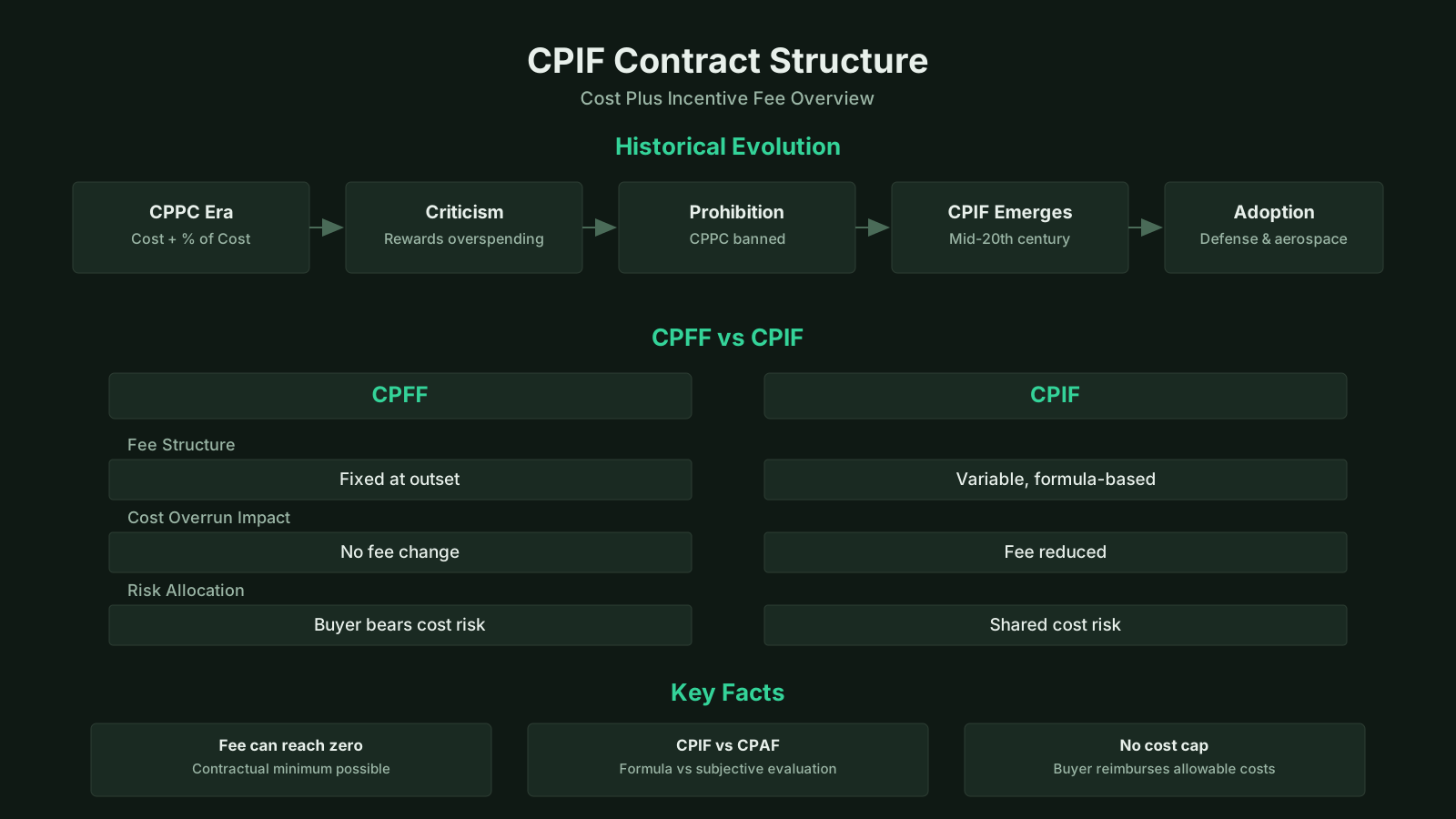
Cost Plus Incentive Fee: Key Topics at a Glance
| Key Concept | Summary |
|---|---|
| CPIF Definition | Cost Plus Incentive Fee is a cost-reimbursable contract in which the buyer reimburses all allowable costs and pays an additional fee that is adjusted according to the seller's performance against negotiated cost and performance targets. |
| Incentive Fee | Unlike a cost plus fixed fee arrangement, the incentive fee is variable rather than fixed and is determined through a negotiated formula that shares cost underruns and overruns between the buyer and the seller. |
| Purpose | The arrangement motivates the seller to control costs and meet performance objectives while preventing the buyer from paying excessive fees that arise solely from higher spending. |
| Target Cost | The fee rises or falls according to the variance between final actual cost and the pre-agreed target cost, giving the seller a direct financial stake in delivering below the target. |
| Best Use | CPIF is most effective when the buyer needs to retain technical direction while giving the seller a strong financial incentive to avoid unnecessary spending and improve cost efficiency. |
| Fee Limits | Fee adjustments are typically bounded by minimum and maximum caps to shield both parties from extreme cost outcomes and maintain a balanced risk profile. |
| Seller Share | A higher seller share, such as 50 percent, strengthens the incentive for cost discipline but also increases the seller's exposure to fee volatility as actual costs deviate from the target. |
| Risk Concern | If the incentive is too weak, the seller may underbid to win the contract and then suffer substantial fee erosion when actual costs exceed the target, potentially undermining performance quality. |
What Is Cost Plus Incentive Fee?
A precise cost plus incentive fee definition describes a cost-reimbursable contract in which the seller receives reimbursement for allowable project costs plus a fee that is adjusted upward or downward based on the relationship between final actual cost and a pre-agreed target cost. The buyer assumes most of the cost risk, but the fee adjustment creates a shared financial stake in cost performance. This is different from a fixed-price contract, where the seller absorbs the full difference between the agreed price and actual cost. It is also different from a cost plus fixed fee contract, where the fee remains constant regardless of cost performance.
The contract type belongs to a broader family of cost-reimbursable procurement instruments that also includes cost plus fixed fee and cost plus award fee. In project management, the choice of contract type is a strategic decision made during procurement planning, not an administrative detail. The contract structure directly shapes seller behavior, risk allocation, and the level of oversight required from the buyer. CPIF is especially relevant when the buyer wants to retain control over technical direction but still wants the seller to have a financial reason to avoid unnecessary spending.
Cost Plus Incentive Fee in Project Management
Within project management practice, a CPIF contract governs the commercial relationship between the performing organization and an external supplier or contractor. The project manager and procurement team define the target cost, target fee, share ratio, and fee limits before solicitation begins. These elements become part of the procurement documents and later part of the signed contract. During execution, the project team tracks actual costs against the target and calculates the fee adjustment according to the agreed formula.
The primary value of CPIF in project management is that it preserves flexibility for scope clarification while still incentivizing cost discipline. A pure cost-reimbursable contract without incentives can lead to cost indifference because the seller has no financial reason to spend less. By adding an incentive structure, the buyer gives the seller a direct economic interest in beating the target cost or schedule. At the same time, the fee adjustment is often subject to minimum and maximum limits to protect both parties from extreme outcomes.
How Cost Plus Incentive Fee Works
The mechanics of a CPIF contract revolve around a simple formula. The final fee equals the target fee plus an incentive amount derived from the difference between the target cost and the actual cost, multiplied by the seller’s share ratio. For example, if the target cost is $1 million, the target fee is $100,000, and the seller share ratio is 30 percent, an actual cost of $900,000 creates a cost underrun of $100,000. The seller receives 30 percent of that underrun, or $30,000, added to the target fee, resulting in a final fee of $130,000. If actual cost rises to $1,050,000, the overrun is $50,000 and the fee falls to $85,000, assuming no floor applies.
The total contract price is the actual cost plus the final fee. The buyer pays the actual cost regardless of whether it is above or below target, subject to allowability rules. The seller’s profit is not the entire underrun but only the share specified in the contract. This structure means the buyer benefits from cost savings through a lower total payout while the seller benefits through a higher fee. It also means both parties share the pain of overruns, unlike a cost plus fixed fee contract where the fee stays constant.
Key Takeaways on CPIF Contracts
- Definition and fee structure
- A CPIF contract reimburses the seller for all allowable project costs and adds an incentive fee that varies directly with cost performance, increasing when final actual costs fall below the negotiated target cost and decreasing when they exceed it.
- Shared cost risk
- Although the buyer retains the majority of cost risk, the variable incentive fee aligns seller and buyer interests, giving the seller a direct financial stake in controlling unnecessary spending and improving cost efficiency.
- Distinct from other contracts
- Compared with fixed-price and cost plus fixed fee contracts, CPIF arrangements tie seller compensation to actual cost outcomes through a negotiated incentive mechanism, rather than fixing the fee in advance or shifting all cost risk to the seller.
- Strategic procurement planning
- Selecting a CPIF contract is a strategic procurement planning decision in which the project team establishes target cost, target fee, share ratio, and fee limits before solicitation begins.
Key Components of a Cost Plus Incentive Fee Contract
The key components of a cost plus incentive fee contract are the target cost, target fee, share ratio, minimum fee, maximum fee, and the definition of allowable costs. Each component influences the behavior of the seller and the financial exposure of the buyer. These elements are negotiated before contract award and are documented in the contract terms and conditions. If any component is poorly defined, the incentive effect can disappear or produce unintended consequences.
Target Cost and Target Fee
The target cost is an estimate of the expected allowable cost of completing the contracted work. It serves as the reference point against which performance is measured. The target fee is the amount of profit the seller would earn if actual cost exactly equals the target cost. Together, these two figures create a baseline that both parties accept as a reasonable expectation at the time of contracting.
Target cost and target fee must be realistic. If the target cost is set too high, the seller can overrun without penalty and still appear to perform well. If it is set too low, the seller may underbid to win work and then face severe fee erosion when costs exceed target. In practice, target cost negotiations often resemble scope negotiations because every scope clarification can shift the expected cost. The project manager needs a well-developed work breakdown structure and cost estimate before these numbers can be defended.
Share Ratio and Fee Adjustment Formula
The share ratio determines how cost underruns and overruns are divided between the buyer and the seller. A common split is 70/30, meaning the buyer retains 70 percent of any underrun and the seller receives 30 percent as additional fee. For overruns, the same ratio applies in reverse, reducing the seller’s fee by its share of the overrun. The share ratio can be symmetrical or asymmetrical depending on the risk appetite of the parties and the nature of the work.
A high seller share, such as 50 percent, creates a stronger incentive for cost control but also exposes the seller to greater fee volatility. A low seller share, such as 10 percent, reduces that incentive and moves the contract closer to a cost plus fixed fee arrangement. The fee adjustment formula is normally expressed in the contract in mathematical terms to avoid ambiguity. In addition to cost incentives, some contracts include separate schedule or technical performance incentives, but the core CPIF formula focuses on cost.
Minimum and Maximum Fee
Most CPIF contracts include a minimum fee and a maximum fee. The minimum fee protects the seller from excessive fee erosion when cost overruns are large. The maximum fee caps the seller’s upside when cost underruns are significant. These limits prevent the seller from earning an unreasonable profit from underestimated targets or from being driven to zero profit by circumstances beyond its control.
The fee range also affects the seller’s motivation. If the maximum fee is close to the target fee, the incentive to beat the target is weak because the potential reward is small. If the minimum fee is close to the target fee, the seller has little fear of overrun and may not control costs aggressively. The range should therefore be wide enough to drive meaningful behavior change but narrow enough to keep total contract cost within the buyer’s tolerance. The exact limits are a commercial decision, not a technical formula.
Cost Plus Incentive Fee in PMBOK and Other Frameworks
The Cost Plus Incentive Fee in PMBOK framework sits within the Project Procurement Management knowledge area, specifically during Plan Procurement Management and Control Procurements. PMBOK describes contract types as a key input to the procurement management plan and source selection criteria. The choice of CPIF affects how the buyer evaluates proposals, monitors seller performance, and manages changes. PMBOK does not prescribe one contract type as universally superior; it directs project teams to select the type based on risk, scope clarity, and market conditions.
PMBOK Process Groups and Knowledge Areas
In the PMBOK framework, CPIF selection occurs during the planning process group when the procurement management plan is developed. The project manager and procurement specialists analyze the scope of work, the degree of cost risk, and the ability to write measurable performance targets. The decision to use CPIF is documented in the procurement strategy, and the specific incentive formula appears in the request for proposal or invitation to bid. During monitoring and controlling, the buyer tracks actual cost and calculates incentive adjustments as part of Control Procurements.
Control Procurements also includes managing claims, reviewing contractor performance, and verifying that costs claimed by the seller are allowable and allocable under the contract. The cost-reimbursable nature of CPIF means the buyer has a legitimate interest in auditing seller records. The project manager may work with finance and contract administration personnel to review invoices, labor rates, and indirect cost rates. This level of oversight is greater than in fixed-price contracts but is a normal feature of CPIF arrangements.
PRINCE2 Perspective
PRINCE2 does not define contract types in the same level of detail as PMBOK, but it treats supplier relationships within the commercial management theme of a project. The project board and senior supplier role must understand how the selected contract type influences delivery risk. In PRINCE2, the business case remains the central control document, and a CPIF contract can support the business case by limiting fee escalation while still allowing cost flexibility.
PRINCE2’s emphasis on management stages and tolerances creates a natural fit with CPIF because the buyer and seller can review cost performance at stage boundaries. The incentive formula can be recalculated as the project board approves each stage plan. This allows the project board to maintain control without renegotiating the entire contract. However, PRINCE2 does not prescribe the CPIF mechanism; it leaves contract type selection to organizational procurement policy and commercial judgment.
Agile and Hybrid Contexts
In Agile and hybrid projects, CPIF contracts appear less frequently than in traditional predictive procurement, but they can be adapted for situations where scope evolves through iterative delivery. A hybrid arrangement might use CPIF for the overall engagement while using fixed-price increments for well-defined sprints or work packages. The incentive component may focus on cycle time, defect density, or delivered business value rather than only cost performance.
A challenge in Agile settings is that target cost becomes meaningful only if there is enough upfront scope definition to estimate total effort. Many Agile projects intentionally avoid detailed upfront scope, which makes target cost estimation difficult. In such cases, a cost plus fixed fee or time and materials arrangement may be more appropriate. When CPIF is used in an Agile context, the incentive criteria should be reviewed frequently because product backlog changes can alter the cost baseline and make the original target obsolete.
Key CPIF Framework Insights
- CPIF within PMBOK structure
- CPIF is situated within the Project Procurement Management knowledge area and spans the Plan Procurement Management and Control Procurements processes.
- Risk-driven contract type selection
- PMBOK guides project teams to select a contract type by evaluating risk allocation, scope clarity, and market conditions, rather than assuming one contract form is inherently superior to another.
- CPIF documented in procurement strategy
- Once CPIF is selected, the procurement strategy documents the rationale, and the detailed incentive fee formula is embedded in the request for proposal or invitation to bid.
- Cost verification under Control Procurements
- In the Control Procurements process, the buyer monitors contractor performance, administers claims, and confirms that seller costs meet the contract's allowability and allocability requirements.
- PRINCE2 aligns with CPIF
- PRINCE2 supports CPIF effectively because its business case discipline and stage tolerance controls align with a contract structure that caps fee escalation while allowing controlled cost flexibility and formal stage boundary reviews.
Purpose and Importance of Cost Plus Incentive Fee
The core purpose of cost plus incentive fee is to create shared financial motivation for cost efficiency and schedule performance without shifting excessive risk to the seller. The buyer wants the seller to control costs, but the buyer also accepts that the actual cost may legitimately exceed the original estimate due to technical uncertainty. CPIF provides a middle ground between fixed-price contracts, which can produce disputes over scope changes, and cost plus fixed fee contracts, which offer no cost-control incentive.
Aligning Buyer and Seller Interests
The incentive mechanism directly aligns the seller’s profit interest with the buyer’s cost-control interest. When the seller reduces costs below target, both parties benefit. When costs exceed target, both parties lose something. This shared consequence reduces the adversarial friction that often appears in fixed-price contracts when the seller tries to protect margin by minimizing scope or resisting change. Because CPIF rewards cost savings, it can encourage constructive suggestions for efficiency improvements.
The alignment is not perfect, however. The seller may still focus only on the specific metrics that drive the incentive fee while ignoring longer-term quality or maintainability concerns. The buyer must therefore design the incentive criteria carefully and monitor performance beyond cost alone. The purpose of CPIF is not to make the buyer’s oversight unnecessary; it is to create a commercial reason for the seller to care about the same cost outcomes the buyer cares about.
Risk Allocation
Under CPIF, the buyer retains most of the cost risk because the buyer reimburses allowable actual costs even if they exceed the target. The seller bears the risk of reduced profit when costs overrun and gains additional profit when costs underrun. This allocation is reasonable when the buyer has greater ability to absorb cost uncertainty or when the work involves significant unknowns that the seller cannot reasonably price. The buyer also retains the risk of target cost being set incorrectly, which is why the target must be negotiated with care.
The seller’s risk is limited by the minimum fee, which ensures that even a severe overrun does not eliminate all profit. The buyer’s risk is limited by the maximum fee, which prevents the seller from earning excessive profit from a target that turned out to be too high. This bounded risk sharing is one of the main reasons CPIF is preferred over a pure cost plus percentage of cost arrangement, which is generally prohibited in many procurement regulations because it rewards spending rather than efficiency.
Cost Plus Incentive Fee vs Other Contract Types
A useful way to understand cost plus incentive fee vs other contract types is to compare fee adjustment mechanics and risk allocation. The adjacent contract types in the cost-reimbursable family are cost plus fixed fee and cost plus award fee. The adjacent type in the fixed-price family is fixed price incentive fee. Each creates different levels of seller motivation, buyer oversight, and financial exposure.
CPIF vs CPFF
A cost plus fixed fee contract reimburses allowable costs and pays a fixed fee that does not change with cost performance. The seller has no direct financial incentive to reduce cost below target because the fee stays the same. CPIF adds a variable component that increases the fee for underruns and decreases it for overruns. This makes CPIF more attractive when the buyer wants the seller to actively manage cost rather than simply report it.
CPFF is often used when the scope is so uncertain that setting a meaningful target cost is impossible, or when the buyer wants the seller to focus purely on technical quality without financial pressure. CPIF requires enough scope clarity to establish a target cost and enough performance measurability to calculate the incentive. Choosing between the two depends on whether a reliable target cost can be negotiated and whether cost control is a priority.
CPIF vs CPAF
A cost plus award fee contract also reimburses allowable costs and pays a fee, but the fee is determined subjectively by the buyer based on the seller’s performance against qualitative criteria. There is no formula that automatically adjusts the fee based on cost underruns or overruns. CPIF uses a predetermined mathematical share ratio, which gives the seller more certainty about how its fee will change. CPAF gives the buyer more discretion but can lead to disputes over whether the award decision was fair.
CPIF is generally preferred when cost performance can be measured objectively and both parties want a transparent incentive. CPAF may be used when the buyer wants to reward technical excellence, responsiveness, or other qualitative outcomes that are difficult to express in a formula. Some contracts combine both, using CPIF for cost and CPAF for technical performance, but this increases administrative complexity.
CPIF vs FPIF and Fixed-Price
A fixed price incentive fee contract includes a target cost, target profit, share ratio, and a price ceiling. If actual cost exceeds the ceiling, the seller must absorb all additional cost beyond that point. Under CPIF, the buyer reimburses all allowable actual costs regardless of how far above target they fall, subject to contract terms. The absence of a price ceiling in CPIF is a fundamental distinction because it means the buyer retains more cost risk.
A firm fixed price contract transfers almost all cost risk to the seller, who must deliver for the agreed price no matter what the actual cost turns out to be. CPIF is more appropriate when the buyer cannot fully specify the work or when forcing the seller to bear all cost risk would result in excessively high bid prices. The seller prices risk into fixed-price bids, and for highly uncertain work that premium can be substantial. CPIF avoids that risk premium while still giving the seller a reason to control costs.
Key Takeaways on CPIF Comparison
- CPFF lacks cost incentive
- Under a cost-plus-fixed-fee contract, the fee remains unchanged regardless of actual cost performance, which removes the seller's financial incentive to control spending and makes CPIF the stronger option when disciplined cost management is a priority.
- CPAF relies on subjective fees
- A cost-plus-award-fee contract determines the fee through the buyer's subjective judgment of performance against qualitative criteria, whereas CPIF uses objective, measurable cost targets tied to a predetermined formula to calculate the incentive.
- CPIF requires target cost clarity
- CPIF requires a well-defined scope so the parties can agree on a realistic target cost and measurable performance thresholds, while CPFF is better suited to highly uncertain scopes where establishing a meaningful target cost is impractical.
Practical Application of Cost Plus Incentive Fee
The cost plus incentive fee practical application is most appropriate when project scope is defined enough to estimate a target cost but uncertain enough to make a fixed price impractical. Such conditions often appear in research and development, complex engineering, defense procurement, and large construction projects. In these environments, the buyer expects that technical discoveries or site conditions may alter the cost, but still wants the seller to work against a disciplined baseline.
When to Use CPIF
CPIF works best when the buyer can define performance objectives and the seller can substantiate actual costs through an acceptable accounting system. The buyer must be willing to invest in cost verification and oversight. The seller must be willing to accept variable profit based on cost performance. If the buyer cannot verify costs or the seller’s cost accounting is opaque, CPIF creates a high risk of inflated claims and administrative conflict.
The contract type is less suitable for small, simple procurements where the cost of administration would exceed the benefit of incentive alignment. It is also less suitable when the primary objective is speed and not cost control. A time and materials contract may be simpler if the buyer can direct work in short increments. CPIF should not be used when the scope is so unstable that the target cost becomes meaningless within weeks of award.
Common Scenarios and Lifecycle Stage
The decision to use CPIF occurs during procurement planning, before the buyer issues a solicitation. The project manager and procurement team analyze the scope, the risk profile, and the seller market. CPIF may appear in the procurement strategy as the planned contract type, and the incentive formula is included in the request for proposal so that all potential sellers understand how their fee will be calculated. During source selection, the buyer evaluates proposals not only on target cost and fee but also on whether the proposed share ratio reflects a reasonable risk position.
After award, the contract enters the execution and control phase. The seller reports actual costs against the target at regular intervals. The buyer reviews these reports, verifies allowability, and calculates fee adjustments as part of payment processing. If the scope changes, the target cost and fee may need to be revised through a formal change order. The CPIF mechanism therefore requires ongoing contract administration discipline throughout the project lifecycle, not only at the negotiation stage.
Common Challenges, Pitfalls, and Misconceptions
The most common cost plus incentive fee pitfalls relate to incentive design, cost verification, and behavioral gaming. A poorly designed share ratio or fee range can neutralize the incentive effect. Weak cost verification can allow unallowable costs to enter the reimbursement stream. A narrow focus on cost can lead the seller to cut corners in ways that harm quality, safety, or long-term value. These pitfalls are not unique to CPIF, but the contract type amplifies them because the buyer is directly exposed to cost increases.
Administrative Burden and Cost Verification
CPIF contracts require a higher level of administration than fixed-price contracts. The buyer must review time sheets, material invoices, subcontractor costs, and indirect cost allocations. The seller must maintain an accounting system that meets the buyer’s standards for allowability and allocability. This burden can become a source of friction, especially if the buyer challenges costs that the seller considers legitimate.
In complex projects, the cost of administering the contract can be several percentage points of total contract value. Smaller organizations may not have the infrastructure to support this level of oversight. The buyer must be prepared to assign contract specialists, finance staff, and project controls personnel to manage the CPIF arrangement. If the buyer is not willing to make that investment, the contract can drift toward a de facto cost plus arrangement with little effective oversight.
Incentive Gaming and Metric Distortion
A common misconception is that the incentive formula automatically produces good behavior. In practice, sellers may shift costs between periods, defer maintenance, reduce testing, or use lower-cost materials to protect the fee. If the contract only measures cost performance, the seller may neglect quality indicators that are not part of the incentive formula. The buyer should therefore include non-cost performance measures in the evaluation criteria or pair the CPIF with technical performance standards.
The target cost itself can become a negotiation game. A seller may deliberately bid an unrealistically low target cost to win the contract, knowing that the minimum fee will protect it if actual costs exceed target. The buyer must test the realism of the target cost during source selection and reject proposals that appear intentionally low. Without that realism check, the CPIF formula rewards underbidding rather than actual efficiency.
Misconceptions About Risk Transfer
Some project managers believe that CPIF transfers significant cost risk to the seller because the seller’s fee decreases when costs overrun. That is true only for the profit portion. The seller still recovers all allowable costs, so the buyer bears most of the total cost risk. The seller’s risk is limited to fee erosion and the administrative burden of defending its cost claims. The buyer should not treat CPIF as a substitute for a fixed-price contract when it genuinely needs a ceiling on total price.
Another misconception is that the fee cap fully protects the buyer. The maximum fee limits profit, but it does not limit total cost. A CPIF contract can still result in very high total expenditure if actual costs spiral far above target. The buyer’s protection comes from oversight, realistic target setting, and the willingness to terminate or renegotiate if costs become unacceptable. The contract type is a management tool, not a guarantee of cost control.
Key Pitfalls in CPIF Contracts
- Flawed incentive design
- Poorly calibrated share ratios or fee ranges can neutralize the incentive fee's ability to drive contractor performance.
- Weak cost verification
- Inadequate scrutiny of timesheets, invoices, and indirect cost allocations allows unallowable expenses to enter the reimbursement stream undetected.
- Quality and value erosion
- An overemphasis on cost containment may lead contractors to cut corners that compromise quality, safety, or long-term value.
- Strategic underbidding risk
- Contractors may deliberately understate the target cost at bid stage to secure the contract, relying on the minimum fee to offset the impact of cost overruns.
Relationship to Other Project Management Concepts
Understanding cost plus incentive fee and earned value management helps project managers link contract incentives to objective cost and schedule performance data. Earned value management provides a structured way to compare planned value, earned value, and actual cost, which can support fee adjustment calculations in CPIF contracts. While CPIF does not require EVM, the two concepts complement each other because both rely on a disciplined cost baseline and regular performance measurement.
Procurement Planning and Make-or-Buy Analysis
CPIF is one option in the broader procurement planning process that includes make-or-buy analysis, market research, and source selection criteria. The project manager must determine whether external procurement is necessary and, if so, which contract type best balances risk and motivation. Make-or-buy analysis examines whether the work can be performed internally at lower risk or cost. If the decision is to buy, the contract type selection considers the same risk factors that drive the make-or-buy decision.
A CPIF contract often appears when the buyer decides to buy complex services or development work that is difficult to specify fully but can be measured against cost and schedule targets. The procurement management plan documents this decision and explains why a cost-reimbursable incentive structure is more appropriate than a fixed-price arrangement. The plan also defines the roles of the procurement team, the project team, and contract administration during execution.
Earned Value Management and Cost Control
In a CPIF contract, the buyer may use earned value management to track cost performance index and schedule performance index. These metrics help the project manager detect early signs of cost overrun or schedule delay that will affect the incentive fee. The seller may also maintain its own EVM system, and the two systems must be reconciled to avoid disputes over actual cost and earned value. When the buyer and seller use different accounting conventions, the project manager must establish clear rules for cost collection and progress measurement.
EVM also supports the negotiation of target cost revisions when scope changes occur. A change order that adds work should adjust the target cost and possibly the target fee. EVM data can show the impact of the change on the original baseline and provide a factual basis for the revised target. This reduces the guesswork and adversarial negotiation that often accompanies scope changes in cost-reimbursable contracts.
Risk Management and Contract Strategy
CPIF is fundamentally a risk management instrument. The buyer and seller use the contract structure to allocate cost risk according to their relative ability to manage it. The risk management plan should identify cost uncertainty as a risk and assign the appropriate response, which may include selecting a CPIF contract type. The share ratio itself is a form of risk sharing, and the fee limits are a form of risk mitigation for the seller.
The contract type also interacts with other risk responses such as contingency reserves, management reserves, and insurance requirements. The buyer may hold a contingency reserve to cover the possibility that actual costs exceed the target. The seller may hold its own reserves to cover fee erosion risk. In this way, CPIF sits within a larger risk management ecosystem rather than operating as an isolated commercial decision.
Evolution and Current Thinking
The evolution of cost plus incentive fee reflects a shift from defense-oriented cost control toward broader commercial and outcome-based applications. Early use of CPIF was concentrated in government procurement, particularly in aerospace and defense programs where technical uncertainty was high and cost reimbursement was standard. Over time, commercial buyers in construction, energy, information technology, and professional services adopted similar incentive structures to balance risk and motivation.
From Defense Procurement to Commercial Projects
The roots of CPIF lie in large government procurement environments where contractors could not reasonably bear all cost risk on experimental or development work. Government agencies needed a way to reimburse costs while still discouraging inefficiency. The incentive fee structure emerged as a refinement of cost plus fixed fee contracts, adding the share ratio and fee limits that are now standard. This history explains why CPIF contracts often carry detailed cost allowability rules and audit requirements.
In commercial settings, CPIF has been adapted for complex engineering, infrastructure, and software integration projects. Buyers apply the same logic: high cost uncertainty combined with a desire for seller cost discipline. The commercial version may be less formal than government procurement, but the core components remain the same. Some organizations use a simplified version in which the incentive is calculated at project completion rather than at regular intervals, reducing administrative overhead.
Current Debates and Best Practices
Current thinking around CPIF acknowledges both its strengths and its limits. There is ongoing debate about whether cost-based incentives are enough to drive value delivery or whether they merely encourage cost reduction at the expense of quality and innovation. Some practitioners argue for incentive criteria that include schedule, technical performance, safety, and customer satisfaction, not just cost. Others warn that too many incentive dimensions dilute the focus and create confusion.
Best practice has moved toward periodic review of target cost and share ratio rather than treating them as fixed for the entire contract. This is especially important in multi-year projects where market conditions, technology, and business priorities change. A target cost set at the beginning of a five-year project may lose relevance by year three. Rebaselining through formal change control keeps the incentive meaningful and reduces the likelihood of perverse behavior.
Business Value-Oriented Project Management treats incentive contracts as one tool for aligning vendor behavior with value delivery, but warns that poorly designed fee formulas can create process damage when sellers optimize for fee targets at the expense of quality, user outcomes, or long-term maintainability. A CPIF arrangement that focuses only on cost underruns may reduce spending while also reducing product utility. In that view, the incentive structure should be connected to value outcomes and reviewed alongside the broader value delivery system, not managed solely as a procurement artifact.
Key Insights on CPIF Evolution
- Origins in defense procurement
- CPIF contracts emerged in government aerospace and defense programs, where high technical uncertainty made conventional cost reimbursement structures inadequate for managing performance risk.
- Expansion into commercial markets
- Construction, energy, information technology, and professional services later adopted CPIF incentive structures to allocate risk more precisely while strengthening contractor incentives for cost control.
- Refinement of fixed fee model
- The incentive fee model evolved from cost plus fixed fee contracts through the introduction of share ratios and fee ceilings, features that continue to define modern CPIF agreements.
- Dangers of flawed fee formulas
- Flawed incentive formulas can drive sellers toward fee optimization at the expense of quality, user outcomes, and the long-term maintainability of deliverables.
