The Drexler Sibbet Team Performance Model is a team development framework that describes seven stages through which a team moves as it builds trust, clarifies purpose, commits to action, delivers results, and eventually renews or dissolves. Each stage is tied to a central question that team members must resolve sufficiently before the team can operate at the next level.
In project management the model is not a scheduling tool or a delivery methodology. It is a map of team dynamics used to diagnose where a project team is getting stuck. The model applies to newly formed project teams, cross-functional delivery groups, steering committees, and ongoing product teams. Its value comes from making visible the interpersonal and motivational issues that often sit underneath missed deadlines and poor communication.
Drexler Sibbet Model: Summary of Key Topics
| Key Concept | Summary |
|---|---|
| Model Overview | The Drexler Sibbet Team Performance Model structures team development into seven distinct stages, guiding teams from initial trust building and purpose alignment through sustained delivery and eventual renewal or closure. |
| Seven Stages | Each stage centers on a core question; when left unresolved, it triggers observable behaviors that signal stagnation, misalignment, or hidden resistance. |
| Applications | It adapts to newly formed project teams, cross-functional delivery groups, steering committees, and established product teams seeking a renewed sense of direction. |
| Practical Value | The model surfaces hidden interpersonal and motivational friction that typically underlies missed deadlines, weak engagement, and breakdowns in communication. |
| Typical Use | Facilitators and team coaches rely on it because it mirrors the private questions team members ask during new assignments, making unspoken concerns discussable and actionable. |
| Model Origins | Developers Drexler and Sibbet built the model from direct field work across corporate, nonprofit, and community settings, distilling recurring patterns that differentiate high-performing teams from those that stall. |
| Orientation Stage | Unresolved orientation shows up as disengagement, vague questioning, or private doubts about the project's rationale and business case, often before any formal resistance appears. |
| Cross-Functional Fit | The first two stages are critical for cross-functional initiatives, where members from different departments, vendors, or business units must align on shared purpose and mutual trust before technical work can proceed effectively. |
What Is the Drexler Sibbet Team Performance Model?
The Drexler Sibbet Team Performance Model definition centers on a sequence of seven team development stages, each with a guiding question. The stages are Orientation, Trust Building, Goal Clarification, Commitment, Implementation, High Performance, and Renewal. The model is descriptive rather than prescriptive. It does not tell a team what procedures to follow, but it does give a shared language for what is happening in the group.
In practice, a project team does not simply appear and begin delivering. Members first wonder why they are in the room. Then they assess whether they can trust the people around them. Only after those concerns are settled can the team meaningfully align on goals and commit to a plan. The model gives each of those concerns a name. That naming is often the first step in addressing a blockage.
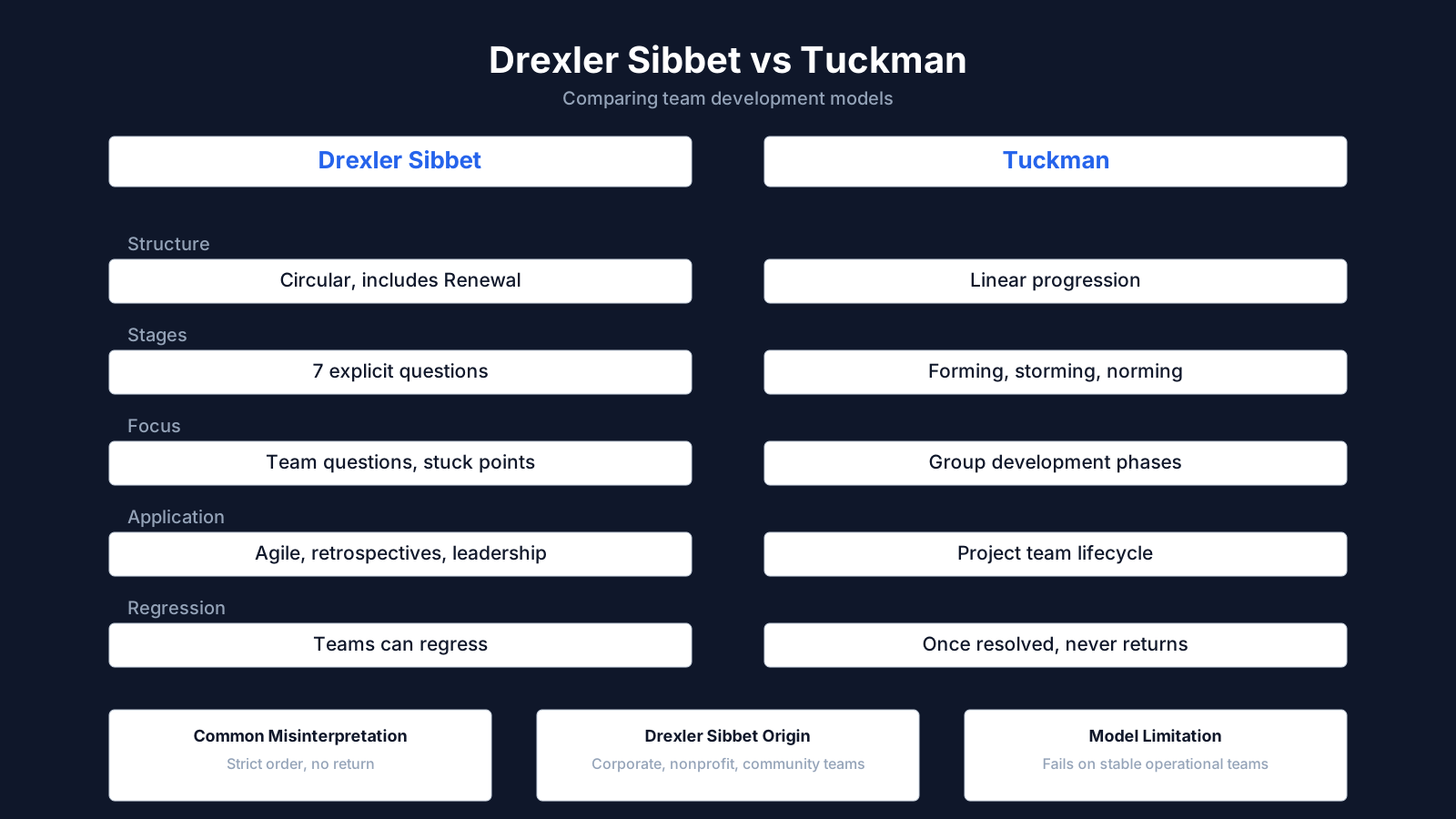
The model is widely used in facilitation and team coaching because it matches the natural questions people ask themselves, often privately, during a new assignment. It also accounts for the fact that teams can regress. A change in sponsor, a failed deliverable, or the arrival of a new member can pull a team back to an earlier stage. The circular representation of the model reflects this iterative quality.
Within project management the model functions as a team diagnostic rather than a process framework. It does not replace a project charter, a work breakdown structure, or a schedule. It complements those artifacts by addressing the human system that has to use them.
Core Insights on Team Stages
- Seven sequential development stages
- The model charts team development across seven stages, each anchored by a guiding question the group must resolve before it can progress.
- Descriptive, not prescriptive
- The model avoids prescribing specific procedures and instead gives teams a shared language for interpreting what is happening within the group.
- Answers members' natural questions
- Teams reach genuine alignment on goals and commit to plans only after members work through their early private concerns about why they are present and what their role should be.
- Team diagnostic, not process framework
- Within project management, the model serves as a diagnostic tool, and disruptions such as a new sponsor or a new team member can push the team back to earlier stages of development.
Origins and Development of the Drexler Sibbet Team Performance Model
The history of the Drexler Sibbet Team Performance Model begins with the work of Allan Drexler and David Sibbet in the 1980s. Drexler brought a background in organizational development and group process. Sibbet brought expertise in graphic facilitation and visual thinking. They developed the model while working with teams in corporate, nonprofit, and community settings, observing recurring patterns in how teams succeeded or failed.
The model emerged from an interest in making group dynamics more accessible. Traditional team development theory was often described in academic language that practitioners did not use in real meetings. Drexler and Sibbet translated the underlying patterns into a simple visual map organized around questions. David Sibbet later popularized the model through Grove Consultants International and through books such as Visual Teams.
One distinction of the model is its explicit inclusion of Renewal. Earlier team development models often ended at performing or adjourning. Drexler and Sibbet recognized that many teams do not disband after reaching high performance. They shift purpose, absorb new members, or take on new work. The Renewal stage gives attention to that transition instead of treating it as an afterthought.
Although the model is not part of the PMBOK Guide, its intellectual roots overlap with widely accepted group development research. It sits in the same tradition as Tuckman's stages of team development, but it was designed to be used in facilitated workshops rather than only as a theoretical description.
Key Components of the Drexler Sibbet Team Performance Model
The key components of the Drexler Sibbet Team Performance Model are the seven stages, each defined by a central question and a set of unresolved behaviors that appear when the question is not answered. These stages are Orientation, Trust Building, Goal Clarification, Commitment, Implementation, High Performance, and Renewal.
Orientation and Trust Building
Orientation is the first stage, associated with the question "Why am I here?" Team members need to understand the purpose of the team, their own reason for being included, and what is expected of them. In a project environment this maps to the project kickoff, the sponsor's explanation of business need, and the initial statement of scope. When orientation is unresolved, members may appear disengaged, ask vague questions, or hold private doubts about whether the project makes sense.
Trust Building follows, centered on the question "Who are you?" At this stage team members assess each other's competence, reliability, and intentions. They begin to form the working relationships that will carry the project through difficult moments. Trust in this model is not a warm and fuzzy ideal. It is the practical confidence that colleagues will share information, admit mistakes, and follow through. Without that confidence, teams tend to withhold bad news until it is too late.
These first two stages matter more in cross-functional projects where members come from different departments, vendors, or business units. A project manager may see polite behavior in meetings while hidden mistrust slows decisions. The model points to that gap by separating Orientation from Trust Building instead of merging them into one broad forming phase.
Goal Clarification and Commitment
Goal Clarification answers the question "What are we doing?" Here the team develops a shared understanding of objectives, deliverables, boundaries, and success criteria. This is the stage where a project charter and scope statement become more than documents. They become a collective mental model. If different members have different pictures of the goal, the team will produce fragmented work even with a well-written plan.
Commitment addresses "How will we do it?" Team members move from agreeing that the goal is correct to accepting their part in the effort. Commitment is not simply the project manager assigning tasks. It involves resource availability, sequencing, risk tolerance, and the willingness to make trade-offs. Unresolved commitment often shows up as passive resistance, missed deadlines, or a team that agrees in the meeting and renegotiates immediately afterward.
Implementation and High Performance
Implementation answers "Who does what, when, and where?" This is where the project plan becomes actual work. Coordination, handoffs, progress reporting, and problem solving dominate daily activity. The model recognizes that a team can be highly skilled in task execution and still underperform if earlier stages were not resolved. Implementation failures are often symptoms of a gap in trust or goal clarity rather than a lack of technical ability.
High Performance is the stage often labeled with the question "Wow!" The team operates with a high degree of synergy. Members anticipate needs, flex across roles, challenge each other productively, and produce outcomes that exceed the sum of individual contributions. Not every team reaches this stage. High performance is not a permanent condition. It can appear during a critical phase of the project and then fade under pressure or membership change.
Renewal
Renewal asks "Why continue?" Teams reflect on what they have accomplished, consider whether their purpose is still valid, and decide whether to evolve, pause, or close. In a project setting Renewal aligns with the closing process group and with lessons learned. It also applies to ongoing product teams that finish one release and need to reset before the next. Teams that skip Renewal often carry unresolved frustration into the next effort or simply drift without a clear reason to continue.
To make the stages concrete, think of a newly formed project team where one department does not trust another after a failed past initiative. The project manager might be pushing for a detailed schedule, but the team is still in Trust Building. Until that historical breach is acknowledged, the schedule will look like commitment on paper and fall apart in execution. The model gives the project manager a way to see that the problem is not poor planning but an unresolved earlier stage.
Seven Stages Core Insights
- Seven sequential performance stages
- The Drexler Sibbet Team Performance Model structures team development into seven sequential stages, each anchored by a defining question. When that question remains unresolved, it produces predictable stalls, conflict, or disengagement within the team.
- Orientation answers purpose questions
- During Orientation, team members clarify why the team exists, why they personally belong, and what is expected of them. In project settings, this maps to the kickoff meeting, the sponsor's business rationale, and the initial scope statement.
- Trust building fosters practical confidence
- Trust Building cultivates the interpersonal reliability and psychological safety needed for colleagues to share information openly, admit mistakes without fear, and honor commitments. This foundation is especially critical in cross-functional project teams, where differing backgrounds and priorities can otherwise create friction.
- Distinct orientation and trust stages
- By keeping Orientation distinct from Trust Building, the model underscores that understanding shared purpose and developing relational confidence require different conversations and interventions.
Drexler Sibbet Model in Project Management and PRINCE2
The Drexler Sibbet model in project management functions as an applied team development tool within the broader people management processes of the PMBOK framework. The PMBOK Guide does not name the Drexler Sibbet model as a required technique. However, the model fits naturally within the Develop Team and Manage Team processes. Those processes emphasize improving competencies, team interaction, and the overall team environment. Team performance assessments, one of the outputs of Develop Team, can be structured around the seven stages to identify where intervention is needed.
The model also aligns with the PMBOK Guide's acknowledgment of Tuckman's stages as a widely used model for team development. Drexler and Sibbet offer a more granular alternative. Project managers who find Tuckman too broad can use the seven questions to pinpoint whether a team is stuck because of trust or because of unclear goals. That distinction matters because the corrective action is different in each case.
In the PMBOK Guide Sixth Edition, team development sits in the Project Resource Management knowledge area. In the Seventh Edition, the focus shifts from process groups to project management principles and performance domains. The Team performance domain explicitly addresses shared ownership, trust, and high-performing teams. The Drexler Sibbet model supports that domain by providing a structured vocabulary for team health. It also connects to the project team charter and working agreements, artifacts that teams use to make expectations explicit.
PRINCE2 does not prescribe a specific team development model. Its method separates the Project Board, Project Manager, and Team Manager roles, and it delegates delivery through work packages. The Drexler Sibbet model can still be used by a Team Manager or Project Manager to assess whether the delivery team is ready to accept work packages with the necessary autonomy. PRINCE2's emphasis on defined roles and management by exception presumes a level of trust and clarity that the model helps create. When a PRINCE2 team repeatedly escalates issues or asks for more direction than expected, the cause may be an unresolved stage rather than a process failure.
From a Business Value-Oriented Project Management perspective, the model connects with that methodology's requirement for cross-functional teams as a core success factor. The stages give substance to the shared purpose and commitment that cross-functional teams need before they can deliver value reliably.
Drexler Sibbet Model in Agile and Hybrid Environments
The Drexler Sibbet model in Agile environments is often used by Scrum Masters, Agile coaches, and product delivery leads to support team formation and continuous improvement. Agile methods assume that small, self-managing teams can deliver valuable increments quickly. That assumption depends on team maturity. A new Scrum team that has not resolved trust or commitment issues will not produce a potentially shippable increment just because a sprint cadence has been set.
Agile frameworks do not mandate a particular team development model. The Scrum Guide describes the Scrum Team's roles and accountabilities but does not explain how the team matures psychologically. Coaches therefore bring in models like Drexler
Key Insights on Agile Team Maturity
Practical Application of the Drexler Sibbet Model in Projects
The practical application of the Drexler Sibbet model occurs most often during project initiation, team formation, and major transition points. Project managers and facilitators use it to design kickoff meetings, structure team development workshops, and diagnose performance problems. It is not a step-by-step checklist. The model works best as a lens for interpreting team behavior and choosing interventions.
During project initiation, the sponsor and project manager can address the first two stages directly. Orientation is handled by explaining the business case, the project's strategic fit, and the reason each person was selected. Trust Building is supported through introductions, discussion of working preferences, and early agreements on how the team will communicate and escalate issues. Skipping these stages to get to planning often creates a false start.
During planning, the Goal Clarification and Commitment stages become central. A work breakdown structure and schedule are only as good as the shared understanding behind them. Facilitating a discussion around "What are we doing?" can reveal differences in interpretation that would otherwise surface later as scope disagreements. A separate conversation around "How will we do it?" surfaces resource conflicts, risk tolerance, and the level of autonomy the team expects.
During execution, the model helps interpret frictions that appear in team meetings, status reports, and quality issues. If a team is missing deadlines despite clear plans, the problem may not be task management. It may be unresolved trust or ambiguous commitment. A project manager who sees the pattern can shift from tightening controls to facilitating the needed team conversation.
At project closure, the Renewal stage provides a frame for lessons learned and transition planning. Rather than rushing to disband after the final deliverable, the team can reflect on what it learned and how relationships should carry into future work. For teams that will continue into a new phase or program, Renewal resets the team's sense of purpose and prevents drift.
A subtle point in practice is that team stages are not always sequential. A team can move into Implementation and then regress to Trust Building when a key member leaves. The model allows for that movement. Project managers who treat team development as a one-time event at kickoff will miss the regression and react to symptoms instead of causes.
In practical terms the model is closer to a weather map than a road map. It tells you what conditions the team is moving through, not the exact route to take. That distinction keeps the model useful across different industries and delivery approaches.
Common Challenges and Misconceptions About the Drexler Sibbet Model
One of the most common misconceptions about the Drexler Sibbet model is that it is a linear process. Project teams do not start at Orientation and move neatly through to Renewal. They loop, skip stages, and sometimes move backward. A team that appears to commit during planning may rediscover trust issues during execution when the plan forces hard conversations. Treating the stages as a rigid sequence reduces the model to a mechanical exercise.
Another misconception is that High Performance is the normal end state for a high-functioning team. The model describes High Performance as a stage that some teams reach under the right conditions. It is not a permanent plateau. Pressure, membership changes, or external interference can pull a team out of High Performance quickly. Teams that believe they have "arrived" can become complacent and ignore early signs of decline.
Managers sometimes ignore the early stages because they seem soft compared with task planning. This is a common challenge. A project manager under schedule pressure may skip Orientation and Trust Building to get to the schedule. The result is often a plan that looks complete but lacks the team's real commitment. Later the project suffers from passive resistance, hidden conflicts, and missed handoffs.
The model also has limitations in very short-lived or highly transactional teams. A team assembled for a two-day task may not need deep Trust Building or Renewal. Applying the model too heavily in that setting can feel like unnecessary process. The practitioner has to judge how much team development attention is proportionate to the project's complexity and duration.
Virtual and hybrid work environments add another challenge. Trust Building depends on repeated small interactions that are harder to replicate remotely. Teams may believe they have resolved Trust Building because video meetings are friendly, but the absence of informal contact can leave unstated doubts in place. Facilitation in these settings requires more explicit design.
Some practitioners confuse the Drexler Sibbet model with Tuckman's stages and assume they can be used interchangeably. While they cover similar ground, the questions and granularity differ. Treating them as identical loses the diagnostic value of the seven stages, especially the distinction between Goal Clarification and Commitment, which Tuckman does not separate in the same way.
Challenges and Model Misconceptions
- Model is not linear
- Team development is recursive rather than sequential; execution pressures routinely push teams back into earlier work on trust, commitment, or role clarity before they can sustain later stages.
- High Performance is temporary
- High Performance is a conditional state, not a permanent achievement; teams frequently regress under pressure, membership turnover, or external disruption, so sustained excellence requires continuous attention and reinforcement.
- Confusing diagnostic value with Tuckman
- A common error is to treat the seven stages as a simple relabeling of Tuckman's framework or to mistake cordial video meetings for fully established trust, which overlooks critical distinctions such as the gap between Goal Clarification and true Commitment.
Relationship to Other Team Development Models and Project Tools
The Drexler Sibbet model vs Tuckman comparison is useful for understanding what each framework offers. Tuckman describes five broad stages: forming, storming, norming, performing, and adjourning. Drexler and Sibbet provide seven stages with explicit questions. The Drexler Sibbet model separates trust building and goal clarification from commitment, while Tuckman groups much of that into forming and norming. Tuckman also places conflict in a distinct storming stage. The Drexler Sibbet model treats conflict as a possible symptom of unresolved trust, goals, or commitment rather than as a stage in itself.
The model also overlaps with Patrick Lencioni's Five Dysfunctions of a Team. Lencioni identifies absence of trust, fear of conflict, lack of commitment, avoidance of accountability, and inattention to results. Both frameworks emphasize trust as foundational. The Drexler Sibbet model adds a fuller lifecycle view, including high performance and renewal, while Lencioni focuses on dysfunction and remediation.
Within project management artifacts, the model connects to the team charter, working agreements, and team performance assessments. A team charter can be structured around the seven questions, making each stage explicit at the start of the project. Working agreements can support Trust Building and Commitment by defining how disagreements are handled and how decisions are made. Team performance assessments can use the seven stages as diagnostic categories to track progress beyond simple morale surveys.
The model also relates to stakeholder engagement. A project team that has not resolved its own Goal Clarification will struggle to communicate a coherent picture to stakeholders. Conversely, stakeholder ambiguity can pull a team back into Goal Clarification even after planning is complete. The model helps project managers connect internal team dynamics with the broader stakeholder environment instead of treating them as separate concerns.
In the broader project management ecosystem, the Drexler Sibbet model is a people-focused complement to task-focused tools such as the work breakdown structure, RACI matrix, and critical path method. Those tools organize the work. The model organizes the human system doing the work. Both are necessary, but they answer different questions.
Evolution and Current Thinking on the Drexler Sibbet Team Performance Model
The current thinking on the Drexler Sibbet Team Performance Model reflects a broader shift away from rigid stage-based descriptions of team life. Teams today are often fluid, distributed, and assembled around temporary work streams. Researchers and practitioners increasingly treat stage models as useful heuristics rather than universal truths. The Drexler Sibbet model has remained relevant because it was designed with questions and visuals, which makes it flexible in complex settings.
One evolution is the integration of the model with graphic facilitation and visual collaboration tools. David Sibbet's work on visual teams brought the model into workshops where participants map their current stage on a large graphic template. That visual use has translated well to virtual whiteboards and remote facilitation platforms. Teams can collectively assess where they are and where they are stuck without needing a facilitator to diagnose them from outside.
Another shift is the growing recognition that high performance is context-dependent. A team may perform at a high level for a limited phase of the project and then return to a more routine mode. Current thinking is less likely to treat High Performance as a badge of permanent excellence and more likely to see it as a state that requires conditions, focus, and periodic renewal. This matches the model's own circular logic.
There is also debate about the universality of the stages. Some practitioners argue that teams with high psychological safety or long-established working relationships may move through Orientation and Trust Building quickly or even bypass part of the normal sequence. Others point out that cultural differences shape how trust is established and how commitment is expressed. The model provides structure, but it should not be applied as a universal script. Facilitators need to adapt the questions to the cultural and organizational context.
The rise of Agile and hybrid delivery has renewed interest in team development frameworks. While Scrum and Kanban focus on flow and iteration, they do not eliminate the human dynamics that affect performance. Coaches often pair the Drexler Sibbet model with retrospective techniques, team health checks, and working agreements to give teams a way to talk about issues that metrics do not capture.
The model's emphasis on Renewal is particularly relevant in program and portfolio management. Programs often continue for years, but the teams within them change. Renewal allows a team to pause, assess its value, and recommit to a new phase. This prevents the drift that occurs when teams keep working out of habit after the original business problem has shifted.
As project management has moved from a primarily technical discipline to a broader leadership discipline, models like Drexler Sibbet have gained recognition. They address the reality that many project failures are traceable not to poor scheduling but to unresolved team dynamics. The model remains a practical, accessible tool for making those dynamics discussable and manageable.
Key Insights on Model Evolution
- Fluid teams need flexible models
- Researchers and practitioners increasingly treat stage models as flexible heuristics, recognizing that contemporary teams are fluid, distributed, and often assembled around short-term work streams.
- Visual tools expand model use
- David Sibbet's visual teams approach embedded the model into graphic facilitation, enabling workshop participants to locate their current stage on large visual templates and make team dynamics immediately visible.
- High Performance requires renewal
- High Performance is increasingly understood as a dynamic state requiring deliberate conditions, sustained focus, and periodic renewal rather than a permanent achievement.
- Experienced teams adapt the sequence
- Teams with strong psychological safety or well-established relationships often accelerate through Orientation and Trust Building, while coaches combine the model with retrospectives, team health checks, and working agreements to surface issues that quantitative metrics overlook.
