In the world of project management, the term “buyer” refers to the organization or individual that acquires products, services, or results from an external seller through a formal contractual agreement. The buyer in agreements and contracts sits at the center of procurement activities, defining what needs to be purchased, selecting a supplier, negotiating terms, and then overseeing performance to ensure that project deliverables meet the specified requirements. Unlike a casual purchaser, the project buyer operates within a disciplined framework of procurement management, where every step—from a make-or-buy decision to contract closeout—follows established processes that protect the project’s scope, schedule, and budget.
Buyer in Contracts: Summary of Key Topics
| Key Concept | Summary |
|---|---|
| Buyer Definition | The buyer is the organization or individual that formally procures products, services, or outcomes from an external seller through a legally binding contractual agreement. |
| Procurement Role | The buyer occupies the central role in procurement, systematically defining requirements, evaluating and selecting suppliers, negotiating contractual terms, and monitoring performance to secure deliverables that meet specifications. |
| Project Framework | Distinct from an ad-hoc purchaser, the project buyer functions within a structured procurement management framework that safeguards scope, schedule, and budget across the full continuum from make-or-buy analysis through contract closeout. |
| Contract Ownership | Upon contract execution, the buyer assumes ownership of all contractual obligations, actively tracking progress, approving milestone payments, managing change control, and making formal acceptance or rejection decisions on deliverables. |
| PRINCE2 View | PRINCE2 does not define a distinct buyer role; instead, the Customer or Senior User assumes the buyer function to ensure that project outputs align with business requirements and investment constraints. |
| Historical Origins | The buyer construct originates from centuries-old commercial law and supply chain traditions, predating modern project management methodologies. |
| Industrial Influence | The Industrial Revolution institutionalized procurement functions, while mid-20th century government and defense initiatives imposed rigorous acquisition standards that heavily influenced the PMBOK's framing of the buyer role. |
| Lifecycle Integration | Project management embeds the buyer within the full project lifecycle; procurement decisions are directly linked to the work breakdown structure, risk register, and master schedule, positioning the buyer as a critical stakeholder with continuous input. |
Definition and Core Meaning of the Buyer in Project Contracts
The buyer in project management procurement is formally defined as the party that solicits and contracts for goods, services, or outcomes to fulfill project needs. Project management frameworks avoid using the term loosely. In the PMBOK Guide, the buyer is the entity that acquires the products or services, while the seller provides them. This buyer-seller pairing is fundamental to the Project Procurement Management knowledge area. The buyer can be a single person, a department, or an entire organization, but the role carries clear legal and administrative responsibilities. The moment a contract is signed, the buyer assumes ownership of the agreement’s obligations—monitoring progress, authorizing payments, handling change requests, and ultimately accepting or rejecting deliverables.
Across different methodologies, the label shifts slightly. PRINCE2 does not use the word “buyer” as a defined role, but the customer or Senior User typically represents the buyer function, making sure the project’s outputs align with commercial needs and funding constraints. Agile environments often blur the lines between buyer and end user. When an organization hires an external Agile team, the internal product owner acts as the buyer’s proxy, continuously clarifying requirements and inspecting increments. The conceptual anchor remains the same: the buyer is the party that commits organizational funds and bears the risk if the seller fails to deliver. Understanding this definition clarifies why so many project controls revolve around the buyer’s rights, obligations, and limitations.
A common mental model is to think of the buyer not as a passive recipient of goods, but as an active orchestrator of the acquisition chain. Even in small projects, the buyer writes the statement of work, determines evaluation criteria, and structures the contract type. The sheer weight of these decisions shapes both project success and the long-term relationship with the seller.
Distinction from Related Terms
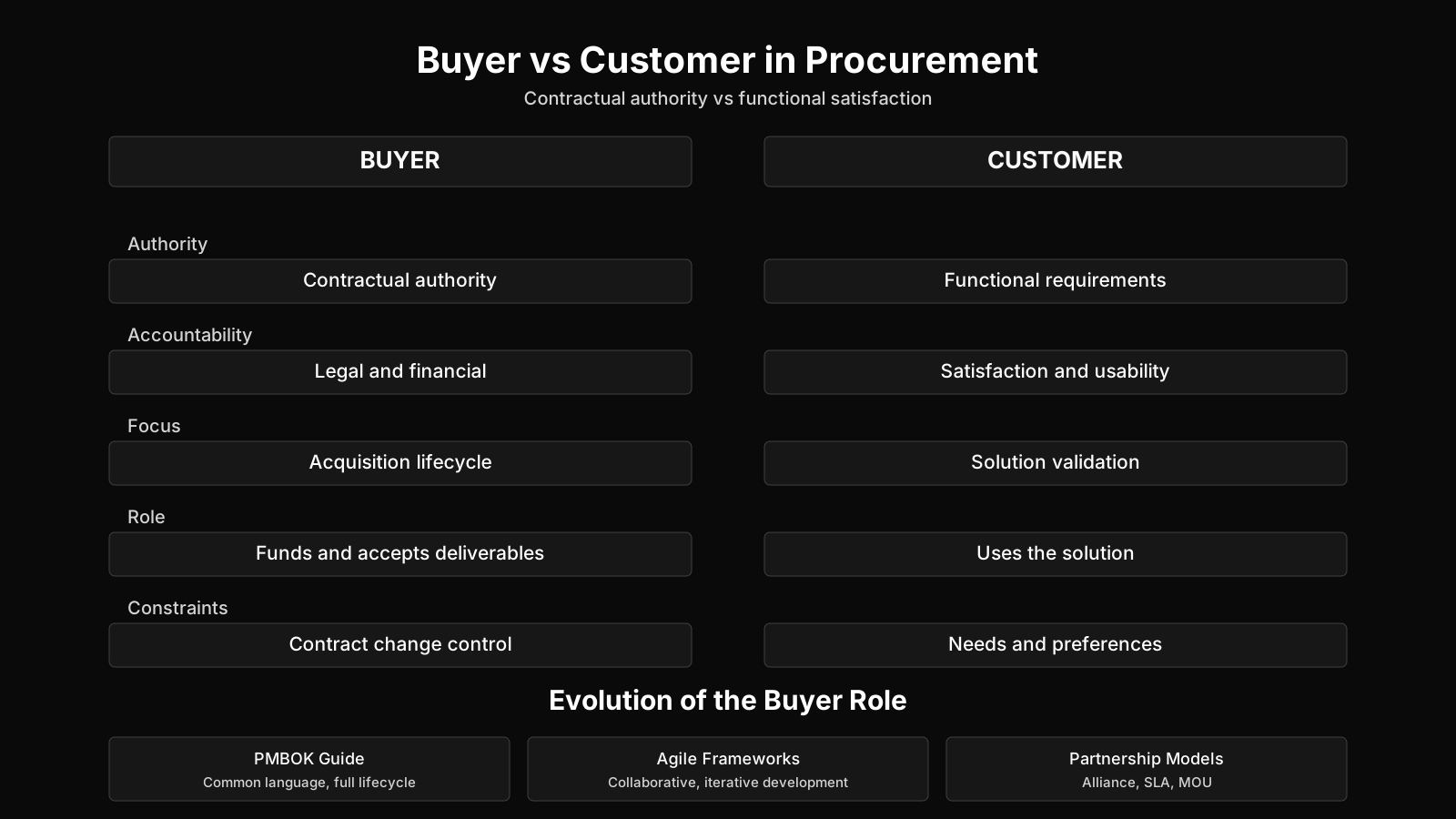
In everyday language, “buyer,” “customer,” and “sponsor” are often used interchangeably, but project management draws sharp distinctions. The buyer is specifically the contracting party with a financial and legal stake in the procurement. The customer is the end-user who will ultimately employ the product or service; sometimes the same organization wears both hats, but not always. The sponsor, meanwhile, champions the project and secures funding but may delegate the nuts-and-bolts procurement work to a specialist buyer. Confusing these roles can lead to contract misalignment, where the person signing the agreement does not fully represent the users who will actually work with the result. This nuance matters a great deal when requirements are complex and user involvement is scattered across multiple departments.
Key Insights on the Buyer's Role
- Formal definition of the buyer
- The buyer is the organizational entity that actively solicits and contracts for the goods, services, or outcomes needed to achieve project goals, thereby creating the central buyer-seller dynamic that shapes the entire procurement cycle.
- Contractual duties and risks
- After contract award, the buyer must continually monitor seller performance, authorize payments, manage change requests, and formally accept deliverables, while also absorbing the commercial risks that arise from seller non-performance or delay.
- Buyer across project methodologies
- PMBOK formally distinguishes the buyer and seller; PRINCE2 vests the buying role in the customer or Senior User; and Agile methodologies appoint the product owner as the buyer's proxy, meaning the buyer consistently acts as the active orchestrator who translates project needs into tailored procurement activities.
Origins and Cross-Industry Context of the Buyer Concept
The origin of the buyer role in contracts traces back to commercial law and supply chain practices that predate modern project management by centuries. Merchants, builders, and ship captains have always needed to acquire materials and labor through agreements that spelled out what was being exchanged and at what price. The industrial revolution formalized procurement departments within manufacturing enterprises, and by the mid-twentieth century, large-scale government and defense projects introduced rigorous procurement standards that heavily influenced the PMBOK’s treatment of the buyer. What project management inherited was not a fuzzy idea but a hardened discipline of bid evaluation, source selection, and contract administration that had been tested in high-stakes engineering environments.
In construction, the buyer is the project owner or developer who lets contracts to general contractors and specialty trades. In information technology, the buyer might be a corporate IT group contracting with systems integrators or cloud service providers. In pharmaceuticals, clinical research organizations serve as sellers to a buyer running a drug trial. Each industry tailors the buyer role, but the core expectation—that someone must define the need, select a capable partner, and enforce the agreement—remains constant. The project management profession adds a layer of formality, integrating the buyer into the project lifecycle so that procurement decisions are not made in a vacuum but are directly tied to the work breakdown structure, risk register, and master schedule.
When the concept moved from pure commerce into the project realm, something important shifted: the buyer was no longer just a transactional figure but a key stakeholder whose decisions echo through the entire project plan. A poor selection of a vendor can break a critical path, while a well-negotiated incentive clause can accelerate delivery. This cross-pollination between traditional procurement and project management has, over time, created a much richer understanding of what the buyer actually does.
Key Components and Characteristics of the Buyer Role
Several key characteristics of a buyer in project contracts define how the role operates in practice. First, the buyer holds decision-making authority over what is purchased, under what terms, and from whom. This authority is rarely absolute; it is constrained by organizational policies, funding limits, and sometimes by procurement regulations. Second, the buyer carries a fiduciary responsibility to spend the organization’s money wisely, which means diligently comparing alternatives and documenting the rationale behind the chosen seller. Third, the buyer must be capable of translating technical requirements into contractual language that a seller can bid against without ambiguity. This bridging function between technical teams and legal or procurement specialists is one of the most underappreciated skills in project management.
The buyer is also the primary risk owner for the supply side of the project. If a key component arrives late, the buyer cannot simply blame the seller and move on; the project schedule slips and the buyer must manage the consequences, including claims and re-sequencing of work. For that reason, experienced buyers front-load risk assessment, building contingency into both the budget and the schedule while negotiating terms that provide advance warning of trouble. Many project failures that are attributed to “vendor problems” can be traced back to a buyer who underestimated the seller’s capacity or glossed over warning signs during the bid evaluation.
Authority, Accountability, and the Buying Center
In larger organizations, buying is not a solitary act. The buyer often operates within a “buying center” composed of technical evaluators, legal reviewers, and financial approvers. While one person may sign the contract, the real influence dance involves multiple stakeholders who each hold a piece of the puzzle. This distributed authority keeps the buyer honest but also introduces coordination overhead. A buyer who cannot align the buying center around clear priorities may find the procurement process stalling at the finish line. The inherent tension is that the buyer is accountable for the result even when the ultimate choice is shaped by others—a dynamic that seasoned project managers learn to navigate through transparent scoring models and early stakeholder engagement.
Buyer Behavior Across Different Contract Types
The buyer’s posture changes dramatically depending on the contract type chosen. Under a fixed-price contract, the buyer locks in a price and transfers significant cost risk to the seller, but must provide a meticulously defined scope to avoid expensive change orders later. Under a cost-reimbursable contract, the buyer retains more financial risk and therefore must invest in rigorous cost monitoring and auditing. Time-and-materials contracts blur the line even further, requiring the buyer to actively control daily burn rates. An effective buyer does not cling to a single contracting preference but matches the risk appetite of the organization with the nature of the work being procured. This decision is not merely a procurement formality; it fundamentally alters the working relationship between buyer and seller for the life of the project.
Core Takeaways on Buyer Role
- Limits on Authority, Full Accountability
- Although the buyer’s decision-making authority is bounded by funding limits, procurement policies, and organizational rules, the buyer retains ultimate accountability for project outcomes regardless of who influences the seller selection.
- Fiduciary Duty for Wise Spending
- The buyer’s fiduciary duty extends beyond cost comparison to include rigorous documentation of selection criteria, market analysis, and the strategic justification for each chosen vendor, ensuring every expenditure withstands scrutiny.
- Bridging Technical and Contractual Language
- A defining yet often underestimated buyer capability is converting complex technical specifications into clear, objective contract language that enables equitable bidding and reduces misinterpretation risk.
- Managing Delivery Risks and Consequences
- Seasoned buyers proactively integrate risk analysis into procurement planning, embed financial and timeline buffers, and secure contractual obligations for early warning signals, thereby mitigating delivery failures without resorting to post-hoc blame.
- Fixed-Price Contracts Demand Precise Scope
- While fixed-price contracts shift cost risk to the seller, the buyer must supply an exhaustively detailed scope of work, as any ambiguity invites costly change orders that erode the intended financial certainty.
The Buyer in Project Management Frameworks
In the PMBOK framework, the buyer in PMBOK procurement management is embedded in a structured sequence of processes. Plan Procurement Management kicks things off with a make-or-buy analysis, and it is the buyer who owns the output: a procurement management plan that lays out which items will be bought, when, and using which contract types. The Conduct Procurements process then sees the buyer issue procurement documents, solicit bids, select a seller, and finalize the agreement. Finally, Control Procurements keeps the buyer actively engaged through the execution phase, managing changes, monitoring performance, and closing out contracts. The framework treats the buyer as the principal actor who orchestrates these processes, even though parts may be executed by a dedicated procurement department.
PRINCE2 takes a governance-oriented approach. The Senior User, who represents the buyer’s interests at the Project Board, ensures that the project’s products will deliver the expected business benefits. While the Project Manager handles day-to-day procurement logistics, the Senior User retains final approval authority on deliverables. This separation prevents a project manager from single-handedly signing off on something that does not meet user needs. In practice, this means the buyer’s voice is embedded in the project’s highest-level decision body, which can cut through the bureaucracy when a contract issue threatens viability.
Agile and hybrid environments complicate the buyer role in interesting ways. When a buyer contracts with an external team to deliver using Scrum, the contract must accommodate iterative scope discovery. Traditional fixed-scope, fixed-price agreements can strangle an Agile effort. Progressive organizations adopt Agile-friendly contract structures—such as those that cap scope and allow frequent re-prioritization within budget envelopes—while still preserving the buyer’s right to inspect and steer. Here, the buyer becomes less a distant approver and more a continuous collaborator who participates in sprint reviews and, through an internal product owner, regularly reshapes the backlog. This evolution shifts the buyer’s focus from rigid compliance to outcome-centric partnership, without giving up the essential safeguard of a signed agreement.
Governance and Decision-Making Authority in Hybrid Models
Hybrid projects, blending predictive milestones with iterative development, introduce a dual-natured buyer. For the predictive scope, the buyer adheres to traditional change control and phased payments. For the iterative portion, the buyer must be comfortable with a rolling wave of detail, signing off on high-level requirements early but postponing fine-grained acceptance until later. Getting this right demands a governance model where the buyer can delegate day-to-day product decisions to a product owner while retaining escalation rights for budget, schedule, and legal matters. It is a difficult balance, but one that more organizations are learning to manage as they move away from pure waterfall procurement.
Practical Application and Use of the Buyer Role
In real project settings, the practical application of the buyer role rarely looks like a clean textbook diagram. A project manager in a mid-sized construction firm might simultaneously act as the buyer for subcontractor services, negotiating terms over the phone and then pushing paperwork through a centralized contracts office. In a large technology firm, the buyer function is split: the project manager defines the technical scope and evaluates proposals, while a corporate procurement officer handles pricing negotiations and legal terms. The most fluid arrangement emerges in smaller consultancies, where a partner both sells to clients and buys from freelancers, wearing the buyer hat with little formal support. Despite these variations, certain patterns recur.
The buyer typically becomes most active in the planning and execution phases. Early on, the buyer shapes the procurement strategy—deciding whether to go to a single source, run a competitive tender, or use a preferred supplier list. During execution, the buyer shifts to performance oversight, reviewing status reports, conducting acceptance tests, and authorizing milestone payments. When things go wrong, the buyer steps into the difficult territory of claims management, invoking remedies like liquidated damages or negotiating a settlement. The role therefore demands not just procurement knowledge but also negotiation, financial literacy, and a dash of diplomacy.
An example helps ground this. Imagine a buyer in a hospital network procuring a new patient management system. The buyer works with clinicians to draft a requirements document, releases a request for proposal to several software vendors, leads the technical and financial evaluation, selects a vendor, and then participates in monthly steering committee meetings throughout a two-year implementation. When the vendor delivers a module that does not integrate smoothly with existing lab equipment, the buyer must decide whether to accept a workaround, force a rework at the vendor’s cost, or trigger a dispute resolution clause. None of these choices are purely contractual; they are strategic decisions informed by project priorities and stakeholder tolerance.
Buyer Role Applications: Core Insights
- Varied buyer role structures
- Buyer roles differ markedly across sectors: construction managers often negotiate subcontractor agreements firsthand, technology firms separate technical evaluation from commercial negotiations, and small consultancies let partners procure freelance services with little central procurement support.
- Early procurement strategy decisions
- At the very outset, buyers determine the procurement approach by selecting from sole-source contracting, an open competitive tender, or a prequalified preferred supplier framework.
- Execution shifts to performance oversight
- Once implementation begins, the buyer tracks progress through status reports, formal acceptance testing, and milestone-linked payment authorizations, ensuring vendor accountability throughout the delivery phase.
- Claims management during problems
- When issues emerge, the buyer handles claims by invoking contractual levers such as liquidated damages or by negotiating a structured settlement to safeguard project value.
- End-to-end buyer engagement example
- A healthcare IT project illustrates the full cycle: the buyer works with clinicians to draft requirements, issues a request for proposals, evaluates submissions to choose a vendor, and then attends monthly steering committee meetings throughout a two-year implementation to maintain strategic oversight.
Common Challenges, Pitfalls, and Misconceptions
A persistent misconception about the buyer in project contracts is that the buyer’s job ends once the ink is dry on the agreement. In reality, post-award contract administration can consume as much effort as the sourcing phase. A buyer who disappears after signature leaves the project manager without the contractual muscle needed to hold an underperforming seller accountable. On the other end of the spectrum, buyers who micromanage every vendor decision risk poisoning the relationship and discouraging innovation. Navigating this middle path—sometimes called “trust but verify”—is a hallmark of experienced procurement professionals.
Another common pitfall is requirements myopia. Buyers sometimes focus so intently on technical specifications that they neglect commercial terms that can make or break the project. Payment milestones that do not align with measurable deliverables, for instance, can create cash flow problems and misaligned incentives. Similarly, acceptance criteria that are vaguely worded invite later disputes. Agile procurement introduces its own set of traps: a buyer who insists on a firm fixed-price for an Agile project often forces the seller to buffer risk, inflating the bid and reducing flexibility. Practitioners often observe that the hardest part of buying is not selecting the vendor, but precisely defining what “done” means in a way that both sides accept.
The buyer also contends with internal forces that can undermine procurement effectiveness. Budget holders may push for the cheapest bid against the buyer’s recommendation, only to see quality and schedule suffer. Legal departments might delay review cycles to the point where the project timeline is compromised. Recognizing these organizational dynamics is essential; the buyer cannot operate as an island but must build alliances within the project to push procurement decisions through efficiently.
When the Buyer Should Not Act Alone
There are scenarios where the buyer’s traditional authority must be deliberately constrained. In projects with high ethical risk—such as public-sector procurements or those involving close ties to specific vendors—the buyer should share the stage with independent evaluators and transparent scoring rubrics. Lonely buyers, left to judge proposals without checks and balances, become vulnerable to both actual conflicts of interest and the perception of bias. Good governance structures diffuse this risk, making the buying process defensible and fair even when outcomes are contested.
Relationships Between the Buyer and Other Project Management Concepts
The buyer exists in a dense web of interrelated terms, and understanding these relationships clarifies the entire procurement ecosystem. The relationship between buyer and seller in project management forms the most obvious pairing. The seller is the counterparty that delivers the contracted work, and the two sides are linked by a mutual set of obligations. This relationship is not static; it evolves from competitive tension during bidding to a more collaborative, and occasionally adversarial, posture during execution. Effective buyer-seller relationships are nurtured through clear communication protocols, shared risk registers, and joint escalation procedures that keep minor disagreements from ballooning into legal battles.
The buyer also interacts with the concept of the statement of work. The buyer authors or sponsors the SOW, and the clarity of that document directly affects the quality of proposals received and the stability of the contract. A blurry SOW produces divergent interpretations, while a tightly written one gives the buyer a firm baseline for evaluating seller performance. The procurement documents bundle—request for information, request for quotation, request for proposal—are all instruments the buyer uses to probe the market and structure competition. The smart buyer tailors the invitation to the complexity of the purchase, using an RFI to gather ideas before committing to a full-blown RFP.
Other touchpoints include the risk register, where procurement-related threats and opportunities are logged, and the project schedule, where vendor lead times and delivery milestones are integrated. Even earned value management can connect to the buyer role when cost-reimbursable contracts require the buyer to track actual costs against planned value to forecast final expenditures. Contract change control is perhaps the most critical intersection; the buyer is the gatekeeper who approves or rejects changes, and the discipline with which changes are managed often separates successful projects from those that bleed margin through uncontrolled modifications.
Core Takeaways on Buyer Relationships
- Evolving buyer-seller dynamic
- The dynamic shifts from the competitive tension of bidding to a collaborative yet occasionally adversarial relationship during execution, held together by clear communication protocols, shared risk registers, and joint escalation procedures.
- SOW clarity drives contract stability
- Since the buyer authors or sponsors the statement of work, a meticulously drafted SOW establishes an unambiguous baseline for evaluating seller performance, whereas a loosely defined one breeds misinterpretation and costly disputes.
- Interfaces with project tools
- The buyer links to the risk register to capture procurement-related threats and opportunities, aligns vendor lead times and delivery milestones within the project schedule, and applies earned value management for cost-reimbursable contracts to track actual costs against planned value.
- Change control as critical gate
- The buyer serves as the gatekeeper for contract changes, and disciplined change management often dictates whether a project meets its financial targets or erodes margin through uncontrolled modifications.
Evolution and Current Thinking on the Buyer Role
Modern thinking has transformed the evolution of the buyer role in procurement from a transaction enforcer to a relationship builder. Since the 1990s, project procurement has steadily shifted away from adversarial, claim-heavy contracting toward collaborative models that incentivize mutual gain. Concepts like relational contracting, partnering charters, and NEC4 forms of contract embed joint problem-solving mechanisms that ask the buyer to work with the seller before resorting to contract remedies. The buyer is still the party that holds the contract, but the expectation is now to exhaust all cooperative avenues first.
The rise of digital procurement platforms has also reshaped the buyer role. Automation handles reverse auctions, compliance checks, and even basic contract analytics, freeing the buyer to focus on strategic activities: market research, supplier development, and risk orchestration. Some critics worry that over-automation distances the buyer from the human nuances of the seller relationship, but the counterargument is that routine tasks never added much value anyway. The best buyers today blend data-driven decision-making with a finely-tuned ability to read a counterparty’s constraints and motivations.
Agile and lean thinking have nudged the conversation further. Outcome-based contracts, where the seller is paid for business results rather than effort, force the buyer to become comfortable with specifying the “what” but not the “how”. This requires a deeper level of trust and a shared commitment to transparency. While not appropriate for every project, these models are gaining traction in IT outsourcing, facilities management, and major infrastructure initiatives. The evolving buyer is no longer merely a check-writer and inspector; they are a value catalyst who structures deals so that the seller’s profit motive aligns with the project’s success criteria. Whether the industry fully embraces this shift remains an open question, but the direction of travel is unmistakable.